


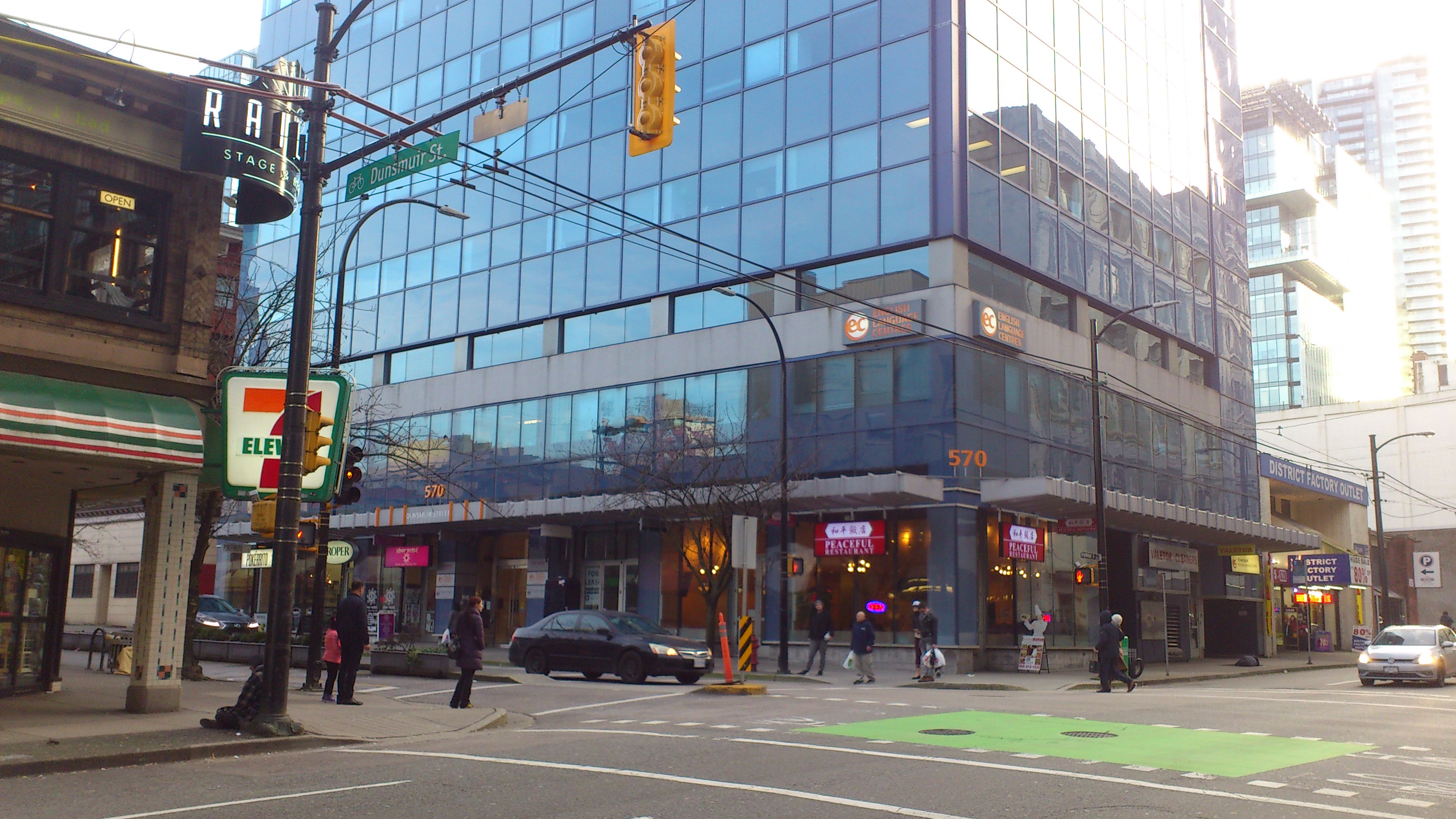
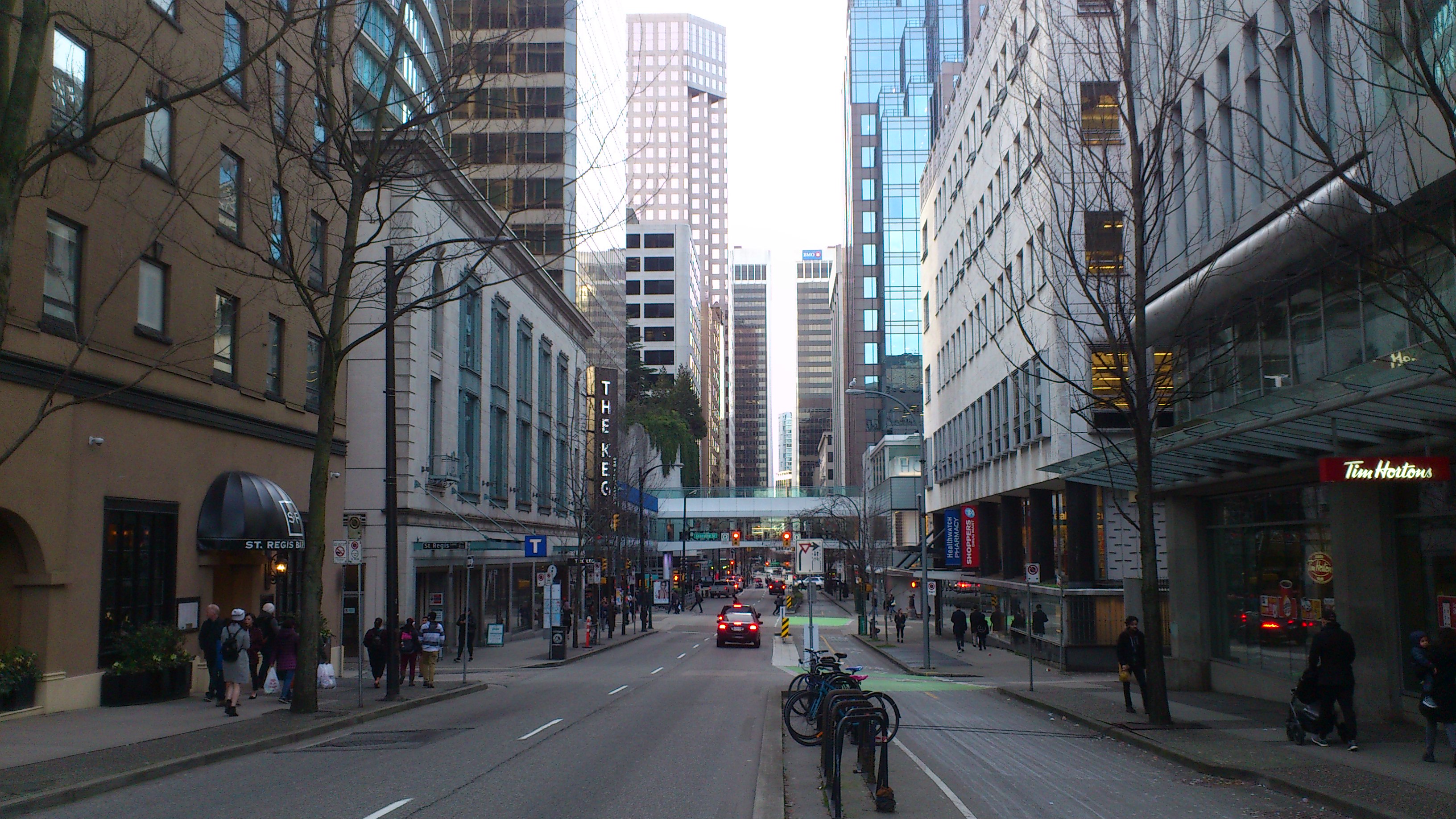
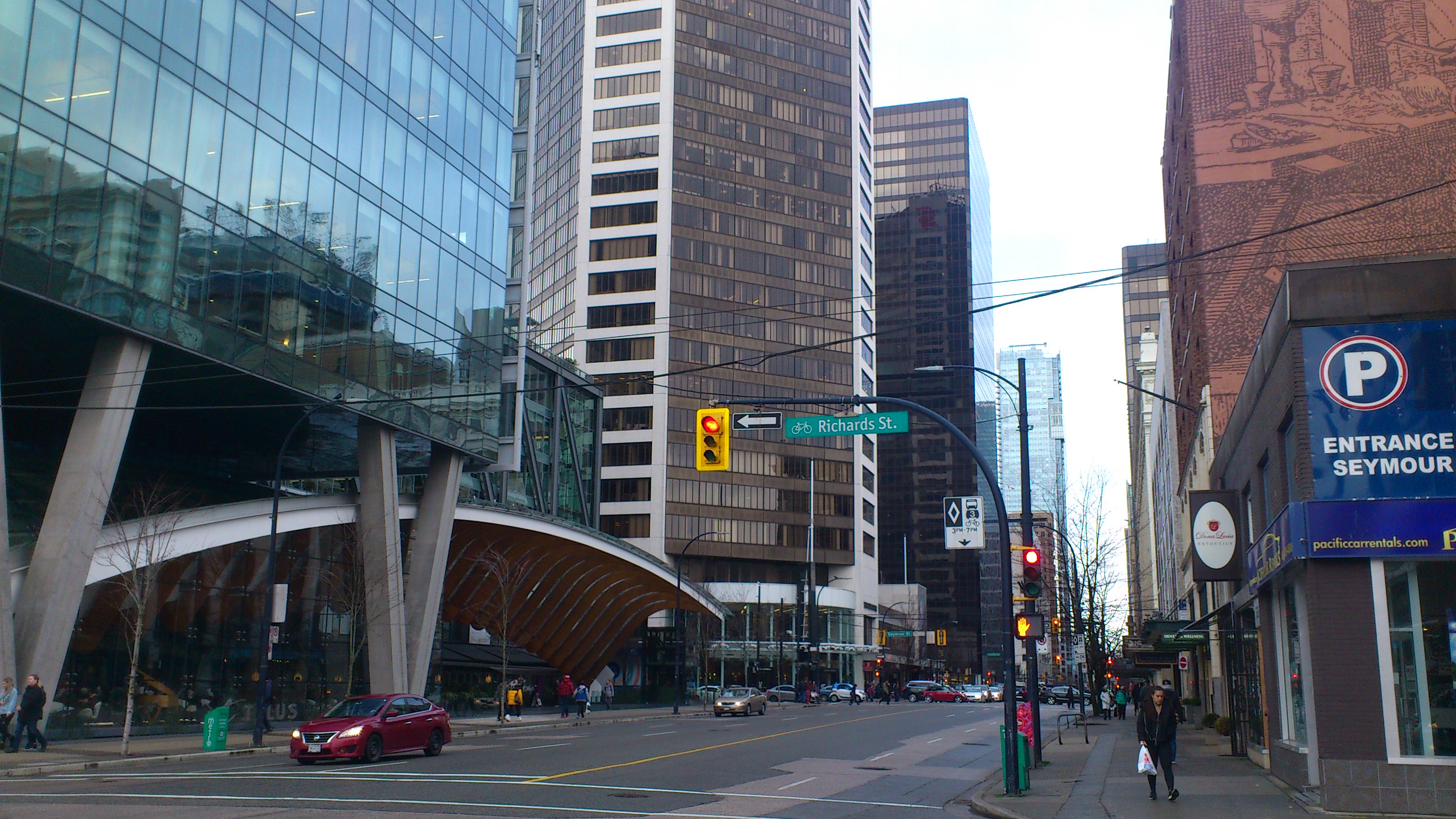

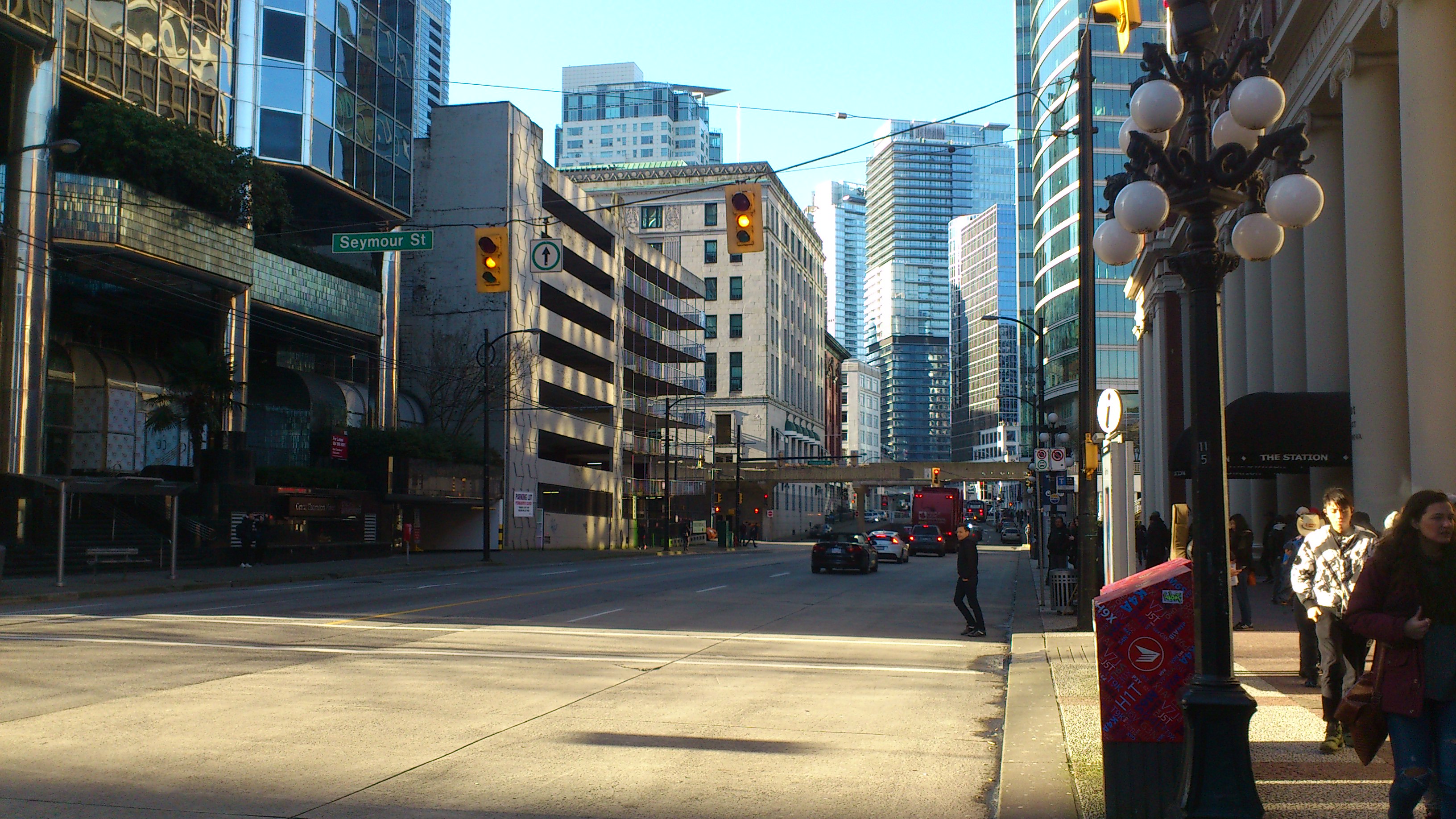

Waterfront is a major intermodal public transportation facility and the main transit terminus in Vancouver, British Columbia, Canada. It is located on West Cordova Street in Downtown Vancouver, between Granville and Seymour Street. The station is also accessible via two other street-level entrances, one on Howe Street to the west for direct access to the Expo Line and another on Granville Street to the south for direct access to the Canada Line.
The station is within walking distance of Vancouver’s historical Gastown district, Canada Place, Convention & Exhibition Centre, Harbour Centre, Sinclair Centre, and the Vancouver Harbour Flight Centre float plane terminal. A heliport operated by Helijet, along with the downtown campuses for Simon Fraser University and the British Columbia Institute of Technology, are also located within the vicinity of the station.
Waterfront station was built by the Canadian Pacific Railway (CPR) and opened on August 1, 1914. It was the Pacific terminus for the CPR’s transcontinental passenger trains to Montreal, Quebec and Toronto, Ontario. The current station is the third CPR station. The previous CPR station was located one block west, at the foot of Granville, and unlike the current classical-styled Waterfront station was built in “railway gothic” like the CPR’s many railway hotels.
In 1978, when Via Rail took over the passenger operations of the CPR and the Canadian National Railway, it continued using both railways’ stations in Vancouver, but a year later, Via consolidated its Vancouver operations at Pacific Central Station, the CN station near False Creek, and ceased using the CPR station. The last scheduled Via passenger train to use Waterfront station departed on October 27, 1979.
Waterfront station’s transformation into a public intermodal transit facility began in 1977. That year, the SeaBus began operating out of a purpose-built floating pier that was connected to the main terminal building via an overhead walkway above the CPR tracks. The CPR’s passenger platform and some of its tracks were torn up in the early 1980s to make way for the guideway of the original SkyTrain line (Expo Line), which opened on December 11, 1985. During Expo 86, SkyTrain operated special shuttle trains between Waterfront station and Stadium–Chinatown station (then named Stadium station), connecting the Canadian Pavilion at Canada Place to the main Expo site along False Creek.
A private ferry company, Royal SeaLink Express, ran passenger ferries from a new dock on the west side of the SeaBus terminal to Victoria and Nanaimo in the early 1990s, but ultimately folded. In 2003, HarbourLynx began operating out of Royal Sealink’s old facility at the SeaBus terminal. In 2006, following major engine problems with their only vessel, they folded as well.
In 1995, platforms were built adjacent to the SkyTrain station for the West Coast Express, which uses the existing CPR tracks. The platforms for the West Coast Express were built in the same location as the old CPR platforms.
In 2002, Millennium Line trains began to share tracks with the Expo Line at Waterfront station. The lines continued to share tracks until late 2016, when an Expo Line branch to Production Way–University station was created in replacement of the Millennium Line service between VCC–Clark and Waterfront stations.
In 2009, the Canada Line opened with separate platforms which are accessible via the main station building, but require leaving the fare paid zone when transferring between other modes. Waterfront station serves as a common terminus point for both the Expo Line and the Canada Line.
Waterfront station was one of the first stations to receive TransLink’s “T” signage, denoting a transit station. This signage was originally installed in the downtown core of Vancouver to help visitors during the 2010 Olympics, as it made transit hubs easier to identify.
In 2018, TransLink announced that Waterfront’s Canada Line platforms, as well as two other stations on the line located within downtown Vancouver, would receive an accessibility upgrade which includes additional escalators, as most Canada Line stations were built with only up escalators initially. Construction is expected to begin in early 2019.
Waterfront’s main station building was designed in a neoclassical style, with a symmetrical red-brick facade dominated by a row of smooth, white Ionic order columns. The Ionic columns are repeated in the grand interior hall, flanking the perimeter of the space. The main hall features two large clocks facing each other high on the east and west walls. Paintings depicting various scenic Canadian landscapes, completed in 1916 by Adelaide Langford, line the walls above the columns. The Montreal architecture firm Barott, Blackader and Webster was responsible for designing the main station building.
Interview with director Grigori Chukhrai and stars Vladimir Ivashov and Zhanna Prokhorenko, conducted after a preview screening in New York.
Ballad of a Soldier (Russian: Баллада о солдате, Ballada o soldate), is a 1959 Soviet film directed by Grigori Chukhrai and starring Vladimir Ivashov and Zhanna Prokhorenko.
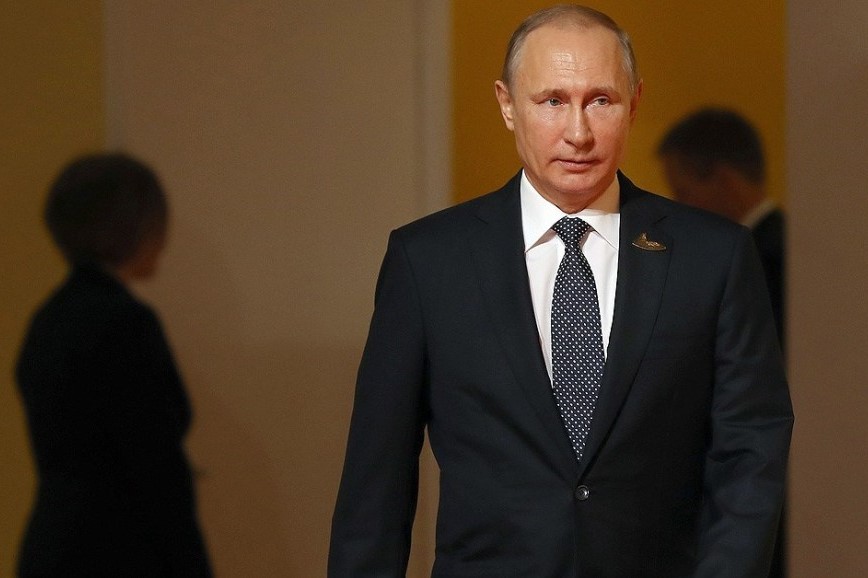
Can we analyze the situation objectively and understand why the U.S.-Russia relations soured?
While
writing my book on the Syrian war, I came across several disturbing
videos. In one, Syrian rebels destroyed a church and riddled the Cross
with bullets; in another terrifying video, an armed Syrian rebel asks
someone if he was a Sunni or an Alawite (Shiite Muslim). When the victim
says, “Alawite,” the rebel fires multiple rounds and kills the victim.
Such psychopaths have three qualities: (1) Fanatic belief in their
ideology (2) Inability to sympathize with other people’s point of view,
and (3) Refusal to coexist with others who are different.
While
we insist upon tolerance within America, our foreign policy is quite
different. Americans are told they are the “greatest”, “#1” and
“exceptional.” We are stuck in perpetual wars and we always have a
bogeyman du jour.
To justify all the aggression, we are fed
endless atrocity propaganda that incontrovertibly proves how evil
another country and its leaders are. In this mythology, America is the
innocent Little Red Riding Hood who’s threatened by wolves like Putin.
He attacks our democracy! He threatens Europe! (There’s also new vitriol
towards China and Iran).
The fact is that U.S. policies over the
last 25 years have consistently pushed Russia away and fostered enmity
between the two nations.
1990’s, Harvard boys and the Russian economy
1992
started with a new Russia that had just dissolved its communist system.
Everything American was considered awesome. American TV shows, American
products and … American economists … took over Russia. What better way
to achieve prosperity?
The Harvard Boys were in charge of the
Russian economy. Larry Summers, Jeffrey Sachs, Robert Rubin and others
implemented their grand economic “reforms” with the help of handpicked
Russian politicians and businessmen (future oligarchs).
To make
the long story short, Russia experienced the Great Depression for the
next eight years. Hyperinflation, 40% drop in GDP, mass unemployment,
widespread poverty, soaring suicides … the reforms turned out to be a
cruel shock therapy.
However, pro-West oligarchs such as
Khodorkovsky, Berezovsky and Abramovich became instant billionaires.
Americans like Bill Browder – the now famous anti-Putin warrior behind
the Magnitsky Act – also enjoyed the spoils of the plunder.
U.S. meddling in Russian politics
While
we are shocked by the Russian interference in our election, back in the
1990s, Washington elites literally picked the Russian President and the
cabinet. As Bill Clinton bragged to Tony Blair, he also had tremendous
influence over the Russian parliament. And when Boris Yeltsin was about
to lose in the 1996 election, Bill Clinton arranged an IMF loan that
went into Yeltsin’s campaign coffer; and U.S. campaign experts flew into
Russia and engineered a resounding victory for Yeltsin. The U.S. media
gloated about the meddling with titles, “Yanks to the Rescue!” and
“Rescuing Boris.”
American Jihadists, part II
If the CIA
and Saudi Arabia created Mujahideen/Al Qaeda in Afghanistan to defeat
the USSR, they didn’t want to dismantle such a splendid organization. In
1992, those fighters were sent to Bosnia, Azerbaijan, Chechnya and
Kosovo, which all had economic and geopolitical significance.
Azerbaijan
on the Caspian Sea has vast reserves of oil and gas. And the only
competition was the Russian pipelines that went through … Chechnya.
Soon, a pro-US dictator took over Azerbaijan – he and his son have been
ruling the country for the last 25 years (obviously, we won’t demand
“democracy” there). In Chechnya, the Mujahideen blew up the Russian
pipelines and then defeated the Russian army in the First Chechen War.
In
Bosnia and Kosovo, Islamic terrorists engaged in ethnic cleansing and
mass murder of Serbians. The CIA and US private military contractors
(such as MPRI) played a major role in the chopping up of Yugoslavia.
When separatists in Kosovo started losing, NATO stepped in and bombed
Serbia into submission in 1999. The following year, Soros-funded group
Otpor! (“Resistance”) overthrew the Serbian president. Why was Serbia so
relentlessly targeted? It was pro-Russia.
I describe these events in details in my new book, “Geopolitics for Dummies.”
Color revolutions against Russia – Georgia, Ukraine
Many
color revolutions followed the same playbook. When a pro-US leader lost
an election, grassroots organizations funded by Soros/USAID/NED will
start protesting. This will be called a “revolution,” with catchy names
as Tulip, Orange, Rose, Umbrella etc. Following sophisticated propaganda
and international pressure, there would be a new election and, voila,
the pro-U.S. candidate would win. Rinse, Repeat.As for the oil/gas by
the Caspian Sea, they could not reach Europe without going through
Georgia. Hello, George Soros! Goodbye pro-Russia president! Within a few
years, western conglomerates started reaping big profits from the BTC
pipeline as shown below:
Next, Soros did his magic in Ukraine in
2004 and got rid of the pro-Russia president. Of course, in 2013, the
U.S. staged another clever coup in Ukraine.
While we’re enraged
by Russia spending $100,000 on Facebook ads, U.S. Asst. Sec. of State –
Victoria Nuland – admitted that the U.S. spent $5 billion in Ukraine.
She was also famous for handing out cookies at the faux Euromaidan
revolution in Kiev in 2013.
In his 2015 annual report, George Soros bragged that he had spent $180 million in Ukraine.
NATO expansion
When
the USSR was dismantled, U.S. elites had promised Russians that NATO
would not expand. However, while the Russian military was being
decimated, globalists kept expanding NATO. In 1999, NATO added Poland,
Hungary and Czech Republic. In 2004, when Russia was still weak and
friendly towards the U.S. … NATO added 7 more countries.
Many of
these new NATO members have anti-missile defense systems, and U.S.
soldiers participate in massive war games right on the Russian border.
Obviously, all these are terrifying security threats to Russia.ABMT
In
2001, George Bush and the Neocons unilaterally cancelled the
Anti-Ballistic Missile Treaty, which had been in place since 1972. This
was a needless provocation against Russia, which reduced its nuclear
weapons from 45,000 to 7,000 and signed many treaties to promote peace.
NATO rejects Russia
In
2001, Putin offered to join NATO, but was turned down. If Russia joined
NATO, how will the military-industrial complex justify its annual
budget and expensive projects? No enemy, No money!
Trying to steal Crimea
In
the 1850s, Great Britain and France tried to steal Crimea from the
Russian Empire. Why? Without Crimea and control of Black Sea, Russia
will be severely hampered. Geography hasn’t changed in 160 years and we
shouldn’t be too Machiavellian. Crimea belongs to Russia, let’s move on.
Pipeline war continues
Poland
and Ukraine were the most important transit countries for Russian
pipelines. Now, thanks to the U.S., both countries are hostile towards
Russia. So, when Putin tried to build pipelines that would reach Europe
through Bulgaria, the US stopped it. When he tried to build pipelines
through Greece, well, the U.S./EU blocked it again. As the last resort,
Putin laid pipelines under the sea (NordStream), and the U.S. found 100
reasons to object and threatened to impose more sanctions against
Russia.
It’s rather difficult to love someone who’s persistently trying to sabotage your economy.
Hybrid wars
Without
an iota of diplomacy, the U.S. media and politicians constantly attack
Putin, demonize him, and use derogatory language. On the other hand,
Putin always talks about “our American partners.”
Japanese
leader, Abe, has met with Putin 20 times, and nobody freaks out in
Japan; India and China treat Putin with enormous affection and respect.
Even geopolitical enemies Israel, Saudi Arabia and Iran often meet with
Putin and negotiate like reasonable adults.
The U.S. spends too
much time on hybrid and propaganda wars — placing sanctions on Russia,
attacking its currency, expelling Russian diplomats, seizing Russian
embassies, stopping Russian athletes from participating in Olympics,
accusing Putin – without any public evidence – of poisoning people
(especially right before the World Cup) and so on.
Conclusion
Going
back to the beginning of the article, do we want to be like that
jihadist? Or can we analyze the situation objectively and understand why
the U.S.-Russia relations soured? Given the vast powers of the U.S.,
other countries don’t deliberately provoke us; ipso facto, if we have
terrible relations with a country, it’s most likely a conflict of choice
started by warmongering Washington elites. Russia, China, Iran and
others want prosperity, respect and sovereignty. Whether the U.S. can
accept this paradigm and recalibrate its foreign policy to reflect the
emerging multipolar world or not will determine global peace and wars in
the coming years.

Sometime in the mid-1990s, British Prime Minister John Major reportedly asked Russian President Boris Yeltsin to describe the Russian economy in one word. Yeltsin replied, “Good.” Seeking greater detail, Major asked Yeltsin if he could describe it in two words. Yeltsin replied, “Not good.”
While this old joke is probably a myth, the current state of the Russian economy matches that “not good” of lore, and its prospects of getting better any time soon look dubious — and this could lead to a serious geopolitical altercation.
After the collapse of the Soviet Union, Russia’s gross domestic product declined by 40 percent during the 1990s. Then, from 1999 to 2008, Russia’s GDP grew by roughly 7 percent per year, almost doubling in size in nine years. Floating on a sea of hydrocarbons, this was the high-water mark of the Russian economy.
At the end of the decade, during the global financial crisis, Russia’s economy contracted approximately 8 percent. In an attempt to preserve the ruble’s value as capital was fleeing the country, the Central Bank of Russia aggressively intervened. But in the process, it lost more than $200 billion of foreign-exchange reserves in a matter of months.
Although Russian economic growth slowed dramatically well before energy prices plunged and economic sanctions were imposed over Russia’s invasion of Ukraine, lower energy prices have obviously taken their toll. Russia is a petro-state. Half of its budget revenues come directly from taxes on oil and gas, and approximately 70 percent of Russia’s export revenues come from hydrocarbons.
Over the past two years, energy revenues have shrunk from more than 7 trillion rubles in 2014 (about $200 billion at that year’s exchange rate) to an estimated 6 trillion rubles in 2016, or about $80 billion at the current exchange rate.
Western sanctions have crippled the ability of Russian financial institutions and companies to borrow money from abroad — not just from the United States, but from all over the world. Not even the Chinese are lending the Russians a renminbi. According to data from the Economist Intelligence Unit, the deprivation of capital has shrunk Russia’s gross fixed investment from $197 billion in 2012 to an estimated $126 billion in 2016.
Russia’s economy is suffering in other areas as well. In 2015, inflation reached 13 percent, with food inflation considerably higher. The ruble’s exchange rate is now roughly half of what it was just two years ago. The Russian stock market has fallen to just over one-quarter of its 2008 peak (denominated in dollars).
Capital has fled from the Kremlin. Since 2011, Russia has been losing 4-8 percent of GDP annually in capital outflows.
According to the World Bank, real incomes shrank 9.5 percent in 2015, and the number of those living below the poverty level was projected to grow in 2016 at its fastest rate since the 1998 crisis. The World Bank estimates that the number of people living in poverty in Russia will increase to more than 20 million this year, in a country with a population of 140 million. That’s the highest number in nine years.
So far, Russia has been able to rely on reserves built up over almost a decade of high oil prices to minimize the impact on its official budgets. But the Reserve Fund dropped to $44.9 billion this month — its lowest point in four years and down from about $90 billion two years ago.
Interestingly, the World Bank and the International Monetary Fund have praised Russia’s government and central bank for their handling of the economic crisis. Kudos were extended to Russia for avoiding a colossal deficit in its energy-dependent budget by allowing the ruble to depreciate by 60 percent against the dollar in 2015. In addition, federal spending (outside of defense outlays) was controlled.
While controversial, the Central Bank of Russia received good marks for moving to a floating exchange rate. In 2015 and early 2016, Russia’s Central Bank chose not to intervene in the currency market. As the price of oil fell, the CBR allowed the ruble to depreciate — it fell 40 percent against the dollar in 2015 — helping the economy regain international trade competitiveness.
On his first day in office in 2012 (the beginning of his third term), President Vladimir Putin promised wholesale privatization. Four years later, little if any of that has occurred. Similar promises were made in Putin’s first two terms. Yet the economic crisis hasn’t dented the president’s approval rating, which hovers around 80 percent.
This may be in large part because most Russians blame foreigners for their economic hardships. To hedge his odds, Putin recently created a new national guard, in the event of domestic conflict with the general public.
That may say more about the state of the economy than all the numbers combined. It’s “not good.”





 Igor's Blog