


SYNOPSIS:
“On January 5th 1900, a disheveled looking H.G. Wells – George to his friends – arrives late to his own dinner party. He tells his guests of his travels in his time machine, the work about which his friends knew. They were also unbelieving, and skeptical of any practical use if it did indeed work. George knew that his machine was stationary in geographic position, but he did not account for changes in what happens over time to that location. He also learns that the machine is not impervious and he is not immune to those who do not understand him or the machine’s purpose. George tells his friends that he did not find the Utopian society he so wished had developed. He mentions specifically a civilisation several thousand years into the future which consists of the subterranean Morlocks and the surface dwelling Eloi, who on first glance lead a carefree life. Despite all these issues, love can still bloom over the spread of millennia.”
REVIEW:
Having graduated from short animated Puppetoons for children during the forties, Hungarian-born producer-writer-director George Pal was the creative mind behind a number of special effects-driven films that set the scene for American science fiction cinema during the fifties and sixties. Obviously feeling quite chuffed with the success of The War Of The Worlds (1953), Pal chose to adapt another H.G. Wells story. The result was The Time Machine (1960). Again the effect was weakened by using a rather conventionally handsome inflexible actor as hero: The War Of The Worlds had Gene Barry, and The Time Machine had Australian Rod Taylor. And once again, the intellectual complexity of the original was pared down to straightforward adventure.
The best sequences of the film show the optimistic time traveler going into the future, pausing occasionally to watch London changing, only to be bitterly disappointed that time and again the world is at war. Fleeing a nuclear war in 1966, he zooms into the far-flung future year of 802,701. There he finds a colony of Eloi – young, blonde, ignorant, apathetic, carefree people living in an Eden-like garden. When a young woman named Weena (Yvette Mimieux) almost drowns, he is appalled that he is the only person who attempts to rescue her, and he is repelled by how far mankind has sunk: Their lack of culture; their work-free existence; and their refusal to defend themselves against the Morlocks who live below ground.
These hideous mutants of nuclear war provide plenty of fruit to feed the Eloi but, being carnivorous, the Morlocks use the passive Eloi much like cattle for all their meat-eating needs. While George recognises a weak trace of their former humanity even in the Morlocks, Pal’s protagonist is incensed by their inhumanity. He is sympathetic to the Elois essential goodness, and their helplessness against their inhuman exploiters, and accepts as an ethical imperative the task of liberating them from their Utopian indolence and advancing them to hard work and technological progress.
He may dress like a Victorian Englishman, but Pal’s protagonist is an all-American two-fisted hero who brings to the Eloi the profound message that a good punch on the jaw will solve anything. His example finally jolts them out of their fatal lethargy and within moments they are all gleefully committing acts of violence. With their assistance George manages to set fire to the Morlocks underground establishment and everyone lives happily ever after – providing the Morlocks from neighbouring districts don’t move in – it’s unlikely that all the Eloi and Morlocks in the world are restricted to one small area, after all.
Gene Warren, Wah Chang and Tim Barr won an Oscar for their well-crafted special effects. In fact the design is quite successful throughout, but Wells’ grim allegory of evolution (the grotesque symbiosis of the working classes feeding cannibalistically upon the elite capitalist classes they serve) is lost. Here the Morlocks are nothing more than stereotyped hairy ape-people. George Pal, who also directed, chose to ignore Wells’ intention to set up two distinct classes, as well as the author’s application of Social Darwinism to the survivors of a nuclear war. Instead, the film deals with how the Eloi make the choice not to be cattle raised for slaughter, but to regain their human traits – care for each other, fight for survival, gather food, work hard – which are distinct from the beastly traits of the Morlocks.
The film is not without its moments though. For example, the diseased white sphinx statue of the original is still there but, overall, it is an appalling vulgarisation of a great novel, and is one of the instances that caused science fiction fans to wonder if science fiction cinema would ever rise above its preoccupation with adventure and spectacle to produce something to excite the mind. That being said, the film itself does have adventure and spectacle, an excellent opening scene, superb time-travel effects, scary-looking monsters, and a pleasing though too-innocent love affair.
Speaking of which, The Time Machine was the lovely Yvette Mimieux‘s first claim to fame, and immediately followed through with the first teenage-girl road-movie Where The Boys Are (1960). Her career quickly deteriorated to roles in rarely screened B-grade films like Three In The Attic (1968), The Neptune Factor, Journey Into Fear (1975) and Devil Dog The Hound Of Hell (1978). Just when it looked like it couldn’t get any worse, Yvette co-starred in what was to become one of Disney’s most infamous films of all-time: The Black Hole (1979). But I digress.
Given the popularity of the original novel, Pal’s film stays relatively close to the basic plot but, despite its melancholic evocation of late-Victorian London, the warm glow of its patented Metrocolor palette, the steam-punkish quaintness of its models and miniatures, and its time-lapse and stop-motion effects, Pal’s film is not an exercise in nostalgia. Rewritten for American audiences at the height of the Cold War, it is anchored firmly in the global politics of the time. Where Wells’ novel features a scene of dark cosmic grandeur in which two feeble cretaceous descendants of humankind struggle mutely toward each other, in a distant future beneath a dying sun, Pal takes us through a twentieth century of perpetually escalating warfare, culminating in the annihilation of London by an atomic satellite that triggers natural disasters on an unprecedented scale. As in The War Of The Worlds, some of the most spectacular scenes in The Time Machine revel in howling air-raid sirens, urban crowds fleeing to public shelters, destruction on a massive scale.
After the many pleasures provided by The Time Machine, Pal’s next film – Atlantis The Lost Continent (1961) – came as a severe letdown. The scenes of destruction at the end of the film also suffered from the shoestring budget, despite being padded out with stock footage of Rome burning from Quo Vadis? (1951), but that’s another story for another time. Right now I’ll ask you to please join me next week when I have the opportunity to present you with more unthinkable realities and unbelievable factoids of the darkest days of cinema, exposing the most daring shriek-and-shudder shock sensations ever to be found in the steaming cesspit known as…Horror News! Toodles!

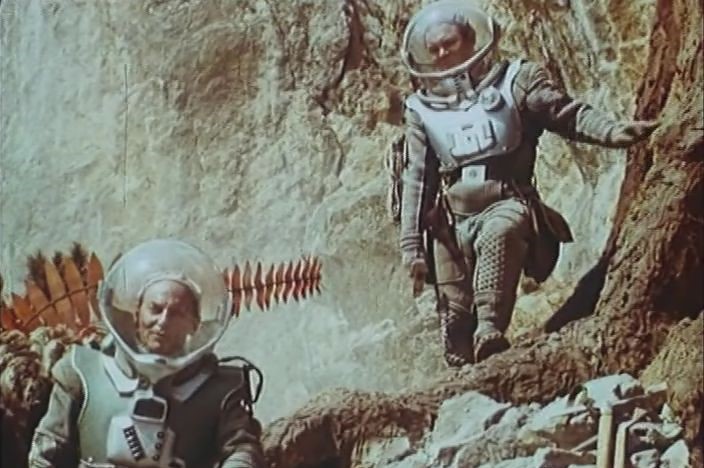
PLANET OF STORMS (1962), aka PLANETA BURG, is often cited as one of the finest Russian SF ‘rocketship’ films ever made. That may sound like a dubious distinction, but consider: the Soviets were at the time of this movie’s release at the very least ‘ahead’ in the ‘space race’ by a Sputnik’s length or so, arguably more. The fact their cinema was freed from total commercial restrictions (since the state sponsored all production and distribution costs, attendance costs were so nominal as to be free) but restricted by the need to propagandize communist state ideals (there’s lots of talk about the superiority of the red way, comrade!) makes for an interesting tension not unlike their American brethren of the era’s ceaselessly pro-American jingoism.
Propaganda aside, PLANET OF STORMS works because of the unique Soviet approach to SF. Whereas American rocketship flicks always had the buck hero deal with any situation ray guns blasting until Kubrick and 2001, the Russian approach was vastly more in line with the speculations and fictions of the day. In other words, more intellectual (gasp!). The difference is at times sobering but never less than entertaining, particularly when you realize how effectively the filmmakers have evoked your actual landing on an alien planet (in this case Venus) for the duration.
This applied not only to their SF films conceptual ideas but also the production design. Again, the American counterparts were always ready and eager to forsake realism for sensationalism and (more typically) as a cost-saving option — after all, stock footage of rockets blasting off is always cheaper than a model and effects photography! The approach used by PLANET OF STORMS is much more refined and stylistically cohesive. Take for example the robot John, one of the truly most underrated cinematic robots ever created. To this day he should rank in the top ten of all-time greats in terms of believability and actual screen impact right alongside his American counterparts. The fact this movie is relatively obscure is the only reason John does not enjoy the true cult recognition he deserves. With his massive girth and uber Soviet design mechanics, John’s impact is as memorable as Robby’s in FORBIDDEN PLANET, an admitted influence. Watch as the mighty iron man falls trees, climbs dangerous mountain passages, and even braves a Venusian river of lava to save his human masters. He is the rare embodiment of Asimov’s benign Laws of Robotics in SF film.
The film’s bold sense of adventure helps it survive relatively watchable ‘as is’ despite the occasional lapses into propagandspeak. So much happens in the short running time, from meteors destroying spaceships, to giant dinosaurs on Venus, to man-eating tentacled plants, to an attack by a flying reptile, underwater scenes on the alien planet, and even a volcanic eruption to end it all, that it’s easy enough to drop the ‘fast forward’ remote and let the flick wash over you.
Though it’s influence was indirect on such current filmmakers as James Cameron and the Skotak Brothers (in that they saw the two versions Corman made of it with inserts of American actors like Basil Rathbone in the end of his career), it was the Soviet part of the efforts that captured their young imaginations. In other words, the production design and use of miniatures, as well as the overall effects photography. No joke, you can vividly see the influence in early Cameron pictures like GALAXY OF TERROR and THE TERMINATOR.
Many folks remember bits and pieces of these flicks despite the fact they’ve rarely if ever been aired in America since their Corman-ized release back in the late 60’s. That’s because they made the usual rounds as cheap syndicated fodder for late night local t.v. slots eager to use such sensational sounding A.I.P. titles like ATTACK OF THE MUSHROOM PEOPLE, et al. But it’s a tribute to the Russian filmmakers who toiled in near obscurity that today these flicks are highly prized and sought after for their historic cinematic value. The value is not merely retrostalgic, but truly deserved, as these movies advanced SF cinema as surely as BLADE RUNNER and other more well-regarded efforts albeit in a less spectacular way. — Notes by Dave Coleman


In my opinion, in the eyes of the masters of our universe, the (s)election of 2016 was a disaster from the start which might lend one to believe, as I think you do, that the whole purpose of it was to undermine not only our belief in the system we have but also to undermine young people’s expectation of a better tomorrow. To kill hope, so to speak.
I don’t think that is true. It may be the unintended consequence of (s)Election 2016, but often times people misconstrue “outcome” with “plan” when it comes to the workings of our Deep State. Because that’s how the Deep State likes it. Even their losses become victories.
Don’t give into that thinking, it’s just their spin. Because when you do that, you really have lost.
Donald Trump, like Bernie Sanders, never expected to be president. He, like Bernie, was a foil for the real chosen one… Jeb Bush.
You see, TPTB understood there was a growing hostility on the right to yet another Bush Presidency. So what did they do? They ran and promoted a FORMER DEMOCRAT and NEW YORK LIBERAL in the Republican Primary to serve as a kind of a threat. The idea was the primary would come down to Jeb or Trump and folks would “hold their nose” and vote for the “responsible” choice, in part because… Trump couldn’t beat Hillary.
Sanders served in a similar but different capacity (kind of like the difference between “ISIS” in Syria and “ISIS” in Iraq.) His role was too keep the young people motivated and engaged in the unDemocratic Party right up until the end when he would lose and then, knowing progressives, his followers wouldn’t show up to vote for Hillary. Bernie wouldn’t stump for her and that would be that.
In the end it was supposed to be Hillary Vs Bush and they KNEW how unpopular that would be, but remember… George H. W. Bush helped them considerably over the course of his life from serving their interests at the Bay of Pigs to JFK to serving as head of the CIA for a while. And Prescot was also a loyal servant to their interests.
That would have broken spirits as well, a kind of a “in your face, we will run who we want and MAKE you vote for him” kind of thing.
But a funny thing happened on the way to the forum… Jeb was SOOOOO hated, he couldn’t get out of the primaries NO MATTER HOW MUCH THEY TRIED TO RIG IT. And when that happened and they couldn’t get Marco out either, they had to change their plans.
They knew they didn’t want Ted Cruz. He was detestable even by them. Marco wasn’t ready and Bush, in spite of spending nearly a hundred million dollars before Jan. 1 2016, was a non-starter.
They needed to figure out what to do then and the ONLY course left to them… was to ordain Jeb’s planned foil for the General Election, Hillary Rodham Clinton. The primaries were nearly over and it was too late to run another candidate on the unDemocratic Party ticket (but remember, they did float that idea, Joe Biden I believe was talked about stepping in for a while)
True, she was flawed and pushing TPP early on (because remember, she was SUPPOSED to lose at first) and not showing up for the campaign (270 days while under investigation) and seemingly out of it much of the time back then but all of that would change once it was clear Jeb was out. Suddenly her campaign took a turn because all of a sudden, she was the chosen one.
It was at that time that the role Sanders was too play changed as well. Now his task was to keep the youth energized and then, once it was stolen from them, he had to convince as many as he could to vote for Hillary.
The focus on Trump also changed. Overnight almost. The media viciously attacked him at every turn whereas before he had been the quirky darling of the Republican primary getting about 2 billion in free airtime.
But HIS approach also changed. I think his advisors, all of whom were attacked and are gone now, told him… you know… you could win this thing and BECOME PRESIDENT.
Think about it. He was supposed to be out in June of 2016 and throwing his support behind Jeb but now he had to run the course of the election and the ONLY THING standing between himself and the Oval Office was a HATED Hillary Clinton.
What kind of businessman isn’t going to see and take advantage of that kind of easy money?
So his rhetoric changed a bit, he became even more populist and non-interventionist and anti-globalization in his speeches and while everyone outside his offices thought he was still playing along… he and his closest advisors had a different plan.
That’s why they were all targeted for removal especially the one guy who was probably behind Trump’s treachery as they saw it… Steve Bannon.
In the end when it became obvious he was really running, yes, they wiretapped him, they unleashed identity politics in the election campaign at him, they did everything they could to ensure Hillary would “win” including rigging many of the outcomes in various states, but ultimately, he won those three states he wasn’t supposed to, because Hillary is so corrupt and deplorable, and he won the damn thing.
So, understandably, he immediately had to be put in his place. The Russian hacking/collusion thing was designed for that purpose. Meant to undermine him, our faith in “populist” presidents AND to keep him “on the farm” so to speak, with the constant threat of removal from office for one reason or another.
Yes, they did their best to undermine the seated president of the United States and more importantly, the office which he held. Yes, they attacked our democracy and undermined our FAITH in our system. The Russians didn’t do that, our Deep State assets and their minions in politics and the media did.
They did it because… Americans “VOTED THE WRONG WAY”
When one thinks about Trump’s betrayals it’s easy to come to the conclusion that he was ALWAYS the choice by TPTB and everything went according to plan in Nov. of 2016. I don’t think that is the case and the evidence is overwhelming to the contrary in fact.
I think Jeb was supposed to be our next president. I thought that from early 2015 and have seen nothing since then to make me feel otherwise. Condi Rice would have probably been his VP pick, since they were running against Hillary, a vote for Condi would have been a welcome alternative choice for women on BOTH SIDES of the fake political divide. PLUS, Condi would have been a great pick for them as she could have actually run the White House like Dick Cheney did for “W”
THAT would have sent a more devastating message to the American people about their power. Taking someone like Jeb Bush and FORCING the American people to vote for him and elect him into office would have been a powerful statement about REAL power in this country. But they failed and that pissed them off.
Then they figured they would FORCE us, once again, to vote for ANOTHER CANDIDATE we hated, Hillary. And once again, they failed.
Then they were frightened. They were frightened not of Trump or his phony populism (he’s a damn neoliberal billionaire silver-spooner fo God’s sake) but rather… they were frightened of their LACK OF CONTROL. Because, I think it is safe too say at this point, they are control freaks and “stability” is the only other alter (other than Mammon) at which they worship.
That’s a terrifying thing to the real governance of any country. When you think you have the levers of power so well calibrated as to control the outcomes of any given circumstance and suddenly find you don’t, that’s a sort of “Coming to Jesus” moment for you. All of your assumptions are suddenly cast into doubt. You begin to think you have little to no control over anything and desperation ensues.
The glorious markets become tepid, your billionaire owners wonder about your value and you yourself start to fear if that dreaded SHIFT away from neoliberalism is on the horizon. They know it’s coming and the backlash will be a terrible,unforgiving thing. It gives them nightmares akin to images of the French and Russian revolutions. Cold sweats. Wet beds. Sleepless nights. Instability.
Trump’s betrayal was never a matter of “if” as much as it was “when” but that’s not because he was their plan from day one.
That’s because, like Obama before him, Donald Trump has no moral center. And though people wrongly thought that him being a billionaire would FREE him from their control, the opposite is in fact at play. His personal/business empire gives them that much more to threaten him with… threaten him with or bribe him with… depending on how you look at it.
Presidents always betray the candidate that ran for them. That’s how it works in the Shining City on the Hill. Reagan betrayed his promises. So did Clinton. So did Bush. So did Obama.
Mr. Smith doesn’t change Washington with his powerful, down-home, populist, po-dunk charm… Washington rewires Mr. Smith from the inside out. It reboots him with a different operating system and a built-in back-door access that allows them to monitor and guide his every move.
That’s why weak, overly ambitious, morally ambiguous men have always been the preferred champions for that particular office. Any office for that matter. It’s a corrupt, neoliberal, corporate Western “democracy” thing. It’s one reason when you look at statesmen from countries not infected with our disease, they look like the kinds of real leaders of principle we wish we still had.
It’s very simple… they are chosen because they are weak by our real leaders who are not. They are chosen as yesmen and sycophants to power because the REAL power wants it that way.
Trump is the accidental president because a funny thing happened on the way to the forum. His betrayals are one part cowardice and one part ambition but they were not what was supposed to be and they do not serve as any kind of proof that his orange ass was ever intended to sit in the throne.
Though the power behind the throne would LOVE anyone aware enough to even consider such questions to BELIEVE that they never lost control of the process, in truth, they did …
And there is a message in that somewhere, one of real hope, despite Trump’s turning into Hillary with a comb-over… which is absolutely WHY they would rather you BELIEVE he was their choice and you would just a dupe.
But nothing could be further from the truth and they know it… AND SO SHOULD YOU.
Their power is not absolute and that scares the shit out of them. Democracy reared it’s ugly head, you “VOTED THE WRONG WAY” and for a brief moment in history… we steered the ship of state into uncharted waters despite their best efforts to maintain the course of history they plotted for us.
All things being equal, I would say 2016 wasn’t a bad year after all. We shouldn’t let them turn their loss into ours. Because that’s what they do.
screw em. They lost. We won. And no amount of RussiaGate or self doubt will change that fact.
Of course.. when we won we got… Donald Trump.
Oh joy.
Hurray.
Yipee.
Oh f*ck.











I think that it’s time for me to again share some of the things that I enjoyed lately. First of all, I decided some months ago to remove a photograph of myself as my profile image on my blog. I did this not because I think that the photo is bad, though I could have taken a better photo of myself. I did this to keep my anonymity. The thing is that after I posted the photo of myself on my blog, I began to notice people looking at me for an unusually long time when I’m outside, as if they recognize me. This is something that hadn’t happened to me before. This didn’t happen often, but this did make me notice that something is not right. I have no idea how popular my videos channel and my blog are, but it seems that they’re considerably more popular than I initially thought. Since there’s no independent media in the West, it’s not surprising that people are now focusing on internet bloggers, who seem to be the only ones who are providing some truth and discrediting the official propaganda. Consequently, for about a decade already, bloggers in the West have been intimidated, blocked, or persuaded to follow the official propaganda line in exchange for money or safety from intimidation and persecution. In the current Western society, the opinions that I sometimes express are frowned upon, to say the least, by most people because most people are obedient and brainwashed. I haven’t been everywhere in the world, but I think that people in the West may be the most obedient, uninformed, and uncritical people in the world. I’m not a politician, but even my very small blog and channel attract attention. Initially, I didn’t think that this is a problem, but then I decided that it would be foolish of me to allow myself to come under possible attack. After all, I’m not like Alex Jones, which means that I’m not rich, that I’m not a Freemason and a propagandist for the American establishment, and that I can’t hire lawyers and bodyguards. I’m not doing something that is officially illegal, and I make my posts on a Russian website, but I’d still rather not have people stare at me. Therefore, for the time being, a photo of me won’t be available on my blog. By the way, I can demonstrate how indoctrinated people in the West are by taking my younger sister as an example. Several years ago, the Western media (primarily the British media) organized yet another anti-Russian and anti-Putin campaign around the issue of gay rights in Russia. The Western media, as usual, completely misrepresented what went on in Russia and put out deceitful reports in order to demonize Vladimir Putin. Not surprisingly, my sister, like so many other people in the West, believed what the Western media reported, without criticism. If the Western media had reported that Putin personally tortures gays in a secret dungeon beneath the Kremlin, my sister would have believed that too. And so, back then, she looked at me as if there’s something wrong with me when I raised a slight objection while she was repeating what the Western media reported. Obviously, my sister isn’t the only one who thinks like this. Most people in the West uncritically believe what they’re told by the media, and very few people question or criticize the propaganda.
When it comes to the books that I’ve been listening to, I can recommend Harold Lamb’s well-written books. The ones that I purchased are titled ‘Iron Men and Saints’, ‘The Flame of Islam’, ‘Tamerlane’, ‘Genghis Khan: The Emperor of All Men’, ‘Alexander of Macedon: The Journey to World’s End’, ‘Charlemagne: The Legend and the Man’, ‘Hannibal: One Man Against Rome’, and ‘Suleiman the Magnificent’. These old American history books are a pleasure to listen to, especially when they’re narrated by Charlton Griffin. I bought several books by the well-known UFOlogist John Keel. The first book of his that I listened to is titled ‘The Mothman Prophecies’. I was hooked when I listened to that book, and, afterwards, I immediately purchased ‘Our Haunted Planet’, ‘Jadoo’, and ‘Operation Trojan Horse’. Keel, of course, wrote a number of other books too, but I haven’t yet finished listening to the ones that I’ve listed. Keep in mind, though, that I’m listening to them not because I believe everything that Keel wrote. I’m listening to them out of curiosity and because they’re interesting. While we’re on this subject, I can also recommend Ivan T. Sanderson’s book ‘Abominable Snowmen: Legend Comes to Life’. By the way, it seems to me that Jim Marrs borrowed a lot of information from John Keel’s books when he wrote the book ‘Our Occulted History: Do the Global Elite Conceal Ancient Aliens?’. I don’t really hate Marrs, and I think that some of his books are interesting to read, but I must acknowledge that Marrs belonged to the “lunatic radical right” of the American establishment. Therefore, it’s not surprising that he tried as much as he could to lie about communism and the Soviet Union in his books. Well, as an establishment writer and journalist, Marrs deceived people about other things too. He engaged in sensationalism in order to win over readers. I mean, who’s really supposed to believe his claims about aliens? Naturally, I don’t agree with the propaganda that comes from the “lunatic radical right” because it’s anti-democratic and pro-oligarchical. For example, Alex Jones, who’s one of the deceivers and propagandists of the “lunatic radical right”, always yells about “1776” and “the republic”. Yet he never yells about democracy or about the rights of the working class, and he has no problems with American imperialism in Latin America or Israeli aggression in the Middle East. I guess that it’s not hard to figure out what the interests of his masters are like. So, the propaganda of the “lunatic radical right” is primarily aimed at the dissatisfied and angry members of the American lower middle class. These are the people that the “lunatic radical right” wants to win over when, for example, they propagandize about how a horde of virile, mighty Muslim men from the Middle East is invading Europe, threatening Western culture and values, and knocking over the pathetic, powerless Western men while taking their jobs, women, and welfare. The lower middle class also seems to be the class that produces the most fascists and reactionaries in a time of economic crisis. Wasn’t Adolf Hitler from the German lower middle class?
I finished listening to ‘Pericles and Athens’ by Andrew Burn a while ago, and I can definitely recommend this history book about Classical Athens. I’m still listening to ‘The Persian Wars’ by Herodotus and ‘The History of the Decline and Fall of the Roman Empire’ by Edward Gibbon. I began listening to ‘Das Kapital’ by Karl Marx only recently. This book, which is one of the must-read texts of the 19th century, is in two volumes, and it’s narrated by Derek Le Page. Other educational books that I’ve purchased in the last several months include ‘Lost Enlightenment’ by S. Frederick Starr, ‘The Structure of Scientific Revolutions’ by Thomas S. Kuhn, ‘Tesla: Man Out of Time’ by Margaret Cheney, ‘The Age of Living Machines’ by Susan Hockfield, ‘Darwin Devolves’ by Michael J. Behe, ‘The Pursuit of Power’ by William H. McNeill, ‘On the Origin of Species’ by Charles Darwin, ‘Skeleton Keys’ by Brian Switek, ‘The Demon-Haunted World’ by Carl Sagan, ‘Chariots of the Gods’ by Erich von Daniken, ‘Parallel Worlds’ by Michio Kaku, ‘Comet’ by Carl Sagan, ‘Science in the Soul’ by Richard Dawkins, and ‘Physics of the Future’ by Michio Kaku. This is a list of the books that I have on my Audible account. But more important for me are the books that I purchased in stores, that I downloaded in PDF format, or that I purchased on Google Books because they’re not available in audio form. They include ‘The Story of the Heavens’ by Robert Stawell Ball, ‘Vestiges of the Natural History of Creation’ by Robert Chambers, ‘Bohemian Grove and Other Retreats’ by G. William Domhoff, ‘Riddles of Science’ by Arthur Thomson, ‘Mars’ by Percival Lowell, ‘The Mystery of Numbers’ by Annemarie Schimmel, ‘Who Rules America?’ by G. William Domhoff, ‘Imperial Germany and the Industrial Revolution’ by Thorstein Veblen, ‘The Remaining Signs of Past Centuries’ by Al-Biruni, ‘Atlantis: The Antediluvian World’ by Ignatius L. Donnelly, ‘The Mind and its Place in Nature’ by C. D. Broad, ‘The Ascent of Man’ by Jacob Bronowski, and ‘Behemoth: The Structure and Practice of National Socialism, 1933 – 1944’ by Franz Neumann. The one book that I finished reading so far is ‘Tear Down This Myth: The Right-Wing Distortion of the Reagan Legacy’ by Will Bunch. I difinitely recommend reading this book because it’s not very thick, it’s easy to read, and it contains a lot of good information about Ronald Reagan and American history of the last several decades. The book was written by an establishment journalist, and I don’t agree with everything in it, but it’s worth getting anyway. By the way, when it comes to groundbreaking science books, the CIA’s Wikipedia features an article that includes a list of some of the books that were released in the West and in Russia. Most of these books can easily be acquired on the internet in PDF format because they’re in the public domain. Here is the link:
https://en.wikipedia.org/wiki/Antiquarian_science_books
In an earlier post, I wrote about how only two films that were released in theaters during the summer pleased me. They’re Toy Story 4 and Spider-Man: Far From Home. Well, Avengers: Endgame played in theaters during the summer too, but I don’t consider it to be a very good film. There were also several other summer movies that I kind of like. So, when it comes to new Hollywood films, it wasn’t a good summer or a bad summer. It was an average summer. I mean, one can’t expect an excellent new film to be released every week. Who would have the time to go to a theater every week? This isn’t realistic. Well, anyway, after the summer movie season came to an end, Hollywood quickly released several enjoyable films that make the summer movie season pale in comparison to this autumn movie season. I haven’t seen every film that has been released in the autumn yet, but I can say that Terminator: Dark Fate, Zombieland: Double Tap, Maleficent: Mistress Of Evil, and Abominable are worth seeing. Most are so good that they can be seen more than once. I’d also like to see 21 Bridges, Charlie’s Angels, Frozen 2, and Jojo Rabbit. Joker is a film that I think isn’t worth seeing more than once. It’s not a bad film. For a modern film, it’s good, but the filmmaking leaves a lot to be desired. I mean, it’s no Apocalypse Now (1979). That’s for sure. There are a few moments of brilliance in Joker, but, for the most part, it’s a rather dull film, and I’m not judging it based on its message or content. The performance by Joaquin Phoenix is good, but not extraordinary. The cinematography doesn’t look very good. Most of the scenes in the film aren’t interesting. And the direction, though certainly better than average for modern times, isn’t very good either. What did surprise me is how much I enjoyed seeing It Chapter Two and Doctor Sleep. I don’t think that these films are very good, but they’re better than I expected them to be. In It Chapter Two, the director, Andy Muschietti, showed more of his artistic side, as he did in his fine horror film Mama (2013). It Chapter Two is more atmospheric, better shot, and features better acting than It (2017). And it doesn’t rely as much on silly jump scares. All of this added together made it a more enjoyable film for an adult like me. But the film still suffers from the fact that, like It, it was made to appeal to as large an audience of modern moviegoers as possible. Doctor Sleep is another well shot and atmospheric film that was directed by Mike Flanagan, who directed the fine horror film Oculus (2013). As a film, Doctor Sleep is kind of enjoyable. The novel by Stephen King is, in my opinion, bloated and rather dull. Still, the film isn’t much better because there’s nothing about it that stands out. The acting is fine, but not great. The story is fine, but not very interesting. The cinematography is good, but not in any way truly appealing. The music isn’t memorable. Some of the scenes are good, but most of the scenes are just passable. By the way, one of the horror films that I really enjoyed seeing lately is Candyman: Farewell To The Flesh (1995). It’s better than I expected it to be. The first film, Candyman (1992), is, in my opinion, fantastic when it comes to its artistry. It’s easily one of the best horror films of the 1990s. When I was thinking about it, I thought that it must be the best of the 1990s, but then I remembered that Scream (1996) was released in the 1990s too. Scream is overall a slightly better film than Candyman. With Candyman: Farewell To The Flesh, the filmmakers at least attempted to make a good film, and in some ways they succeeded. It’s obviously inferior to Candyman, but the acting, the cinematography, and the direction still make it worth seeing. And, finally, I’m almost done with my Marvel Cinematic Universe marathon, which I began in May of this year, when I watched Iron Man (2008) again. From then on, I’ve been watching every MCU film in order, and I’m still not quite finished. Of course, it hasn’t been an obsession with me because I haven’t been watching the films one after the other all in one sitting. I’ve seen many other films in this time period too. In this way, I’ve now seen every MCU film at least twice, and I don’t consider this to be a bad thing because MCU films are good. There still hasn’t been a single bad MCU film. Quite impressive. The years 2018 and 2019 are particularly memorable in the history of the MCU because Marvel released four fantastic films one after the other. They’re Black Panther, Avengers: Infinity War, Ant-Man And The Wasp, and Captain Marvel. When I watched these films again on home video I noticed how well made they are. The acting is good. The stories are interesting. The music is fitting. The entertainment factor is high. The special effects are excellent. Need I say more? I can say that by the time Phase Three began in the MCU, Marvel truly found its groove.
 Igor's Blog