


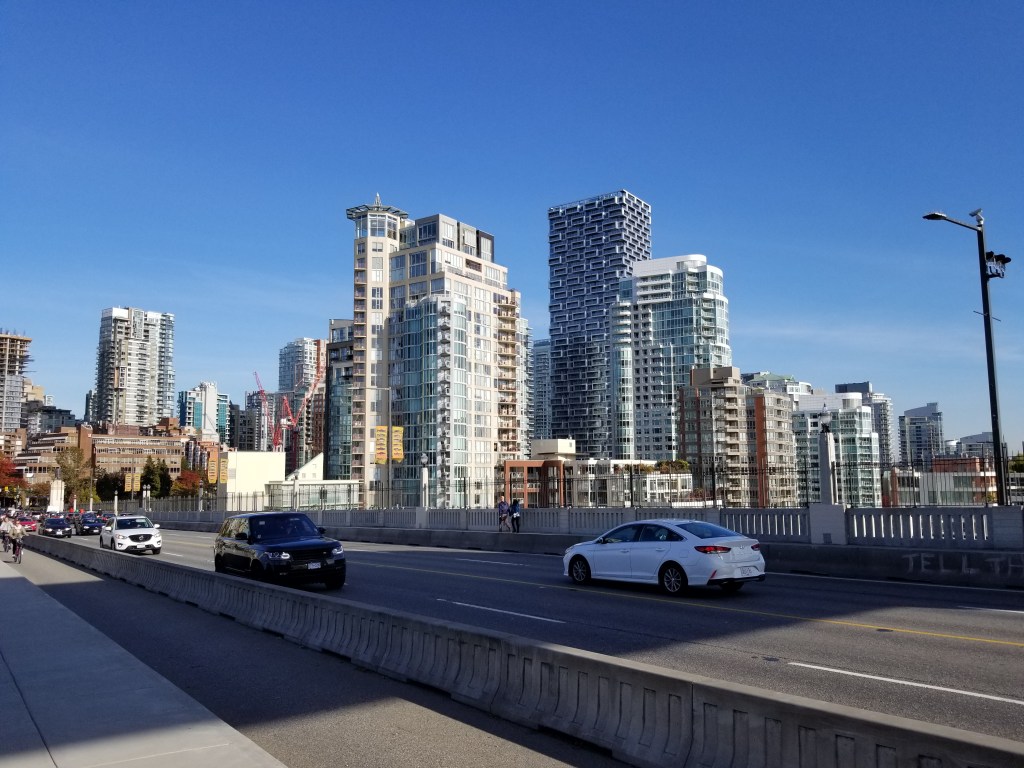
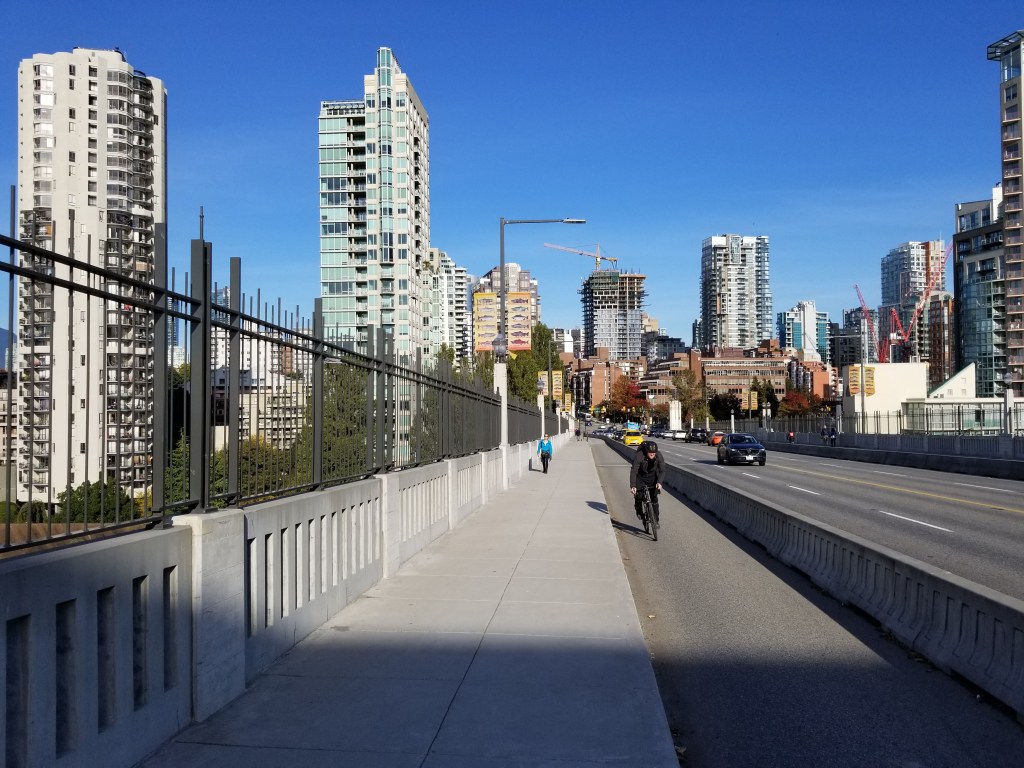

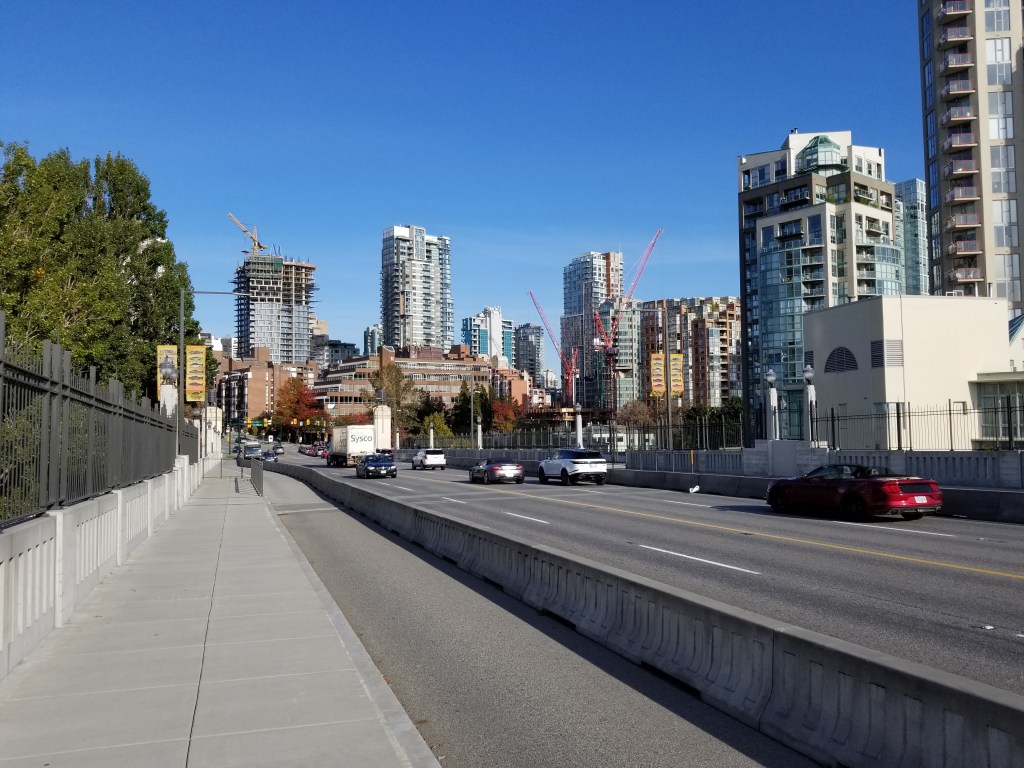

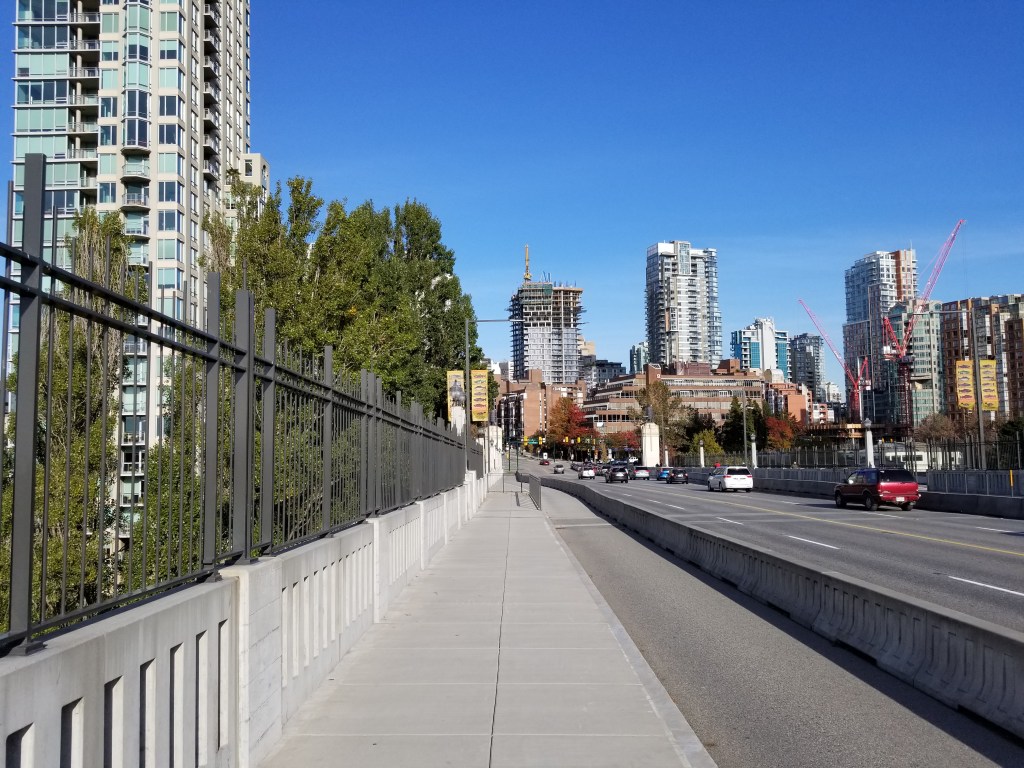

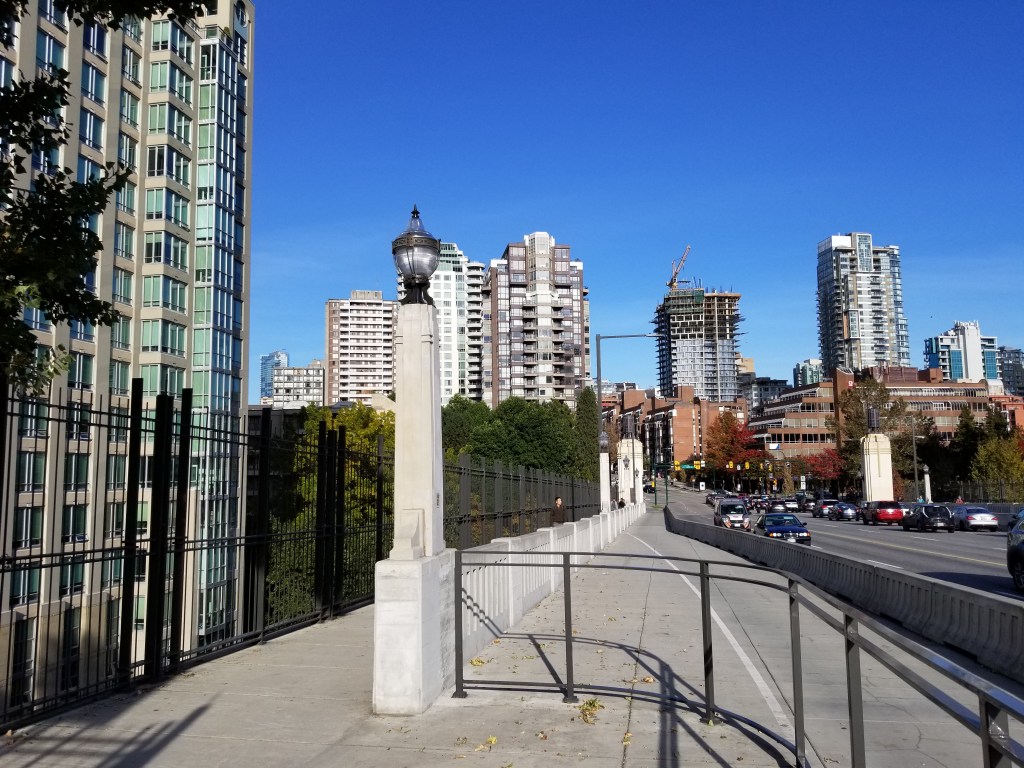
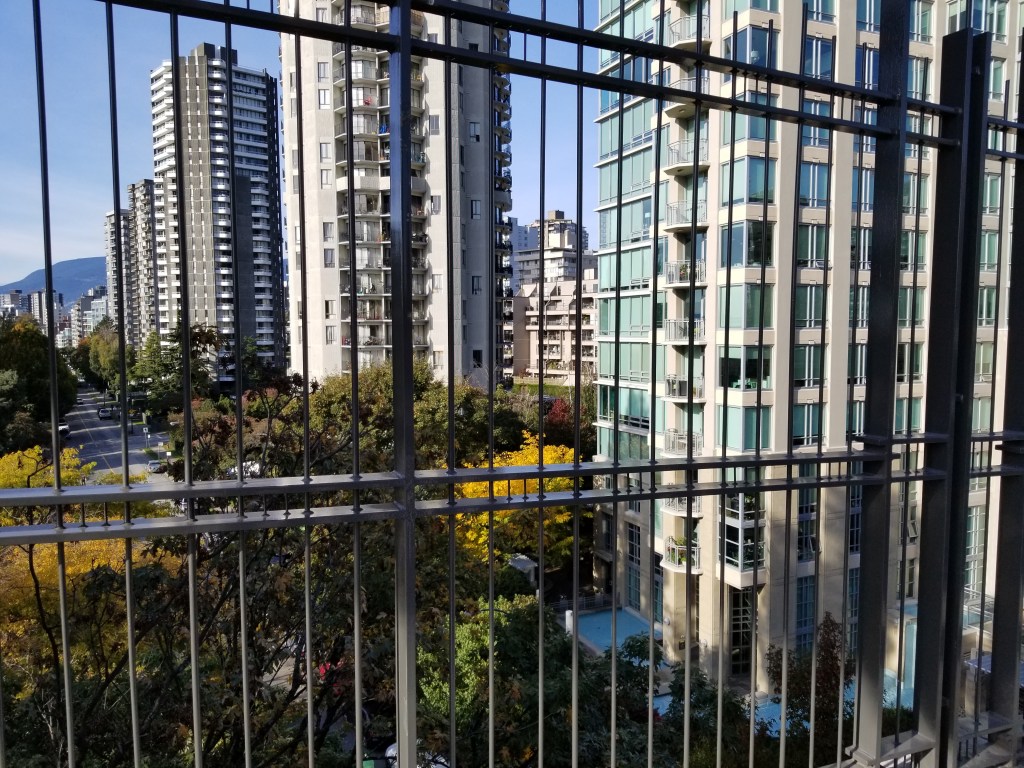
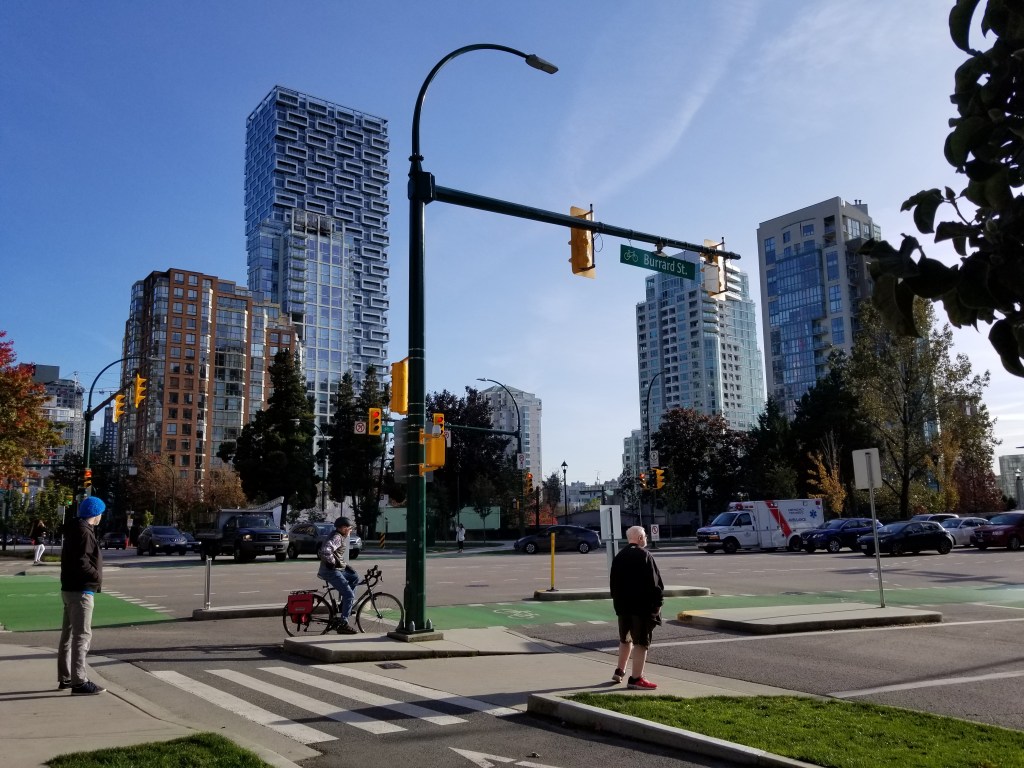
The Burrard Street Bridge (sometimes referred to as the Burrard Bridge) is a four-lane, Art Deco style, steel truss bridge constructed in 1930–1932 in Vancouver, British Columbia, Canada. The high, five part bridge on four piers spans False Creek, connecting downtown Vancouver with Kitsilano via connections to Burrard Street on both ends. It is one of three bridges crossing False Creek. The other two bridges are the Granville Bridge, three blocks or 0.5 km (0.31 mi) to the southeast, and the Cambie Street Bridge, about 11 blocks or 2 km (1.2 mi) to the east. In addition to the vehicle deck, the Burrard Bridge has 2.6 m (8 ft 6 in) wide sidewalks and a dedicated cycling lane on both sides.
The architect of the Burrard Street Bridge was George Lister Thornton Sharp, the engineer John R. Grant. The bridge’s two close approach spans are Warren trusses placed below deck level, while its central span is a Pratt truss placed above deck level to allow greater clearance height for ships passing underneath. The central truss is hidden when crossing the bridge in either direction by vertical extensions of the bridge’s masonry piers into imposing concrete towers, connected by overhead galleries, which are embellished with architectural and sculptural details that create a torch-like entrance of pylons. Busts of Captain George Vancouver and Sir Harry Burrard-Neale in ship prows jut from the bridge’s superstructure (a V under Vancouver’s bust, a B under Burrard’s).
Unifying the long approaches and the distinctive central span are heavy concrete railings, originally topped with decorative street lamps. These pierced handrails were designed as a kind of visual shutter (stroboscopic effect), so that at a speed of 50 km/h motorists would see through them with an uninterrupted view of the harbour. The effect works at speeds from about 40 to 64 km/h.
The Burrard Street Bridge, opened July 1, 1932, was built to provide a high-level crossing from Vancouver to the southwestern neighbourhoods in Kitsilano, by connecting Burrard Street to Cedar Street. After completion, Burrard was extended through to the base of downtown and Cedar Street disappeared.
At the opening ceremony, entertainment was provided by two bands, the Kitsilano Boy’s Band and the Fireman’s Band. An RCAF seaplane flew under the bridge and later a sugar replica of the bridge was unveiled at the civic reception in the Hotel Vancouver.
G.L. Thornton Sharp, of Sharp and Thompson, was the architect responsible for the distinctive towers on the bridge and its middle galleries. “Both central piers,” Sharp told a reporter, “were designed and connected with an overhead gallery across the road. This helped to mask the network of steel in the truss from the two approaches, and has been treated as an entrance gateway to the city.” Along their other axis, the full height of the piers above the water also serve to frame a sea entrance gateway, notably for pleasure craft: “by sea and land we prosper”. The piers have provision for a rapid transit vertical lift span beneath the highway deck, never installed.
Burrard Street Bridge has been assessed by heritage consultants retained by the City of Vancouver as being in the top category of historic buildings in Vancouver. The bridge appeared on a stamp issued by Canada Post in 2011, in a series showcasing five notable Art Deco structures in Canada.
When constructed, the Burrard Street Bridge did not have dedicated lanes for cyclists, who shared the bridge’s six vehicle lanes with motorists. Later, as traffic volume grew and speed limits were increased on the bridge to 60 km/h, cyclists were directed to share the bridge’s sidewalks with pedestrians. Over time, the volume of pedestrians and cyclists on the 2.6 m (8 ft 6 in) sidewalks created a dangerous situation, with several accidents occurring, which resulted in at least one successful lawsuit against the city.
Since the mid-1990s, the city of Vancouver has investigated various options to rectify the situation. The two most prominent options were 1) to introduce bicycle lanes on the bridge’s vehicle deck by reallocating one or more vehicle lanes, and 2) to build horizontal extensions on the outside of the bridge to create additional sidewalk space. Other options have included building an entirely new pedestrian and/or cyclist only bridge, and building another deck on the bridge below the existing deck.
Heritage advocates have been strongly opposed to the construction of outside sidewalk extensions, which would likely alter significantly the historical character of the bridge. Fiscal conservatives have also been opposed to high costs associated with this option.
Many motorists and others have opposed reallocation of vehicle lanes to bicycle lanes, believing that the reduction in vehicle carrying capacity would create excessive traffic problems both on the bridge and on and around alternate crossings, such as the Granville Street Bridge.
Beginning March 26, 1996, in a six-month trial by the City, one commuter lane was closed to automobile traffic and made into a temporary cyclist lane. However, after one week, the City was forced to revert the lane to its original purpose, due to outrage by some motorists.
On May 31, 2005, a detailed engineering and planning report was presented to Council, reviewing the situation broadly, presenting alternatives, and offering recommendations.
That day Vancouver City Council voted 10–1 not to follow the recommendations of the report, but to reallocate the two curb-side lanes to cyclists for another trial, as part of Council’s plan to increase cycling in Vancouver by 10 percent for the 2010 Winter Olympics.
The issue was carried into the municipal election of November 19, 2005.
On December 20, 2005 the newly elected Council voted 6-4 to cancel the lane reallocation trial and to proceed directly to widening the bridge sidewalks as promised in that election.
In 2006, the City considered removing the concrete railings and widening the bridge deck by outward (‘outrigger’) sidewalks, at projected cost of over $40 million. To preserve the bridge’s heritage value, such cantilevered structures would not include the bridge’s central piers, or towers. Critics of this plan argued that the resulting “pinch points” would defeat the purpose of widening the bridge by creating bottlenecks, through which a greater number of cyclists, skaters and pedestrians must pass over coming decades.
For the third consecutive year, in 2008 Heritage Vancouver listed the Burrard Bridge first on its Top Ten endangered sites in Vancouver. It had ranked fourth in 2005.
Sidewalk expansion was delayed by the Squamish First Nation, which controls the land directly under the south (or west) side of the bridge. For construction to begin, the city would require permission from this group, which has expressed concern that machinery working on the site may affect their land.
The Squamish First Nation erected advertising billboards on their properties, located at that bridge approach, and is proposing the same for similar properties by the Lions’ Gate Bridge and the Ironworkers Memorial Second Narrows Crossing.
In a late April 2008 report to Council, city engineers raised the estimated cost of widening to $57 million, due to reconsideration of the additional weight to the existing bridge structure and rising construction costs. $61 million was set as a more likely figure.
In Nov. 2008 the current Council, which advocated widening the bridge, was defeated and replaced by a new mayor and Council opposed to the widening but supportive of lane reallocation from vehicles to cyclists. In late January 2009, in an economic downturn and anticipating the 2010 Winter Olympics, the City announced plans for trials of three kinds of auto traffic lane closings, allowing bicycle use of the road surface. This would be supplemented by safety upgrades.
In March 2009, the City of Vancouver delayed discussing the Burrard Bridge Bike Lane Trial at least one month. Council rescheduled meeting to May 5, 2009 to discuss the three kinds of possible trials, to begin summer 2009, where one approved.
On May 7, 2009, Council approved a motion to proceed with option 3 of the proposed trials, to begin in June 2009. The proposed trial began on July 13. It saw the southbound motor-vehicle curb lane and the northbound-side sidewalk allocated to bicycles, with the southbound-side sidewalk allocated to pedestrians. The reassigned lane was separated from motor vehicles by a physical barrier. As part of the trial, traffic pattern changes to accommodate feeder bicycle traffic were also completed on Pacific St., next to the North bridgehead, over complaints from local merchants that cited lack of consultation and possible negative impacts on their businesses. Three days into the trial, a local merchant reported a 46% drop in sales compared to the same days the year before. Six weeks into the trial another local merchant reported a 25% drop in sales, and a local restaurant reported a 30% drop in sales.
Regarding effects on three kinds of traffic: two weeks into the trial, the City of Vancouver released a data report showing daily bicycle travel across the bridge had increased by an average of 30%. The same report indicated little change in pedestrian trips, a slight drop in motor vehicle trips, but no change in motor vehicle travel times between 12th Avenue and Georgia Street along Burrard via the bridge.
In July 2009 a website allowing people to register opposition to the bike lane trail was set up by local realtor and former NPA parks candidate Keith Roy at www.unblockthebridge.ca
(On August 24, 2009 the Vancouver Police Department announced a sharp increase in bicycle theft, with the first three weeks of August experiencing a 53 percent increase over 2008, however, VPD spokesperson Constable Jana McGuinness denied a link between the rise in theft and the lane reallocation trial.)
By 2019, the bike lane on the Burrard Bridge had become the busiest bike lane in North America. The Downtown Business Improvement Association, which had originally opposed the conversion of vehicle lanes into bike lanes, stated that it endorsed cycling infrastructure because many employees and customers bike to downtown businesses.
In December, 2009 the Squamish First Nation erected an electronic billboard on their land adjacent to the south end of the bridge on the west side. It is visible to traffic travelling in both directions on the bridge and each screen (one for each direction) measures 9 metres wide x 3 metres tall. The advertisements will cycle every ten seconds. There has been controversy and protest from neighbouring residents who claim the billboard is unsightly, blocks view corridors of the mountains and even that it is a dangerous distraction to drivers. There are at least five other similar billboards going up near the Lions Gate Bridge and Ironworkers Memorial Second Narrows Crossing as well as near the Stawamus Chief on Highway 99. The billboards were approved by the federal government. Local and regional governments have acknowledged they have no control over what is done on native reserve lands. The Squamish Nation has said that the purpose of the billboards is primarily to make money.
There continues to be a significant problem with PCB contaminants at the bridge; in 2012 Vancouver City Council allocated $14 million in funding over two years to the removal of PCB contaminants from the Burrard and Granville bridges.

How many mistakes, outright lies and convoluted perceptions about the history of our involvement in the Middle East can one writer stuff into an Op-ed for the Washington Post (where “Democracy Dies in Broad Daylight”) and what does their twisted version of “truth” reveal about their fascist agenda?
It’s a good question isn’t it? Lets ask Yoav Fromer, a man who teaches a particular version of American history at Tel Aviv University and who just wrote a piece for the Post titled (believe it or not) “The Middle East doesn’t lack democracy. It has too much.”
“From Turkey to Israel to Iran, popular opinion drives the radicalism and instability of governments in the region“ Yoav Fromer
Is Turkey a “radical” nation because they oppose the faction of their Kurdish population who are striving to bust off part of the country for the Greater Kurdistan project? Are they “radical” because they call out Israeli aggression in places like Syria, Lebanon and Gaza? Or perhaps because they rejected a pipeline deal the Saudis and Qatar wanted? What exactly makes them “radical”?
And one can ask the same questions about Iran.
I think we all know what makes Israel radical. Endlessly posturing for war with Iran, bombing targets in Syria in support of groups like al Qaeda and ISIS and of course, the constant abuse of Palestinians in the West Bank and Gaza. Folks sitting on lawn chairs watching children being bombed during Operation Cast Lead didn’t help much either for that matter.
“Things got even worse after the United States inaugurated its new embassy in Jerusalem in May and violent protests erupted along the Gaza-Israeli border that left more than 60 Palestinians dead” Yoav Fromer
The protests were not only not violent… they started on March 30 as part of the Great Return March. One might think that a professor in Israel would have to toe the party line as it were but one would be wrong. The one country where criticism of Israeli foreign policy is allowed… is Israel. So Fromer’s historical white-washing of the IDF’s snipe murder-spree is completely by choice.
“There’s something that links all these crises: the considerable role of democratic majorities and public support in fueling them.” Yoav Fromer
Here are the crises that he mentioned as being caused by “democracy”:
Trump scrubbing the Iran nuke deal (on behalf of Israel)
Pompeo’s ridiculous list of 12 demands to Tehran (on behalf of Israel)
the conflict between Iran and Israel “heating up” (due to Israel bombing targets in Syria)
Lebanese election which Hezbollah won a majority (because they stand up to Israel)
Iraqi election which Moqtada al-Sadr won (because he supposedly stands up to the U.S.)
Trump moving the embassy to Jerusalem (obviously to appease Zionists across the world and in his own administration)
conflict between Turkey and Israel (because of Israel’s vicious treatment of Palestinians in Gaza)
While I agree with Yoav in so much as he claims “(e)ven by Middle East standards, recent weeks have been harrowing”, I have to take exception with him as he posits the notion that democracy is the problem. I think a slightly more thorough examination of his list might find a different, more obvious common thread running through all these crises. But that’s just me. I don’t teach American history on the university level… so… I might not be as… careful as he is.
Now, if you think that is a rather striking display of someone misreading current events in the Middle East, try wrapping your head around Fromer’s take on American foreign policy since the end of WWII:
“If there has been one constant in U.S. foreign policy since 1945, it has been the firm belief that the defense and expansion of democracy are aligned with the national interest. That was the rationale for the Truman Doctrine and the Marshall Plan, which aimed to buttress America’s Cold War allies and contain the Soviet Union; later, it became a central pillar of the Bush Doctrine . Although Presidents George W. Bush and Barack Obama disagreed on how to promote democracy, they both thought spreading it was vital to America’s national security.” Yoav Fromer
Wow. Yoav thinks all we’ve been doing since WWII has been focused on spreading democracy huh? Like all that democracy we dropped on North Korea, Vietnam, Panama, Indonesia, East Timor, Yugoslavia, Iraq, Afghanistan, Pakistan, Sudan, Somalia, Yemen…. and of course… Libya.
A pillar of the Bush Doctrine of unilateral warfare is democracy? Obama and Killary “spread” it butter all over places like Ukraine, Syria and Libya, didn’t they? Hell, they tried to “spread” some in Russia and Iran as well but I guess it just didn’t take.
Does this guy have any idea what an NGO is and what Capitalism’s Invisible Army (CIA) does with them in other countries? Did he never hear of Operation Gladio or understand it’s purpose was to crush democracy across Europe and elsewhere if it was moving in a direction our glorious “national interests” couldn’t profit from? Yoav would do well to read some Wayne Madson from time to time (US Meddling in Foreign Elections: A CIA Tradition Since 1948)
“The CIA never meddled in foreign elections for purposes of extending democratic traditions to other nations. The chief purpose was to disenfranchise leftist and progressive voters and political parties, ensure the veneer of “democracy” in totalitarian countries, and protect the interests of the US military bases and US multinational corporations.
In double-talk that is reminiscent of the Cold War years, the CIA considers its election interference to fall under the category of “influence operations,” while the same agency accuses Russia of “election meddling.” In truth, there is no difference between the two categories. Election interference represents intelligence service “tradecraft” and it has been practiced by many intelligence agencies, including those of Israel, France, Britain, China, India, and others.
On the rare occasions when the CIA’s efforts to rig an election failed – as they did in Guatemala in 1950 and Chile in 1970 – the agency simply organized bloody military coups to replace with military juntas the democratically-elected presidents who defeated CIA-supported candidates at the polls.” Wayne Madson April 3, 2018
Since the end of WWII America’s foreign policy, for the most part, can best be described as a vulture capitalist applying the “mergers and acquisitions” model to the world where instead of acquiring, strip-mining and selling off companies… they do that to nations, one after the other.
And one might think that Yoav Fromer would be unaware of such things as he is an academic and lives in an academia bubble where real evaluation of our foreign policy doesn’t serve the interests of the donor class… but one would be wrong about that as well.
“Latin America, for instance, understands all too well what Trump means when he says “America First,” the motto of his foreign policy doctrine. Driven by self-interested realpolitik or exploitative economic interests, the U.S. has threatened, intervened — and even invaded — Mexico, the Dominican Republic, Haiti, Grenada, Cuba, Panama, Honduras and Nicaragua. When voters in Chile and Guatemala democratically elected leaders deemed unfavorable to America’s interests, America had them removed. And it didn’t end there: From the Philippines to Vietnam, through Lebanon, Iran, Cambodia, Angola and recently in Iraq, America — although its heart was sometimes in the right place, but often not — has time and again bullied other nations in an imperial manner that led Robert Kagan to aptly title his study of America’s foreign relations “Dangerous Nation.” Yoav Fromer July 8, 2016
At some point Yoav understood what it meant to oppose America’s interests at the ballot box. It often meant you would be regime changed, sanctioned or bombed out of existence and back then he seemed at least somewhat perturbed by the obviously anti-democracy trend. However, today he is openly advocating for it.
“But recent events in the Middle East suggest otherwise. Far from being the panacea that could save the volatile region from itself, democratization has bred unintended consequences that are tearing it apart. In Iran, Gaza, Turkey, Lebanon, Iraq and even Israel — the only functioning liberal democracy in the area — democracy may be the problem, not the solution” Yoav Fromer
Ironic isn’t it? A paper who’s motto is “Democracy Dies in Darkness” publishes an Op-ed that suggests we kill it in broad daylight. Of course, the fact that the CIA, enemy of democracy since it’s inception, essentially bought the Washington Post years ago shouldn’t be mentioned or considered… right?
When the will of the people gets in the way of our neoliberal agenda or Israel’s land-grabbing agenda, then the will of the people is wrong and must be thwarted. That’s the historical opinion of the CIA and their masters and apparently, that it is the opinion of Yoav Fromer and the editorial staff at the CIA’s main Mockingbird outlet, the Washington Post.
To sum up his article, Yoav makes his point perfectly clear:
“Meanwhile, the main source of stability in the Middle East remains the dictatorships and monarchies where the popular will has little impact on government policy…
THIS Humic Fulvic Has Cured Cancer and Much More! Stops Diseases DEAD! (See VIDEO)
Motivated by deeply rooted historical, economic, cultural and religious grievances, large majorities throughout the Middle East are hostile to the United States and Israel…
The particular form of government taking root in the Middle East — (democracy) — has not made it any more safe or stable. Instead of imagining how to spread democracy in the region, the United States may soon begin thinking about how to contain it.” Yoav Fromer
Pretty remarkable huh?
Pretty remarkable that a writer who, two years ago, fully understood how the fascists at the CIA and the State Department have hated and worked against democracies for decades, now suddenly takes up their campaign and calls for less in the Middle East.
Contrary to what this new Mockingbird writes, the people in the Middle East aren’t motivated by historical, economic, cultural and religious grievances. That’s another of Yoav’s efforts to white-wash history AS IT HAPPENS.
But they are motivated by:
the U.S, and Israel constantly bombing them or hiring terrorists to regime change them or sanctioning them or endlessly lying about them in pursuit of WAR and REGIME CHANGE.
They are sick of being OCCUPIED like an apartheid state or being IMPRISONED in “the world’s largest open air prison“
They are tired of being SHOT when they peacefully protest or being RENDITIONED when they get in the way of our leaders “democratization” schemes.
They are tired of TORTURE inflicted upon them by our allies we installed.
They are fed up with our plans for the “New Middle East” which features Greater Kurdistan and Greater Israel.
I recently wrote several articles that expose the sudden shift in our national propaganda away from democracy, even rising to the level of condemning it when public opinion isn’t that which we are supposed to hold. They would be worth reviewing at this point so you can see this is more than just one man’s convoluted opinion and in fact, it’s probably the direction they want to take us. Right out in the open… declare the failure of government of the people, by the people and for the people.
When Democracy Rears its Head in Italy, Horrified Oligarchs and their Apologists Move to Kill it
Two CFR Videos Expose Hatred of Populism and Fear of an Interconnected, Uncensored Participatory Public
Meet The Transatlantic Commission on Election Integrity: Ensuring “Democracy” in a Neoliberalized World Order
60 Protesters Barely in the Ground and South Carolina Sneaks in Law to Make Illegal Any Criticism of Israel and it’s Behavior
Democracy isn’t the problem in the Middle East. We are. Us and Britain and France and Israel are. Our endless attempts to thwart the will of the people in pursuit of our own greedy, self-serving interests are the problem and efforts like Yoav’s here to misdirect blame are incredibly enlightening when it comes to seeing the truth for what it is.
The CIA and their Mockingbirds want to bring the killing of the Great Experiment right out in the open, in broad daylight, and so this article is a sort of trial balloon, seeing what kind of blow-back they get from it. Because it’s very clear to me that if they can get a public to support the notion of killing democracy abroad, it’s just a small thing to get them to accept that same effort back home.

 Igor's Blog