
GT rounds up the top 10 games from 2000-2009!
Month: March 2020
Why isn’t 9/11 a national holiday?
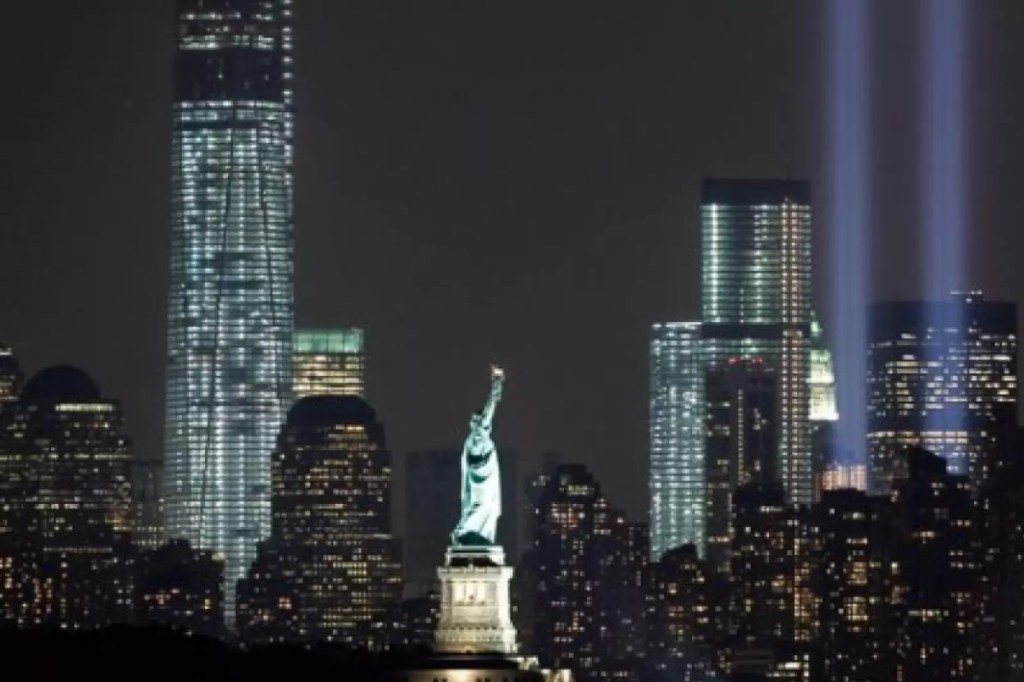
In New York City, Sept. 11 is something of a somber, unofficial holiday, with quiet memorial events around the city and twin beams of light rising from the Manhattan skyline.
It is not, however, an official federal holiday — which is why businesses and schools don’t shut down. Instead, Congress dubbed it a “National Day of Service and Remembrance,” which lawmakers officially named “Patriot Day” in 2001.
Congress has the power to make Patriot Day a permanent federal holiday. Right now, there are 10: New Year’s Day, President’s Day, Independence Day, Thanksgiving Day, Christmas Day, Memorial Day, Veterans Day, Columbus Day, Labor Day, and Martin Luther King Jr.’s birthday. Only federal employees and employees in the District of Columbia are guaranteed these holidays off, which is why you might still have to work on Columbus Day. (People in the Washington D.C. area also get to enjoy Inauguration Day once every four years).
Shortly after the 9/11 attacks and during their 10th anniversary, there were plenty of calls to make Patriot Day a holiday, mostly out of a fear that it would be forgotten by an apathetic public. Joe Brettell, a Republican consultant living in Virginia, made that case on Fox News:
In the years following the 9/11 attack, Congress has taken care to mark the day with moments of silence and resolutions. But those proclamations, while important, rarely gain the awareness of everyday Americans … Surely this effort will inspire the cynics to suggest that commemorating September 11 will eventually relegate it to another day of barbecues and baseball games, with only passing regard given to the heroes of that day. Yet in a deeper sense there can be no greater response to an attack that was launched at our very way of life than to celebrate the institutions, gatherings, and freedoms that drove our enemies to violence. [Fox News]
There is some credence to concerns that a 9/11 holiday would be trivialized by commercialism. Yesterday, Tumbledown Trails Golf Course, located near Madison, Wis., got in trouble for offering nine holes of golf for $9.11 to “commemorate” the 12th anniversary of 9/11.
September 11 is also just a few days after Labor Day, meaning the United States would either have to move Labor Day to some other date or deal with two short work weeks in a row.
That gets to the biggest reason Sept. 11 probably won’t be a holiday anytime soon: Federal holidays cost money. A lot of money. According to Rasmussen, every holiday costs the federal government $450 million in employee pay and lost productivity.
States have also been reticent to give their employees an extra holiday. In 2002, the New York state legislature decided not to make 9/11 a holiday after the state comptroller said it would cost $43 million. Other states, like Colorado, have also briefly considered it before scrapping the idea because of costs.
In 2007, Montana state Sen. Don Ryan tried to solve the cost problem by suggesting that 9/11 be made into a holiday instead of Columbus Day. One Italian-American lawmaker, according to the Los Angeles Times, told the Irish-American Ryan, “Why don’t you take away St. Patrick’s Day?”
And that was before the financial crisis hit in 2008. In that light, it’s easy to see why many politicians prefer a somber day of remembrance that doesn’t offend anyone or strain state and federal coffers.
Just because it’s not a federal holiday now, however, doesn’t mean it never will be. Martin Luther King Jr.’s birthday wasn’t made a holiday until 1984. Memorial Day, initially created to honor fallen Union soldiers, wasn’t declared a federal holiday until 1967. And Thanksgiving? That was officially made a federal holiday by President Abraham Lincoln, more than two centuries after the Pilgrims landed at Plymouth Rock.
Just finished watching Knives Out (2019) and 1917 (2019)…


Iron Man 3 Teaser Trailer UK – Official Marvel | HD
Watch the first official Iron Man 3 trailer. Marvel’s Iron Man 3 – coming to UK cinemas April 24th 2013, starring Robert Downey Jr.
In Marvel’s “Iron Man 3”, brash-but-brilliant industrialist Tony Stark/Iron Man played by Robert Downey Jr., is pitted against an enemy whose reach knows no bounds. When Stark finds his personal world destroyed at his enemy’s hands, he embarks on a harrowing quest to find those responsible. This journey, at every turn, will test his mettle. With his back against the wall, Stark is left to survive by his own devices, relying on his ingenuity and instincts to protect those closest to him. As he fights his way back, Stark discovers the answer to the question that has secretly haunted him: does the man make the suit or does the suit make the man?
Iron Man 3 continues the epic adventures of “Iron Man” and “Iron Man 2”, starring Robert Downey Jr., Gwyneth Paltrow, Don Cheadle, Guy Pearce, Rebecca Hall, Stephanie Szostak, James Badge Dale with Jon Favreau and Ben Kingsley, “Iron Man 3” is directed by Shane Black from a screenplay by Drew Pearce and Shane Black and is based on Marvel’s iconic Super Hero Iron Man, who first appeared on the pages of “Tales of Suspense” (#39) in 1963 and had his solo comic book debut with “The Invincible Iron Man” (#1) in May of 1968. “Iron Man 3” arrives in UK cinemas on April 25th 2013.
In Davie Village in Downtown Vancouver. Autumn of 2019.


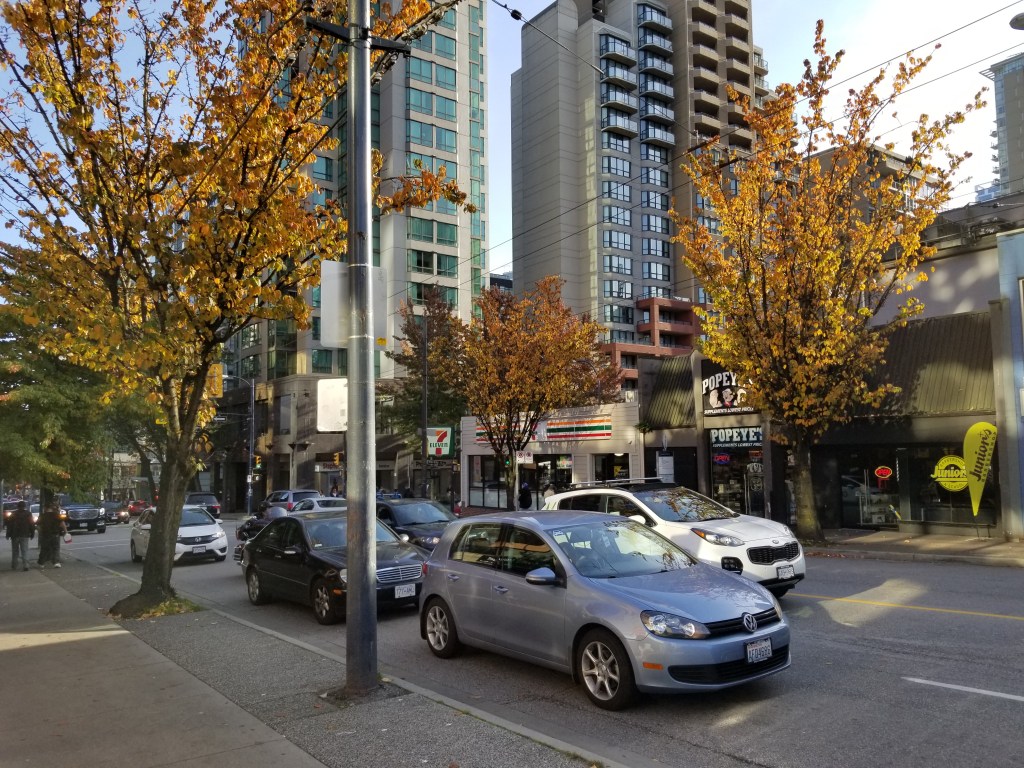
Davie Village (also known as Davie District or simply Davie Street) is a neighbourhood in the West End of Vancouver, British Columbia, Canada. It is the home of the city’s gay subculture, and, as such, is often considered a gay village, or gaybourhood. Davie Village is centred on Davie Street and roughly includes the area between Burrard and Jervis streets. Davie Street—and, by extension, the Village—is named in honour of A.E.B. Davie, eighth Premier of British Columbia from 1887 to 1889; A.E.B’s brother Theodore was also Premier, from 1892 to 1895.
Along Davie Street are a variety of shops, restaurants, services, and hotels catering to a variety of customers, in addition to private residences. The business with the most notoriety is Little Sister’s Book and Art Emporium (“Little Sister’s”), a gay and lesbian bookstore, because of its ongoing legal battles with Canada Customs that have received extensive national media coverage. Many businesses and residents along Davie Street and in the West End generally also fly rainbow flags as a symbol of gay pride, and many of the covered bus stop benches and garbage cans along Davie Street are painted bright pink.
The Village hosts a variety of events during the year, including the Davie Street Pride Festival which runs in conjunction with Vancouver’s annual Gay Pride Parade, during which sections of the street are closed to motor traffic.
Davie Day is also held each year in early September, to celebrate local businesses and the community itself. This Day is designed to build awareness and promote the surrounding businesses, and is focused around Jervis to Burrard Street.
The Davie Street Business Association coined the name “Davie Village” in 1999 and also commissioned banners from local artist Joe Average, which fly from lampposts in the district. The two-sided banners depict a rainbow flag on one side and a sun design by Average on the other.
Davie Village is also home to the offices of Xtra! West, a biweekly LGBT newspaper, Qmunity (formerly the Gay and Lesbian Centre) which provides a variety of services for the city’s lesbian, gay, bisexual, and transgender residents, and the Vancouver Pride Society, which puts on the annual Pride Parade and Festival.
Just finished watching Bad Boys For Life (2020) and The Matrix Revolutions (2003)…
Putin’s Russia is a poor, drunk soccer hooligan
Russia is not the country you think it is. Its economy is smaller than South Korea’s. Its people are poorer than Kazakhstan’s. It trails Finland in technology. And it has a smaller military budget than Saudi Arabia.
For most of the 20th century, what Moscow thought and did mattered from Havana to Hanoi. Then the collapse of the Soviet Union left behind a battered, broken shell of a country. When the Berlin Wall fell, so did Russia’s status in the world.
A boozy Boris Yeltsin was a fitting representative for a country whose average life expentency tumbled a staggering five years in the wake of the fall. There were the coups, industrial collapse, spreading corruption, and shrinking borders. After generations of fearing the Soviet Bear, the West patted it on the head, sent it some aid, and turned its eyes with expectation towards the emerging powers of Brazil, India, and China.
But Vladimir Putin’s rise to power marked a sea change in Russia’s fortunes. How the world sees Russia began to shift. The often bare-chested leader consciously cultivated a new brand, for himself, and for the country. Putin’s new Russia was a country that mattered again.
Russia hosted the Olympics, punched Georgia in the nose, took back the Crimea, invaded Ukraine, flew bombers through NATO airspace, built military bases in the Arctic, and generally flexed and posed like an oiled, aged, but still buff, body builder. And we’ve been paying increasingly rapt attention, not noticing the geriatric walker hidden just off stage. A closer look is almost shocking.
According to the International Monetary Fund’s most recent data, the Russian economy is approximately the same size as Australia and slightly smaller than South Korea. As an exporter, it is now less important than Belgium, Mexico, and Singapore.
And it is poor. The World Bank ranks Russia’s GDP per capita below Lithuania, Equatorial Guinea, and Kazakhstan. A larger proportion of its population lives below the poverty rate than in Indonesia, India, or Sri Lanka. It is ranked 67th in the world in the Global Competitive Index and 66th in the UN’s Human Development Index.
These economic woes are having serious social impacts. There are now fewer doctors than a decade ago. Life expectancy in Russia is nine years less than in the United States and is declining. Infant mortality rate is two to three times higher than most of the Western world. Its alcoholism rate is now the highest on the planet, three times North America’s; and consumption of alcohol has doubled in the past 20 years. Not surprisingly, the Russian statistical agency Rosstat has identified aging and shrinking demographics as the single biggest challenge facing the country over the next 30 years.
Intellectually, Russia is a distant speck in the rearview mirror. Once, esteemed Soviet universities educated the engineers and doctors of the developing world. Now, the United Nations ranks Russia’s education system behind nearly every other European country, and on par with the Pacific island of Palau. The technological leader that launched Sputnik now produces fewer patents per capita than Iceland. Its scientific publications are cited less often than Finland’s.
In nearly every indicator of health, wealth, and influence, Russia ranks below even the middle powers. What do they have left? Guns and bombs mostly. At 8,000 nuclear warheads, it still has 700 more than the United States. It ranks second globally for combat aircraft, military satellites, and nuclear submarines. Moscow’s military budget has increased every year since Putin’s arrival in 1999.
But even these numbers are misleading. According to data compiled by the Stockholm International Peace Institute, Russia’s defense budget is still less than China, and Saudi Arabia. It is roughly on par with India, France, and the United Kingdom. And it is nine times smaller than the Pentagon’s budget.
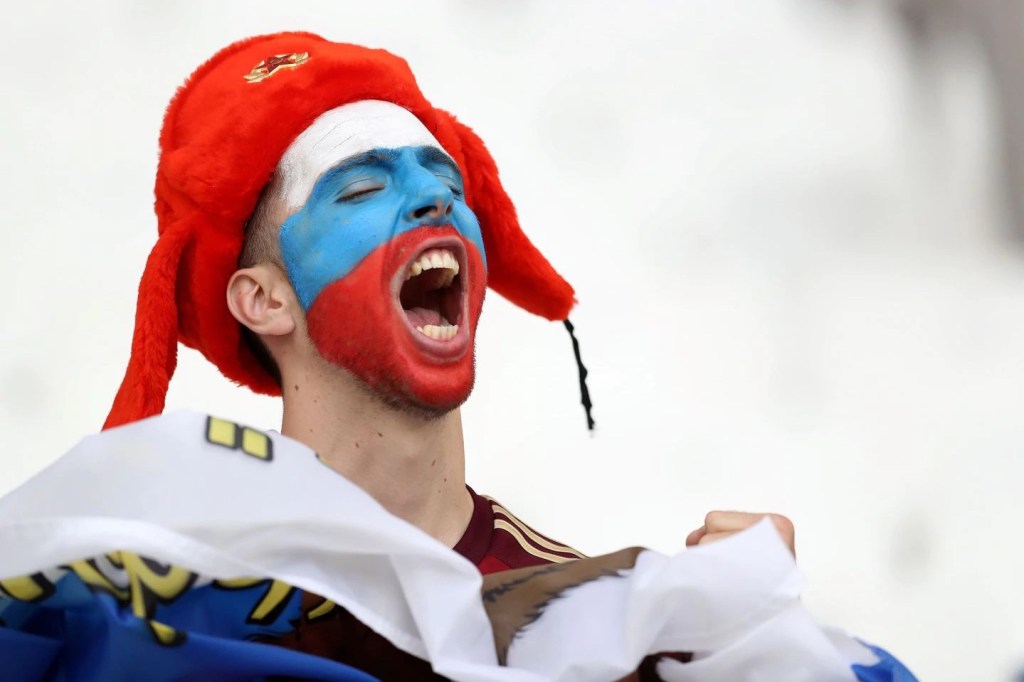
The fact is, if it wasn’t for Syria, the Crimea, and some ageing warheads, Russia would get as much global attention as Slovakia or perhaps Wales. Not coincidentally, those are two nations that recently played Russia in the ongoing European soccer championship. In both cases, the results were resounding defeats for the Russians despite their opponents being one-twentieth and one-fortieth its size, respectively. In spite of these resounding defeats, which have relegated them to the bottom of the league tables, the Russian team, and its fans, still dominated the news.
When we talk about the Eurocup, we talk about Russian hooligans rioting in the stands, attacking other spectators, and even assaulting tourists on the trains home. Or we marvel at the belligerent response from Moscow when Igor Lebedev, the Deputy Chairman of the Russian parliament and a senior official in the Russian soccer official tweeted “I don’t see anything wrong with the fans fighting. Quite the opposite, well done lads, keep it up!”
Lebedev understands a lesson that has been well taught by Putin: If you can’t compete on the field, make as much noise as you can off it. Russia is so far behind economically, technologically, socially, and politically, it just doesn’t matter anymore. But it can still get our attention, and it is.
When Russia next moves its tanks to the border, we should take it seriously. It has a lot of tanks (although less than Pakistan). But we should also remember that this is not a world power. By most indicators, it’s not even a middle power. Russia is a soccer hooligan: poor, drunk, and frustrated it can’t win anymore. It can only throw beer bottles from the bleachers.
Looking At Gorbachev’s Stupid Pizza Hut Commercial
Here we’re taking a look at how Gorbachev sold out his country for crap pizza. Enjoy.
Why I QUIT McDonald’s – STORYTIME + McDonald’s Horror Stories
Reasons why I left America’s biggest and most notorious fast food chain, McDonald’s.
Just finished watching Star Wars: The Rise Of Skywalker (2019) and Jumanji: The Next Level (2019)…


 Igor's Blog