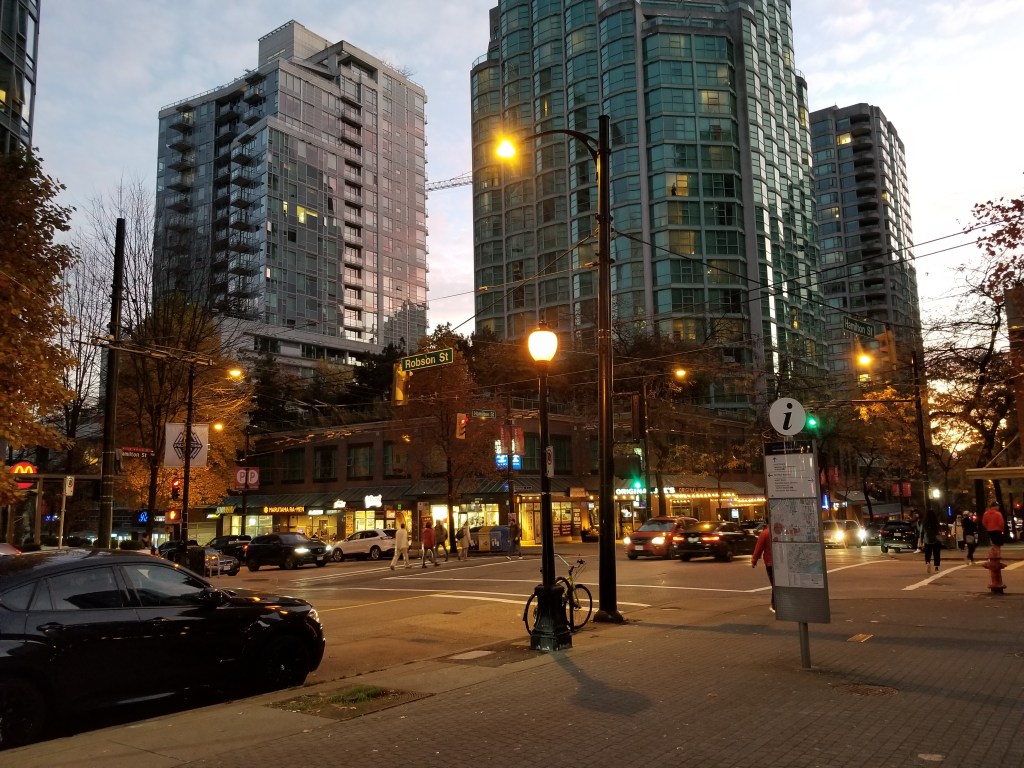
Robson Street is a major southeast-northwest thoroughfare in downtown and West End of Vancouver, British Columbia, Canada. Its core commercial blocks from Burrard Street to Jervis were also known as Robsonstrasse. Its name honours John Robson, a major figure in British Columbia’s entry into the Canadian Confederation, and Premier of the province from 1889 to 1892. Robson Street starts at BC Place Stadium near the north shore of False Creek, then runs northwest past Vancouver Library Square, Robson Square and the Vancouver Art Gallery, coming to an end at Lost Lagoon in Stanley Park.
As of 2006, the city of Vancouver overall had the fifth most expensive retail rental rates in the world, averaging US$135 per square foot per year, citywide. Robson Street tops Vancouver with its most expensive locations renting for up to US$200 per square foot per year. In 2006, both Robson Street and the Mink Mile on Bloor Street in Toronto were the 22nd most expensive streets in the world, with rents of $208 per square feet. In 2007, the Mink Mile and Robson slipped to 25th in the world with an average of $198 per square feet. The price of each continues to grow with Vancouver being Burberry’s first Canadian location and Toronto’s Yorkville neighbourhood (which is bounded on the south side by Bloor) now commanding rents of $300 per square foot.
In 1895, train tracks were laid down the street, supporting a concentration of shops and restaurants. From the early to middle-late 20th century, and especially after significant immigration from postwar Germany, the northwest end of Robson Street was known as a centre of German culture and commerce in Vancouver, earning the nickname Robsonstrasse, even among non-Germans (this name lives on in the Robsonstrasse Hotel on the street). At one time, the city had placed streetsigns reading “Robsonstrasse” though these were placed after the German presence in the area had largely vanished.
Robson Street was featured on an old edition of the Canadian Monopoly board as one of the two most expensive properties.
It is the time of monsters. The organic crisis of the old neoliberal project has also brought forth the rise of a new radical right. Yet these monsters are quite different from one another: we have strong men like Trump, Kurz and Macron – political entrepreneurs shaping a new authoritarianism from positions of governance. Theresa May and Boris Johnson act quite similar, with less success, but unlike the others they are established representatives of authoritarian elite right-wing conservatism. They all share an anti-establishment discourse, although they have strong capital factions backing them.
The authoritarian-nationalistic regimes in Poland and Hungary (or Turkey) are distinct, and are in turn different from the radical right like the Front National, Geert Wilders’s PVV or the Alternative für Deutschland (AfD), the Austrian FPÖ and Italy’s Lega – both operating from a position of government. Very different from them, in turn, is the Five Star Movement. How can we understand these formations’ differences and commonalities? This question must be addressed to identify specific tactics and counter-strategies in the concrete countries (see Wiegel 2018).
Here, I will try to tease out a more fundamental question: how can we understand the reasons behind the rise of the radical right? Many different explanations exist, most of which are valuable in explaining certain aspects. But they exist in parallel at best, sometimes even in conflict with one another. So is there a specific relation that we could flesh out theoretically?
Beyond empirical detail, only a few attempts at systematic and subject-orientated research have been undertaken. Rarely are these conducted with recourse to or for the further refinement of critical theory. Of course, the phenomenon is extremely heterogeneous and highly dynamic and thus eludes simple explanation. It must be seen in the framework of a crisis and concrete transformation of the mode of production and living. Why has this phenomenon gained so much importance now, and not ten years ago? In fact, it was already there. I will thus seek to elaborate the concept of a generalized culture of insecurity, including highly distinct but intertwined dimensions in the context of an organic crisis of the old neoliberal project – insecurity in the field of work, family, territory and homeland, one’s own perspectives and history, gender identity or mode of living.
The following will draw on a research project conducted with the University of Stendal, a small town in eastern Germany and former stronghold of Die Linke that has now become a bastion of the AfD. We also draw on our experience from the hundreds of door-to-door conversations and our pilot project in disadvantaged neighbourhoods.
Although the Alternative für Deutschland is certainly not a workers’ party, when we look at its constituency and electorate it appears they receive a significant degree of support from workers and poor people. The French sociologist Didier Eribon calls this electoral decision an “act of self-defence” – to have a voice, to be heard in political discourse even when it is only a “negative self-affirmation.” This is true of our experience, as well. Betrayed by Social Democracy and disappointed by the powerlessness of the left, they turn to a new powerful narrative: the defence of hard-working men, of our nation, our culture, against the Other – Islam, refugees, globalization, gays and lesbians, the moralizing ’68 elite in government, etc.
This phenomenon is nothing new and well-documented. But why has it gained such momentum? Explanations often pose the dilemma of: is it the social question, or racism? In the words of Stuart Hall, we can say that “the problem is not if economic structures are relevant for racial divisions, but how they are connected” (Hall 1980, 92). He continues: “It is not the question if people make racist ascriptions, but what are the specific conditions under which racism become socially decisive and historically effective” (129).
A Culture of Insecurity
1989 marked an historical rupture that began with the crisis of Fordism in East and West 20 years before. This was a moment of generalized neoliberalism, with shock therapies in Eastern Europe and deindustrialization with social subsidies in eastern Germany. The east was a field of experimentation for neoliberal flexibilization and precarization, but was also the moment of phasing out the remains of West German and Western European Fordism.
The result was a widespread culture of insecurity – emblematic were the workfare programs all over Europe and the USA and the Agenda 2010 in Germany, which dismantled the old unemployment security system. The goal was to establish the largest precarious low-wage sector in Western Europe. The fear of falling was not limited to those at the bottom of the social hierarchy, but spread to the established so-called middle classes, who knew the safety net was fraying while experiencing a rapid intensification of work, flexibilization, and fluid structures of protection. The fear was used to produce “compliant workers,” as Klaus Dörre (2005) puts it.1
The implicit social contract – promising recognition and social security in exchange for hard work – was unilaterally broken. While unions were unable to oppose this development, frustration and anger often was directed toward groups assumed to be under less pressure, performing less and taking money from the state – the unemployed, people receiving social assistance, refugees.
As I said, this reaction was not particularly true for the lowest class segments, but rather emanated from the middle – those who had something to lose, who see themselves as the productive core of society. Even when they were able to maintain or even improve their social position and status, this came at the price of increased workloads, unrestricted working hours, and exhaustive flexibility requirements.2
Oliver Nachtwey (2016) found a brilliant metaphor for the situation: the image of a moving escalator going downward. One is not intended to stand still – one must struggle to avoid going downward, while moving upward proves even more exhausting. Only a few manage to take the escalator to the top. But the upper segments of society are closed off; the rich live in a world of their own.
Beyond the dramatic increase in inequality, hard divisions of respectability (not only small distinctions) were drawn: the bourgeois class produced popular images legitimizing the authoritarian education of the unemployed, migrants and other subaltern groups, pushing for a conscious class distinction from the under-performers. The parts of the working class which have something to lose draw a line against those further below, denying them respectability as well. The fear of not being respectable – the fear of falling and failing – produced a feeling of guilt leading to self-loathing directed against weaker groups and individuals: a revaluation of the self through the devaluation of others. The most effective forms of this are classism, racism, and sexism.
Beyond precarization, however, more dimensions are at the root of a culture of insecurity, and all are interconnected. A brief overview:
a) The Crisis of Male Subjectivity:
New forms of male individuality could not be generalized in neoliberalism – “emotional intelligence,” self-reflexivity, cooperative and communicative capabilities, gender equality, anti-sexist discourse and so on. In contrast, many feel a kind of feminization of work requirements as well as in family relations and child care, up to feeling forced to eat less meat. On the labour market, they experience women as fierce competition, while losing their role as family breadwinners and feeling the gender hierarchy at home has been turned upside down. Entire male-dominated sectors of the economy, often bound to a certain exploitation of nature, are threatened – from mining to automobile manufacturing. This challenges certain habits of skilled male labour, already under pressure from permanent technological requirements of re-qualification and further education. This leads to experiences of being incapable of meeting requirements – incurring a certain nostalgia for the good old notions of family, clear gender roles and male work habits. This might be a reason why men of a certain age are particularly likely to vote for the radical right and why anti-genderism is so central for them.
b) The Crisis of Female Subjectivity:
Promises of emancipation through integration into the labour market encountered several “glass ceilings”: the pay gap, omnipresent requirements of being flexible incompatible with family life – even with a more or less equal distribution of care work or delegation to others, often illegalized migrants – the new family models (Gabriele Winker) are not working, not only because of increased requirements on the job, but also because of new aspirations concerning (quality) time with children and life partners (but also to meet the competitive pressures on children within educational institutions, concerning one’s own fitness, etc.). Out of this stress between increased requirements and own aspirations, some develop a nostalgia for old family models – exaggerating the value of motherhood, especially where these new experiences meet with conservative values. This may be a reason why women vote for a radical right which is so anti-feminist – after all, liberal feminism rarely addresses these needs and problems, particularly for woman of the popular classes.
There are other dimensions as well, but we lack the space to delve into them. I will simply name them:
c) Insecurity due to certain kinds of lifestyles growing outdated, losing their claim to what is culturally “normal.” Old milieus dissolve and new modern, diverse, cosmopolitan, multi-cultural and multi-lingual lifestyles seem to dominate media and advertising. The world and experience of skilled workers is no longer the standard – it becomes unsettled, proletarianized. Being sensitive to gender, ecologically responsible, accepting of gay and queer people, using a non-discriminatory language etc. – all of these are perceived as “political correctness” directed against persistent but outdated habits. This often meets with pre-existing prejudice and may revert into aggressive denial and intolerance.
d) Insecurity due to “external threats”: experiencing the demise of social infrastructures (especially schools, public transport, public administration and police, public security in general), particularly in certain regions, causes real social problems but is not traced back to the roots of neoliberal reform, instead falsely associated with assumed external causes like “migration into our social systems,” ”’kanakization’ of our schools,” “parallel societies,” migrant delinquency or Islamism, even terrorism, but also job insecurity because of multinational corporations, European reforms, or competition through labour migration. This often links up with pre-existing racial prejudice, which becomes increasingly important for individuals against this backdrop.
e) Insecurity through discharged democratic institutions and organized irresponsibility: who decides on new requirements, what kinds of life experiences and identities are still represented, where do I have a voice in family decisions, in living my own identity, in transnational production chains or in despotic low-wage relations? Economic imperialism is eating away at individual responsibility. One cannot direct demands toward a super-powerful globalized market. Politics seems to have deprived itself of power vis-à-vis the market and detached itself from the people, even become corrupt. Democracy is becoming a play without any real actors. This may often be articulated mistakenly, but the experience is real: feeling helpless and powerless, without control of one’s conditions of life. This reverts into “anger without a target” (Detje et al. 2013), and to an “extreme fatalism” (Haug 1993, 229): “You can do nothing about it.”
The point is: when the various dimensions come together, this can condense into a state of panic (Balibar/Wallerstein 1990, 271). The radical right is mobilizing and fuelling a “moral panic” (Demirović 2018, 29). This way, they encourage the subaltern to disconnect their feelings from efforts to understand the reasons behind their predicament and translate them directly into resentment, racism, coldness, and denial of solidarity instead. The reward is attention and false grief from above: “We have understood, and we take your worries and concerns seriously,” etc. (32).
Bizarre Everyday Consciousness and Right-Wing Populism
Most of the time, however, we encounter a bizarre form of everyday consciousness (Gramsci), not a coherent and closed view of the world, but what W.F.Haug calls “proto-ideological material” (Haug 1993, 52), meaning impulses and elements of feeling and thinking which are not yet ideologically determined. The impulse of discontent and anger is not in itself ideological. This depends on how it articulates itself or is articulated along with other elements. Thus, discontent can be translated into solidarity and horizontal practices of association from below, or revert into hierarchical forms, depreciating and excluding the Other.
If we seek to understand the rise of the radical right, it is less about right-wing attitudes in the population (as can be found in polls for the last 20 years or so) than it is about how these loose, proto-ideological impulses, feelings, forms of thinking, desires and aspirations – often in contradiction to one another – are integrated into a political project, giving them a coherent articulation. This explains why right-wing attitudes may decline in the polls, while the right-wing agenda continues to rise in the public eye.
This is not a mono-causal process: proto-ideological material is formed and processed in constant discourses in various ideological apparatuses such as the media and political parties, but also in schools, on the shop floor, in associations or in the family. At the same time, social individuals appropriate political discourses in the sense of active subjectivation, adapting them to their respective conditions in order to gain at least a “restrictive capacity to act” (Holzkamp 1987). The question is “how the social individuals integrate themselves in to the existing structures (and discourses), thereby shaping their own subjectivity” (F.Haug 1983, 16). But we also have to ask why leftist or solidary discourses are less effective than elsewhere, for instance in Spain or Greece (see Candeias and Völpel 2013).
Especially when the experience of solidarity is lacking or disappointed, this opens a window of opportunity for the radical right. When the experience of solidary practice or the prospect for their possible success is absent, this may lead to stubborn dissidence, as represented also by the radical right: their dissidence at the same time defends the status quo of existing social relations, the “good old past,” while questioning them partially. There is a dominant feeling of “extreme fatalism,” very aware of its powerlessness against “those at the top,” re-enacting a rebellious gesture, combined with an “extreme voluntarism” (Haug 1993, 229) against the weaker social groups at “the bottom and outside,” very aware that they face little danger of being sanctioned for that. This attitude is in “opposition to the ruling bloc in power,” but is “dangerous” only where the foundation of capitalist rule is not concerned (222). The radical right enables social individuals a “nonconformist conformism” (Thomas Barfuss): an attitude of resistance toward the ruling power bloc, at the same time requesting (in a form of interpellation) for their action to depreciate and actively exclude “the Other” – migrants, those “unwilling to work,” the “toxic ‘68er,s” feminists, etc. This can be experienced as stabilizing a restrictive capacity to act under heightened conditions of insecurity.
The new authoritarianism could be read as an “attempt to build a coalition with parts of the petit bourgeoisie and the working class from the side of the bourgeois class, without the need to make concessions. It works like a short circuit between the forces of the bourgeoisie and the subaltern” (Demirović 2018, 34). In doing so, this does not lead to a simple rejection of democracy, but to its reactionary re-making – an illiberal democracy – a plebiscitary strategy, dividing and mobilizing along the lines of racism, nationalism, religion, sex and gender, or form of exploitation of nature, “reproducing and disarranging the bizarre everyday consciousness, converting into neurotic subjectivities” (ibid).
Their form of mobilizing is connected to an imagined self-empowerment of the subaltern, based on the promise of taking back control. Once the different proto-ideological elements are articulated in a coherent way, it is much more difficult to re-articulate them in a different manner.
New Relations of Representation
Against the backdrop of this culture of insecurity, modernized radical right parties – the ugly siblings of neoliberalism – could be established in many European countries over the last 20 years. In Germany, they vanished time and again, but authoritarian or racist attitudes spread nevertheless. With the rise of the Alternative für Deutschland, one could say the country reverted to the European norm (Opratko 2016). Its appearance led to a complete shift of the whole political and ideological spectrum toward the right, creating a new relation of representation (Demirović 2018, 28). The previous “anger without a target” found a representative to articulate this anger – not in the sense of simple expression of that anger, but in a specific coherent and increasingly radical way.
The AfD began with the dream of a return to the Deutschmark and a strong national, one could almost say “imagined economy.” The rise could not have been consolidated with the critique of the Euro alone, however. The clear class character of the project, created by angry neoliberal professors looking with arrogance and disdain at the subaltern, would have been too obvious.
Only taking up and intensifying the anti-migration, anti-Muslim, anti-feminist, homophobic and anti-liberal discourse strategically directed against all minorities enabled the party to invert popular discord into popular compliance – against its own class composition concerning its constituency and leadership (cf. Hall 1982, 114). Polemics against “migration into our social security systems” and turning the social question into an ethnic question proved particularly effective (Wiegel 2014, 83).
Insofar as the ethno-nationalist and social wings of the party are becoming more influential (in the workplace as well), their notion of “exclusive solidarity” (Dörre 2005) could broaden their appeal in sections of the working class. It does not seem to matter that the party advocates for the most radical neoliberal reforms at the same time. In fact, they play with ambiguity, relativizing truth. This is one of their most effective strategies. They have succeeded in re-articulating the populist agenda and asserting right-wing hegemony in public discourse.
Most of the other parties are taking up this agenda, always with a shift to the right – even the media, and talk shows in particular. Now, it would seem, people can say whatever they want in public. An astonishing symbol was the last German government crisis between Horst Seehofer, Minister of the Interior and head of the right-wing Bavarian CSU (the sister party of the ruling CDU), and Chancellor Angela Merkel. It revolved around closed detention centres and how to send back refugees, completely ignoring the mass carnage in the Mediterranean. The radical right has set the agenda and are “on the hunt,” as Alexander Gauland, head of the AfD, said. Only a few weeks later, we watched huge crowds of Neo-Nazis parade through the small city of Chemnitz (formerly Karl-Marx-Stadt), giving open Hitler salutes and chasing people of colour through the streets, with a small number of police units unable and unwilling to stop the mob (while any leftist or anti-fascist activity is confronted with huge numbers of militarized anti-terror units). The head of the secret service (the so-called “Federal Office for the Protection of the Constitution”), Hans-Georg Maaßen, denied the incidents and implied that media coverage and film footage had been “fake news.” Following extensive public outcry, this prompted another government crisis with Seehofer backing Maaßen, while Merkel and her coalition partner SPD demanded his demotion. In the end, Maaßen was removed from his position but only to become state secretary for internal security and cyber security. The crisis is still smouldering and the established parties are losing popularity, pushing more people toward frustration and toward the anti-elite course of the AfD.
The radical right’s strategy is combined with an open hostility toward parliamentarism and its democratic procedures, while using the parliament as a stage. Of course, post-democracy already began under neoliberalism, but now it approaches a rupture with democratic procedures – starting with Berlusconi, then Orbán, Trump, etc. The radical right, one could say, is doing the legwork for a new authoritarian project.
Attempts are ongoing to assert political control over jurisdiction (in Poland, Hungary, the USA, Turkey) and constrain freedom of the press, or at least disparage them as “lying press” while deploying fake news and “alternative facts,” often combined with a vulgar historical revisionism. The rights of minorities, women, unions, and science are at least questioned. A violent language becomes normal, affirming and relativizing physical violence, enforcing security discourses and repressive apparatuses. Expanding the range of acceptable language is expanding the space for maliciousness from open hatred to real individual violence. I think these are clear tendencies of what in German is called Faschisierung: not fascist regimes, but clear tendencies against a democratic and solidary mode of living.
Racism from Below as Reactionary Self-Empowerment and Expansion of One’s Capacity to Act
The production and combating of “the Other” plays a central role here.
The tremendous heterogeneity of the subaltern classes could serve as a fruitful foundation for solidarity in plurality, but of course could also be the foundation for strategically dividing the class. This is especially done by integrating factions of the class into a hegemonic project. Forms of chauvinism, racism, sexism, and classism in the everyday consciousness – as well as the distinction of certain professions from others, different modes of consumption and lifestyle – are useful elements to expand minor differences into real divisions.
A common pattern is to compensate one’s own (real or feared) social decline by depreciating others, because the feeling of dignity and individual social position is a relative one always in comparison to others. To allocate someone else a lower position makes one feel that they not at the bottom of the social hierarchy, maybe they still part of the middle class, part of a nation – in the German case, a successful export leader and football world champion (the latter may be weakened after the last World Cup, where Germany was knocked out in the first round).
Racism and nationalism were always present, but remained in a subaltern position in most people’s minds, emerging to the fore from time to time but not systematically. That they gained so much importance is also a symptom of the lack of effective class struggle (Balibar/Wallerstein 1990, 259). In the moment of this generalization of a culture of insecurity and crisis of the old neoliberal project, the articulation of the proto-ideological elements changes: what was marginal or less important takes on a central position in the ideological structure, becomes a point of condensation.
The ruling class seeks to divide the subaltern classes via integration into a hegemonic project. This is not a mere ideological phenomenon, but includes the realization of material interests: because of power relations and a strong workers’ movement, class compromise in Fordism was broadly inclusive, although it also produced an exterior and exhibited a patriarchal and paternalistic structure. In neoliberalism, the basis of class compromise was much smaller, more and more reduced to high-tech specialists and the core workforce in production. Export-nationalism, purchased at the dear price of austerity and wage restraint, still guarantees a highly contested degree of participation for a certain part of the working class. This kind of class compromise has high costs entailing subordination, increased flexibilization, tightened performance requirements, etc. This kind of class compromise with less and less concessions mobilizes tremendous fears of tailing to keep up in this universal “war of every one against everyone” (Hobbes, as cited by Haug 1993, 228).
This becomes evident with the constant burden of increasing contributions to social insurance and higher taxes, combined with declining benefits and crumbling social infrastructure – first due to German reunification, rising unemployment, the costs of the EU, and then the arrival of hundreds of thousands of refugees. The so-called middle classes and high performers are burdened more and more (so the story goes), while the real reasons – the dramatic re-distribution of wealth in favour of capital and the rich – are not discussed. One cannot do anything about it – otherwise they would have turned their anger against the ruling power bloc to offer at least a small portion of the economic success as part of the class compromise, albeit in a very subaltern position.
The feeling of bearing the burden grows even more when faced with heightened competition on the labour market, in housing, for access to high-quality social services, especially child care and schools, and for public space. Although the actual cause might be permanent neoliberal restructuring, some fear that with the arrival of so many refugees there will be even less left for them.
These unreasonable demands should also apply to the Other even more so, up to denying them individual and social rights. The higher the perceived pressure is, the harsher the break with solidarity vis-à-vis social groups outside the class compromise. Even a portion of those excluded, the poor, desperately want to be part of that compromise, struggling for recognition, adopting the images and forms of social exclusion against their own group to mark a distinction from them.
If it is true that racist ideology is primarily an ideology of those segments of those in-between classes – not only in the sense of ascending or descending class segments, but concerning “active negation of class solidarity,” as Balibar/Wallerstein put it (1990, 263) – then we could understand the radical right as a class alliance between descending segments of skilled labour, endangered segments of the working class that developed into a petit bourgeoisie defending their small residential property and consumptive status, between ascending individualistic high performers, family businesses under pressure from globalization, bourgeois intellectuals lacking recognition or experiencing marginalization in institutions. Concerning the descending class factions, one can speak of manifest or threatened social declassification (see Kahrs 2018), while the ascending segments and class factions are engaged in the struggle over the recomposition of the power bloc.
The mix of heightened requirements and unreasonable demands, experiences of declassification, insecurity, attempts to stabilize the self via imaginary communities (Benedict Anderson), racism and other forms of depreciating Others add up to a radical right articulation of initially independent phenomena. “The racial stigma and class hatred” against those below in the social hierarchy coincide with the category of migration (Balibar/Wallerstein 1990, 249). “Insofar as they project their fears and resentments, their desperation and defiance onto the strangers, they not only fight competition, as it is said, but they try to distance themselves from their own exploitation. They hate themselves as proletarians or as humans, in danger of falling into the mill of proletarianization.” (258) A constant interplay and entanglement of “class-racism” and “ethnic racism” (ibid) against the ones below and outside. The interpellation of racism (or anti-Semitism) “instantly operates like directing a magnet onto loose iron filings,” rearranging the whole political field – after which it becomes possible to “organize a populism from the right, that is to say an authoritarian constitution of Volk” (an ethnic unity of the people) (Haug 1993, 222).
Against this backdrop we can understand the growing significance of racism, chauvinism, nationalism, etc. as creating a more coherent everyday consciousness as active inscription of individuals into an ideological project from the right. This is connected with a transition from a latent to openly racist mode of living.
This is not a seduction by pied pipers of the far right, but an active subjectivation enabling a reactionary self-empowerment and expansion of one’s capacity to act. This may help to understand why the question of migration advanced as a central social line of conflict, inverting the hierarchical conflict between capital and class into a horizontal conflict between class factions in and outside of the class compromise.
The problem? The left cannot win on this terrain. We need to shift it.
Connective Class Politics from Door to Door
Thus, back to the manifold dimensions of a generalized culture of insecurity in times of an organic crisis of the neoliberal project, with uncertainty at work, in family relations, neighbourhoods and whole regions, future prospects, one’s own history, identity, gender or mode of living. This pervasive insecurity is the basis for subjective strategies to confront the situation, which in absence of experiences with solidarity receive an ideological supply from the right to win back control.
But one can link up from the left on the same basis. Most people do not have a closed view of the world, but a bizarre everyday consciousness in which conflicting impulses coexist. We have to be aware that it is much more difficult to win people back once they become part of a radical right project, seeking to lend coherence to their everyday consciousness with a radical right view of the world and a racist mode of living. But many are aware that the radical right will not solve their everyday problems of manifold insecurity, and feel discomfort and a guilty consciousness with the right. Die Linke lost 400,000 voters to the AfD in the last elections. We want them back. So, how to connect with them from the left?
This has been a focus of the debate around new connective class politics (cf. Luxemburg Special Issue, 2017) in recent years, i.e. a class politics reaching beyond the usual suspects (Candeias 2017), developing and experimenting with new concrete projects. This sometimes means simple things that seem so difficult: knocking on doors in disadvantaged neighbourhoods all over Germany (and especially in the left’s former strongholds), taking lessons from Greece and Spain, the Netherlands, Austria, Great Britain and the USA (cf. Steckner 2017a, Pieschke 2016). We need patience and endurance to build active relations. We have to listen, debate, organize local meetings centred around everyday problems such as neighbourhood rent policies or struggles in and for health and child care services. We have to come back and try again. It was often a surprising experience for both sides: first to be approached at all, and then to have a political conversation focused on everyday problems.
We sent hundreds of militants to knock on doors all over Germany. Our activists of course encountered resentment and racism, even among people leaning to the left. Nevertheless: most of the time, a conversation was possible. Frequently, people responded the question of what has to happen for their situation to progress with “Asylanten” – a derogatory term for asylum seekers – “must go!” “Okay, but was your situation better before the refugees came – or do you expect it will be better when they are gone?”
“No! I know that this will not change, even with the AfD…”
People then started to talk about their own problems: that they have three kids, receive social assistance but are not able to pay the rent or buy enough food or a birthday present for their kids, and so on. Less political correctness and more listening and taking experiences seriously – without denying one’s political point of view.
Other studies confirm our findings: according to a recent study documenting a door-knocking project across more than 500 doors in Germany and France (Hillje 2018), the first things people would like to change if they were in power were: “higher minimum wages, universal basic income, and more assistance to single mothers” (15f).
The same study concluded that “when people talk about politics in their own words, fear of Islam, Euroscepticism, the ‘lying media’ or an emphasis on national identity doesn’t play a major role.” They do not even have anything against migrants, at least it is not a major point, but the feeling that politics follows the wrong priorities, is not serving their needs, especially in disadvantaged regions or neighbourhoods.
As discussed above, they do not necessarily believe that the AfD or Front National could really solve their problems (Hillje 2018, 10). This was also true for our conversations: voting for the radical right is more an expression of the desperate wish to be heard and have politics focused on everyday needs. We interviewed a middle-aged man who always voted for the left. After years of disappointment, he voted for the AfD. When we talked he was already sceptical that this would change anything for the better. We invited him to a longer interview. After a while we called again, he joined the local organizing initiative and will vote for the left again. This is not an isolated case. This is an opportunity for the left: to proceed from solidary forms of working together on social problems in the neighbourhood, building structures of mutual solidarity (see Candeias and Völpel 2013). This is what we are trying to develop and spread across the party, and to support movements doing similar things.
From this common ground on social issues, we can work on questions like racism and sexism as they are modified and reduced in significance to an initially reactionary capacity to act. However, we cannot stop there, as this leads to a silent toleration of these ideologies. Rather we have to work on this, with continuous training and political education, but moreover by organizing space for experiences of solidarity irrespective of one’s migrant background. Experience with refugees as part of organizing projects in the neighbourhoods is crucial. Moreover, it is at least as important to support the self-organization of migrants and refugees. How to do all this can be learned, requiring systematic training so people lose the fear of approaching the Other.
At the moment, we think it is the only and most promising way to win back those segments of the popular classes we have lost over the years – not only those who voted for the AfD, but the even larger number of people who do not vote at all (cf. Candeias 2015, Schäfer et al. 2013a, 2015).
Decisive is whether everyday experience is shaped by practical solidarity or by competition and isolation. It is not impossible that a successive practice of solidarity could be more attractive than the imagined self-empowerment of the radical right, without any solution for people’s everyday problems. It is about a “generalized capacity to act” (Klaus Holzkamp) on the path toward a common and solidary disposition about our own conditions of life – “taking back control,” but “for the many, not the few.”
A “helpless antifascism” (Haug) focusing too much on the radical right and its agenda, rushing from one counter-demonstration to another, defensively concedes the chosen terrain of struggle. We have to develop our own agenda and shift the terrain with concrete organizing around everyday social problems with connective class politics, focused not only on the antagonist from above and from the radical right, but creating its own broader basis for a lived solidarity for all (cf. Candeias 2017).
There’s finally a well built handheld emulation console that doesn’t feel like a cheap knockoff. The RG350M takes the top spot as my favorite retro ROM player to date.
The good outweighs the bad, though weird interview choices add unfortunate bloat.
We at Ars Technica’s gaming section are flattered by High Score, the newest docu-series launching August 19 on Netflix. The easiest way to describe this gaming-centric interview series, split into six 40-minute episodes, is to give a shoutout our own War Stories video series.
For a few years, War Stories has been asking developers of beloved game series to explain how they overcame problems and got their eventual classics to your favorite PCs and consoles. Netflix’s new series does something very similar: it asks members of the game industry to stitch together a narrative of gaming’s so-called “golden era,” which, in their eyes, begins with Space Invaders in arcades and ends with Doom on PC.
All in all, I’m happy High Score exists. If you want to watch it uncritically, especially with people who don’t necessarily play video games, you can look forward to a mix of intriguing and all-too-familiar classic-gaming tales, told with high production values and clear storytelling throughlines. For the most part, the series is dignified, not embarrassing—a fact that delights the inner 12-year-old in me, who still has a chip on his shoulder about being a gamer “outcast” for most of my youth.
Parchment, magic hats, and “solace and peace”
Maybe it’s the War Stories bias in me, however, but the series’ biggest weakness is its desperation to stitch all of its interviews into a cohesive “game history” story.
In isolation, High Score has some of the best interviews with game-industry luminaries I’ve ever seen. The absolute highlight is an interview with Roberta and Ken Williams, the co-founders and architects behind Sierra Entertainment. Together, they tell the most detailed story I’ve ever seen on camera about their work on 1980’s Apple II game Mystery House. This includes Roberta pulling out a sheet of parchment to draw a facsimile of her original Mystery House design documents for the Netflix camera crew. I’ve maybe never seen a more beautiful “how it was made” demonstration of a game’s origin story.
Similarly thoughtful interviews play out over the series’ six-episode span, and High Score hits the ground running with Taito mastermind Tomohiro Nishikado telling the creation story of Space Invaders. We see him play with an ancient electromechanical “magic hat” machine; we see him imagine Tokyo overrun with massive, robotic spider creatures; we see him pull out pages of original concept art while explaining the design decisions driving what the final game’s characters looked like. As the very first story from the very first episode, it sure sets a tone.
This is followed by a refreshing conversation with legendary programmer Rebecca Heineman about her origins in the game industry: as a competitor in one of the world’s earliest examples of a formal gaming championship. This segment is rich with archival footage and Heineman’s insights, along with her frank admission that games were a crucial escape during her childhood struggles with gender dysphoria: “[Gaming] allowed me to play as a female. I’ve always identified as a woman. Unfortunately, my anatomy didn’t agree. So when I played video games, I was in this virtual world where I was mowing down rows of aliens and ignoring the world around me. It was the only place I was able to find solace and peace.”
The rest of this pilot episode nimbly connects other early ’80s dots, including a great story from the children of engineer Jerry Lawson. He’s largely credited with developing cartridge-based gaming while making the otherwise unsuccessful Fairchild Channel F console. Some of the episode’s stories—particularly that of Ms. Pac-Man’s origin as a “speed-up kit”—won’t be news to savvier game-history fans. But they are at least told in polished, humorous fashion, and their montage sequences’ pixelated art are a clever touch.
Join the Nintendo Fun Club today!
But let’s get back to Heineman—her experience in the games industry, as far as High Score is concerned, is relegated to her victory in a Space Invaders tournament. The series makes no mention of Bard’s Tale, Wasteland, or even Heineman being hired as a 16-year-old game-studio programmer. And as the series rolls along, more lapses in game-history storytelling emerge.
The issue is that High Score lands quite a few formative interviews on its quest to tell a certain history of the industry. But if the crew didn’t score a particular interview, then the story in question barely exists. We only hear about Shigeru Miyamoto’s game design prowess when English-speaking members of the Star Fox team (Giles Goddard, Dylan Cuthbert) are interviewed about that project. Otherwise, Nintendo’s history is told almost exclusively by one of its American PR leads, who tells the story of Nintendo Power’s formation as a magazine. The story is told well in High Score’s format, but it leaves Nintendo design luminaries like Satoru Iwata in the shadows (and, weirdly, pretends the Nintendo Fun Club Newsletter never existed).
And we only hear about one Electronic Arts series, John Madden Football, because that’s how High Score tries to explain Sega’s console-war dominance in the sports genre. This sports sequence drove me particularly insane. Madden launched near-simultaneously on Super Nintendo and Sega Genesis, so it was a terrible example to hinge this anecdote on. Plus, Sega’s bullishness about self-published sports games, usually with athletes attached, went completely unmentioned. At the time, Sega aggressively marketed Sports Talk Football with Joe Montana as a rival to Madden, but Netflix leaves that and other major Sega sports games unmentioned.
High Score includes one story of famous failure: ET for the Atari 2600, as told by lead designer Howard Scott Warshaw (the genius behind Yars’ Revenge). Yet Trip Hawkins, who guests on High Score to talk about Madden’s development, doesn’t get the opportunity to talk about his own console-launch failure, the 3DO. Other notable gaming-industry failures go similarly unmentioned.
Some of the series’ lapses would be more forgivable if Netflix wasn’t so stuck on following winners of ’80s and early ’90s game tournaments. Heineman’s story is a gem. The same can’t be said for other episodes’ segments dedicated to the Nintendo World Championship and the Sega Rock the Rock Championship. If this were a longer series, an entire episode about early game championships might be lovely. But here, these stories suffer because they only interview one participant each, drag for far too long, and place far more cultural import on the tournaments than they’re arguably worth. (I know, the Nintendo World Championship was massive for my generation, but High Score’s version of that story isn’t told with multiple participants, with Nintendo organizers, or even with a mention of tie-in film The Wizard.)
Don’t spoil things for gaming novices
Again, I must insist: if you want to enjoy the series uncritically and deal with a mix of storytelling delights and slower, “Guess I’ll check my phone for a few minutes” segments, High Score has enough good content to sit through. This is boosted significantly by Charles Martinet as narrator; you may recognize his voice as that of Super Mario and other famous Nintendo characters, and he handles his humorous-enough script with a gentle cadence. (No, he never sneaks an “it’s-a me!” into the series. Super Mario receives paltry lip service through the course of High Score, honestly.)
Just be warned that some uneven interview choices and leaps past significant game-history developments will leave anybody knowledgeable about gaming history yelling at their TV. Your favorite console, arcade, portable, or PC game from the era in question is, in all likelihood, not given enough time or coverage by Netflix’s filming crew. (I, for example, couldn’t believe how little was said about Tetris. Tetris!)
With that in mind, keep the whining to the minimum if someone has a pleasant time not knowing better and watching the whole series at your side. Once you’re done with Netflix’s take, our War Stories series will continue feeding you the game-history goods.
KIEV — Ukraine, a former economic powerhouse for the Soviet Union, once produced four times the output of the next-ranking republic and enjoyed a wealth of fertile black soil for farming and a growing heavy industry. However, after the fall of the Soviet Union, Ukraine’s economy began to suffer. The government tried to liberalize prices, but reform was halted after resistance was met within the government.
As a result, the economy fell to the point that in 2009 Ukraine had one of the worst economic performances in the world. Today, the gross domestic product (GDP) stands at $352.6 billion — 50th in the world. Ukraine’s GDP is surprisingly low considering its possession of all the tools for a successful, production based economy with thriving agricultural and industrial industries.
Therefore, poverty is a major concern, with 24.1 percent of the country’s citizens below the poverty line.
How did a nation with such promise end up with such a disappointing economy?
Ukraine’s economic woes can be traced back to failures by the government to resolve disputes and agree on reform, as well as widespread corruption and political instability. Poverty in Ukraine was at its highest in the 1990s, when hyperinflation abounded following the fall of the Soviet Union, as huge monetary expansion was necessary to finance government spending.
However, while this expansion was able to finance government spending to a degree that they could work on reforms that would stop hyperinflation, it was too late for the people of Ukraine who lived in poverty.
What are the main causes of poverty in Ukraine?
One of the main causes of poverty in Ukraine from the early 2000s to today is the government’s complacency in providing reforms that would stabilize the economy. Aforementioned heavy industry exports were booming, and Ukraine was especially successful in providing exports to Russia.
Instead of investing in reforms that would result in long-term stability and a middle-class income for many citizens, government officials chose instead to appeal to their own interests.
Ukraine has struggled with corruption at the highest levels of its government, with the Panama papers exposing widespread corruption at every level and industry. The Mossack Fonesca files — the law firm at the heart of the Panama Papers — exposed Ukrainian corruption going back to the earliest days of independence, when money was laundered offshore.
So what’s Ukraine’s solution?
It is impossible to grow an economy when the government officials are putting money in their own pockets, and therefore, the only way to sustainably improve the economic situation of Ukraine and to draw Ukraine’s people out of poverty, is to engage in necessary reforms and take steps to halt corruption.
Although pervasive corruption continues to be problematic, Ukrainian citizens have seen some hope following the most recent International Monetary Fund (IMF) assistance package of $17.5 billion, and reforms instituted after the Revolution of Dignity in 2014. These reforms are designed for democratic transparency, which is a great first step in a history of corruption.
The assistance package and recent reforms have sent Ukraine in the right direction, as was recently reported in June 2017 that the average salary (UAH) reached an all-time high of 7360 UAH, an increase from 6840 UAH in the previous year.
So, while there is still plenty of work to be done — a better legislative framework, more solutions to combat corruption and a development of capital markets — the causes of poverty in Ukraine are gradually being solved, and the future is looking brighter than ever before.
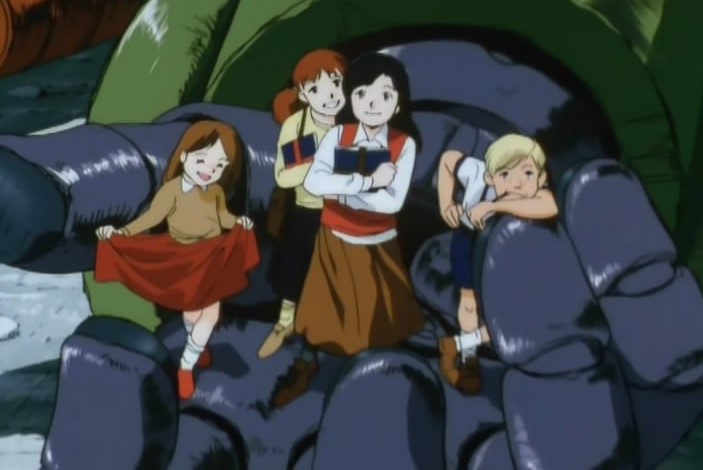
A still from Mobile Suit Gundam 0080: War in the Pocket
Originally posted on March 16, 2019:
Since I’ve been sick for the last few weeks, I’ve had to stay at home. Lately, I’ve been beginning to think about finding a new place to work and about whether or not I should go back to school. Therefore, my rate of making videos for my channel has slowed in the last few months. I still make videos, however, and this doesn’t mean that I have to stop making them. But I should have other things on my mind at this time. In addition, since I’ve become sick recently, and since I shouldn’t wear my glasses for now, I really don’t have the time to make videos. Making videos for my channel has never been an occupation for me. It has always been a hobby, and it was smart of me to spend as little time as possible on YouTube because I’ve always known that, sooner or later, YouTube would turn into a highly controlled and problematic website. YouTube is now sort of like American television. There are a few positives to this and some negatives. One positive is that people can now rent or purchase many films or shows that have been made in Hollywood on YouTube. One negative is that YouTube has become just another platform for American propaganda, kind of like television, radio, newspapers, magazines, or books. And other Western video-sharing websites aren’t much better in this respect. Some of them are even worse. Dailymotion, for example, is in some ways better than YouTube and in some ways worse. The video-sharing website that has given me the least trouble over the years is Rutube. Never have I had my account deleted on Rutube. YouTube, on the other hand, is the website that has given me the most trouble over the years. I’ve heard that Facebook and Twitter are also controlled websites, but I’ve never seriously used them, and, therefore, I’ve never experienced how problematic they can be. Still, I’m not planning on stopping making videos for the time being because uploading videos to YouTube is still possible to do. I’ve uploaded a number of good lectures and lists already. There’s plenty of good information in those videos. Moreover, I’ve discovered that my YouTube channel has some notoriety, not only because it has existed for about a decade already but also because it’s one of the very few channels that offer alternative information. It’s clear that the managers of YouTube will never allow my channel to become popular, but it’s still popular enough to irritate the owners of the numerous anti-leftist channels that exist on YouTube and elsewhere. These propagandists and haters of my channel react to almost every video and post that I make. Wow. They sure are dedicated haters. Or is it because some of them are paid to do this?
I can point out that when I make posts on my blog about the films that I see, this doesn’t mean that I recommend these films. These are simply films that I’ve recently seen. But, since I usually see films because I want to see them, I would recommend seeing almost all of them. I know that many Hollywood films feature American propaganda, but this doesn’t stop me from seeing them and enjoying some of them. Since I’ve been sick for the last few weeks, and since I can’t wear my glasses for now, I’ve been spending my time on watching films, and I’ve seen a number of films that I can really recommend. The one film that I’ve seen not long ago that I would definitely not recommend is The Predator (2018). It’s just a bad and vile film. But here are examples of films that I would recommend. Most of them are old Hollywood films because there’s no point in spending time and money on seeing new Hollywood films. New Hollywood films are just not good if they’re compared to old Hollywood films. The Hindenburg (1975) features good special effects and is definitely worth seeing. The Raid (1954) is a neat Western set during the American Civil War. Young Winston (1972) is a classy adventure about Winston Churchill in his youth. Nightfall (1957) is a good film noir in black and white. The Miracle Worker (1962) features some of the best acting by actresses in the 1960s. Crimes of the Heart (1986) is a good southern gothic film that features good performances from the leads. The Morning After (1986) includes one of the best performances by Jane Fonda. ‘night, Mother (1986) is an interesting drama with only two roles. Alice Doesn’t Live Here Anymore (1974) is simply essential viewing, and it features an excellent performance by Ellen Burstyn. Forever Young (1992) is one of those neat little romantic science fiction films from the 1990s. The Fly (1986) is just plain awesome. Bachelor Party (1984) is a surprisingly funny comedy from the 1980s. The White Buffalo (1977) is a Western that features Charles Bronson and… a big white buffalo. Nuff said. Assassination (1987) is another unintentionally funny and enjoyable piece of action junk from Cannon Films. Tough Guys (1986) is a pleasant and somewhat moving comedy. Coma (1978) is an excellent suspense film that was directed by Michael Crichton, of Jurassic Park fame. Demetrius and the Gladiators (1954) is an impressive epic in which Victor Mature “acts”. It’s set in Rome and features gladiator fights. Avenging Force (1986) is yet more action junk from Cannon Films in which Michael Dudikoff delivers yet again in the leading role. April Fool’s Day (1986) is quite a good mystery slasher film that was filmed in British Columbia. Death Wish 3 (1985) features Charles Bronson talking about killing bad guys, with a wicked little smirk on his face. Death Wish 3, by the way, is one of those 1980s flicks, like RoboCop (1987), that show some of what happened during the economic depression that took place in the USA in those years. American Dreamer (1984) and Bad Medicine (1985) are two funny comedies from the 1980s that I would definitely recommend seeing. Agnes of God (1985) is worth seeing simply because of the excellent performances by Anne Bancroft and Jane Fonda. A Soldier’s Story (1984) is a fantastic drama, and I can’t believe that I’ve never heard about it before I saw it. Country (1984) is yet another fantastic drama that has been forgotten in the mainstream. Well, anyway, I can go on and on with this list, but these are some of the most memorable films that I’ve seen in recent months.
By the way, I’m glad that Eileen Rockefeller has her website and blog back on. For a while, it seemed to me like she turned them off because of me. But I can’t be sure about this. I posted one video on my blog that features an interview with her. Why did I do this? Only because she has a pleasant way of speaking and because there may be one or two things that I find to be interesting in that interview. Perhaps she didn’t like that I did this. Well, I didn’t do this because I think that she’s a bad lady. I know almost nothing about her. I don’t know what she likes or doesn’t like. But I know a few things about the imperialist Rockefeller family. So, she might have noticed this and reacted because she thought that I consider her to be bad. Well, I’ve deleted that video since then, and her blog is back on now, so everything is fine because I didn’t want her to discontinue her blog. I haven’t read her book (Being a Rockefeller, Becoming Myself: A Memoir). I’m reading other books at the moment. But I think that I will read it soon. It probably includes almost nothing that I would find interesting. But I’d still read it as a curiosity.
Originally posted on December 26, 2017:
Sure, I will write a review, maybe a short one, about Star Wars: The Last Jedi (2017), which is seemingly the worst Star Wars film ever. But, for now, I’d like to get into the Gundam franchise. I already made a list about the best Gundam releases. However, not all of them are all they’re cracked up to be. Well, first of all, instead of watching the original series, I’d recommend watching Mobile Suit Gundam: The 08th MS Team, Mobile Suit Gundam: Char’s Counterattack, Mobile Suit Gundam 0080: War in the Pocket, and Gundam Wing: Endless Waltz. I think that these are the best of the best of the Gundam releases. Yoshiyuki Tomino, with his 1979 original series, may have started the franchise, but it’s admittedly a rather dull series now, for the most part. Tomino is fine at showing the realities of war, and he knows his science, but his direction doesn’t make the original Gundam a truly compelling series. If you compare the Gundam franchise to other giant robot anime series, you’ll see that not one of the Gundam releases reaches the heights of The Vision Of Escaflowne, Gurren Lagann, Neon Genesis Evangelion, Giant Robo, Martian Successor Nadesico, RahXephon, Gunbuster, or Macross Plus. Still, the four Gundam releases that I listed are very good, and I’d recommend them to anyone.
I agree with this magazine’s picks. The people working there sure do know anime and they sure do have taste. As you can see, the original Gundam is number 2 on their list. Well, it’s that high up probably because of its influence on the anime industry and because of its impact back then, in the early-1980s. In the 1980s, Japanese animation was lower in quality than American animation or Soviet animation. But some of what Japanese animators made in the 1980s is very good and original. Anime became even more popular in the 1990s. More quality releases appeared as well, in part because the quality of animation improved. But, in the 2000s, anime began to turn into repetitive, unoriginal… stuff. Judging by user comments, I see that some people are smart enough to realize that this is the case, that the anime industry in Japan is producing unoriginal content now, similar to how Hollywood is producing unoriginal content now. In this environment of creative stagnation, releases that are good and original are rare.









 Igor's Blog