Donald Trump’s Sneak Attack on Social Security

https://www.truthdig.com/articles/donald-trumps-sneak-attack-on-social-security/

Donald Trump’s recent budget proposal included billions of dollars in Social Security cuts. The proposed cuts were a huge betrayal of his campaign promise to protect our Social Security system. Fortunately for Social Security’s current and future beneficiaries, he has little chance of getting these cuts past the House of Representatives, which is controlled by Democrats.

So Trump and his budget director/chief of staff Mick Mulvaney, who has long been hostile to Social Security, are trying another tactic to cut our earned benefits. They are pursuing a long game to reach their goal. In a divide-and-conquer move, the focus is not Social Security. At least, not yet.

Last week, the Trump administration revealed that it is planning to employ the so-called chained Consumer Price Index (CPI) in a way that does not need congressional approval. “Chained CPI” might sound technical and boring, but anyone who has closely followed the Social Security debate knows better. It has long been proposed as a deceptive, hard-to-understand way to cut our earned Social Security benefits.

Trump plans to switch to the chained CPI to index the federal definition of poverty. If he succeeds, the impact will be that over time, fewer people will meet the government’s definition of poverty—even though in reality, they will not be any less poor. The definition is crucial to qualify for a variety of federal benefits, including Medicaid, as well as food and housing assistance. The announcement was written blandly about considering a variety of different measures, but anyone who knows the issue well can easily read the writing on the wall.

So, what does this have to do with Social Security? Like the poverty level, Social Security’s modest benefits are automatically adjusted to keep pace with inflation. If not adjusted, those benefits will erode, slowly but inexorably losing their purchasing power over time. These annual adjustments are already too low, but they are better than no adjustment at all. The chained CPI would make these adjustments even less adequate.

Proponents of the chained CPI say that it is better at measuring “substitution,” but don’t be fooled. The current inadequate measure already takes into account substitution of similar items. This is the idea that if the price of beef goes up, you can substitute chicken. In contrast, the chained CPI involves what are called substitutions across categories. If your planned vacation abroad goes up, you can stay home and buy a flat screen television and concert tickets instead.

Of course, neither form of substitution is much help to seniors and people with disabilities whose health care costs are skyrocketing. There’s no substitution for hospital stays and doctor visits. Those who propose the chained CPI are apparently fine with letting seniors who can’t afford even chicken substitute cat food.

The idea of substitution within or across categories makes no sense for people with no discretionary income. If all of your money goes for medicine, food and rent, how does substitution make sense? If you are so poor that your children go to bed hungry, how do you substitute?

Back in 2012, President Barack Obama proposed a so-called Grand Bargain to cut Social Security using the chained CPI, in return for Republicans agreeing to increase taxes on the wealthy. The goal of this Grand Bargain was ostensibly to reduce the deficit, despite the fact that Social Security does not add a single penny to the deficit.

Grassroots activists around the country fought back, and Obama ultimately realized his error. He removed the chained CPI from his budget proposals and endorsed expanding, rather than cutting, Social Security’s modest benefits. Social Security expansion is now the official position of the Democratic Party.

Yet Republicans have still continued to push Social Security cuts, including the chained CPI. Back in December 2017, they passed a massive tax cut for corporations and the super-wealthy. Afterwards, they used the predictable deficits their tax cuts caused as an excuse to call for cutting Social Security. Senate Majority Leader Mitch McConnell and other Republicans made well-publicized statements about the so-called “need” to cut Social Security. What was much more secret was a provision in the tax bill which replaced the measure used to index the tax brackets with the chained CPI.

Now, Trump wants to apply the chained CPI to the calculation of poverty rates. This will directly hurt many seniors and people with disabilities by making it more difficult to qualify for Medicaid and other programs many of them rely on, including food and housing assistance. It is also a long-term threat to Social Security itself.

The strategy is clear: Trump and his Republican supporters in Congress plan to apply chained CPI everywhere else, and then say that it is only common sense and indeed fair that we apply it to Social Security as well. We should be consistent, right?

Trump thinks that he can get away with executing this long-game attack on Social Security quietly, while the media and public are focused on his tweets, name calling, and scandals. But we must not be distracted. If we do not stop this attack in its tracks, our earned benefits will be next.

If you want to forestall another fight over cutting Social Security through the chained CPI, call your members of Congress, write to your local paper, and tell your friends: No chained CPI! No chained CPI for our earned benefits! No chained CPI for the most vulnerable among us!

This quiet effort to embed the chained CPI is a fight Trump does not want to have, certainly in an election year. But it is one we will bring to him. Grassroots activism defeated the chained CPI before. This time it will be harder because Trump can substitute the chained CPI without legislation. That means we have to simply fight harder. If we stick together, we surely will win. And we must. All of our economic security depends on it.
PSP Review – ‘Death Jr.’

https://worthplaying.com/article/2005/9/12/reviews/27281/

Death Jr. is a new action platforming game that seamlessly blends elements from first-person shooters with the exploration of a third-person platformer and serves up a large dose of intense gameplay and weapon heavy combat for the PSP.

My PSP is so nice looking that I almost don’t like taking it out of its protective sleeve, and I even cover it with a tissue when I’m charging it. “Goodnight, sweet prince,” I’ll whisper into the headphone jack before I go to sleep every … morning.

Okay, well, I admit, having to actually touch my PSP is probably the best part of playing Death Jr.. I really and truly wanted to like this game, but it has some problems that prevented me from doing so.

The camera is terrible. Things are bad enough in any third-person action game when a large group of enemies tries to overwhelm you, but when the camera decides to focus on a patch of grass in the middle of such a battle, well, I don’t think I need to say any more. A bad camera pretty much ruins any game, but having tight, responsive controls usually helps the situation a lot.

Unfortunately, Death Jr. doesn’t have tight, responsive controls. Trying to lock on to enemies with the right shoulder button while simultaneously jumping, shooting, and slashing isn’t that easy on the PSP. On a regular controller that didn’t have a screen attached to it, it wouldn’t be as big of a problem, but as it is, it just feels really awkward. This is, of course, assuming that when you do hit the right shoulder button, it will actually lock on to an enemy. You can destroy just about everything you see in Death Jr. , which lends itself to the problem of, say, locking on to a parked car, rather than a charging enemy.

You might be wondering how this game actually plays, how it feels aside from the bad control and camera. Three words: Devil May Cry. We have one button to jump, one to shoot our equipped long-range weapon, and another to slash with our giant scythe.

Death Jr. doesn’t have much in the way of a story to pad the UN-fun gameplay. It seems that the writers for many games these days think that creating a bunch of self-consciously quirky characters is going to make the game a hit. Death Jr. sports a cast of “off the wall” characters such as a dead guppy and a goth girl (bless their black hearts) with OCD, and yet the best they can muster up is a fart joke. Fart jokes aren’t funny, they never have been, and they never will be. It might appeal to 10-year-olds, though.

The graphics are good enough, at least. The levels are pretty bland otherwise and aren’t particularly inspired. The music consists of (from what I can tell) one droning hip-hop beat. Why hip-hop? Has it become so ingrained in our society’s consciousness that rap music is always associated with death and killing rather than being a post-modern musical art form, that it would be featured in a game that stars the very spawn of death itself? Nah, that couldn’t be.

By the later stages, the platforming sections of Death Jr., combined with hordes of enemies and the bad camera can be totally infuriating. There are some mildly enjoyable weapons for us to use as we progress further into the game, however.

One of the most mind-bogglingly outrageous features of Death Jr. is its “save anywhere” system. Press the start button on the PSP, and you’ll see a save option … or rather, insanity disguised as a save option. Normally, being able to save anywhere is good when, for instance, your girlfriend is screaming at you from the other room that she’s out of wine, or, say, your neighbor is playing bagpipes while drunk. We might be playing Death Jr. when one of these events arises, so we’ll save the game in the middle of an aggravating level.

A few hours later, we’ll turn on the PSP, put in our copy of Death Jr. and load our save game. Allow me digress for a second … the levels in the game are accessed via a central hub, which in this case is a museum that DJ and his friends are visiting on a school field trip. Pandora, the aforementioned goth girl with OCD, finds an ancient wooden chest on display (gee, I wonder what that could be?). Our good friend DJ, in a stunning display of strength, opens the box for Pandora. Big mistake, because, well …you know. Anyway, it’s up to us to save DJ’s friends, each of whom are trapped in some sort of alternate nether-dimension, which, like I said, is accessed from the museum.

So when we come back to our PSP a few hours later (after buying wine, or suffering through the “Call to Arms” 10 times in a row) and load our saved game, we find ourselves back in that really annoying level we were trying to beat, right? The one we were almost done with? No! We’re back in the museum, in that central hub, and guess what? We get to play that level all over again!

It’s a cardinal sin, my friends, to do that to a man (or woman). It’s not right to punish the player like that, but you know … I really don’t mind it that much anymore. When I play through another level again, I realize that Death Jr. is bland, boring, infuriating, and above all, painfully disappointing.

‘Final Fantasy XIII-2’ Review

https://gamerant.com/final-fantasy-13-2-reviews/

Can ‘Final Fantasy XIII-2’ compete in a market dominated by Western RPGs like ‘Mass Effect’ and ‘The Elder Scrolls’? Read our full review for the answer!

From the earliest days of console role-playing games, titles produced in Japan have both defined and dominated the genre. The importance of Yuji Horii’s seminal Dragon Quest cannot be overstated, but no series did more to spread the international popularity of JRPGs than Hironobu Sakaguchi’s Final Fantasy.

Starting last generation, a shift began to take place. Studios like BioWare and Bethesda — both veterans of PC development — delivered titles that redefined just what console role-playing games could be. Ask today’s average North American gamer what her favorite RPG is, and you are far more likely to hear The Elder Scrolls or Mass Effect than anything from Japan.

This shift in RPG tastes coincided with a difficult period for Square Enix. The mixed reception to Final Fantasy XIII, and the slow-motion train wreck of Final Fantasy XIV, conspired to “greatly damage” the brand. Final Fantasy XIII-2 is the series’ shot at redemption. Does the game successfully update the Final Fantasy formula for modern players? Read on for our full review of Final Fantasy XIII-2.

Though it is a direct sequel to Final Fantasy XIII, Final Fantasy XIII-2 smartly does not count on players being familiar with that divisive game. Accessibility is a clear design goal of Final Fantasy XIII-2, from its battle system to the wealth of information offered in its Datalog menu, and players deterred by having not completed the first game will be missing out on an experience that easily competes with the best RPGs available.

Over the months leading up to Final Fantasy XIII-2’s release, Square Enix issued a frankly staggering number of trailers for the game. That abundance of sneak peeks does nothing to blunt the impact of FFXIII-2’s remarkable visual presentation. The game’s engine is astonishingly nimble, able to seamlessly move between rendered footage, in-engine cut-scenes and gameplay.

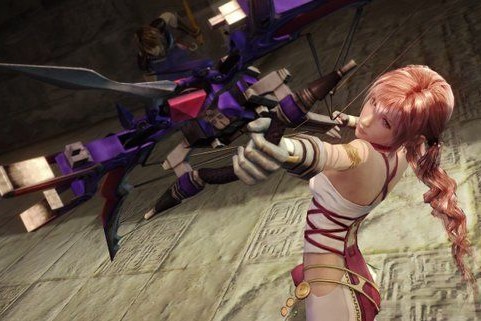
While Final Fantasy XIII-2 is jam-packed with screen-filling pyrotechnic spectacles of color and light, it is the game’s characters that leave the most vivid impression. Characters look simply fantastic throughout, with flowing hair and elaborate costumes and weapons. Textures are often astounding — facial details, particularly lips and eyes, are especially impressive. But it is not just technical excellence that sets Final Fantasy XIII-2’s visuals apart from the competition, it is the artistry of their execution.

The game’s characters, highlighted by protagonists Noel and Serah, have tremendously expressive faces. There are no dead-eyed automatons here, and the game neatly avoids any uncanny valley creepiness. Final Fantasy XIII-2’s story frequently shifts tone from whimsical to deadly serious, and the performances of the central characters always keep pace.

It’s not just the properly lip-synced dialog or the natural body language or the clarity of the emotions reflected on the characters’ faces, but also the cinematic camera work and the exceptional voice acting (especially from Spirited Away’s Jason Marsden as Noel and Darksiders’ Liam O’Brien as Caius) that makes Final Fantasy XIII-2’s cast so believably alive. Though it could not be more aesthetically different, only Uncharted 3 compares where character performances are concerned.

The game’s audio landscape is every bit as impressive as its visual assault. Cocktail jazz, orchestral bombast, and a convincing approximation of death metal (“Do it!”) all have a place in FFXIII-2’s aural spectrum, along with simple, melancholy piano and an explosive range of sound effects. Many games use music in an effort to amplify the emotional resonance of their onscreen action. Where others try, Final Fantasy XIII-2 succeeds.

The game’s audiovisual excellence is backed-up by a flexible, engaging turn-based battle system that offers a huge amount of depth, but does not require that players dedicate themselves to micro-managing every aspect. Again, accessibility is the rule. Players can assign custom roles to their characters and specify each individual attack. Alternately, they can allow the game to manage that for them, and simply rely on the “Auto-Chain” command.

Monsters defeated in battle can be recruited to fight alongside Serah and Noel, and can be leveled up just like the main characters. Finding and training new battle companions adds an undeniably Pokemon-esque element to the game that remains fun throughout. It helps that those monsters show a great deal of personality, and are often endearingly goofy, from Chocobos to the many iterations of flan — yes, flan, the caramel-topped custard — that appear (Flanbanero, Flanborg, Flandit, Flanitor, Miniflan… it’s a long list).

Battles are random, but not unavoidable. Players can choose to flee from monsters once they’ve appeared, though there is a benefit to landing the first blow, and a penalty should monsters do the same. That said, for long stretches of the game, there are many, many battles to contend with, and avoiding too many of them will leave players ill-equipped to face the gauntlet of bosses that await at the story’s end.

Final Fantasy XIII-2’s complex story is revealed gradually, and centers on Serah’s search for her sister, Lightning, who is lost not in space, but in time. It’s a novel and productive framework for the game, and the designers at Square Enix make the most of it. As Serah and Noel use the Historia Crux to travel through time, they revisit familiar locations at varying points in history, often to find stark differences — a peaceful and friendly locale in one time may be dark and dangerous in another.

Although destinations in time must be unlocked, players are free to explore available locations at will. Occasionally, this freedom makes it difficult to discern the path forward, though exploration has its rewards. In addition to the twisting central story, Final Fantasy XIII-2 is packed with optional side-quests, not unlike, say, Kingdoms of Amalur: Reckoning. Those side-quests occasionally span multiple points in time, and cannot all be completed when first encountered, adding yet more playtime to an already long game.

The density of Final Fantasy XIII-2’s story can be intimidating. There is a degree of built-in ambiguity in the fragmented nature of the storytelling, and the central characters’ evolving understanding of exactly what is transpiring — to say nothing of the changes wrought by tampering with the timeline. What is important is that the story consistently connects emotionally — once again, thanks largely to the game’s amazing character work — and that the disparate story threads do come together to form a deeply satisfying whole.

Square Enix has been upfront about its intention to extend Final Fantasy XIII-2’s story with downloadable content, and it is widely known that the game ends with the words “To Be Continued.” Without giving away any specifics, I will offer this: Final Fantasy XIII-2 tells a complete tale and ends at a logical point. The events that set up the “To Be Continued” tag flow directly from the game’s story. In short, it’s more The Empire Strikes Back than Harry Potter and the Deathy Hallows: Part 1.

If ever there were a game that deserved to resurrect the reputation of its franchise, this is it. More than just an update to a well-established formula, Final Fantasy XIII-2 is vital and modern, and deserves to be the blockbuster it was designed to be. Emotionally engrossing, technically dazzling, and deeply playable, Final Fantasy XIII-2 delivers the goods, and is highly recommended.

Final Fantasy XIII-2 is available now on PS3 and Xbox 360. Game Rant played the PS3 version for this review.

The Putin myth: why Russia is no economic superpower

https://www.smh.com.au/business/the-economy/the-putin-myth-why-russia-is-no-economic-superpower-20180412-p4z946.html

Russia’s GDP was smaller than that of Texas even before the latest and most lethal sanctions imposed by Washington.

It has diminished further to Benelux proportions after the rouble’s 10 per cent crash this week, the steepest fall since the late Nineties.

Upon this slender economic base, Vladimir Putin’s Russia is posing as a world-class superpower, the new master of the Middle East, insisting on its “droit de regard” over the old Tsarist realms as if by natural right.

What is extraordinary is than anybody should believe in such posturing.

The harsher truth is that Mr Putin squandered the windfall wealth of the commodity supercycle and hollowed out what remained of the Soviet industrial base, leaving Russia’s Potemkin economy in a cul de sac.

He has succeeded (so far) in propping up his ally in Syria but this tells us little about the global balance of power. The Kremlin likes to dismiss Western sanctions as a flea bite. Not any longer. “The measures are turning into a tool of real economic war,” said Russian premier Dmitry Medvedev.

The US Treasury document announcing sanctions to punish “worldwide malign activity” is a comic read, but it is also mortal threat to the Putin oligarchy. It alleges that Oleg Deripaska, aluminium king and head of Rusal, “ordered the murder of a businessman”.

It cites allegations that Suleiman Kerimov from Polyus Gold laundered hundreds of millions of euro buying villas in France, “transporting as much as €20 million ($31.9 million) at a time in suitcases.”

Deripaska has described the sanctions as “groundless, ridiculous and absurd”.

What is new about these sanctions is that they target the pre-existing securities, and not just new issuance. This turns the named companies into international pariah, as Rusal is discovering. It has been blackballed from the London Metal Exchange. Its listed share price on the Hong Kong exchange has fallen 58 per cent this week.

It is a foretaste of what lies in store for Russia’s corporate elite as the Mueller investigation uncovers the whole ghastly truth about Kremlin cyber-aggression against the US political system. Whatever the White House may or may not want to do, the policy is being pushed by a wrathful Congress intent on avenging what some call a Russian Pearl Harbor.

No Americans can deal with sanctioned entities, and no Europeans can do so lightly without provoking the US Treasury under “secondary sanctions” clauses, if they have any commercial dealings with the US. Belgium-based Euroclear said immediately that it would comply.

Investors must now contend with the prospect that almost any oligarch could be targeted and that any Russian asset – including sovereign bonds – could be tainted and plunge in value overnight. This risks a collective rush for the exits since nobody wants to be trapped in a fire sale. Sberbank shares are down 17 per cent over the last two days even though it is not on the list.

Russian vice-premier Arkady Dvorkovich has promised to rescue sanctioned companies, implying that the state will cover the debts of private firms and state-owned companies if need be. Yet the Reserve Fund is exhausted and was shut down in December. Much of the residual $US67 billion Welfare Fund is committed. The Kremlin will have to tap the central bank’s $US453 billion portfolio of foreign reserves. “If the sanctions go on long enough and the circle expands, the cushion may not be enough” warned Vedomosti.

To be clear, the country is not facing an imminent financial crisis. The floating rouble acted as a shock absorber through the oil and commodity crash. Russia survived the trauma. What it faces instead is “neo-stagnation”, to borrow from former British ambassador Sir Andrew Wood. It is caught in a self-feeding cycle of decline as infrastructure crumbles and young brains leave.

The deep recession of 2015 and 2016 may be over but per capita income is stuck at $US8,800 and industrial wages are now lower than in eastern China – let alone Poland. The post-Soviet convergence with the West has stalled. There is no new growth model for the 21st century. The drastic plan of autarky and import substitution launched three years ago by President Putin to break dependence on commodities – 80 per cent of exports during the boom – has come to little. Reliance on foreign farm machinery was to be cut 56 per cent by 2020, and engineering equipment by 34 per cent. None of this is happening.

Russia is still hostage to oil and gas. Energy provides a tolerable living for now but US shale has entirely changed of global oil industry, capping each rise in prices with a surge of new drilling. It has become a structural headwind. Russia’s own production costs are rising as the old fields decline by 5 per cent a year in Western Siberia. The energy ministry warns that output could halve by 2035 unless there is a wave of investment.

The coming surge of US liquefied natural gas (LNG) has deprived Mr Putin of his pricing power in Europe. He was able to charge $US12 (MMBtu) in the glory days of 2012. Today his gas fetches around $US5.

By the mid-2020s, other powerful forces will be at work. Electric vehicles will probably have reached take-off; battery costs will have come down far enough to give wind and solar an edge over gas. By then the fossil industry will be looking tired.

Mr Putin wasted Russia’s oil bonanza from 2005 to 2014 on hubristic rearmament. The Stockholm International Peace Research Institute said the military budget rose 8.1 per cent in real terms in 2014 and another 15 per cent in 2015 when the economy was already contracting. Finance minister Alexei Kudrin resigned with a warning that it would ruin the country, and that is exactly what it did.

The Russian military added a fleet of new Su-34 long-range combat aircraft, and batteries S-400 surface-to-air missile systems, even as pauperisation spread. It coincided with the negligent disarmament of the West, made worse by Europe’s austerity overkill.

This misalignment created a window that Mr Putin has exploited. The window is about to close again. Russia can no longer afford the rent, and the West is rearming fast.

A nuclear-armed Sparta under a despotic leader with totalitarian propaganda tools can of course be very dangerous. But please don’t call Putinism a success.