










In the last decade, fans of sci-fi strategy have divided into two basic groups. One group has stuck with the old-school 4x genre (eXplore, eXpand, eXploit, eXterminate) through thick and thin, preferring the turn-based games that have sprung up in the wake of Master of Orion, Ascendancy and Alpha Centauri, more recent examples being the Space Empires and Galactic Civilizations series. The other group has embraced the RTS genre, adopting the starship combat of Homeworld and its imitators, or the ground-based tactics of StarCraft and Supreme Commander.
In a lot of ways, the chasm only seems to be widening. While the big-league publishers push for the mainstream audience with more action-oriented RTS games like Command and Conquer 3 or Universe at War, the smaller developers involved in the 4x category seem to be making games that are ever more complex, convoluted and inaccessible. Surely there’s room for something that sits in the middle, harnessing the long-term depth of the 4x style to the more exciting pace and visual spectacle of the RTS?
It appears so, because Sins of a Solar Empire is currently looking like the PC sleeper hit of the season. Currently only downloadable from publisher Stardock (annoyingly you’ll have to install and use Stardock’s own client, which didn’t work flawlessly on my machine) if you live in the UK, it’s a sprawling strategy epic that seamlessly combines the 4x and RTS traditions. Note the word seamlessly – this isn’t an RTS with the campaign structured around a political/economic map, nor is it a 4x game where the action switches from turn-based fleet manoeuvres to RTS combat whenever two forces collide. It’s a game where the 4x stuff and the RTS stuff is happening at the same time, all of the time, on the same map.
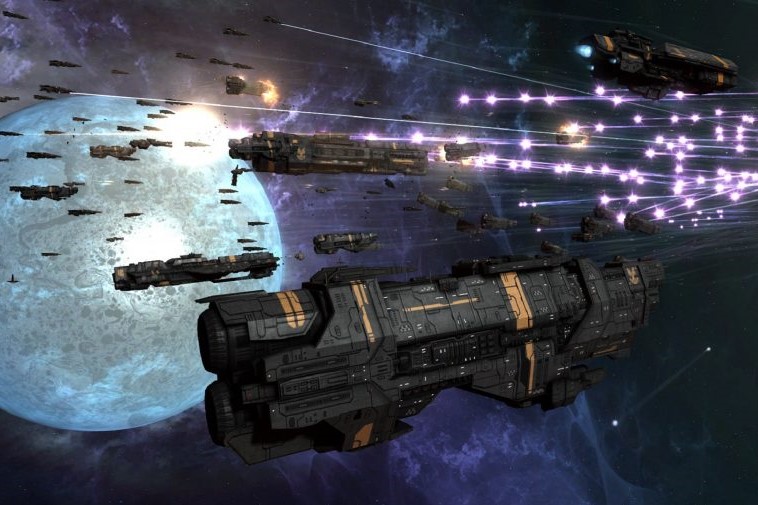
The secret is the way the game handles scale. Zoom all the way out and you can see the whole of the current planetary system, each star or planet linked to its neighbours by a network of ‘phase lanes’ – essentially hyperspace motorways that enable high-speed travel across the map. Zoom in using the scroll wheel and you can see the planets and the various military and logistic installations orbiting around them. Zoom in further and you can home in on the battleships and frigates in the vicinity, right down to the smallest individual fighter. It’s fast, and gives you a breathtaking sense of the game’s epic scale.
While zoomed out, you can still make out facilities and fleets from the reasonably intuitive icons. While zoomed in, you can admire the graphics in all their glory. Those hoping for a next-generation Homeworld with Unreal 3 engine levels of detail may be disappointed, not least because some of the smaller animations that made Ritual’s debut so lovable are missing. All the same, Ironclad’s own Iron engine does a nice line in bump mapping, plasma effects and specular lighting, all of which help to make the game’s space battles look suitably cinematic when seen up close.
Enjoy the sight of grand battlecruisers exploding, because it’s one you’ll become familiar with the more the game goes on. This is a galaxy at war. The Trader Emergency Coalition is already locked in battle with the cruel Vasari Empire when the Advent, a bunch of religious outcasts, forced from their homeworld years before, come looking for revenge. Not only are the TEC, Vasari and Advent factions scrapping over every system, but the galaxy is infested with gangs of space pirates to boot. There’s no need to get too caught up in the story; with no formal story-based campaign it’s little more than a framework for a whole bunch of skirmish scenarios, but this isn’t a game of gentle colonisation and exploration. It’s a resource grabbing, arms race running festival of destruction, and while alliances, diplomacy and trade have their place, building and using a mighty starfleet is the most crucial aspect of the game.
Doing so involves a lot of work. First, you’ll need money, and that means a) taxes and b) trade. Colonising planets and improving the civilian infrastructure means more happy taxpayers, and therefore more cash in the bank. Secondly, you’ll need facilities; not just frigate factories and capital ship factories to build the ‘bread and butter’ units and commanding capital ships, but defensive structures and military and cultural research facilities. The last bit is important, because Sins of a Solar Empire relies heavily on research in order to optimise the offensive and defensive capabilities of your ships, but also to raise the cap on the number of frigates and capital ships you can command, or give you the skills you’ll need to colonise more hostile worlds. Finally you’ll need metal and crystal resources in order to build your facilities and fleet. All these things are connected by a number of fairly complex game mechanics, but your task is reasonably simple: build and upgrade your fleet then explore, colonise and defend new planets from aggression, while mining resources and boosting civilian facilities to keep the credits flowing. And don’t forget to chip away at your rival factions and deal with the space pirates while you’re at it.
If this sounds like a lot to be getting on with then rest assured: it is. Luckily, the guys at Ironclad have done everything they can to stop it feeling like hard work. For a start, everything in your budding galactic empire is available at a click from the Empire Tree on the left of the screen. This collapsible, tree-structured list means you can click on a single ship or an entire fleet and send it off to battle in some far flung corner of the galaxy, then click on the frigate factory orbiting your home planet and order up some reinforcements, then find a construction frigate and order a new missile platform to be built around your latest acquisition, all without having to scroll around the map or click through a succession of menu screens. What’s more, you can reorganise your ships into separate fleets or ‘pin’ specific fleets or structures if you need to find them quickly, making an initially daunting display surprisingly easy to navigate.
In addition, a lot of things are quite sensibly handled automatically. Ships that ‘phase space’ to a new planet will automatically be added to the fleet surrounding that planet unless you command otherwise. That fleet will automatically attack hostile forces as they phase in, with individual ships picking targets appropriate to their own offensive strengths and defensive weaknesses. Units with special powers, like colonisation or heavy attacks, will use them automatically unless you decree otherwise. In other words, you don’t have to micro-manage every single little aspect of the game – you can keep your head on the big picture, moving the fleet that’s just attacked planet X to defend planet Y when necessary, without having to worry whether every last unit will know what it’s doing. Even construction isn’t a chore. Select a builder unit and ask it to build a metal or crystal refinery and it will pick out the nearest available resource, not sit their dumbly while you specify where to go.
Admittedly, not everything comes easy. The initial tutorials take you through the basics of construction, combat and resource management, but you’re well advised to start off with a short game against a single, easy AI to give you breathing space while you learn the ropes. Pick one without pirates while you’re at it. One thing the initial tutorials don’t make clear is that the pirates in the galaxy operate on a bounty system. Pay them off and they’ll attack your rivals. Don’t bother, and they’ll attack you, sending larger and larger waves of ships the higher the bounty goes up. This can be infuriating, because just as you’re preparing your grand offensive or recovering from a heroic defence, the blasted pirate fleet will show up and knock your right back to square one. Trust me; you’ll have enough to deal with in your first games without dealing with the pirate menace (though note that in games with more than one enemy faction you can make a little cash on the side by attacking the faction with the highest bounty and claiming the prize for yourself).
The combat will also take some getting used to. With so many ships covering quite large distances, this isn’t a game of tank-rush tactics or complex manoeuvres; more a question of ensuring that you deploy balanced forces in sensibly structured waves and understanding how and when to move fleets from one flashpoint to another. Building reinforcements can take time, and phasing in from one planet to another takes time, and going from planet A to planet C will involve two legs in the journey (stopping via planet B) not just one. As a result, you need to keep travel times between planets in mind and avoid sending reinforcements one by one; if you’re already losing the battle, you’ll just send more ships to their demise. Sheer numbers of capital ships can win the day, but you’ll do better if you understand the strengths and weaknesses of your various craft and deploy a balanced selection of all types. What’s more, you also need to protect and make the most of your capital ships. Like the hero units in some RTS games, these gain experience in combat and, through that experience, develop new offensive and defensive capabilities. Grooming super units will make things a lot easier later in the game, but the downside is that there’s nothing more depressing than losing the capital ship you’ve spent hours beefing up in a hasty attack against overwhelming odds. Save often is my advice.
Sins of a Solar Empire is not a game for everyone. It’s very demanding on both your time and your concentration – even a short game can take several hours to complete, and you’ll need several of those before you really understand the various game mechanics. On top of that, it has a tendency to over-prolong the end game, though a) this is a common fault of strategy games and b) there are plans to address this with an upcoming patch. And while the sound of the multiplayer game sounds appealing, will you ever find someone with the time to play through a whole game?
That said, Sins is still a hell of a lot more streamlined and accessible than its standard 4x rivals, most of which look about as much fun as, say, debugging Visual Basic scripts in a complex Excel spreadsheet. Best of all, it reminds me of the Battlefield games, in that it manages to make something powerful and cinematic out of unscripted moments of gameplay. One minute you’re weeping as enemy frigates wipe out your capital ship’s shields, the next you’re cheering as a cluster of your own attack ships arrive and blast the foe to kingdom come. At the same time, it has the depth and obsessive qualities you just don’t get from your regular RTS. Provided you have time, brains and patience, buy it. The effort you put in will be richly rewarded, and it’s all the strategy game you’ll need to last you out the year.
Sins effortlessly combines the depth of the 4x strategy genre with the more straightforward appeal of the RTS. It still hasn’t got the mainstream appeal of, say, World in Conflict or Homeworld, but settle in for the long haul and you’ll find this a very worthy game.
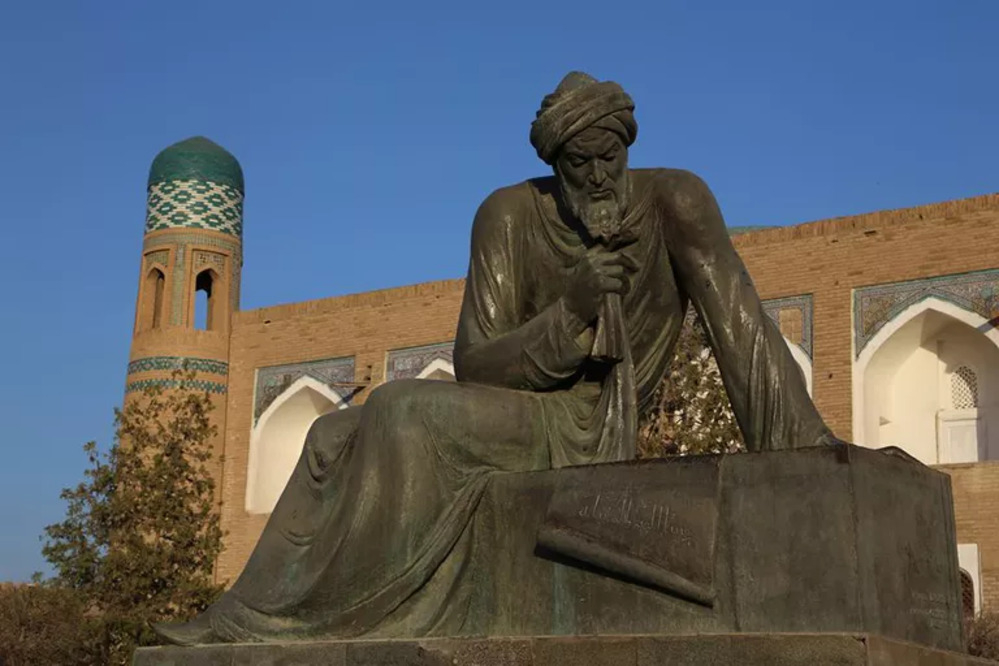
Al-Khwarizmi was also known as Abu Ja’far Muhammad ibn Musa al-Khwarizmi. He was known for writing major works on astronomy and mathematics that introduced Hindu-Arabic numerals and the idea of algebra to European scholars. The Latinized version of his name gave us the term “algorithm,” and the title of his most famous and important work gave us the word “algebra.”
Muhammad ibn Musa al-Khwarizmi was born in Baghdad in the 780s, around the time Harun al-Rashid became the fifth Abbasid caliph. Harun’s son and successor, al-Mamun, founded an academy of science known as the “House of Wisdom” (Dar al-Hikma). Here, research was conducted and scientific and philosophic treatises were translated, particularly Greek works from the Eastern Roman Empire. Al-Khwarizmi became a scholar at the House of Wisdom.
At this important center of learning, al-Khwarizmi studied algebra, geometry, and astronomy. He wrote influential texts on the subjects. He appears to have received the specific patronage of al-Mamun, to whom he dedicated two of his books: his treatise on algebra and his treatise on astronomy. Al-Khwarizmi’s treatise on algebra, al-Kitab al-mukhtasar fi hisab al-jabr waʾl-muqabala (“The Compendious Book on Calculation by Completion and Balancing”), was his most important and well-known work. Elements of Greek, Hebrew, and Hindu works that were derived from Babylonian mathematics of more than 2,000 years earlier were incorporated into al-Khwarizmi’s treatise. The term “al-jabr” in its title brought the word “algebra” into western use when it was translated into Latin several centuries later.
Although it sets forth the basic rules of algebra, Hisab al-jabr w’al-muqabala had a practical objective: to teach. As al-Khwarizmi put it:
…what is easiest and most useful in arithmetic, such as men constantly require in cases of inheritance, legacies, partition, lawsuits, and trade, and in all their dealings with one another, or where the measuring of lands, the digging of canals, geometrical computations, and other objects of various sorts and kinds are concerned.
Hisab al-jabr w’al-muqabala included examples as well as algebraic rules in order to help the reader with these practical applications.
Al-Khwarizmi also produced a work on Hindu numerals. These symbols, which we recognize as the “Arabic” numerals used in the west today, originated in India and had only recently been introduced into Arabic mathematics. Al-Khwarizmi’s treatise describes the place-value system of numerals from 0 to 9 and may be the first known use of a symbol for zero as a place-holder (a blank space had been used in some methods of calculation). The treatise provides methods for arithmetical calculation, and it is believed that a procedure for finding square roots was included. Unfortunately, the original Arabic text is lost. A Latin translation exists, and though it is thought to be considerably changed from the original, it did make an important addition to western mathematical knowledge. From the word “Algoritmi” in its title, Algoritmi de numero Indorum (in English, “Al-Khwarizmi on the Hindu Art of Reckoning”), the term “algorithm” came into western usage.
In addition to his works in mathematics, al-Khwarizmi made important strides in geography. He helped create a world map for al-Mamun and took part in a project to find the Earth’s circumference, in which he measured the length of a degree of a meridian in the plain of Sinjar. His book Kitab surat al-arḍ (literally “The Image of the Earth,” translated as Geography), was based on the geography of Ptolemy and provided the coordinates of approximately 2,400 sites in the known world, including cities, islands, rivers, seas, mountains, and general geographical regions. Al-Khwarizmi improved on Ptolemy with more accurate values for sites in Africa and Asia, and for the length of the Mediterranean Sea.
Al-Khwarizmi wrote yet another work that made it into the western canon of mathematical studies: a compilation of astronomical tables. This included a table of sines, and either its original or an Andalusian revision was translated into Latin. He also produced two treatises on the astrolabe, one on the sundial and one on the Jewish calendar, and wrote a political history that included the horoscopes of prominent people.
The precise date of al-Khwarizmi’s death is unknown.
While working behind the scenes to shape the post-Maidan Ukrainian government to their liking, powerbrokers in Washington — Biden included — have done all they could to downplay the U.S. role.
Former Vice President Joe Biden launched his candidacy for the American presidency on Thursday morning with the release of his first campaign video, ‘’America Is An Idea.’ The first word from the candidate’s mouth — “Charlottesville,” a town now synonymous with neo-Nazi hate in the U.S. — is the overwhelming focus of the ad, which attacks Trump for his widely criticized “moral equivalence” between neo-Nazis and anti-fascists.
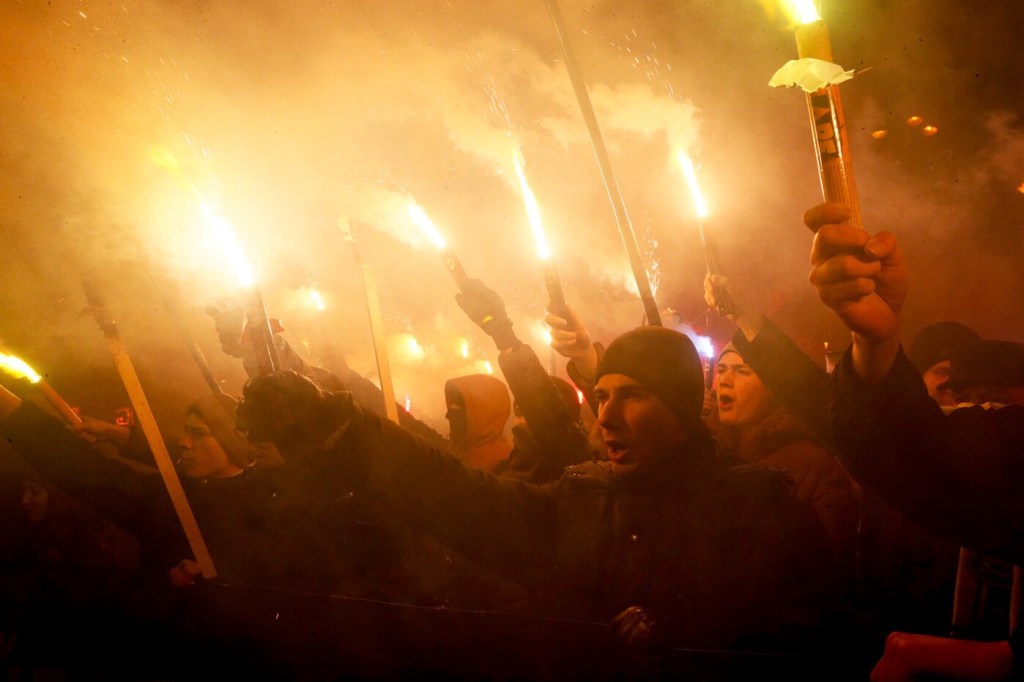
Biden argues that “We are in a battle for the soul of this nation,” after bloviating over b-roll of the infamous torch-lit march the night prior to the murder of activist Heather Heyer by a supporter of Adolf Hitler. “Folks, America is an idea,” Biden says.
Heather Heyer’s mother, Susan Bro, seemingly condemned the exploitation of her daughter’s untimely demise, saying “I wasn’t surprised. Most people do that sort of thing. They capitalize on whatever situation is handy.”
Biden’s centering on the neo-Nazi violence in Charlottesville has also been roundly denounced by Charlottesville locals and activists who bore witness to it on Twitter and other social media. Yet, the candidate has received little scrutiny over the years for his role in abetting the neo-Nazi renaissance in Ukraine that followed the fascist takeover of the government, known as the Euromaidan.
Blowback from the U.S. government support for the far-right coup has already struck Charlottesville. The U.S. previously gave military assistance to the Azov Batallion, a neo-Nazi paramilitary organization that has been incorporated into the Ukrainian national guard. One neo-Nazi contingent present in Charlottesville, comprised of four men indicted by the FBI last year, trained under Azov. During the bloody clashes in Virginia, those men were caught on camera pushing down and repeatedly punching an African-American protester as well as choking and bloodying two women.
Meanwhile, the slayer of 50 Muslims in a white supremacist attack on a mosque and Islamic center in New Zealand earlier this year claimed in his manifesto to have trained under Azov and had a symbol associated with the group on his flak jacket.
Biden’s role in fueling the revival
It is widely known by international observers of Ukraine that Joe Biden, as vice president, served as Obama’s chief operative when it came to matters pertaining to the country.
In late 2013, Biden seemed to have been a key player in former President Victor Yanukovych’s bid to secure a loan from the International Monetary Fund.
Later, Biden would go on to boast that, “after three months into the demonstrations,” he personally told Yanukovych to “walk away” from Ukraine. Yanukovych has lived in exile in Russia since the takeover.
As the U.S. and violent protests were turning up the heat on the government, the U.S. was doing all it could to mold the government to its liking, and Biden played a pivotal role in this process.
In February 2014, leaked recordings emerged of Assistant Secretary of State for European Affairs Victoria Nuland and Geoffrey Pyatt, the U.S. ambassador to Ukraine, plotting to unite the Ukrainian opposition to take over the government. They sought to use Biden as an intermediary with the three main leaders of the opposition, hoping he could get the details of the U.S. plan for the country to “stick” with the trio.
“So Biden is willing,” Nuland assured Pyatt.
Washington had its favorite of the three picked already. The most popular of them had little political or economic experience (he was a professional boxer), while the other guy, Oleh Tyahnybok, had longstanding ties to neo-Nazis, which would have legitimized Russian claims that the uprising was of a fascist nature. Tyahnybok is the leader of the Svoboda Party, a fascist organization that refers to the Holocaust as the “light period” and bans Jews from participation.
One Svoboda leader had posted a Facebook message to Jews in 2017 who were upset with a statue of Symon Petliura, who murdered tens of thousands of Jews: “If you want to live with us, get used to our rules, and if not, go to your land or be punished.”
In the leaked audio, Pyatt said the “problem is going to be Tyahnybok and his guys.”
Nuland responded by saying she thought their favored opposition leader, Arseniy Yatseniuk, needed “Tyahnybok on the outside. He needs to be talking to them four times a week, you know.”
This is the plan that Nuland said Biden was “willing” to help further.
By April, Biden was delivering aid packages personally to the opposition. In Ukraine, he met with “leading members of parliament, including several candidates for the presidency — speaking to them of Ukraine’s “heroism” and humiliations. “We want to be your partner, your friend in the project. And we’re ready to assist,” Biden reportedly said.
Among those he met with: Oleh Tyahnybok.
Continuing corruption after the coup
Ukrainian media portrayed the meeting with a different tone. A rough translation of Interfax quotes the then-VP:
“Especially in terms of corruption in Ukraine, he stressed, ‘You are unable to overcome corruption. The world will not tolerate this, nor can we solve this problem. You keep stressing that you need help in the energy sector, but you also have this system completely corrupt.’”
Like his stance on neo-Nazism, Biden’s stance on corruption seems to change with the political winds.
As journalist and lawyer Kevin Zeese recently noted, WikiLeaks previously reported that Biden “pledged U.S. financial and technical assistance to Ukraine” for fracking projects. Just months after Yanukovych was ousted and forced to flee to Russia, Biden’s son, Hunter, was put on the board of directors of Burisma Holdings, the largest private gas company in the country.
As the coup ended, the Washington-backed government eventually took shape under the auspices of billionaire Petro Poroshenko, who became the president in June. Biden may have gotten what he wanted — an ostensible end to corruption in Ukraine’s energy sector. At least that was the goal of Prosecutor General Viktor Shokin, who opened an investigation into Burisma Holdings.
And so daddy came to the rescue. Here is Joe Biden, in his own words:
“I got all the good [assignments]. And so I got Ukraine. And I remember going over, convincing our team, our leaders to — convincing that we should be providing for loan guarantees. And I went over, I guess, the 12th, 13th time to Kiev. And I was supposed to announce that there was another billion-dollar loan guarantee. And I had gotten a commitment from Poroshenko and from Yatsenyuk that they would take action against the state prosecutor. And they didn’t…I looked at them and said: ‘I’m leaving in six hours. If the prosecutor is not fired, you’re not getting the money.’ Well, son of a bitch — he got fired. And they put in place someone who was solid at the time.”
Biden made those comments at a Council on Foreign Relations event in 2018, during which he sat on a panel with Michael Carpenter, his former underling at the White House, who helped egg on the Maidan coup.
Biden’s sidekick Carpenter ran cover for neo-Nazi Andriy Parubiy
While working behind the scenes to shape the post-Maidan government to their liking, powerbrokers in Washington — Biden included — have done all they could to downplay the U.S. role.
In an article published last year, Biden and Carpenter co-wrote that “Putin and his associates have long peddled a conspiracy theory that accuses the United States of engineering popular uprisings in… Ukraine in 2004 and 2014.”
Yet Nuland’s own comments at the time (2014) reveal the farcity of the claim:
“Since Ukraine’s independence [read: the collapse of the Soviet Union] in 1991, the United States has supported Ukrainians as they build democratic skills and institutions, as they promote civic participation and good governance, all of which are preconditions for Ukraine to achieve its European aspirations. We have invested over $5 billion to assist Ukraine in these and other goals that will ensure a secure and prosperous and democratic Ukraine.”
State Department spokeswoman Nicole Thompson later reaffirmed that $5.1 billion at the expense of U.S. taxpayers was mostly expended via the U.S. Agency for International Development — a CIA cutout — and the Pentagon, among other institutions.
The claim from Carpenter and Biden that Putin has peddled conspiracy theories of the U.S. engineering popular uprisings is evidently the kind of deflection the former has a reputation for.
Carpenter is a senior non-resident fellow at the Atlantic Council think tank, which is funded by Gulf petro-monarchies and U.S. defense contractors. In addition to special advisor to the vice president, Carpenter’s resume also includes the State Department, the National Security Council, and the Pentagon.
Last year, when the neo-Nazi speaker of Ukraine’s parliament, Andriy Parubiy, was invited for a talk hosted at a U.S. Senate building, journalist and author Max Bumenthal asked Carpenter, “Did you think it was a good idea to bring Parubiy, who has founded two neo-Nazi parties, to the Senate for Paul Ryan to meet with him?”
Carpenter replied:
“Look, I think Andriy Parubiy is a conservative nationalist who is also a patriot [who] cares about his country. I don’t think he has any neo-national, neo-Nazi inclinations nor background. I mean, a lot has been made of this. Frankly, I think it’s mostly Russian propaganda.”
Parubiy founded the Social National Party and the Patriot of Ukraine party. The Patriot of Ukraine later branched off into the Azov Battalion and Right Sektor, another fascist paramilitary with its own troubling record of violence against minorities. Both served as shock troops during the Maidan.
Following his confrontation with Carpenter, Blumenthal commented on the Social National Party that “if it sounds like the National Socialist party, that’s because it was directly inspired by the Nazi party.”
On Tuesday, Parubiy tweeted “Glory to the heroes!” and a number of other remarks honoring the Ukrainian Insurgent Army (UPA), a paramilitary that slaughtered thousands of Jews and tens of thousands of Poles. According to the online web journal Defendng History, which is dedicated to exposing the glorification of Nazi collaborators in Ukraine, UPA’s “core was composed of Holocaust perpetrating former Auxiliary Police.” UPA’s political directors were also affiliated with a faction of the Organization of Urainian Nationalists led by Nazi collaborator and pogromist Stepan Bandera.
Bandera was involved in the complete ethnic cleansing of Jews from the city of Lviv, once a thriving nerve center of Yiddish culture, with Jews forming 32 percent of the population prior to the pogroms.
More than a decade before the Euromaidan coup, which saw Parubiy gain prominence he could have never attained otherwise, the Ukrainian House Speaker was the chairman of a committee that built a monument to Bandera in Lviv.

Neo-Nazi mobs in Odessa were involved, with the support of the Kiev regime, in a terrorist operation geared towards the killing of innocent civilians.
There was nothing spontaneous or accidental in this diabolical and criminal undertaking which consisted in the mass murder of federalist activists inside the House of Trade Unions. The building was set on fire quite deliberately as part of a carefully planned paramilitary operation.
People were trapped inside the building, burnt to death:
Survivors of the fire say they had to barricade themselves inside the House of Trade Unions, to hide from an aggressive mob, which had torched their tent camp.
Radicals [Right Sector]then began throwing Molotov cocktails at the Trade Unions building, setting it on fire. Witnesses say that those who managed to escape the fire, were severely beaten outside by the besiegers of the burning building. (RT)
Who was behind the Odessa killings?
Under what auspices was this diabolical operation formulated? What is the underlying geopolitical agenda? What is the “US Foreign Policy” agenda? Trigger a response from Russia? Foster a process of escalation and destabilization?
The Neo-Nazi mobs had been trained and indoctrinated. Western special forces and mercenaries on contract to NATO and the Pentagon were involved in the training of the Right Sector paramilitary. In turn, the National Guard civilian militia created in mid-March is financed by Washington.
The Right Sector Brown shirts had received prior paramilitary training in Poland in September 2013 ahead of the EuroMaidan riots.
America’s Neo-Nazi Government in Kiev is a reality
The body of evidence suggests that US-NATO is directly involved in the crackdown on so-called “pro-Russian” activists, advising both the Right Sector and the Kiev government’s National Guard.
The Neo-Nazi mobs in Odessa bear the hallmarks of US sponsored terrorism (e.g Syria). The Right Sector terrorists are trained to commit atrocities against civilians. Confirmed by Germany’s Bild: “Dozens of specialists from the US Central Intelligence Agency and Federal Bureau of Investigation are advising the Ukrainian government”
“Citing unnamed German security sources, Bild am Sonntag said the CIA and FBI agents were helping Kiev end the rebellion in the east of Ukraine and set up a functioning security structure.”
Historical Background: During the Cold War, Washington Supported Ukraine’s Neo-Nazis
US intelligence is indelibly behind the Right Sector.
There is a longstanding relationship between US intelligence and the Neo-Nazi groups in Ukraine, which has a bearing on our understanding of recent events including the crimes committed by the Right Sector militia in Odessa.
The Organization of Ukrainian Nationalists (OUN) (Організація Українських Націоналістів) led by Stepan Bandera, actively collaborated with Nazi Germany during World War II in the mass murder of Jews, Poles, Russians and Ukrainians under what was known as the “Nachtigall Battalion“ (Bataillon Ukrainische Gruppe Nachtigall, (Eng: the OUN Nightingale Battalion)
While recent news reports confirm US support to the two Neo-Nazi parties, CIA support to Ukraine’s OUN dates back to the Cold War era. Acknowledged by historians yet unknown to the American public was Washington’s insidious support of Ukraine OUN Neo-Nazis after World War II as a means of destabilizing the Soviet Union.
This support was an integral part of what was called the “Truman Doctrine” formulated by State Department official George Kennan.
In a bitter irony, following the defeat of Nazi Germany, the Truman administration instructed US intelligence at the height of the Cold War to ensure the continuation of Nazi Germany’s support to Ukraine’s OUN “Nachtingall battalion”, reshaped and transformed into a subversive guerrilla group under an Anglo-American acronym.
According to US historian and former Under Secretary of the Air Force Townsend Hoopes and Rice University history professor Douglas Brinkely (quoted by Washington Blog)
When the Germans were driven out of the Ukraine, many OUN members who had served the Nazis’ police formations and execution squads fled with them, but several thousand retreated into the Carpathian Mountains to fight another day against the hated Soviet government. It was this remaining Nightingale group that fascinated the CIA and was recruited essentially en bloc. To bring its leaders to the United States for training and indoctrination required special bureaucratic exertions, as well as an immigration law permitting the admission of one hundred such immigrants per year, provided the Director of the CIA, the Attorney General, and the Commissioner of the Immigration and Naturalization Service all personally stated that the action was vital to national security.” As one army intelligence officer noted sardonically, one wing of the CIA was hunting Ukrainian Nazis to bring them to trial at Nuremberg, while another wing was recruiting them.
After training in the United States, the Nightingale leaders were parachuted into the Ukraine to link up with their compatriots and to carry out measures of subversion, agitation, and sabotage, including assassination [against the Soviet Union].
In the wake of World War II, the OUN led by Nazi collaborator Stepan Bandera was reformed under a US sponsored “Nightingale Operation” directed against the Soviet Union. Moreover, according to Stephen Dorril, author of MI6: Inside the Covert World of Her Majesty’s Secret Intelligence Service, the OUN was also supported by the British Secret Service MI6.
This complex historical background is important in assessing the contemporary relationship of US-NATO to the two Neo-Nazi parties Svoboda and Right sector, both of which glorify the Nazi legacy of Stepan Bandera and the OUN. (image left)
There is continuity: What the historical record suggests is that US intelligence from the “Truman doctrine” to the NeoCons (not to mention Obama) has supported Ukraine’s Neo-Nazi entities. The latter constitute “intelligence assets” which are currently being deployed in the wake of the Cold war, with a view to absorbing Ukraine within the realm of NATO enlargement as well destabilizing the Russian Federation.
“Massive Casualty Producing Events”. The Killing of Civilians and US Military Doctrine
It is important to analyze the Odessa mass killings in relation to US military doctrine.
“Massive casualty producing events” resulting in the deaths of innocent civilians are part of a US military modus operandi applied extensively in Central Asia, the Middle East, North Africa and Central Africa.
Historically, local level insurgencies have been supported by US intelligence.
From the Soviet-Afghan war (1979-1989) to Syria and Libya, jihadist rebels and Mujahideen involved in countless civil wars are supported by the CIA, financed and trained by the US and its allies. The objective is to destabilize sovereign countries.
In Syria, the opposition Al Qaeda affiliated terror organizations are funded by the Western military alliance.
The atrocities committed by Al Nusrah mercenaries (trained in Saudi Arabia and Qatar on behalf of US-NATO) are casually blamed on the government of Bashar Al Assad.
More generally, supported by media disinformation, the deaths of civilians resulting from US sponsored terror operations and “false flags” will invariably be blamed on the victims. Ukraine is no exception.
Media propaganda serves to turn realities upside down. The atrocities committed by Right Sector “Patriots” are barely the object of media coverage. The blame is placed on Moscow and its “pro-Russian separatists”.
Are the atrocities committed in Odessa of a similar nature to those committed by US-NATO sponsored terrorists in Syria?
While Al Nusrah militants are portrayed as “freedom fighters” against the “despotic secular government of Bashar Al Assad”, Right sector Neo-Nazis in Ukraine are portrayed by the Western media as “True Patriots”.
The New Normal: Socializing with Terrorists and Neo-Nazis
Of significance, Republican Senator John McCain will mingle with Al Qaeda leaders in Syria while also establishing a a routine dialogue with the leader of the Neo-Nazi party Svoboda.
Ukraine vs. Syria
While the geopolitical context is different, there are certain obvious similarities. Innocent civilians are the victims of a US-NATO military which consists in supporting terrorist entities.
Ask John McCain. In both countries, the US is in the pursuit of “real democracy” by supporting rather than combating terrorism.
Al Qaeda in Syria, Neo-Nazis in Ukraine.
Its all part of “The New Normal”.
Is US-NATO Applying the “Syria Model” in Ukraine?
Both Al Nusrah and Right Sector have links to US intelligence. In both Syria and Ukraine, Washington’s intent is to destabilize and destroy the institutions of a sovereign country.
Killing civilians is a means to create social divisiveness, thereby curtailing the development of a mass movement against US-NATO.
What is at stake is a process of destabilization and societal destruction.
From the outset of the conflict in Syria in mid-March 2011, US-NATO sponsored mercenaries were involved in the killing of civilians as well as acts of arson.
Amply documented, Al Qaeda affiliated mercenaries were recruited and trained by the Western military alliance. The paramiliarty agenda was to wreak havoc and enforce a process of regime change.
Al Nusrah is to Syria what Right Sector is to Ukraine.
They are the foot soldiers of the Western military alliance.
While Al Nusrah is trained in Qatar and Saudi Arabia, Right Sector is trained in Poland. In both Ukraine and Syria, Western special forces are involved in overseeing terrorist operations.
In both Syria and Ukraine, the deaths of civilians are blamed on the victims.

The following text and photos were sent to Global Research. They indicate a carefully planned agenda to burn people alive inside the Trade Unions building.
The images as well as reports suggest that the death toll was significantly higher than that published by the media.
The Western media has been involved in acts of coverup and distortion, describing the self-proclaimed Neo-Nazi Brown shirts as nationalists and “honest patriots”. Western governments have casually blamed the atrocities in Odessa on “pro-Russian paramilitaries”.
The Neo-Nazi thugs are directly supported by the Right Sector and Svoboda which play a central role in the coalition government. The Right Sector is supported by Washington.
The Neo-Nazi mobs in Odessa bear the hallmarks of US sponsored terrorism (e.g Syria) trained to commit atrocities against civilians. America’s Neo-Nazi Government in Kiev is a reality. Confirmed by Germany’s Bild: “Dozens of specialists from the US Central Intelligence Agency and Federal Bureau of Investigation are advising the Ukrainian government”
Michel Chossudovsky, Global Research Editor, May 5, 2014
A Great tragedy happened to the port city of Odessa at Friday, May 2nd, 2014.
Supporters of federalism were chased to the Trade Unions House by Right Sector mob. The building caught fire soon afterwards, which resulted (by official reports) in 42 deaths.
Thank you for the opportunity to read The Naked Capitalist and Midgley’s review of it. I think his review is very perceptive, and there is very little I can add to it.
Midgley is correct in his basic statement that Skousen has simply taken extended passages from my book, in violation of copyright, and put them together in terms of his own assumptions and preconceptions to make a picture very different from my own. Skousen is apparently a political agitator; I am an historian. My book merely tried to give an account of what happened in the world in the early part of the 20th century. I did a good deal of independent research on it, much of it in places which did not attract Skousen’s attention at all (such as French economic history, and economic history in general). The book was published five years ago. On the whole, except perhaps for my section on Red China, it has stood the challenge of later information fairly well. The chapter on “Germany From Kaiser to Hitler” has just been re-published by Houghton Mifflin in a book entitled Why Hitler?
Midgley has pointed out the chief distortions of my materials in Skousen’s book. My picture of “Financial capitalism” said that it was prevalent in the period 1880-1933. Skousen quotes these dates in several places (p. 14), yet he insists that these organizations are still running everything. I said clearly that they were very powerful, but also said that they could not control the situation completely and were unable to prevent things they disliked, such as income and inheritance taxes. Moreover, I thought I had made it clear that the control of bankers was replaced by that of self-financing or government-financed corporations, many of them in the West and Southwest, in oil or in aero-space, arid I saw a quite different alignment of American politics since 1950 (pp. 1245-1247). Skousen implies that financial capitalism was not only omnipotent but immoral, both of which I denied.
Most notably, Skousen asks in his foreword: “Why do some of the richest people in the world support communism and socialism?” He says that I give the answer. I never anywhere said that financial capitalism or any of its subsidiaries sought to “support communism.” On the contrary, I said two things which Skousen consistently ignores: (1) that bankers sought to influence all shades of American political opinion across the board from Right to Left (p. 945); and (2) that Wall Street support of Communist groups was based on three grounds, one of which was to “have a final veto on their publicity and possibly on their actions, if they ever went radical” (p. 938). Morgan’s pipeline to the Liberals (the Straights) was no more liberal than his pipeline to the Communists (the Lamonts) was communist. Skousen simply assumes that anyone who tries to infiltrate the communists or contributes funds to them must be a sympathizer, but, as he must know, the FBI has been doing this for years, as the CIA has been doing it all across the political spectrum on American campuses in recent years.
I must say that I was surprised at the picture of myself which I found in Skousen. Midgley is correct in his statement that I never claimed to be an “insider” of the Eastern Establishment, as Skousen seems to believe I was; I simply said that I knew some of these people, and generally liked them, although I objected to some of their policies. It seems to me that Skousen is unable to understand their point of view, simply because he upholds what I would regard as “the Radical Right” view that “exclusive uniformity” is the basis on which our society should be based. My own view is that our whole Western tradition rests, despite frequent aberrations, on what I call “inclusive diversity.” These are the last two words of my book, and they are its chief message, which seems to me to be one of the chief aspects of the Christian way of life: that diverse peoples with diverse beliefs must live together and work together in a single community. It seems to me that the Wall Street power group sincerely held this belief; that is why they made Harvard and other institutions they influenced so “liberal.” They felt strongly that communists and the Soviet Union and other diverse peoples were in this world together and had to live and let live in order to co-exist. It seems to me that this is what Skousen cannot accept. His political position seems to me to be perilously close to the “exclusive uniformity” which I see in Nazism and in the Radical Right in this country. In fact, his position has echoes of the original Nazi 25 point program.
Midgley says that Skousen was triggered into writing The Naked Capitalist by my critical remarks on the Radical Right. I agree with him. If you will look at my book (pages 146-147), you will see that the Round Table Group, under the influence of Lionel Curtis, held basically Christian beliefs. These were sincere. But they bungled them greatly in application. Perhaps it was intellectual arrogance to expect to “build the Kingdom of God here upon this earth,” and they certainly failed disastrously. No one knows this better than I do. But I still cannot condemn them, and I cannot see that the American Radical Right has anything better to offer. I think the Round Table effort failed because they tried to work through government, rather than through each person’s individual effort in his private life.

I thank the organizers of this conference for the honor of inviting me to address you.
The true history of Soviet-Polish relations from 1939 to 1941 is very different from the false version promoted by Polish nationalists and by anticommunists everywhere.
I will speak briefly about the issue of Katyn.
As most of you know, I have now published two books on Katyn. My most recent, and most complete, book is Тайна катынского расстрела. Доказательства, решение (Тверь: Изд. Кормушкин, 2020), translated from English.
In this book, I examine all the evidence concerning the Katyn issue. Much of this evidence is contradictory. Some of it has to be falsification.
I discovered that ALL of the genuine evidence – the evidence that cannot be falsification – points to German, not Soviet, guilt in the mass murders of Polish prisoners known as the “Катынский расстрел”
It was the Germans – the Nazis – who planned and carried out the fabrication to blame Stalin and the Soviet leadership for shooting the Polish prisoners whom the Germans themselves had murdered.
However, the Nazis could never have convinced anyone without the help of the Polish Government-In-Exile, in London. If the Polish regime had not agreed to support the Nazis in blaming the Soviets, no one would have paid any attention to the German claim of Soviet guilt.
Likewise, if the Polish regime had said that the Germans were to blame – or even if they had said: “We do not know who is to blame” – no one would have believed the German claim of Soviet guilt.
Therefore, it is clear that from the beginning the Polish Government-in-Exile conspired with the Germans.
The Western Allies did not accept the German – Polish account until well after the end of the war, when the anticommunist Cold War had begun.
At some point before 1959, Nikita S. Khrushchev ordered that documents be forged that would blame Katyn on Stalin. Some documents from Khrushchev’s forgery plot have been preserved.
Ultimately, Khrushchev decided not to continue his plan to blame the Stalin leadership. He probably did so because Khrushchev himself was a member of the Politburo in the spring of 1940, so any plot to blame Stalin and his supporters would have also implicated Khrushchev himself.
However, some of the documents that Khrushchev had drafted were not destroyed, but were kept in a secret folder.
We know that Aleksandr Shelepin, Chairman of the KGB between 1959 and 1961, was convinced by the forged documents that Stalin had ordered the Poles to be shot. It appears that others in the Khrushchev-era Soviet leadership also believed this, though Khrushchev himself did not, of course.
Therefore, in 1988, when Gorbachev, Shevardnadze, and Falun decided to blame Stalin and Lavrentii Beria for Katyn, it is likely that they believed it.
However, they had no evidence. So they had more documents faked. These Gorbachev-era fakes were put into the same folder with the Khrushchev-era fakes. This folder was named «Закрытый пакет № 1» – “Closed Packet No.1.”
In the frenzy of accusations unleashed by Gorbachev against Stalin and the Stalin-era Soviet leadership, this folder of forgeries became the “evidence” that the Soviets had shot the Poles.
In 2010 the late Viktor Iliukhin, member of the Duma for the КПРФ, published documents and other materials that he claimed had been given to him by a member of the Gorbachev team who had fabricated the Gorbachev-era documents in “Closed Packet No. 1.”
At that time, it became clear to anyone who was interested in historical truth that neither of these document collections could be used to determine who was really guilty of shooting the Polish prisoners.
This was a blow against the anticommunist Polish nationalists, the Polish regime, and anticommunist, anti-Stalin forces within Russia such as the “Memorial” Society. These forces simply ignore the evidence Iliukhin published. So does the Russian government.
Meanwhile, more evidence has appeared since the mid-1990s that points to German guilt and/or to Soviet innocence. I studied all the evidence in my book. I will soon publish an article in and English-language academic journal that examines this newer evidence. When it is published, I will send it to my friends in Tver’. I hope they will translate it into Russian.
The conclusion is unequivocal: on the evidence, the Soviets cannot possibly have killed the Poles. Therefore, the Germans did.
For the details, I refer you to my book. I also refer you to a very perceptive review of my book by Олег Сдвижков, «Загадка Катынского расстрела» and another skillful and appreciative review by Vladimir L. Bobrov.
Despite all the evidence proving Soviet innocent at Katyn, the Polish government, along with anticommunist and anti-Stalin forces in the rest of the world, continue to blame Stalin and the Soviet leadership.
The Russian government also continues to blame Stalin and the Soviet Union.
But the evidence of Soviet innocence continues to grow. The recent excavations at Mednoe, sponsored by the Polish government and the “Memorial” Society, failed to find the bodies of the more than 6,200 Polish prisoners that are supposedly buried there.
This means that the testimony of the late NKVD officer Dmitry Stepanovich Tokarev (Дмитрий Степанович Токарёв) is false! Moreover, there are many problems with Tokarev’s testimony, which I discuss in my book. It is clear that Tokarev was threatened with some kind of punishment if he did not testify that the Soviets had shot the Poles.
In conclusion: the Russian government, together with the Polish regime and anticommunists worldwide, continue to falsely blame Stalin and the Soviet leadership of the mass murder of the Polish prisoners.
It is the citizens of Poland, perhaps more than anyone else, who have been most shamefully deceived about Katyn. The lie that the Polish prisoners were shot by the Soviets poisons the relationship between Russians and Poles. It helps the crypto-fascist Polish government fan hostility against Russia and friendliness towards NATO. In doing so, it endangers the security of all of Europe.
It is up to private citizens, such as yourselves, to wage the fight for historical truth. The Tver’-Mednoe organization is leading the way for the whole of Russia, and for the whole of the world, in this struggle.
I am very proud to play a small role in the struggle for historical truth concerning Katyn, and to stand shoulder to shoulder with my friends of Tver’.
Grover Furr
Montclair State University, Montclair NJ USA
November 15, 2020

“You will die in seven days.” A strange, disturbing video is carrying a curse. Whoever sees it receives a phone call and seven days later, the viewer dies a horrible death. When Katie Embry (Amber Tamblyn) dies, her aunt Rachel (Naomi Watts) begins investigating the rumors of the tape. When she watches it, a countdown begins as she must find the mystery behind the girl (Daveigh Chase) in the tape and stop the cycle. When Rachel’s son Aidan (David Dorfman) accidentally watches the tape, Rachel must solve the mystery of Samara and where the deadly tape originated.
Directed by Gore Verbinski, The Ring is a remake of the 1998 horror film Ringu which is an adaption of Koji Suzuki’s 1991 novel. The movie was relatively well received and was a blockbuster at the box-office by tapping into the PG-13 horror market. The movie started a big chain of Japanese imports and remakes.
I love a good horror movie, but as an adult, horror movies sometimes struggle to scare. There is something to be said about The Ring which manages to bring scares, a compelling story, and a great cast to a PG-13 film.
The Ring does a good job of scaring without showing much. It plays on the idea of the Bloody Mary type of legend. If you see the video, you’re dead, but the temptation to see the video is also great. With that as a basis, the movie is able to freak out viewers by making them watch this cursed video within the movie. It is all made up, but it plans this hint of doubt in their mind that they are along with Naomi Watts’ character for the ride. She has to solve the mystery of the video to save the viewers.
The Ring also is benefited by strong acting. It gets two good child actors in David Dorfman as the somewhat psychic Aidan, and Daveigh Chase as the creepy Samara that the smart script makes parallels between. Naomi Watts just off of her breakout role in David Lynch’s Mulholland Dr. turned an easy role into a much better role and really did a nice job as the mother fighting for her life and her son’s life…which leads to a difficult choice for her character at the rather open ending.
Gore Verbinski does a great job with the visuals in the movie. First he had to recreate a video that was half-way creepy, and he did it with a lot of style. I know that you are supposed to like the original more than the remake, but having seen both Ringu and The Ring, I actually kind of enjoyed The Ring more. The movie is just faster paced and better constructed.
The Ring is a creepy movie. It is scary and full of jumps. It manages to do this while keeping it PG-13. This shows the power of film and how something can be scary without being gory. Unfortunately in the modern market, this wasn’t enough and The Ring was followed by the disappointing The Ring Two in 2005.
 Igor's Blog