




Being a fan of the Dead Space series, I couldn’t help but pre-order the game (getting the free upgrade to the Limited Edition in the process) and making sure we got you the skinny you need as soon as possible. Many necromorph impalements later, we bring you Dead Space 3 in all its glory.
Dead Space 3 is rated “M” for Mature. Also note that, while I will keep spoilers to a minimum, there are a couple of things I will be giving away. I’ll try to make it only things that you will learn within the first ten minutes anyway.
Story:
It’s now two years after the events of Dead Space 2. The Unitology movement is as strong as ever and our hero, Isaac Clarke, has been laying low; trying to forget the markers and everything he’s seen. While we’ve been gone, Clarke has been hiding from the government, from the Unitologists and probably from himself too. All of that is about to change.
Isaac is cornered in his apartment by some soldiers claiming to be part of the last of the government’s military. We soon learn that Jacob Danik, the leader of the Unitology movement, has led a worldwide riot against the government and they are trying to release any and all markers in existence. Danik is played by none other than Simon Templeman, who has been awesome forever and has lent that awesomeness to videogames for years now. Some examples include Absalom in Darksiders II, Admiral Han’Gerrel vas Neema in Mass Effect 2 and Mass Effect 3, General Threnoldt in Star Wars: The Old Republic and the voice of Kain in the Legacy of Kain series (which I personally wish was still ongoing).
Gunner Wright and Sonita Henry both return to their roles as Isaac Clarke and Ellie Langford and Ricardo Chavira is the voice of Sgt. John Carver, who is the character the second player can use for cooperative play, which I also think is awesome. Coming from a guy who’s girlfriend is a Zombie Apocalypse Geek, being able to shoot space zombies (necromorphs, for purists out there) together is always a plus.
Gameplay:
The interface is the same, though the opening menu screen has a darker, grungier look to it. That goes perfectly with the story once you get started though. The rest of the interface is quicker and just as easy to use. Because of the circumstances in the story, it allowed them to change the upgrading of the suits and weapons and they did it in a very modular and interesting way.
Instead of simply having set things you can add to particular guns, they’ve made Dead Space 3 much more customizable. To start, you can create your own weapons with seemingly endless configuration possibilities. My favorite creation was a semi-automatic machine gun with a shotgun attachment, that allowed for fast shots as well as a show stopper if needed or if a necromorph got too close for comfort. Not only is the creation innovative, but you also have improvement slots with circuits you find or create yourself. As you find different kinds of circuits or plans for different gun styles and types, Isaac learns to build different circuits out of spare parts found all over. While I didn’t take advantage of this as much as I would have liked, it was still much more imaginative and far more personalized than we could have expected from previous Dead Space upgrades. I thought it was pretty awesome. You can also create schematics for the weapons you create and then share those schematics with your friends online.
Graphics:
What can I say about the graphics? They are beautiful. Definitely a good notch up from Dead Space 1 and 2, while still retaining the style we have come to love and expect. Isaac is looking a little frayed, with a beard and a little age showing (probably all the stress), but that doesn’t stop him from getting everything done.
The space walks and space flights in zero gravity are still my favorite and they showcase the graphics especially well, but there are a few new twists with things like rappelling up and down cliff faces and fast-paced zero gravity flights with obstacles and enemies to avoid.
The necromorphs are even uglier than I remember and that’s saying something. The details are as beautiful as they are disturbing. For a horror game, I can’t give higher praise.
Music:
The music, as always with the Dead Space series, seems to thrill you, calm you, keep you exactly where you need to be and just when you think you’ve got it all figured out, they throw in some heavier music and you’re ambushed by necromorphs you didn’t know could be that big; Or ugly.
Multiplayer:
There are so few truly co-operative games out there that let you go through the storyline together instead of just multiplayer online or capture the flag or things of that nature, that I’m always glad to see them. The only other truly co-op game that was memorable for me this year is Halo 4 and I haven’t even been able to Co-Op through it yet. More Co-Op, I say!
Replayability:
Are you kidding? I finished it and almost hit New Game+ right away. I had to pry my fingers off my own controller just to write this and once I’m done I have to force myself not to start a new game. So on Replayability, this one deinitely gets high marks. Now if I can just stop talking myself into starting the entire series over again…


No figure among the capitalist restorationists in the East has won more adulation from U.S. officials, media pundits, and academics than Vaclav Havel, a playwright who became the first president of post-Communist Czechoslovakia and later president of the Czech Republic. The many left-leaning people who also admire Havel seem to have overlooked some things about him: his reactionary religious obscurantism, his undemocratic suppression of leftist opponents, and his profound dedication to economic inequality and unrestrained free-market capitalism.
Raised by governesses and chauffeurs in a wealthy and fervently anticommunist family, Havel denounced democracy’s “cult of objectivity and statistical average” and the idea that rational, collective social efforts should be applied to solving the environmental crisis. He called for a new breed of political leader who would rely less on “rational, cognitive thinking,” show “humility in the face of the mysterious order of the Being,” and “trust in his own subjectivity as his principal link with the subjectivity of the world.” Apparently, this new breed of leader would be a superior elitist cogitator, not unlike Plato’s philosopher, endowed with a “sense of transcendental responsibility” and “archetypal wisdom.” Havel never explained how this transcendent archetypal wisdom would translate into actual policy decisions, and for whose benefit at whose expense.
Havel called for efforts to preserve the Christian family in the Christian nation. Presenting himself as a man of peace and stating that he would never sell arms to oppressive regimes, he sold weapons to the Philippines and the fascist regime in Thailand. In June 1994, General Pinochet, the man who butchered Chilean democracy, was reported to be arms shopping in Czechoslovakia – with no audible objections from Havel.
Havel joined wholeheartedly in George Bush’s Gulf War, an enterprise that killed over 100,000 Iraqi civilians. In 1991, along with other [e]astern European pro-capitalist leaders, Havel voted with the United States to condemn human rights violations in Cuba. But he has never uttered a word of condemnation of rights violations in El Salvador, Columbia, Indonesia, or any other U.S. client state.
In 1992, while president of Czechoslovakia, Havel, the great democrat, demanded that parliament be suspended and he be allowed to rule by edict, the better to ram through free-market “reforms.” That same year, he signed a law that made the advocacy of communism a felony with a penalty of up to eight years imprisonment. He claimed the Czech constitution required him to sign it. In fact, as he knew, the law violated the Charter of Human Rights which is incorporated into the Czech constitution. In any case, it did not require his signature to become law. In 1995, he supported and signed another undemocratic law barring communists and former communists from employment in public agencies.
The propagation of anticommunism has remained a top priority for Havel. He led “a frantic international campaign” to keep in operation two U.S.-financed, cold war radio stations, Radio Free Europe and Radio Liberty, so they could continue saturating Eastern Europe with their anticommunist propaganda.
Under Havel’s government, a law was passed making it a crime to propagate national, religious, and CLASS hatred. In effect, criticisms of big moneyed interests were now illegal, being unjustifiably lumped with ethnic and religious bigotry. Havel’s government warned labor unions not to involve themselves in politics. Some militant unions had their property taken from them and handed over to compliant company unions.
In 1995, Havel announced that the ‘revolution’ against communism would not be complete until everything was privatized. Havel’s government liquidated the properties of the Socialist Union of Youth – which included camp sites, recreation halls, and cultural and scientific facilities for children – putting the properties under the management of five joint stock companies, at the expense of the youth who were left to roam the streets.
Under Czech privatization and “restitution” programs, factories, shops, estates, homes, and much of the public land was sold at bargain prices to foreign and domestic capitalists. In the Czech and Slovak republics, former aristocrats or their heirs were being given back all lands their families had held before 1918 under the Austro-Hungarian empire, dispossessing the previous occupants and sending many of them into destitution. Havel himself took personal ownership of public properties that had belonged to his family forty years before. While presenting himself as a man dedicated to doing good for others, he did well for himself. For these reasons some of us do not have warm fuzzy feelings toward Vaclav Havel.
From Michael Parenti’s Blackshirts and Reds (1997) pp. 97-99.
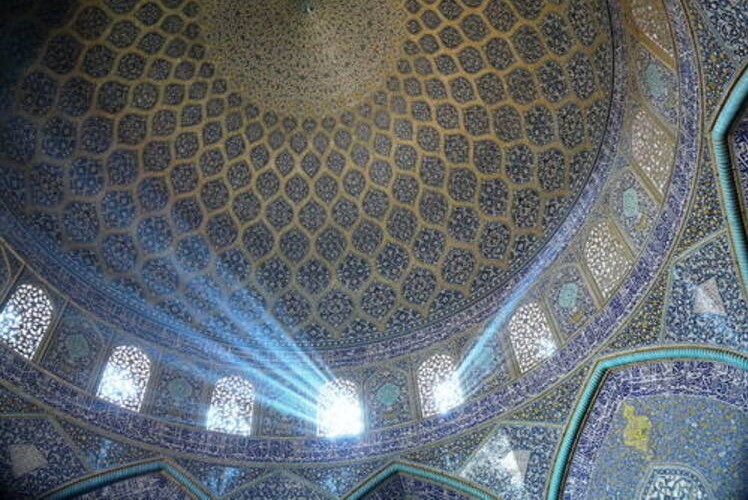
Built by Shah Abbas I the Great at the beginning of the 17th century, and bordered on all sides by monumental buildings linked by a series of two-storeyed arcades, the site is known for the Royal Mosque, the Mosque of Sheykh Lotfollah, the magnificent Portico of Qaysariyyeh and the 15th-century Timurid palace. They are an impressive testimony to the level of social and cultural life in Persia during the Safavid era.
Brief Synthesis
The Meidan Emam is a public urban square in the centre of Esfahan, a city located on the main north-south and east-west routes crossing central Iran. It is one of the largest city squares in the world and an outstanding example of Iranian and Islamic architecture. Built by the Safavid shah Abbas I in the early 17th century, the square is bordered by two-storey arcades and anchored on each side by four magnificent buildings: to the east, the Sheikh Lotfallah Mosque; to the west, the pavilion of Ali Qapu; to the north, the portico of Qeyssariyeh; and to the south, the celebrated Royal Mosque. A homogenous urban ensemble built according to a unique, coherent, and harmonious plan, the Meidan Emam was the heart of the Safavid capital and is an exceptional urban realisation.
Also known as Naghsh-e Jahan (“Image of the World”), and formerly as Meidan-e Shah, Meidan Emam is not typical of urban ensembles in Iran, where cities are usually tightly laid out without sizeable open spaces. Esfahan’s public square, by contrast, is immense: 560 m long by 160 m wide, it covers almost 9 ha. All of the architectural elements that delineate the square, including its arcades of shops, are aesthetically remarkable, adorned with a profusion of enamelled ceramic tiles and paintings.
Of particular interest is the Royal Mosque (Masjed-e Shah), located on the south side of the square and angled to face Mecca. It remains the most celebrated example of the colourful architecture which reached its high point in Iran under the Safavid dynasty (1501-1722; 1729-1736). The pavilion of Ali Qapu on the west side forms the monumental entrance to the palatial zone and to the royal gardens which extend behind it. Its apartments, high portal, and covered terrace (tâlâr) are renowned. The portico of Qeyssariyeh on the north side leads to the 2-km-long Esfahan Bazaar, and the Sheikh Lotfallah Mosque on the east side, built as a private mosque for the royal court, is today considered one of the masterpieces of Safavid architecture.
The Meidan Emam was at the heart of the Safavid capital’s culture, economy, religion, social power, government, and politics. Its vast sandy esplanade was used for celebrations, promenades, and public executions, for playing polo and for assembling troops. The arcades on all sides of the square housed hundreds of shops; above the portico to the large Qeyssariyeh bazaar a balcony accommodated musicians giving public concerts; the tâlâr of Ali Qapu was connected from behind to the throne room, where the shah occasionally received ambassadors. In short, the royal square of Esfahan was the preeminent monument of Persian socio-cultural life during the Safavid dynasty.
Criterion (i): The Meidan Emam constitutes a homogenous urban ensemble, built over a short time span according to a unique, coherent, and harmonious plan. All the monuments facing the square are aesthetically remarkable. Of particular interest is the Royal Mosque, which is connected to the south side of the square by means of an immense, deep entrance portal with angled corners and topped with a half-dome, covered on its interior with enamelled faience mosaics. This portal, framed by two minarets, is extended to the south by a formal gateway hall (iwan) that leads at an angle to the courtyard, thereby connecting the mosque, which in keeping with tradition is oriented northeast/southwest (towards Mecca), to the square’s ensemble, which is oriented north/south. The Royal Mosque of Esfahan remains the most famous example of the colourful architecture which reached its high point in Iran under the Safavid dynasty. The pavilion of Ali Qapu forms the monumental entrance to the palatial zone and to the royal gardens which extend behind it. Its apartments, completely decorated with paintings and largely open to the outside, are renowned. On the square is its high portal (48 metres) flanked by several storeys of rooms and surmounted by a terrace (tâlâr) shaded by a practical roof resting on 18 thin wooden columns. All of the architectural elements of the Meidan Imam, including the arcades, are adorned with a profusion of enamelled ceramic tiles and with paintings, where floral ornamentation is dominant – flowering trees, vases, bouquets, etc. – without prejudice to the figurative compositions in the style of Riza-i Abbasi, who was head of the school of painting at Esfahan during the reign of Shah Abbas and was celebrated both inside and outside Persia.
Criterion (v): The royal square of Esfahan is an exceptional urban realisation in Iran, where cities are usually tightly laid out without open spaces, except for the courtyards of the caravanserais (roadside inns). This is an example of a form of urban architecture that is inherently vulnerable.
Criterion (vi): The Meidan Imam was the heart of the Safavid capital. Its vast sandy esplanade was used for promenades, for assembling troops, for playing polo, for celebrations, and for public executions. The arcades on all sides housed shops; above the portico to the large Qeyssariyeh bazaar a balcony accommodated musicians giving public concerts; the tâlâr of Ali Qapu was connected from behind to the throne room, where the shah occasionally received ambassadors. In short, the royal square of Esfahan was the preeminent monument of Persian socio-cultural life during the Safavid dynasty (1501-1722; 1729-1736).
Integrity
Within the boundaries of the property are located all the elements and components necessary to express the Outstanding Universal Value of the property, including, among others, the public urban square and the two-storey arcades that delineate it, the Sheikh Lotfallah Mosque, the pavilion of Ali Qapu, the portico of Qeyssariyeh, and the Royal Mosque.
Threats to the integrity of the property include economic development, which is giving rise to pressures to allow the construction of multi-storey commercial and parking buildings in the historic centre within the buffer zone; road widening schemes, which threaten the boundaries of the property; the increasing number of tourists; and fire.
Authenticity
The historical monuments at Meidan Emam, Esfahan, are authentic in terms of their forms and design, materials and substance, locations and setting, and spirit. The surface of the public urban square, once covered with sand, is now paved with stone. A pond was placed at the centre of the square, lawns were installed in the 1990s, and two entrances were added to the northeastern and western ranges of the square. These and future renovations, undertaken by Cultural Heritage experts, nonetheless employ domestic knowledge and technology in the direction of maintaining the authenticity of the property.
Management and Protection requirements
Meidan Emam, Esfahan, which is public property, was registered in the national list of Iranian monuments as item no. 102 on 5 January 1932, in accordance with the National Heritage Protection Law (1930, updated 1998) and the Iranian Law on the Conservation of National Monuments (1982). Also registered individually are the Royal Mosque (Masjed-e Shah) (no. 107), Sheikh Lotfallah Mosque (no. 105), Ali Qapu pavilion (no. 104), and Qeyssariyeh portico (no. 103). The inscribed World Heritage property, which is owned by the Government of Iran, and its buffer zone are administered and supervised by the Iranian Cultural Heritage, Handicrafts and Tourism Organization (which is administered and funded by the Government of Iran), through its Esfahan office. The square enclosure belongs to the municipality; the bazaars around the square and the shops in the square’s environs are owned by the Endowments Office. There is a comprehensive municipal plan, but no Management Plan for the property. Financial resources (which are recognised as being inadequate) are provided through national, provincial, and municipal budgets and private individuals.
Sustaining the Outstanding Universal Value of the property over time will require developing, approving, and implementing a Management Plan for the property, in consultation with all stakeholders, that defines a strategic vision for the property and its buffer zone, considers infrastructure needs, and sets out a process to assess and control major development projects, with the objective of ensuring that the property does not suffer from adverse effects of development.

Further information that has emerged about the July 1 fire on the Russian nuclear submarine Losharik in the Barents Sea, which forms part of the Russian Arctic, sheds light on the enormous dangers bound up with the preparations for world war. The fire claimed the lives of 14 high-ranking Russian navy officers.
Russian president Vladimir Putin called the disaster a “big loss to the Russian navy and army.” The Kremlin has classified details about the disaster as a “state secret.” The navy officers on board had all been trained in St. Petersburg and were, according to the newspaper Izvestiia, “the best in Russia.” They were directly subordinated to the Ministry of Defense. The Losharik is deployed by the Main Directorate of Deep-Sea Research, which reports to the Russian military intelligence agency GRU.
At the funeral for the 14 officers on Sunday, an aide to the commander of Russia’s navy, Captain Sergei Pavlov, suggested that a nuclear disaster had been narrowly averted by the crew: “With their lives, they saved the lives of their colleagues, saved the vessel and prevented a planetary catastrophe.”
The Kremlin subsequently denied the gravity of the threat posed by the fire, with spokesman Dmitry Peskov insisting that “there are no problems” with the nuclear reactor. Initially, the Kremlin had denied that a nuclear reactor had been on board the submarine at all.
However, an investigative report that appeared on July 9 in the St. Petersburg-based Fontanka newspaper confirms that the situation on the vessel was far more dangerous than previously known. The newspaper reported that the cause of the fire was an electrical short circuit that occurred while the Losharik was docking with its mothership, Podmoskovye, which led to a heat dissipation of the lithium-ion battery, which subsequently exploded and went up in flames.
The information was submitted to the newspaper by five anonymous sources, independent of each other. The newspaper wrote:
“The large-scale fire was provoked, according to our information, by heat dispersal of the battery, which was followed by a series of explosions. The personnel in the front compartment died. So powerful was the shock wave that it was even felt on the mothership. At the moment of the explosion, the apparatus [submarine] was in the process of docking onto it. The survivors sealed off the central compartment, completed the docking, shut down the nuclear reactor and evacuated to the BS-136 Orenburg. Fearing further explosions and that the fire would spread to the carrier, the crew of the mothership flooded the submarine, and this is why by the time it arrived at its base in Severomorsk the submarine was completely underwater.”
Because of the flooding of the submarine, it took over four days to recover 10 of the 14 bodies of the officers. The report about the explosions on board the Losharik would also corroborate a statement by the Norwegian Radiation Protection Authority, according to which they had been notified by the Russians of a gas explosion aboard a vessel in the Barents Sea. The report by the Norwegian Authorities had been denied by the Kremlin.
The struggle to save the submarine by the crew took up to one-and-a-half hours, according to a Russian military expert who spoke to the Komsomolskaya Pravda: “The standard fire-extinguishing equipment worked, but they could not completely eliminate the source, and the crew entered the fight for the survivability of the ship.”
Specialists told Fontanka that the height of the flames during the explosion of a lithium-ion battery could reach several meters and that it would be impossible to extinguish the fire with a dry-chemical fire extinguisher or water, because the battery itself would release flammable elements and oxygen. The only way to end the fire was to cool the battery.
The emergency breathing apparatus for the crew in the enclosed compartment provided only 15 minutes of air.
Russian fishermen witnessed the emergency surfacing that the crew managed to initiate. One of them told the Murmansk news site Severpost, “We were heading toward Kildin, and then, about half past nine in the evening, a submarine surfaces. Suddenly and completely surfaces. I have never seen anything like it in my life. On the deck, people were running around and making a fuss.”
While the Losharik is powered by a nuclear reactor, it also includes electrical propellers that are powered by batteries.
In the past, the Russian navy has been known to use silver-zinc batteries to power submarines, which are non-flammable but expensive. According to Fontanka, the Russian navy has started looking for alternatives in the form of lithium-ion batteries because they are substantially less expensive.
Lithium-ion batteries, which are commonly used to power devices like laptops and smartphones, are notorious for exploding and causing fires. In 2016, NASA lost the complex robot RoboSimian, designed to rescue people from dangerous situations, when the lithium-ion batteries implanted in the robot exploded and caused a massive fire.
It was not known that any Russian submarine had already started to deploy them and the only lithium-ion battery producer in Russia told Fontanka that all their products are still in a testing phase. In October 2018, Japan, involved in a military build-up against China, launched the first-known lithium-ion-equipped Soryu-class submarine, which does not have a nuclear reactor. South Korea has also announced plans to use lithium-ion batteries on its submarines.
The July 1 Losharik disaster is a deadly serious warning about the enormous dangers bound up with the international arms race and preparations for world war.
It remains unknown what exactly was the aim of the Losharik deployment, but there is little question that it was related to the efforts of the Russian state to prepare itself for a potential assault, involving nuclear weapons, by the US and NATO, which have engaged in an open and aggressive military build-up against Russia for years. The US build-up has recently culminated in a $750 billion military budget passed by the Senate in June and has put enormous pressure on the Russian oligarchy, which has recently cut back on military spending amidst a prolonged economic crisis.
Nuclear submarines play an important role in the build-up, both as weapons of nuclear deterrence and as a military means to spy on opponents, intercept and cut internet and other communication cables. Meanwhile, according to one former employee of Russia’s General Staff, “The reactors on submarines and other deep-sea vessels aren’t typically very well protected.”
Russian newspapers have referred to the Losharik submarine, worth an estimated $1.5 billion, as Russia’s main military “horror story” for the US. It is deemed capable of cutting internet and other communication cables and can also descend lower into the sea than all other known submarines.
In 2012, the Losharik performed missions on the sea floor in the Arctic Ocean at depths between 2,000 and 2,500 meters (6,600-8,200 ft), whereas the US Navy gives the maximum operating depth of its Los Angeles class attack submarines, the world’s largest fleet of nuclear submarines, at 200 meters (650 ft). The Losharik has played an important role in efforts by Russia to explore and dominate substantial parts of the Arctic. The rapidly melting ice in the region—a result of climate change—has dramatically intensified competition over military control over the Arctic and its natural resources in recent years.

A horrific drunk-driving accident in Moscow has prompted Russian politicians to seek to impose tougher sentences on those who get behind the wheel of a car inebriated.
Some MPs are seeking life imprisonment for drunk drivers, following the public’s fury over a man who smashed his car into a bus stop in Moscow and killed seven people, including five teenage orphans.
Alexander Maximov was driving at an estimated speed of 125 miles per hour when he lost control and hit a bus shelter on Saturday. The driver, who admitted he had been drinking continuously for two days, survived the tragedy but now faces up to nine years in jail. Some Russian lawmakers want to upgrade the maximum punishment in such incidents to life in prison.
On Sunday, two people died when a minivan taxi collided with a car in Moscow. On Monday, five people were killed in a traffic accident in Russia’s Far East.
In July of this year, a woman who was rushing her boyfriend to the hospital killed five people outside Moscow. Yekaterina Zaul, 24, smashed her Land Rover into a group of pedestrians, killing five of them, including a seven-year-old girl.
Zaul was driving under the influence, having downed several shots of whiskey earlier that day.
Russia has one of the world’s highest rates of traffic accidents — about 30,000 people die annually on the roads, some due to alcohol consumption by motorists. (In comparison, that many people died on Britain’s roads between 2000 and 2010, according to the Daily Telegraph newspaper.)
Shamsail Saraliyev, an MP from the ruling United Russia Party, compared drunk driving to terrorism.
“Last year, drunk drivers killed 2,103 people,” Saraliyev told Russian media. “This is a colossal number. This year, as of September, tragedies on the roads have [already] killed 2,300 people.”
By comparison, 57 people were killed in terrorist attacks in Russia last year.
Prime Minister Dmitry Medvedev raised his concerns.
“We’ve recently had a series of horrifying road accidents,” he said. “Unfortunately, the majority of them were caused by people in a state of extreme intoxication. In that respect, the picture here is worse than in any other country. Probably it’s worth thinking about how to introduce tougher criminal punishment for such crimes.”
President Vladimir Putin also weighed in on the issue.
“Some things must be punished,” he said. “Sadly, it is the only way. We will have to toughen legislation in that area. The current legislation does not work.”
The Russian Duma (parliament) will consider changes in the law related to impaired driving on Oct. 16.
As for Maximov, Moscow police said he had consumed at least a liter of vodka within a short time period just prior to the crash. A judge ordered him to be taken into custody pending trial.
In addition, he was driving with a suspended license and had received numerous speeding tickets.
Natalia Antonova, deputy editor of the Moscow News, commented that while Maximov can only get nine years in prison for killing seven people, “opposition leader Alexei Navalny faces a maximum of 10 years in the slammer after being charged with embezzlement.”
However, drunk driving is perhaps an inevitable consequence of Russia’s long and deep love affair with alcohol.
Antonova wrote: “Legal issues aside, it remains to be seen whether this tragedy will do anything to influence drunk driving rates across the country,” Antonova wrote. “I do not know anyone who drinks and drives in Moscow. The rules are strict: Just one drink puts you over the limit. Yet stories of drunk-driving deaths — particularly on weekends — abound in the news.”
She quoted a friend of hers who linked alcohol abuse to a “culture of desperation.”
“Take the children I work with,” her friend lamented. “Most of their parents are still alive; they just happen to be addicted to alcohol or something else and are not able to look after their own kids. You see them every once in a while — some really do miss their children. But when you look in their eyes, all you see is desperation. I wouldn’t say they’re desperate for a better life. They’re desperate for things to be over.”
In 2010, then Prime Minister Vladimir Putin said he wanted to cut alcohol consumption in Russia in half by the year 2020, by, among other things, eliminating the nationwide black market for booze.
According to official statistics, more than 23,000 Russian die of alcohol poisoning annually, while, on the whole, 500,000 die from alcohol-related diseases, crimes, accidents and illnesses.
Rospotrebnadzor, a consumer advocacy group, estimates there are more than 2 million alcoholics in Russia.
The World Health Organization warned in early 2011 that Russia’s high rate of alcoholism will damage the country’s future economic growth and pose a demographic catastrophe.
The report cited, among other things, that Russian adults drink the equivalent of about four gallons of pure alcohol per capita each year (double the amount of their U.S. counterparts) and 10 million Russian children between the age of 10 and 14 drink alcohol regularly.
Perhaps more alarming, one-fifth of Russian male deaths are directly attributed to alcoholism, leading to lower life expectancies for men and a future of declining overall population.



Does this sequel adhere to the spooky spirit of the original, or take one liberty too many in trying to improve itself? Read to find out! The first Dead Space set a new standard for sci-fi horror in video games, taking classic rules of terror and twisting them into a new dimension of fear. Dead Space 2 sought to continue the franchise, putting players back in the boots of space engineer Isaac Clarke and pitting him against the Necromorph menace once more.
Introduction
Of all the games in the Dead Space franchise, the second, Dead Space 2, is widely held as the best of the bunch. Developed by the newborn Visceral Games, the second entry in the series took the lessons of the first game and improved on them on a scale that few sequels ever accomplish. It’s no Mass Effect 2, but that’s an unfair comparison to make in any case, given the different themes Dead Space runs with. Regardless, it’s a vast improvement, and despite being almost seven years old at the time of this writing, it remains a fun, exciting and spooky experience. You can pick it up on Steam for $19.99, where it comes bundled with a bunch of integrated extra material that was originally only available as paid downloadable content, such as extra RIGs, weapon variants and more! Of course, a lot of other DLC isn’t available or supported for the PC version, but having looked into it myself, I can safely say you’re not missing anything by getting this edition. The scares are just as scary and the combat is just as gory, so don’t listen to anyone who says it’s better on consoles.
Story
For those new to the universe of Dead Space, a handy synopsis of the original’s plot is immediately available from the main menu, and provides a rapid means of catching up for those who need it. Isaac Clarke, protagonist of the first game, is once again the hero, with opening scene placing him in a government-run mental ward, where he has been kept for the past three years, wracked with guilt over the death of his girlfriend Nicole on the Ishimura and haunted by the lasting mental scars of his contact with the mysterious Red Marker. Of course, it’s not Dead Space without Necromorphs, and this time the game skips most of the build-up, with Isaac’s unlucky rescuer getting skewered and infected right before Isaac’s eyes seconds into the plot. The initial chase scene as Isaac flees the ward, with Slashers bursting out of cells and other creatures lunging out of side passages while he struggles with his straight-jacket is heart-pounding, and is an excellent example of what sets the second Dead Space apart from the first. Where the original relied on dread, a heavy, oppressive atmosphere and a somewhat slower pacing, Dead Space 2 is like the second half of Pitch Black, where horror is still present, but takes on a more ‘thriller’ vibe. The game’s no less scary of course, and while the action is more intense, it retains a uniquely Dead Space vibe that no amount of shooting sequences can detract from.
The whole plot of Dead Space 2 ties very heavily into Isaac’s decaying grip on sanity.The first quarter of the game places you at the mercy of two unreliable narrators; Stross, a mental patient from the same lab Isaac was held in, and Daina, partner of Isaac’s unlucky would-be rescuer, who seems trustworthy, but quickly begins to project the sense that she has a hidden agenda. This battle of trust is overlaid on the fact that the Marker pattern in Isaac’s brain is taunting him with hallucinations of his dead girlfriend who mocks and degrades him for his guilt over his self-perceived involvement in her demise on the Ishimura. A heavy emphasis on eye imagery also helps set up the player for one of the most knee-knocking and nail-biting end sequences I have ever seen. On top of that, Isaac has to fight to stay alive in the midst of a massive Necromorph outbreak while at the same time being hunted by the forces of EarthGov. This layer cake of lunacy is delicious, and makes for a rich, engrossing experience.
Of course, there are some things that could’ve been done better. The involvement of the followers of Unitology (an in-universe religion rooted in the worship of the alien Markers) only lasts for a small portion of the game, and the game’s primary antagonist seems cartoonishly two-dimensional at times. It’s not until the last few minutes of the game that he gets any kind of real characterization, which is unfortunate, given how hard he seems to be trying to kill Isaac. Despite this, all the actors make stunning performances, including Isaac himself, who now has a voice despite being mute for the entirety of the first game. Normally when a silent protagonist gets a voice, it doesn’t go well, but Isaac is an exception, and comes across as a genuine human character with problems you can relate to. His voice actor does a great job of conveying the sense that he’s an everyman hero, an engineer caught in the midst of extraordinary events. It’s a great performance that only adds to some already-great writing. Overall, the whole plot works well to retain the sense of Lovecraftian mystery of Isaac’s situation while balancing it on top of a heavier diet of action than his previous adventure. Its human and sci-fi aspects still stand strong even today.
Gameplay
Dead Space 2 retains much of the play-style of its predecessor, with all the old weapons making a comeback, though many now have new alternate fire-modes that make them less situational and more versatile than in the previous game. This is refreshing, since while Dead Space had a creative and brutal arsenal, only the Plasma Cutter ever seemed to remain usable throughout the campaign. New weapons make an appearance as well, with my personal favorite being the viscerally-satisfying Javelin Gun, which when fully upgraded shoots yard-long spikes that can then be triggered to electrify and explode impaled enemies. Furthermore, as if it wasn’t enough fun nailing thing to other things with a high-tech nailgun, the game vastly improves on Isaac’s Kinesis power, letting him grab and toss all sorts of environmental objects to stun or kill attackers. This includes ripping the bone blades off of slain Necromorph Slashers, which can then by launched like a spear. There’s nothing quite as satisfying as turning the enemy’s weapons against them, especially when that weapon is part of their own body.
The game also introduces new enemies, which mix with the old roster in a remarkably well-crafted system of encounters that strive to test your tactical flexibility. Chief among these are Stalkers, crafty, almost alien-looking creatures that, as their name implies, take a stealthy approach to fighting you. They hide behind crates and attack in a hit-and-run fashion, working to unnerve you with their whale-like vocalizations while peeking out occasional to confirm your location. Another is the Pack, which is among the more controversial of the game’s already gruesome creature designs. These nasty critters are made from the adolescent and pubescent humans that fell to the Necromorphs, and charge at you in large numbers with bald, child-like faces set on lanky pale bodies with razor-sharp claws. They serve to occupy and distract you from the more heavy-hitting enemies, weighing you down in a frenzied dog-pile of death whole a Slasher or Leaper winds up for another attack.
Dead Space 2 also introduces a multiplayer component known as Outbreak Mode, where two teams of four human players compete against a third team of Necromorphs and each other in a race to complete objectives before time runs out. The mode contains much of what you’d expect to see from many modern multiplayer modes, with outfits, weapons and boosts to existing abilities locked behind a level-progression system which awards players for completing objectives and killing enemies in matches. It’s mostly defunct now, having never been hugely popular to start with, but it does make an interesting addition to a game that is chiefly action-horror. It’s not without its own element of terror either. As a Necromorph, players can use vent-access to ambush other players, making matches a tense affair, with environments seeming overtly hostile at every turn. Again, it’s not going to win any awards, and it never did, but it is an interesting experiment in trying to expand the series’ repertoire from a single-player focus.
Sound & Design
Dead Space 2’s art design is probably one of the best things about it. Despite being five years old at the time of this writing, it looks better than many other triple-A games, with its careful application of lighting, its butter-smooth frame-rate and its jaw-dropping scenery all well up to spec. Its a testament to what good environmental design can do for a game over the long term. Furthermore, the environment itself again feels like a living character, even moreso than the Ishimura of the first Dead Space. The game takes place on Titan Station, otherwise known as ‘the Sprawl’, a veritable city in space made from the ruins of Saturn’s titular moon. Text, audio and video logs all lend a bit to fleshing out the lore and helping with puzzles, but most of the character of the world comes from the visual and auditory storytelling you experience as you progress.
An excellent example is the segment after Isaac’s harrowing escape from the secure government wing of the station’s hospital at the game’s opening. Once outside the facility, he ends up in the Cassini Towers apartment complex, where he bears witness to the full-scale madness of the Necromorph outbreak sweeping the station. Panicking crowds flee from the swarm of the risen dead, while others lock themselves in their homes in fear. The sounds emanating from the sealed apartment units are like a window to the apocalypse. A man threatens to shoot anyone who tries to remove him from his home, while across the way, an abandoned infant screams and cries for a mother who isn’t there. Overlaid on this is an unusual amount of ominous Unitology imagery, with bloody alien writing that was established as the Church’s calling card in the original Dead Space scrawled all over the place in blood, hinting that the area might be thick with members of the pseudo-religious order.
This kind of artful design is a thing to be cherished, as it so rarely appears in games these days. Like the first game, Dead Space 2 is heavy with metaphors. It even continues the series’ tradition of spelling out a message in an acronym composed of the first letter of each of the game’s chapter titles. The sound and voice acting also shine, with the Necromorphs providing suitably creepy and disgusting audio cues. It also features one of the earliest forms of dynamic musical cues, with the various creatures all having signal sounds and themes equipped with dynamic triggers to help synchronize the soundtrack with the scares. It’s simply amazing, and deserves to be appreciated since many developers today still use the same techniques.
Final Verdict
Dead Space 2 is to Dead Space what the later Resident Evil titles are to the first (though without the silly over-the-top convoluted plot). It’s a take on a similar scenario but compensates for the lack of that special first-time scare you get from something original and terrifying with an increase in the action. While it can’t truly capture the spine-tingling terror of that first time on the Ishimura, it still handles itself well, with a dread-filled atmosphere, a rip-roaring pacing and plenty of gruesome action in between. It also plays off the last game in a novel and heart-breaking manner, with Isaac’s emotional struggle serving to make him a very human and fragile character despite his swearing and zombie-stomping abilities. I actually feel it outdoes the first game in many areas, and for that reason, I highly recommend it, both for fans of horror and action. It’s rare a sequel does so much to improve while staying original. It deserves appreciation; your appreciation. So what are you waiting for? Put on your RIG…and m̲͔̮A̞̝̰̺̘̖͔k̵̬͍͈̳͉̻̬e͇̦̠͕̙̹̮ ̼̼͖ͅu̪̠S͙̼̬͝ ̡͍̠͓̙̣w̹̗̝̭͠H͚̹̖̦̖O̧̰̹͙͇̪̤͖l̝e̬͖!
 Igor's Blog