Broadway is a major east-west thoroughfare in the city of Vancouver, British Columbia, Canada. In Vancouver’s numbered avenue grid system, it runs in place of a 9th Avenue, between 8th and 10th. The street has six lanes for most of its course. Portions of the street carry the British Columbia Highway 7 designation.
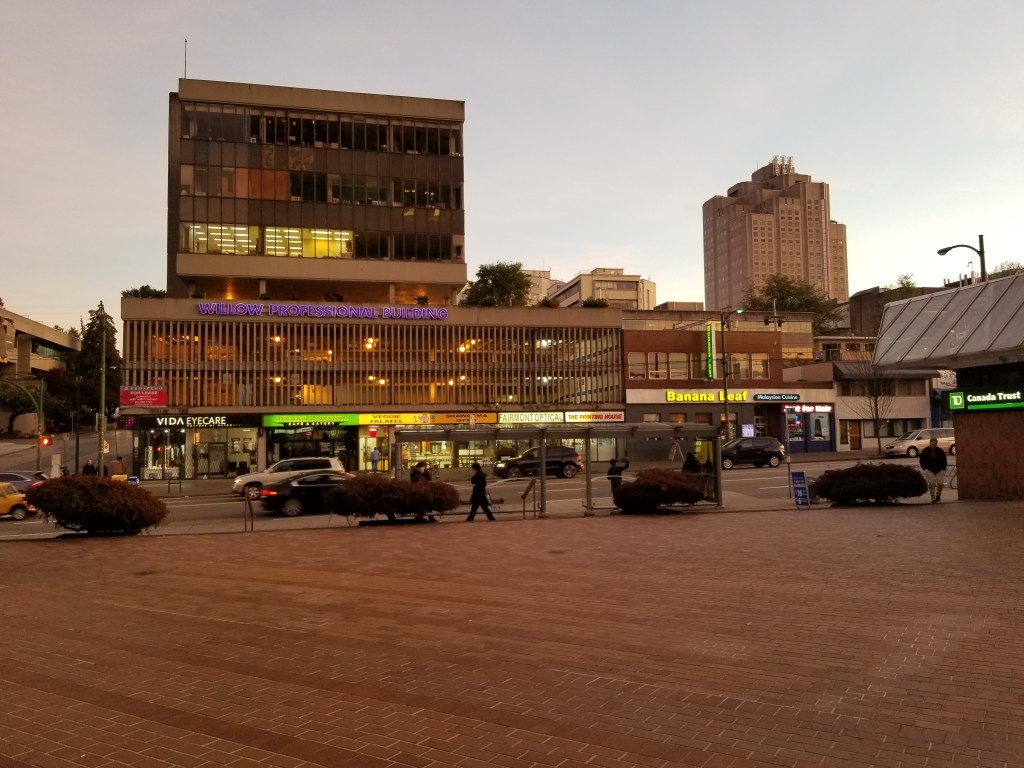
The route begins as “West Broadway” at the intersection of Wallace Crescent and 8th Avenue, in the affluent residential neighbourhood of West Point Grey, a few kilometres east of the University of British Columbia (UBC). Past Alma Street, Broadway takes over from 10th Avenue as one of Vancouver’s major thoroughfares, as it enters Greek West Broadway (or Greektown) section of Vancouver’s Kitsilano district. East of here are several blocks of generally trendy, upscale shops interspersed with low-rise apartment blocks and small supermarkets. The surrounding neighbourhoods generally consist of large, older homes dating from the early twentieth century, many of which have been subdivided into rental suites.
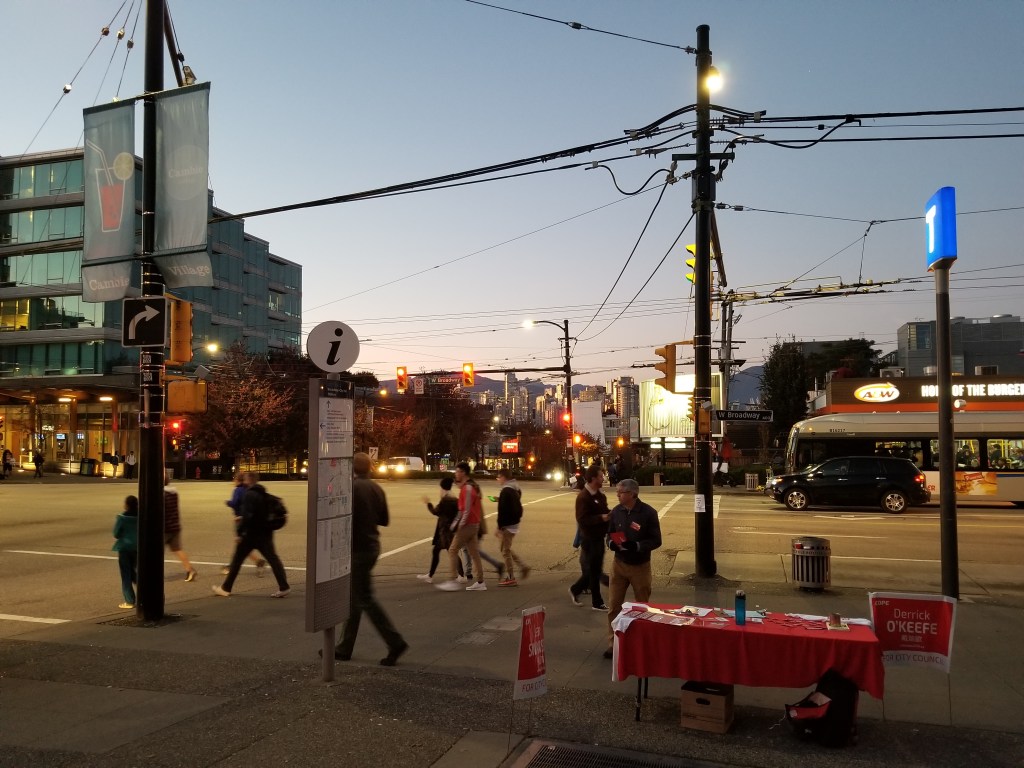
As Broadway approaches Arbutus Street, the commercial establishments become larger before transitioning into a mix of small to mid-size apartment blocks. East of Burrard Street, the apartment blocks get progressively taller, and commercial establishments larger and busier. Between Burrard and Main Street, Broadway can be considerably congested by vehicular traffic. Past Granville Street, Broadway yields completely to medium-to-large commercial structures and high-rise apartments and condominiums. Between Cambie and Main, the commercial establishments become smaller and somewhat more downscale.
At Ontario Street, two blocks west of Main, the route becomes “East Broadway.” After bisecting Main and Kingsway, traffic on Broadway eases somewhat, and the character returns to a mix of small-to-medium apartment buildings and commercial establishments, interspersed with older homes – all considerably less affluent than those to the west. At Commercial Drive, Broadway passes by the Commercial–Broadway SkyTrain Station. Past here for several blocks, the neighbourhood consists predominantly of older residential homes.
As Broadway travels east of Renfrew Street, the neighbourhood once again becomes mixed, with older homes to the north and larger industrial, commercial, and warehouse establishments to the south. Broadway finally ends at Cassiar Street, just short of the Vancouver-Burnaby boundary, where it becomes the Lougheed Highway.
Broadway was created at the turn of the 20th century, along with other gridded roads south of False Creek, to meet the needs of an expanding population in Vancouver. The name of the route was changed from 9th Avenue to Broadway in 1909, at the behest of merchants around Main Street (at that time the hub of Vancouver commerce), who felt that it bestowed a more cosmopolitan air. Commercial establishments originally spread out around the intersections of Cambie and Main Streets, while the character of the rest of the route remained predominantly single-family dwellings.
By the 1970s, the length of Broadway had become a major arterial route in Vancouver, conveying commuters from downtown to the neighbourhoods of the west and east sides. With the growth of UBC and the expansion of the Vancouver General Hospital (one block south of Broadway between approximately Oak and Cambie), traffic demands accelerated. In the 1990s, the agency then responsible for public transit in Greater Vancouver — BC Transit — introduced an express bus route, the 99 B-Line, to help reduce congestion. The Vancouver transportation plan for Broadway notes that congestion is such that the bus service is at capacity, and will not be eased until a new rapid transit line is built paralleling the street. It is anticipated that the SkyTrain’s Millennium Line will be extended to Central Broadway by 2021; the extension is expected to connect with Canada Line at Broadway-City Hall Station, at the intersection of Broadway and Cambie Street.
Pokémon turns 25 this year! In honor of this milestone, Tama takes a look back at where Pokemon as a franchise all began, with the release of Pokemon Red and Blue on the GameBoy in 1996. Tama asks the question that no one dares to: is it still good? These games have a bit of a bad wrap (haha see what I did there?) with Pokemon fans two decades on, but do they really deserve it? Well, we need to take an excruciating deep dive to find out! Is Charizard as good as you remember it? Is Blastoise? What’s the deal with Mewtwo? Did you know video descriptions need to be really long these days?
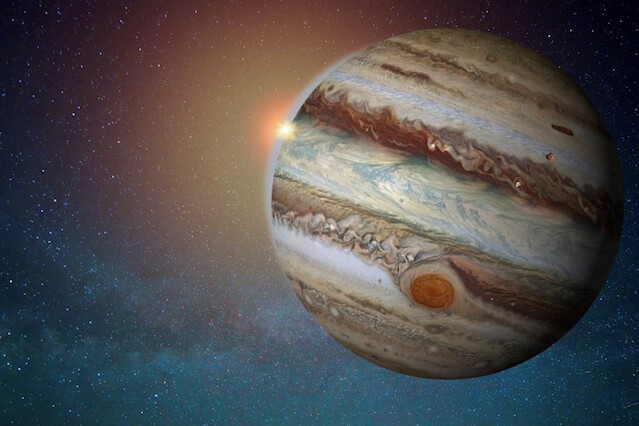
In his book “2061 – Odyssey Three” (the third of his Space Odyssey series), Arthur C. Clarke put forward the intriguing proposal that the core of the planet Jupiter was, in fact, a diamond the size of Earth.
Now Clarke, even though a science fiction author of some repute, had a science background and always tried to bring rigorous scientific accuracy to his stories. So, could his proposition be possible?
The somewhat predictable answer is – we don’t know. But we can analyse the possibility within known scientific parametres, to see if it is, at least, possible.
For diamond to form, the element carbon must be present. Diamond, as you probably know, is a form of carbon, as is coal and graphite (the “lead” in pencils).
It was once thought that the core of Jupiter was a giant snowball. However, the NASA probe Galileo, arriving at Jupiter in 1995 and orbiting the planet for the next eight years, sent back information that changed all that.
It found that Jupiter contained far less water than originally thought, but was very abundant in hydrocarbons – things like tar. The possible composition of Jupiter’s core was therefore changed to incorporate this new information. What was important here was that carbon was indeed present – but in chemical compounds.
It is now also known that the interior of Jupiter contains liquid hydrogen, which can only exist under tremendous pressures. Whether this pressure also results in the carbon separating from the hydrogen atoms is a matter of conjecture.
Anyway, supposing that free carbon molecules exist at Jupiter’s core, what are the criteria for them to become the form known as diamond? Well, high pressure is one – and Jupiter’s interior certainly has that. Also, the environment must be at a certain temperature – something above 1,500 degrees Celsius, again present within Jupiter. So, in theory, a core that is a diamond the size of Earth could be possible. Let’s hope so anyway.
A Diamond as Big as the Moon – Really
Until the Jupiter diamond core issue is proved one way or another, the biggest actual diamond ever discovered in our galaxy is a star formerly known as BPM 37093, in the constellation Centaurus, which is about 50 light years from Earth.
This heavenly body is actually a white dwarf star, around 2,500 miles across, making it slightly larger than our Moon. It is made up of crystalized carbon, cloaked in a layer of hydrogen and helium gas. Although not quite a diamond the size of Earth, it has still been calculated at 10,000 million million million million million carats!
Yet More Diamond in our Solar System
It has been postulated that the two outer liquid giants of our solar system, Uranus and Neptune, are hiding, beneath their dense atmosphere, oceans of liquid diamond, in which float solid diamond icebergs! It may seem far-fetched, but this proposal comes from a respected American scientific institution, Caltech.
These two planets are rich in methane, which is a compound of hydrogen and carbon. Under certain conditions of pressure and temperature, these can be forced to separate, resulting, usually, in hydrogen and graphite. Special circumstances may cause the carbon to crystallize as diamond and the pressure involved is sufficient to keep it in liquid form.
Imagine that – an ocean of liquid diamond! You can’t, can you?
In A. E. van Vogt’s famous novel The Voyage of the Space Beagle, there is a character who practices what van Vogt called “nexialism”: a sort of inspired deductive ability that spans all scientific disciplines and permits a practitioner to synthesize hosts of disparate details into a coherent picture.
Victor Hunt, the hero of Inherit the Stars, is much like this. Trained as a theoretical physicist, he nevertheless can reason effectively in geology, biology, chemistry — indeed, any scientific field, and often more effectively than the experts in that field.
That’s useful, for Hogan’s tale is one vast intellectual jigsaw puzzle. Its genesis, I believe, was the real observation that the far side of the Moon is more heavily cratered than the side that faces us. What if, Hogan wondered, that bombardment was intentional? From that speculation, he extrapolated an earlier human technological civilization that did not originate on Earth — and much more. The story describes Hunt’s quest to uncover and understand the many novel and seemingly contradictory pieces of evidence to form a complete, coherent picture that leads him to a shattering conclusion.
Hogan says on his Web site that this was his first book. It began when he was a technical sales representative for Digital Equipment Corporation. After he watched 2001: A Space Odyssey… But let him tell the tale in his own words:
This was what started it all off — the first book I wrote. It began as an office bet while I was working in computer sales. Although there was much that I enjoyed about the movie “2001”, I never understood the ending. I listened to all kinds of ingenious interpretations, but they were all mutually contradictory, and I suspected existed more in the eyes of the people doing the interpreting than in anything objective out there, that they were seeing. So one day I was complaining about this in the office. Probably more to shut me up because there was work to do, one of the other sales engineers said what we all say at some time or other: “If you think you can write something that makes more sense, do it.” I said okay I would, and a bunch of us ended up betting on whether I’d get it published. Well it was, and I was launched into a completely new career as a consequence. The punch line to it all was that years later, after I had moved to the U.S. and was living in Massachusetts, I had dinner with Judy Lynn Del Rey and Arthur C. Clarke in Boston one night and was finally able to ask him — the ultimate source — “What did the ending to that movie mean?” And Arthur’s answer was, “I haven’t the faintest idea.” It was based on his short story The Sentinel, and apparently none of the Hollywood people involved could agree on how to end it. Arthur walked away and left them arguing over it. “And that was what they came up with,” he said. “I’ve never really understood it either.” Before finishing Inherit the Stars, I realized that there was another story to be told — concerning an extinct alien race, relics of which had been found in the course of further lunar exploration. The sequel, The Gentle Giants of Ganymede, followed in 1978, and the “Giants” series eventually grew to include Giants’ Star and Entoverse. The first three novels have been packaged into a single volume as The Minervan Experiment, by the Nelson Doubleday Book Club, and The Giants Novels, by Ballantine/Del Rey.
For some, this novel (and the other two parts of Hogan’s “Giants Trilogy” that followed it) may contain too much exposition of scientific detail to be enjoyable. I lapped it up, on first reading; and despite having important parts of its thesis invalidated by later discoveries, it remains in my top rank of hard science fiction tales. I recommend it unreservedly, especially to new readers of SF.
it’s a miracle I didn’t pass out halfway through honestly hi you, how are you? I took a few days away from filming mostly because it’s essay season and had to fill my days with too much research, too much coffee, and probably too little writing but I’m back with everything I read in February! What have you been up to? xx
The Umayyad Dynasty (Arabic بنو أمية banū umayya / الأمويون al-umawiyyūn ; Persian امویان (Omaviyân), Turkish, Emevi) was the first dynasty of caliphs of the Prophet Muhammad who were not closely related to Muhammad himself, though they were of the same Meccan tribe, the Quraysh. The first dynasty reigned from 661 to 750 C.E. Ironically, the Qurayshi clan from which the Umayyads originated had initially been bitter enemies of Muhammad. They greatly expanded the size of the caliphate and established sound administrative practices, although tended to favor Arabs over non-Arabs. They were criticized for ruling the caliphate as if they were kings, not leaders of a religious community with authority as a divine trust. They lost power to the Abbasids in 750 C.E., who promised to govern according to the edicts of Islam, but a survivor established a sultanate (later declared a caliphate) in Andalusia, where they presided over a flourishing civilization. At a critical time in the development of Islam, the Umayyads at Damascus ensured the new faiths survival while their later rule in Spain remains an outstanding example of Muslims living in positive exchange with Christians and Jews and of an intellectual flowering that remains of significance today. Generally, the early Umayyad dynasty is regarded as a less than ideal period of Islamic history, when the struggle between faith and temporal power saw the former dominate at the expense of the latter.
Umayyad rulers in Damascus
MuawiyahI had been the governor of Syria under the 3rd caliph and his kinsman, Uthman ibn Affan. After the assassination of Uthman, he was replaced by the new caliph, Ali ibn Abi Talib. Since the killers of Uthman had allied themselves with Ali, Muawiyah refused to accept his caliphate, and in 657 led an army against him. The two sides agreed to a conciliation procedure, resulting in an arbitration that many of Ali’s partisans saw as unfair, and the Muslim empire was partitioned. When Ali was assassinated in 661, his son Hasan pledged allegiance to Muawiyah (disputed by Sh’a) and Muawiyah was declared caliph of all Muslim lands. This established the Umayyad dynasty, and the capital of the caliphate was moved to Damascus.
Great waves of expansion occurred under the reign of the Umayyads. Muslim armies pushed across North Africa and Iran through the late 600s, expanding the borders of the empire from the Iberian Peninsula in the west and to India in the east. Under Sulayman (715 – 717) son of Abd al-Malik, forces led by Tariq ibn-Ziyad crossed Gibraltar and established Muslim power in the Iberian Peninsula while other armies established power far away in Sind, on the Indian subcontinent. Hisham’s long reign (724 – 743) saw the empire reach the limits of its expansion. The Muslim empire under the Umayyads was now a vast domain that ruled a diverse array of peoples. However, in 740 the Shi’a Imam, Zayd b Ali (Hussain’s grandson) led a rebellion that resulted in a Shi’a state in Northern Iran (Tabaristan) between 864 and 928, and also in the Zaydi state in the Yemen (established 893). The second Umayyad ruler, Yazid I is especially vilified by Shi’a for the murder at the Battle of Karbala (October 10, 680) of Husayn (or Husain), the prophet’s grandson who claimed leadership of the community.
The Umayyads were overthrown in the east by the Abbasid dynasty after their defeat in the Battle of the Zab in 750. Following the battle, the Abbasids massacred most of the clan. In 749 Abu al-Abbas al-Saffah was proclaimed the first Abbasid caliph. An Umayyad prince, Abd-ar-Rahman I, took over the Muslim territory in Al-Andalus (Hispania) and founded a new Umayyad dynasty there. From 929 they claimed the title of caliph, thus challenging the legitimacy of the Abbasids. The Umayyads, it is generally argued, ruled their territory as if it were their personal possession and paid only lip service to Islam. Their story, however, is largely told through the eyes of their successors—the Abbasids—and reflects the view that they were worldly rulers, yet they left behind two of the most significant Islamic monuments, the Dome of the Rock (Qubbat As-Sakrah) and the Umayyad Mosque in Damascus.
They built ornate palaces, which their predecessors had not, living a more humble life-style. The Qur’anic inscriptions on the Dome are the oldest in existence. According to the secular historians Michael Cook and Patricia Crone (1977), the Qur’an itself dates from the same period, while Islam is a back-projection from the time of Abd-al-Malik (685 – 705), who more or less created it (29). Muawiyah and Yazid, certainly, were worldly rulers but there is some evidence that al-Malik took Islam more seriously and may have intended the Dome (built between 687 and 691) to accommodate the hajj while the rival caliphate under Ibn al-Zubayr held Mecca (680-692). The beautiful calligraphic citation from the Qur’an celebrates Islam’s triumph over the earlier monotheistic religions, Judaism and Islam.
Treatment of Non-Muslims
Non-Muslims were well treated under the Ummayads. Zakaria (1988), however, states that they were better off than under the first four caliphs:
The Umayyads improved upon the past treatment of the non-Muslims. They did not only guarantee them religious freedom and protection of civil rights but also appointed them to some of the highest places in government. In many respects, they were more trusted than the Muslims. Key departments such as finance, taxation, commerce and trade were usually manned by Jews or Christians (73).
Umar II “reversed the process and dismissed many Christians and Jews,” citing Q5: 21 (“don’t take them [peoples of the book] as your friends”) but “his successors reverted to the old practice.” It was not until as late as the middle of the ninth century that Muslims formed the majority of the population in the Middle East heartland of the caliphate.
The Abbasids may have attracted support for their coup because they promised to restore the non-hereditary caliphate; using shura (consultation) to select successors but they in fact also established a dynasty. Like the Umayyads, they also used the title ‘deputy of God,’ omitting ‘of the prophet of God,’ thus claiming a direct line of communication with God. It was the religious professionals who codified the Shar’iah and the traditions (sunned) of the Prophet and who claimed that they, not the caliph, possessed the right to interpret the Qumran which effectively resulted in a separation of roles, fish (law) became the province of the lama (religious scholars often financially independent of the State by means of religious endowments) and siyasa (politics), the realm of the temporal ruler. In the Umayyads favor, too, is the fact that throughout their caliphate, its borders were commensurate with those of the Muslim community, which was not true for the Abbasids. The Abbasids initially attracted Shi’a support for the revolt since they could use their kinship with Muhammad (via his uncle) to challenge the Umayyad’s lack of any close family tie. Indeed they were descendants of Abu Sufyan, Muhammad’s long-standing foe, and were also known as the Sufyanids. This early effort at Shi’a-Sunni reconciliation was short lived.
Rulers in Cordoba
The first caliph extended his territory towards the Fatimids, controlling Fez and Mauritania in North Africa. The last caliph resigned in 1031. The caliphate then split into numerous taifa (small emirates, about 43 in all).
The Almoravids, invited by the emirs (see below) from Morocco to help in the war against the Christian Reconquistadores, took control of Cordoba in 1082, although Cordoba eventually fell to the Christians in 1236. From 1085, Toledo took over the role of center of learning, also attracting students from Europe. The Umayyad’s sultanate (756 – 929) and later caliphate of Cordoba (929 – 1031) in Andalusia (modern Spain) rivaled the Abbasids at a time when the Fatimids also challenged their supremacy, and provides an example of an Islamic society where scholarship (which was already patronized by the early Damascus based Umayyads) and inter-community exchange flourished. Pragmatically, fair treatment of non-Muslims (Christians and Jews were known as the Mozarabes) made sense in a context where Muslims were a minority. Nonetheless, the Islamic civilization over which the Umayyads of Cordoba (and some of their successors) presided was one that valued synthesis. The Arab and Moor (North Africans) Muslims there continued to develop as well as to preserve the Greek heritage they had acquired in Syria.
Cordoba’s main library, established by Hakim II (796 – 822), housed 600,000 manuscripts and served as an embryonic university, attracting Christian students from Europe (Britain, France, Italy, Germany) as well as from the Muslim world. Altogether, there were 70 libraries, and the city boasted seven hundred mosques and three hundred public baths; it was elegantly designed and spotlessly maintained. Houses (113,000 of them) had central courtyards with gardens and fountains and hot-air ducts for the winter. Many of the leading scholars acquired Latin names, as their seminal works were rendered into Latin becoming standard texts throughout Europe.
Scholarly Legacy
For example, Al-Bakri (after whom a moon crater has been named) (1014–1094) was a renowned geographer and historian. al Zahrawin (Albucasis) (936–1013) was court physician to Hakim II, whose 30 volume medical text, al-Tasrif, was translated into Latin as Concessio ei data qui componere haud valet. Al-Zarqali (1028–1087) (Arzachel) was an astronomer whose “Toledo Tables” were translated by Gerald of Cremona (1114–1187) and whom Copernicus cited four hundred years later. Many stars still have Arabic names. A commonly used term such as “Nadir” is from an Arabic word, nazir, meaning the point of heavens directly under an observer.
The political theorist, ibn Tufail (1105–1185) edited Ibn Sina’s classic Hayy ibn Yaqzan (“Alive, Son of Awake”) and introduced Ibn Rushd to the court, where he was secretary. Ibn Hazm (994 – 1064) served as vizier to two caliphs, ‘Abd al-Rahman III and ‘Abd al-Rahman V al-Mustazhir, systematized the Zahir school of law (literalist) and wrote the Fisal (detailed examination) in which he analyzed numerous philosophical traditions, including Christian. Ibn Firnas invented the eyeglass, Ibn Bitruji (d. 1204) (Alpetragius) the theory of stellar movement. Several of the above lived after the demise of the Umayyads but continued to work due to the flourishing academic environment that they had created. Without this climate, the first Latin translation of the Qur’an in 1133 by the Englishman Robert Ketton, commissioned by Peter the Venerable (1092–1156), would not have been possible. Perhaps the greatest scholar to emerge was Ibn Rushd (Averroes), whose work influenced Thomas Aquinas (1225–1274).
Franciscan Roger Bacon (1214–1292), an expert on Aristotle, was familiar with the work of many Muslim authors and, as did others at the time, regarded knowledge of Arabic as an indispensable part of the tool-kit of any serious scholar. Aristotle was lost to Europe until he was re-introduced in the twelfth century by the Muslims and Jews of Spain. An earlier Christian thinker such as Augustine of Hippo (354–430) knew Plato but was unfamiliar with Aristotle. Like the earlier Ibn Sina, he is credited with synthesizing faith (revelation) and reason, positing two sources of knowledge and two realms of truth. Their critics (including al-Ghazali) say that they substituted Plato for the Qur’an.
Christians and Jews also participated in this scholarship and the period 900 to 1200 in Spain is known as the “Hebrew Golden Age.” This produced the great Maimonides (1135-1204), although he had to flee to Egypt in 1165. The Almoravid successors to the Umayyads supported a different interpretation of Islam, one which believed that the peoples of the book should be humbled and severely dealt with (Q29 refers to dhimmis, paying the poll-tax until they are humiliated).
Europe also benefited from Arab music via Spain—the Lute (from Arabic: al’ud) found its way into Europe through Spain and influenced the development of the classical guitar (Arabic: qitar).
Contemporary Significance
Just as the Umayyad’s rule at Damascus was criticized as lax vis-à-vis the orthodox understanding of Islam, so their rule in Cordoba has its critics, being dismissed by contemporary fundamentalists as a devious form of Islam. Yet the same fundamentalists argue that European science and technological achievement is so indebted to these Muslim scholars that when Muslims utilize European science they are repossessing what is rightly their own (Nasr, 1990: 19). Other Muslims believe that Andalusian Islam can be a model for Muslims today who wish to embrace pluralism, thus:
The … aql-based Islamic philosophy [reason-based] is a lasting indication of a Western-Islamic encounter in its best terms. I continue [says this writer, a Syrian born German Muslim scholar] to argue that this encounter is still topical (Tibi 2001: 204).
Legacy
The Umayyads are generally credited as competent administrators and the Abbasids left much of their infrastructure in place. They delegated full administrative, legislative and judiciary power to regional governors, who in turn appointed legal secretaries (qadis) to exercise judicial authority although they could also reserve cases for themselves. The first qadis were secular officials. Under the Abbasids, their religious function became more dominant. According to Joseph Schacht (1978):
Whereas the legal subject-matter had not as yet been Islamized to any great extent beyond the stage reached in the Qur’an, the office of qadi itself was an Islamic institution typical of the Umayyad period, in which care for elementary administrative efficiency and the tendency to Islamize went hand in hand.












 Igor's Blog