Marvel Studios is infamously known for hiring up-and-coming independent directors to assemble their focus-grouped-to-death features, but when was the last time they brought one with such an established style and cult fandom as Sam Raimi? The man behind The Evil Dead, Drag Me to Hell, Oz the Great and Powerful (well … we can forget about that one), and yes, the initial cinematic outings of Spider-Man was brought on to spearhead the newest Doctor Strange project after Scott Derrickson, director of Strange’s first solo adventure, left over “creative differences.” It was assumed Derrickson wanted to make Marvel’s first real horror-ish outing just a little too scary – then they brought on the guy who gets his kicks directly from campy frights.
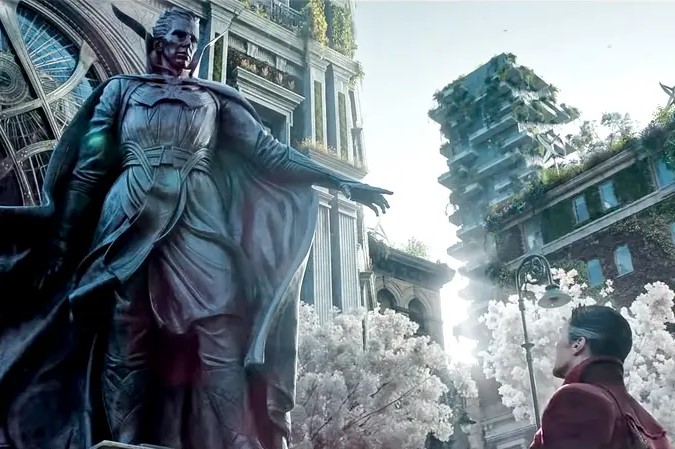
It’s no surprise, then, that there’s an interesting tension at play within Doctor Strange in the Multiverse of Madness, the strongest MCU outing since Black Panther, that’s nevertheless as much Marvel Machine as it is Raimi enjoying his return to the big screen after almost 10 years away, deploying every trick he keeps up his sleeve. It’s a movie well-suited to his sensibilities, full of monsters, portals to other worlds, evil spiritual books, doppelgängers, eyeballs where they don’t belong, and even the undead. When he’s able to let loose, it’s a total blast that’s replete with creative scene transitions, generous use of Dutch angles, a few jump scares, weird grunge guitar riffs, superimposed editing, and some appearances of his signature projectile POV camera effect.
Harder to determine is how much say Raimi had over Michael Waldron’s script that has the ultimate obligatory task of moving the greater universe along, which means this is still an MCU movie that is forced to go through the motions. We catch up with Stephen Strange (Cumberbatch) not long after the events of Spider-Man: No Way Home, as he saves a multidimensional traveler named America Chavez (Gomez) from a giant, one-eyed alien monster trying to kidnap her for her powers. Strange attempts to enlist the help of Wanda Maximoff (Olsen), still reeling from the events of WandaVision, in protecting Chavez. Things don’t go as planned, to put it lightly, and Strange and Chavez end up in a multidimensional chase to outrun the evil that threatens them.
As is requisite for these films, all of this means dealing with a lot of info-dumping and clunky exposition shot in generic coverage about this film’s context within the MCU at large. Being a sequel to both Doctor Strange, WandaVision, and a general extension of the franchise, it also cannot escape feeling like various parts and ideas cobbled together into a single entity that, surprise, doesn’t always mesh. That said, there are portions outside of the genre leanings that are pure echoes of the more overt earnest sentimentality and attuned sense of story and character present in Raimi’s Spider-Man trilogy that find their way into this. Even the quipping is amazingly reduced down to the absolute barest essentials. There are several truly touching moments around the climax that feel downright refreshing in how they allow the emotional character beats to just breathe.
Also noteworthy is how surprisingly mean this is able to get at times. This is maybe somewhat pushing the boundaries of a PG-13 rating, but it certainly is pushing the boundaries of what has been acceptable in the MCU up to this point. One particular segment around the halfway mark has some kills that carry a genuine sense of shock from just how bleak they are. This seems about as far as Marvel would be willing to go on the gore and scares while still maintaining the brand identity, but it’s the most revitalized the franchise has felt in a long time. There are plenty of reservations to be had about the baggage that comes with it, but it’s also just a ton of fun to sit back and watch the keys to the castle get handed over to someone who knows what to do with it.
Spanning three continents, Indiana Jones and the Fate of Atlantis finds our intrepid hero embroiled in a deadly race against the Third Reich to discover the secrets of Atlantis. With the help of archaeologist-come-psychic and ex-flame Sophia Hapgood, Jones attempts to foil the Nazi’s diabolical plans, save the world, and get the girl…again.
From the outset, Fate of Atlantis is exceptional, with an interactive introductory sequence that sees Jones repeatedly battered whilst exploring a collection of artifacts at Barnett College, looking for an unusual statue for the antiquities collector “Mr. Smith.” With the statue located and unlocked, a bead of the mythical Atlantean metal orichalcum is discovered. Smith threatens Jones and escapes with the artifact, though not before Indy recovers his jacket in a struggle, finding a passport exposing “Smith” as Nazi spy Klaus Kerner, and a magazine article featuring Jones and Sophia Hapgood. Fearing she is in danger, he goes to New York to track her down. We soon find out that ten years prior to the events of Fate, the two worked together on an expedition in Iceland, from which the latter stole artifacts. Through one such artifact, a necklace, Sophia “channels” the spirit of Atlantean King Nur-Ab-Sal, and has become an expert authority on Atlantis. She reveals the Nazis are hunting for orichalcum, an awesome source of energy that can power trucks, airplanes and bombs, ultimately assuring Nazi world domination.
Fate of Atlantis is fortunate in that, unlike its predecessor Indiana Jones and the Last Crusade, the story is not confined to the limits of the movie franchise. Instead, Fate of Atlantis enters uncharted territory with a highly original plot based upon the legend of Atlantis, the fantastically advanced city, which legendarily sank beneath the waves. Although the plot here is fictional, it is strongly based upon popular Atlantean lore, with the game manual listing a bibliography. Such research is impressive, and gives Jones’ somewhat unbelievable discoveries an air of authenticity. Despite this originality, Fate never forgets its source, with abundant references to the movie franchise. On one path, Jones is confronted by a boulder, precariously balanced on a ledge. “You know, I can’t put my finger on it, but this boulder looks vaguely familiar,” he quips delightfully. Gamers will rejoice in this combination of original plot and movie references to create a thoughtful title, instead of a shoddy, overpriced cash-in.
The characters populating Fate of Atlantis are colourful and lively, from sharp trader Omar Al-Jabbar, to an egomaniacal German scientist. The chemistry between the two lead characters, particularly in the team path provides an interesting dynamic due to the combination of two abrasive personalities; that of psychic and believer Sophia, and the other the pragmatic, cynical Jones. This is a source of much humour as the two characters make continual snipes at one another. Although characters are arguably less developed than in games such as Microïds’ Syberia, this is true to the spirit of the original films, in which clichés and stereotypes were also utilised to allow focus on the action-packed plot.
Fate of Atlantis utilises the classic SCUMM interface seen in other LucasArts games such as Monkey Island 2, with verbs such as “use,” “pick up” and “talk to,” yet it is unique in the incorporation of different sequences throughout the game. In the course of the adventure, Jones is called upon to pilot a hot air balloon, commandeer a German U-Boat and race through the streets of Monte Carlo. The only weakness is the arcade-style fight sequences, with their rudimentary punch and block functions. These sequences are, however, still a vast improvement from those in Indiana Jones and the Last Crusade; in Fate Indy recovers more of his health between fights, and purists will be pleased with the addition of a “sucker punch” key that will automatically KO opponents at the expense of a few Indy Quotient points.
The VGA graphics used in Indiana Jones and the Fate of Atlantis are similar in style to those in Gabriel Knight: Sins of the Fathers, which (though perhaps now looking dated in light of modern developments) were breathtaking at the time of original release. The colourful streets of Algiers and imaginative scapes of subterranean Atlantis are rendered in beautiful detail, complimented by smooth animations and fantastic cut-scenes.
The musical score is superb, which along with the exhilarating main Indiana Jones theme embraces a range of styles to suit the location Indy is exploring. In Tikal soft strains of pan-pipes can be heard, whilst the music during confrontational scenes heightens the impression of danger. Unlike many other LucasArts adventure games, it is possible to die in Indiana Jones and the Fate of Atlantis. Dangerous situations are, however, clearly signposted, and, after all, one can hardly expect to confront the Nazi hordes and escape completely unscathed. Playing the CD-ROM version of Fate, I benefited from an enhanced audio score, though due to unfortunate compatibility issues was unable to receive spoken dialogue. The only problem with the game are some technical issues associated with newer systems, though it will run comfortably in Windows ’95 and ’98.
The challenges in Fate range in difficulty, depending largely upon the “path” chosen by the gamer. Puzzles are generally logical or require a degree of lateral thinking, though not the zany sense of humour demanded by games such as Day of the Tentacle. Challenges include traditional dialogue puzzles, object hunts and inventory based challenges. The first segment of the game, where Jones must search for the Lost Dialogue of Plato presents a gentle learning curve, though the difficulty soon increases. Perhaps the most striking feature of game play is the ability to choose a “path” according to your own tastes. You can continue your quest alone and unaided on the “wits” path, or be accompanied by Sophia, who provides hints on how to proceed in the “team” path. Those preferring a brawn over brain approach can select the “action” path, involving fewer or simplified puzzles, but more fighting. Each of these paths interweaves, so gamers experience the same locations but in different scenarios, before the paths converge for the denouement in Atlantis.
The originality and innate re-playability of Fate stems from the different ways in which gamers can approach puzzles. For example, one of the first challenges is to gain entry to a theatre in which Hapgood is lecturing. A doorman bars your way, but can be overcome in a number of ways; by reasoning with him, starting a fight, or by finding an alternative entrance. The more inventive your approach, the more IQ (Indy Quotient) points are earned. Ingeniously, based upon your approach to these early puzzles, in a short sequence where Sophia “reads your mind” the computer suggests the path to which you are best suited. You are free, however, to select any path of your choice, and a saved game slot for the decision is highly recommended.
Fate of Atlantis is a true classic, worthy of every adventure gamer’s collection. The epic plot is involving and suspenseful, putting you in the shoes of the world’s most famous archaeologist as he single-handedly wards off the forces of evil. Effectively three games in one, due to the multiple paths, Indiana Jones and the Fate of Atlantis offers excellent value for money, with re-playability, a fantastic musical score and lively characters combined to create an exceptional gaming experience. I thoroughly recommend buying a game that forever raised the bar in the adventure gaming genre.
Li Zicheng (22 September 1606 – 1645), born Li Hongji, nicknamed “Dashing King”, was a Chinese rebel leader who overthrew the Ming dynasty in 1644 and ruled over China briefly as the emperor of the short-lived Shun dynasty before his death a year later.
Early years
Li was born in Mizhi County, Yulin, Shaanxi in the late Ming dynasty. Initially a shepherd, he started learning horse riding and archery at the age of 20, and had also worked in a wine shop and as a blacksmith’s apprentice.
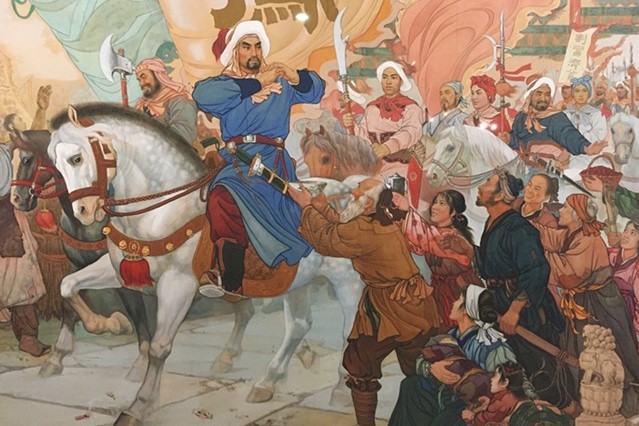
According to folklore, in 1630, Li was put on public display in an iron collar and shackles for his failure to repay loans to a usurious magistrate, Ai. Ai struck a guard who offered shade and water to Li, whence a group of peasants friendly to Li tore apart Li’s shackles, spirited him to a nearby hill, and proclaimed him their leader. Although they were only armed with wooden sticks, Li and his band managed to ambush a group of government soldiers sent to arrest them, and obtained their first real weapons.
As a general under Gao Yingxiang
At the same time, the Shaanxi region was hit by a famine, and the common people resented the Ming government. Li joined a rebel army led by Gao Yingxiang, who was nicknamed “Dashing King”. He inherited Gao’s nickname and command of the rebel army after Gao’s death.
Within three years, Li succeeded in rallying more than 20,000 men to form a rebel army. They attacked and killed prominent government officials, such as Sun Chuanting, in Henan, Shanxi and Shaanxi provinces.
Some battles Li fought in this period were the Battle of Chexiang Pass and the Battle of Fengyang.
Battles of Luoyang, Nanyang and Kaifeng
Li advocated the slogan of “dividing land equally and abolishing the grain taxes payment system” which won great support of peasants. The song of “killing cattle and sheep, preparing tasty wine and opening the city gate to welcome the Dashing King” was widely spread at that time.
The 1642 Kaifeng flood (during the 3rd Battle of Kaifeng), caused by breaches of the Yellow River dikes by both sides, ended the siege of Kaifeng and killed over 300,000 of its 378,000 residents. After the battles of Luoyang and Kaifeng, the Ming government was unable to stop Li’s rebellion, as most of its military force was involved in the battle against the Manchus in the north. Li declared himself the King of the Shun dynasty in Xi’an, Shaanxi.
From the Battle of Xiangyang to the creation of the Shun dynasty
In 1642, Li captured Xiangyang and proclaimed himself “King Xinshun”.
In April 1644, Li’s rebels sacked the Ming capital of Beijing, and the Chongzhen Emperor committed suicide. Li proclaimed himself the Emperor of the Shun dynasty.
After Li’s army was defeated on 27 May 1644 at the Battle of Shanhai Pass by the combined forces of the defecting Ming general Wu Sangui and the Manchus, Li fled from Beijing towards his base in Shaanxi.
The decline and death of Li
After a number of defeats Li Zicheng disappeared. Some folktales hold that Li survived after his defeats and became a monk for the rest of his life. Li mysteriously disappeared and there were different theories about his death too, at the age of 40. Some suggested that he committed suicide by hanging himself on a lotus tree, while others thought that he was killed by pro-Ming militia during his escape in 1645.
Historiography
Although the success of the Manchu conquest of China was attributed to the weakening of the Ming dynasty (exacerbated by Li Zicheng’s rebellion), official historiography during the Qing dynasty regarded Li as an illegitimate usurper and outlaw. This view sought to discourage and demonize notions of rebellion against the Qing government, by propagating that the Manchus put an end to Li’s illegitimate rule and restore peace to the empire, thus receiving the Mandate of Heaven to rule China. In 20th century China, the anti-Confucian and radical inclinations of the Communist Party of China viewed Li favourably, portraying him as an early revolutionary against feudalism.
In popular culture
Li appears as a bandit in Baifa Monü Zhuan, a wuxia novel by Liang Yusheng, where the heroine comments he is worthy of being a king. Li is featured as a character in some of the works of Hong Kong wuxia writer Jin Yong (Louis Cha). Li’s rebellion against the Ming dynasty is featured in Sword Stained with Royal Blood and his personality is analysed from the point of view of Yuan Chengzhi, the protagonist. In The Deer and the Cauldron, set in the Qing dynasty during the early reign of the Kangxi Emperor, Li is revealed to have survived and fathered a daughter, A’ke, with Chen Yuanyuan. Li is also briefly mentioned by name in Fox Volant of the Snowy Mountain and The Young Flying Fox.
Li is the main character of the historical epic novel Li Zicheng by Yao Xueyin.
And speaking of “fake news”… CNN has some breaking this morning.
Fake news outlet CNN is reporting on this story as if it is the gospel truth and they apparently refuse to link their readers/viewers to the actual 35-page document so folks can judge it for themselves. There’s good reason for that. It’s ridiculous. Here is a link to the entire 35-page “report” (PDF)
Here’s the story in a nutshell: an organization of Trump rivals in the primary contest last year hired some former British MI-6 liar to dig up some dirt on Donald Trump during the run-up to the election. The guy cobbled together some bullshit fabrications about Russia cultivating Trump for the past 5 years while simultaneously collecting sex videos of him and some hookers peeing on a bed the Obamas once slept in for blackmail purposes. The “report” was so stupid and devoid of actual facts, the group shelved the “report”. In their desperation toward the end, the Hillary team bought the rights to it, but again, because it was so stupid and sophomoric sounding, even they refused to use it.
CNN calls this “breaking news” but in fact, it came out on Oct. 31st, 2016 when David Corn of Mother Jones covered the stupid story in an attempt to help usher Killary into the White House. They also refused to publish the document because, as they said, it was “completely unsubstantiated” which translates to “if folks look at it they will immediately recognize it as either a hoax or the work of an out of work desperate man looking for a paycheck”
The report looks like it was written by someone in middle school in 1984. The formatting looks nothing like what intelligence agency professionals would produce in 2015 and 2016 which were the years the thing was dated.
Gateway Pundit made note of that when they called it a hoax way back when.
A 4chan member says he sent the thing to #NeverTrump butthole Rick Wilson as a joke, never expecting him to fall for it, but he did and so did CNN and Mother Jones in their desperation. Seems to me to be far too convoluted in terms of demonizing various other events (Ukraine, Syria, etc.) to have been simply a joke, but could be it started out that way with the Russian hookers story.
The last update of “intel” is dated mid-December so it seems someone was definitely adding to it all along.
The 4chan story does fit at least partially with the official version of events. The #NeverTrump group getting the report first.
We are being told that the top intel chiefs from the four major agencies (Brennan, Comey, Rodgers, Clapper) met with the leaders from both parties in the House and Senate as well as Trump and his people to discuss the specifics of this ridiculously stupid hoax document. If that is the case, our intel agencies are in even worse shape than I thought they were. If they were dumb enough to fall for this, it’s no wonder Trump puts the word ‘intelligence’ in quotation marks when he Tweets about them.
Golden showers with hookers in Russia in an Obama bed? Trump and Putin planned all the hacks to make Hillary “look bad”? Give me a fucking break.
Maybe they didn’t go with the story because they figured if they did come out with it, Trump’s supporters would develop even more respect for the man for getting a couple of Russian hookers to pee on a bed where Obama slept.
Hell, if I had known that back in October, I would have gone out and voted for the guy just on principle and originality. Russian hookers peeing on a bed? Shit, I would buy that video. Wait, I think I already have it…
For those of you who don’t know, the inside joke here is “golden shower” as it relates to Trump’s mythical “golden toilet seat”
Get it? ha? I guess CNN doesn’t. What do you expect from a company that still employs Don Lemon?
Hey CNN. I got a story about how North Korea is blackmailing The Donald over a video they got of him purchasing some extra-small rubbers when he was out with a geriatric crack-ho. Here’s some photographic evidence.
As the US and Europe weep for Ukraine, what their extensive reports and images fail to show are the corpses of the forgotten Iraqis, Afghans and other people in the region torn to shreds by the West’s war machine.
Condemnations are mounting against Russia’s military operation in Ukraine, contrary to the global impunity that the US and the Europeans were met with following war crimes in the Middle East and Afghanistan.
In early 2003, the US invaded Iraq under the later debunked pretext that the regime of Saddam Hussein possessed weapons of mass destruction.
It withdrew soldiers from Iraq between 2007 and 2011 but redeployed them in 2014 along with other partners to allegedly counter the threat of the Daesh terrorist group.
Iraq managed to end the territorial rule of the Takfiri outfit in the country thanks to the sacrifices of the national army as well as the anti-terror Popular Mobilization Units (PMU) or Hashd al-Sha’abi, which had the backing of neighboring Iran.
However, Washington remained in occupation of Iraq in defiance of a resolution that required its withdrawal. The resolution was passed by the Arab country’s parliament on January 5, 2020, two days after the US assassinated Iran’s anti-terror commander General Qassem Soleimani and his Iraqi trenchmate Abu Mahdi al-Muhandis, the deputy head of the PMU.
The US military declared the end of its combat mission in Iraq in December 2021, but said it would keep a number of troops in the country there under the guise of training Iraqi forces or playing an advisory role.
The Middle East Eye (MEE) news portal said the war machine unleashed an orgy of death in Baghdad, which unfolded to hysterical ululations from Western newsrooms.
Unlike Russia’s military operation against Ukraine, “the Iraq war was met with no sanctions or diatribes, receiving hardly a fraction of the condemnation we hear today. In 2003, generations of Iraqis came out limping from a decade of sanctions and into the arms of another war, sugarcoated in ostensibly benign intentions by the US and UK. Hundreds of thousands of Iraqis had their lives ended early and quietly by UN sanctions, and those who survived were irreparably damaged by repeated air raids,” it read.
“Today, each bomb launched by Russian soldiers lays bare the West’s hypocrisy, piercing its tattered cloak of righteousness and morality.”
The article, written by journalist Nabil Salih, said the US invasion of Iraq did not bring about democracy for the country but rather diseases for its children.
“It seems that the Iraqi babies born with encephalocele, cleft lips, and spina bifida are not enough of a reminder that it was not democracy, but depleted uranium and white phosphorous that the US was spreading in places that definitely had no interest in them,” it added.
“In the face of this forgetfulness and denial of our pain and our dead, I feel violated. There is no escape from the beasts of trauma when acknowledgment, let alone accountability, is absent.”
The Iraq Body Count database documented 315 daily civilian deaths during the US invasion of Iraq, from 20 March to 9 April 2003, according to the article. More than 22,000 others were wounded during the invasion phase alone.
Olivia de Havilland, Shelley Winters, Eva Marie Saint and Shirley Jones chat with Dinah Shore about their careers in this 1977 TV discussion of “Ladies Who Won Oscars,” joined by a young Robert Osborne.
It’s difficult to overstate how serious Russia’s alcohol problem is.
More than 30% of all deaths in Russia in 2012 were attributable to alcohol, according to WHO data crunched by the OECD. That’s by far the highest among the nations it tracked.
Russian drinkers die a variety of deaths. Alcohol poisoning. Cirrhosis. Accidents. Suicide.
The result? Russians live some of the shortest lives in any large economy. Life expectancy for a Russian man was roughly 65 years in 2012, compared to 76 years for the US and 74 for China.
Part of the reason is cultural. Hard drinking has long been a Russian habit. A paper published in 2013 found that relatively high levels of alcohol-related deaths can be found in Russian data going back to the late 19th century.
But the mortality rate surged amid the collapse of the Soviet Union, especially among men, largely thanks to more drinking. The economic collapse of the former Soviet republics during the 1990s is unparalleled among major economies since World War II. By some estimates the region’s GDP fell by roughly 40%. The ruble fell 99% against the US dollar (pdf, p. 159) between December 1991 and December 2001. Many turned to alcohol amid economic chaos.
Another reason is low prices. In the 1990s, Russian vodka got very, very cheap. This paper (pdf), published in 2010, argues that real vodka prices plummeted in Russia in the early 1990s, as nascent competition in the industry led to overproduction, excise tax went uncollected (the tax authorities were in disarray) and misguided government policies held vodka prices down amid disastrous inflation. (Keeping vodka cheap was viewed as a political priority.) Daniel Treisman, the political economist behind the paper, writes:
In December 1990, the average Russian monthly income would buy 10 litres of ordinary quality vodka; 4 years later, in December 1994, it would buy almost 47 litres. Initially, vodka became much more affordable because of a dramatic drop in its relative price.
Drinking deaths are only part of the reason that the Russian demographic picture looks so dire. Birth rates are another. In recent years, the working-age population has also begun to decline quickly, weighing on the productive capacity of the economy. Putin’s state has taken action to stabilize Russia’s demographics, including instituting payments for child-bearing. The results are seemingly mixed (pdf, p. 4).
As bleak as things are, they’re not without hope. Policy changes to alcohol licensing and sales laws instituted in 2006 seem to have had some success in decreasing vodka consumption and marginally reducing deaths, at least according to one study. And if official Russian statistics are to be believed, birthrates have bounced up a bit, the population is no longer shrinking, and alcohol-related deaths are on the decline. These claims, though, are pretty controversial, as anything involving Russian official statistics tends to be.
Either way, a glimpse at the chart above shows just what a tragic outlier Russia remains. Even if it’s begun to tackle its drinking problem, it’s still a long, long way from bringing it down to manageable proportions.
Midtown Manhattan, looking north towards Times Square, in August 1979
In this post, I will paint a more detailed picture of what I think the future of the USA will be like in this century. I will again compare the USA to the Abbasid Caliphate because I think that this is fitting and because I had already done so before. In addition, my knowledge of the history of Islamic Civilization isn’t bad. I can, of course, compare the USA to other similar great powers that existed in history, like the Zhou Empire of Sinic Civilization or the Heian Empire of Japanese Civilization, but most people have never heard of the Zhou dynasty or of the Heian period. I can’t compare the USA to just any great power that existed in the past because the USA exists at a certain stage in the history of Western Civilization. Therefore, the USA has certain features that most other great powers of the past didn’t have. First of all, the USA is not what I would call a military (post-expansion) empire. Almost all of the great powers of the past that people are familiar with are military empires, like the Roman Empire or the Ming Empire. Military empires arise in the history of a civilization after it has entered the Age of Conflict. The Age of Conflict is usually the longest stage in the history of a civilization. The last military empire that appears in the life of a civilization is called the universal empire. In the Age of Conflict of a civilization, expansion gradually slows, the civilization gradually loses its vigor, and irrationality appears. The four indicators of expansion in an Age of Expansion (population, geographic area, production, and knowledge) are affected in the Age of Conflict. These four kinds of expansion slow down in the Age of Conflict. In the Age of Conflict, a civilization acquires little, if any, new territory for settlement. Significant scientific progress also ceases. This can clearly be seen in the history of Russian Civilization in the 20th century. In the Age of Expansion of Russian Civilization, which lasted from 1,500 to 1,900, the Russian Empire acquired new territories and settled them with Russians, who obviously had Russian culture. For example, Russians moved to the eastern part of European Russia and to Siberia and founded new cities there. In the 20th century, when Russian Civilization entered the Age of Conflict and when the Soviet Union emerged, the Russians founded almost no new cities and there was little expansion of geographic area, though the cities that had already existed grew in population. For example, the Soviet Union did add Eastern Europe to its empire after defeating Nazi Germany, but, obviously, the countries of Eastern Europe didn’t get settled by Russians and Russian culture wasn’t imposed on them. So, a state like Hungary didn’t become a Russian state and Russian culture wasn’t imposed on the Hungarians. In Islamic Civilization, the Age of Expansion began under the Rashidun Caliphate in 632, after the death of Muhammad, continued under the Umayyad Caliphate and the Abbasid Caliphate, and came to an end in 861, although sings of weakness in the Abbasid Caliphate began to appear even in 833. The Age of Conflict that began in Islamic Civilization in 861 got interrupted for several decades by the emergence of the Seljuk Empire in 1051. The Seljuk Empire was the first military (post-expansion) empire of Islamic Civilization, and Seljuk conquests and political domination brought stability, successes, and significant economic growth to much of Islamic Civilization for several decades. The Seljuk Turks ruled their empire from their capital of Isfahan, in what is today Iran. The Seljuk Empire existed about as long as the Soviet Union, which was the first military (post-expansion) empire of Russian Civilization. Since the core of Islamic Civilization was located in Western Arabia, peripheral areas of the civilization, which were added during the Age of Expansion, became wealthier and more powerful than Western Arabia as the civilization continued to expand. Therefore, peripheral areas like Spain, Iran, Afghanistan, and Central Asia later became more prosperous and progressive than the core or semi-peripheral areas like Egypt, Syria, and Iraq. Whatever scientific progress took place in Islamic Civilization by the end of the Abbasid Caliphate and afterwards, took place mostly in Iran, Central Asia, and Spain. The Turks, who began to dominate Islamic Civilization with their military empires after the fracture of the Abbasid Caliphate, also came from fully peripheral Central Asia.
The following is an entry about Baghdad in ‘Encyclopedia of the World’ (in Colour) by Hamlyn Publishing Group Limited, published in 1978. “Capital of Iraq since 1921, on the Tigris River. The sprawling city (population 2,969,000) extends to 15 miles (24 km) along both banks of the historic Tigris. Industry is largely confined to bazaar crafts, such as textiles, metals and foodstuffs. The old part of the town lies on the right bank around a large mosque. On the left bank is the modern section, with parks and broad avenues. Baghdad was founded in the 8th century by the caliphs (Moslem rulers) as a natural crossing point of the Mesopotamian plain, where the Tigris and the Euphrates approach to within 20 miles (32 km) of each other. Under the caliph Harun-al-Rashid (786-809), Baghdad was the centre of the far-flung Moslem world. It was the home of scholars and artists, and a city of great wealth with two million inhabitants. Its glory is reflected in the stories of the ‘Thousand and One Nights’. The city was sacked by the Mongols in the 13th century, and occupied by the Turks from 1638 to 1917. It did not regain importance until modern times.”
So, what about the United States? The USA has come to dominate Western Civilization politically and economically after the British Empire ceased to dominate Western Civilization. The agricultural revolution and the industrial revolution first took place in England in the 18th century. Because of these two revolutions, a new, third, Age of Expansion began in the history of Western Civilization, and it lasted from 1770 to 1929. England is a part of the core of Western Civilization, and England, with its empire, dominated Western Civilization politically and economically while this expansion was taking place. The third Age of Conflict in the history of Western Civilization began as early as 1893 in the core area and this was about the time when the British Empire began to go into decline. Still, it took several decades and two big wars in Europe for the British Empire to fracture and to get replaced by the USA as the dominant power in the West. Even as late as 1913, the British Empire remained as the dominant economic power in the West and in the world. In 1913, the GDP of the British Empire made up 21.1% of global GDP. In that same year, the GDP of the United States made up 19.1% of global GDP. The GDP of the Russian Empire made up 9.8% of global GDP. In 1870, however, when British domination was even more obvious, the GDP of the British Empire made up 24.1% of global GDP. In that same year, the GDP of the USA made up 8.9% of global GDP. The GDP of the Russian Empire made up 7.6% of global GDP. The political, cultural, and economic center of the British Empire was obviously the capital London. The USA began to dominate Western Civilization in the middle of the 20th century. In 1950, the GDP of the USA made up 27.3% of global GDP. In that same year, the GDP of the Soviet Union and Eastern Europe made up 13.1% of global GDP. The GDP of the United Kingdom, which was no longer a great power, made up 6.5% of global GDP. In 1973, when the USA was about to go into decline, the GDP of the USA made up 22% of global GDP. In that same year, the GDP of the Soviet Union and Eastern Europe made up 12.8% of global GDP. The GDP of Japan made up 7.7% of global GDP. The GDP of China made up 4.6% of global GDP. The GDP of the United Kingdom made up 4.2% of global GDP in that year. When it comes to the whole of Western Civilization, its GDP made up about 60% of global GDP in that year. So, according to these statistics, Western Civilization is about five times wealthier than Russian Civilization. These two civilizations, Western and Russian, are currently the only living civilizations in the world, and both of them are in the Age of Conflict. Although the seat of the United States government is in Washington, I think that the cultural, economic, and even political center of the USA is New York City. Let’s not forget that Wall Street is located in New York City. The East Coast of the United States, where New York City is located, is one of the peripheral areas of Western Civilization. Therefore, by the middle of the 20th century, the center of power of Western Civilization moved from the core area, which is located in Western Europe, to a peripheral area, the East Coast of the United States. American conquests and political domination brought stability, successes, and significant economic growth to Western Civilization for several decades after World War II. However, it’s again important to point out that the USA is not a military (post-expansion) empire. It’s an expansionist empire, just like the British Empire was. That is, the USA began to dominate Western Civilization at a time when expansion wasn’t quite over. Therefore, the military doesn’t play a very important role in the USA, the USA doesn’t have a large standing army, the Americans don’t build many monuments and statues of their famous leaders, and the Americans don’t engage in the conquest of other areas of Western Civilization and outside of this civilization. The imperialism that the USA engages in around the world isn’t mostly about conquest but about controlling natural resources, which are vital for Western industry, and about making it safe for Western capital to continue to operate globally. Therefore, the Americans find it sufficient to overthrow or strangle hostile or unfriendly foreign governments instead of conquering them. Naturally, this kind of imperialism also involves eliminating other great powers in the world that can pose a threat to Western capital or to the interests of the USA. This is a policy that the USA continues to pursue to this day. Therefore, since the Soviet Union posed a threat to Western capital for a few decades after World War II, the USA and other states in the West engaged in the Cold War against the Soviet Union and brainwashed the masses in the West in order to make them hate Russians and “communism”. Although the decline of the USA began as early as the 1970s, the USA continues to exist for the time being. The collapse of the Soviet Union brought a respite for the USA and for the rest of the West in the 1990s, but the social degradation and the slowing of economic growth that began in the 1970s still continued. When the Abbasid Caliphate began to go into decline, weak or incompetent caliphs began to appear. Similarly, when the USA began to go into decline, weak presidents began to appear. The first weak president was Jimmy Carter, then came Ronald Reagan, then came George H. W. Bush, then came Bill Clinton, and, in 2001, the first incompetent president, George W. Bush, appeared. When the Abbasid Caliphate was in decline, fully peripheral areas of Islamic Civilization, like Central Asia, were already wealthier and more progressive than areas like Iraq, Syria, or Western Arabia. Similarly, since the middle of the 20th century, the Western and the Southern states of the USA have been getting wealthier and more progressive than the states on the East Coast. These Western and Southern states of the USA are fully peripheral areas of Western Civilization. So, states like California, Texas, Florida, and Washington are now the wealthiest, or some of the wealthiest, states in the USA. Another way of putting this is that industrial capitalism isn’t as institutionalized in these states as it is in the Eastern states of the USA or in Western Europe. I think that in the coming decades, as the decline of the USA continues, the USA will lose its hold on Western Civilization and even on some of the states of the USA. I think that the first states that will break away from the USA will be some of the Western and Southern states. This will happen because the government in Washington and the oligarchy that’s based in New York City will continue to get weaker and more incompetent. At least this is how the picture of the future looks to me at this time. Later, if the current Age of Conflict in Western Civilization continues, military (post-expansion) empires will come to dominate Western Civilization one after the other, like how the Seljuk Empire and the Ottoman Empire came to dominate Islamic Civilization after the fracture of the Abbasid Caliphate. I think that the capital and the center of at least one of these empires will be one of the cities in the West or the South of what is now the USA. This empire will attempt to conquer and to dominate not only North America but also other areas of Western Civilization, such as Australia, Western Europe, and possibly South America. Because of the immense wealth, power, and span of Western Civilization, any empire that comes to dominate this civilization in the future will also probably dominate the world, similar to how the British Empire did in the past and to how the USA has done since the middle of the 20th century. Theoretically, an empire that will dominate Western Civilization in the future can appear anywhere on the territory of this civilization. It’s very unlikely that it will appear in Western Europe, although local empires, like Nazi Germany or Fascist Italy, will almost certainly appear in this area in the future. It’s also possible, but also unlikely, that such an empire will appear in Australia or in Canada. These areas of Western Civilization are so much smaller in population than the USA, however, that I don’t see them dominating Western Civilization in the future. The most likely place where a new empire will appear in the future is in what is today the USA. But any power with an effective army will have a chance to dominate Western Civilization politically and economically in the future. This is how it always is in the Age of Conflict of a civilization. For example, the Mongols, who weren’t even Chinese and who weren’t civilized people, were able to conquer the territory of Chinese Civilization and to create the Yuan Empire (1,276 to 1,368) only because Genghis Khan was able to create a highly effective army. This army was of such terrifying power that the Mongols were able to conquer not only China but also most of Asia.
Of course, the picture that I’ve painted in this post will change entirely if Western Civilization enters a new, fourth, Age of Expansion in the future. If a new instrument of expansion will appear in Western Civilization, I think that it will have to appear in the core area of the civilization. Feudalism, which was the first instrument of expansion, appeared mainly in France. France is a part of the core of Western Civilization. Commercial capitalism, which was the second instrument of expansion, appeared mainly in Northern Italy. Northern Italy is also a part of the core. Industrial capitalism, which was the third instrument of expansion, appeared mainly in England. England too is a part of the core. At this time, I don’t see any dynamic changes taking place anywhere in the core of Western Civilization. It’s still possible that a new instrument of expansion will appear, but I think that this is unlikely.
Davie Village (also known as Davie District or simply Davie Street) is a neighbourhood in the West End of Vancouver, British Columbia, Canada. It is the home of the city’s gay subculture, and, as such, is often considered a gay village, or gaybourhood. Davie Village is centred on Davie Street and roughly includes the area between Burrard and Jervis streets. Davie Street—and, by extension, the Village—is named in honour of A.E.B. Davie, eighth Premier of British Columbia from 1887 to 1889; A.E.B’s brother Theodore was also Premier, from 1892 to 1895.
Along Davie Street are a variety of shops, restaurants, services, and hotels catering to a variety of customers, in addition to private residences. The business with the most notoriety is Little Sister’s Book and Art Emporium (“Little Sister’s”), a gay and lesbian bookstore, because of its ongoing legal battles with Canada Customs that have received extensive national media coverage. Many businesses and residents along Davie Street and in the West End generally also fly rainbow flags as a symbol of gay pride, and many of the covered bus stop benches and garbage cans along Davie Street are painted bright pink.
The Village hosts a variety of events during the year, including the Davie Street Pride Festival which runs in conjunction with Vancouver’s annual Gay Pride Parade, during which sections of the street are closed to motor traffic.
Davie Day is also held each year in early September, to celebrate local businesses and the community itself. This Day is designed to build awareness and promote the surrounding businesses, and is focused around Jervis to Burrard Street.
The Davie Street Business Association coined the name “Davie Village” in 1999 and also commissioned banners from local artist Joe Average, which fly from lampposts in the district. The two-sided banners depict a rainbow flag on one side and a sun design by Average on the other.
Davie Village is also home to the offices of Xtra! West, a biweekly LGBT newspaper, Qmunity (formerly the Gay and Lesbian Centre) which provides a variety of services for the city’s lesbian, gay, bisexual, and transgender residents, and the Vancouver Pride Society, which puts on the annual Pride Parade and Festival.
















 Igor's Blog