


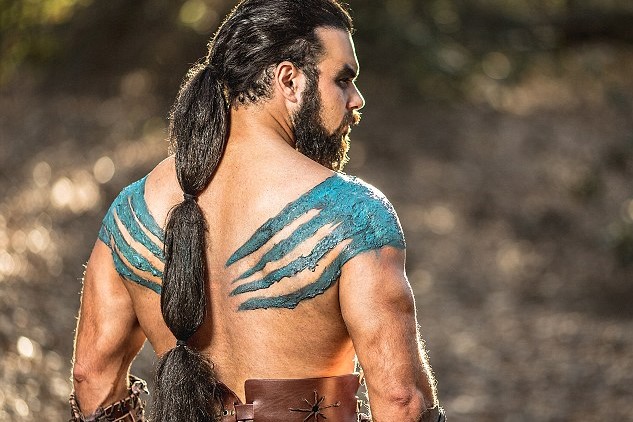
An obsessed Game of Thrones fan has put on 10lbs of pure muscle to transform himself into a hulking star of the show.
Rene Koiter, 29, spent ten months training to perfectly resemble the imposing character Khal Drogo, leader of the Dothraki.
Mr Koiter even employed a team of eight staff to help him with his professional transformation, so that he could look just like Khal – married to character Daenerys Targaryen.
When he first debuted his muscly new look at a staff party, the subsequent video went viral amassing over a quarter million hits on YouTube.
Since his makeover to the character – played by Jason Momoa – the graphic designer has gained a legion of female fans and has been bombarded with marriage proposals from women online.
Mr Koiter, from Lake Forest, California said: ‘Honestly, I had no idea what the reaction would be towards my transformation.
‘Many marriage proposals have been flung at me.
‘My joking response to these women is usually “Can you eat a horse heart like Daenerys famously does in the TV series?”
‘Imagine my surprise when they come back to me, saying they would eat two hearts for me.
‘It’s flattering of course but I worry that people are mixing up the fantasy from the reality.
‘Nevertheless, I do enjoy that the public are entertained because of this.’
Mr Koiter – who is already fluent in five languages – also learnt Dothraki, Khal Drogo’s fictional dialect in the series for a complete makeover.
In order to beef up for his transformation, Mr Koiter attended a boot camp class three times a week, and worked out at a gym during his lunch breaks and took long walks on his days off.
He also took afternoon bike rides in the Californian sunshine to perfect his Khal Drogo tan.
His rigorous training regime means he is now able to flip an 850lbs tyre, equivalent in weight to the average horse.
Mr Koiter also completely changed his diet.
He said: ‘I used to be a big cereal junkie – I would eat that for breakfast, lunch and dessert. But no more.
‘I had to quit all sugars and simple carbs to achieve this look. Now I eat things like veggies, fruits, eggs, oatmeal, chicken, lean beef, fish and protein shakes.’
Rene enlisted the skills of a costume designer, make-up artist, hair stylist to create Khal Drogo’s look.
He said: ‘Drogo was indeed a juggernaut of a character to bring to life. The whole process took almost ten months and what I’ll say is that you really need a team of people to build him properly.
‘I spent months growing out my hair for extensions, pumping iron like a mad man and then mimicking his Dothraki speech and mannerisms.’
For his next project, Rene is considering transforming into another Game of Thrones’ character, Jon Snow played by Kit Harington in the series.
The new series of Game of Thrones airs on 6 April 2014 and a 15-minute trailer for series 4 came out last night.
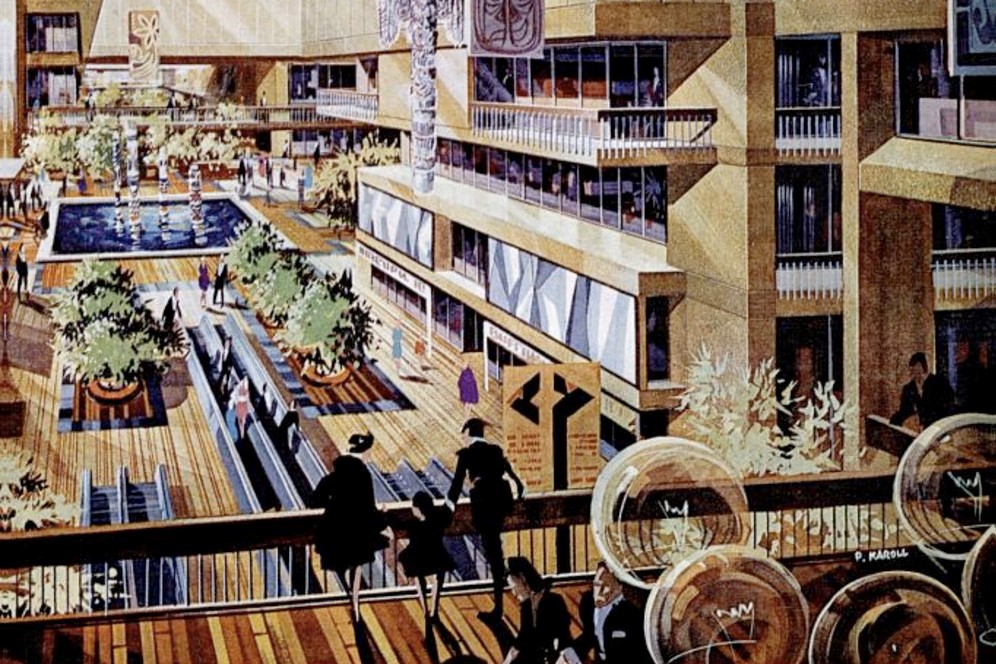
Today, in Alaska, there is much debate over building a bridge over Knik Arm from Anchorage to the largely undeveloped Point MacKenzie. This infamous “Bridge to Nowhere” has garnered national attention for being an example of government waste. Today, there is very little around Point MacKenzie. Supporters of the bridge say that this will change with a bridge, which will allow development that will pay for itself. While the ultimate outcome of the Knik Bridge argument is uncertain, it is interesting to note an idea that sprung from Alaska’s early oil days 4 decades ago in the same spot. This was Seward’s Success.
Seward’s Success was the ultimate futurist idea. A city of 40,000 located at Point MacKenzie in a glass, climate controlled structure. Touted as the world’s first enclosed city, it was a dream thought up during the rush of money expected from the discovery of oil in Prudhoe Bay in 1968. The idea was developed by Tandy Industries of Tulsa, with designers from Los Angeles. Seward’s Success would feature offices, shops and restaurants, an indoor sports arena, and housing units. The temperature would be kept at 68 degrees all year round, with natural gas providing the power supply.
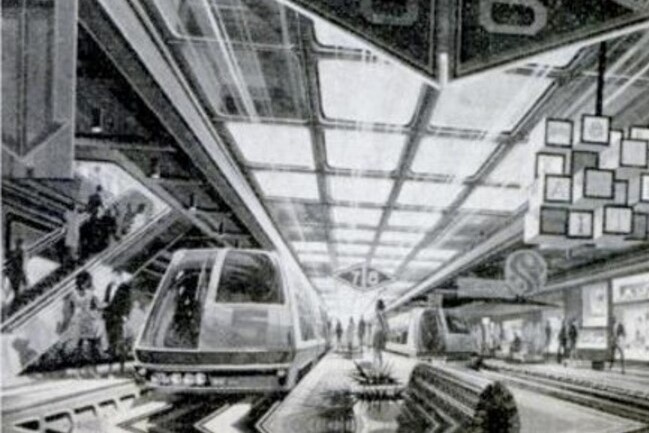
Transportation between Seward’s Success and Anchorage would initially be a high speed tramway across Knik Arm. Eventually, a monorail would connect the two cities and provide transportation within Seward’s Success (cars were not to be allowed in the city). Within the city, moving sidewalks would allow residents to move around the city.
So why is there no futuristic city at Point MacKenzie. Ultimately, the idea was short lived. In the early 1970s, the building of the Trans-Alaska Pipeline was held up in court. With the expected onrush of people and dollars held up, the subcontractor could not make the payment on the lease. And the dream of a glass city across from Anchorage fell away. In all likelihood, the city would have been a failure. Alaskans (or anyone else) would probably not go for living in what would basically be a gigantic shopping mall. Seward’s Success stands out as a social experiment that would have likely failed. Still, it is fun to sit look northwest from downtown Anchorage across the two mile strait and wonder.
Many an architect has dreamed up visionary plans for city centers, but few have actually seen their designs come to fruition in a real live urban setting. And while many such unbuilt concepts are technically viable, others are wacky, fanciful or downright bizarre. These 13 vintage urban design ideas for the future, from perfectly symmetrical egalitarian communities to the egotistical demands of a deranged dictator, will probably never become reality – and in many cases, we’re better off that way.
Gillette’s Metropolis
Before his name was inextricably connected to safety razors, King Camp Gillette had a utopian vision for the future which revolved around a waterfall-powered tiered city he dubbed ‘Metropolis’. All residents of this imagined city would have access to the same amenities including rooftop gardens in the perfectly round, precisely divided multi-functional buildings in which they would live, work, play and eat. Like many of Gillette’s ideas, the design never went anywhere, but it’s notably similar to many very modern 21st-century concepts for sustainable urban centers.
Broadacre City
Like Gillette’s Metropolis, Broadacre City was meant to be an urban utopia. But when renowned architect Frank Lloyd Wright imagined the picture-perfect society of tomorrow, he saw not highly compact and efficient high-rises, but sprawling self-sustainable homesteads. Originally conceived in 1932, Broadacre City puts each homeowner in a self-built single-family home on an entire acre of land brimming with gardens. Complete with multiple cars per family, it would almost be an accurate prediction of future suburbia if not for the airplane in every front yard.
Atomurbia
If giving each and every family in America an acre of land seems impossible, imagine what life would be like if ‘Atomurbia’ had come to pass. This concept, published in a 1947 issue of Life magazine, detailed how to atomic bomb-proof America by spreading the population across the land in a geometric grid and relocating all industry into underground structures so that any single bomb would do a minimum of damage. The whole plan would have cost a measly 5 trillion dollars in today’s currency, and the authors – atomic scientists from Chicago – thought it could be pulled off within a decade.
Hotel Attraction
Antoni Gaudi’s architecture defines Barcelona, Spain even today with its fluid curves, reflective surfaces and organic shapes – but it would stick out like a sore thumb in the comparatively staid cityscape of Manhattan. Perhaps that’s what he had in mind for ‘Hotel Attraction’, commissioned in 1908 and also known as the Grand Hotel. The rounded, spaceship-like form would have risen in the exact spot where the Twin Towers of the World Trade Center were later built, but the idea was ultimately abandoned. Gaudi’s unrealized design was actually considered as a possibility for the Ground Zero memorial after the attacks of September 11th, 2001.
Welthauptstadt
We all know that Adolf Hitler had many an ambitious plan that (thankfully) never came to pass – but few are aware of ‘Welthauptstadt’ (German for ‘World Capital’), the Fuhrer’s design for a new Berlin to be constructed after his expected victory in World War II. Taking elements from other empires around the world, Hitler imagined a broad ‘Avenue of Victory’ down the center as well as his very own ‘Arch of Triumph’. A test structure constructed in 1938 to determine whether Berlin’s marshy ground could have even held up such heavy Romanesque architecture (verdict: nope) still stands today.
Palace of Soviets
The Palace of Soviets would have been the world’s tallest structure at 100 meters high and crowned with a brightly lit hammer and sickle as a monument to Lenin on the site of the demolished Cathedral of Christ the Savior, if only the Nazis hadn’t invaded in 1941, putting a stop to construction. Its steel frame was disassembled for use in fortifications and bridges, and its foundations served as the world’s largest open-air swimming pool for a while before 1995 when the whole thing was filled in so that the cathedral could be rebuilt.
Ville Contemporaine
The architect known as Le Corbusier was an essential figure in the development of what we now know as modern architecture, and his many theoretical urban design projects aimed to make life better for residents of cramped cities. Displeased with the chaos of big cities, Le Corbusier designed ‘Ville Contemporaine’ as an orderly home to three million people where housing, industry and recreation all occupied distinct areas connected by roads that emphasized the use of personal vehicles for transportation.
Seward’s Success
If it was Seward’s Folly to purchase Alaska from the Russian Empire in the first place, perhaps Seward’s Success – a huge climate-controlled, glass-enclosed city for 40,000 people – could have made up for it. Or not. Proposed in 1968 and nixed in 1972, this unbuilt community was dreamed up after the discovery of oil reserves at Prudhoe Bay, Alaska when developers imagined droves of people coming to the area. The crowning jewel of the perpetually 68-degree dome would have been a 20-story Alaskan Petroleum Center, surrounded by housing, offices, retail space and an indoor sports arena.
Triton City
If not for a certain tell-tale 1960s aesthetic, Buckminster Fuller’s ‘Triton City’ could easily fit among today’s designs for floating eco-friendly cities. The futurist, architect and inventor was ahead of his time as usual when he imagined this tetrahedronal metropolis for Tokyo Bay, a seastead for up to 6,000 residents. Fuller wrote about the possibility of desalinating and recirculating seawater “in many useful and non-polluting ways” and using materials from obsolete buildings on land, which were hardly popular ideas at the time.
Future New York, “The City of Skyscrapers”
By 1925, many of New York City’s skyscrapers were already present, but futurists of the time envisioned not only a great deal more but a sort of aerial civilization complete with elevated train platforms and perhaps a rather unsafe number of aircraft flying around all at once.
New York City’s Dream Airport
All the airplanes in that 1925 postcard would definitely require a monumental airport in New York City, and what better location than right smack in midtown Manhattan? This concept for “New York City’s Dream Airport” featured an astonishingly large – and some say ugly – runway platform. But for all of the prime real estate that this monstrosity would have devoured, it seems as if it could only handle a handful of planes at a time with absolutely zero margin of error, sending errant planes straight into Central Park or the East River.
Slumless, Smokeless Cities
How do you build a city so egalitarian that slums are eliminated entirely, and nobody ever has to breathe in pollution? Sir Ebenezer Howard, the father of the garden city movement, believed that a careful layout with six satellite garden cities connected via canals to a densely populated central city would do the trick. Thoughtfully, the design included specially designated spaces for “Eplileptic Farms”, “Homes for Waifs”, “Homes for Inebriates” and an insane asylum.
Boozetown
“Just imagine a resort entirely centered on the culture of alcohol. A boozer’s paradise built expressly to facilitate drinking and the good times that naturally follow. Where the bars, clubs and liquor stores never close.” Mel Johnson’s ‘Boozetown’ was an entirely sincere proposal with street names like “Gin Lane” and “Bourbon Boulevard” that would have begun as a resort town in Middle America and eventually expanded into a full-sized adults-only city with permanent housing and its own suburbs. After many obsessed years of struggling for financing, Johnson gave up on his dream in 1960 and died in a mental hospital in 1962.

Final Fantasy X is one of the most popular games in the series to date, and many fans would say that it’s the greatest Final Fantasy ever released. It was the first Final Fantasy for the PS2, having a huge graphical upgrade, and being the first in the series to feature voice acting for the major characters. In it, players take control of Tidus, who suddenly gets pulled from his home in Zanarkand and taken to an unknown land. He joins a Summoner named Yuna on her Pilgrimage to save the world from Sin, while also trying to find a way back home. With its amazing story, strategic turn-based combat, and highly customizable Sphere Grid system, Final Fantasy X is a great entry in the series for both old and new fans.
Final Fantasy X-2 is the first direct sequel in the series and made a lot of big changes from the original game. The story takes place two years after the events of FFX and follows Yuna as she begins a new journey. The tonal shift may be off putting to some, but the game expands on the world of Spira, and allows you the freedom to explore it as much as you’d like. The combat for X-2 is much more fast paced compared to its predecessor, featuring an ATB (Active Time Battle) system, and the Dressphere system, allowing characters in your party to change their roles mid battle. While not as highly regard as FFX, its sequel is a fun game that’s worth playing, and its multiple endings and New Game+ even encourage multiple playthroughs.
The Final Fantasy X/X-2 HD Remaster bundles both of these games into one package and adds many new features to the game to give even veterans a fresh experience.
Graphical and Music Upgrades
Probably the most obvious improvement from this remaster is the graphical upgrade. Since this isn’t a full remake, the PS2 models are still used, but everything is retextured and smoothed out, adding much more detail to the environment, and making all of the character models look much better. Major characters are also remodeled, but the only thing that suffers from this are the faces. Some of the faces feel off compared to the original, and their eyes look less expressive, especially when the camera zooms in on them.
The music for Final Fantasy X has been given a complete overhaul. Just about every song in the game has a new arrangement to it, giving a new feel to areas and cutscenes. If you prefer the original versions of the music, you can easily toggle between the original and new soundtracks within FFX’s menu.
Added Content
The most exciting thing about the remaster is that we get the International versions of both X and X-2. These versions were Japan exclusive re-releases for the PS2, where many features, bosses and even story content were added.
FFX adds the Expert Sphere Grid. This is a complete reconfiguration of the Sphere Grid, where all of the characters start near the middle, and their paths are a lot more intertwined. This makes it a lot easier to build your characters off of their standard path (for example, Yuna can learn Black Magic spells much earlier in the game). Many new superbosses were also added, now giving you the option to fight Dark Aeons and Penance.
FFX-2 adds new Dresspheres (Festivalist and Psychic), and a Creature Creator system, which allows you to capture enemies and recruit them as your party members, along with a Monster Arena. Also added is the Last Mission, which is a new side story set three months after the events of X-2, featuring all new gameplay.
We even get some extra story content with Eternal Calm, a short movie set one year after the events of FFX, and Final Fantasy X -Will-, a 30-minute audio drama set after the events of FFX-2. PC players also get some optional boosts for both games. The main draw here is 2x/4x speed, which is really helpful when wanting to grind levels or farm materials. Other boosts include Supercharge and the ability to grant all items and abilities if you want to have a more casual playthrough.
For some reason, the remaster did not add the ability to skip cutscenes in either game. This can be frustrating if you get stuck in a boss fight because you will have to watch a potentially long cutscene before every attempt at the fight.
Replayability
With all of the added features, there is a ton of replay value in both X and X-2. For FFX, you can do another playthrough using the Expert Sphere Grid, or you can build the perfect party in order to take on the Dark Aeons and Penance. X-2 already had a lot of replay value for players who wanted to see all of the endings and try the countless party configurations using different Dresspheres. Now with the Creature Creator and Monster Arena, you can spend hours trying to build the perfect team and take on the new superbosses, or try to catch every monster and watch their story. Between both games, you can easily spend hundreds of hours in the world of Spira.
Verdict
Final Fantasy X is an amazing and highly influential game, while Final Fantasy X-2 is a really fun experience for those that don’t mind a huge change. With both titles being bundled together, having a great graphical upgrade, and having all of the International content included, I would highly recommend picking this up if you’re a fan of RPGs. Even if you played these before, there are plenty of new things to discover in the remaster, and if you’re looking to get into Final Fantasy for the first time, FFX is one of the best games to get you into the series.








 Igor's Blog