Qutb Minar and its Monuments, Delhi

https://whc.unesco.org/en/list/233

Built in the early 13th century a few kilometres south of Delhi, the red sandstone tower of Qutb Minar is 72.5 m high, tapering from 2.75 m in diameter at its peak to 14.32 m at its base, and alternating angular and rounded flutings. The surrounding archaeological area contains funerary buildings, notably the magnificent Alai-Darwaza Gate, the masterpiece of Indo-Muslim art (built in 1311), and two mosques, including the Quwwatu’l-Islam, the oldest in northern India, built of materials reused from some 20 Brahman temples.

Brief synthesis

The ensemble of mosques, minars, and other structures in the Qutb Minar complex is an outstanding testimony to the architectural and artistic achievements of Islamic rulers after they first established their power in the Indian subcontinent in the 12th century. The complex, located at the southern fringe of New Delhi, illustrates the new rulers’ aspiration to transform India from Dar-al-Harb to Dar-al-Islam with the introduction of distinctive building types and forms.

Referred to as the Qutb mosque, the Quwwatu’l-Islam, meaning the Might of Islam, introduced to India the classic model of Islamic architecture that had developed in western Asia. The mosque constituted a large rectangular courtyard enclosed by arcades having carved pillars on three sides and an imposing five-arched screen marking the west. Incorporating temple elements such as the carved pillars and cladding characteristic of Hindu and Jain temples, it was completed by subsequent rulers – Qutb ud din Aibak and Shamsu’d-Din Iltutmish. Drawing references from their Ghurid homeland, they constructed a minar (minaret) at the south-eastern corner of the Quwwatu’l-Islam between 1199 and 1503, thereby completing the vocabulary of a typical classic Islamic mosque. Built of red and buff sandstone and eloquently carved with inscriptional bands, the Qutb Minar is the tallest masonry tower in India, measuring 72.5 metres high, with projecting balconies for calling all Muadhdhin to prayer. An iron pillar in the courtyard gave the mosque a unique Indian aesthetic.

The 13th-century square tomb of Iltutmish in the north-western part of Quwwatu’l-Islam marks the beginning of the tradition of constructing royal tombs, a practice followed as late as the Mughal era in India. The tomb-chamber is profusely carved with inscriptions and geometrical and arabesque patterns associated with Saracenic tradition. Expansions made by Allaudin Khilji to the existing ensemble between 1296 and 1311 reflect the power wielded by the monarch. In his short reign, the emperor added a massive ceremonial gateway (Alai Darwaza) south of the Qutb Minar, and also added a madarsa (place of learning). The first storey of the incomplete Alai Minar, which was envisaged to be twice the scale of the Qutb Minar, stands 25 metres high.

Criterion (iv): The religious and funerary buildings in the Qutb Minar complex represent an outstanding example of the architectural and artistic achievements of early Islamic India.

Integrity

The boundary enveloping the remains of the Qutb and Alai minars, Quwwatu’l-Islam mosque with its extension, madarsa of Alauddin Khilji, tomb of Iltutmish, Alai Darwaza (ceremonial gateway), Iron Pillar, and other structures is of adequate size to ensure the complete representation of the features and processes that convey the property’s significance, including the aspiration and vision of the Ghurid clans to establish their rule and religion in India. The state of conservation is stable and the property does not suffer from adverse effects of development and/or neglect.

The peripheral area of the property has mixed land use, a large tract of green area (Mehrauli Archaeological Park), and facilities to support visitor movement. No threats to the integrity of the property have been identified by the State Party.

Authenticity

The Qutb Minar and its Monuments complex is substantially authentic in terms of its location, forms and designs, and materials and substance. The attributes that sustain the Outstanding Universal Value of the property are truthfully and credibly expressed, and fully convey the value of the property. To maintain the state of conservation of the property, repairs undertaken have respected the original construction, architectural, and ornamentation systems that demonstrate the Outstanding Universal Value of the property. Works periodically undertaken to ensure the property’s structural and material sustainability are reversible.

Protection and management requirements

The Qutb Minar and its Monuments complex is owned by the Government of India and managed by the Archaeological Survey of India (ASI). Its peripheral area is managed by multiple stakeholders, including the ASI, Delhi Development Authority, Municipal Corporation of Delhi, and Government of the National Capital Territory of Delhi. The overall administration of the property and its peripheral area is governed by the Ancient Monuments and Archaeological Sites and Remains Act (1958) and its Rules (1959), Ancient Monuments and Archaeological Sites and Remains (Amendment and Validation) Act (2010), Delhi Municipal Corporation Act (1957), Land Acquisition Act (1894), Delhi Urban Art Commission Act (1973), Urban Land (Sealing and Regulation) Act (1976), Environmental Pollution Control Act (1986), Indian Forest Act (1927), Forest Conservation Act (1980), and Delhi Development Act (1957). Annual funds are provided by the Central Government for the overall conservation, maintenance, and management of the property.

The Qutb Minar and its Monuments complex is maintained, monitored, and managed by the ASI Acts and Rules through an annual conservation and development plan. To strengthen the plan, training, researchers, and experts are engaged to ensure high-quality conservation that respects the authenticity of the property. Although there is a proposal to prepare a management plan for the property that includes conservation, integrated development, visitor management, and interpretation, in the meantime the property is protected under a well-established management system.
Moon (1965)

Luna (Russian: Луна, “Moon“) is a Soviet popular science and science fiction film directed by Pavel Klushantsev.

The first part of the film, popular science, tells of recent (mid-1960s) achievements in the exploration of the Moon. Scientists discuss the hypothesis of the origin of the lunar maria, about the temperature of the lunar surface and the supposed properties of the lunar soil. The second part of the film, science fiction, shows how the moon in the near future will be developed by people from a hypothetical first lunar mission to lunar cities and laboratories.

The film won the “Golden Seal of Trieste” at the IV International Science-Fiction Film Festival (Italy, 1966).

The Mystery Of The Amber Room, The Astonishing Russian Treasure That’s Been Missing Since World War II

https://allthatsinteresting.com/amber-room

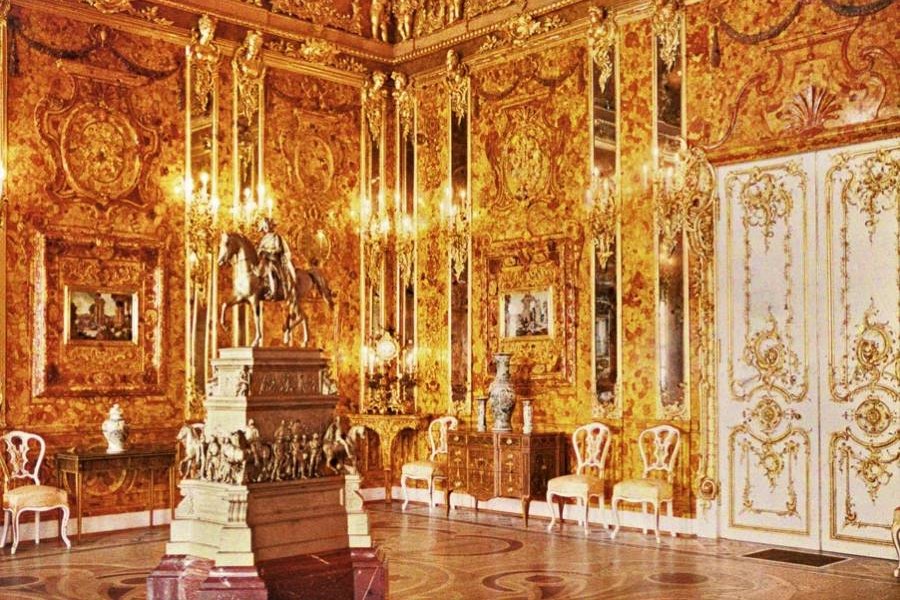
Known as the “eighth wonder of the world,” the Amber Room at the Catherine Palace in St. Petersburg was looted by the Nazis and disappeared forever in 1943.

The fate of the Amber Room in Catherine Palace outside of St. Petersburg, Russia, is one of Europe’s most enduring mysteries.

The Amber Room was once the jewel of the Romanov’s luxurious summer residence and was covered in amber, gems, and gold leaf from floor to ceiling. Estimated to be worth between $142 million and $500 million in today’s dollars, the room astonished visitors, who called it the “eighth wonder of the world.”

Then, during World War II, the Amber Room vanished after Nazi soldiers looted it. Because the room was originally built in Germany for the Prussian Emperor Frederick I and later gifted to Peter the Great of Russia, the Nazis claimed it was theirs.

But when they took it back to Germany, all records of its location disappeared. And while some claim that Allied bombs destroyed the precious historic room, others are certain that the Nazis must have hidden away its millions worth of amber. To this day, no one has ever found the amber room.

Prussia’s first king, Frederick I, ordered the construction of the Amber Room in 1701. The room would stand as a testament to Prussian wealth. The king brought in sculptor Andreas Schlüter to design the room, while the Danish craftsman Gottfried Wolfram put together the delicate pieces.

The Baltic region contains some of the largest amber deposits in the world. And amber, fossilized tree resin dubbed the “gold of the north,” became a symbol of Prussian riches.

Not long after the Amber Room was completed at Charlottenburg Palace in Berlin in 1709, royals from across Europe expressed astonishment at its ingenuity. Kings had built rooms covered in gold and precious stones before. But no one had taken amber and transformed it into a glowing art installation.

And in addition to the multicolored amber set onto gold leaf panels to create intricate mosaics, the room was also decorated with mosaics of quartz, jasmine, jade, and onyx. In 2016, the original Amber Room was valued as high as $500 million.

But the room would not remain in Berlin for long. Frederick I died in 1712, and his son, Frederick William I, decided to gift the magnificent creation to the Russians in 1716 to commemorate their alliance against Sweden after Peter the Great spoke highly of the room during a visit to the palace.

So, only years after putting it together, Prussian artisans took apart the room and packaged up a fortune’s worth of amber in 18 boxes. The Russians recreated the display in the Winter Palace of St. Petersburg.

The Romanovs preened over their stunning room. In 1755, Peter the Great’s daughter, Empress Elizabeth, relocated the display to the Catherine Palace outside of St. Petersburg, where the family spent their summers.

Now in a larger space, the Romanovs brought in an Italian designer to expand the Amber Room. Bartolomeo Francesco Rastrelli brought in more amber and crafted an even more impressive version of the room.

By the end of the 18th century, the room stood at around 180 square feet. It contained six tons of amber mixed in with other precious stones and gold leaf.

When Catherine the Great wanted to impress visitors, she hosted them in the Amber Room. And Czar Alexander II displayed his trophies in the room. Empress Elizabeth used the space for another purpose: private meditation.

In 1917, the Romanovs lost power in Russia. A revolution swept new rulers into power. And while much of the Romanov wealth disappeared, the Amber Room remained in the Catherine Palace — until the Nazis invaded Russia and stole the entire room.

Hitler’s invasion of the Soviet Union — known as Operation Barbarossa — began in 1941. Three million Nazi soldiers flooded into the Eastern Front. And they hauled off a fortune in art, including the Amber Room.

With Nazis marching toward the Catherine Palace, Soviet officials tried to save the amber. But when they tried to take apart the intricate installations, the amber crumbled to pieces.

That was, in part, because of how the craftsmen created the room. They heated fossilized tree resin and dunked it in honey and linseed. Then, artisans pressed the amber into wood panels. Centuries later, the dry amber had grown incredibly fragile.

Panicking, the officials put up wallpaper to hide the precious amber. But Nazi soldiers quickly saw through the deception. They took apart the room in a matter of hours and shipped it to Königsberg Castle.

The Nazis declared that the Amber Room was German. A German designer crafted it for a German king. And it should not remain in Russia.

In Königsberg, museum director Alfred Rohde looked after the artifacts. And when Allied advances threatened the castle in late 1943, Rohde packed away the amber. Then, in August 1944, a bomb hit the castle.

But did that bomb destroy the Amber Room? When the Soviets marched into Königsberg, they searched the rubble for the treasure. Yet no trace remained.

No one has found the Amber Room since it vanished in 1943. But since its disappearance, many treasure hunters have clamored to discover the location of this lost horde, but none have been successful so far. So, what happened to the tons of amber worth millions?

One theory claims the bombings and fires destroyed the amber. A Soviet professor sent to investigate the missing artifacts claimed he found burned evidence of the amber mosaics in the Königsberg Castle cellar. But many refused to accept that explanation.

Then in 1997, a clue emerged. The son of a Nazi soldier tried to sell a panel from the Amber Room at an auction in Germany. But a follow-up investigation showed that the panel was a one-off — his father stole just the single mosaic while removing the artifact from Russia.

One eyewitness claimed to see Nazis pack boxes onto a transport ship called the Wilhelm Gustloff. In the final months of the war, the Soviets sank the ship. Yet dives to the wreckage of the Wilhelm Gustloff have not turned up any evidence.

Another theory claimed the Nazis snuck out the boxes through tunnels under the castle. The amber may have been hidden away in underground salt mines, sunk to the bottom of a lagoon, or shipped overseas.

In 2017, three amateur sleuths, homeopath Leonhard Blume, 73, scientist Günter Eckardt, 67, and georadar specialist Peter Lohr, 71, thought they’d found the lost treasure. They believed that the famed room resided in Prince’s Cave in the Hartenstein hills near Dresden.

The cave is known to have been used by Nazi scientists, and Lohr told The Daily Mail that a “reliable source” told him in 2001 that the room was brought to an underground bunker there in 1945. And in fact, they even found evidence of a large bunker in these hills and a location where steel ropes were used to haul crates to their desired location.

But when they investigated, they came up empty-handed. No one else has found the Amber Room either.

And even if they had found it, Alexander Shedrinsky, a conservator and biochemistry professor at New York University, told The New York Times, it wouldn’t have been much to look at.

“If the Amber Room lies hidden somewhere, it is most probably in some damp mine, which means it is almost certainly in a state of ruin,” he said.

“Even before it was stolen, it was in poor shape, in need of restoration, and the amber pieces were falling out.”

Today, the mystery of the Amber Room still has no solution — but one last theory holds that the Soviets themselves covered up the destruction of the room. After the war, Königsberg, Germany, became Kaliningrad, Russia, and in 1968, the Soviets destroyed the remains of Königsberg Castle, making it impossible for anyone else to find traces of the original room.

Then, in 1979, the Russians decided to rebuild the entire room. Using black and white photos of the Amber Room and uncovering the trade secrets necessary to create the multicolored amber of the room, the Russian government completed their recreation of the Amber Room in 2004.

The replica cost $11 million and marked the 300th anniversary of St. Petersburg. Ironically, when the organization tasked with recreating this landmark ran out of money in 2000, a German company raised the necessary funds to finish the project.

So a German-made artifact, given to the Russians, reworked by Russians and Germans, stolen by the German army, is finally recreated by the Russians with the help of a German company. The complicated relationship between these two great nations is embodied in the history of this work of art.

While visitors can view this new Amber Room in St. Petersburg, the original remains lost to history, at least for a while longer — until the original Amber Room may be found.

Remarks on Interview of Professor Stephen Cohen on RT

https://msuweb.montclair.edu/~furrg/research/furr_cohen_rt11012015.html

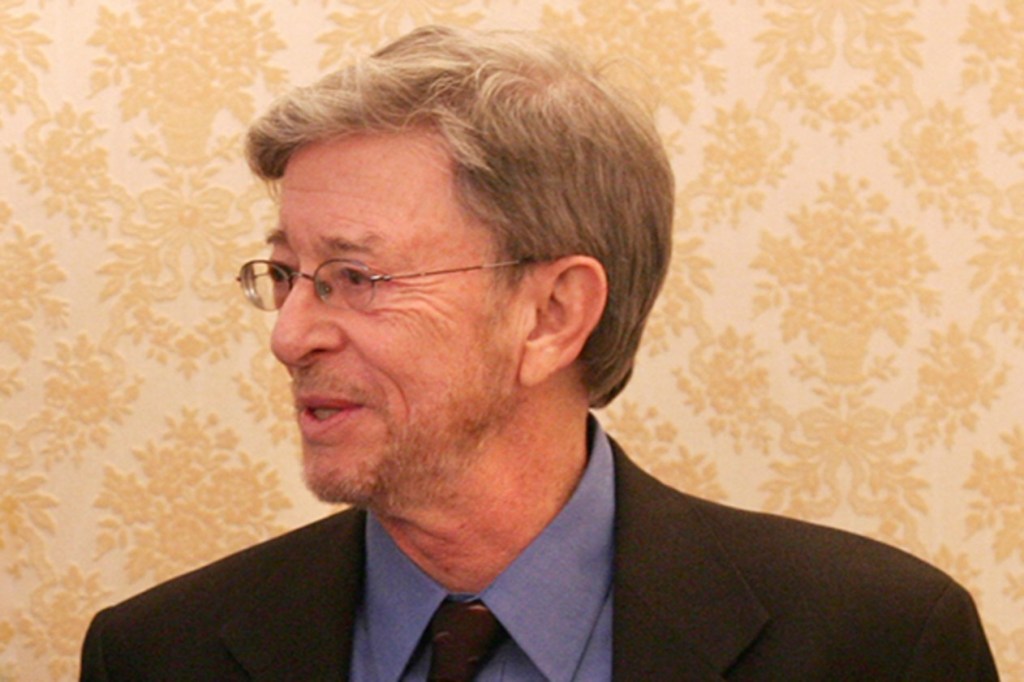
On November 1, 2015 Stephen F. Cohen was interviewed by Oksana Boyko, a journalist for RT.COM.

Cohen is a retired professor of Soviet history at Columbia University and New York University,a longtime columnist for The Nation magazine, and expert on Nikolai Bukharin.

In the late 1970s Cohen’s 1973 book Bukharin and the Bolshevik Revolution was translated secretly into Russian and smuggled into the USSR. Mikhail Gorbachev said that it helped convince him of the evil of the Stalin years. It was the first book by a Western “Sovietologist” to be officially published in Russian, in the USSR, by a Soviet publisher.

Cohen has some credibility among leftists because he is a liberal among the scholars on the USSR. He has said that he was sorry to see the demise of the USSR and felt terrible about the suffering of the (former) Soviet working class during the Yeltsin years, when living standards and life expectancy went into a free fall. Cohen has opposed US policy on Ukraine and is much more supportive of the Putin policy than virtually any other mainstream scholar of Russia or the USSR.

It’s all the more important, therefore, to understand that on the subject of Stalin Cohen is more similar to than he is different from the Cold War anticommunist and anti-Stalin ideologues who are the main “expert” voices about Soviet history. Cohen shares with them what I have called the “anti-Stalin paradigm” of history. This is a version of Soviet history of the Stalin period entirely built on lies, fabrications, and forgeries. Cohen repeats some of them here.

In 2012 my Moscow colleague Vladimir L. Bobrov and I published a lengthy article titled “Stephen Cohen’s Biography of Bukharin: A Study in the Falsehood of Khrushchev-Era ‘Revelations’.” (Cultural Logic for 2010) In it we show that virtually every fact-claim Cohen makes in Chapter 10 of his Bukharin biography is false. This is the chapter that takes Bukharin’s life from 1930 to his trial and execution in 1938.

We begin that article by showing that Cohen deliberately lies in this book. Cohen quotes from the memoirs of one of Bukharin’s close friends and colleagues of the 1920s, the Swiss communist Jules Humbert-Droz. Humbert-Droz revealed that Bukharin told him in 1928 that he and his supporters were plotting to assassinate Stalin. Cohen never mentions this passage, concealing it from his readers. When confronted about this omission in 2014 Cohen claimed: “I knew nothing about his subsequent remark until well after my book was published.” This cannot possibly be true since Cohen quotes from the very same memoir in his book.

(I would like to note here that I was directed to Humbert-Droz’ memoir some years ago by a review by Vijay Singh, founder and editor of the fine journal Revolutionary Democracy.)

Therefore Cohen is not above lying about Soviet history of the Stalin period. But I think the main issue here is not Cohen’s personal dishonesty. Rather, it is the “anti-Stalin paradigm” which is required, is the only “politically correct” version of Soviet history allowed. And it is built on lies.

In this talk I will just outline the lies that Cohen tells in this RT.COM interview.

  • Cohen refers to “20 million victims of Stalin.” This is a big lie. No anticommunist scholar has come anywhere close to such a number. Timothy Snyder, in Bloodlands, gets a figure of 6-8 million only by including 5 million who died in the 1932-33 famine as “Stalin’s victims.” The best estimates are that the real number of those who died as a result of the famine is about 2.9 million.
  • “Collectivization led to the famine.” The opposite is true. Collectivization was a true reform, as Mark Tauger, the foremost expert on Russian famines, has written. As a result of the modernization and mechanization of agriculture, the cycle of famines every 2-3 years in Russia and Ukraine was stopped for good. I discuss this in detail in Blood Lies, where I state that the collectivization of agriculture should have been awarded a Nobel Prize as the greatest feat of social engineering of the 20th century.

We should never concede that there were any “victims of Stalin” other than the exploiters, the capitalists and their supporters, whose “victims” the Russian peasants and working class had been for centuries. Nor should we ever concede that “Stalin killed” anyone – not even one person. Stalin did not “kill” people at all.

  • Cohen claims that “the terror continued till Stalin dies in 1953.” Even the most anticommunist researchers acknowledge that the so-called “terror” – mass executions – stopped when Lavrentii Beria took over as head of the NKVD from Nikolai Ezhov in late 1938.

Likewise, we should never concede that there was ANY “terror.” In a 1986 article in Slavic Review, “Fear and Belief in the USSR’s ‘Great Terror’: Response to Arrest, 1935-1939” Robert Thurston argued that there was no “terror” because people were not “terrorized.”

The best term for this period is the Ezhovshchina, or “bad time of Ezhov.”

  • Cohen claims that Stalin wrote “arrest family,” “arrest and shoot” on “lists.” This is false. I discuss this in my book Khrushchev Lied.
  • These lists were sent to the Secretariat, including Stalin, “for review.” Many people on them were not executed, or received lesser punishments, or were released.
  • Cohen claims that “the NKVD was given quotas by Stalin’s office.” A lie!
  • Arch Getty discusses this in his latest book Practicing Stalinism. These were not quotas but limits – not minimum, but maximum numbers. Ezhov treated them as “quotas” – but Ezhov had his own conspiracy against the Soviet leadership, for which he was eventually arrested, tried, and executed.
  • Cohen said: “We know Stalin issued an order for the NKVD in prisons” to “use physical force.”
  • This is false too. I cover this in Khrushchev Lied. The order in question – which may be a forgery, authorizes the use of “means of physical pressure” only in the case of the most hardened and intransigent enemies of the state. (Cohen gets the dates wrong – the actual date is January 1939, not 1936-37, as Cohen says.)
  • Cohen says: “Why did he [Stalin] destroy the military high command? Why did he kill them? He convinced himself that they were not loyal.”

We have a great deal of evidence that confirms the guilt of Marshal Tukhachevsky and other military commanders in plotting both a coup d’etat against the Soviet government and Party leadership, and also plotting with Germany and Japan to join invading fascist armies against the Soviet government in the event of war.

The truth, as demonstrated by the best evidence, is that in stopping the military conspiracy Stalin’s leadership contributed to saving not only the Soviet Union, but all of Europe and indeed the world from fascism at that time. Both Germany and Japan would have been immeasurably stronger in their wars against the Allies if the military conspirators had succeeded. Germany would have had the immense material and human resources of the Soviet Union to turn against England and the US. Japan would have had the petroleum of the Soviet East and Sakhalin, making it far less vulnerable in its war against the USA.

Since Khrushchev’s day it has been heresy in the USSR, and now in Russia, to discuss the evidence that the military conspirators were guilty. But the evidence is there. I wrote about this in Chapter 17 of The Murder of Sergei Kirov. I have much more about the military conspiracy in my forthcoming book Trotsky’s ‘Amalgams.’ It will be published in December, 2015.

Cohen has been close to the family of Nikolai Bukharin for decades and is completely committed to the position that Bukharin was innocent, “framed” and murdered by Stalin. This flies in the face of all the evidence now available. Vladimir Bobrov and I have published several articles on Bukharin and the evidence against him that is now available. All are on my Home Page.

  • Cohen claims that he met the daughter of “Kogan,” an NKVD man who had “tormented” Bukharin, and that Bukharin’s aged widow said that Kogan too had been a “victim” of Stalin. This is all wrong.

There were at least two NKVD men named Kogan. We don’t know which “Kogan” is in question here. In her autobiography, Bukharin’s widow Anna Larina just calls him “Kogan.” She also states that Bukharin sent her a note saying that his conditions in prison were very good! Neither she nor anyone else has any evidence that Kogan, or for that matter anybody, “tormented” Bukharin.

Some other sources assume the “Kogan” here is L.I. Kogan. If so, this Kogan was arrested tried, and executed in 1939, under Beria, for “illegal arrests of Soviet citizens and the falsification of criminal cases.” That is, when Beria, with the agreement of Stalin and the rest of the Soviet leadership, was investigating the criminal mass executions carried out under Ezhov. I cover this in my book Blood Lies.

Boyko, the interviewer, calls Timothy Snyder and Anne Applebaum “good historians” and contrasts them to Cohen, who is certainly a liberal compared to these two. In Blood Lies I expose Snyder’s dozens of lies about Stalin, the USSR, and communists.

This shows the convergence of overtly right-wing anticommunists with liberal anticommunists like Cohen in the “anti-Stalin paradigm.” This paradigm can accommodate both. Just as it also accommodates anarchists and Trotskyists, who compete with the overly pro-capitalist anticommunists in spreading lies and horror stories about Stalin.

In conclusion: lies about the Stalin period are promoted by all anticommunists, from the pseudo-left to liberal and right-wing. The Russian Revolution, the high point of whose achievements were attained during the period of Stalin’s leadership, continues to incite fear and hatred among its enemies.

Dugong – New World Encyclopedia

https://www.newworldencyclopedia.org/entry/Dugong

Dugong is the common name for a large, herbivorous, fully aquatic marine mammal, Dugong dugon, characterized by gray-colored, nearly hairless skin, paddle-like forelimbs, no hind limbs, a fluke-like (forked) tail, a sharply downturned snout, and tusks. The dugong is only living representative of the once-diverse family Dugongidae; its closest modern relative, Steller’s sea cow (Hydrodamalis gigas), was hunted to extinction in the eighteenth century. The dugong is found in Indo-Pacific waters from eastern Africa to southeast Asia.

Dugongs are part of the order Sirenia along with manatees, both of which are sometimes known as “sea cows” for their grazing of vegetation. The dugong is heavily dependent on seagrasses for subsistence. A “cultivation grazer,” it feeds on the seagrass in a manner that actually promotes regrowth of the seagrass, though aerating the sea floor and increasing the amount of organic matter in the area.

The dugong has been hunted for thousands of years for its meat, fat, oil, hides, and bones. However, their significance to humans goes beyond such physical values to cultural significance for the indigenous peoples throughout the dugong’s range. The dugong also has an ecological function as part of marine food chains, although its large size means adults have few predators, these being such as sharks, killer whales, and saltwater crocodiles.

Despite these values, the dugong faces many risks from such anthropogenic (human caused) factors as habitat destruction, pollution, hunting, fishing-related fatalities, and collisions with boats and propellers as they surface for air. With its long lifespan and slow rate of reproduction, the dugong is especially vulnerable to these types of exploitation. The dugong’s current distribution is reduced and disjunct, and many populations are close to extinction. The IUCN lists the dugong as a species vulnerable to extinction, while the Convention on International Trade in Endangered Species limits or bans the trade of derived products based on the population involved. The dugong population is predicted to enter a steep decline. However, many scientists are working to prevent this potentially cataclysmic blow to the entire dugong population. Currently, this effort is proving futile, as the dugong population is not showing any increased population numbers.

Overview and description

The dugong is a large marine mammal which, together with the manatees, is one of four living species of the order Sirenia. Sirenians are one of four groups of marine mammals, the others being cetaceans (whales, dolphins, and porpoises), sea otters, and pinnipeds (walruses, earless seals, and eared seals). The sirenians and cetaceans are completely aquatic, while pinnipeds spend considerable time on land, including giving birth and raising their young, and sea otters can mate and raise their young entirely at sea. Sirenia is thought to have evolved from four-legged land mammals over 60 million years ago, with the closest living relatives being the Proboscidea (elephants) and Hyracoidea (hyraxes) (Domning 1994). The dugong is the only strictly-marine herbivorous sirenian, as all species of manatee utilize freshwater to some degree.

Like all modern sirenians, the dugong has a fusiform body with no dorsal fin or hindlimbs, instead possessing paddle-like forelimbs used to maneuver itself. The main visual difference between manatees and dugongs are the tails. A manatee tail is paddle-shaped, while a dugong tail is forked, similar in shape to that of a whale of dolphin. The paddle-like forelimbs aid in movement and feeding, while its fluked tail provides locomotion through vertical movement. The dugong also possesses a unique skull and teeth (Myers 2002).

Unlike the manatees, the dugong’s teeth do not continually grow back via horizontal tooth replacement (Self-Sullivan 2007). The dugong has two incisors (tusks) which grow posteriorly until puberty, after which they first erupt in males. The female’s tusks continue to grow posteriorly, often not externally evident, but sometimes erupting later in life after reaching the base of the premaxilla (Marsh 1989).

Like other sirenians, the dugong experiences pachyostosis, a condition in which the ribs and other long bones are unusually solid and contain little or no marrow. These heavy bones, which are among the densest in the animal kingdom (Waller et al. 1996), may act as a ballast to help keep sirenians suspended slightly below the water’s surface (Myers 2000).

Dugongs are generally smaller than manatees (with the exception of the Amazonian manatee), reaching an average adult length of 2.7 meters (8.9 feet]]) and a weight of 250 to 300 kilograms (550 to 660 pounds]) (IFAW 2008). An adult’s length rarely exceeds 3 meters, and females tend to be larger than males (Marsh 1989). The largest known dugong was an exceptional female landed off the Saurashtra coast of west India, measuring 4.03 meters (13.3 feet) and weighing 1,018 kilograms (2,240 pounds) (Wood 1982).

The word “dugong” derives from the Tagalog term dugong, which was in turn adopted from the Malay duyung, both meaning “lady of the sea” (Winger 2000). Other common local names include “sea cow,” “sea pig,” and “sea camel” (Reeves et al. 2002).

The dugong was first classified by Müller in 1776 as Trichechus dugon (PD 2008a), a member of the manatee genus previously defined by Linnaeus (PD 2008b). It was later assigned as the type species of Dugong by Lacépède (PD 2008c) and further classified within its own family by Gray (PD 2008d), and subfamily by Simpson (PD 2008e).

Distribution

The dugong is the only sirenian in its range, which spans the waters of at least 37 countries throughout the Indo-Pacific, from Africa to the Philippines and the South China and East China Seas, where sea grasses are found (Marsh et al. 2002; Grzimek et al. 2004). However, the majority of dugongs live in the northern waters of Australia between Shark Bay and Moreton Bay (Lawler et al. 2002).

The dugong is heavily dependent on seagrasses for subsistence and is thus restricted to the coastal habitats where they grow, with the largest dugong concentrations typically occurring in wide, shallow, protected areas such as bays, mangrove channels, and the lee sides of large inshore islands (Marsh et al. 2002).

Remaining populations of dugong are greatly reduced, although they once covered all of the tropical South Pacific and Indian Oceans. Their historic range is believed to correspond to that of certain seagrasses (Marsh et al. 2002). Groups of 10,000 or more are present on the Great Barrier Reef of Australia, at Shark Bay, and in Torres Strait south of New Guinea. Before 1970, it is thought that large populations were also present in Mozambique and coastal Kenya, but these have dwindled. Palau also has a small population.

Moreton Bay in Brisbane, Australia is one of many homes to the dugong because it contains clean, clear water at the appropriate depth ranges, suitable food, and access to the sea for warmth. Although strong tidal currents affect the exact times and durations of each visit to the bay, the dugong return for protection from large sharks. This area is very important to the future of the dugong—it is a 200 km stretch of high density human habitation and recreation, with ease of access to study and learn how to best protect the remaining herds.

A small number of dugongs are also found in the Straits of Johor, (which separates Johor in Malaysia and Singapore), in the Philippine provinces of Palawan, Romblon, Guimaras, Arabian Sea along Pakistan, and Davao Oriental, and in the Red Sea in Egypt provinces Marsa Alam at Marsa Abu Dabbab.

An endangered population of 50 or fewer dugongs survives around Okinawa (Galvin).

Feeding, reproduction, and life cycle

Dugongs are particular about their diets, with certain “fields” of sea-grass cropped. Dugongs commonly are referred to as “sea cows” because their diet consists mainly of the leaves and roots of sea-grass. An adult eats about 30 kilograms of seagrass each day (EPA 2007).

Unlike manatees, dugongs are exclusively benthic feeders. The muscular snouts of dugongs are more dramatically tapered than those of manatees. Their primary feeding mechanism is uprooting sea-grass by digging furrows in the seafloor with their snouts. Dugons are known as “cultivation grazers,” since they feed in a manner that promotes growth of the seagrass; pulling out the seagrass in a way that aerates the sea floor and increases the amount of organic matter in the area, therefore promoting regrowth of the seagrass (EPA 2007.

Dugongs in Moreton Bay, Australia are omnivorous since they choose to eat invertebrates such as polychaetes when the supply of their choice grasses decreases (Berta et al. 2006).

They will also go to any fresh water sources for drinking. Without these fresh water sources, many would not survive. The amount of these fresh water sources, however, is beginning to decline.

Because of their large size, they do not have many natural predators. These include sharks, killer whales, and saltwater crocodiles.

During the winter, a few herds of dugongs will move to warmer places in the northern countries, such as bays and canals. Dugongs also live in warmer waters of many other countries near the equator.

Gestation in the dugong lasts around 13 months, and results in the birth of a single young. The calf is not fully weaned for a further two years, and does not become sexually mature until the age of 8 to 18, longer than in most other mammals. They give birth to a calf only once every three to five years, depending on the suitability of the food source (EPA 2007). As a result, despite the longevity of the dugong, which may live for seventy years or more (EPA 2007), females give birth only a few times during their life, and invest considerable parental care in their young (Anderson 1984).

The primary social unit is the female with her calf. Dugongs may form large foraging herds, from tens to hundreds of individuals (Grzimek et al. 2004).

Importance to humans

There is a 5000-year old wall painting of a dugong, apparently drawn by neolithic peoples, found in Tambun Cave of Ipoh city in the state of Perak, Malaysia. This dugong image, together with some thirty other images, were painted using haematite, a type of red coloring easily available in the area to ancestors of the Orang Asli living in and around Tambun.

It is possible that the dugong or manatee could be source for the origin of the mermaid myth. When seen from above, the top half of a dugong or manatee can appear like that of a human woman. Coupled with the tail fin, this produced an image of what mariners often mistook for an aquatic human.

During the Renaissance and the Baroque eras, dugongs were often exhibited in wunderkammers. They were also presented as Fiji mermaids in sideshows.

The dugong is referred to in the Bible by the phrase “sea cow” in several places in Exodus (for example, 25:5 and 26:14) and in Numbers. Dugong hides may have been used in the construction of the Tabernacle, if dugong is an accurate translation of the biblical animal tachash.

Worldwide, only a few dugongs are held in captivity, including in Japan, Singapore, and Australia.

Dugons face a number of risks, from hunting, habitat destruction, and collisions. Dugongs are hunted for food throughout their wildlife range, usually for their meat, blubber, and hides. Also, the seagrass beds which the dugong depend on for food are threatened by eutrophication caused by agricultural and industrial runoff. Due to their shallow water feeding habits and surfacing for air, dugong are frequently injured or killed by collisions with motor vessels.

Around the waters of Papua New Guinea, natives have been known for hunting dugongs. However, they also hunt dugong’s predators, such as sharks.

R. Is for Robot: Reviewing The Robots of Dawn by Isaac Asimov – Criminal Element

https://www.criminalelement.com/r-is-for-robot-reviewing-the-robots-of-dawn-by-isaac-asimov/

For Isaac Asimov’s detective, Elijah Baley, it’s been two long years since he’s set forth on an interstellar adventure, and though he once shuddered at the thought of hyperspace travel, he’s now itching to once again do some planet hopping.

However, for Asimov enthusiasts, the wait was a great deal more labored. There is a span of twenty-six years between The Naked Sun (1957) and The Robots of Dawn (1983), the next full-length sci-fi/mystery whodunit featuring Baley and his robot partner Daneel Olivaw. Patient fans’ appetites were whetted with a Baley and Daneel short story that appeared in a 1972 issue of Analog Science Fiction and Fact called, “Mirror Image.” Asimov said the general reaction was, “Thanks, but we wanted another novel.” Let’s take a look and see if it was worth nearly three decades of yearning.

Baley has been promoted to a higher C-7 rating that allows him to go outside the concealed city and is attempting to begin again, so to speak, with a select group of agoraphobic humans—experiencing air, dirt, and other dizzying aspects of nature that in this future Earth is mostly patrolled by robots. His nineteen-year-old son, Bentley, is on this particular exploit and is also planning to go into space. Baley’s wife, Jessie, who played an important role in the first novel, is only mentioned in passing—she is much more comfortable staying within the hive. As Baley returns after one such jaunt outside, he reflects on the caves of steel:

Baley felt his breath drawn in tremulously and he gladdened in the realization that he was home and safe with the known and knowable. That was what always happened. Again he had accepted the City as the womb and moved back into it with glad relief. He knew that such a womb was something from which humanity must emerge and be born.

Baley is now a bona fide hero after a hyperwave dramatization (kind of like a movie of the week streamed universe wide) recounted, with great embellishment, the events of his last murder case on the planet Solaria. And, while cracking that case raised respect for Earthling’s in the eyes of the other planets and gained him an upgrade in professional ranking, it also netted the ire of his superiors by unveiling the ineptness of his own government. So, when Baley’s friend—the 165-year-old Dr. Han Fastolfe—requests assistance on Aurora, the largest of all Spacer worlds, Baley goes knowing that if he fails, his bosses will be in a good position to place the blame squarely on him.

Teaming once again with Daneel, a robot that is nearly indistinguishable from a human, they begin investigating the roboticide (term coined by Baley and Daneel on the journey to Aurora) of Jander Panell, the second humaniform ever designed. Jander’s mind was destroyed in what Aurorans call a “mental freeze-out.”

Like the murder case of The Naked Sun, there is only one logical explanation, and, in this outing, that explanation is Fastolfe committed the crime because he alone—as the leading theoretical scientist—has the knowledge to “murder” Jander. Fastolfe maintains that “a spontaneous event in the positronic brain paths” caused the freeze-out, then just as quickly admits it’s highly unlikely.

As Baley prods and pokes for information, it’s apparent that not everyone is an admirer of the celebrity investigator. Fearing his life is in danger, he’s surrounded by a large contingent of robots for his safety. And yet, despite all their efforts, it’s somehow missed that an airlift he’s riding in has been sabotaged:

The airfoil came down with a bump and a short, harsh, scraping noise. The doors flew open, one on either side, and then closed with a soft, sighing noise. At once, the robots were gone. Having come to their decision, there was no hesitation and they moved with a speed that human beings could not duplicate.

Asimov’s 1983 tech includes an “Astrosimulator” that creates the sensation of being in space, a “Spicer” that delivers a dozen different seasonings at the flip of a wrist, and the “Personal,” which is a Trek-like holodeck bathroom, where Baley’s senses are enlivened when washing his hands under a replicated image of a running waterfall, complete with soap. Nothing earth shattering, though the “Astrosimulator” is very much with us in the form of virtual reality goggles, and I, for one, am still longing for the holodeck.

In the hyperwave dramatization, it’s implied that Baley had an affair of sorts with Gladia Delmarre, the widow of the murder victim in Sun. She conveniently returns, having relocated to Aurora, and, you guessed it, is involved with the erased robot…Asimov is anything but subtle.

More surprising is the improvement in Asimov’s handling of female characters—feminism happened and Asimov must have been paying attention because, compared with the last adventure, the Gladia of Robots is more three-dimensional, operating on an intellectual level with Baley and carrying the secret of a relationship with the “murdered” Jander. Despite the advancement, the female voices, even if technically interesting, continue to have a tendency to be clumsy—like Gladia’s dialogue struggling through some inelegantly wrought emoting and embarrassingly touching on orgasms and masturbation.

All that aside, when Asimov switches back to the future of mankind, expressing the need to vacate this planet and move out among the stars (as esteemed scientist Stephen Hawking has recently stated), it’s essential reading. Almost like Humanity 101.

In The Robots of Dawn, Asimov begins connecting his universe by mentioning Dr. Susan Calvin, a heroine of his classic I, Robot (1950) collection. This technique would be further utilized in the fourth novel, Robots and Empire, where he began connecting his Robot books to his equally acclaimed Foundation series, and Daneel goes on to become the focal point, where it’s gradually revealed he’s guiding humankind toward idealized goals.

Fans of the first two novels and the short story “Mirror Image” will be much rewarded by The Robots of Dawn’s more mature setting, though I wouldn’t necessarily recommend the uninitiated dive-in here. The Baley/Daneel relationship—the heart of this series—is best viewed from the beginning with The Caves of Steel (1954), when these two opposites meet, not knowing that their partnership would change the future.

Drunk Boris Yeltsin was found outside White House in underpants trying to hail cab ‘because he wanted some pizza’

https://www.dailymail.co.uk/news/article-1215101/Drunk-Boris-Yeltsin-outside-White-House-underpants-trying-hail-cab-wanted-pizza.html

Former Russian president Boris Yeltsin got so drunk during a visit to Washington that he was found standing outside the White House in his underpants trying to hail a cab to go and buy a pizza.

The following night he was mistaken for a drunken intruder when he was discovered stumbling around the basement of his guest house by secret service agents.

The drunken behaviour of Yeltsin, who was known for his fondness for vodka and died two years ago aged 76, were revealed by former US president Bill Clinton.

Clinton, who is no stranger to indiscretions of his own, sat down with historian Taylor Branch to give an “oral history” of his presidency.

The results of 70 taped interviews between Clinton and Branch, who were former flatmates from the 1970s, is a new book “The Clinton Tapes: Wrestling History with the President.”

Branch, a Pulitzer prize winning writer, was chosen by Clinton to be the unofficial historian of his eight years in power.

He taped all the interviews with Clinton who in 1998 survived a call for impeachment over his affair with White House intern Monica Lewinsky.

His relationship with Lewinsky is the one area that Clinton does not expand on during his taped conversations with 62 year old Branch.

Branch said Clinton told him he “just cracked” under political and personal pressure.

The book also details an “explosive” row between Clinton and Al Gore after the vice president lost the 2000 election campaign to George W Bush.

According to excerpts of the book published in USA Today newspaper, Clinton told Branch they had a heated two hour discussion in which Gore said the president’s scandalous behaviour had cost him the election.

The book reveals that Yeltsin’s drinking binge while staying at Blair House, the guest accommodation used by visiting dignitaries in 1995, almost ended in an international incident.

Mr Clinton told how he was briefed by secret service after they found Yeltsin standing outside the building dressed in his underwear trying to hail a taxi.

In a slurred speech he told the agents he wanted a pizza.

The following night he eluded his Russian bodyguards to climb out of Blair House into the basement where he was initially mistaken for an intruder.

The 707 page book, which is published next week,was sent to Clinton to proof read.

Branch said he did not ask for any alterations.

Other subjects covered included Clinton’s view of George Bush, describing him as “unqualified” to be president.