

When you come out of the bathroom, and Hitler has stolen your seat.
When you come out of the bathroom, and Hitler has stolen your seat.
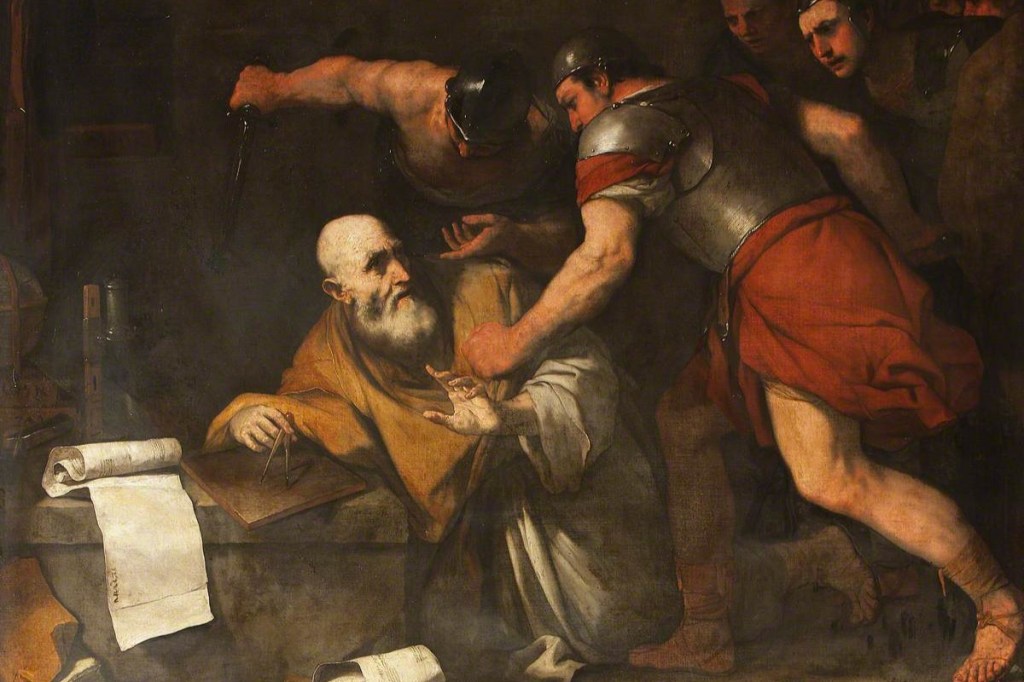
Archimedes, the great Greek mathematician and inventor, elucidated plane and solid geometry, arithmetic, and mechanics. He was a solitary, eccentric figure and appears to have possessed some traits that suggest he may have exhibited autism/Asperger Syndrome.
Life History
Archimedes was born in Syracuse, Sicily. His father was the astronomer Pheidias, and he is said to have been related to Hiero II, tyrant of Syracuse. “He was one of the greatest mechanical geniuses of all time, if not the greatest when we consider how little he had to go on” (Bell, 1986, p. 29).
He spent most of his life in Syracuse. According to Strathern (1998), “Archimedes appeared to have lived a normal eccentric life of a mathematician. Quiet, solitary, and quietly potty — with only the occasional spectacular incursion into the public arena” (p. 72).
After Syracuse was captured during the Second Punic War (despite the deployment of Archimedes’s mechanical expertise in its defense), he was killed by a Roman soldier. There are two stories of the exact circumstances of his death: (a) that he was working on a circle in the sand and said to the soldier, “Don’t disturb my circle”; and (b) that he refused to go to see the Roman consul Marcellus until he had worked out a mathematical problem, whereupon the soldier became angry and killed him.
Work
In mechanics, Archimedes defined the principle of the lever and is credited with inventing the compound pulley. He also invented an ingenious screw that was used as a water pump. The Archimedes screw remains in use in the Nile Delta to this day, and the same principle is used for raising grain and sand when loading bulk carriers.
Plutarch stated that Archimedes “Did not deign to leave behind him any written work on such subjects (practical engineering abilities and inventions) … he regarded as sordid and ignoble the construction of instruments, and in general every art directed to use and profit, and he only strove for those things which, in their beauty and excellence, remained beyond all contact with the common needs of life” (Strathern, 1998, p. 25). Calculus, which developed out of his method, has been described as the most useful mathematical tool ever invented for describing the workings of the real world (Bell, 1998).
Some are of the opinion that Archimedes did in fact use integral calculus in his treatise On Conoids and Spheroids, which expands geometry beyond the rigidity imposed upon it by Plato and his mystical attitude toward forms. (Plato believed that forms or ideas were the ultimate reality out of which the world was made — a development from Pythagoras’ belief that “all is number.” Plato believed in God and geometry.)
Possible Indicators of Asperger Syndrome
Like many mathematicians, Archimedes tended to relate to other mathematicians (e.g., Conon of Samos). A famous legend tells that he jumped out of the bath and ran without clothes through the streets shouting “Eureka! Eureka!” (“I have found it!”). This relates to Archimedes’s principle that a floating body will displace its own weight in fluid. According to Strathern (1998), “Archimedes was a lonely sort of eagle” (p. 29).
Narrow Interests and Obsessiveness
Archimedes was fascinated by pure mathematics. He put in long and arduous hours of theoretical work, which established him as the finest mathematical mind for almost two thousand years to come.
Any individual who spends most of his waking life in obsessive mental activity attracts wild anecdotes, and Archimedes was no exception. According to Plutarch, “He was so bewitched by thought that he always forgot to eat and ignored his appearance. When things became too bad his friends would forcibly insist that he had a bath, and make sure that afterwards he anointed himself with sweet smelling oils, yet even then he would remain lost to the world, drawing geometric figures” (Strathern, 1998, p. 27). Plutarch stated that Hieron II, the king of Syracuse and a friend and relation of Archimedes, was not happy with this kind of behavior and “emphatically requested and persuaded (Archimedes) to occupy himself in some tangible manner with the demands of reality” (Strathern, 1998, p. 29).
According to Bell (1986), Archimedes is a perfect specimen of the popular conception of what a great mathematician should be. Like Newton, he left his meals untouched when he was deep in his mathematics.
Idiosyncrasies
In addition to narrow interests and pervasive obsessiveness, Archimedes demonstrated a number of idiosyncrasies. According to Bell (1986),
In one of his eccentricities Archimedes resembled another great mathematician, (Karl) Weierstrass (1815-1897). According to a sister of Weierstrass, he could not be trusted with a pencil when he was a young school teacher if there was a square foot of clear wallpaper or a clean cuff anywhere in sight. Archimedes beats this record. A sanded floor or dusted hard smooth earth was a common sort of “blackboard” in his day … Sitting before the fire he would rake out the ashes and draw in them. After stepping from the bath he would anoint himself with olive oil … and then, instead of putting on his clothes, proceed to lose himself in the diagrams, which he traced with a fingernail on his own oily skin. (p. 30)
Conclusion
Although the relevant information on Archimedes’s life is somewhat scanty, it would appear that the great mathematician may have met the criteria for Asperger Syndrome.

Hawkeye is a playful, freewheeling show from Disney Plus.
This year has been a lot. That’s why, this Thanksgiving, I’m thankful for Hawkeye.
Marvel’s latest Disney Plus series is a fun, free-wheeling action show energized by scene-stealing Hailee Steinfeld, who joins grouchy archer Jeremy Renner for some good, honest comfort viewing. Its snackable action makes it the opposite of Disney’s other big holiday release, the super-long Beatles documentary Get Back.
The first two episodes of Hawkeye stream on Disney Plus on Nov. 24. The remainder of the six-episode series then arrive each Wednesday until Christmas, which means you could save them up for a festive binge. On the cozy side, Renner returns as archery-themed Avenger Clint Barton (aka Hawkeye) just trying to get back to his loving family in time for Christmas. And if you’re sick of your family’s nonsense, maybe you’ll vibe with the complicated familial dynamics encountered by his new sidekick Kate Bishop, whose fairytale life comes complete with a wicked stepfather.
The show opens with a focus on Kate, a new character to our screens who is already a part of the Marvel Cinematic Universe: She’s one of the many unseen ordinary people whose lives have been touched — and not for the better — by the superpowered shenanigans unfolding on big screens through the past decade. Even the opening titles focus on Kate, deftly sketching in her backstory as she grows into Steinfeld, star of True Grit, Dickinson and Bumblebee.
On the scale of imagination from earthbound punch-ups to cosmic flights of fancy, WandaVision and Loki were dementedly ingenious trips to the more surreal reaches of Marvel lore, while The Falcon and The Winter Soldier was a much more meat-and-potatoes action story. Inspired by writer Matt Fraction and artist David Aja’s entertainingly grounded 2012 comic, the Hawkeye series is way down at the earthier end of the Marvel weirdness spectrum, dealing with all-too-human heroes, family politics and grubby street crime. The enjoyment comes not from brain-battering cleverness but from the show’s energy: The fight scenes fizz with kinetic energy, and the whole thing is carried by lead actors sparking off each other.
Kate is a rich kid with a chip on her shoulder, much to the exasperation of her mom, played warmly by Vera Farmiga (last seen in Sopranos prequel The Many Saints of Newark). Kate’s also a talented martial artist and archer, not to mention a Hawkeye super-fan. The best thing about the show is the classic buddy pairing between the enthusiastic youngster and moody mentor, with Steinfeld and Renner sparking off each other to amusing effect.
Hawkeye himself, meanwhile, is drawn back into the violent underworld searching for the suit he wore while temporarily rebranding as violent vigilante Ronin during the Blip (the years when Thanos wiped out half of the galaxy’s population, including Hawkeye’s wife and kids). The New York setting flits from high-society murder mystery to street-level punch-up in a way that will strongly remind fans of a previous attempt to bring the MCU to the small screen: Daredevil.
Back in 2015, Daredevil was the start of an unprecedented and at the time pretty audacious experiment, ushering in a series of four interlinked Netflix shows starring Marvel heroes yet to appear in the MCU. Daredevil, Jessica Jones, Luke Cage and Iron Fist (plus spinoff The Punisher) were gritty action dramas set in New York City’s shadows, and Hawkeye is more like them than anything else in the whole MCU. There’s even a long-take fight sequence that recalls the showpiece one-shot punch-ups in Daredevil (excuse me while I step out to watch those on YouTube).
Back again. In the first two episodes, Hawkeye is generally more lighthearted than the somber Netflix shows, which were absorbing but cumulatively became a bit of a drag. On paper, Hawkeye has a tortured-hero thing going on, but here’s the thing about the whole Ronin business: It doesn’t work. Clint’s loss is supposed to have driven him to betray his morality as a vicious killer. Unfortunately, that isn’t really what Endgame showed us. Thanks to Marvel’s family-friendly tone and all the other massive amount of stuff that had to be fitted into the film, all we actually saw on screen was Clint getting a crap haircut and beating up some yakuza. Which is literally what a superhero usually does (dispatching gangsters, that is, although silly haircuts are also pretty common). OK, so he sliced people up with a sword, which is frowned upon in superhero circles, but we only know Clint was supposed to have crossed some moral line because he wouldn’t shut up about it.
More affecting is Clint’s sense of loss for Natasha Romanoff, aka Black Widow, lost fighting Thanos in Endgame. This summer’s Black Widow movie served as a belated moment in the spotlight for Scarlett Johansson, and it also adds a layer to Renner’s relatively uncomplicated character. Which ties into Black Widow’s post-credits scene, suggesting the series will bring together two scene-stealing new recruits as Steinfeld and Black Widow’s breakout Florence Pugh are set to face off.
Overall, Hawkeye isn’t a tortured antihero searching for redemption, he’s still just affable Jeremy Renner trundling around looking grumpy. And the show mostly knows this, sticking him into action scenes that are more playful than perilous. Episode 2 in particular has both Clint and Kate engaged in mock combat that’s fun to watch rather than hazardous to their health, a jaunty twist on the gritty action-scene-every-episode formula.
Combined with little snippets of silliness like the comical villains the Tracksuit Mafia and a musical about Steve Rogers and the Avengers (which gets plenty of screen time in episode 1), Hawkeye makes a fun festive treat. Comparisons with Daredevil and its ilk are a reminder that for many fans there were just too many of those shows, giving them the dubious distinction of making the MCU feel inessential. With a whopping 14 further Marvel series confirmed for Disney Plus, it feels like fans could be overwhelmed again.
But don’t worry about that this holiday season. Just stuff yourself full of turkey and some warmed-up Hawkeye.
Heyyy, what’s happening~ I’ve been asked for years to do a video with ONLY otoscope, and I finally got around to it 🙂 I present to you: ALL OTOSCOPE. I kept the intro short & sweet so you have as much otoscope time as possible. The sound in this video is more intense than I usually go for, but not in an overbearing sort of way and I’ve marked out the more intense parts in the timestamps! Hope you enjoy 😀

To be completely honest, I was never a huge fan of Stephen King’s breakout novel, Carrie. Today I can admit that I have no explanation for that, it seemed a mere misfire on some unidentified level. These days, I have no trouble absorbing Carrie like a Sunny summer sky’s warming ultraviolet rays.
Carrie is a tightly knit piece of work that captures the essence of youth in rather convincing fashion. I wouldn’t say King nails teenage life with the same faithfulness he managed in Christine, but this is close. Kids can be serious assholes, and Stephen does a wonderful job of reminding us that with this piece of work. He also effectively explores a vast gamut of emotions experienced during the transition from child to adult. He hammers home anger, ingrains shame and ignites a fuse that forces rage to shimmer and undulate behind the mask of the burning fuse.
I don’t need to possess telekinetic abilities to relate to Carrie’s horrid experience with life.
There isn’t much need for me to delve into every last intricacy of this story. If you’re a fan of Stephen King’s work, you’ve read the novel. If you’re a horror buff, or a fan of classic cinema in general, you’ve seen the movie. Surprisingly, what you see on screen in Brian De Palma’s 1976 shocker is quite faithful to King’s source material. That said, I’ll give you a quick rundown: Carrie White lives with her deranged religious fanatic of a mother, Margaret White. Margaret surpasses abusive by a country mile, and her focal target, her own daughter, is about to turn the tides. See, Carrie is telekinetic, fed up with her mother’s extremist ways, and about to be turned into the laughing stock of a high school filled with enough douche bags to cause a mature individuals cranium to implode. It all makes for a bloody and… fiery conclusion.
What strikes me as special about this particular work is the pronounced measure of melancholy that King sprinkles throughout the story. The man never lets up in reminding us that Carrie’s existence is severely bleak. Sad in every sense of every letter… almost to the point of utter hopelessness. What’s also stirring is the fact that as a reader, it’s almost easy to feel as though Carrie’s place is better somewhere other than earth. She’s one of the most sympathetic creatures ever created, and her presence conjures emotional sensations that are difficult to deal with.
Carrie’s quickly climbed into the upper-tier of my favorite King books. The novel has always had my respect, but it now has my heart, as does the tragedy of Carrie White’s complete existence.
Rating: 5/5
what do u get when u cross undiagnosed autism with the american midwest and catholic hell?? two thumbs!! this guuuuy!!!!














Media in India is now broadcasting segments about how the ‘Canadian dream’ is nightmare.
As Canada maintains immigration at rates unseen in its history, an increasingly large share of those newcomers are finding that they hate it here, feel hoodwinked by the Canadian government and want to go home.
Amid statistics showing higher rates of outmigration and newcomer dissatisfaction, social media and immigrant forums are increasingly filled with warnings for foreigners to stay away.
This week, the website BlogTO published a series of interviews with recent immigrants who are desperate to leave.
“There is no living in this country; it’s just surviving,” said 39-year-old Raghunath Poshala. A Mexican immigrant told them he no longer sees Canada as a developed country. “I realized that Canada is a very poor country, too; it’s just that everyone is in debt,” he said.
Late last year, Bloomberg News interviewed a Ukrainian refugee who fled Russian shelling and missile attacks — only to find a Canada that was practically unliveable. “I’m tired all the time now,” said Oleksii Martynenko, 44.
Around the same time, CTV interviewed Indian immigrant Emilson Jose. “No matter how much you make, your take home pay is not even keeping up the expense. Families barely keep their head above water,” said Jose. “After 10 years of hardship, I am now a proud Canadian citizen who doesn’t want to live in Canada anymore.”
Last year, the Conference Board of Canada published The Leaky Bucket, a report finding that the rates of recent immigrants deciding to leave Canada were on the rise. It “suggests immigrants may not be seeing the benefits of moving to Canada,” the report says.
The reason for the dissatisfaction is simple: Amid spiking prices and shortages in everything from housing to health care, it’s immigrants that are being hit hardest.
Average rents in Canada have hit an all-time high, with a two-bedroom purpose-built rental now going for $1,359 per month.
But asking rents — the advertised rents that would be faced by a newcomer looking for shelter — are significantly higher. According to the latest survey of asking rents by Rentals.ca, the average two-bedroom now costs more than $2,300 per month — with that figure rising above $3,000 in markets like Vancouver or Toronto.
And while much of the recent immigration influx was driven by stated fears of a labour shortage, newcomers are often encountering a job market that is utterly overwhelmed by applicants.
It’s now a semi-regular phenomenon across Southern Ontario that a routine job fair for entry-level positions will attract blocks-long lines of prospective applicants. In December, a job fair at the Save Max Sports Centre in Brampton drew so many job-seekers that videos posted to Instagram showed the entire plaza in front of the building filled with queues.
There exists an entire online ecosystem of bloggers, TikTokers and YouTubers providing advice for new Canadians or prospective immigrants. Of late, many of them are telling their audience not to come — or at least warning that it’s not what it seems.
Febby Lyan, a Singaporean immigrant to Canada, garnered nearly 400,000 views on a recent video about “why people are leaving Canada.” Over 20 minutes, she detailed rising homelessness, rising crime, limited job opportunities, worsening affordability and even a few qualms with the political situation. Lyan noted that the recently passed Online News Act meant that Canadians couldn’t access news through Facebook.
The YouTuber “Angry Canadian Immigrant” wrote an entire e-book accusing Canada of running an immigration system designed to “scam” newcomers.
“After three years in Canada I see it as one of the most overrated countries in the world; very high taxes, enormous cost of life, very few well-paying jobs with insane competition for them … no access to health care whatsoever,” he says in one of his most popular videos, Top 5 reasons not to move to Canada.
The notion of Canada as an “immigrant trap” has even started to make the foreign press.
The Indian news channel WION broadcast a segment in mid-February titled Canada: The Dream that Became a Nightmare.
“Today, youngsters that immigrate to Canada are struggling to find jobs that match their skill sets and also pay them well,” said host Molly Gambhir.
The comments below a video of the segment are replete with viewers expressing their desire to leave. “As an immigrant who came here in 2019 to fulfil my Canadian dream, I am moving back to India next month. The situation is getting worse every passing day,” reads the top comment.
All of this has actually happened before. The last time Canada dialled up immigration to record-breaking levels, it was similarly accompanied by an undercurrent of disappointment and outmigration.
In the years before the First World War, Canada took in as many as 400,000 immigrants annually in a frantic bid to homestead the prairies. Often, these newcomers had been lured by rosy advertised images of Canada as a temperate land of plenty.
At the peak of the boom, outmigration was often as high as immigration. And even a cursory look at immigrant diaries from that era reveal accounts of despair and horror.
“The women and children raised such lamentations as defies description,” reads the 1899 account of Ukrainian immigrant Maria Adamowska, who said panic began to rise among her fellow immigrants as their train ride west revealed the harshness of the Canadian landscape.
In 1913, a Montreal-based German consul even penned a report home urging his countrymen to avoid immigration to Canada. “The Canadian prairie with its long winters and impermanent rectangular houses conveys something indescribably sad and depressing,” he wrote.
 Igor's Blog