












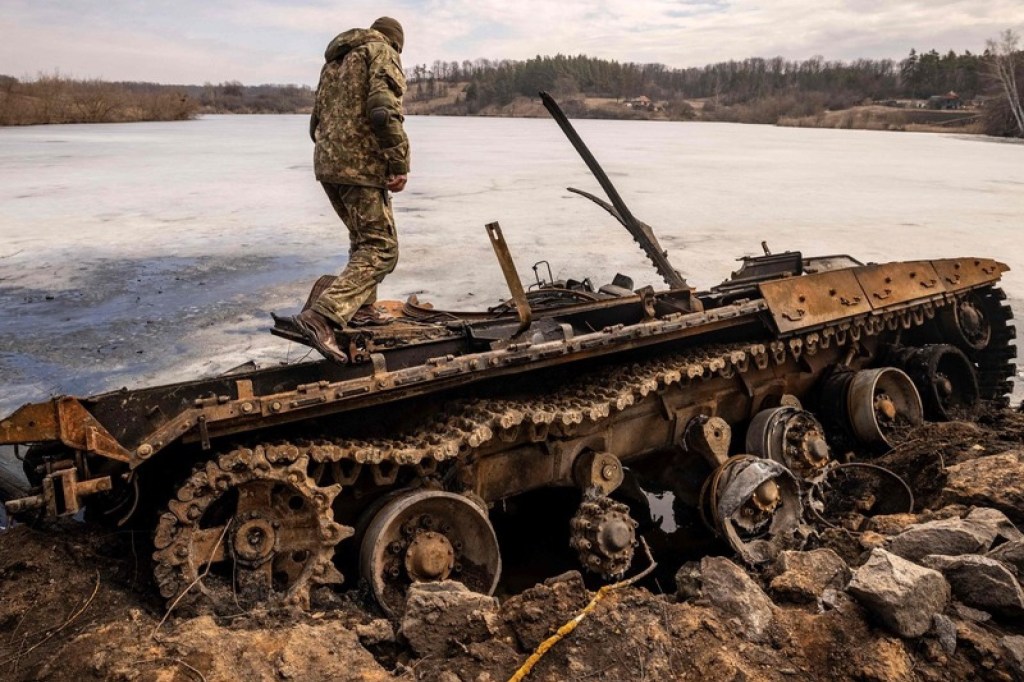
Russia’s once-extensive Soviet-era stockpile, which has propped up its war effort in Ukraine, is dwindling, and could affect Moscow’s ability to continue advancing in the east of the country, according to a new report.
The Kremlin has relied heavily on Soviet reserves of tanks, armored vehicles and weapons to push forward with its offensives across the hundreds of miles of front lines in Ukraine.
Slews of more advanced equipment, like newer main battle tanks, were destroyed, damaged or captured in the initial phases of the war after Moscow launched its full-scale invasion in February 2022. Russia has hiked its defense spending to expand tank and vehicle production, and turned to thousands of mothballed vehicles in storage to fill the gaps.
Reserves of tanks and armored vehicles are key for fighting the battles going on in eastern and northeastern Ukraine, as are supplies of artillery systems.
But experts told The Economist in an article published on Tuesday that by mid to late 2025, Russia’s ability to use vehicles that have long sat in storage will have reached a “critical point of exhaustion.” Many of Russia’s T-72 tanks have reportedly been exposed to the elements since the fall of the Soviet Union in late December 1991, and have likely suffered for it.
Russian forces may have to fight a more defensive battle in Ukraine by the end of the year, Michael Gjerstad, an analyst with the U.K.-based International Institute for Strategic Studies (IISS) think tank, told the outlet.
Newsweek has reached out to the Russian Defense Ministry for comment via email.
The IISS think tank said in February 2024 that Russia has been able to replenish its extensive tank and vehicle losses in Ukraine, but much of the hardware heading for the front lines are “not new.” Moscow is often sacrificing quality for quantity, the think tank added.
According to Ukraine’s count, Russia has lost well over 8,000 tanks. This estimate comes in higher than many Western intelligence figures, which typically sit at under roughly half of this tally. Dutch open-source intelligence outlet, Oryx, has visually verified 3,243 Russian tank losses, but stresses the true number is likely to be higher.
The IISS estimated in February that Russia had lost at least 3,000 tanks, adding at the time: “To put that in perspective, Russia’s battlefield tank losses are greater than the number it had when it launched its offensive in 2022.”
Moscow is also contending with having to replace the barrels of artillery systems like howitzers that are in constant use, according to Tuesday’s report. The barrels in artillery pieces littered along the hotspots of fighting need replacing as frequently as every few months, the outlet said, with Russia taking barrels from old, towed artillery pieces to fix onto self-propelled howitzers for the battlefield.
Ukraine has lost a significant number of its own vehicles and artillery pieces, although it is hard to discern the extend of the losses. According to Russia’s figures, Kyiv has lost a collective total of over 16,602 tanks and armored vehicles and more than 12,000 artillery pieces. Oryx puts the tank and armored vehicle losses at just shy of 3,500.
Khara Khoto is an ancient city located in the western part of Inner Mongolia. It was once a thriving city, thanks to its location on the famous Silk Road. But a devastating massacre left the city in ruins and, until recently, many locals refused to approach the ruins of Khara Khoto, for fear of its ancient ghosts.
This contributed to the discovery of the city’s ruins at the beginning of the 20th century. Excavations at Khara Khoto have uncovered thousands of manuscripts in the Tangut language, arguably one of the site’s most impressive finds. These were preserved by the area’s dry climate and spared from looters due to the remoteness of the ruins.
The name ‘Khara Khoto’ literally means ‘Black City’ in the Mongolian language. This is also seen in the name given to the city by the Chinese, i.e. Heicheng. As for the Tanguts, who founded the city, they knew it as Yijinai.
Interestingly, Khara Khoto is believed to have been mentioned by the famous Venetian traveler, Marco Polo. It has been identified (by the archaeologist Aurel Stein) as Etzina (also spelled as Ezina) in The Travels of Marco Polo. The description of the city by Marco Polo is as follows:
“Leaving this city of Kampion, and travelling for twelve days in a northerly direction, you come to a city named Ezina, at the commencement of the sandy desert, and within the province of Tanguth. The inhabitants are idolaters. They have camels, and much cattle of various sorts. Here you find lanner-falcons and many excellent sakers. The fruits of the soil and the flesh of the cattle supply the wants of the people, and they do not concern themselves with trade. Travellers passing through this city lay in a store of provisions for forty days, because, upon their leaving it to proceed northwards, that space of time is employed in traversing a desert, where there is not any appearance of dwelling, nor are there any inhabitants excepting a few during the summer, among the mountains and in some of the valleys.”
As mentioned by Marco Polo, Khara Khoto is situated on the edge of the ‘sandy desert’, i.e. the Gobi Desert. Although the city lies on the Silk Road, its inhabitants were not involved in trade and commerce. Instead, they made a living by supplying provisions to those who were making the journey into the desert.
When Marco Polo wrote his work about his travels to Asia during the 13th century, Khara Khoto had already existed for several centuries. It is often claimed that the city was established in 1032 by the Tanguts.
The Tanguts, known also as the Xia, were an important ethnic group in northwestern China. They were mentioned in Chinese sources as early as the 6th and 7th centuries AD. During that time, the Tanguts were invited by the Chinese to settle in what is today the provinces of Sichuan, Qinghai, and Gansu.
The Chinese were hoping that the Tanguts would act as a buffer zone between them and the Tibetans. Although the Tanguts occasionally joined the Tibetans in attacking the Chinese, on the whole, they served their purpose well. This is seen, for instance, when Emperor Taizong, the second ruler of the Tang Dynasty, bestowed his family’s surname, Li, on the family of the Tangut chief during the 630s AD.
By the 11th century, however, the Chinese, who were now under the Song Dynasty, were forced to turn their attention to the east. This was due to the fact that the they were in conflict with the Khitans, who had founded the Liao Dynasty shortly after the collapse of the Tang Dynasty at the beginning of the 10th century.
As a consequence, the Chinese had little time to focus on the western borders of their empire, and the Tanguts seized this opportunity to establish their own state, Xi Xia, or Western Xia, in 1038. This state flourished for about two centuries, until it was conquered by the Mongols in 1227. The Tanguts were in control of such a powerful state that It took the Mongols about 20 years to subdue them.
Khara Khoto was only captured in 1226, a year before the Tanguts surrendered to the Mongols. According to a popular misconception, the city went into decline once it became part of the Mongol Empire. In reality, however, Khara Khoto continued to prosper.
As a matter of fact, one of the positive effects of the Mongol conquests was the re-establishment of the Silk Road, which would have resulted in more traders passing through Khara Khoto. The city’s prosperity, however, came to an end not long after the fall of the Mongol Yuan Dynasty.
In 1368, the Yuan Dynasty was overthrown by the Ming Dynasty, and the Mongols expelled from China. Many of the surviving Mongols are said to have fled to Khara Khoto. They were allowed to settle there by its inhabitants. As the immediate concern of the Ming Dynasty at the time was to impose law and order on their newly gained territories, they were not really bothered about pursuing the fleeing Mongols. By 1372, however, there were so many soldiers at Khara Khoto that the Mongols were able to entertain the idea of launching an invasion on China, in order to retake it from the Ming Dynasty.
When news of the Mongols’ plans reached the ears of the Chinese, they were alarmed. By this time, the Ming Dynasty had consolidated their rule over China, which meant that they were able to address the Mongol threat more forcefully. Therefore, in 1372, the Chinese sent an army to attack the Mongols at Khara Khoto.
This military expedition is mentioned briefly in the historical records of the Ming Dynasty. According to these records, the Mongols of Khara Khoto, who were led by Buyan Temur, surrendered to Feng Sheng, a Chinese general, when he arrived at the city. Feng Sheng’s army was in fact part of a much larger expedition by the Ming Dynasty to destroy the Northern Yuan Dynasty, which the surviving Mongols established.
The Chinese military expedition was a force of 150,000 men, and was divided into three divisions, each advancing to the north of the Gobi Desert via a different route. The western division was led by Feng Sheng, while the eastern and central divisions were led by Li Wenzhong and Xu Da respectively. Despite the strength of their army, the Chinese were defeated by the Mongols. In the centuries that followed, the Mongols continued to menace the Ming Dynasty, until they were conquered by the Later Jin Dynasty (the precursor of the Qing Dynasty) in 1635.
While the fall of Khara Khoto is a small episode in the military expedition of 1372, more details about the event can be found in local legend. According to this legend, the leader of the Mongols at Khara Khoto is said to have been a general named Khara Bator (meaning ‘Black Hero’). The legend also states that the fortifications of the city were so strong that the Chinese were unable to take it by force.
Therefore, they laid siege to the city. In order to increase the pressure on the defenders, the Chinese diverted the Ejin River, which flowed outside the city, and was its only/main source of water. As a consequence, Khara Khoto’s wells soon dried up, and the defenders were forced to choose between dying of thirst or dying in battle against the besiegers.
In one version of the legend, Khara Bator lost his mind due to this dilemma, and murdered his family before committing suicide. Another version of the legend has the Mongol general escape from the city through a breach he made in the northwestern corner of the city walls. Apparently, a hole in the walls large enough for a rider to pass through can still be seen at Khara Khoto.
The remaining Mongol soldiers waited in the city until the Chinese finally launched their final assault on Khara Khoto. The defenders were mercilessly slaughtered, leading to rumors in the present day that the city’s ruins are still haunted by the ghosts of the fallen Mongol soldiers. Until recently, many locals refused to approach the ruins of Khara Khoto, for fear of these ancient ghosts.
Unlike the Mongols, who preserved Khara Khoto when they captured it from the Tanguts, the Chinese did not bother to maintain this city on the edge of the Gobi Desert. As a result, it was abandoned. It has been speculated that one of the reasons for the abandonment of Khara Khoto was the shortage of water.
In the centuries that followed, Khara Khoto fell into ruin. But it was not completely forgotten, as rumors of its existence continued to circulate. In fact, it was in the early 20th century that these rumors led to the rediscovery of the city’s ruins.
Towards the end of the 19th century, the Russians were conducting scientific expeditions in northern China and Mongolia. Two of the explorers, Grigory Potanin and Vladimir Obruchev, heard rumors about a lost ancient city somewhere downstream along the Ejin River. Back in Russia, these rumors attracted the attention of the Asiatic Museum in Saint Petersburg (today part of the Institute of Oriental Manuscripts of the Russian Academy of Sciences). A Mongol-Sichuan expedition under Pyotr Kuzmich Kozlov was launched in 1907.
Within a year, Kozlov had discovered the location of Khara Khoto. In May 1908, Kozlov obtained permission to excavate the site from Dashi Beile, a local Torghut chief. In return for his permission to excavate the site, Kozlov gave Dashi Beile a free dinner and a gramophone.
The expedition’s most remarkable discovery at the ruins was a large quantity of texts, including manuscripts, books, and scrolls. These were written in the Tangut language, and were preserved thanks to the dry conditions of the surrounding desert. By the time the first expedition ended, Kozlov had sent 10 chests of artifacts back to Saint Petersburg.
In addition to over 2000 Tangut texts, the chests also contained Buddhist objects. In 1909, Kozlov returned to Khara Khoto, and more manuscripts were unearthed. The artifacts remain in Saint Petersburg to this day, though they have been published as the Russian Collection of Khara-Khoto Manuscripts.
In the decades that followed, other expeditions to Khara Khoto were undertaken by various explorers. In 1917, for instance, Aurel Stein visited Khara Khoto on his third Central Asian expedition, and surveyed the site for eight days. Other archaeologists, such as the American Langdon Warner, and the Swedish Folke Bergman, also visited the ancient city, the former in 1925, and the latter in 1927 and 1929. On his second visit, Bergman stayed at Khara Khoto for a year and a half, surveying and making maps of the area.
The Chinese also took interest in the site. Between 1927 and 1931, for example, a Sino-Swedish expedition, led by Sven Hedin and Xu Bingchang, carried out excavations at the site. Additionally, between 1983 and 1934, Li Yiyou, from the Inner Mongolian Institute of Archaeology, carried out excavations at Khara Khoro, unearthing another 3000 manuscripts.
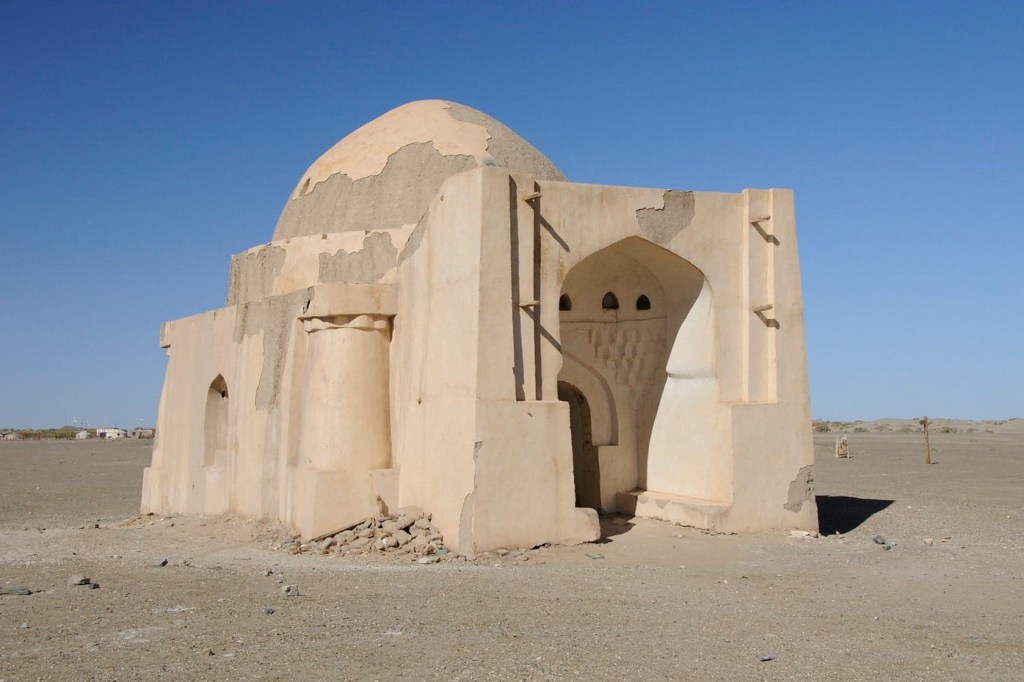
The remains of the buildings at Khara Khoto have received much less attention than the manuscripts. These structures include the city’s ramparts, which are 9 meters (29.5 ft) high, 4 meter (13.1 ft) thick outer walls, a 12 meter (39 ft) high pagoda, and crumbling mud houses. In addition, there is a building that may be a mosque outside the city walls. It has been speculated that this building would have been used by Muslim traders who stopped at the city.
Considering the fact that Khara Khoto is not easily accessed, due to the surrounding desert, the ruins have not been developed into a tourist attraction. While this means that the site does not reap the benefits brought about by tourism, it also does not suffer from the damages caused by receiving numerous tourists. This may help to preserve the ruins for the future.

https://texashistory.unt.edu/ark:/67531/metadc1482958/m1/
This video is part of the collection entitled: KXAS-NBC 5 News Collection and was provided to The Portal to Texas History by the UNT Libraries Special Collections.
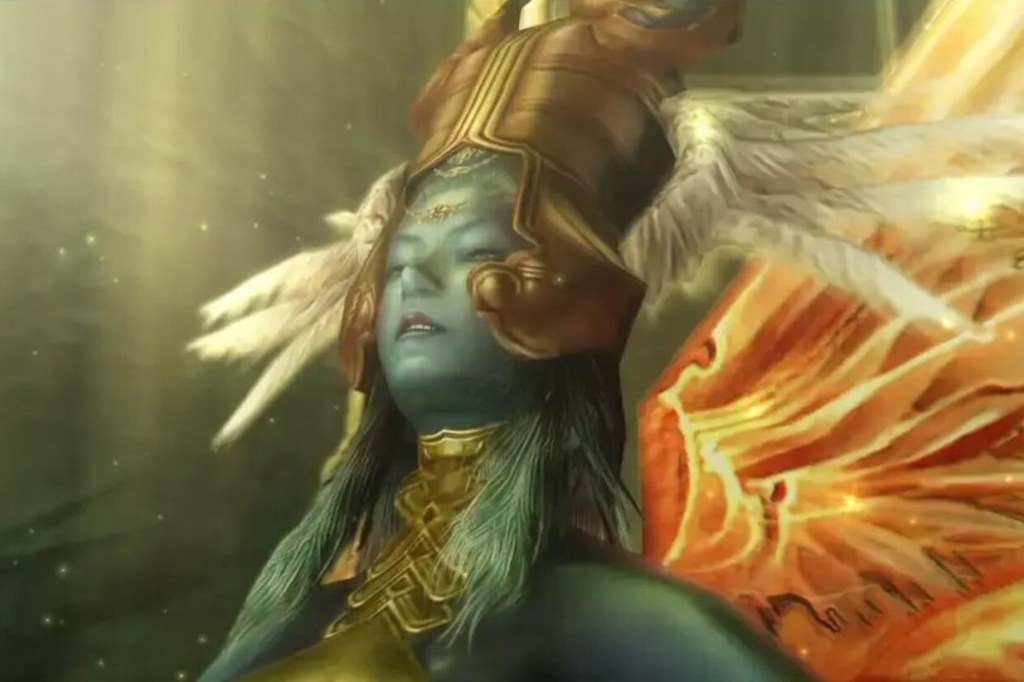
Final Fantasy XII shakes the series to its core with the introduction of a unique new combat system, while still honoring the franchise’s reputation for epic storytelling, incredible spectacle, and compelling characters.
In the time between my preview and this review, seemingly no generalized perception of Final Fantasy XII has developed. I was expecting this to be an extremely polarizing entry in the series, eclipsing FFXI as a subject of controversy (because really, even the lower-level gaming drones easily wrote that game off as “Final Fantasy Online” and left the bulk of the arguing to the MMO crowd). Just thinking of how radical a departure FFXII truly is, I’m surprised I’m not writing this overwhelmingly positive review from behind a riot shield.
Then again, maybe I’m not giving Square Enix enough credit. This game could have ripped its battle system straight out of Final Fantasy: Mystic Quest, and it would still rate as one of the most epic, gorgeous games of all time, and most of us would have bought the game anyway. FFXII is far beyond any expectations I ever had for it; I should note here that I am not a FF fanboy by any means – not by a long shot. I’ll also take this opportunity to note that, in my eyes, the cut-scene-heavy FFX was a blemish on the creative path of Japanese RPGs. Yet it is a cut scene – an amalgamation of cut scenes, at that! – that elevated FFXII beyond the fancy departure from the world which was introduced in the Dragon Quest pack-in demo. As soon as the beautiful orchestration comes rumbling in and those great, dramatic scenes rhythmically follow it, it’s hard not to have a chill swing down your spine.
The upcoming DS spin-off notwithstanding, it’s a shame that producer/director Yasumi Matsuno, who dropped off FFXII toward the end of development for as-yet undisclosed reasons, is no longer a Square Enix employee. Ivalice, the world of FFXII as well as the Final Fantasy Tactics series, seems to have just come to fruition with this game. The city-state of Dalmasca, both the setting and the main subject of contention, is rendered beyond compare, and begs to be seen again once the game is through. Without Matsuno, a FFXII-2 seems very unlikely; but perhaps I am getting ahead of myself here.
Very early on, an important character is revealed to be a completely different person than originally presented, so it shouldn’t be surprising that the story will evolve into a daunting, multi-faceted beast. Granted, if you’ve paid any attention to the press this game has received over the past few years, you’ll see right through this early deception, but it’s indicative of the type of storytelling FFXII offers. Whether you expect it or not, things get much more interesting as the story moves forward. Nothing is content to remain exactly as it seems, and nothing plays out as console RPG conventions dictate.
In a Dragon Quest-like move, without actually going too far in that direction, the fight for Dalmasca is primarily seen through the eyes of a young street urchin named Vaan, who is undoubtedly intertwined in the events of the story, yet not in the same way most FF leads are. The main characters in the series have been the center of the storytelling for just about every entry since FFIV, but Vaan serves mostly as a vehicle to pull players through the political and action-driven twists and turns that more involved players take him through. If this seems counter-intuitive, just think of famous silent characters like Chrono, or even, to take this example into a slightly different genre, Link from The Legend of Zelda. Their silence serves to subconsciously pull the player closer to the adventure at hand.
By giving Vaan a speaking role, the cut scenes and sprawling dialogue are unhampered by an awkwardly silent character; yet, in many cases, Vaan is decidedly quiet, simply because certain conversations are not his business, and he knows it. This is a brilliant interactive storytelling device, and while it isn’t unique, I hope FFXII will prove the impetus for developers to use this method more often.
FFXII isn’t packed with high-concept allegories like Shin Megami Tensei: Digital Devil Saga, but it’s got similar meta-thinking behind it, if you look between the high polygon count and ultra-sharp, beautifully detailed cut scenes. There’s a wonderful charm to meta-gaming, and I’d never want to play a Metal Gear Solid game where Snake doesn’t ramble on about pressing the ‘Circle’ button, but maybe this is the proper way it should be done. At the risk of sounding like a pretentious charlatan: FFXII doesn’t knock down the fourth wall, but installs a small window instead.
I promise I won’t mention the words “meta” or “fourth-wall” in a game review ever again. I’m just far too excited to play an AAA game that actually takes the fact that it is a video game into account. The fact that I can’t immediately compare Vaan’s character to any counterparts within the medium is incredibly exciting. Better yet is the fact that Nick Carraway (The Great Gatsby) is the name that keeps popping into my head whenever I think of how Vaan is used. Perhaps a couple decades after Matsuno’s death, FFXII will have a sudden second wind and become required high school curriculum, as well.
Disclaimer: I’m joking.
While noting FFXII as a status-quo shifting trigger, now is probably the right time to delve into the battle system. If you haven’t read about it hundreds of times already, I am pleased to inform you that the traditional turn-based and Active Time Battle systems have been left behind. This may prove to be the anomaly in the series, especially with Matsuno out of the picture, but I can’t help but hope that a great change will take place in the Japanese RPG landscape. With so many Japanese games going for fast-moving, non-traditional takes on traditional RPG gameplay – Devil Summoner and Contact being the most notable recent examples – it does seem as though a widespread change is occurring.
FFXII takes the concept far beyond what would be expected from this title, or any console RPG not developed by Bioware or Bethesda: The battles, along with the entire world, are completely seamless. Oh, yeah, and in case you didn’t hear, a menu isn’t going to pop up and ask you to press “attack” every single time your character’s turn comes up. It does it for you, and with the Gambit system, so you’ll have unprecedented control over what your characters decide to do, even if you aren’t directly telling them to do it every single time.
This is without a doubt the most radical moment Final Fantasy has ever had, besides the 11th iteration being a slow-moving MMORPG. FF games have always been about very obvious seams, with many different ways to manipulate the characters, or not manipulate them at all, depending. The very existence of FFXII seems to be to dismantle that precedent. The old standard requires six layers of presentation: world map exploration, city/town exploration, battle mode, menu tweaking, dramatic cut scenes, and text-based dialogue sequences. The former three are now a single unit, with only a minor change when in a town, where attacking is usually not possible. This means that monsters and even NPC allies unrelated to the story progression roam Dalmasca freely. They will run away on-sight if they are so inclined. They will cast protective spells on each other before even considering attacking your party. They will attack each other, and become so wrapped up in their battle that they won’t bother to pursue you.
If a certain amount of an enemy is defeated, a few extra pages of information on the creature, as well as general FFXII knowledge, are unlocked in the profile. I’m so wrapped up in this game that I actually sit and read each and every creature’s profile, and go out of my way to unlock the extra content for each one. It’s like getting DVD extras for performing well, and I love the idea. There is also a clan record trophy section, which gives avid players little hand-drawn rewards for things like using a spell 100 times and 50+ combo.
Instead of dropping directly useful items or cash – and really, what were Bombs and Cacutars doing with straight-up cash in the first place? – enemies sometimes drop Loot. These are items that monsters might actually carry with them, and if you focus your rage on a single genus of enemies, you’ll get greater bonuses depending on how many have been killed in a row up to that point. So, once you’ve killed 70 wolf-related creatures, you’ll be getting much better Loot, including some that cast positive status-effects on your party. This is all the more reason to go back to dungeons that were hastily run through, even if the experience points aren’t entirely worth it.
However, the License Points are pretty much always worth it, making almost any run a good idea in FFXII. LP is more important than EXP itself, which is usually the driving force of console RPGs. These points are spent on the License Board, a modified (and better!) version of the Sphere Grid from FFX, if it could even be called that. The main similarity between the two systems is that they both offer complete customizability for all party members, with the single limitation of their base stats. Balthier (who has the best voice actor out of the entire exceptionally talented cast) starts off with a pistol, and his partner, Fran (who has the most annoying voice out of the bunch, although the actress still comes off as a professional), with a bow; a few hours later, these characters could specialize in Great Swords and Hammers, respectively, and still retain their long-range skills when the need comes up.
The License Board is also where specialized skills are obtained. Many of the skills, spells included, are present on all of the characters’ Boards, but have to be purchased in shops to be used. To use Steal, you must have purchased the skill, as well as unlock it on the Board. The same goes for Cure, Fire, and so on. The upside to this is that a skill only needs to be purchased once for all characters to be able to utilize it.
Mist Knacks are the FFXII equivalent of the limit break system. In this case, they can be used as long as MP is at 100%, and in the end, it will always result in magic being fully drained. Mist attacks appear on all party members’ Boards, but each individual attack can only be assigned to one character. It took me a few tries to fully grasp the Mist system, but it had more to do with not being prepared for such a twitch-based method than anything. Simply, a bar appears and quickly drains, and the button that flashes on-screen has to be pressed before time runs out. If pressed on time, it either repeats what just occurred with a different button and moves on to any other Mist-ready character, thus adding their attack into the combo. This continues until a mistake is made, or there are no more phases of the Mist available for any of the characters performing the attack.
A simple strategy for tough boss fights is to keep a full reserve party (that’s three characters, by the way) Mist-ready, and switch them out mid-battle in case things look dire for the first-stringers. Unleash the Mist flurry, and in some cases, you’ll quickly be given the upper hand. Some bosses will shrug off these attacks like nothing more than an insect, though, so be careful not to rely completely on this system. This is where my biggest complaint comes in; many of the battles I’ve had trouble with have been fixed with a single three-character Mist assault, and while the aforementioned safety against Mist-reliance is there, it isn’t used often enough. Of course, if I managed my MP a little less closely, I wouldn’t have Mist attacks ready most of the time!
The final, and probably least important implement is the new Summon (or Esper) system. There are many summons in the game, although you won’t run into a single one until at least 12 hours into it. Instead of having single attacks and running off into nothingness like a traditional FF summon, these Espers will stay with your party and pummel enemies for a limited time, then run off into nothingness. They are useful and will probably save your party a handful of times, but mostly, they don’t have the power to really change the tide of a battle. Any help is good help, and anything to make running through swaths of enemies move quicker is a good concept, in my book.
So, with all of these complex systems in place, how does it all happen? Without a menu slavishly popping up between every turn, how do all these skills and Mists and spells and summons come into play?
The easy answer is Wait Mode. A familiar battle-menu pops up and freezes the screen on command, lets you make your choice, and immediately enacts your decision.
The real answer is Gambits.
A warning: when FFXII was first shown to the world – and I mean really shown, not a bunch of worthless CGI-only trailers – the word “Gambit” echoed through the console gaming community with not a little thunder behind it. The topic has been discussed so much in so many different mediums (magazines, television, forums, etc.) that you might not want to read even more about it here. Frankly, almost every time it’s brought up in the media, it’s explained entirely from point A all the way to point Z, and as tired as I am of seeing the FFXII manual reprinted every single time the game is brought up, it would be an injustice to the ingenuity of the system to avoid explaining it in great detail here for the minority that hasn’t heard much about it. If you’re one of the few that glossed over the details every time it was brought up, take the time to read it this time around, because hopefully it’s the last time it shows up on a major gaming website (yes, we’re tooting our own horn with that line).
A Gambit is a pre-made command that tells your character how to react in a given situation. Think of Gambits as the programming language of FFXII. If you’ve ever used a program that touted itself as “the easy way to make your own videogames without programming know-how!” you know exactly how Gambits work, because there is more to them than throwing as many of them as possible on each character. They must be in a logical order, as well, which may take a great deal of trial-and-error to perfect.
Also, each character has a limited number of Gambit slots (more are unlockable on the License Board), so which Gambits are used must be thought out very carefully. Finally, Gambits can be turned off without being deleted, so if a specific enemy is too weak to fire, the Gambit “Cast Blizzard ‘ Party Leader’s Target” should be turned off, and “Cast Fira ‘ Party Leader’s Target” should be flipped on. However, changing that Gambit setup would be futile if the “Attack Party Leader’s Target” Gambit were at the top of the list, because it would take precedence over the spell-casting directives below it.
This sounds complex, and really, there is a lot more to it than the usual FF menu-tweaking; it stops just short of fighting your battles on a management screen. Think of how much time is saved when you aren’t plugging in the same commands to fight the same enemies ad infinitum. Also, you can always press X and get the traditional menu to pop up at any time to make up for what your Gambits aren’t set up to do, and with Active Mode switched off, as previously mentioned, you can freeze the game while you make your decision, which is incredibly useful for boss fights, which often demand a constantly changing strategy.
When all of these features and concepts come together, it’s obvious that the team behind FFXII- most of whom never worked on a flagship Final Fantasy title before – was trying to change the status quo of the franchise, as well as the genre. They’ve succeeded. This is a nearly seamless world that feels so much more alive than the mechanical settings and story development and gameplay that we’ve been used to for so long. Ivalice is more alive than any other setting in Square Enix history, and in FFXII, it’s taken to an entirely new level. FFXII is widescreen capable, too, so it’ll look pretty good on that expensive new television or monitor you just committed insurance fraud to buy.
FFXII has my vote for Game of the Year for 2006, and I’d even go as far as to call it my personal Game of the Generation. When it comes to recognizing the true quality of a game – it does what it does better than any other game – I know that I’m going to be coming back to this game for years to come.
Final Fantasy XII, if it does not become an unpredictable phenomenon, will probably end up with a fate like FFVIII. The general fan base will buy it, and might be disgusted by it at first, but after years of analysis, I guarantee the integrity of this game will hold up quite solidly. I’m proud to be on the side that recognizes this the first time through.
 Igor's Blog