Leonardo da Vinci – New World Encyclopedia

https://www.newworldencyclopedia.org/entry/Leonardo_da_Vinci

Leonardo di ser Piero da Vinci (April 15, 1452 – May 2, 1519) was an immensely talented Italian Renaissance polymath: architect, anatomist, sculptor, engineer, inventor, geometer, musician, and painter. Leonardo was the archetype “Renaissance man,” infinitely curious and equally inventive. He is widely considered to be one of the greatest painters of all time.

Leonardo is famous for his realistic paintings, such as the Mona Lisa and The Last Supper, as well as influential drawings including the Vitruvian Man. He conceived of ideas vastly ahead of his time. Notably, he invented concepts for the helicopter, a tank, the use of concentrated solar power, the calculator, a rudimentary theory of plate tectonics, the double hull, and many others. Relatively few of his designs were constructed or were feasible during his lifetime as modern scientific approaches to metallurgy and engineering were only in their infancy during the Renaissance. However, he greatly advanced the fields of knowledge in anatomy, astronomy, civil engineering, optics, and hydrodynamics.

Of his works, only a few paintings and his notebooks (scattered among various collections) containing drawings, scientific diagrams and notes have survived.

Biography

The first known biography of Leonardo was published in 1550 by Giorgio Vasari, who wrote Vite de’ più eccelenti architettori, pittori e scultori italiani (“The lives of the most excellent Italian architects, painters and sculptors”). Most of the information collected by Vasari was from first-hand accounts of Leonardo’s contemporaries because Vasari was only a child when Leonardo died. This biography remains the first reference in studying Leonardo’s life.

Leonardo was born in the village of Anchiano, a few miles from the small town of Vinci, in Tuscany, near Florence. It was thought that Leonardo was the illegitimate son of a local peasant woman known as Caterina. His biological father appears to have been a Florentine notary or craftsman named Piero da Vinci. Leonardo’s mother was married off to one Antonio di Piero del Vacca, a laborer employed by his biological father. According to papers recently found by the Museo Ideale Leonardo Da Vinci in his home town of Vinci, the marriage occurred just a few months after she gave birth to a boy called Leonardo. Even though he was born after modern naming conventions came into use, he was known as “Leonardo di ser Piero da Vinci,” which simply means “Leonardo, son of Piero, from Vinci, Italy.” Leonardo signed his works “Leonardo” or “Io, Leonardo” (“I, Leonardo”).

Leonardo grew up with his father in Florence, where he started drawing and painting. He started school when he was five years old. His early sketches were of such quality that his father showed them to painter/sculptor Andrea del Verrocchio, who subsequently took on the 14-year old Leonardo as a garzone (an apprentice). In Verrocchio’s workshop Leonardo was introduced to many activities, from the painting of altarpieces and panel pictures to the creation of large sculptural projects in marble and bronze. Leonardo also worked with Lorenzo di Credi and Pietro Perugino. According to Giorgio Vasari, Leonardo’s first biographer (1550):

But the greatest of all Andrea’s pupils was Leonardo da Vinci, in whom, besides a beauty of person never sufficiently admired and a wonderful grace in all his actions, there was such a power of intellect that whatever he turned his mind to he made himself master of with ease.

In 1472 Leonardo was inducted into the painter’s guild of Florence, while even four years later, he was still considered Verrocchio’s assistant. The earliest known dated work of Leonardo’s is a pen and ink drawing of the Arno Valley. It is dated August 5, 1473. This work was done before Leonardo became an independent master in 1478 at age 26. His first commission, to paint an altarpiece for the chapel of the Palazzo Vecchio, the Florentine town hall, was never started. His first large painting, The Adoration of the Magi, started in 1481, was never completed. It was to be for the Monastery of San Donato a Scopeto in Florence.

From around 1482 to 1499, Ludovico Sforza, Duke of Milan, employed Leonardo, providing him a workshop, complete with apprentices. During this period, seventy tons of bronze set aside for Leonardo’s Gran Cavallo horse statue were cast into weapons for the duke in an attempt to save Milan from the French under Charles VIII in 1495.

When the French returned under Louis XII in 1498, Milan fell without a fight, overthrowing Sforza. Leonardo stayed in Milan for a time, until the morning he came upon French archers using his life-size clay model of the Gran Cavallo for target practice. He left with Salai, his assistant, and his friend Luca Pacioli for Mantua. After two months, he moved on to Venice where he was hired as a military engineer.

Leonardo returned to Florence briefly at the end of April 1500. In Florence he entered the services of Cesare Borgia, the son of Pope Alexander VI. He worked as Borgia’s military architect and engineer and traveled with him throughout Italy. In 1506 he returned to Milan, then in the hands of Maximilian Sforza after Swiss mercenaries drove out the French.

From 1513 to 1516, Leonardo lived in Rome, where painters Raphael and Michelangelo were active at the time, although he had little contact with these artists. However, Leonardo was probably pivotal in the relocation of Michelangelo’s David in Florence; the move was against Michelangelo’s will.

In 1515 Francis I of France retook Milan. Leonardo was commissioned to make a centerpiece mechanical lion for the peace talks between the French king and Pope Leo X in Bologna. This was likely his first encounter with the French king. In 1516 he entered Francis’ service, and was given the use of the manor house Clos Lucé (also called “Cloux”; now a museum open to the public) next to the king’s residence at the Royal Chateau Amboise. The king granted Leonardo and his entourage generous pensions. A surviving document lists 1,000 écus for the artist, 400 for Count Francesco Melzi, his apprentice, and 100 for Salai (“servant”). In 1518 Salai left Leonardo and returned to Milan, where he eventually perished in a duel.

King Francis became a close friend of Leonardo. Some 20 years after Leonardo’s death, Francis told the artist Benevenuto Cellini that he believed about Leonardo that, “No man had ever lived who had learned as much about sculpture, painting, and architecture, but still more that he was a very great philosopher.”

Da Vinci lived for the last three years of his life at Clos Lucé, France, and died there on May 2, 1519. According to his wish, 60 beggars followed his casket. He was buried in the Chapel of Saint-Hubert in the castle of Amboise. Although Melzi was his principal heir and executor, Salai was not forgotten. He received half of Leonardo’s vineyards.

It is apparent from the works of Leonardo and his early biographers that he was a man of high integrity and very sensitive to moral issues. His respect for life led him to vegetarianism for at least part of his life. The term “vegan” would have fit him well. He entertained the notion that taking milk from cows amounted to stealing. Under the heading, “Of the beasts from whom cheese is made,” he answers, “the milk will be taken from the tiny children.” Vasari reported a story that as a young man in Florence, Leonardo often bought caged birds just to release them from captivity. He was also a respected judge on matters of beauty and elegance, particularly in the creation of pageants.

Leonardo pioneered new painting techniques in many of his pieces. One of them, a color shading technique called Chiaroscuro, used a series of glazes custom-made by Leonardo. It is characterized by subtle transitions between color areas. Chiaroscuro is a technique of bold contrast between light and dark. Another effect created by Leonardo is called sfumato, which creates an atmospheric haze or smoky effect.

Early works in Florence (1452–1482)

While working as an apprentice to in 1476, Leonardo worked with Verrocchio to paint The Baptism of Christ for the friars of Vallombrosa. He painted the angel at the front and the landscape. The difference between the two artists’ work can be seen. Leonardo’s blending and brushwork was finer than Verrochio’s technique. Vasari told the story that when Verrocchio saw Leonardo’s work he was so amazed that he resolved never to touch a brush again.

Leonardo’s first solo painting was the Madonna and Child, completed in 1478. During the same time period, he also painted a picture of a little boy eating gelato. From 1480 to 1481, he created a small Annunciation painting, now in the Louvre. In 1481 he also painted St. Jerome, but never finished the painting. Between 1481 and 1482 he started painting The Adoration of the Magi. He made extensive, ambitious plans and many drawings for the painting, but it was never finished, as Leonardo’s services had been accepted by the Duke of Milan.

Milan (1482–1499)

Leonardo spent 17 years in Milan in the service of Ludovico Sforza (between 1482 and 1499). He did many paintings, sculptures, and drawings during these years. He also designed court festivals, and drew many engineering sketches. He was given free rein to work on any project he chose, though he left many projects unfinished, completing only six paintings. These include Virgin of the Rocks in 1494 and The Last Supper (Ultima Cena or Cenacolo, in Milan) in 1498. In 1499 he painted Madonna and Child with St. Anne. He worked on many of his notebooks between 1490 and 1495, including the Codex Trivulzianus.

Leonardo had a habit of planning grandiose paintings with many drawings and sketches, only to leave them unfinished. One of his projects involved making plans and models for a monumental seven-meter-high (24 feet) horse statue in bronze called Gran Cavallo. Because of war with France, the project was never finished. The bronze originally intended for use in building the statue was used to make a cannon. Victorious French soldiers used the clay model of the statue for target practice. The Hunt Museum in Limerick, Ireland has a small bronze horse thought to be from Leonardo’s original design and created by an apprentice. In 1999 a pair of full-scale statues based on his plans were cast. One was erected in Grand Rapids, Michigan, the other in Milan.

When the French invaded Milan in 1499, Ludovico Sforza lost control, forcing Leonardo to search for a new patron.

Nomadic Period: Italy and France (1499–1516)

Between 1499 and 1516, Leonardo had numerous patrons. He traveled around Italy doing several commissions before moving to France in 1516. This period has been described as his “Nomadic Period.”

He visited:

  • Mantua (1500) (sketched a portrait of the Marchesa Isabella d’Este)
  • Venice (1501)
  • Florence (1501–1506) sometimes referred to as his Second Florentine Period.
  • Traveled between Florence and Milan staying in both places for short periods before settling in Milan.
  • Milan (1506–1513) sometimes referred to as his Second Milanese Period, under the patronage of Charles d’Amboise until 1511)
  • Rome (1514)
  • Florence (1514)
  • Pavia, Bologna, Milan (1515)
  • France (1516–1519) (patronage of King Francis I)

Upon returning to Florence, he was commissioned by the Grand Council Chamber in the Palazzo Vecchio, the seat of government of the Florentine Republic for a large mural commemorating a great military triumph in the history of Florence, The Battle of Anghiari. Leonardo’s rival, Michelangelo, sketched on the opposite wall. After producing a fantastic variety of studies in preparation for the work, Leonardo left the city with the mural unfinished. He was not getting paid as he had expected. More importantly, he was struggling with his choice of technique. Instead of the fresco technique, he experimented (as in the Last Supper) with oil binders, hoping to extend the time to manipulate the paint. The incomplete painting was destroyed in a war during the mid-sixteenth century. Not only Peter Paul Rubens but artists in the modern era have produced their own studies based on Leonardo’s original sketches.

Most evidence suggests that he began work on the Mona Lisa (also known as La Gioconda, now at the Louvre in Paris) in 1503 and continued to work on it until 1506. He continued to work sporadically on it well after that. The painting is likely to be of Lisa de Gherardini del Giocondo, wife of the silk merchant Francesco del Giocondo. The painting was commissioned by the silk merchant to commemorate the birth of their second son as well as a move to a new home. Leonardo most likely kept the painting with him at all times, and did not travel without it.

The Mona Lisa is the most famous painting in the world. It was famous at the time because of his use of sfumato (the smoky effect he created), which transcended the convention of the time, as did the sitter’s angle, contrapposto, as well as the bird’s-eye view of the background. In modern times, the painting has received an astounding amount of media attention. In addition to Leonardo’s cutting edge techniques, Mona Lisa’s alluring and mysterious smile is very captivating.

The Mona Lisa was one of only three paintings that Leonardo took with him to his final residence at Clos Lucé. It may have been his favorite work, and the painting had a rather large monetary valuation listed in the will of his protégé, Salai.

Between 1506 and 1512, Leonardo lived in Milan under the patronage of the French governor Charles d’Amboise. He painted St Anne in 1509. One painting, The Leda and the Swan, is known now only through copies as the original work did not survive. He also painted a second version of The Virgin of the Rocks during this time (1506–1508).

While under the patronage of Pope Leo X, he painted St. John the Baptist (1513–1516).

During his time in France, Leonardo made studies of the Virgin Mary for The Virgin and Child with St. Anne, and many drawings and other studies.

Selected works:

  • The Baptism of Christ (1472–1475) – Uffizi, Florence, Italy (from Verrocchio’s workshop; angel on the left-hand side is generally agreed to be the earliest surviving painted work by Leonardo)
  • Annunciation (1475–1480) – Uffizi, Florence, Italy
  • Ginevra de’ Benci (c. 1475) – National Gallery of Art, Washington, D.C., United States
  • The Benois Madonna (1478–1480) – Hermitage Museum, Saint Petersburg, Russia
  • The Virgin with Flowers (1478–1481) – Alte Pinakothek, Munich, Germany
  • Adoration of the Magi (1481) – Uffizi, Florence, Italy
  • The Madonna of the Rocks (1483–86) – Louvre, Paris, France
  • Lady with an Ermine (1488–90) – Czartoryski Museum, Krakow, Poland
  • Portrait of a Musician (c. 1490) – Pinacoteca Ambrosiana, Milan, Italy
  • Madonna Litta (1490–91) – Hermitage Museum, Saint Petersburg, Russia
  • La belle Ferronière (1495–1498) – Louvre, Paris, France—attribution to Leonardo is disputed
  • Last Supper (1498) – Convent of Sta. Maria delle Grazie, Milan, Italy
  • The Virgin and Child with St. Anne and St. John the Baptist (c. 1499–1500) – National Gallery, London, UK
  • Madonna of the Yarnwinder 1501 (original now lost)
  • Mona Lisa or La Gioconda (1503-1505/1507) – Louvre, Paris, France
  • The Madonna of the Rocks or The Virgin of the Rocks (1508) – National Gallery, London, UK
  • Leda and the Swan (1508) – (Only copies survive; best-known example in Galleria Borghese, Rome, Italy)
  • The Virgin and Child with St. Anne (c. 1510) – Louvre, Paris, France
  • St. John the Baptist (c. 1514) – Louvre, Paris, France
  • Bacchus (or St. John in the Wilderness) (1515) – Louvre, Paris, France

Science and Engineering

Renaissance humanism saw no mutually exclusive polarities between the sciences and the arts. Leonardo’s studies in science and engineering, recorded in notebooks comprising some 13,000 pages of notes and drawings, fuse art and science. They are as impressive and innovative as his artistic work. These notes were made and maintained during Leonardo’s travels through Europe, as he made continual observations about the world around him.

Leonardo was left-handed and used mirror writing in his journals throughout his life. The explanation is that it is easier to pull a quill pen than to push it. By using mirror writing, the left-handed writer is able to pull the pen from right to left and also avoid smudging what has just been written.

Leonardo’s approach to science was an observational one. He tried to understand a phenomenon by describing and depicting it in utmost detail. He did not emphasize experiments or theoretical explanation. Since he lacked formal education in Latin and mathematics, contemporary scholars mostly ignored Leonardo the scientist. Later, he did teach himself Latin and it has been said that he was planning a series of treatises on a variety of subjects, though they were never written.

Anatomy

Leonardo started to discover the anatomy of the human body while apprenticed to Andrea del Verrocchio. His teacher insisted that all his pupils learn anatomy. When he became a successful artist, he was given permission to dissect human corpses at the hospital Santa Maria Nuova in Florence. Later in Milan, he performed dissections at the hospital Maggiore and in Rome at the hospital Santo Spirito (the first mainland Italian hospital); from 1510 to 1511 he collaborated with the doctor, Marcantonio della Torre. Leonardo dissected 30 male and female corpses of different ages. Together with Marcantonio, he prepared to publish a theoretical work on anatomy and made more than two hundred drawings. His book was finally published in 1580, 61 years after his death. It was titled Treatise on Painting.

Leonardo drew many images of the human skeleton, and was the first to describe the double-S form of the backbone. He also studied the inclination of pelvis and sacrum, stressing that the sacrum was not uniform, but composed of five fused vertebrae. He was also able to represent the human skull and cross-sections of the brain exceptionally well (transversal, sagittal, and frontal). He drew many images of the lungs, mesentery, urinary tract, sex organs, and even coitus. He was one of the first who drew the fetus in the intrauterine position and wished to learn about “the miracle of pregnancy.” He often drew diagrams of the cervical muscles and tendons and the shoulder. He was a master of topographic anatomy. He not only studied human anatomy, he studied the anatomy of many animals, as well.

It is important to note that he was not only interested in structure but also in function, so he became a physiologist in addition to being an anatomist. Leonardo actively searched for models among those who had significant physical deformities, for the purpose of developing caricature drawings.

Leonardo’s study of human anatomy led to the first known design of a robot in recorded history. The design, which has come to be called Leonardo’s robot, was probably created around 1495 but was rediscovered in the 1950s. It is not known if an attempt was made to build the device.

Leonardo also correctly worked out how heart valves eddy the flow of blood, yet he was unaware of blood circulation. He believed that blood was pumped to and consumed by the muscles. A diagram Leonardo did of a heart inspired a British heart surgeon to pioneer a new way to repair damaged hearts in 2005.

Inventions and Engineering

Fascinated by the phenomenon of flight, Leonardo produced detailed studies of the flight of birds, and plans for several flying machines, including a helicopter and a light hang glider which could have flown.

In 1502 Leonardo produced a drawing of a single span 720-foot (240 meter) bridge as part of a civil engineering project for Sultan Beyazid II of Constantinople. The bridge was intended to span an inlet at the mouth of the Bosporus known as the Golden Horn. Beyazid did not pursue the project because he believed that construction was impossible. Leonardo’s vision was resurrected in 2001 when a smaller bridge based on his design was constructed in Norway.

Owing to employment as a military engineer, Leonardo’s notebooks also contain several designs for military machines: machine guns, an armored tank powered by humans or horses, cluster bombs, a working parachute, a diving suit made out of pig’s leather and a hose connecting to air, etc. He came to believe that war was the worst of human activities. Other inventions included a submarine, a cog-wheeled device that has been interpreted as the first mechanical calculator, and one of the first programmable robots that has been misinterpreted as a car powered by a spring mechanism. In his years in the Vatican, he planned an industrial use of solar power, by employing concave mirrors to heat water. While most of Leonardo’s inventions were not built during his lifetime, models of many of them have been constructed with the support of IBM and are on display at the Leonardo da Vinci Museum at the Château du Clos Lucé in Amboise.

The Notebooks

Leonardo wrote daily in notebooks throughout his life. He wrote about his sketches, inventions, architecture, elements of mechanics, painting ideas, human anatomy, grocery lists and even people that owed him money. These notebooks—originally loose papers of different types and sizes, distributed by friends after his death—have found their way into major collections such as the Louvre, the Biblioteca Nacional de España, the Biblioteca Ambrosiana in Milan, and the Victoria and Albert Museum and British Library in London. The British Library has put a selection from its notebook (BL Arundel MS 263) on the web in the Turning the Pages section. The Codex Leicester is the only major scientific work of Leonardo’s in private hands. It is owned by Bill Gates, and is displayed once a year in different cities around the world.

Why Leonardo did not publish or otherwise distribute the contents of his notebooks remains a mystery to those who believe that Leonardo wanted to make his observations public knowledge. Technological historian Lewis Mumford suggested that Leonardo kept notebooks as a private journal, intentionally censoring his work from those who might use it irresponsibly (the tank, for instance). They remained obscure until the nineteenth century, and were not directly of value to the development of science and technology. In January 2005, researchers discovered the hidden laboratory used by Leonardo for studies of flight and other pioneering scientific work in previously sealed rooms at a monastery next to the Basilica of the Santissima Annunziata, in the heart of Florence.

GHOST SWEEPER MIKAMI (DVD) Reviews, Uncategorized Film Threat

https://filmthreat.com/uncategorized/ghost-sweeper-mikami-dvd/#google_vignette

“Ghost Sweeper Mikami” is a 55-minute anime feature originally presented in 1994 as the final episode of the long-running Japanese television program of the same name. It seems fairly strange that it would take eight years for this highly entertaining production to make its way across the Pacific, but in this case we should be grateful that its American release is better late than never.

The eponymous heroine of “Ghost Sweeper Mikami” is a highly successful ghostbuster/exorcist who runs an independent agency that sweeps away the ectoplasmic nasties who haunt Tokyo. The buxom, red-haired Mikami is very much a woman of the go-go 1990s when it comes to accounts receivable, at one point commenting bitterly about a ghoulish foe: “I won’t live in a world where I can’t make a profit, and this guy’s bad for business.” Mikami’s staff consists of a motley bunch including the cowardly Yokishima (who is tied up to a flagpole as a bait for wandering ghosts), a mysterious blue-haired girl who floats through the air, a humorless priest who destroys ghosts with Billy Graham-worthy recitations from the Gospels, and a blonde dude who may or may not of vampiric heritage (the film is a bit vague on his roots and talents). However, Mikami is clearly the brains and brawn of the operation, knocking down her otherworldly opponents with the same vigor and enthusiasm that she tallies her earnings (the latter effort causes the priest to comment sourly: “She has a bad case of yen on the brain”).

Into this unlikely world comes the spirit of a 17th century samurai, who presents Mikami with a special lance designed to kill the resurrection of a Nosferatu who recently came back from the dead with the intention of taking over Japan. The behemothic Nosferatu, assisted by a white spider transformed into a pale assassin with arachnoid powers that make Spider-Man look like a horsefly, run amok and begin to upset Japanese capital by turning many of its inhabitants into flesh-eating zombies. Mikami, aided primarily by the samurai’s spirit (most of her team are trapped in a hospital overrun by zombies) takes on the Nosferatu in a spectacular battle that hops across the Tokyo skyline.

Admittedly, this is a great deal to pack in less than hour’s running time and “Ghost Sweeper Mikami” moves at breakneck speed to accommodate its wild plotline and bizarre characters; at certain times, this is not so much a movie as it is an adrenaline rush. The film is also blessed with wild over-the-top visual comedy and sarcastic humor that pokes fun at the excessive nature of both anime and science-fiction. Characters gets sliced, smacked, blown up, yelled at, and tormented with a fury that swings from manic to outlandish. At one point in the frenetic ebb and flow, Mikami pauses to observe her career landscape and wonders with mild confusion: “I don’t know why, but it feels like evil spirits are getting more powerful these days.”

At times, however, the film offers too much of a good thing. A pair of rival exorcists abruptly appear in mid-film to challenge Mikami’s pre-eminence, including one with the priceless moniker of Dr. Chaos, but they are quickly dispatched before their personalities can be established and their appearances ultimately make little sense. The aforementioned hospital which comes under zombie attack provides care to both humans and bizarre animals, though the latter creatures are never identified in any way. Perhaps it would help to be familiar with the television series from which the film is based, or at least the popular manga which was the original source of Mikami’s adventures, to understand some of the situations here.

Furthermore, it should be noted the animation here is not among the most challenging or imaginative. Even by the standards of television anime, “Ghost Sweeper Mikami” is often stiff and functional, with only a rare leap into the eye-catching (most notably the wild climactic fight). However, the film’s wit compensates for whatever shortcomings are evident in the animation, and “Ghost Sweeper Mikami” is a truly the one to call for busting up ghosts.

WHY LIVING IN CANADA SUCKS (YOU MIGHT FIND THIS INTERESTING)

Is Canada a good place to live in? This video might surprise some of you. In it, I talk about how WHY LIVING IN CANADA SUCKS. Sorry! I go over 5 reasons why it’s really not a great place to live. If you’ve ever thought about living in Canada, or plan on moving there in the near future, do yourself a favor and watch this video! You might be surprised with what I have to say. The points I make are based upon my personal experience and research I have done on the subject.

Ashwagandha supplements may be one of the best things for an autistic person

A still from Trigun (1998), directed by Satoshi Nishimura

First of all, now that autumn is upon us, it’s beginning to rain almost every day again in Vancouver, and I’m beginning to miss the warm and sunny summer weather. The summer of this year and the summer of last year, however, had some surprisingly hot days. There were even a few days when I was losing so much water because of sweating due to the heat that I rarely had to go to the bathroom. I don’t remember it being this hot even when I lived in Los Angeles, California. Still, I do miss the sunny summer days. Since there are a few things that I can write about, I’ll be making a post at this time, though, yet again, I didn’t think that I’d be making a post so soon after my last post. I already mentioned in an earlier post that I’ve been taking serrapeptase capsules (serratiopeptidase), but this medicine hasn’t had the effect that I thought it would. My fatigue and my inability to think well most of the time are some of my most important health problems. I mean, I’m only a few decades old, but I feel like an old man most of the time, and this isn’t anything new because I’ve been feeling like this since I was a teenager. When I began taking serrapeptase capsules every day, it seemed to me that they’re the solution to some of my health problems because there was a noticeable beneficial effect right away. Thanks to these supplements, I began to have more energy and I began to think better. This happened in the first several days. But this superior state quickly subsided and hasn’t returned, though I continued to take the capsules every day. The inscription on the bottle with the capsules, however, doesn’t say anything about the capsules boosting a person’s energy. It says that the capsules are for relieving pain and swelling. The bottle that I purchased has capsules with 90,000 SU. There are also capsules with 60,000 SU or 120,000 SU available. I bought empty clear capsules separately and then emptied half of every serrapeptase capsule into an empty capsule so that my daily dose would be about 45,000 SU. I did this because I didn’t want the capsules to have a strong effect on me immediately. So, serrapeptase didn’t turn out to be the miracle drug that I thought it is, though it still has its benefits. Fortunately, several months ago, I found out about another medicine. It’s called ashwagandha (withania somnifera). My mother bought ashwagandha powder and recommended it to me. The inscription on the packet that she gave to me says that a teaspoon of ashwagandha powder should be consumed, but my mother proposed that I take only a fraction of that dose per day. After doing this for a few days, I didn’t notice any beneficial changes to my state, but I still purchased a bottle with ashwagandha capsules on the internet for myself soon after that. I don’t like to accept medicine or advice from my mother because she’s an abusive and controlling (neurotypical) woman who knows almost nothing about my health problems. Still, she does have a large collection of herbs and medicine, and it’s thanks to her that I found out about ashwagandha, though what actually helps me isn’t the ashwagandha powder that she showed me but the ashwagandha capsules that I bought. Since I didn’t think that ashwagandha is anything special, the bottle continued to sit on my table and I instead continued to consume serrapeptase capsules every day in the hope that they’ll improve my state. After a few months had passed, and after I realized that the serrapeptase capsules aren’t having the effect that I want, I decided to finally begin taking the ashwagandha capsules every day. The inscription on the bottle says that two capsules should be consumed every day, but I decided to take one capsule per day, at dinner time. And I continued to take my probiotics and serrapeptase capsules at breakfast time because they still have their own beneficial effects on me. The ashwagandha capsules improved my state immediately. They provided me with the energy that I thought serrapeptase capsules would continue to provide me with. I was actually kind of struck by how much better they make me feel. Thanks to the ashwagandha, I can think better and I have the energy that I need. Ashwagandha helps me to sleep better too. Since I have ADHD, I can have serious problems with sleeping normally. I already made a post in which I tried to remind myself about the importance of easing off in order to think more clearly so that I’d be able to act better in public. The ashwagandha capsules, however, allow me to do this effortlessly because they provide me with the energy that I sorely lack. The inscription on the bottle says that ashwagandha helps with resistance to stress and increased energy, and this is indeed the case. Moreover, ashwagandha doesn’t lose its beneficial effect with prolonged use. So, ashwagandha is the closest thing so far to a miracle drug that I’ve discovered. I just regret the fact that I didn’t begin taking these capsules right away and instead let the bottle sit unopened on my table for at least a few months. In addition, I continue to take my probiotics and serrapeptase because I think that they contribute to making me feel even better. Perhaps in the future I’ll try taking serrapeptase capsules with more than 45,000 SU in order to find out of this will have a better effect on me, but ashwagandha supplements seem to be the best thing that I have at this time, though it’s worth mentioning that what helps me is not the ashwagandha powder that my mother gave to me but the ashwagandha capsules that I bought myself. These capsules contain black pepper for increased absorption. The powder by itself has a considerably weaker effect. Well, the fact that I need special supplements and other medicine in order to feel better shows how hard it can be for an autistic person to function well in this neurotypical society that we live in. I found out that I have autism at the end of the summer of 2023. Since then, I’ve found out about some crucial things when it comes to my health. These findings are perhaps the most important findings that I’ve ever made. But autism isn’t my only serious condition. I have ADHD (attention deficit hyperactivity disorder) too. Having just one of these conditions can be very detrimental for some people. But I have both of them. I’m not surprised that autistics are called sufferers because I know first-hand that having autism means having a life of frequent suffering. Neurotypicals just don’t have to deal with the things that autistics have to deal with.

My health has been perhaps my top preoccupation in the last year, and I haven’t been using the internet for much else. Using the internet has become a somewhat unpleasant activity for me. I already mentioned in an earlier post that a website like YouTube is something that I don’t really like using anymore because it’s now crammed with propaganda and with dumb, useless, and even offensive content. YouTube is now a website that I visit almost entirely only when I search for specific things. Monetization has made YouTube even worse than American television, in some ways. And the internet as a whole has become an obnoxious money-making establishment. Almost every website that I visit has tons of advertisements now. These ads slow down or even freeze my web browser whenever I visit a website. Good informative websites are disappearing or becoming harder to find. What is easily accessible is only what the establishment wants people to see. I must say that the American authorities have succeeded in putting the internet under tight control in the last decade or so thanks to companies like Google and thanks to restrictions and copyright claims. But using the internet for watching new television shows and films has become a lot more convenient. That’s obvious. Cobra Kai (2018) and The Boys (2019) are the few new shows that I’ve been watching in the last several years, but I must admit that I haven’t done a good job of keeping up with these television series. I still haven’t seen season 5 of Cobra Kai and season 4 of The Boys. I’ve done a better job of keeping up with the shows that Marvel Studios has been releasing. I’ve taken a break from watching Dallas (1978) in the last year, though I’ve already reached season 9 of the show. I’ve been spending a lot more time recently on continuing to watch the Japanese tokusatsu shows that I have in my collection. I’ve already seen a good chunk of B-Fighter Kabuto, Juukou B-Fighter, Mobile Cop Jiban, Special Rescue Police Winspector, Seijuu Sentai Gingaman, Denji Sentai Megaranger, Kousoku Sentai Turboranger, Taiyo Sentai Sun Vulcan, Kamen Rider W, and Kagaku Sentai Dynaman. I’m so glad that there are people out there that create subtitles for these and other Japanese shows. These television series simply make me feel good when I watch them. I’m not surprised that there were many “otaku” in Japan in the 1980s and the 1990s because the excellent and original television series, anime, manga, and video games that were being made at that time are definitely worth collecting. In addition, I recently got hooked on watching Trigun (1998) and A Different World (1987). Trigun is an anime series that I’ve known about for a very long time, though I began watching it for the first time only recently. I found out about A Different World a few years ago thanks to an internet article. Having finished to read ‘Mysteries of the Past’ (1977) by Joseph J. Thorndike Jr. several months ago, I think that it’s worth complimenting this book now. The book claims to probe enigmas in the company of the best experts who have ever examined the evidence, with the benefit of the soundest scientific thinking. There are many, many things in this book that I found to be interesting, and it features excellent photographs on almost every page. The following quotation is from the chapter ‘What caused the collapse of the Maya?’. “The Maya, or at least the priestly and educated classes, were as profoundly intellectual in their approach to life as any people who ever lived. Their great genius was astronomy, their obsession was time. They devised a concept of universal time, and a method of keeping track of it, that is (so far as we understand it) as grandiose as any achievement in Western philosophy. They believed, as we do, that time had an infinite span: their calendar reached millions of years into the past, encompassing more than one creation. As astronomers they accurately calculated the length of the solar year (365.2420 days was their figure, as compared with our slightly more precise count of 365.2422), and in the sixth century A.D., at Copan, they recorded their correction for the 365-day year – a thousand years before Europe caught up to its calendrical inaccuracies and adopted the present Gregorian calendar with leap year. The Maya understood the movements of the moon, the sun, Venus, and possibly the other planets. Their mathematics included the concept of zero – a notion not adopted in Europe until the fifteenth century.” And the following quotation is from the chapter ‘How has climate affected history?’. “Shortly after 7 A.M. on June 30, 1908, early rising farmers, herdsmen, and trappers in the sparsely settled vastness of the central Siberia Plateau watched in awe as a cylindrical object, glowing with an intense bluish-white light and trailing a fiery tail, raced across a clear blue sky toward the northern horizon. At 7:17, over a desolate region of bogs and low, pine-covered hills traversed by the Stony Tunguska River, it disappeared; instantly, a “pillar of fire” leaped skyward, so high it was seen hundreds of miles away; the earth shuddered under the impact of a titanic explosion; the air was wracked by thunderous claps; and a superheated wind rushed outward, setting parts of the taiga on fire. At a trading post forty miles from the blast, a man sitting on the steps of his house saw the blinding flash and covered his eyes; he felt scorched, as if the shirt on his back were burning, and the next moment he was hurled from the steps by a shock wave and knocked unconscious. Four hundred miles to the south the ground heaved under the tracks of the recently completed Trans-Siberian Railway, threatening to derail an express. And above the Tunguska region a mass of black clouds, piling up to a height of twelve miles, dumped a shower of “black rain” on the countryside – dirt and debris sucked up by the explosion – while rumblings like heavy artillery fire reverberated throughout central Russia. Since seismographs and barographs everywhere had recorded the event, the entire world knew that something extraordinary had occurred in the Siberian wilderness. But what? Scientists conjectured that a giant meteorite must have fallen, exploding from the intense heat its impact generated. On hitting the ground, such a body would, theoretically, have blown out a huge crater like the one in Arizona, three-quarters of a mile square, left by a meteorite that fell fifty thousand years ago, but the Siberian “impact site” turned out to be a dismal swamp, with no trace of a meteorite to be seen. Nevertheless, for want of a better explanation, scientists continued to ascribe the cataclysm to a meteorite, and Leonid Kulik, a mineralogist who headed government-sponsored expeditions to the Tunguska in the early 1920s and again in 1938-39, searched for evidence to support this view. Although this search proved fruitless, Kulik uncovered a wealth of information about the blast. Near the swamp into which the meteorite had supposedly plummeted, scorched trees, stripped of branches, still stood, but around this weird “telegraph-pole” forest, except where intervening hills had shielded them, every tree within fifty miles had been blown flat, its trunk pointing away from the swamp. From this – and from his failure to find even a small impact crater – Kulik concluded that the meteorite had never reached the ground but had exploded two or three miles up in the air. During World War II Kulik was captured by the Germans and died a prisoner. The riddle he had worked to solve was forgotten. In August 1945, however, certain Russian scientists were abruptly reminded of it by the atom-bombings of Hiroshima and Nagasaki, events which seemed uncannily familiar in both their manifestations (the fireball, the searing thermal current, the towering “mushroom” cloud) and their effects (the instantaneous and near-total destruction, the radiation burns on living flesh, the accelerated growth of new plant life, even the “telegraph-pole” appearance of scorched and branchless trees standing below the point at which an atom bomb was detonated). Could the Siberian blast have been atomic? In 1958 a Russian engineer-turned-writer, Aleksander Kazantsev, published a story-article pinning that disaster on Martians killed on their way to Earth by cosmic rays or meteorite bombardment; their ship, with no one at the controls, hurtles into our atmosphere at reduced speed and burns up from friction, triggering a chain reaction in its atomic fuel that sets off the explosion. Few informed readers by then still accepted the meteorite theory, and some, particularly younger men and women, found Kazantsev’s hypothesis persuasive, but others rejected it in favor of an earlier alternate explanation, according to which the head of a comet had penetrated the atmosphere at such high velocity that the heat thus generated had caused the comet to blow up. (Skeptics pointed out, however, that a comet could hardly have approached Earth without being seen). In the end, we do not know what caused the cataclysm in Siberia. We may never know.”

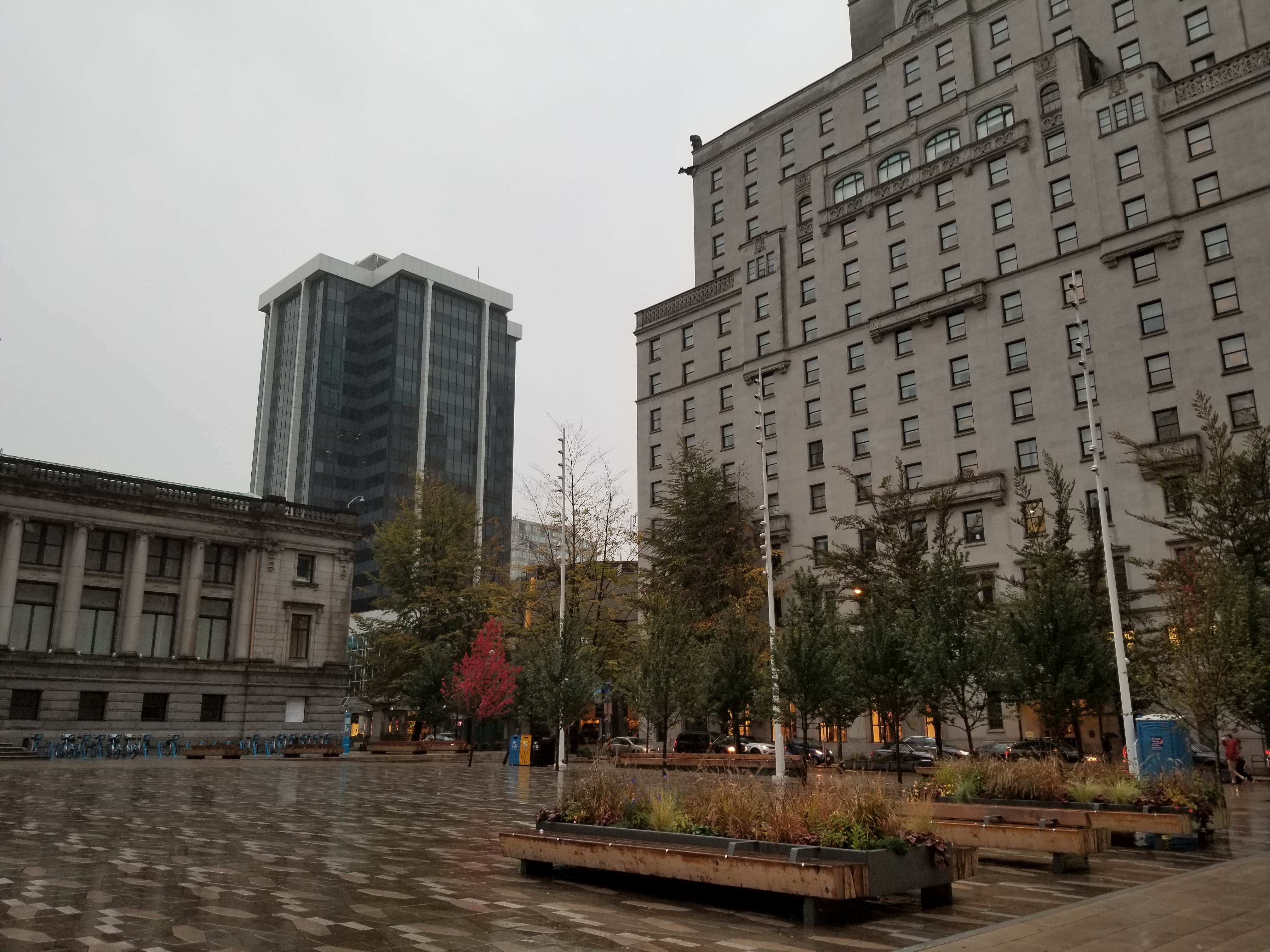
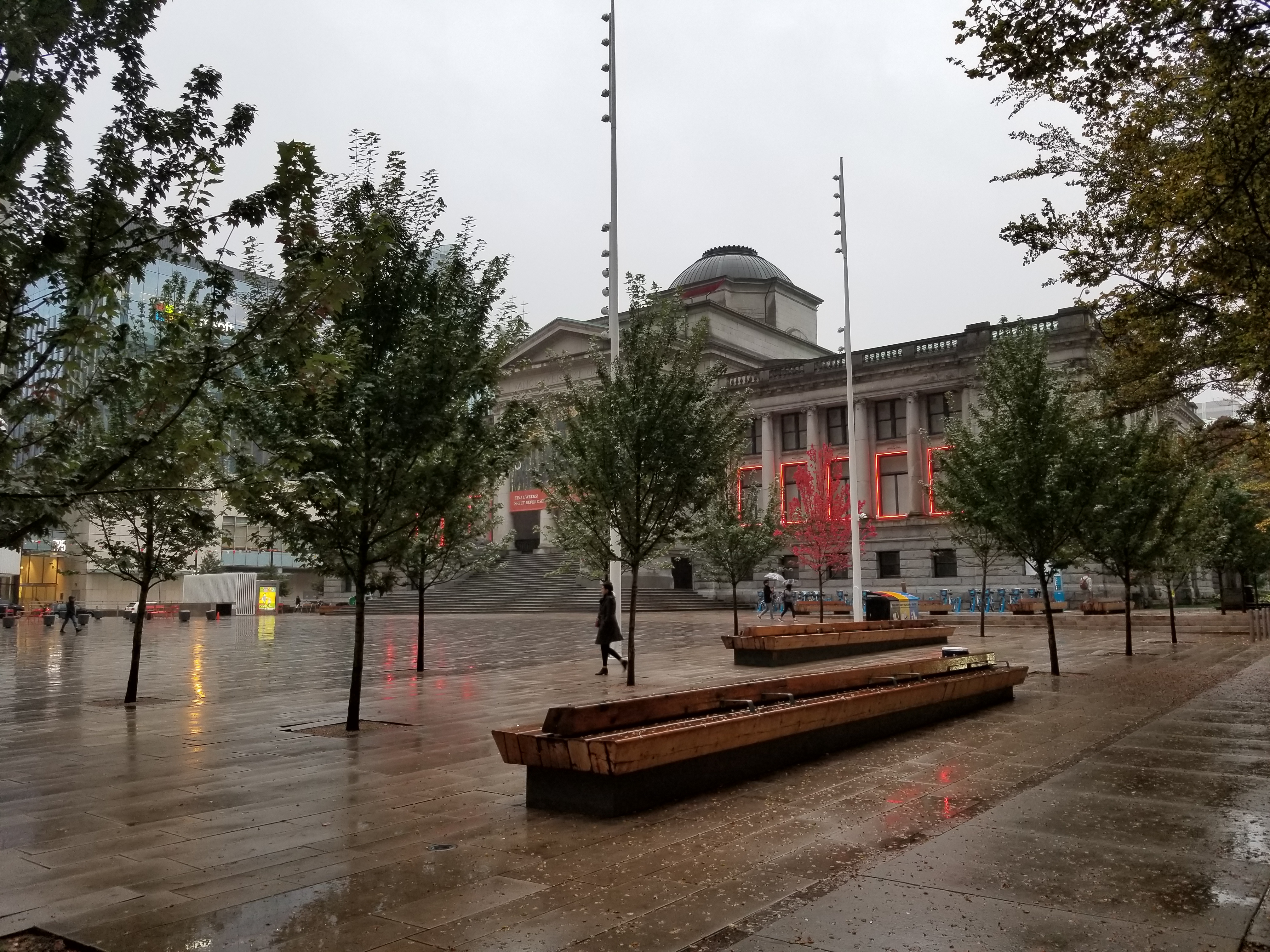
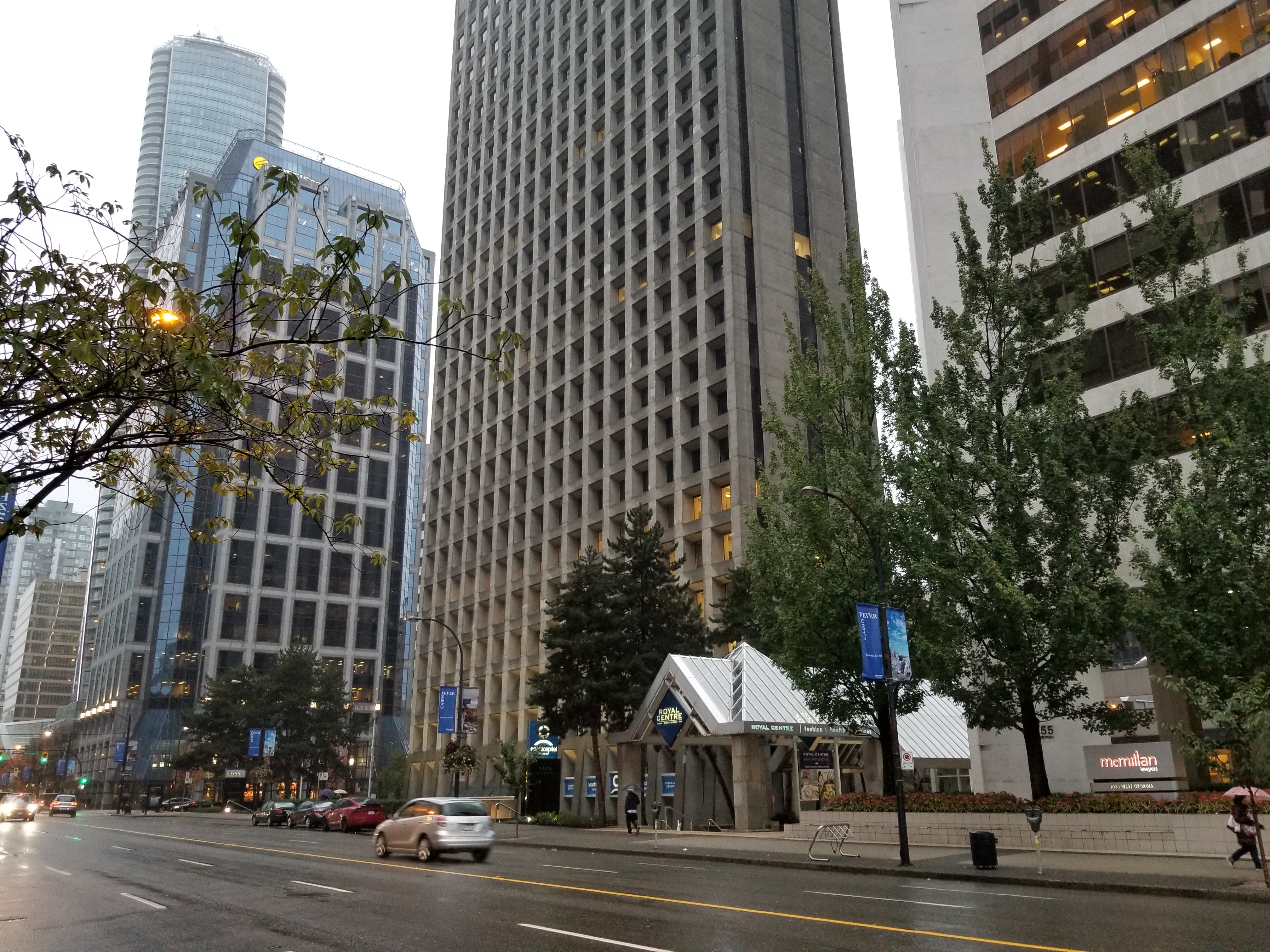
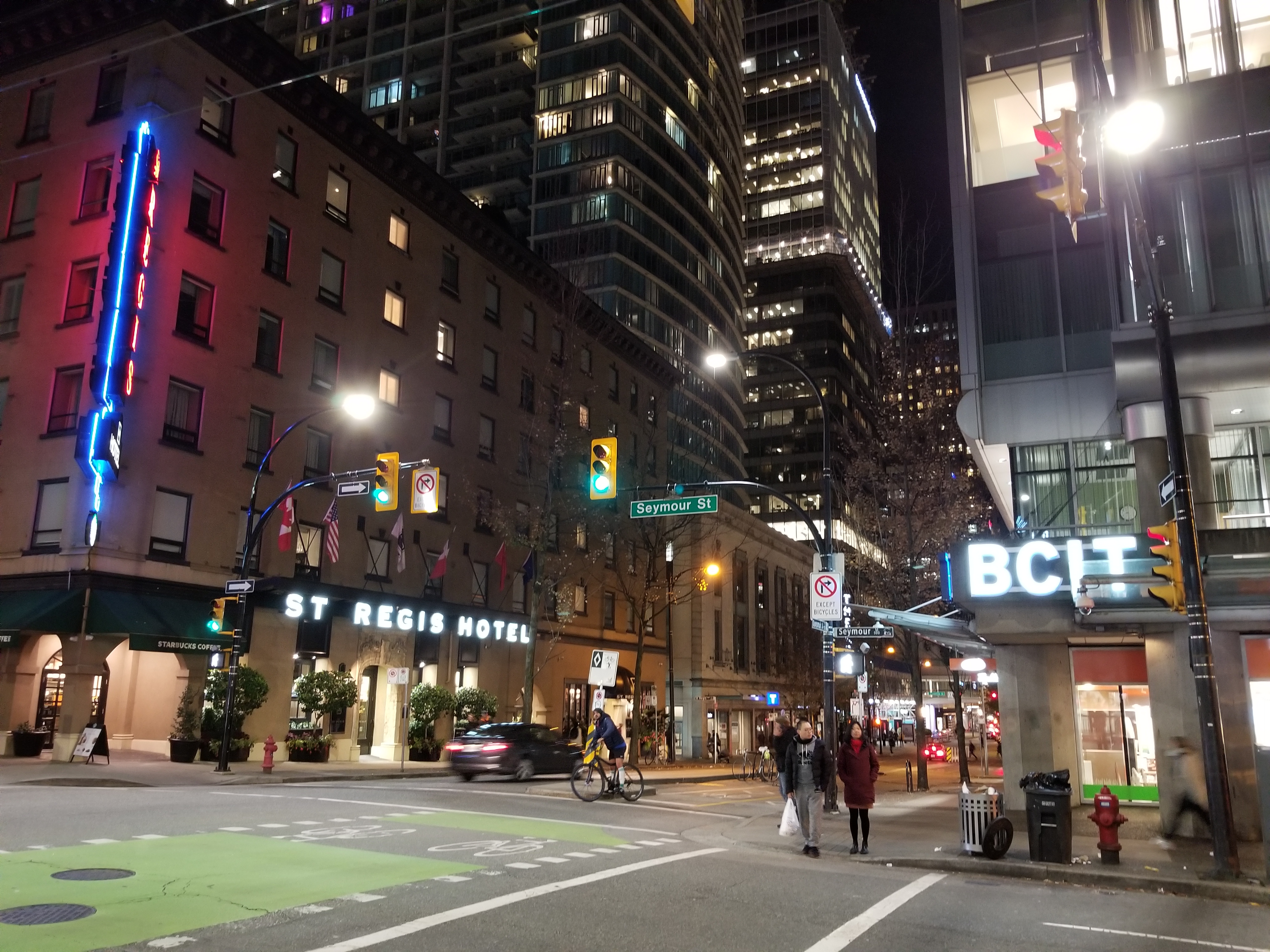
On Georgia Street in Downtown Vancouver. Autumn of 2018.

Georgia Street is an east–west street in the cities of Vancouver and Burnaby, British Columbia, Canada. Its section in Downtown Vancouver, designated West Georgia Street, serves as one of the primary streets for the financial and central business districts, and is the major transportation corridor connecting downtown Vancouver with the North Shore (and eventually Whistler) by way of the Lions Gate Bridge. The remainder of the street, known as East Georgia Street between Main Street and Boundary Road and simply Georgia Street within Burnaby, is more residential in character, and is discontinuous at several points.

West of Seymour Street, the thoroughfare is part of Highway 99. The entire section west of Main Street was previously designated part of Highway 1A, and markers for the ‘1A’ designation can still be seen at certain points.

Starting from its western terminus at Chilco Street by the edge of Stanley Park, Georgia Street runs southeast, separating the West End from the Coal Harbour neighbourhood. It then runs through the Financial District; landmarks and major skyscrapers along the way include Living Shangri-La (the city’s tallest building), Trump International Hotel and Tower, Royal Centre, 666 Burrard tower, Hotel Vancouver and upscale shops, the HSBC Canada Building, the Vancouver Art Gallery, Georgia Hotel, Four Seasons Hotel, Pacific Centre, the Granville Entertainment District, Scotia Tower, and the Canada Post headquarters. The eastern portion of West Georgia features the Theatre District (including Queen Elizabeth Theatre and the Centre in Vancouver for the Performing Arts), Library Square (the central branch of the Vancouver Public Library), Rogers Arena, and BC Place. West Georgia’s centre lane between Pender Street and Stanley Park is used as a counterflow lane.

East of Cambie Street, Georgia Street becomes a one-way street for eastbound traffic, and connects to the Georgia Viaduct for eastbound travellers only; westbound traffic is handled by Dunsmuir Street and the Dunsmuir Viaduct, located one block to the north.

East Georgia Street begins at the intersection with Main Street in Vancouver’s Chinatown, then runs eastwards through Strathcona, Grandview–Woodland and Hastings–Sunrise to Boundary Road. East of the municipal boundary, Georgia Street continues eastwards through Burnaby until its terminus at Grove Avenue in the Lochdale neighbourhood. This portion of Georgia Street is interrupted at several locations, such as Templeton Secondary School, Highway 1 and Kensington Park.

Georgia Street was named in 1886 after the Strait of Georgia, and ran between Chilco and Beatty Streets. After the first Georgia Viaduct opened in 1915, the street’s eastern end was connected to Harris Street, and Harris Street was subsequently renamed East Georgia Street.

The second Georgia Viaduct, opened in 1972, connects to Prior Street at its eastern end instead. As a result, East Georgia Street has been disconnected from West Georgia ever since.

On June 15, 2011 Georgia Street became the focal point of the 2011 Vancouver Stanley Cup riot.