The Creative Genius Within: Learning From Leonardo

https://www.psychologicalscience.org/news/minds-business/creative-genius-davinci.html

Creative ideas often seem to come out of thin air, but bringing them to life involves a sequence of conscious and controlled steps. Even Leonardo da Vinci, one of the most famous scientists, painters, and inventors of all time, produced more than 500 drawings and 35,000 words on the topic of flight, yet it is doubtful that his ideas for human-powered flying machines would have succeeded, given what we now know about the limitations of human muscle force.

However, da Vinci’s extensive documentation of his ideas paved the way for the invention of airplanes and helicopters some 400 years later. Moreover, those notes and drawings could still spark and nurture a great many new creative theories to come. In fact, according to an article recently published in Perspectives on Psychological Science, da Vinci’s creative process made use of general psychological processes common not only to geniuses like himself, but to every human being.

“Creativity has long been attributed to genius or great talent—characteristics one is believed simply to be born with,” wrote C. Dominik Güss and Sarah Ahmed (University of North Florida) and Dietrich Dörner (Otto-Friedrich Universität Bamberg, Germany). “Although we acknowledge that people differ in the extent of their talent, our assumption is that every human being is capable of creativity and already using some aspects of creative thinking one way or another and that the creative process follows steps similar to those of ordinary motivational and cognitive processes.”

“How did Leonardo da Vinci come up with these two ideas of flying machines?” Güss and colleagues asked, referring to two prototypes from da Vinci’s notes: the “ornithopter,” meant to mimic the flight of birds or bats, and the helicopter, also called the aerial screw or screw air. On the basis of those notes, they identified nine iterative stages of the creative process according to their interpretation of da Vinci’s own creative process.

The nine nonlinear stages all relate to motivation and cognition, the researchers explained, and provide “clarification and more detailed descriptions of the creative subprocesses” absent from previous models of the creative process, including Wallas’s four-stage model (1926), which comprises preparation, incubation, illumination, and verification.

  • Vision and curiosity as motivation to discover. “All great inventions have been preceded by great vision or even a consideration of achieving the impossible,” Güss and colleagues wrote. Da Vinci’s intense curiosity and desire to think about “unthinkable” phenomena, they said, are motivational processes inherent in Dörner’s own “PSI-theory” of basic human needs: the need for certainty and the need for competence. “It was most likely curiosity or the high need for certainty, paired with a stable level of competence from preexisting stores of knowledge and the anticipation of enormous success as an imagined source of competence, that allowed da Vinci to continue pursuing the study of flight and of flying machines over a period of several years.”
  • Social recognition as motivation. In his Codex on the Flight of Birds, da Vinci described wanting to test his flying machines on the hillsides of Mount Cecero, north of Florence, “filling all writings with his fame and bringing eternal glory to his birthplace.” Although he was already acclaimed for his genius at the time, these notes suggest that he—like most people—was motivated at least in part by social recognition, according to Güss and colleagues.
  • Asking questions. Curiosity triggers an important part of the creative thought process, and specific “what,” “why,” and “how” questions can identify gaps in knowledge and provide direction for further thought. The researchers demonstrated da Vinci’s quest for “how” in particular in his notes describing how the movements of birds’ shoulders and wings work together to compress air and sustain motion.
  • Analogical thinking. The “if-then” analogies that guide everyday decisions also motivated da Vinci, according to Güss and colleagues. His “search for an answer to the question of what else can fly was guided by this analogy: If birds can fly, then a human being imitating a bird can fly as well,” they wrote. Likewise, they posited that he may have used either a screw or a child’s “whirligig” toy as an analogy for his helicopter design.
  • Trial and error. Even experts use this simple strategy of trying one approach and, if it doesn’t succeed, trying another. In da Vinci’s case, his writings revealed an evolution in his understanding of the dynamics of wind, wings, and flight through his intensive studies—“most likely through mental trial and error,” the researchers wrote.
  • Abductive thinking. This form of reasoning relies on observing phenomena and introducing new knowledge that might reflect possible explanations. Da Vinci himself wrote, “First I shall do some experiments before I proceed farther, because my intention is to cite experience first and then with reasoning show why experience is bound to operate in such a way. And this is the true rule by which those who speculate about the effects of nature must proceed.”

The other stages identified by Güss and colleagues are incubation and forgetting; overinclusive thinking, latent inhibition, and illumination/insight; and testing and working out details (schema elaboration). These involve setting problems aside and allowing the mind to rest, indulging seemingly unrelated distractions that may lead to “aha!” moments of discovery, and working out the messy details of the idea in question—in da Vinci’s case, for instance, the mechanical details of the ornithopter.

“None of us is Leonardo da Vinci, but all of us are a little like him,” the researchers concluded. The creative process “is at the heart of human intelligence, of the ability to invent, solve problems, and adapt to new situations.”

Russian Aviation’s Darkest Hour Since WWII Gets 40-Second TV News Slot

https://www.newsweek.com/russia-drone-ukraine-ww2-2079812

Kremlin-controlled television dedicated less than a minute of its news coverage to what has been described as the largest single-day destruction of Russian military aircraft since World War II, it has been reported.

Two state channels in Russia only mentioned Ukraine’s daring drone raid in 40-second segments, according to an assessment of coverage by independent outlet Agentstvo.

However, pro-Russian Telegram channels blamed the authorities for not adequately protecting military facilities from what was described as “Russia’s Pearl Harbor,” referring to Japan’s attack on Hawaii on December 7, 1941.

The World War II comparisons did not end there.

John Spencer from the Modern War Institute said on Substack that Sunday marked the largest single-day destruction of Russian military aircraft since Operation Barbarossa in 1941 when Germany launched its surprise invasion of the USSR.

Newsweek has contacted the Russian defense ministry for comment.

The Kremlin strictly controls state media messaging over the war it started in Ukraine, but Russian bloggers on Telegram present a far more unvarnished view of hostilities.

The extent of Ukraine’s operation, which targeted four airfields as far from the border as Irkutsk in Siberia, and comparisons with what Moscow faced in World War II, will deal a setback to Vladimir Putin.

The Security Service of Ukraine (SBU) said its operation, dubbed “Spiderweb,” hit 41 Russian aircraft across four air bases on Sunday, according to Ukrainian media.

The operation involved 117 drones launched from trucks hidden across Russian territory and allegedly destroyed or damaged A-50, Tu-95, and Tu-22 M3 planes parked at the Belaya, Diaghilev, Olenya, and Ivanovo air bases.

Ukraine said that it had disabled one-third (34 percent) of Russia’s strategic bomber fleet, although this has not been independently confirmed.

On his urban warfare Substack, Spencer described the attack as the largest single-day destruction of Russian military aircraft since Operation Barbarossa on June 22, 1941.

The German Luftwaffe destroyed between 1,200 and 2,000 Soviet aircraft on the ground in just hours, but since then, no single strike has inflicted such concentrated losses on Russian or Soviet aviation, Spencer wrote.

The reported destruction of at least 40 strategic bombers was unmatched in the post–World War II era, made all the more notable that it came not from an air force but by a drone-enabled ambush launched by a nation under siege, he added.

Agentsvo said that Channel One and Russia 1 devoted just 40 seconds each to one of the most daring operations during the full-scale war.

Presenters read out defense ministry statements that drones attacked airfields in the Murmansk, Irkutsk, Ivanovo, Ryazan and Amur regions—the latter not mentioned by Ukrainian sources.

In the first two regions, the Russian TV anchors reported that “several units of aviation equipment” had caught fire, but no other details were provided, it said.

The relative silence continued Monday morning, according to Agentstvo, which said neither channel reported on their broadcasts at 9 a.m., although state agencies TASS and RIA Novosti began covering the attacks after the Defense Ministry issued its statement.

Russian military bloggers were more candid and critical. War correspondent Alexander Kots posted on Telegram that there is an ongoing problem with the protection of Russia’s strategic facilities.

Another Telegram channel, “Military Informant”, said Ukraine’s drone attack on Russian bases “was only a matter of time.”

The channel “Novorossiya Militia” said it was unclear why authorities protecting Russia’s strategic aviation were unprepared for such an attack. Meanwhile, Alexey Zhivov wrote, “A ‘Russian Pearl Harbor’ has happened, and the future of our country and civilization depends on how we respond to it.”

Yuriy Boyechko, CEO and Founder of Hope for Ukraine, told Newsweek on Monday that the success of Ukraine’s drone attack showed that Kyiv “has some trump cards up its sleeve.”

No diplomatic breakthrough on peace was expected as Russia held talks with Ukraine in Istanbul on Monday, and eyes will turn to what Putin will do in response.

Aurélien Colson, academic co-director at the ESSEC Institute for Geopolitics & Business, told Newsweek Russia will likely step up missile and drone attacks, but resorting to nuclear weapons “is excluded” given the opposition of China, whose support Putin depends on.

5 Reasons Autistic Women are Under-Diagnosed

👩‍👧‍👧 Did you know that autistic women and girls are often underdiagnosed or misdiagnosed? 😔 This is due to a shortage of specialists, masking, misdiagnosis, phenotype differences, and lack of research. 🔬📚

Read https://www.autismbc.ca/blog/assessment/autistic-women-girls-underdiagnosed-bc/ to find out more about this ongoing issue.

✏️ Were you overlooked as an autistic person because you don’t fit the mould of young, white boy? Share your story of being late-identified using the hashtag #latenotless (or comment below)!

‘Diplomatic catastrophe of century’: Iran’s foreign minister slams US veto of Gaza resolution

https://www.presstv.ir/Detail/2024/02/21/720519/diplomatic-catastrophe-of-century-Iran

Iran’s foreign minister has censured Washington for vetoing, for the third time, a UN Security Council resolution demanding an immediate ceasefire in the besieged Gaza Strip.

Hossein Amir-Abdollahian said “diplomatic catastrophe of the century” had taken place and the United States remains responsible for Israel’s savage campaign in Gaza since early October.

“Continued veto by the US administration clearly creates liability for the White House for the forged Israeli regime unceasing genocide in Gaza and war crimes in the West Bank, Palestine. The world must hold the US accountable,” the Iranian minister wrote in a post on X on Wednesday.

The United States used its veto power at the United Nations Security Council on Tuesday to block the draft resolution prepared by Algeria.

The draft rejected the “forced displacement of the Palestinian civilian population” and urged “all parties to comply with international law.”

Representatives of 13 countries at the 15-member Security Council voted in favor. Britain abstained.

The United States vetoed similar draft resolutions in October and December.

Washington has supplied the Israeli regime with more than 10,000 tons of military equipment over the past months of hostilities in Gaza.

Condemnations have poured in from across the world. Countries such as China, Russia, Saudi Arabia, and even Washington’s close allies, including France and Slovenia, have denounced the veto.

The Palestinian Ambassador to the United Nations Riyad Mansour has said the move was “absolutely reckless and dangerous.”

“The message given today to Israel with this veto is that it can continue to get away with murder,” he said in a statement to the Security Council.

Separately, Nasser Kan’ani, the spokesman for Iran’s Foreign Ministry, condemned the veto.

“The US measure … proved to the world once again that the US is not only not part of the solution to the crisis and humanitarian catastrophe in Gaza, but is the most important factor in the continuation of the crisis and the cause of its expansion to the region.”

Kan’ani said the veto “clearly confirms Iran’s accurate assessment since the beginning of the ongoing crisis in Gaza that the US is the main director of the war and the one preventing the end of genocide and the killing of Palestinian children and women in the Gaza Strip and the West Bank.”

The uncalculated measures, Kan’ani said, by the US at the Security Council and its repeated use of the veto power have endangered global peace and made the United Nations unable to fulfill its main objective of protecting international security.

“This has weakened the trust of governments and nations in the UN role in guarding international peace and security,” the Iranian official said.

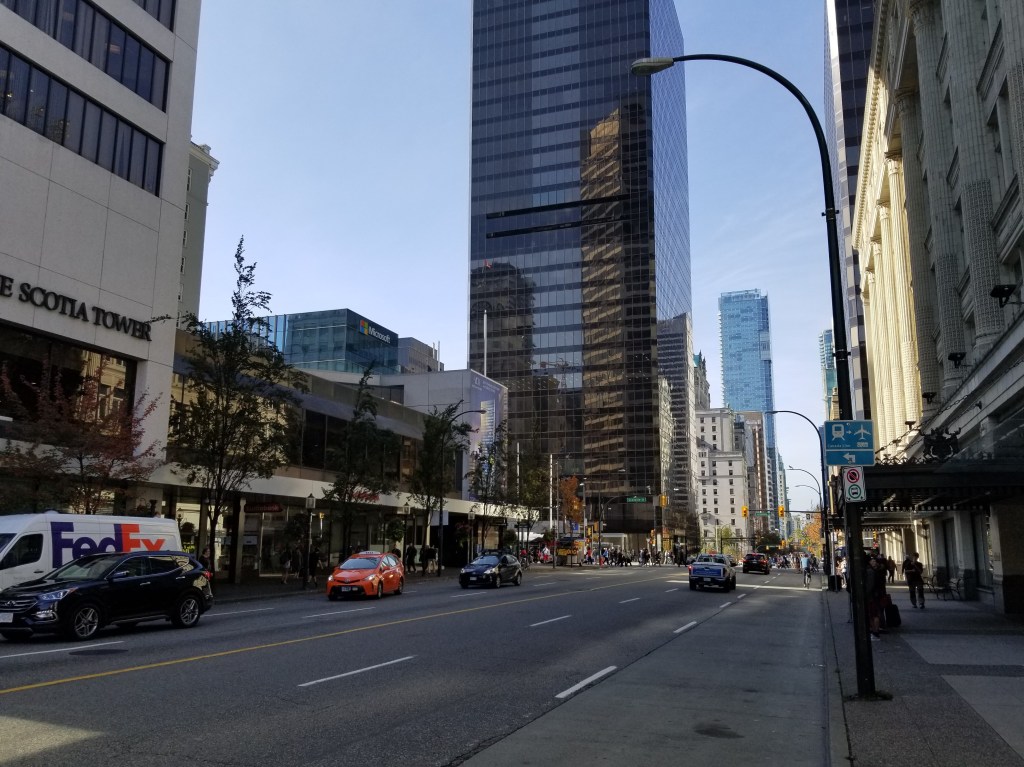
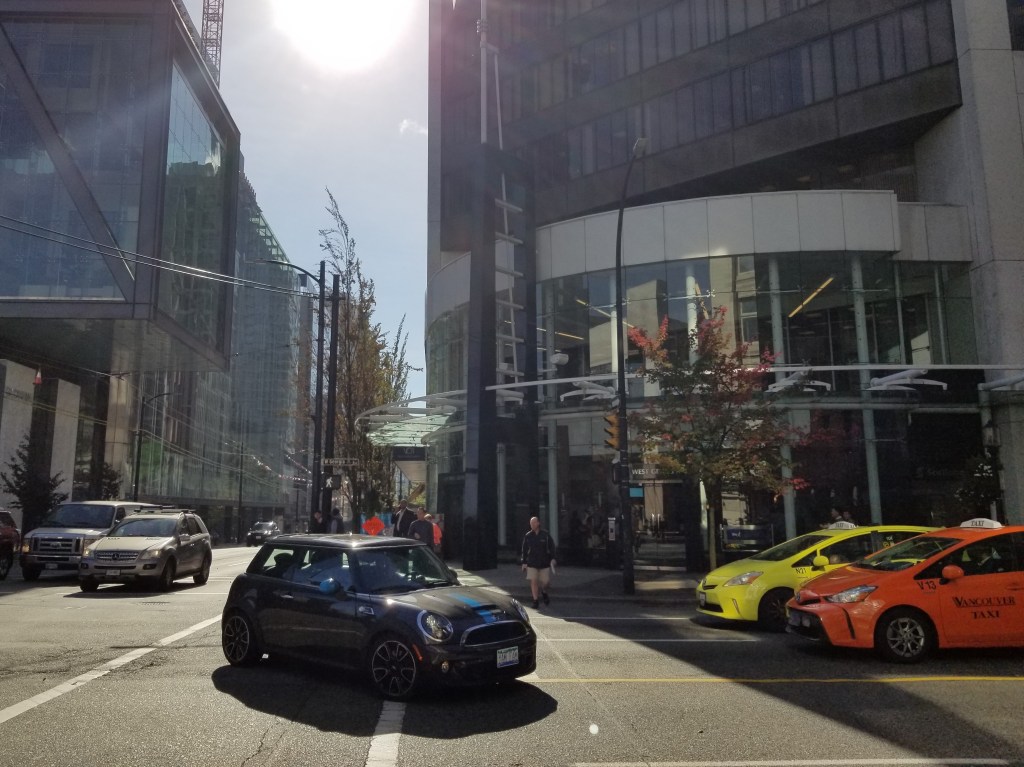
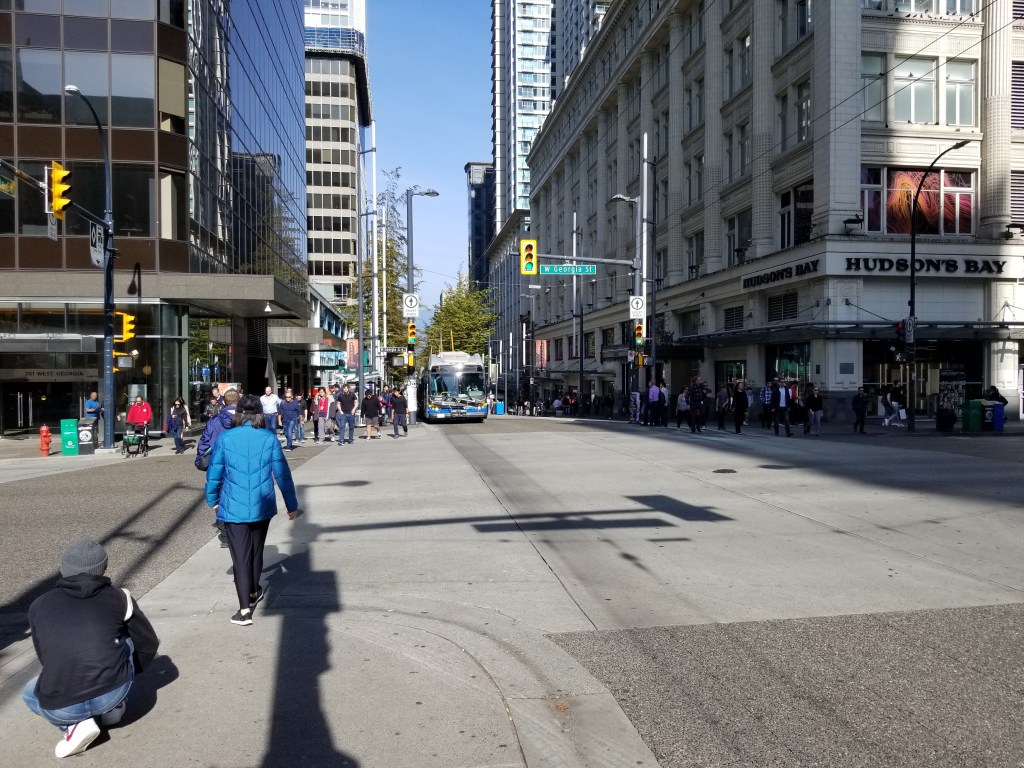
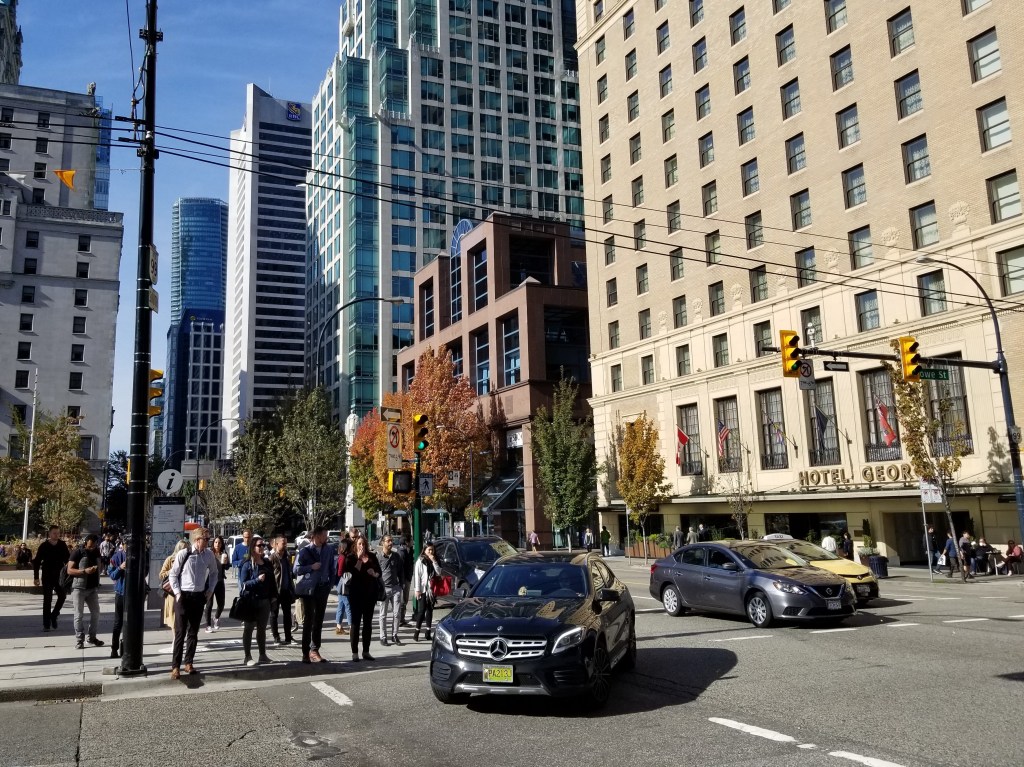
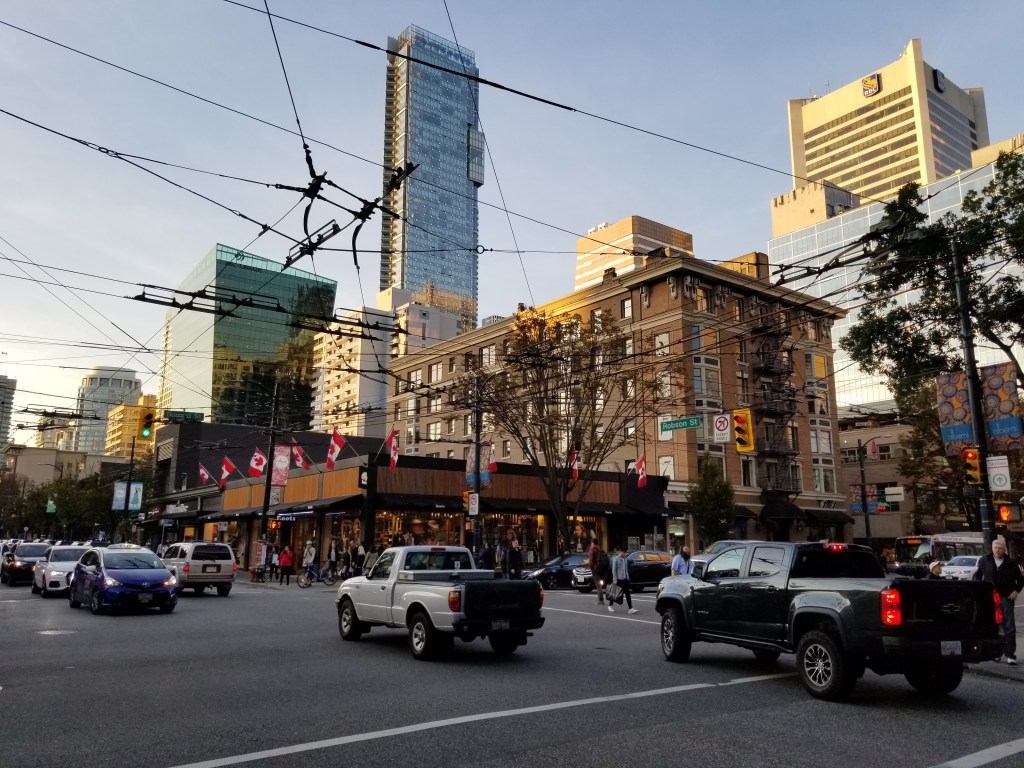
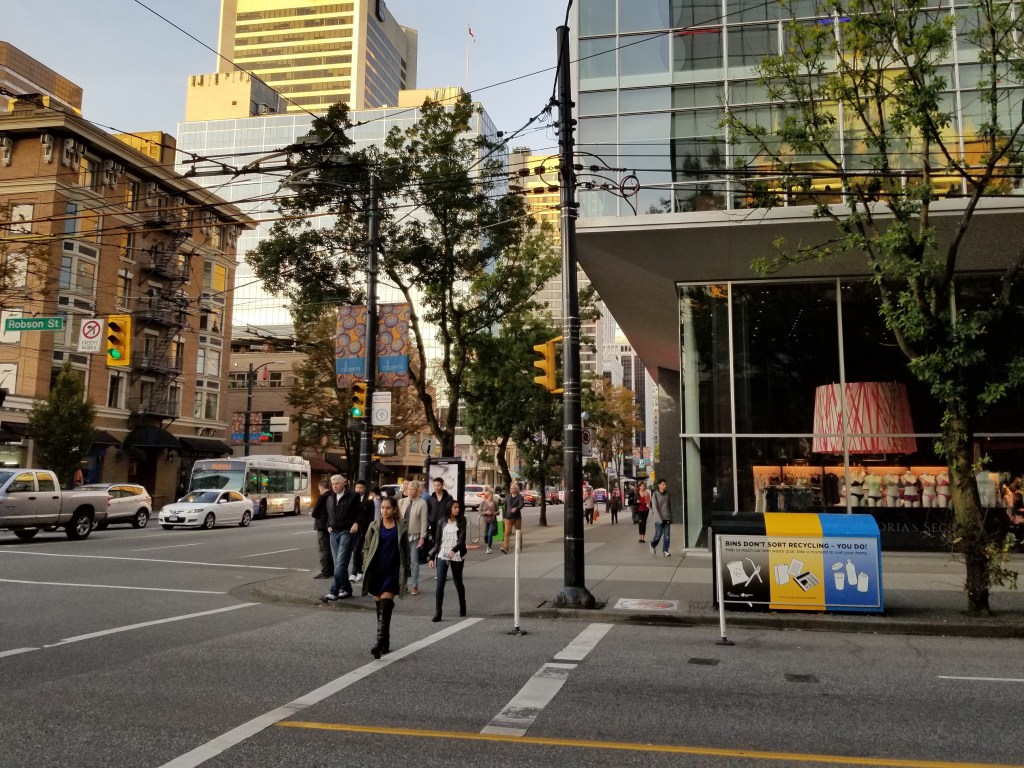
On Georgia Street in Downtown Vancouver. Autumn of 2018.

Georgia Street is an east–west street in the cities of Vancouver and Burnaby, British Columbia, Canada. Its section in Downtown Vancouver, designated West Georgia Street, serves as one of the primary streets for the financial and central business districts, and is the major transportation corridor connecting downtown Vancouver with the North Shore (and eventually Whistler) by way of the Lions Gate Bridge. The remainder of the street, known as East Georgia Street between Main Street and Boundary Road and simply Georgia Street within Burnaby, is more residential in character, and is discontinuous at several points.

West of Seymour Street, the thoroughfare is part of Highway 99. The entire section west of Main Street was previously designated part of Highway 1A, and markers for the ‘1A’ designation can still be seen at certain points.

Starting from its western terminus at Chilco Street by the edge of Stanley Park, Georgia Street runs southeast, separating the West End from the Coal Harbour neighbourhood. It then runs through the Financial District; landmarks and major skyscrapers along the way include Living Shangri-La (the city’s tallest building), Trump International Hotel and Tower, Royal Centre, 666 Burrard tower, Hotel Vancouver and upscale shops, the HSBC Canada Building, the Vancouver Art Gallery, Georgia Hotel, Four Seasons Hotel, Pacific Centre, the Granville Entertainment District, Scotia Tower, and the Canada Post headquarters. The eastern portion of West Georgia features the Theatre District (including Queen Elizabeth Theatre and the Centre in Vancouver for the Performing Arts), Library Square (the central branch of the Vancouver Public Library), Rogers Arena, and BC Place. West Georgia’s centre lane between Pender Street and Stanley Park is used as a counterflow lane.

East of Cambie Street, Georgia Street becomes a one-way street for eastbound traffic, and connects to the Georgia Viaduct for eastbound travellers only; westbound traffic is handled by Dunsmuir Street and the Dunsmuir Viaduct, located one block to the north.

East Georgia Street begins at the intersection with Main Street in Vancouver’s Chinatown, then runs eastwards through Strathcona, Grandview–Woodland and Hastings–Sunrise to Boundary Road. East of the municipal boundary, Georgia Street continues eastwards through Burnaby until its terminus at Grove Avenue in the Lochdale neighbourhood. This portion of Georgia Street is interrupted at several locations, such as Templeton Secondary School, Highway 1 and Kensington Park.

Georgia Street was named in 1886 after the Strait of Georgia, and ran between Chilco and Beatty Streets. After the first Georgia Viaduct opened in 1915, the street’s eastern end was connected to Harris Street, and Harris Street was subsequently renamed East Georgia Street.

The second Georgia Viaduct, opened in 1972, connects to Prior Street at its eastern end instead. As a result, East Georgia Street has been disconnected from West Georgia ever since.

On June 15, 2011 Georgia Street became the focal point of the 2011 Vancouver Stanley Cup riot.

Nintendo Switch Online’s N64 Emulation Is Inexcusable

https://screenrant.com/nintendo-switch-online-n64-emulation-bad-expansion-pack/

Nintendo Switch Online + Expansion Pack has just recently launched, giving subscribers access to Nintendo 64 and Sega Genesis games through emulation. A similar service was already available through the base subscription of NSO, which offered users NES and Super Nintendo games. Early adopters of the Expansion Pack subscription tier have already found some technical issues with the Nintendo 64 emulator technology that the Switch uses, meaning the service has failed to deliver on its ill-conceived, too expensive content package.

To be fair, the N64 and Genesis games are not the only differentiation between the Expansion Pack and the base NSO subscription. The Expansion Pass will also grant Animal Crossing: New Horizons players access to the Happy Home Paradise expansion when it launches on November 5. It also retains the perks of subscribing to the base NSO, including access to online play, the ability to purchase certain peripherals at additional cost, a handful of in-game cosmetic items, and the ability to play NSO-only games like Tetris 99 and Pac-Man 99.

However, Nintendo Switch Online is still rather short on functionality and exclusive content. It does not come close to offering the same features or member-exclusive deals as its closest competitors from Microsoft and Sony. Xbox Live Gold and PlayStation Plus are nearly equivalent in yearly price to Nintendo Switch Online + Expansion Pack, but the latter doesn’t offer dedicated usernames, built-in party chat, even lower sale prices for subscribers, or monthly free games (not to mention the entirety of the PS+ Collection on PS5). On top of NSO’s well-known shortcomings, the service’s premium model has now brought faulty emulations of its most anticipated feature: Nintendo 64 games.

Not long after the Nintendo 64 games went live alongside the NSO + Expansion pack, Twitter user Toufool posted a video demonstrating the input lag present when playing The Legend of Zelda: Ocarina of Time. A follow-up tweet shows a slow-motion comparison between Ocarina of Time on the Switch and the original version on the N64. When the discovery was shared to the NintendoSwitch subreddit, user Dacvak did a more comprehensive investigation, comparing the new NSO version of Super Mario 64 to that previously released for the Switch through the Super Mario 3D All-Stars collection, which also uses emulation for all three games.

Dacvak’s methodologically is admittedly rather rudimentary as far as technical tests go, using the slow-motion video capture on an iPhone 13 Pro, but the range of results gets the point across. Super Mario 3D All-Stars has an input lag for Super Mario 64 of somewhere between 112 and 137 milliseconds, while the new version of SM64 included in Nintendo Switch Online + Expansion Pack has an input lag clocking in somewhere between 150 and 167 milliseconds. According to Dacvak, “this means there is roughly a frame to 1.5 frames of additional latency in the NSO version.” One or two frames dropped from a button press to the corresponding action happening on screen isn’t a major concern, but it should be emphasized that this is a comparison to another emulated version of the game, not the original Super Mario 64 running on its intended hardware, which would likely have the lowest latency.

Another issue – one that’s perhaps more noticeable than input lag – is an apparent problem with rendering fog and reflections in the Expansion Pack’s N64 games. Twitter user stopskeletons shared a few screenshots comparing the water quality in Ocarina of Time, specifically the shallow pool in the Water Temple’s mini-boss room where the player fights Dark Link. Missing visual effects have completely changed the room’s aesthetic, with the new NSO version of Ocarina lacking all reflections in the water and fog that’s used to make the area appear boundless.

Digital Foundry’s John Linneman, who uses the handle dark1x on Twitter, suggests it’s the emulation tech itself that is responsible for the rendering issues, meaning it could have an effect on every title available through the Expansion Pack. Stranger still is the fact that Ocarina of Time has been emulated wonderfully by Nintendo in the past for the Wii and Wii U Virtual Consoles, though Linneman says the NSO emulator looks to be based on the one used for Super Mario 3D All-Stars. Nintendo Switch Online’s N64 games are presented in their native 4:3 aspect ratio rather than full screen, which helps preserve their dated graphics, but it’s all for naught if the emulator can’t properly display the games anyway.

These issues may sound like nitpicks, and relative to game-breaking bugs, they are, but the fact of the matter is Nintendo has charged consumers for a service and failed to deliver what was promised. These may be small complaints in the grand scheme of things, but increased latency and missing visual effects in games that are over two decades old make the Expansion Pack emulations objectively inferior to the originals they are adapting. The N64 and Sega Genesis games are the only offerings in the Expansion Pack until the Animal Crossing DLC launches on November 5, and it costs more than double the standard NSO subscription.

Issues like those above could easily be chalked up to simple oversights or unfortunate limitations in the emulation tech, but a failure to rework features that require the N64 Controller Pak, as documented by TriThreat98 on Twitter, begins leaning the whole situation in the direction of apathy toward the consumer. Without a Controller Pak, it’s impossible to save ghost times on the NSO version of Mario Kart 64. A Controller Pak goes in the back of a Nintendo 64 controller, and the ones specifically made for the Expansion Pack games don’t even have a slot for one. This is bordering on game-breaking since the entire time trials game mode is now useless in Mario Kart 64.

Those who don’t wish to pay another $50 (the same price as a yearly Expansion Pack subscription) for the Switch-compatible controller will also have to deal with Nintendo’s attempt to graft the Joy-Con button layout onto N64 games. As Twitter user Shiori_Ishimaru and Reddit user Enraric have pointed out, rearranging the layout for the N64 controls is almost nonsensical, since the right Joy-Con doesn’t have enough buttons by itself. Custom button mapping is also not possible for the NSO games, and the Switch’s system-wide re-mapping doesn’t solve the issue. Even more complaints have been compiled in a ResetEra thread, which includes delayed audio, frame rate drops, and various issues with music tracks.

Nintendo has taken its already lackluster online service, added these games which are riddled with issues, and charged more than double with the promise of DLC content being included at a later date. The second subscription tier for Nintendo Switch Online was anti-consumer enough, and now the poor execution of the only currently available content in the Expansion Pack is frankly inexcusable. Nintendo’s perennially full-priced games and unwillingness to fix Joy-Con drift are beside the point, but they are emblematic of a pattern in which the company has no regard for the consumer, with the Nintendo Switch Online + Expansion Pack N64 games debacle being just the most recent example.