
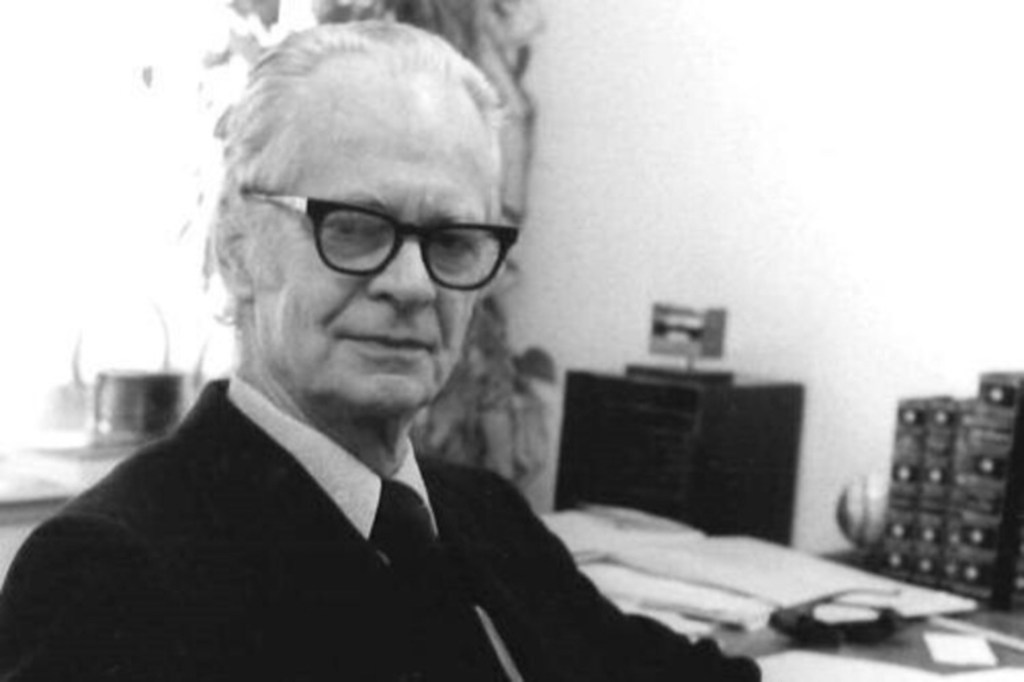
The American psychologist John Broadus Watson was born near Greenville, South Carolina, and educated at Furman University and the University of Chicago. He later became professor of psychology at Johns Hopkins University, where he developed the school of psychology known as behaviorism. This approach sought to abandon the concept of consciousness and restrict psychology to the study of behavior, with the objective of explaining, predicting, and controlling behavior. Watson made the first systematic studies of rat behavior, and had a major influence on the development of psychological research.
Due to an extramarital affair with a student, Watson was forced to leave Johns Hopkins in 1920. His subsequent career was in advertising, where he sought to apply the psychological principles he had derived. After retiring in 1945, he led a reclusive life on a small farm in Connecticut, drinking heavily. He died in 1958, at the age of 80.
According to Buckley (1989),
More than any other psychologist of his generation, he shaped the image of the profession in the public mind. Moreover, his popularized vision of a science of behavior control stirred the imagination of a new generation of psychologists. It was a young B. F. Skinner who as a student glimpsed the “possibility of technological applications” in Watson’s Behaviorism … (p. 160)
Although his ideas were often contentious (e.g., on the rearing of children and the role of women in society), many psychologists regard Watson as one of the greatest psychologists of the twentieth century. This chapter presents evidence that Watson had Asperger Syndrome.
Family and Childhood
Watson was the fourth of six children of Pickens Butler Watson and Emma Roe. His father was a drinker, brawler, and former Confederate soldier; his mother, a devout Baptist, was regarded as far below her husband on the social scale, with the result that the family was ostracized.
Watson grew up first on a small farm and then in the town of Greenville. His volatile father was absent from the family home for long periods. Watson had difficulty in adjusting to town life and showed aggressive behavior.
Social Behavior
At Furman University, Watson described himself as unsocial and made few friends. He had an aloof, almost shy disposition and in later life became a virtual recluse. One professor remembered him as “bright” but “more interested in ideas and theories than … people” (Buckley, 1989, p. 11). According to Buckley (1989), his constant striving for achievement and approval was often sabotaged by “acts of sheer obstinacy and impulsiveness” (p. 12).
Not surprisingly, Watson wanted “a place where daily living can be taught” — daily living was clearly what he had difficulty with. After graduating from Furman, he had a brief spell as principal of Batesburg Institute, a small private academy; one of his students later recalled that Watson “kept to himself and avoided the social life of the community” (Buckley, 1989, pp. 13-14).
At the University of Chicago, where he continued his studies, Watson was “an ambitious, extremely status-conscious young man, anxious to make his mark upon the world but wholly unsettled as to his choice of profession and desperately insecure about his lack of means and social sophistication” (Buckley, 1989, p. 39). Like many psychologists even today, he longed for the prestige of an MD degree.
Watson had major interpersonal difficulties at the university. According to Buckley (1989), “When Watson submitted a request for additional laboratory equipment, some ill-considered remarks contained in the request were taken by William Rainey Harper (president of the University of Chicago) to be either an ‘indication of insanity, or intentional impertinence” (p. 51). As a psychologist in World War I, he again had major interpersonal difficulties, describing the experience as a nightmare. His racism and social insecurity were evident: “Talk of putting a Negro in uniform! It is nothing [in comparison] to making a Major or Lieutenant Colonel of most of the Rotary Club men who went in as officers in the American Army (West Point and Naval Academy men excluded)” (Buckley, 1989, p. 106). Harold Ickes, his brother-in-law, claimed that Watson was not liked or respected at the university.
“Laboratory experiments that involved human participants made Watson uncomfortable, and he always acted unnaturally under those conditions, which he described as stuffy and artificial” (Buckley, 1989, p. 40). He turned with relief to the study of animals. After his retirement, his favorite companions were the animals on his farm. It is common for persons with autism to prefer animals to people.
Notwithstanding Watson’s professional concerns with order, his personal life was “tempestuous and sometimes chaotic” — he chose women who were “young, impressionable and, initially at least, awed by him,” and married one of his students, Mary Ickes, in 1904 (Buckley, 1989, p. 50). Watson was often a willing mentor to his female students, but he was extremely uncomfortable with women as professional peers. The marriage was disastrous for both parties, and ended sensationally after 16 years.
The cause of the divorce, and of Watson’s dismissal from Johns Hopkins University, was his affair with Rosalie Rayner, a graduate student who was his research assistant. According to Buckley (1989), Watson was convinced that his professional stature would render him impervious to any censure of his private life, and he completely misjudged the sensibilities of the authorities at Johns Hopkins. His chances of securing another academic position were ruined by the massive nationwide publicity that attended his divorce hearing.
Narrow Interests/Obsessiveness
Watson was a very insecure man. He worked extremely hard, very long hours, and was hugely ambitious. Buckley (1989) noted that his obsession with achievement reflected deep anxieties about failure and success, and his driving ambition precluded any compromise with competing ideas. Extreme narrowness and inability to listen to anyone else were typical of him.
Watson became convinced of the notion that a human being is simply a biological mechanism, and produced a theory of emotions whose development depended entirely on external conditioning. He viewed the self as defined by the choice of one’s career. Adolf Meyer, the great U.S. psychiatrist, made a wide-ranging attack on Watson’s views and methods. He complained bitterly to Watson about the rigidity of his position: “You would like to see all the psychopathological facts treated under the paradigms of conditioned reflexes, with the elimination of all and every reference to psyche or mental, etc.” (Buckley, 1989, p. 90). Buckley goes on to state, “Meyer thought Watson’s attitude to be ‘immature’ and hopelessly narrow… [he] thought Watson’s position to be ‘psychophobic’ and suggested Watson’s rigidity implied something deeper than a disagreement on principle.” In addition, “Meyer was particularly annoyed with Watson’s use of obfuscating terminology that masked what he considered to be a crude positivism that placed severe limits on the possibility of understanding the complexities of human experience” (p. 91).
Meyer also accused Watson of shutting out everything that might confuse his outlook and thought that Watson needed “a broader human outlook and balance of judgment if he is not to be as much of a danger to the development of psychology as he is a real boon” (Buckley, 1989, p. 117). Watson was completely single-minded: There is little doubt that he was the ultimate mechanical man, who promoted a connection between the development of psychology as a science and its use as a technology. In his promotion of behaviorism he tended, like many persons with high-functioning autism, to be propagandist and evangelistic.
He read huge numbers of western novels and detective stories, just like Ludwig Wittgenstein, who is also thought to have had Asperger Syndrome (Fitzgerald, 2004).
Routines/Control
Watson saw the goal of behaviorism as the gathering of facts necessary to enable it to predict and to control human behavior. He was extraordinarily authoritarian and controlling. According to Buckley (1989), “Watson’s preoccupation with the control of emotions reflected his lifelong struggle with strong feelings that constantly threatened to overturn his carefully maintained equilibrium” (p. 120), and “Since Watson claimed to have refuted the idea of the inner world of the self once and for all, behaviorism became … an instrumental rationality for manipulating the control of emotions” (p. 121). Buckley (1989) pointed out, “William Butler Yeats was not alone among Watson’s contemporaries in seeing the world as a place where ‘things fall apart.’ As an antidote, behaviorism was unambiguous, straightforward, and seemed to offer a hope of certainty for those who so desperately sought it” (p. 123). (Yeats also had high-functioning autism [Fitzgerald, 2004].)
Some aspects of Watson’s preoccupation with control can be seen as sinister: He saw behaviorism as providing the tools with which psychologists would become social engineers. Criminals and social deviants who failed to respond to reconditioning should be “restrained always and made to earn their daily bread in vast manufacturing and agricultural institutions, escape from which is impossible” (Buckley, 1989, p. 146). How psychologists could follow such a man is hard to understand.
Watson said that the measures he envisaged implied the elimination of legal process: He looked forward to the day when “all law books are burned in some great upheaval of nature” and “all lawyers and jurists … decide to become behaviorists” (Buckley, 1989, p. 165). At such a time, that enforcement would hardly be necessary because his utopian citizens would be conditioned from birth to function in a manner predetermined by a hierarchy of technocrats (Buckley, 1989).
Child-rearing and education were fundamental to Watson’s vision: “The success or failure of such a society depended upon the absolute control of an educational process that would function, not as a means of acquiring knowledge, but as the instrument of the individual’s socialization” (Buckley, 1989, p. 166). Watson made outrageous statements about thumb sucking, warning that it bred “introversion, dependent individuals, and possibly confirmed masturbators (Buckley, 1989, p. 152). The uncontrollable child was a result of bad handling through a series of “negative conditioned reflexes.” (As well as being largely untrue, this is extremely simplistic.)
Watson conditioned a 9-month-old infant — Albert B.— to fear animals. It is interesting from the ethical point of view that he made no attempt to recondition Albert afterwards. He even suggested that children could be conditioned by means of a system of electric shocks to avoid objects that they were not allowed to touch.
Watson was uncomfortable with women as professional peers — he could relate only to younger people and was attracted to women who were sufficiently young and inexperienced to be easily controlled. In later life he was obsessed with the pursuit of women.
Not surprisingly, behaviorism had its critics. According to Buckley,
This notion of control in behaviorism disturbed Bertrand Russell. Although he supported Watson in his efforts to demystify the thinking process, Russell saw potential for abuse by a technocratic elite. Exploitation of behavioristic techniques of control, he warned, could result in a society wherein the official class of “thinkers” dominated a passive class of “feelers.” (1989, p. 119)
The psychologist Edward Bradford Titchener stated that “The practical goal of the control of behavior” gave behaviorism “the stamp of technology”: In ‘Titchener’s opinion, Watson’s wish “to exchange a science for a technology” was out of the question (Buckley, 1989, p. 80).
Watson defined behavior as a biological problem while ignoring consciousness, insisting that psychology was a purely objective experimental branch of natural science, with its theoretical goal being nothing less than the prediction and control of behavior. By implication, Watson was clear about what, in his opinion, psychology was not. It was not a stepchild of philosophy. Speculations about the nature of the mind that could not be tested in the laboratory had no place in an experimental branch of natural science. He wanted psychology to be independent of philosophy.
Also, according to Buckley (1989), “Watson’s preoccupation with being busy suggests something other than a search for pleasure; his constant mechanical motion more resembles a flight into the oblivion of activity” (p. 178). Buckley noted that Watson “steadfastly refused to reflect upon his own life. His scant autobiographical writings are curiously flat and omit much more than they reveal” (p. 179). (They are therefore like the writings of the philosophers A. J. Ayer and William Quine.) It was due to his high-functioning autism that he had problems with autobiography. According to Buckley (1989), he had a “rigid, one-dimensional view of life that could tolerate no ambiguity. What many took to be callousness or indifference was, in reality, an extreme sensitivity to the uncertainties of daily existence” (p. 179).
Watson’s youngest son later remarked that growing up with his father was like a business proposition. Their relationship was “devoid of emotional interchange” (Buckley, 1989, p. 180), but the children were expected to be extremely meticulous in their bodily habits and punctual at meals and at bedtime.
Language/Humor
Watson “minimized the importance of language as a factor distinguishing human beings from animals. Language, he believed, was merely a more elaborate and complex category of behavior” (Buckley, 1989, p. 54). Some of his ideas were extraordinarily similar to those of Wittgenstein.
Watson’s own use of language does not appear to have been problematic. He does not seem to have shown a developed sense of humor.
Lack of Empathy
Watson felt that “the psychologist should not be unduly concerned with the individual patient’s interests when conducting experiments” (Buckley, 1989, p. 94). This appears to be an unempathetic and unethical attitude. He was also extremely unempathetic with those around him. At the University of Chicago he was notorious for his lack of tact.
Buckley (1989) noted that “Watson was not bothered ‘in the least’ by hearing his children cry … his temperament as a father was hardly warm. His daughter recalled that the only time her father was physically affectionate towards her was when he departed for Europe during World War I — and then he merely kissed her on the forehead” (p. 55).
According to Buckley (1989), Robert M. Yerkes thought that Watson, at times, resorted to unnecessary criticism calculated to provoke antagonism. Herbert Spencer Jennings considered Watson’s position to be strangely wooden and narrow.
Watson was a misogynist, who believed that a life in the business world made women unfit for marriage, and characterized women who dared to challenge the restrictions of such traditional social roles as maladjusted. His vision of behavioral training for women entailed study of the use of cosmetics, how to stay thin, how to be successful hostesses, and to put on the intellectual attainments that go into the making of a beautiful, graceful, wise woman. As Buckley (1989) pointed out, “all of the wives and mothers in Watson’s utopia were beautiful and graceful because, as he chillingly put it, ‘large women and the occasional ill-favored woman are not allowed to breed” (p. 164). Buckley observed that the function of the “biologically unfit” in Watson’s world is unclear.
Watson believed that most mothers begin to destroy their children the moment they are born, and advised parents to treat their children as if they were young adults. Buckley (1989) correctly described the following advice as perhaps his most notorious: “Never hug and kiss them, never let them sit on your lap” (p. 162). This sounds like a recipe for autistic-style parenting. Watson did not believe that affection would efficiently serve societal needs, and even argued that affection could potentially subvert the social order.
Watson didn’t shirk from applying his principles to his own children. In his book Behaviorism, he described how “he subjected his eldest son, Billy (then about three years old), to an experiment to determine his instinct for jealousy by appearing to physically abuse his wife in front of the child. Terrified and confused, Billy “cried, kicked and tugged at his father’s leg and struck with his hand. Yet Watson continued the display of violence until “the youngster was genuinely disturbed and the experiment had to be discontinued” (Buckley, 1989, p. 180). Billy committed suicide in the early 1960s.
Buckley (1989) also noted that Watson had long dreamed of an “experimental ‘baby farm’ where hundreds of infants of diverse racial backgrounds would be the subjects of observation and research. In his ideal world, child rearing would be brought as much as possible under laboratory control. Mothers would not know the identity of their children. Breast feeding would be prohibited, and the children would be rotated among families at four-week intervals until the age of twenty” (p. 163). This proposal is extremely bizarre and echoes the orphanages that the Nazis set up during World War II.
In Watson’s utopia, there would be no mercy: When conditioning failed to cure what Watson termed the “hopelessly insane” or incurably diseased, the physician would not hesitate to put them to death (Buckley, 1989). This sounds much like what happened in fascist countries during World War II.
Naivety/Childishness
William I. Thomas, a friend who took in Watson after his divorce, stated that he was childish. Thomas observed that Watson’s fault was that
he expects instant appreciation and help from all who are allied with him and has no consciousness at all of reciprocity. He is like a child who expects petting and indulgence, but has no return … He thinks people have and must have a perpetual good opinion of him without regard to his behavior … He has scales on his eyes, and becomes quickly a pest or a comedy to all men who know him intimately … He is a good case to watch with reference to our question whether there is any age at which habits cannot be changed. (Buckley, 1989, p. 131)
Clearly, what Thomas was describing here was autistic behavior Watson didn’t understand conventional behavior, and had many immature and utopian ideas.
Motor Skills
Watson does not appear to have shown an obvious deficit in this area.
Comorbidity
Watson was a workaholic, who suffered what he called a “breakdown” early in his career: “Weeks of insomnia followed by a period of enforced rest during which he could sleep only in a well-lighted place were the manifestations of what he later described as ‘a typical angst” (Buckley, 1989, p. 44). He also showed evidence of a narcissistic pathology.
Conclusion
Like Charles Darwin, Stonewall Jackson, and Nikola Tesla, John Broadus Watson appears to have met the criteria for a diagnosis of Asperger’s disorder, which is defined more widely than Asperger
Syndrome (i.e. neither abnormalities of speech and language nor motor clumsiness are necessary for Asperger’s disorder under the American Psychiatric Association [1994] classification).
- Michael Fitzgerald, Former Professor of Child & Adolescent Psychiatry
 Igor's Blog