
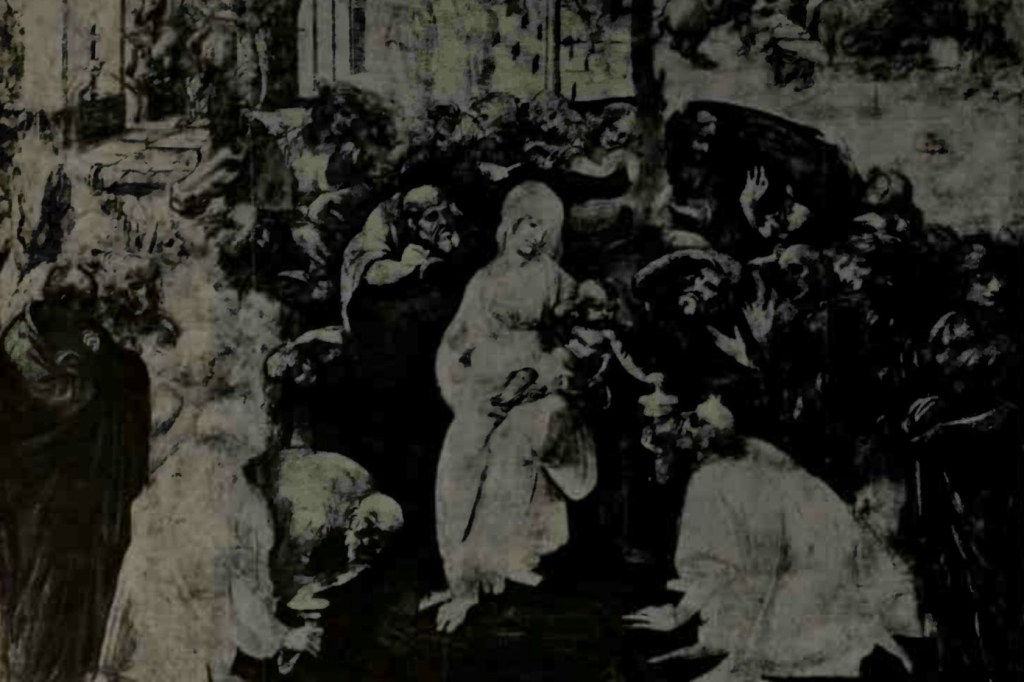
I’m almost done reading Ferdinand Schevill’s thick (though not too thick) book about Florence. It’s titled ‘The History of Florence’ (1936). It was reprinted as ‘Medieval and Renaissance Florence’ in 1965. This is one of a number of books that I acquired about Florence and its famous artists from its “time of greatness” some time ago. For some reason, I’ve had an urge to find out more about this city and its famous artists for more than a year already, and I’ve been able to get through most of Schevill’s well-written and very informative work about the history of Florence quite quickly. Since Schevill’s book is about Florence and not only about its artists, he devoted only several pages to Leonardo and Michelangelo at the end of it, to my surprise. Therefore, I had to finish reading almost the entire book before I could find out what the author had to say about the famous artists. Well, I’m not complaining since I’m now familiar with the history of Florence, the cradle of the Renaissance, because of this. In this post, I will include almost everything that Schevill had to say about Leonardo in the book. I will post the other quotes that I highlighted later. “At the exact middle of the sixteenth century there appeared a history which testifies to that ever-widening genetic curiosity destined to become the perhaps leading trait of the modern mind. I am referring to the Vite (Lives) de’ piu eccellenti Pittori, Scultori, ed Architetti by Giorgio Vasari (1511-71). It may be taken as a sign that the creative urge had passed its peak that Vasari, a fine critical historian but a less than mediocre painter, felt moved to assemble the record of a magnificent burst of expression while the evidence was still relatively fresh and crowded on his attention wherever he went in Italy. Although the minute criticism of the last one hundred years has corrected innumerable small errors of fact of which the author was guilty, it has not succeeded in pushing him from his pedestal. Vasari is still the one indispensable guide to the unfolding of the Fine Arts in Italy between Cimabue and Michelangelo. His Lives are a classic in the same sense in which Machiavelli’s Prince and Cellini’s Autobiography are classics and very few other literary works, which are not poetry. If the Lives have achieved this permanence, they owe it to their author’s zealous scholarship, sympathetic understanding, and literary artistry, a rarely occurring combination of gifts but regularly present when a work qualifying as the history of any human movement or interest achieves a measure of immortality. In turning to the Fine Arts we shall not follow, as we have done for the earlier periods, the separate development of architecture, sculpture, and painting. For a general sketch like this the procedure becomes unprofitable in view of the fact that the energy giving all three of these arts their cinqueccento character issued in so overwhelming a measure from two men that an examination of their contribution is the best conceivable introduction to the new phase of expression. The two men, who carried Florentine art to its apogee, and just as certainly initiated its decline, were Leonardo da Vinci (1452-1519) and Michelangelo Buonarroti (1475-1564). Of course they did not appear in the stark isolation that this setting forth of their names would suggest. The practitioners of the arts were probably numerically as strong in the cinqueccento as in any earlier period, but, overborne by the two geniuses in their midst, they were drawn from their individual orbits into the dependence of declared satellites. Not improbably a decline, if not in the number, at least in the quality of the individuals electing to follow the arts, had already set in by the turn of the century. How else account for the fact that, except in that most Florentine of arts, in painting, there was a decided dearth of men for whom we may claim a genuinely original gift? Where are the architects of the period? Where is the sculptor whom it is not absurd as much as to mention in the same breath with Michelangelo? In painting, on the other hand, we undeniably meet with a number of artists, who, regardless of the influence over them of the two titans, managed to maintain a fairly independent status. Outstanding among such would be Fra Bartolommeo (1475-1517), Andrea del Sarto (1486-1531), Pontormo (1494-1556), and Bronzino (1502-72). Let us salute them respectfully as we pass them by, intent upon our plan of making acquaintance with the age through the work of its two key-men. While Leonardo interested himself in all the arts, including music, his influence on his contemporaries made itself felt chiefly in the realm of painting. The reason is simple: he was a painter. True as this statement is in the realm of objective fact, it tells us nothing of the spiritual significance of Leonardo, the real clue to his wide sway. His puzzling personality must already have begun to disclose itself when, at the age of thirteen, he entered on his apprenticeship in the bottega of Verrocchio. Under this excellent master he absorbed the aims and traditions of the Florentine school of painting and prepared himself to make that magnificent contribution to the art which we shall presently examine. However, presented as a free gift from the gods with a restless, inquiring spirit, he found it impossible to restrict himself to the role of an obedient apprentice. Not only was he compelled to subject the teaching of Verrocchio to a critical examination but he found himself driven by an instinctive and irresistible force to go behind every finished work of his master to the infinite forms of life from which Verrocchio and all his contemporaries as well, according to their own statement, derived their inspiration. Whether Leonardo experimented with painting, or, as was traditional with every ambitious Florentine craftsman, with one or all of the other arts, he regularly found himself in the end brought face to face with nature. He was still a young man when the infinite variety of natural phenomena took possession of his mind. As through the advancing years he saturated himself with this bewildering multiplicity, he became convinced that it represented nothing more than the surface play of hidden principles, by the discovery of which the whole apparently chaotic universe would fall into an ordered system. Starting his observations with the art with which he had embarked on life and gradually extending them to all the cognate arts, he found himself in the end drawn into the realm of science and broadened his studies till they embraced anatomy, physiology, mathematics, astronomy, physics, botany, zoology, and mechanical invention. To keep this crowding wealth of material from getting out of hand he adopted the practice of recording it in the form of notes in private diaries, which, scattered at his death but partially recovered in our day, furnish us with the indispensable means of becoming acquainted with the incomparable energy of his inquiring spirit. It goes to show that, after all, it was painting that served as the point of departure for his studies, that only in this field did he sufficiently systematize his observations to enable a later editor to produce a continuous document, the admirable Treatise on Painting. In this work Leonardo frequently packs the central purpose animating him into pithy aphorisms. Such are: “Practice must always be founded on sound theory”; and again, “My works are the issue of pure and simple experience, which is the only true mistress.” These statements, which are borne to us down the ages with the very quality of the master’s voice, deserve the most careful consideration. While formulated in regard to painting, they affirm guiding principles laid down by Leonardo for his procedure in all his studies. And they tell us in no uncertain manner that, after having begun life as an artist rejoicing in his senses and trusting to a blind inner urge, he passed into the world of experimentation and reflection and became engrossed with the task of reducing experience, his only mistress, to the laws by which it might be comprehended and controlled. Before he had reached middle age his interest in the arts had dwindled till they had become no more than a function of his all-embracing thought. He became in essence a scientist, one of the greatest the world has ever seen, although less by reason of his measurable achievements than by his formulation of an effective scientific method and by his prophetic hints of discoveries, such as the geologic ages of the earth, and of mechanical inventions, such as the submarine and the airplane. In the eyes of the living generation, the mind of which has received its special imprint from the vast scientific development since the cinqueccento, Leonardo looms as a pathfinder and forerunner. While no one will begrudge him his belated fame, the historian of the arts may be permitted to point out that he did not achieve his scientific eminence without a severe loss. Concerned more and more with theory and abstractions, he inevitably gave himself less and less to practice. The time came when he dawdled painfully over the few paintings that he was still willing to undertake and which in the end he usually abandoned in a half-finished state. In the last ten years of his life he did nothing at all but think and dream. The paralysis of the will, as most of his biographers have called this curious lethargy, has been treated by them as the “problem” of the master’s later years, but it is hardly so inexplicable as they would have us believe. Leonardo’s glory as an artist lies without any question in the adjustment which he effected of an amazing natural endowment, essentially irrational, to the demands of a supreme intelligence. He marks a summit in the arts because he achieved a balance such as has been only rarely brought about between the rational and irrational elements present in all great and sustained expression. Then slowly, as his reason mastered his instincts, the balance was disturbed and the fire at the core of his being was banked and subdued. There is no evidence that he ever analyzed his case or regretted the multiplying inhibitions that palsied his hand. He went, like all of us, his fated way, in the course of which the scientist in him, become too strong, devoured the artist. Having dealt with the total man, we now turn to his particular achievement in the art of painting. Its indubitable magnitude is enhanced by the relatively small number of his extant works. Many a respectable modern painter, Renoir for instance, probably turned out more pictures in an average year than stand to Leonardo’s total credit. The earliest evidence of his hand is the angel at the left of Verrocchio’s picture of the Baptism of Christ in the Uffizi gallery. In the same gallery is an Annunciation, in which, designed in the main by Verrocchio, he had a much larger share than in the earlier work by supplying the gracious Gabriel and the characteristic Adoration of the Magi, by which Leonardo disclosed (1481) for the first time his new principles of composition. His other leading works are the Last Supper at Milan; the Virgin of the Rocks, the Virgin with St. Anne and the Infant Jesus, the Mona Lisa – these three at Paris. Beginning with the very first work of the young apprentice, the angel of Verrocchio’s Baptism, we catch the challenge of his genius. It flashes more effectively still from the Annunciation and, excitedly increasing in the Adoration of the Magi, reaches its peak in the works at Milan and at Paris. Let us consider what these creations in their totality bring us that is new, and let our attention turn first to the matter of technique. Leonardo has caught and improved on Masaccio’s chiaroscuro, the infinitely subtle transitions from light to dark. A logical consequence of this addiction to tonal finesse was that he sacrificed the frank color planes of the Florentine tradition and threw his influence on the side of the new oil technique recently imported from northern Europe, since only oil was able to render the sfumature, the imperceptible gradations of light and shade at which he aimed. His second novelty is that he turned away from the simple-hearted realism of the quattrocento which had made the pictures of the period an enchanting mirror of the throbbing life of town and country. The reflective bent of Leonardo, which prompted him to look for uniformity behind the endless individualizations of nature, sent him on the quest for the ideal man and woman never actually to be met with but definitely implied in all existing human forms. The search for the type, a passionate and characteristic pursuit of classical art, has always involved the attempt to create as a counterpart to our fleeting mundane existence a super-realm of permanence, serenity, and beauty. While Leonardo never wholly abandoned the traditional native realism, of which there is still abundant evidence in the rich characterization of the apostles in so relatively late a work as the Last Supper, we already get a glimpse of the artist’s sublimated vision in that very first angel of his in Verrocchio’s Baptism. That delicate celestial visitor, completely out of tune with the harsh literalness of the rest of the composition, carries the unmistakable Leonardesque note. Struck in every subsequent creation with increasing clearness, it achieved its perfection in the unmatched loveliness of the women and children of the Paris altar pieces. The third important contribution of the master is a new style of composition. In his view the quattrocentists, his immediate predecessors, had been guilty of cluttering their pictures with too much distracting detail. However, the greater compactness at which he aimed was not to be won by a simple process of elimination. Master of mathematics that he had become, he recognized that every good picture that has ever been painted possessed a geometrical substructure, whether consciously or unconsciously introduced by the artist. As a reflective, highly analytical painter Leonardo isolated this tectonic core as part of that theory which, according to this already quoted dictum, was a prerequisite of effective practice. The result was the triangle which, subtly broken and varied with straight and curved lines, constitutes his fundamental pictorial pattern. If his contemporaries detected a monumentality in Leonardo’s works which even Masaccio had not attained and which swept them off their feet, it derived from the firm tectonic configuration of his designs. Simple courtesy demands that we do not pass the Mona Lisa by without paying brief homage to her impassioned reticence. She is Leonardo’s one indubitable work of portraiture. In view of the fact that the task which in this case he assigned himself was the likeness of a particular woman, he was obliged somewhat to disguise his preference for the type. The lady was the wife of a Florentine citizen, Francesco del Giocondo, who would not have been the successful business man he was if he had been satisfied with a feminine abstraction. Nevertheless Leonardo’s philosophic passion for the universal over the particular showed itself clearly in his representing his sitter withdrawn into the world of dreams, where she is no longer reached by the earth and its affairs. Her fleeting, inscrutable smile reveals a soul which, having done with doubt and fear, is rapturously at peace with God. Only mystics will respond pleasurably to this pictured transfiguration; but all lovers alike of good painting will linger over and be thrilled by the artist’s consummate chiaroscuro, which in this instance at least, far from being just another technical conquest, serves as the vehicle of a wholly novel kind of psychological portraiture.”
 Igor's Blog