


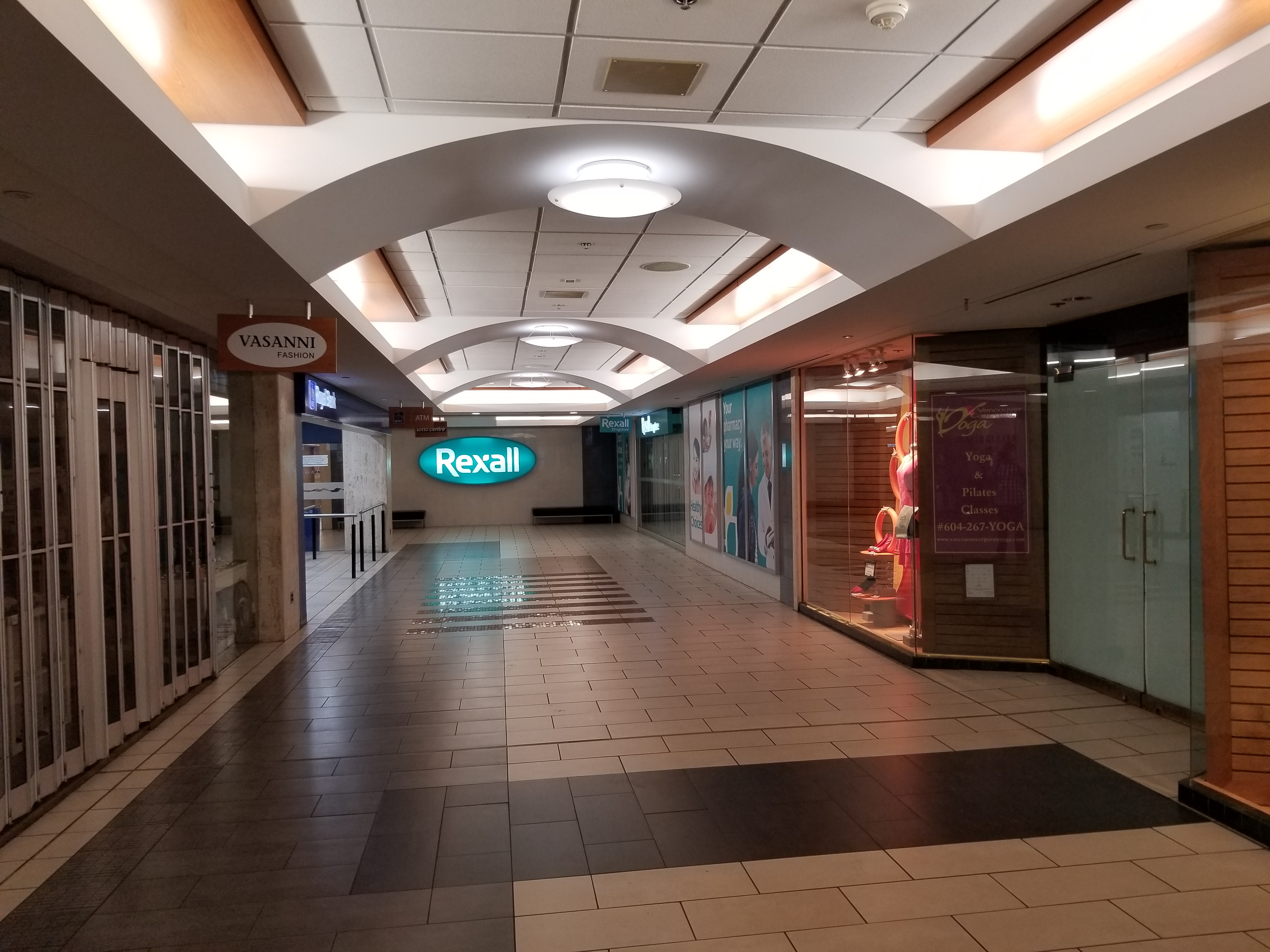


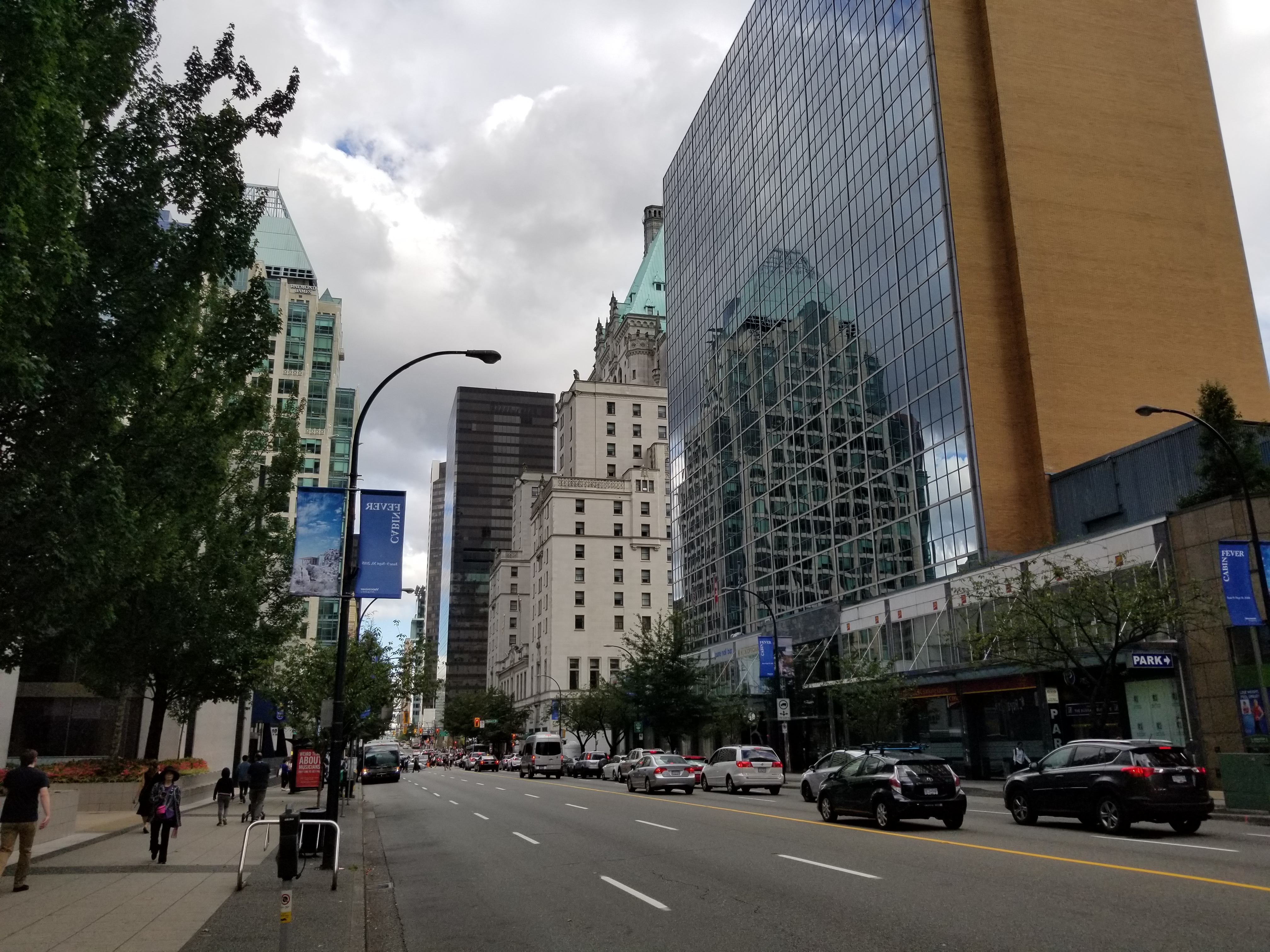


Georgia Street is an east–west street in the cities of Vancouver and Burnaby, British Columbia, Canada. Its section in Downtown Vancouver, designated West Georgia Street, serves as one of the primary streets for the financial and central business districts, and is the major transportation corridor connecting downtown Vancouver with the North Shore (and eventually Whistler) by way of the Lions Gate Bridge. The remainder of the street, known as East Georgia Street between Main Street and Boundary Road and simply Georgia Street within Burnaby, is more residential in character, and is discontinuous at several points.
West of Seymour Street, the thoroughfare is part of Highway 99. The entire section west of Main Street was previously designated part of Highway 1A, and markers for the ‘1A’ designation can still be seen at certain points.
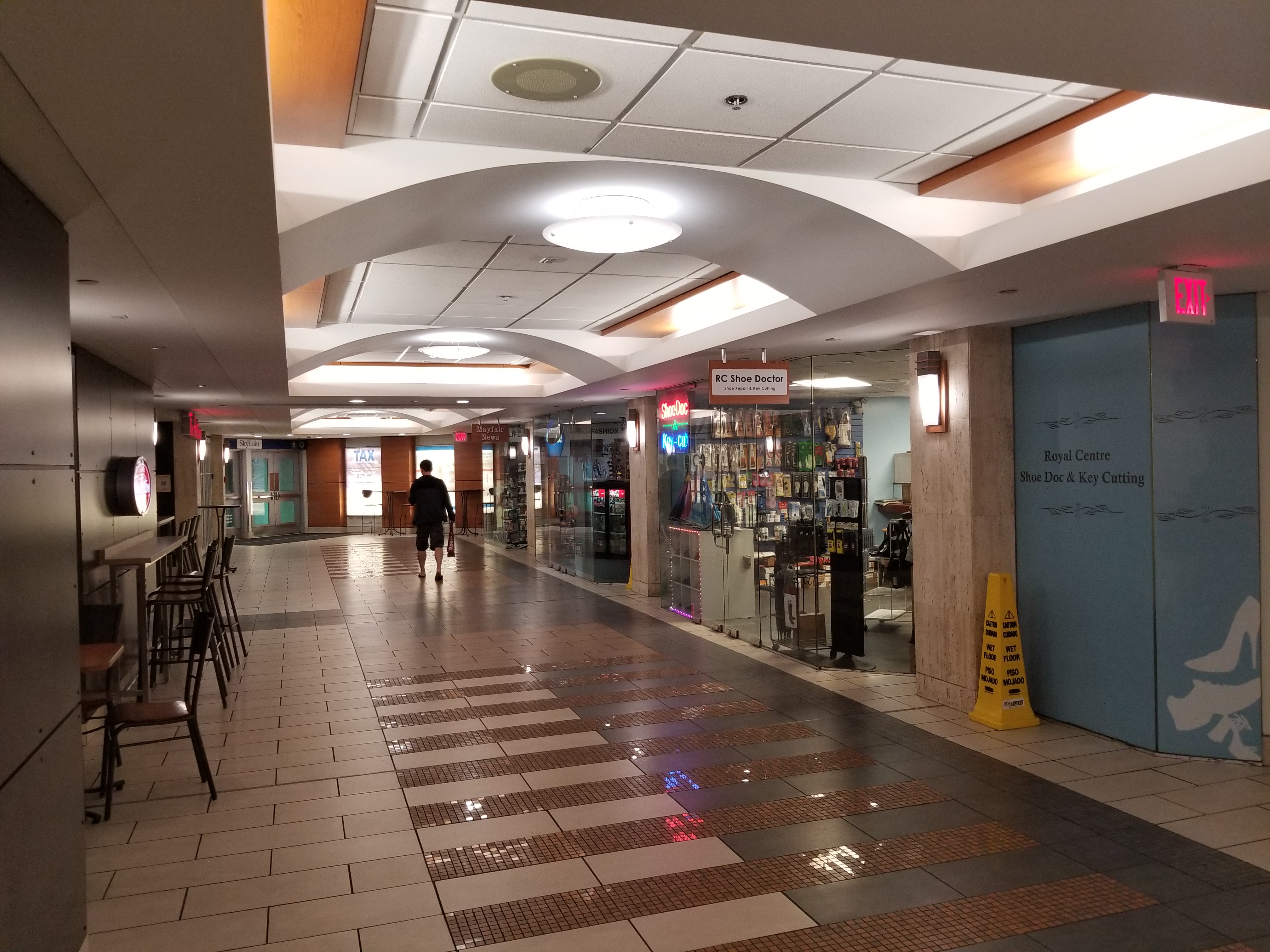
Starting from its western terminus at Chilco Street by the edge of Stanley Park, Georgia Street runs southeast, separating the West End from the Coal Harbour neighbourhood. It then runs through the Financial District; landmarks and major skyscrapers along the way include Living Shangri-La (the city’s tallest building), Trump International Hotel and Tower, Royal Centre, 666 Burrard tower, Hotel Vancouver and upscale shops, the HSBC Canada Building, the Vancouver Art Gallery, Georgia Hotel, Four Seasons Hotel, Pacific Centre, the Granville Entertainment District, Scotia Tower, and the Canada Post headquarters. The eastern portion of West Georgia features the Theatre District (including Queen Elizabeth Theatre and the Centre in Vancouver for the Performing Arts), Library Square (the central branch of the Vancouver Public Library), Rogers Arena, and BC Place. West Georgia’s centre lane between Pender Street and Stanley Park is used as a counterflow lane.
East of Cambie Street, Georgia Street becomes a one-way street for eastbound traffic, and connects to the Georgia Viaduct for eastbound travellers only; westbound traffic is handled by Dunsmuir Street and the Dunsmuir Viaduct, located one block to the north.
East Georgia Street begins at the intersection with Main Street in Vancouver’s Chinatown, then runs eastwards through Strathcona, Grandview–Woodland and Hastings–Sunrise to Boundary Road. East of the municipal boundary, Georgia Street continues eastwards through Burnaby until its terminus at Grove Avenue in the Lochdale neighbourhood. This portion of Georgia Street is interrupted at several locations, such as Templeton Secondary School, Highway 1 and Kensington Park.
Georgia Street was named in 1886 after the Strait of Georgia, and ran between Chilco and Beatty Streets. After the first Georgia Viaduct opened in 1915, the street’s eastern end was connected to Harris Street, and Harris Street was subsequently renamed East Georgia Street.
The second Georgia Viaduct, opened in 1972, connects to Prior Street at its eastern end instead. As a result, East Georgia Street has been disconnected from West Georgia ever since.
On June 15, 2011 Georgia Street became the focal point of the 2011 Vancouver Stanley Cup riot.
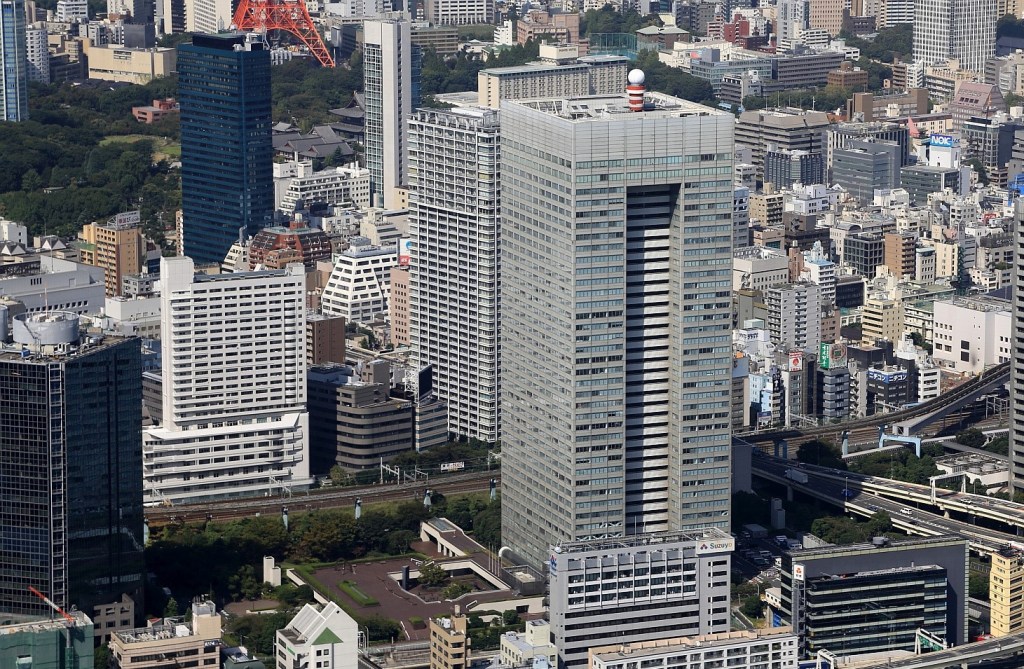
Toshiba Corporation (株式会社東芝, Kabushiki-gaisha Tōshiba) (TYO: 6502) is a multinational conglomerate manufacturing company, headquartered in Tokyo, Japan. The company’s businesses manufacture consumer electronics, including television and audio products, home appliances, and lighting products. Toshiba also produces plants and equipment for the generation of electric power, transportation equipment, industrial motors, and industrial electronics and communications equipment. Toshiba-made semiconductors are among the Worldwide Top 20 Semiconductor Sales Leaders.
Toshiba was formed in 1939, by the merger of Toshiba of Shibaura Seisakusho and Tokyo Denki, and is part of the Mitsui keiretsu (conglomerate). Toshiba’s motto, “Leading Innovation,” is reflected in its group-wide innovation program, called “i cube:” Innovation in development, innovation in manufacturing, and innovation in sales, intended to give Toshiba employees a sense of urgency and encourage them to explore new business processes. Toshiba has been responsible for a number of Japanese firsts, including radar (1942), the TAC digital computer (1954), transistor television and microwave oven (1959), color video phone (1971), Japanese word processor (1978), MRI system (1982), laptop personal computer (1986), NAND EEPROM (1991), DVD (1995), the Libretto sub-notebook personal computer (1996), and HD DVD (2005; now defunct).
Toshiba has applied the concept of innovation to environmental issues. It is a leader among manufacturers who are striving to establish an environmentally safe and sustainable manufacturing model. In 2008, Toshiba tied for first place in Greenpeace’s seventh edition of its Guide to Greener Electronics.
History
Toshiba was founded by the merging of two companies in 1939, “Shibaura Seisakusho” and “Tokyo Denki.”
Shibaura Seisakusho had been founded in 1875 as “Tanaka Seizosho” (Tanaka Engineering Works) by Hisashige Tanaka (1799–1881), known from his youth for inventions that included mechanical dolls and a perpetual clock. The original company manufactured high-powered steam engines for ocean-going ships and machine tools. In 1904, its name was changed to “Shibaura Seisakusho” (Shibaura Engineering Works). It was taken over by the Mitsui business combine (zaibatsu), and during the early twentieth century, it became one of Japan’s largest manufacturers of heavy electrical apparatus. Tanaka Seizosho was Japan’s first manufacturer of telegraph equipment.
Tokyo Denki was established in 1890, as Hakunetsusha & Co., Ltd., and, with Mitsui financing, began manufacturing bamboo-filament electric light bulbs. It was Japan’s first producer of incandescent electric lamps. It diversified into the manufacture of other consumer products and, in 1899, was renamed Tokyo Denki (Tokyo Electric Company).
Both of these companies had early affiliations with the American General Electric Company (GE). In 1907, GE obtained an interest in Tokyo Electric, in exchange for assistance with technology to mass-produce Mazda electric lamps; and in 1909, GE established a similar arrangement with Shibaura Seisakusho. GE is still a major shareholder in Toshiba.
In 1939, Shibaura Seisakusho and Tokyo Denki merged to create a new company called “Tokyo Shibaura Denki” (東京芝浦電気). It was soon nicknamed Toshiba, but it wasn’t until 1978 that the company was officially renamed Toshiba Corporation.
When the zaibatsu were dissolved after World War II, Toshiba separated from the Mitsui Group zaibatsu. Toshiba became re-affiliated with the Mitsui keiretsu (a set of companies with interlocking business relationships and shareholdings), in 1973, and still has preferential arrangements with Mitsui Bank and the other members of the keiretsu.
The group expanded rapidly, both through internal growth and by acquisitions, buying heavy engineering and primary industry firms in the 1940s and 1950s, and, beginning in the 1970s, spinning off subsidiaries. Groups created include Toshiba EMI (1960), Toshiba International Corporation (1970s), Toshiba Electrical Equipment (1974), Toshiba Chemical (1974), Toshiba Lighting and Technology (1989), Toshiba America Information Systems (1989), and Toshiba Carrier Corporation (1999).
Toshiba was responsible for a number of Japanese firsts, including radar (1942), the TAC digital computer (1954), transistor television and microwave oven (1959), color video phone (1971), Japanese word processor (1978), MRI system (1982), laptop personal computer (1986), NAND EEPROM (1991), DVD (1995), the Libretto sub-notebook personal computer (1996), and HD DVD (2005).
Toshiba-Kongsberg scandal
In 1987, Toshiba Machine, a subsidiary of Toshiba, was accused of illegally selling CNC milling machines, used to produce ultra-quiet submarine propellers, to the Soviet Union in violation of the “CoCom” agreement, an international embargo on Western exports to Eastern Bloc countries. The scandal involved a subsidiary of Toshiba and the Norwegian company Kongsberg Defence & Aerospace (Kongsberg Vaapenfabrikk). The incident strained relations between the United States and Japan, and resulted in the arrest and prosecution of two senior executives, as well as the imposition of economic sanctions on the company by both countries.
TV and video products
In 2001, Toshiba signed a contract with Orion Electric, one of the world’s largest OEM (original equipment manufacturer) makers and suppliers of consumer video electronics, to manufacture and supply finished consumer TV and video products for Toshiba, to meet the increasing demand for the North American market.
In December 2004, Toshiba quietly announced it would discontinue manufacturing traditional cathode ray tube (CRT) televisions. In 2006, Toshiba terminated production of plasma TVs. Toshiba quickly switched to Orion as the supplier and maker of Toshiba-branded CRT-based TVs and plasma TVs. However, to ensure its future competitiveness in the flat-panel digital television and display market, Toshiba has made a considerable investment in a new kind of display technology called Surface-conduction electron-emitter display (SED).
In late 2007, Toshiba’s logo replaced the former Discover Card logo on one of the screens atop One Times Square in New York City. It displays the iconic New Year’s countdown on its screen, as well as messages, greetings, and advertisements for the company.
Acquisition of Westinghouse
In July 2005, BNFL confirmed it planned to sell Westinghouse Electric Company, then estimated to be worth $1.8bn (£1bn). The opportunity attracted interest from several companies including Toshiba, General Electric, and Mitsubishi Heavy Industries, and when the Financial Times reported on January 23, 2006, that Toshiba had won the bid, it valued the company’s offer at $5bn (£2.8bn). Many industry experts questioned the wisdom of selling one of the world’s largest producers of nuclear reactors shortly before the market for nuclear power is expected to grow substantially (China, the United States, and the United Kingdom are all expected to invest heavily in nuclear power). The acquisition of Westinghouse for $5.4bn was completed on October 17, 2006, with Toshiba obtaining a 77 percent share, partners The Shaw Group a 20 percent share, and Ishikawajima-Harima Heavy Industries Co. Ltd. a 3 percent share.
Semiconductors
During the 1980s, Toshiba Semiconductors was one of the two largest semiconductor companies (along with NEC). From the 1990s until the present, Toshiba Semiconductors has almost always been among the top five producers of semiconductors; in 2007, Toshiba Semiconductors was number three, behind Intel and Samsung.
Nuclear energy
In March 2008, Toshiba announced that it had launched the Toshiba America Nuclear Energy Corporation. The primary mission of the company is marketing and promoting advanced boiling water nuclear power plants and providing support for related services.
Toshiba is believed to be involved (together with the Central Research Institute of Electric Power Industry) in the preparation of the small (30MW) nuclear plant Toshiba 4S for installation at Galena, Alaska, and even smaller (200KW) plants for Japan and Europe.
Toshiba America, Inc.
Toshiba America, Inc. (TAI), holding company for one of the nation’s leading groups of high technology companies, employs a combined total of approximately 8,000 in the U.S. The U.S.-based companies under TAI’s umbrella conduct research and development, manufacture and market a widely diversified range of modern electronics. The U.S.-based Toshiba operating companies and some of their chief products are: Toshiba America Electronic Components, Inc. (flash memory, LCD panels, microprocessors); Toshiba America Information Systems, Inc. (notebook computers, storage devices, imaging systems, telecommunication systems); Toshiba International Corporation (power generation equipment, industrial electronic equipment); Toshiba America Medical Systems, Inc. (CT, ultrasound, and MRI); Toshiba America Consumer Products, LLC (HDTVs, HD DVD, digital home theater products).
Partnership with UPS
In response to complaints from customers who felt that repairs for broken laptops and computers were taking too long, Toshiba partnered with the United Parcel Service (UPS) to design a more efficient repair process. Customers are told to drop off their machines at a UPS Store, where they are shipped to a Toshiba-run repair facility, which repairs the laptops and sends them back to the customer.
HD DVD
On February 19, 2008, Toshiba announced that it would drop its format in the HD DVD “war” with Sony and Pioneer-backed Blu-ray Disc devices. Following a review of its business, Toshiba determined to stop production of HD DVD players and recorders, since major U.S. film studios backed the Blu-ray format, developed by Sony and its partners. Toshiba will continue to provide technical support to the estimated one million people worldwide who own HD DVD players and recorders.
Toshiba’s president has stated that the company has no intention of manufacturing Blu-ray disc players, and that Toshiba will instead “think about its role in online video-downloading more seriously.” Toshiba will also maintain relations with the companies that collaborated to build up the HD DVD market, including Universal Studios, Paramount Pictures, DreamWorks Animation, and major Japanese and European content providers, as well as leaders in the IT industry, including Microsoft, Intel, and Hewlitt-Packard.
Environmental record
In 2008, Toshiba tied for first place in Greenpeace’s seventh edition of its Guide to Greener Electronics. Greenpeace is an environmental protection organization that ranks electronics companies based on their chemical use and recycling programs. Toshiba received 7.7 points out of ten points possible, showing its improvement in recycling and chemical use since the last edition when it was only ranked number six. Toshiba focused on improving its score in Individual Producer Responsibility (IPR), which measures how efficiently a company deals with e-waste, the waste created when its products are discarded by consumers. The improper disposal of e-waste, such as computers, DVD players, and cell phones, negatively affects the environment by releasing toxic materials, such as lead and mercury, into soil and water, which later affects human, animal, and vegetation health.
In October 2007, Toshiba signed a contract with China’s Tsinghua University to form a research facility focusing on energy conservation and the environment. The new Toshiba Energy and Environment Research Center, where 40 students from the university will research electric power equipment and new technologies that will help stop the global warming process, is located in Beijing. Through this partnership, Toshiba hopes to develop products that will better protect the environment and save energy in China by reducing pollution from automobiles and creating power sources that do not negatively affect the environment.


Flash memory is a term that applies to two types of chips — the NAND and the NOR. The NAND is used in: memory cards, USB flash drives, solid-state drives, and more. Both NOR and NAND types were invented by Dr. Fujio Masuoka around 1980.
Examples of both types of flash memory include: personal computers, PDAs, digital audio players, digital cameras, mobile phones, synthesizers, video games, scientific instrumentation, industrial robotics, and medical electronics.
Flash memory turned out to be one of the greatest inventions of the 1980′s. According to a Forbes report, approximately $76 billion of these chips were sold in 2001 alone. According to BusinessWeek, flash memory sales hit around $25 billion in 2006 alone. While these figures may not be totally accurate, it gives us a good idea how important this invention was.
Toshiba and Samsung have been two of the world’s top flash memory producers.
At the time Fujio Masuoka had discovered flash memory, he was working for Toshiba. However, because he lived in Japan and worked for a powerful company, he didn’t get the full credit that was due.
In fact, company members were so embarrassed about the deal, they told Forbes Global that Toshiba was not the inventor of flash memory. The PR staff at Toshiba claimed Intel invented flash memory. Of course, this would later prove to be a false assertion.
While the engineers at Toshiba failed to understand the foresight of Masuoka’s invention, the team at Intel did recognize its potential. Intel immediately acted upon that potential. Intel introduced the NOR chip in 1988; Toshiba introduced the NAND type chip in 1989.
Masuoka had been working on DRAM when he came across his discovery in the early 1980′s. It was the year of 1984 when he would announce his invention, during an IEEE meeting in San Francisco, California.
Dr. Masuoka eventually got promoted to the head of a department, but he would leave Toshiba in 1994. Masuoka later became a professor at Tohoku University in Sendai, Japan.

I was pretty hyped about Zero Mission, right from the start. Some of my fondest memories are from playing the original Metroid. I’m a “newer-is-better” kinda guy, so I was all for a remake of one of my favorite games of all time.
The screenshots and movies came along, and the hype increased. Every new teaser looked better than the last. This game just couldn’t come out soon enough. Then February 9th, 2004 hit, and there I was, playing Metroid Zero Mission. And it was awesome. It fully lived up to my expectations.
Story
This is a retelling of the original Metroid, what really happened during Samus Aran’s first invasion of the Space Pirate base on the planet Zebes. The game is bigger and the story is more detailed. It extends beyond the battle with the Mother Brain and adds a new element of gameplay to extend the enjoyment factor.
We all know the background story from the original game’s instruction booklet, and that part hasn’t changed. What has changed is the actual mission itself. Cutscenes have been added to flesh out the details and introduce the antagonists, one at a time, as well as to set the mood for the next zone or battle. The scenes are short enough not to interfere with the pacing of the gameplay, and cover every necessary aspect. You won’t be walking away with any questions.
The additions of the Chozo lore and glimpses of Samus’ past fit in well with what has been established in comics during the 90’s and hinted at in Metroid Prime. While I’m not a fan of the “raised-by-Chozo” storyline, it’s upheld in an interesting way in Zero Mission. You’re not beat over the head with it, but it is still ever-present.
Gameplay
Samus Aran has never had tighter control. From blasting to wall jumping to bomb climbing, Metroid has never played so well. It doesn’t take many tries to do exactly what you want to do, even if that means horizontal bomb climbing, or carrying a speed charge through several rooms. In fact, it kind of makes the game too easy. Not that I’m complaining, mind you. I’d rather play a game that is too easy because of perfect control than one that is too difficult because of lousy control.
The only big problem I have with the gameplay is the speed. It’s too fast. To cover the same amount of distance in the original Metroid would take nearly twice as long. Even Metroid Fusion didn’t play this fast. This really does make the game short. You’re covering nearly twice as much area as in the orignal, yet you can finish the entire thing in less time. If the developers has just extended the two-hour time limit for the best endings to four hours and slowed down the gameplay, then the game would have been that much better. The short length of the game hurts, especially because there is so much to see and do. It’s all over much too quickly. And multiple play-throughs don’t help much, because the game just begs to be played at full speed. If you try to take your time, you feel like a senior with a walker. I really wish they would have slowed the game down. It kind of feels arcade-like in its fast pacing.
The speed can be exciting during boss battles, however. I would have preferred a slower, more tactical fight, but a fast and furious battle is still good fun. Ridley was a blast. Far too easy, but still fun nonetheless.
I wasn’t too impressed with the stealth section, though. While it is great to play as an armorless Samus again and the control is very good, it is still very difficult to avoid taking hits from the Space Pirates once they’ve seen you. And several places require absolutely perfect timing to avoid being seen, something that requires more luck than skill. I think the problems are mostly attributed to the level layout. All of Chozodia was a pain to navigate, even with the fully-powered suit. Thankfully, it’s a short section of the game.
Many people complained about the “hint” system in Metroid Fusion, preferring to find things on their own. Unfortunately for them, it’s back, only a little less intrusive this time. Many of the hint-giving Chozo statues can be avoided. It’s not a big deal for those of us who are experienced with the original game, though, as all of the items are still in the same spots as before.
“Sequence breaking” is back in Zero Mission, only this time it’s intentional. Many hidden passages lie in wait for the intrepid explorer who likes to play the game their way. In response to the complaints of no sequence breaking in Metroid Fusion, the developers have gone out of their way to set up various sequences for us to take, making the game path very customizable. In fact, it’s so easy to sequence break now that most people will do it at least once on their first time through the game, not even realizing it. They will later come across a new Chozo statue that won’t give a hint because you’ve already gone out of your way to find that item on your own.
New to North American Metroid fans are the difficulty settings. Normal is pretty easy, Hard is a good challenge, and Easy is for your dog, who could probably beat it with his eyes closed on that setting. Complete Normal mode to unlock Hard mode, and to access the original Metroid, which will then be accessible from the Options menu. Normal and Hard modes must both be played in several different ways to unlock all eight endings. As usual, these are affected by time and item percentage.
Graphics
Zero Mission comes out on top, with a dark, stylized atmosphere that looks fairly realistic. Original screenshots and videos had the game appearing in a somewhat super-deformed anime style, and fortunately that style has made way for the current graphics we have now. They look great, and fit the Metroid style perfectly. Samus looks tough and agile, and the enemies look more menacing than ever. The bosses take the cake, however, as they are all huge and very detailed.
Everything is well animated, and every zone of the game has multiple texture sets. You won’t be seeing the same backgrounds for long, because nearly every set of rooms has something new. This is very refreshing, compared to the original. While we don’t get lost so easily in Zero Mission due to the distinction of each area, it makes up for it in the richness of what we’re seeing. There is so much difference, in fact, that it makes each area feel smaller, as you don’t get to see those textures for very long. Zero Mission is far above average in this regard; it would have looked fantastic with only half of the texture sets it has. There is nothing to complain about in this department.
Sound
Out of the music and the sound effects, I’m not sure which one I liked more. They were both great. The music tracks are all redone versions of the same tunes in the first game and Super Metroid, plus new tunes for the new areas. They all fit together, as if the original game always had these extra zones. While the remixing wasn’t perfect, it was still very good. I can’t complain.
The sound effects are right on. You will find modernized versions of all the old sounds, while still sounding as close to the originals as possible. They sound the way they always should have, without the 8- bit hardware limitations of the mid-1980’s.
I think the only sounds I didn’t like were Kraid and Ridley’s voices. They don’t sound very menacing with such high-pitched screams. But that isn’t much different from Ridley in Metroid Fusion, so at least it’s consistent.
Overall
Metroid Zero Mission is awesome. It has great graphics, sound and gameplay, and it takes us back to the good old days of Metroid. For those new(er) to the series, it gives them a modern way to experience its origin without the old-fashioned graphics and gameplay.
What else is there to say? If you don’t already have Zero Mission, go get it! It might be the best Metroid game in your library.
Warner Bros. Pictures’ and Legendary Pictures’ “The Dark Knight Rises” is the epic conclusion to filmmaker Christopher Nolan’s Batman trilogy. Leading an all-star international cast, Oscar(R) winner Christian Bale (“The Fighter”) again plays the dual role of Bruce Wayne/Batman. The film also stars Anne Hathaway, as Selina Kyle; Tom Hardy, as Bane; Oscar(R) winner Marion Cotillard (“La Vie en Rose”), as Miranda Tate; and Joseph Gordon-Levitt, as John Blake. Returning to the main cast, Oscar(R) winner Michael Caine (“The Cider House Rules”) plays Alfred; Gary Oldman is Commissioner Gordon; and Oscar(R) winner Morgan Freeman (“Million Dollar Baby”) reprises the role of Lucius Fox.
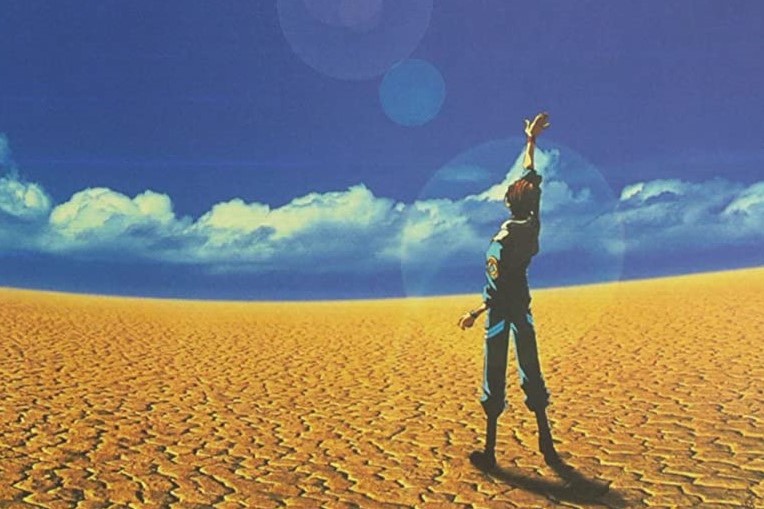
When it comes to what my favorite anime is, I will list 10 films, 10 TV series, and 10 OVAs. I don’t consider these picks to be the best anime. These are simply my favorites, though some of the picks can easily be considered to be the best anime out there. I had to leave out many of my favorites in order to narrow this list to 30 titles. For example, I left out Castle in the Sky (1986) and Spirited Away (2001) because I didn’t want to include many Studio Ghibli films, and I left out Mobile Suit Gundam F91 (1991) because I didn’t want to include many Gundam titles.
Favorite TV series: Cowboy Bebop, Neon Genesis Evangelion, The Vision of Escaflowne, Ghost in the Shell: Stand Alone Complex, Fullmetal Alchemist: Brotherhood, Maison Ikkoku, Gurren Lagann, Martian Successor Nadesico, Saber Marionette J, Kimagure Orange Road.
Favorite OVAs: Tenchi Muyo! Ryo-Ohki, Bubblegum Crisis, Macross Plus, Gunbuster, Mobile Suit Gundam 0080: War in the Pocket, Rurouni Kenshin: Trust & Betrayal, Giant Robo, Moldiver, Oh My Goddess!.
Favorite films: The Fuma Conspiracy (1987), Kiki’s Delivery Service (1989), Ghost in the Shell (1995), Akira (1988), Perfect Blue (1997), Patlabor 2: The Movie (1993), Whisper of the Heart (1995), Grave of the Fireflies (1988), Mobile Suit Gundam: Char’s Counterattack (1988), Ninja Scroll (1993).
I got to see Neon Genesis Evangelion again in 2021. This was probably my third time watching this series from beginning to end. Of course, after I finished watching the series, I also watched Death & Rebirth (1997) and The End of Evangelion (1997). The DVD for Death & Rebirth was probably the first DVD that I ever bought. This happened soon after I graduated from high school, and I think that I bought it in new condition at Future Shop, which was a Canadian electronics store chain. The first half of the film, Death, is a re-cap editing together of scenes from the first 24 episodes of the series. It’s my favorite part of the film, and I watched it multiple times since I bought the DVD. To be honest, I don’t like the second half of the film, Rebirth, much, and I don’t like The End of Evangelion much either. Since The End of Evangelion was released in the 1990s, when anime was still in its golden age, it’s a visually impressive film. The animation is often striking. Some of the scenes are inspired and memorable. But, overall, I don’t find the film to be all that interesting or appealing. Therefore, I watch it only when I decide to watch the TV series from beginning to end in order to have a feeling of completion. Since Evangelion is one of my favorite anime, it’s not surprising that I enjoyed watching it again. When I watch it, I don’t get to relive my childhood, as some people say, because I didn’t watch it for the first time when I was a child, but it does kind of make me relive the time after I graduated from high school because that’s when I watched it for the first time. By the way, Evangelion has an interesting story. For example, I recommend reading about the First Ancenstral Race on the internet. Before I watched Evangelion again in 2021, I watched The Vision of Escaflowne again in 2020. Well, now I’m slowly watching Cowboy Bebop again because it’s another series that I haven’t seen in years. When it comes to the films that I’ve seen recently, I can say that I enjoyed seeing Avatar (2009) again. I got to see it for the first time in 2009, right after it was released in theaters. Back then, I had to wear 3D glasses when I watched it in a theater. In my opinion, the glasses don’t improve the viewing experience of this film. I don’t consider Avatar to be one of James Cameron’s best films, but it’s still one of the best films of the last two decades, in my opinion. Some parts of the film are inspired. The part of the film that I like the most is the battle at the end between Quaritch’s men and the Na’vi, and I like the scene near the end in which Neytiri meets Jake Sully for the first time. What’s odd is that I haven’t seen Avatar since 2009, when I watched it for the first time. Seeing it again in 2022 was only my second time. I like it more now than I did back then. It’s not surprising that I’m still watching Dallas. This TV series has 14 seasons and 357 episodes. I don’t yet know if I’ll watch this show until the very end. This will depend on how good it continues to be. I’m already watching season 7 of the show, and I’ve got to say that it continues to be wonderful. I particularly liked seeing season 6, in which J.R. Ewing and Bobby Ewing fight for control of Ewing Oil. I sure do like the clothes, especially the suits, that they wore in that season. What’s interesting is that I feel like I’ve already been watching Dallas for a very long time. Well, this is true because I’ve already seen over 130 episodes of the show, but season 7 was originally screened on television from 1983 to 1984. So, I still haven’t even watched the mid-1980s phase of the show yet. Hopefully, the show remains as good as it is now for several more seasons. In an earlier post, I pointed out that I like Larry Hagman’s performance and Jim Davis’s performance the most in the show. I like Patrick Duffy’s performance too. He obviously played the most sympathetic male character. Among the women of the cast, I think that Linda Gray’s performance is the best. What surprised me is that Priscilla Presley delivered a good performance as Jenna Wade. Before that, I’ve seen her only in the Naked Gun films. In the Naked Gun films, she played a character that’s almost an airhead. In season 7, Presley joined the main cast of Dallas as Jenna, and I’ve got to say that she played Jenna as a pretty sharp woman.
I can point out that I bought a PlayStation 4 several months ago. Before I bought it, I didn’t think that I’d buy it this early. I used to think that I’d eventually buy it because some of the video games that I want to play are available only on the PS4, but I thought that I’d buy it a few years from now. I bought it at the same pawn shop where I bought my Xbox 360, and I bought it because it was on sale. It cost me less than $150. The version of the PS4 that I bought is the original one, with 500 GB of storage, and I’d say that its condition is very good. There was a reason for the somewhat low price of the console, however, as I later found out. The console itself is in excellent condition, but the Blu-ray drive didn’t work. Since I didn’t want to spend time on finding out if the drive can be fixed or not, I ordered a replacement drive on eBay. The first replacement drive arrived in April from a seller in the United States, but it didn’t work. After returning it, I ordered a replacement drive from a seller in the United Kingdom. This second replacement drive does work. I’ve kept the original broken Blu-ray drive because maybe I’ll try to fix it in the future. I personally don’t like the PS4 as much as the PlayStation 3. I find the graphical user interface of the PS3 to be more appealing, for example. The PS3 was released at about the time when I became interested in gaming. Back then, I couldn’t own a PlayStation 3 or any other console, but I still read about it and watched videos about it because I was impressed by its features and design. I already had small hopes of buying a PS2, but I couldn’t even dream of buying a PS3 back then because of its high price. It seems to me that the success of the PS1 and the PS2 gave quite a boost to Sony because the profits allowed Sony to be quite ambitious in the 2000s and in the early-2010s. Back then, Sony released various walkmans, smarthphones, television sets, laptops, and many other quality electronic devices. It also released the PlayStation Portable, which is a beautiful handheld game console, in my opinion. Nowadays, electronic devices made by Sony are barely present in stores or they’re not present at all. The wide variety and availability of electronic devices in the 2000s is another thing that makes me look back with some fondness at that time. I recently bought a used Sony CD player (Walkman D-EJ361), which was released in 2002, in order to play the compact discs that I have now. Like many other electronic devices made by Sony in the 2000s, it looks beautiful. I remember that in the mid-2000s, I bought a Sony MiniDisc player. The model was probably the Walkman MZ-DH10P. I bought it at an electronics store that was located in Downtown Vancouver, on Seymour Street, near the Granville SkyTrain station. I remember that I was impressed by how well it played music and by how good it looked, but, for some reason, I returned it soon after I bought it. Well, nowadays, I regret returning it. Back then, I was much younger, less knowledgeable, and less restrained. Heck, at that time, Sony even managed to make the best Spider-Man films ever, Spider-Man (2002) and Spider-Man 2 (2004), with its studio Columbia Pictures. Therefore, now that I think about it, Sony provided buyers with many inspired, quality products at that time, when the company was in one of its heydays. In the 2010s, when Sony began to go into a slump, it released the terrible The Amazing Spider-Man films, for example. Moreover, at the same time, Sony failed to turn the PlayStation Vita into a success. I don’t like the Vita as much as I like the PSP, but the Vita was still a very impressive handheld for its time. Actually, the Vita is still an impressive handheld. I guess that in the 2010s Sony kind of went the way of the Internet Archive digital library. Even a few years ago, the Internet Archive provided people with numerous free books and other useful files. Nowadays, like many other popular American websites, it restricts access to information and to quality content, books have to be “borrowed” on it, and it has wiped out the numerous free files that used to be available on it. Anyway, I also remember seeing Christopher Nolan’s Dark Knight films very well at that time. Kick-Ass (2010) and The Dark Knight Rises (2012) are two superhero films that I now remember seeing with some fondness. They’re by no means perfect, but there are still some inspired scenes in them and they feature some excellent music. In addition, they’re quite different from the films that are made by Marvel Studios. The Dark Knight Rises, in particular, is a film that contains very little comedy. It’s a serious and quite ambitious film that I got to see more than once in a theater. I think that, artistically, it’s Nolan’s best Dark Knight film, and it’s my favorite Dark Knight film. One of the big reasons why I like it is because it features an excellent music score by Hans Zimmer. Moreover, the film features Batman’s incredible “WHERE’S THE TRIGGER?!!!” line and Talia al Ghul’s “awesome” death scene. My second favorite Dark Knight film is Batman Begins (2005). Anyway, many video games got released for the PS4, and several of them are indeed great games. One of the games that I’ve already bought and downloaded is God of War (2018). I bought it because it was on sale. I also bought and downloaded Bloodborne, which is the PS4 game that I wanted to play the most. I began playing these games but then stopped after a few hours of playing because I wanted to finish playing some other games first. Therefore, I can’t get into what I think about them yet. I can’t really say anything more about my PS4 for now because I’ve hardly used it since I bought it. It’s interesting that the PS4 is the second best-selling home console. The Nintendo Switch, which I haven’t bought and which I don’t plan on buying, is just behind it when it comes to sales. The PlayStation 2 is still the best-selling console of all time, and it’s also the first video game console that I ever bought.
One novel that I have finished reading recently is John Brunner’s Total Eclipse. I’ve wanted to finish reading an edgy and brilliant science-fiction novel for quite some time, but I must admit that I haven’t been reading much in the last several months. Still, I’ve been craving to finish reading as good a novel as Inherit the Stars (1977), Blood Music (1985), Emergence (1984), or The Robots of Dawn (1983) for quite some time. Total Eclipse is such a novel, and it has mostly satisfied my craving for now. I haven’t read any other novels by Brunner yet, but Total Eclipse is probably one of his best. Good and original science-fiction novels like Total Eclipse simply don’t get written anymore. One of the novels that I’m still reading, for example, is Sylvain Neuvel’s Sleeping Giants (2016). It’s considered by some readers and critics to be one of the best science-fiction novels of the last decade. In reality, however, it’s a disappointment if it’s compared to the science-fiction of the 20th century. Sleeping Giants isn’t a bad novel, but it is pretty dull and not particularly interesting. By today’s standards, however, it’s considered to be good because today’s standards for novels are low. Perhaps I will review Sleeping Giants in more detail after I finish reading it. Something else that I’ve enjoyed reading lately is Masamune Shirow’s Ghost in the Shell manga. It turns out that it’s not only the anime films, Ghost in the Shell (1995) and Ghost in the Shell 2: Innocence (2004), that are worth seeing. The manga is pretty awesome too. It’s best to get the hardcover deluxe edition of the manga because it would look good on any bookshelf. The manga is large, and it features some beautiful colored pages.

Animal Group: Mammal
Regions: Asia
Sub-regions: South-Eastern Asia
Countries: Indonesia
The famous Bali tiger is now an extinct subspecies that was found only on the island of Bali in Indonesia. It became the first tiger to go extinct in recent years and one of three subspecies that make up the tigers of Indonesia. Of the three, only the Sumatran tiger remains and it is dangerously close to becoming extinct itself. There was a close relationship between the Bali and Java Tigers which were probably one group until separated at the end of the last ice age when the oceans split apart the islands of Bali and Java. However, given the relatively narrow straits it is certainly possible that the tigers swam across on occasion.
Of the nine known subspecies of tigers, the Bali tier was the smallest and was about the size of a typical cougar or leopard. Males weighed about 200 pounds and were roughly 7 feet in length while females were smaller at roughly 150 pounds and just under 7 feet in length if you include the tail. Sporting short fur that was a dark orange and relatively few stripes, the most distinguishing features was the bar-type patterns on the head of the animal. Their underbellies sported white fur that really stood out more than any other tiger in existence because of their very dark orange fur on top. The curved line of the Bali tiger helped make it appear more graceful than some of its counterparts.
Habitat
Bali tigers lived in the forested areas of the island which limited their movements considerably. Their main sources of food were a number of creatures that lived on the island which included, but not limited to the following: Wild Boar, Rusa Deer, Indian Muntjac, Red Junglefowl, Monitor Lizards and Monkeys.
The Banteng which is also now extinct may have been prey for the tiger as well. The only predator of the tiger was humans who hunted them mostly for sport.
Reason for Extinction
The last known Bali tiger was killed on September 27th, 1937 which was a female. However, it is believed that the species itself lasted for another ten to twenty years after that incident before dying out. Although the Dutch who came to the island during the Colonial period did great destruction to their population due to their hunting methods, the natives on the island also hunted the tiger frequently as it was perceived as a dire threat.
There were a number of separate reasons that led to the extinction of the Bali tiger. The relatively small size of the island combined with the large hunting radius the tiger needed for food was arguably the most pertinent reason. Add to this the increase in human habitation combined with hunting the tiger helped push it to extinction. However, it must be noted that the limited amount of forestation on the island combined with the relative small size meant that the population of the Bali tiger was fairly small even before humans first arrived on the island.
This presentation by Mario Sousa – less than an hour in duration – will change your view of history. “Most sane and educated people accept that there were serious human rights abuses in the Soviet Union, during the Stalin period.” he says. The evidence is ‘everywhere’ – everyone says so, and there’s no smoke without fire, after all. But what is the evidence? And where does it come from?

