
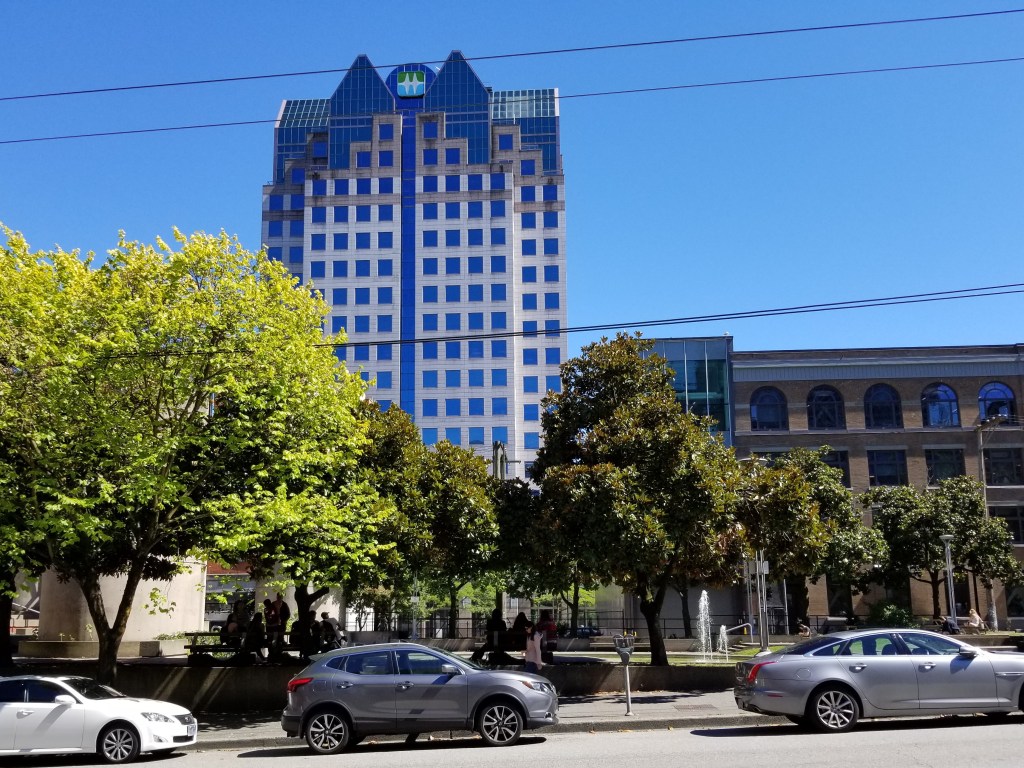
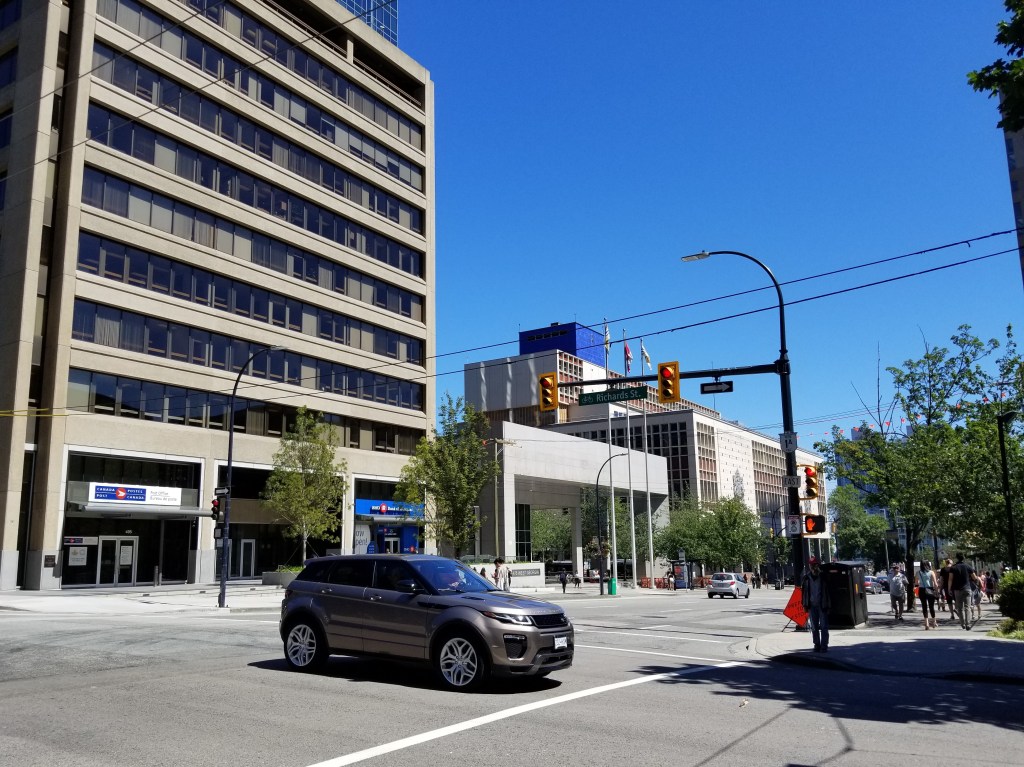
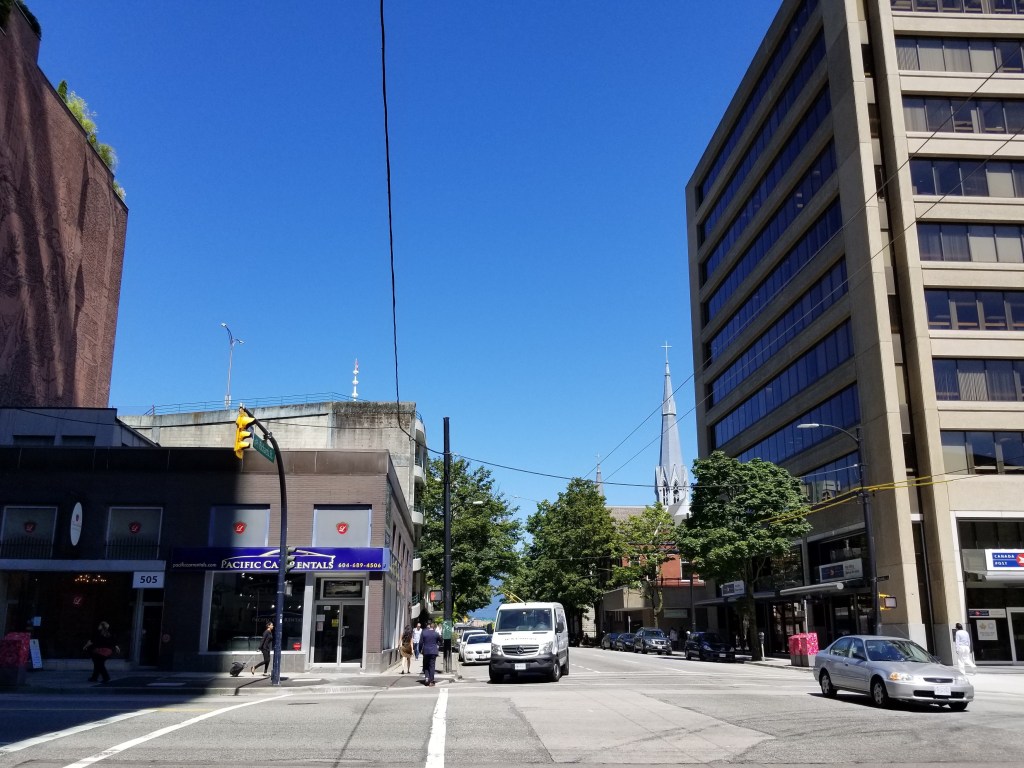
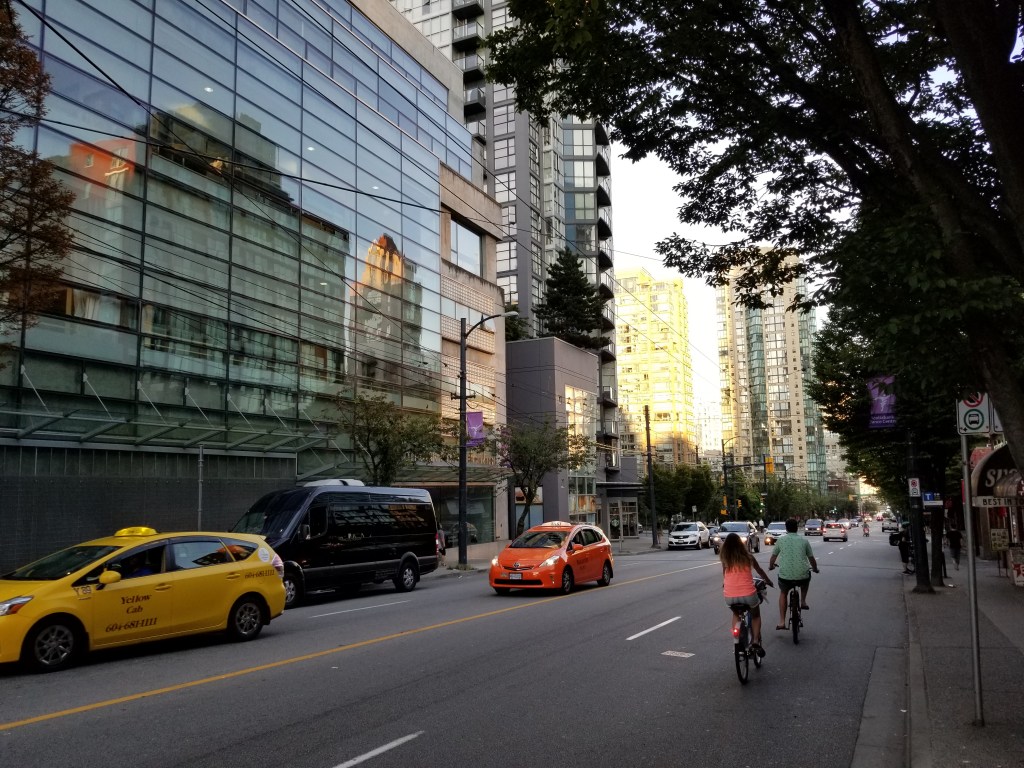


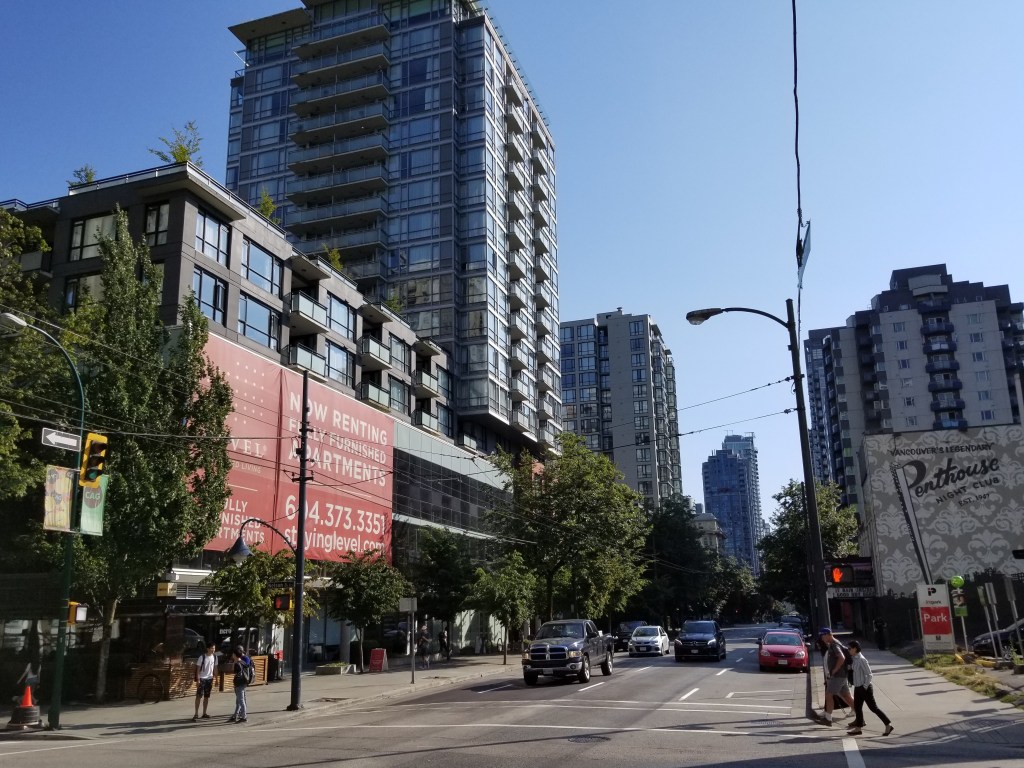

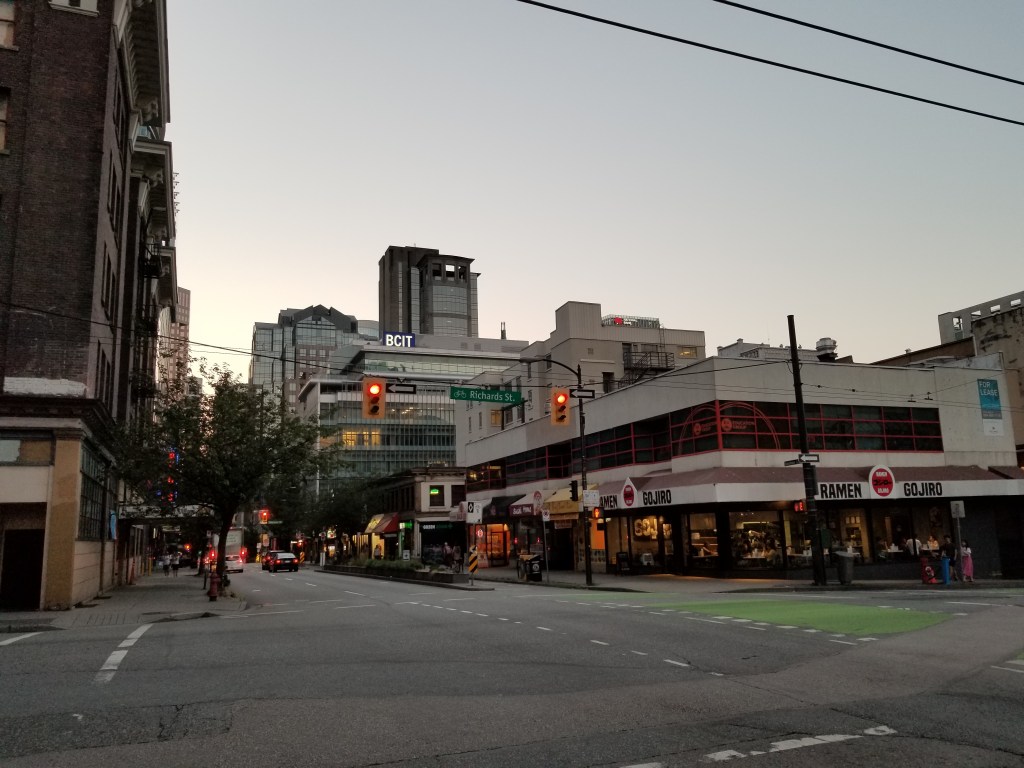
Richards Street in Vancouver, British Columbia, is a key north-south corridor in the city’s downtown core, known for its blend of commercial, cultural, and historical significance. Richards Street runs through the heart of downtown Vancouver, stretching from the waterfront near Canada Place in the north to False Creek in the south. It’s a bustling urban artery in a highly walkable area.
969 Richards Street has a Walk Score of 100 out of 100, meaning it’s a “walker’s paradise.” Daily errands don’t require a car, with amenities like restaurants, shops, and parks within easy reach. The street is well-served by public transit. For example, 969 Richards Street is a seven-minute walk from the Vancouver City Centre Station on the Canada Line (Platform 1), a major SkyTrain line connecting downtown to Richmond and Vancouver International Airport. Nearby green spaces include Yaletown Park, Emery Barnes Park, and Helmcken Park, offering residents and visitors spots for relaxation amidst the urban setting.
Richards Street has played a role in Vancouver’s evolution from its early days. At 422 Richards Street, the Bank of British Columbia building stands as a historical landmark, one of the first commercial structures built outside Gastown, Vancouver’s original commercial hub. According to the Vancouver Heritage Foundation, this building housed Vancouver’s first Aboriginal Friendship Centre from 1952 to 1963. Today, it hosts a mix of commercial businesses, coffee shops, food outlets, and shared workspaces, reflecting the street’s modern vibrancy while preserving its heritage. Vancouver Heritage Foundation, a registered charity, highlights Richards Street as part of its efforts to conserve and promote the city’s heritage places. The buildings on its Heritage Register, like those on Richards, are not owned by the foundation but are significant to the city’s cultural fabric.
Richards Street is a hub for entertainment, particularly at venues like the Red Room. The Red Room (398 Richards Street), an independent nightclub and entertainment venue, as per its website, is a cornerstone of Vancouver’s nightlife. Known for its state-of-the-art PK Sound system and world-class intelligent lighting, it hosts a variety of events, including EDM, Latin nights, and live music. It’s been a staple for bass music through its SUBculture events (featuring Drum & Bass, Dubstep, etc.) and has hosted Vancouver’s longest-running Latin event every Friday for over 18 years. The Red Room also hosts diverse events like comedy nights. On February 1, 2025, it featured a comedy show with Vancouver-based comedian Rory Dunn, who has toured Canada and been featured at JFL Vancouver. The venue’s open floor plan and excellent sightlines make it a popular spot for such performances.
Richards Street is lined with a mix of businesses that cater to both locals and tourists. The area around Richards Street, especially near 422 Richards, is home to coffee shops and food outlets. This makes it a convenient stop for professionals and visitors. The presence of offices and coworking spaces at 422 Richards Street reflects the street’s role in Vancouver’s modern economy, catering to freelancers, startups, and small businesses.
Richards Street is easily accessible by car, with real-time driving directions available. It’s a busy street, so traffic updates are useful, especially during peak hours or events. The street’s design and the surrounding infrastructure make it bike- and pedestrian-friendly, aligning with Vancouver’s emphasis on sustainable transportation. You can explore how far you can travel by foot, bike, bus, or car from spots like 969 Richards Street.
Richards Street lies in a part of Vancouver that balances historical roots with modern development. The Yaletown neighborhood, where much of Richards Street is located, was once an industrial warehouse district but has since transformed into a trendy area with boutique shops, restaurants, and high-rise condos. The street’s proximity to Gastown and the downtown financial district further enhances its role as a connector between Vancouver’s past and present.
Richards Street in Vancouver is a dynamic urban corridor that encapsulates the city’s heritage, accessibility, and vibrant entertainment scene. From historical landmarks like the Bank of British Columbia building to nightlife hotspots like the Red Room, it offers a mix of cultural, commercial, and recreational experiences. Its perfect Walk Score, excellent transit links, and proximity to parks make it a highly livable and visitable part of the city, appealing to a wide range of people—from history buffs to partygoers.
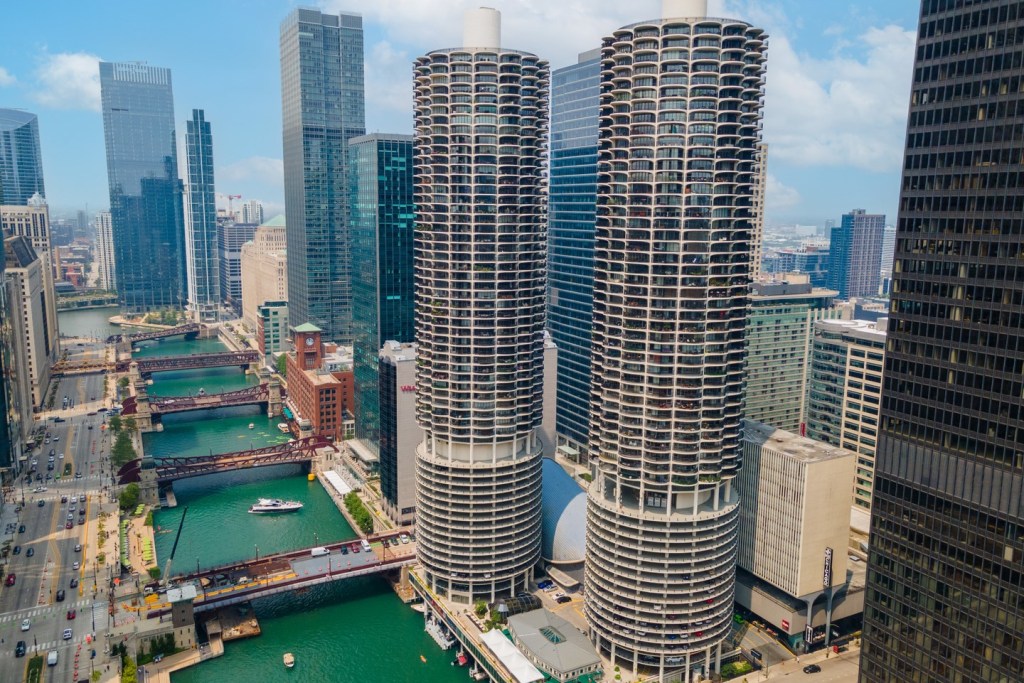
Opened in 1967, Marina City presented a high-profile, architecturally evocative alternative to the suburban ideal many wealthy Chicagoans pursued in the second half of the twentieth century. The five-building downtown complex, with its expressive paired apartment towers and whale’s mouth theater presented an idiosyncratic but compelling vision of vibrant metropolitan life in miniature, prefiguring the urban renaissance of the early twenty-first century.
In 1960 Chicago posted its first ever population loss, beginning four decades of population decline for the city, as many residents of means opted for houses in outlying suburbs. Fearing the consequences of this loss, and acknowledging that the Great Depression and World War II had stalled decades of public investment in the city, Mayor Richard Daley launched a multitude of major urban redevelopment projects in an effort to draw middle- and upper-middle-class taxpayers back to Chicago, including elevated highways and large new hospital and university campuses. In 1959 William Lane McFetridge, president of the powerful Building Service Employee’s International Union (BSEIU), built on this momentum to begin planning for a major urban residential project funded by union dues. There was precedent for unions to develop residential buildings for their own members, but publicly minded real estate financier Charles Swibel persuaded his friend McFetridge that a wiser long-term investment would be an upper-middle-class residential complex that could charge rents beyond what most union members could afford.
McFetridge commissioned Bertrand Goldberg, who had designed several earlier BSEIU projects, for what was preliminarily called Labor Center. A Chicagoan, Goldberg left Harvard to train under Mies van der Rohe at the Berlin Bauhaus in tumultuous 1932. After he completed additional engineering training at the Armour Institute, Goldberg apprenticed with several Chicago firms, including the office of George and Fred Keck, known for their experimental residential work. In 1937 Goldberg opened his own office and his early work earned him a reputation for problem solving, technical expertise, and careful space planning. A founding partner of Standard Houses Corporation, from 1937 until the mid-1950s Goldberg split his energies between his firm’s small modern residential and commercial commissions and the design and manufacturing of prefabricated housing. When McFetridge engaged his services, Goldberg’s small office was designing its largest work to date—Astor Tower, a thirty-story hotel on Chicago’s north side. The exaggerated height of the ground floor, raised above the street on pilotis, emphasized the structural core and transformed it into a design element. McFetridge’s project, however, represented a significant increase in scale for the firm.
The site McFetridge, Swibel, and Goldberg selected for the project was a three-acre rail yard occupying most of the block on the north bank of the Chicago River, between State and Dearborn streets. Surrounded by warehouses, adjacency to the river was the site’s major advantage, but it lacked residential amenities, and the development team determined those must be included in the project. A summer 1959 scheme for Labor Center, now rechristened Marina City, included two round, forty-story residential buildings and a round, ten-story office building. Goldberg’s office continued to develop the scheme, and by December the design largely resembled the final project.
Trained as a modernist, Goldberg found in reinforced concrete a rational yet expressive material that was utterly unlike the celebrated ferro-vitreous residential buildings Mies had designed at 860-880 Lake Shore Drive a decade earlier. A marina occupies the lowest level of the site, allowing seventy boats to dock directly beneath the building. Topped by a one-story restaurant and service level, the marina serves as a platform for the entire project. The paired and rounded towers, offset along the riverbank to maximize views, are each composed of a nineteen-story open parking ramp and a tall glazed transitional story, topped by forty stories of apartments. Each bay of the towers terminates in the hemicyclic balconies that have earned the building its “corncob towers” nickname. Along the parking ramp, spaces are arranged so that cars pull to the edge of the building making them visible from the exterior. Services for each building are clustered into the central shaft, which Goldberg conceptualized as the building’s essential core, accommodating all stairs, elevators, systems, and structure. While circulation and systems are contained within this core, the structural engineers, concerned about the stability of a fully cantilevered system, added columns at the perimeter. Perceptible at the base, at the transitional level, and extending several stories above the roof, each core anchors its tower. On the residential levels, a hall rings the core to produce a round floor plan; this is divided into individual units, studios and one- and two-bedroom apartments, with acutely angled walls. Bathrooms and kitchens are clustered toward the center; at the perimeter are floor-to-ceiling glazed walls with doors leading to the rounded balconies.
At the north end of the site, visually dividing the complex from the industrial district to the north, the commercial building has a two-story glazed lower story, topped by a two-story retail and leisure zone. Finished in concrete panels, this was designed to house shops, a bowling alley, and other amenities for use by Marina City’s residents and office workers. The ten-story office building stands astride the commercial structure, on spindly vaulted concrete legs. Nestled into the center of the complex, the saddle-shaped theater roof rests on low walls, largely glazed at the entry. Walls and roof are finished with standing-seam lead panels, and oversized round cast-concrete eaves mark the transition between roof and walls.
Construction at Marina City began at the end of 1960, and once foundations were completed, an innovative climbing crane allowed workers to complete one tower floor per day. The first tenants moved into the east tower in October 1962 and both buildings opened fully in early 1963. Office tenants occupied that building in late 1964, and the contractor finished construction of the theater in 1967.
Marina City commanded considerable attention when it opened. Goldberg’s office worked closely with the owners to market the commercial and residential leases, producing promotional materials and full-scale mock-ups of apartments and offices. These efforts proved successful and demand allowed the owners to raise rents for both apartments and offices. Goldberg’s paired towers became immediate and enduring Chicago icons, appearing in countless articles and ads, in the opening to CBS’s Bob Newhart Show (1972–1978), the movie The Hunter (1980), where a car famously plunges from the parking ramp into the Chicago River, and on the cover of Wilco’s album Yankee Hotel Foxtrot (2002).
In the last decades, minor changes have done little to alter the appearance of Marina City. In 1977 the apartments were sold as condominiums; in 1994, the office tower was converted into a hotel and a restaurant was built on the site of the ice skating rink at the southeast corner of the complex. The scale, complexity, and audacity of the architecture at Marina City proved Goldberg’s skill and unique vision, and he went on to design such major complexes as Boston’s Affiliated Hospitals (1964–1971), the Chicago Housing Authority’s Raymond Hilliard Homes (1963–1966) and Chicago’s Wilbur Wright College (1986–1992). From cylinders to clover leafs to pyramids, Goldberg’s designs defy the street grid and enclose complex programs and technical requirements in dramatic concrete forms. Among Chicago’s most significant late-twentieth-century architects, Goldberg pushed the Miesian modernism in the direction of a more personal and gestural architectural expression.


Can Gears of War 3 rise to finish the trilogy in style?


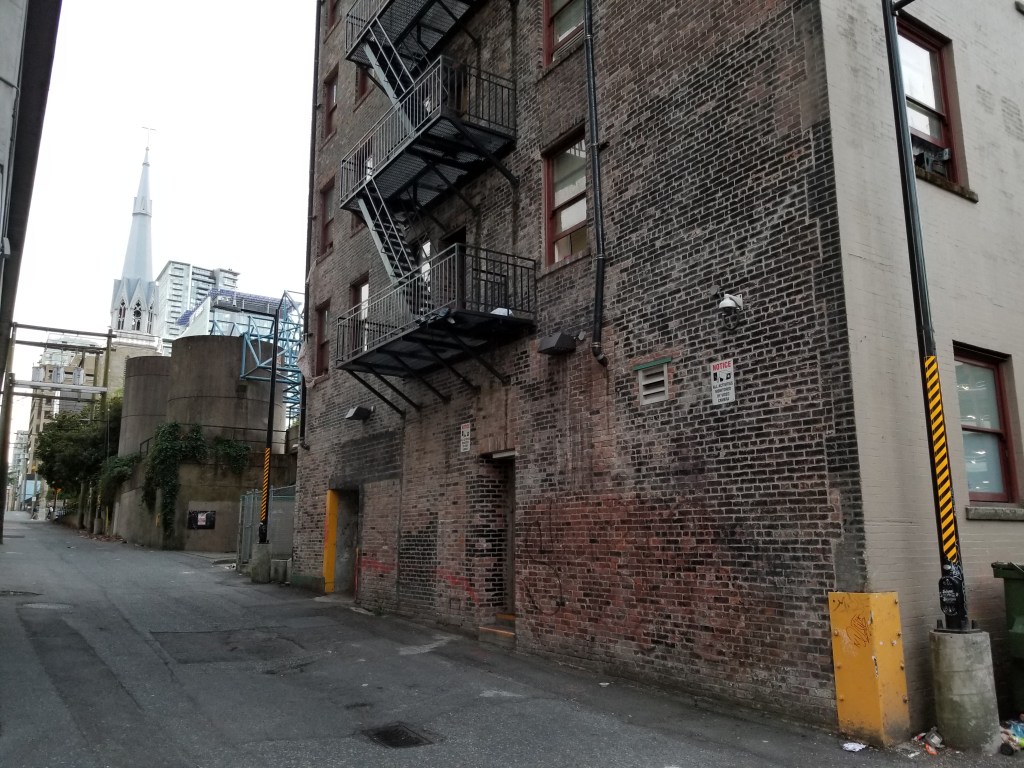

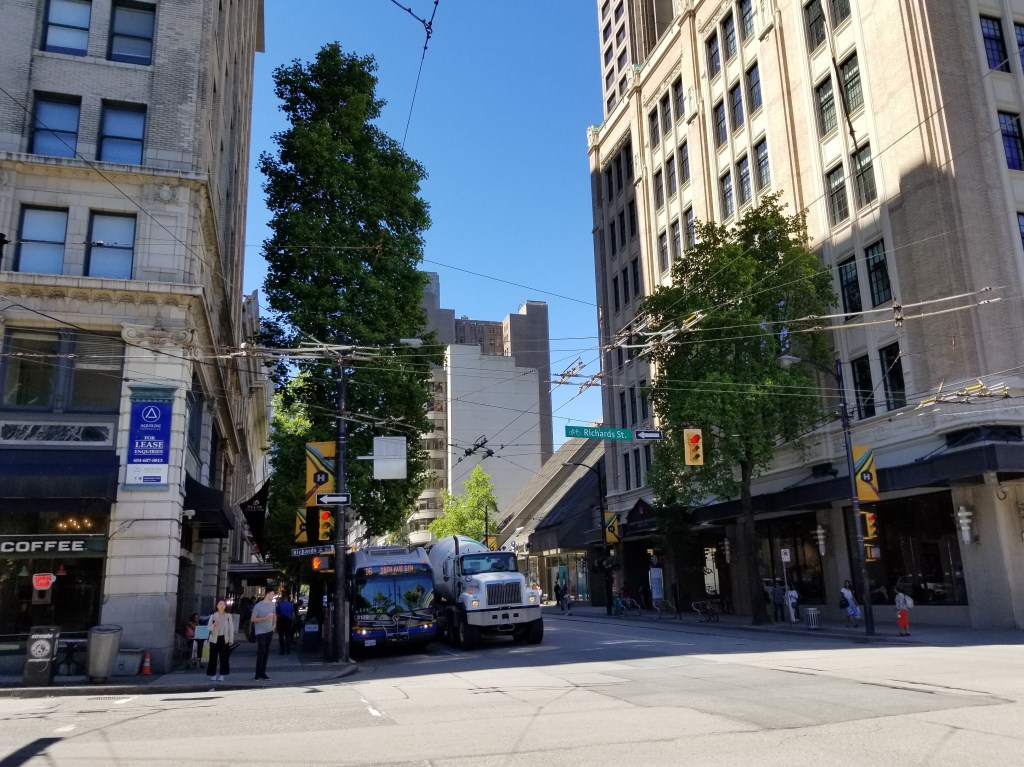
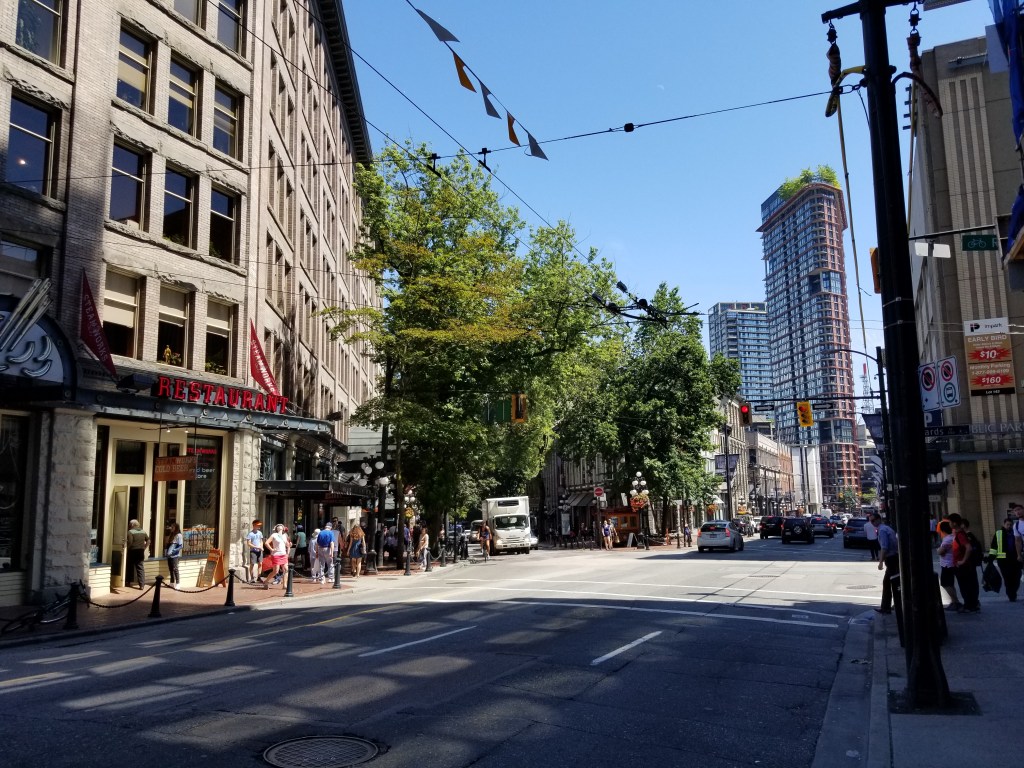


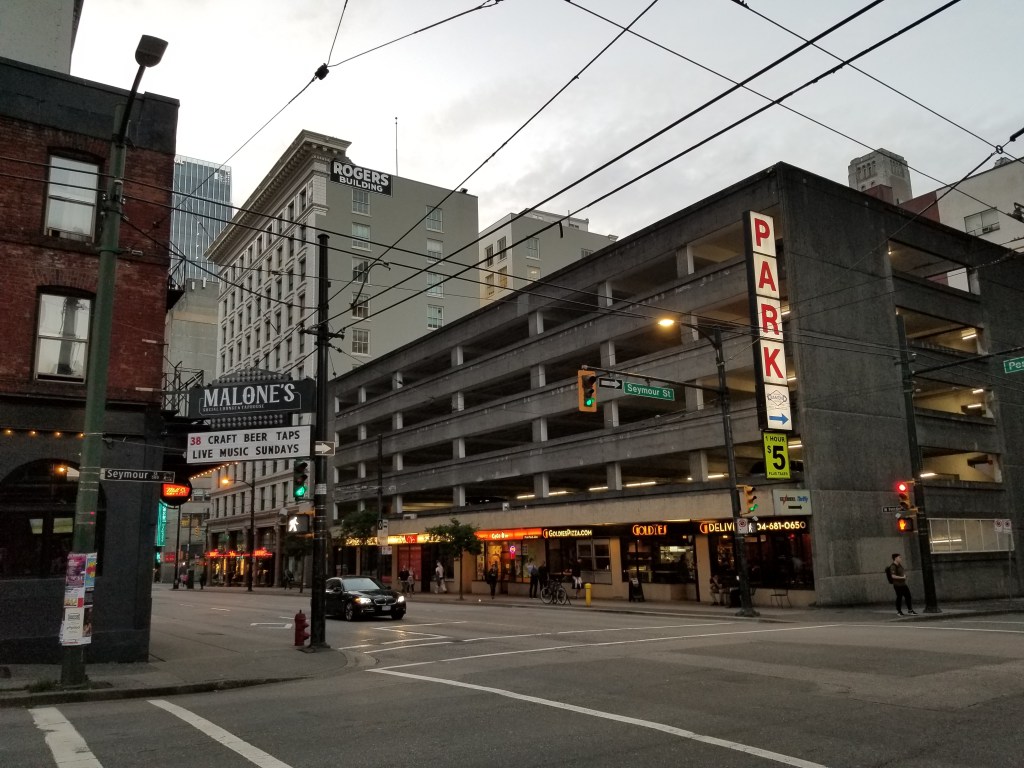
Waterfront is a major intermodal public transportation facility and the main transit terminus in Vancouver, British Columbia, Canada. It is located on West Cordova Street in Downtown Vancouver, between Granville and Seymour Street. The station is also accessible via two other street-level entrances, one on Howe Street to the west for direct access to the Expo Line and another on Granville Street to the south for direct access to the Canada Line.
The station is within walking distance of Vancouver’s historical Gastown district, Canada Place, Convention & Exhibition Centre, Harbour Centre, Sinclair Centre, and the Vancouver Harbour Flight Centre float plane terminal. A heliport operated by Helijet, along with the downtown campuses for Simon Fraser University and the British Columbia Institute of Technology, are also located within the vicinity of the station.
Waterfront station was built by the Canadian Pacific Railway (CPR) and opened on August 1, 1914. It was the Pacific terminus for the CPR’s transcontinental passenger trains to Montreal, Quebec and Toronto, Ontario. The current station is the third CPR station. The previous CPR station was located one block west, at the foot of Granville, and unlike the current classical-styled Waterfront station was built in “railway gothic” like the CPR’s many railway hotels.
In 1978, when Via Rail took over the passenger operations of the CPR and the Canadian National Railway, it continued using both railways’ stations in Vancouver, but a year later, Via consolidated its Vancouver operations at Pacific Central Station, the CN station near False Creek, and ceased using the CPR station. The last scheduled Via passenger train to use Waterfront station departed on October 27, 1979.
Waterfront station’s transformation into a public intermodal transit facility began in 1977. That year, the SeaBus began operating out of a purpose-built floating pier that was connected to the main terminal building via an overhead walkway above the CPR tracks. The CPR’s passenger platform and some of its tracks were torn up in the early 1980s to make way for the guideway of the original SkyTrain line (Expo Line), which opened on December 11, 1985. During Expo 86, SkyTrain operated special shuttle trains between Waterfront station and Stadium–Chinatown station (then named Stadium station), connecting the Canadian Pavilion at Canada Place to the main Expo site along False Creek.
A private ferry company, Royal SeaLink Express, ran passenger ferries from a new dock on the west side of the SeaBus terminal to Victoria and Nanaimo in the early 1990s, but ultimately folded. In 2003, HarbourLynx began operating out of Royal Sealink’s old facility at the SeaBus terminal. In 2006, following major engine problems with their only vessel, they folded as well.
In 1995, platforms were built adjacent to the SkyTrain station for the West Coast Express, which uses the existing CPR tracks. The platforms for the West Coast Express were built in the same location as the old CPR platforms.
In 2002, Millennium Line trains began to share tracks with the Expo Line at Waterfront station. The lines continued to share tracks until late 2016, when an Expo Line branch to Production Way–University station was created in replacement of the Millennium Line service between VCC–Clark and Waterfront stations.
In 2009, the Canada Line opened with separate platforms which are accessible via the main station building, but require leaving the fare paid zone when transferring between other modes. Waterfront station serves as a common terminus point for both the Expo Line and the Canada Line.
Waterfront station was one of the first stations to receive TransLink’s “T” signage, denoting a transit station. This signage was originally installed in the downtown core of Vancouver to help visitors during the 2010 Olympics, as it made transit hubs easier to identify.
In 2018, TransLink announced that Waterfront’s Canada Line platforms, as well as two other stations on the line located within downtown Vancouver, would receive an accessibility upgrade which includes additional escalators, as most Canada Line stations were built with only up escalators initially. Construction is expected to begin in early 2019.
Waterfront’s main station building was designed in a neoclassical style, with a symmetrical red-brick facade dominated by a row of smooth, white Ionic order columns. The Ionic columns are repeated in the grand interior hall, flanking the perimeter of the space. The main hall features two large clocks facing each other high on the east and west walls. Paintings depicting various scenic Canadian landscapes, completed in 1916 by Adelaide Langford, line the walls above the columns. The Montreal architecture firm Barott, Blackader and Webster was responsible for designing the main station building.
 Igor's Blog