

April Sun by Boris Shcherbakov, 1975.
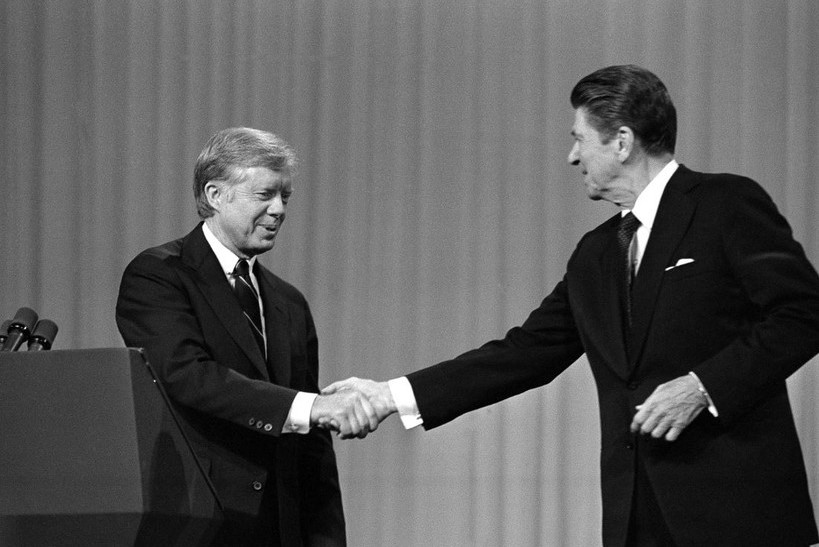
The centennial of Ronald Reagan has just gone by. The former President is highly praised in the media, but in reality there is much evidence that Ronald Wilson Reagan did far more to harm the people of this country and this world than to better their conditions. Both at home and abroad, his legacy is one of gross economic injustice and interventionist foreign policy that led to widespread human rights abuses and mass murder. Reagan’s indifference to and the aiding and abetting of foreign atrocities committed in the name of anti-communism place a shadow of doubt on his “democratic” character as well as the methods he used to supposedly win the Cold War. During the presidency of Ronald Reagan, United States support for anti-democratic regimes abroad reached an all-time high, culminating in massacres and even genocide.
The United States government, with President Reagan’s blessing, gave hundreds of millions of dollars in military aid to dictatorial and fascist regimes in Latin America. Military governments and death squads received weapons, training and financing for decades even as they committed horrid atrocities.
“The death toll [resulting from US/CIA funding] was staggering — an estimated 70,000 or more political killings in El Salvador, possibly 20,000 slain from the contra war in Nicaragua, about 200 political ‘disappearances’ in Honduras and some [200,000] people eliminated during a resurgence of political violence in Guatemala” (Parry).
In Guatemala particularly, there was an internationally-recognized genocide of Maya inhabitants, who were seen as collectively subversive supporters of leftist guerrillas. “The one consistent element in these slaughters [in Central America] was the overarching Cold War rationalization, emanating in large part from Ronald Reagan’s White House” (Parry). All of these movements’ activities were well-known, and yet the Reagan administration’s policy remained unchanged.
The social effects of Reagan’s free market economic policies are rarely discussed in any serious manner in the mainstream media. Praise of the economic miracle that supposedly happened during his presidency is lavish. However, there is much evidence that Reagan’s policies only contributed to the well-being of a small percentage of the population of the United States. “While the richest one percent of the U.S. population saw its financial wealth grow 109 percent from 1983 to 2001, the bottom two-fifths watched as its wealth fell 46 percent” (Smith). In addition, “between 1983 and 1998 the average household net worth of the poorest 40% in the U.S. declined 76%” (Smith). In the eyes of many scholars in economics, Reagan’s presidency was marked by “a mean-spirited, economically unsound, and socially destructive policy agenda” (Miller).
Many praise Reagan’s tax cuts as creating an economic boom, but in fact “most low-income taxpayers missed out on the Reagan tax cuts […] [f]or the richest 1%, on the other hand, the Reagan tax cuts were pure elixir” (Miller). Any serious study of economic data from the period indicates that “Reaganomics” failed to achieve its stated economic boom. “When mainstream economists, such as Barry Bosworth and Gary Burtless of the Brookings Institution, checked out the effects of the 1981 tax cut, they found […] men didn’t work much more at all; although women did work longer hours, their earnings failed to improve” (Miller). While the voodoo economics of the Reagan era certainly helped out those who were already well off, the “economic boom” wasn’t felt so much by working people.
Most will also remember the greatly increased military spending of the Reagan era, including CIA operations worth billions of dollars. In 1979, the Soviet Union invaded Afghanistan. Soon after, “[d]uring the tenure of President Ronald Reagan, military aid to the [Afghan] mujahideen was greatly expanded and included various sophisticated munitions including advanced Stinger anti-aircraft missiles” (Lansford 3). Under the rule of Islamic fundamentalism brought about with Reagan’s help, Afghanistan has seen little improvement since, has legalized rape and supplies 80% of the world’s heroin trade.
This aggressive and interventionist foreign policy was pursued by the Reagan administration from its very beginning—in 1983, the Reagan White House invaded the small country of Grenada, an act which was condemned by the U.N. General Assembly as a violation of international law.
That same year, the Reagan administration bombed Libya and funneled huge sums of money to the Nicaraguan Contras, anti-communist death squads responsible for well-known atrocities in the Nicaraguan Civil War. Reagan was also a hard-line supporter of Israel and approved of its aggressive war against Lebanon.
Clearly, Reagan’s foreign and domestic policy cannot be reconciled with his media portrayal as a purveyor of human rights, justice and freedom. In fact, “[f]rom his eight years in the White House, [….] there are grounds to regard Reagan as the single worst purveyor of mass atrocity in the western hemisphere during the twentieth century. Very little of this surfaced in the nauseating encomiums to Reagan in the US media following his death in 2004” (Jones 146-147).
Reagan, who was allowed to die peacefully in his bed, could easily be counted as one of the greatest criminals of the 20th century, and certainly did not deserve the mantle of a fighter for democracy.
My thoughts on Soviet films and what led me to discover these films.
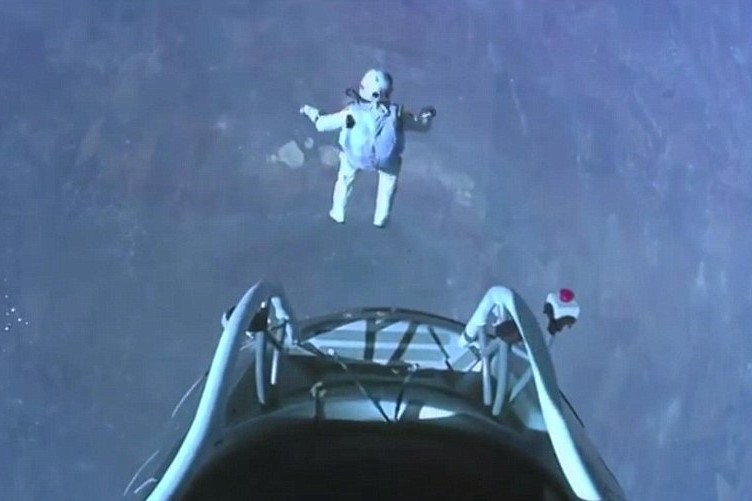
For more than four nerve-racking minutes, he was a tiny white speck against a dark sky, hurtling from 24.5 miles above the Earth at up to 834mph.
Then his parachute opened and five minutes later, to the relief of the millions watching, ‘Fearless Felix’ Baumgartner was back on solid ground – having made the highest and fastest skydive in history.
In the process, the 43-year-old Austrian became the first freefall diver to break the sound barrier, and also broke the record for the highest-ever manned balloon ascent.
He made his death-defying jump from a tiny capsule that took him up to the edge of space.
After days of delays due to bad weather, it took the professional daredevil around two-and-a-half hours to reach 128,177ft above the New Mexico desert – and less than ten minutes to plummet down.
He landed on his feet despite moments during the descent that had silenced his mission control as he appeared to lose control and plunge into a head-over-heels spin.
Falling to his knees, he punched the air in triumph as the control room, packed with scientific experts and family including his teary-eyed mother, Eva, erupted into roars of applause.
Speaking afterwards he said: ‘Trust me, when you stand up there on top of the world, you become so humble.
‘It’s not about breaking records any more. It’s not about getting scientific data. The only thing you want is to come back alive.’
During the first part of Baumgartner’s free fall, anxious onlookers at the command centre held their breath as he appeared to spin uncontrollably.
‘When I was spinning the first 10, 20 seconds, I never thought I was going to lose my life but I was disappointed because I’m going to lose my record. I put seven years of my life into this,’ he said.
He added: ‘In that situation, when you spin around, it’s like hell and you don’t know if you can get out of that spin or not. Of course it was terrifying. I was fighting all the way down because I knew that there must be a moment where I can handle it.’
The extreme sportsman has skydived or base-jumped off statues and skyscrapers around the world, but yesterday’s multi-million pound feat – sponsored by energy drink maker Red Bull, who are refusing to reveal how much they contributed to the final cost – was easily the biggest challenge of his career.
Nobody could be quite sure about the physical effects of breaking the sound barrier in freefall, and if Baumgartner’s pressurised spacesuit and helmet had been damaged it could have been catastrophic.

Can you ever recapture the magic of that first descent into Rapture? It’s the one question that Bioshock Infinite struggles to answer.
The wonder of the original Bioshock was that it took us somewhere completely new then delivered a story-led experience the likes of which we’d never seen before. Here was a miraculous city beneath the waves, crammed with art deco architecture and period atmosphere, and here was a story that shocked, surprised and made you think. It’s not that Bioshock’s elements had never been combined before, but they’d never been combined in such a way, with such power and with such intelligent, deliberate intent.
Bioshock Infinite doesn’t have this advantage. As stunning as its new setting is, it’s made of much the same stuff of Bioshock. Sure, the old power-giving Plasmids are now Vigors while the city’s in the sky, not in the sea, but while Bioshock Infinite is by turns magnificent, awe-inspiring, all-absorbing and every other superlative you might care to throw at it, it never quite feels so strange, fresh and new.
The question is, can it find its own identity, or is this one of those sequels doomed to live in the shadow of a ground-breaking original?
Within a few hours of play, the answer becomes clear: Bioshock Infinite is more than simply Bioshock in the skies. While it might share common DNA with its illustrious forbear, and feel very similar in the moment to moment gameplay, it’s a different experience. In a way, it’s the gaming equivalent of The Godfather Part 2.
While both The Godfather and its sequel concern gangsters, corruption, family and the corrosive lure of power, and both involve scenes of drama punctuated by sudden bursts of violence, there’s no way you could call the second part a retread. The same holds true here. Bioshock Infinite is a continuation, but one that takes the ideas and aesthetics of its predecessor in a new direction.
Spoilers are a problem in any review, but with Bioshock Infinite the story is the key to the whole experience. The less you know when you load the game up, the better.
All you ought to know is that it’s 1912, that you play a Pinkerton private eye with a shady past, and that you’ve been sent by unknown agencies to the floating sky city of Columbia to retrieve a girl. It turns out that the girl, Elizabeth, has mysterious powers, and that getting her out won’t be as easy as you thought. In fact, it’s going to be very hard indeed.
Columbia is not Rapture Mark 2. Where Rapture was in the midst of both a moral and physical collapse, Columbia appears to be a city in full working order.
Admittedly, with its religious fundamentalism, barely-concealed racism and totalitarian leanings it’s not a city you’d want to spend too much time in, but where Bioshock’s motifs were art deco beauty, rust and leaking water, Infinite starts off with sunshine, 1900s American and colonial splendour, before a rapid descent into darkness, anarchy and horror. It’s Disneyland Main Street with a dark side.
Where Rapture had gangs of Plasmid-wielding mutants, Columbia has well-armed police and military forces, backed up by steampunk mechs and psionic freaks. Less obviously but more importantly, Rapture was a city of fairly small spaces, with even its grander areas quite compact. Columbia is a city of large civic spaces and towering buildings, where multiple levels are connected by rollercoaster skyrails. In Rapture the tommy gun and the shotgun were generally the tools of choice, but in Columbia you’ll find yourself reaching for the carbine and the sniper rifle.
Bioshock lived and died on its sumptuous visual design and smog-thick atmosphere, made up not just of its period aesthetic, but of the sound design, the music and the exceptional use of light and colour.
Bioshock Infinite repeats the same tricks, and the graphics are even more dazzling. It’s a stunning game on console, but on the PC with detail levels and textures set to maximum it looks incredible – not photorealistic in the style of Crysis 3 but painterly, like a moving work of art. Pay attention to the music, too. We don’t want to spoil anything, but there’s a genius in the way the game takes the familiar somewhere strange and new.
In terms of combat, the basic feel will be very familiar. Columbia has its own version of Plasmids in its Vigors; liquors that, when drunk, reveal new psychic energies, allowing you to throw fireballs, send out trails of vicious crows at your enemies or suck in and discharge hostile fire.
Most have a secondary fire mode, enabling traps or alternative attacks, and they’re fuelled by vials and bottles of salts, meaning there’s no moral choice involved in getting more. Meanwhile items of clothing take the place of Bioshock’s passive tonics, increasing your resistance to damage, adding ammo capacity or hitting incoming melee attackers with a dose of their own medicine.

Is Glenn Greenwald willingly setting the stage for the passage of the highly unpopular CISPA by helping to create this new “crisis” at this critical time? Is “the conversation” everyone is talking about us having, actually going to center around the passage of “Big Brother’s Friend” CISPA? I believe it is…
“The primary problem (with CISPA), according to Meeks, is that it tries to kill a flea with a baseball bat: Any alleged security the bill offers against potential hackers “comes at the expense of unfettered government access to our personal information, which is then likely to be sucked into the secretive black hole of the spying complex known as the National Security Agency.” Bob Adlemann, April 23, 2012
800 companies spent $68 million dollars lobbying congress to pass CISPA this past year. The first hurdle was the House of Representatives on April 18th of 2013. Glenn Greenwald was contacted on May 1st by Edward Snowden. Suddenly the talk is about “having the conversation” about privacy and security, the EXACT conversation that would be required in order to push something like CISPA into becoming a law.
That is, after the right crisis is created and the MSM hype it enough.
You think that’s a coincidence? That all of this is happening in a non-election year right before the bill is to go to the senate and eventually to Obama for him to sign? I don’t think so.
As many of you know, my ongoing research into the Edward Snowden psyop has been pretty extensive. As soon as the story broke, I started with one theory as to why they would stage this leak which naturally evolved into another as I learned more and more information became available.
But since the beginning, I have understood that this was and is a staged operation.
I looked at the timing of the leak along with various inconsistencies in Edward’s story and then at how the story itself was being crafted by the media. But I didn’t see that one thing that tied it all together, the one thing that will eventually bring the those on the left and the right of the artificial divide back together as per the “fix” to the crisis.
Today I found it.
As is usually the case with propaganda, though you often can determine immediately that something is propaganda, you can’t always see the forest for the trees until you put a little time and space between the event and your vantage point.
I’ve been saying for a week now that the point of this psyop was stated by the ops themselves along with President Obama when they say we have to have “the discussion” about where we go from here to manage this problem between “100% security and 100% privacy“
Obama has said several times already that private sector companies would be involved in the solution.
Yes, they have a plan in mind to fix the problem with the current spying program and yes, the timing of it all is very curious.
Jon Rappoport wrote an article yesterday in which he concludes that the Edward Snowden leak was planned, but according to him, it was planned by the CIA as the result of some kind of Spy vs Spy game between the NSA and the CIA.
He makes a number of good arguments in support of his case, the same ones many of us have been making which go to establishing the fact that Edward Snowden isn’t actually what he appears to be.
Rappoport suggests, based on what Snowden actually says, that it appears as if he’s ridiculing the process and the structure of the NSA more than the legality of the process. In other words, if you take out the ability for one high school flunkie to be able to access the president’s recorded phone calls and everyone else’s on a whim, it might not be that bad.
Rappoport concluded the only reason to make the NSA look bad in this regard must have something to do with Snowden’s history with the CIA. He figures it’s payback from the CIA for the NSA making them look bad after 9/11 and trying to overreach in the globalism spying game. Basically a turf war.
Though his evaluation of Snowden’s statements is right on the money, Rappoport misses the bigger picture.
In fact, his theory almost sounds like a reworking of the old propaganda that we all heard right after 9/11… that the reason all those “terrorists” slipped through the cracks was because of a lack of communication or competition between intelligence agencies. A turf war, in short.
You will recall, it was that particular bit of blanket propaganda that got us the Department of Homeland Security.
Except for his conclusion, I concur with much of what Rappoport says in his well documented article.
However, the conclusion is a big part of it all and in fact, Mr. Rappoport’s conclusion bolsters what I believe to be the real reason for this little sideshow stage play of a leak.
The idea that what we have is a turf-war between agencies plays right into the hands of those who I think wrote it in the first place. Might explain why Mr. Rappoport’s article is featured on Di$info’s site right now.
Let’s look at how this crisis is being addressed.
There are many people out there starting to question the legitimacy of the Edward Snowden story. Even people who supported him right off the bat with no questions at all are starting to back away a bit, one such writer has even said he doesn’t care at all about Snowden, all he cares about is the information he leaked and what we do about it now.
The “what we do about it” theme is everywhere. No doubt what we do is something to think about.
Here’s what we do… it’s illegal and against our constitutional rights to allow the spying agencies access to our personal data as a broad sweeping generality AND it’s certainly against our constitutional rights to have them recording everything we say for future use or blackmail. So how about this: we boycott the companies involved until it stops? How about we take the batteries out of our phones and our vehicle mapping computers, use cash for our purchases where ever possible and we figure out an online access provider who will stand with the constitution and make them into a trillion dollar company? Hows that sound?
If you don’t think that will change the game plan for the big telecoms you don’t know what share-holders can do til you drop the value of their stock holdings by 30% in a week. You would be surprised what they can do once that happens.
Notice none of the “alternative” sites are promoting or even talking about that because the focus has been on the NSA’s government program (Big Guberment?) and not the companies themselves like it was during the FISA retroactive immunity scandal back in 2008.
Notice, everyone out there feigning some big plan to end this process are talking about one form of a “new Church Committee” or another.
That’s the “big plan”… congress fixes it after another 9/11 Commission Report or Warren Commission Report. Our bought and paid for congress, that is. Our congress that currently enjoys about an 8% approval rating. Our congress (the House of Representatives) which just recently passed the new CISPA bill. Our congress that has been paid $68 million dollars by the corporation who want CISPA.
That’s the big plan? Get congress to investigate and fix it? With what? CISPA?
Let’s look at what is currently going on. The other day, the NSA’s director, Gen. Keith Alexander, spoke to the members of the House Intelligence Committee (many of the same people who would naturally be involved in “a new Church Committee” hearing on intelligence gathering procedures and limits.
“The National Security Agency is reviewing whether to stop collecting a vast stockpile of records of Americans’ telephone calls — the most controversial component of its surveillance programs— by allowing telecommunications companies to retain the data until U.S. intelligence officials have a specific reason to review it for possible connections to terror plots, U.S. officials said Tuesday. The NSA’s director, Gen. Keith Alexander, disclosed the review during a hearing before the House Intelligence Committee, saying the agency and the FBI are jointly re-examining “how we actually do this program.” Asked by Rep. Adam Schiff, D-Calif., if the records of phone calls – known as metadata — could be left in the hands of telecommunications firms and then reviewed only when there is a suspicion “of a foreign terrorist connection,” Alexander replied: “I do think that that’s something that we’ve agreed to look at and that we’ll do. It’s just going to take some time. We want to do it right.” NBC News
So what is the procedure here? The proposed process would involve the big telecoms themselves recording everything you say and do and handing it over to the various agencies when they request it or handing it over to other companies when they buy it. Basically, what we are talking about is allowing the telecommunications companies to turn your private information into a marketable commodity.
If you look back at Snowden’s statements, they play right into this.
His accusation was that the NSA was so slack, anyone could grab anything they wanted, a CEO’s private communications about business matters or Hillary Clinton’s hairdresser gossiping about something Hillary told her the day before. That accusation when you think about it is less a condemnation of the COLLECTION of material and more about HOW and WHO had ready access to it.
You will also notice a growing meme in the MSM discussion about all of this: it’s less about “protecting us from the terrorists” and more about how access to this illegally recorded information is handled.
For more specifics on Snowden’s real message with his leak, I recommend Rappoport’s article.
Well, how does that lead to CISPA?
Let’s start with the obvious… the timing.
April 15th, 2013… right before this whole thing kicked off and Glenn Greenwald was contacted by Edward Snowden, 200 senior IBM executives hit D.C. like a plague of locusts to push them to pass the new CISPA bill.
“The message we’re going to give [lawmakers] is going to be a very simple, clear message: support the passage of CISPA,” he later added. The Hill
IBM is not the only megacorp pressing congress to pass this bill. In fact, when you start looking at the proponents of it, you will find SEVERAL of the companies directly linked to the Edward Snowden psyop.
“CISPA had garnered favor from corporations and lobbying groups such as Microsoft, Facebook, AT&T, IBM, Apple Inc. , Intel, Oracle Corporation, Symantec, and Verizon and the United States Chamber of Commerce, which look on it as a simple and effective means of sharing important cyber threat information with the government. Google has not taken a public position on the bill but has shown previous support for it…” List of companies who have sent letters of support for CISPA since 2012
You will also find major players like the Business Roundtable in support of CISPA as well as:
In all, with the aligned companies that make up the various Roundtables and alliances, there are 800 corporations that support the passage of CISPA.
800 corporations, Business Roundtable, Financial Roundtable, Boeing, Lockheed Martin, the Military Industrial Complex in general all standing for something the general public is strongly against.
Back in Aug of 2012, after CISPA and SOPA failed to garner enough support to become the law of the land, long after PIPA also failed, the groundwork was already being laid for the House vote on CISPA scheduled for April 23rd of this year. It passed the House last year but public outcry against it was such
That brings me back to the quote I teased you with at the opening of this article from Bob Adelmann in an article he wrote in 2012 titled “CISPA is Big Brother’s Friend“
The primary problem, according to Meeks, is that it tries to kill a flea with a baseball bat: Any alleged security the bill offers against potential hackers “comes at the expense of unfettered government access to our personal information, which is then likely to be sucked into the secretive black hole of the spying complex known as the National Security Agency.” Despite some window dressing by Mssrs. Rogers and Ruppersberger, the bill still has major problems. First it has “an overly broad, almost unlimited definition of the information [that] can be shared [by private Internet companies] with government agencies.” It overrides existing federal or state privacy laws with its language that says information between private and public agencies is shared “notwithstanding any other provision of law.” In addition, the bill would create a “backdoor wiretap program” because the information being shared isn’t limited specifically to issues of cybersecurity but could be used for any other purpose as well. The language is unclear about what would trigger a CISPA investigation: “efforts to degrade, disrupt or destroy” a network. Would that apply to someone innocently downloading a large file — a movie, perhaps — that is perceived, under the bill, to be an “effort to degrade, disrupt or destroy” a network? Bob Adelmann, April 2012
This is basically the wet dream of the fascist state which is why 800 corporations support it and spent $68 million dollars last year lobbying congress to push it through this year.
With CISPA they can do anything with the data, your personal data; they can trade it, sell it, use it for marketing, make derivatives off it for all I know which is probably one reason the Financial Services Roundtable and all their globalist banking members want it so bad.
But back in 2012 when they were trying to get it pushed through, way too many people across the net were screaming bloody murder about it:
And that’s just a very small sampling of the general mood of the nation about this bill. Remember, April 2012 was right before a major election. Nobody wanted to vote for the extremely unpopular “draconian CISPA” bill at that time. It was political suicide.
But here we are today, 2 years from even a mid-term election, and suddenly we are being told by everyone we have to “have the conversation” about how to fix this spying program crisis.
A sudden, blind rush to fix the problem, the problem thrust into the forefront of our public discourse by the NSA and various MSM corporations which by and large support the passage of CISPA.
The head of the NSA, the agency which I think actually ran the Edward Snowden psyop, just came out and said we have to get the private sector companies to store this data and share it with the government agencies and others as needed. That’s CISPA folks.
Keep in mind that the Federal Government stepped-up their prosecution of Aaron Schwartz, the leading defender of online privacy rights and open access to educational materials, on Sept. 12th 2012. They wanted him silenced and out of the way when the new CISPA was being ramrodded through congress since he was so instrumental in killing it the first time as well as SOPA.
Schwartz was a consummate activist and he certainly didn’t run off to Hong Kong and hide at the CIA compound where Snowden probably is today.
He vowed to fight the 9 new felony charges they leveled at him in court and eventually they offered him a plea deal with only 60 days in jail but he refused to cut a deal and looked forward to beating them once and for all in public on this very critical issue.
On the evening of January 11, 2013, Swartz was found dead in his Crown Heights, Brooklyn apartment by his partner.[74][86][87] A spokeswoman for New York’s Medical Examiner reported that he had hanged himself.[86][87][88][89] No suicide note was found.[90]
Like I said about the Benghazi psyop and the 45 major corporations who got together in April of last year to decide how they are going to chop up the continent of Africa, when these major companies get together and come up with an agenda, no one’s safe, everything is “on the table” from staging the suicide of an effective and popular activist to killing a few State Department employees. The endgame represents far too much profit for these companies. No one is bigger than that.
That’s what happens in a fascist state. That’s why we don’t want to live in one. But we do.
The ground work has been done. The pieces of the narrative are all set.
We now have what was missing prior to last year’s effort to pass CISPA and SOPA… a crisis… a crisis which is being blasted across the MSM (the same MSM which to a company, supports CISPA) and the alternative sites across the board (most of those sites are supported by various foundations, all of which support CISPA)
The alternative view is that it’s infighting among the spy agencies.
Infighting and lack of communication between these same agencies prior to 9/11 supposedly required the creation of the Homeland Security Act.
We know that was bullshit.
The same story looks like it is going to be used to justify yet another congressional act, one that is and was highly unpopular.
NSA’s director, Gen. Keith Alexander says they’ve been “working” on this plan. Yes, they have.
The main activist thorn in their side is out of the way. The narrative of the out of control spying agency is in place. Even the liberals like Greenwald are out in the forefront drumming up outrage over the situation as it is, calling for some kind of congressional action.
And the whole time, this action has been sitting there waiting for just the right crisis environment to slip through the cracks in our sanity to become the law of the land.
The Shock Opera of the Snowden psyop has a final chapter written and directed by 800 major corporations.
The Cyber Intelligence Sharing and Protection Act (Cispa) passed by a 288-127 vote, receiving support from 92 Democrats. It will move to the Senate and then to the president’s desk.
The bill allows private businesses to share customers’ personal information with any government entity, including the National Security Agency. Reintroduced in February after failing to pass Congress last year, the bill would afford legal protection to the government and businesses to share data with each other on cyber threats. Its co-author, Mike Rogers, the intelligence committee chairman and a Republican from Michigan, argues that cyberattacks and espionage, particularly from China, where a number of high profile attacks have originated recently, are a number one threat to US economic security. “We have a constitutional obligation to defend this nation,” said Rogers, on the House floor. “This is the answer to empower cyber information sharing to protect this nation, to allow those companies to protect themselves and move on to economic prosperity. If you want to take a shot across China’s bow, this is the answer.” Guardian April 18th 2013
Taking a shot across China’s bow?…. and where did Snowden go?
He went to China.
Schwartz was finally found dead with no suicide note in mid January, the new CISPA bill hit congress less than a month afterward.
It’s kinda hard to miss the thru-line at this point, wouldn’t you say?
When 800 corporations want something in a non-election year and they pay $68 million to congress to get it passed, there are literally no limits to what they and their intelligence agencies wont do to see it done.
That’s the missing piece of the Edward Snowden psyop. The motive. CISPA. And it’s just as plain as the nose on your face.


 Igor's Blog