



It hardly seems like a story worth reporting on anymore. “At least” eight civilians killed during a U.S. commando raid in Yemen. The headline at the New York Times focuses exclusively on the American hostage, Luke Somers, who also died as a result.
The left is busy running around protesting the militarization of police departments and the deaths of a couple unarmed men here in the states and feeling very good about themselves while they do it… while in the meantime, the military continues to rain hell down on unarmed civilians across the world and there isn’t a peep out of the fake left anymore.
According to the story, Luke Somers was a freelance photojournalist working in Yemen when he was abducted late last year. The group that took him is supposedly part of a movement that wants our puppet dictatorship out of power in the country and an end to the brutal austerity of free-market neoliberalism.
Luke’s family released a video pleading for his return. In it, his brother stated “Luke is only a photojournalist, and he is not responsible for any actions the U.S. government has taken,”
According to witnesses who were there when the rescue raid took place, it must have looked like something out of Apocalypse Now with scores of helicopters flying into the little village unloading up to a hundred U.S. commandos looking for Luke.
A Yemeni tribal leader who said he was a witness to the raid, in the southern province of Shabwa, said that two Al Qaeda militants and at least eight civilians were killed during firefights as U.S. commandos raided several homes… The tribal leader who said he witnessed the raid, Tarek al-Daghari al-Awlaki, said helicopters and as many as a hundred troops descended on the village, Wadi Abadan. The U.S. forces deployed concussion grenades as they raided four houses in the village, he said. “The shooting caused panic,” Mr. Daghari said. “Nine of the dead are from my tribe. Two of the dead are known to be members of Al Qaeda.” He said that two wounded civilians, a woman and a child, were taken to a nearby hospital. New York Times
There was once a time in this country when fatality numbers like these (2 fighters, at least 8 civilians and women and children rushed to a hospital) would have been unacceptable to the morally upstanding members of the left. Specifically, that time was between 2000 and 2008. Then came the CHANGE followed by SILENCE.
Suddenly everyone is worried about the militarization of the police. Can’t have our cops treating us like we treat the rest of the world, now can we?
There are conflicting reports about how exactly Luke Somers died and no word as of yet about the fate of the other two hostages who were being held with him.
But, once again, we have put boots on the ground in yet another country and their civilian population has paid a staggering price for it. Or at least, 8 families of those killed did.
They’ll be no protest. Al Sharpton wont say a word. Just a few more dead poor people in a nation far far away in the name of our “national interests”.
It should be noted that Luke Somers did a lot of work for al Jazeera and reported on the growing anti-American movement in Yemen.
It should also be noted that al Qaeda is a CIA fabrication designed to give the U.S. sufficient probable cause to get involved militarily in nations that we wish to either support or destabilize. The same is true in Yemen. al Qaeda is there for the express purpose of demonizing the growing resistance to our brutal puppet dictator.
When you look at it in that context, the conspiracy theorist in you can’t help but start to wonder.
The decision by Houthis to hold a public celebration of the Prophet Muhammad’s birthday was a departure from tradition in Sanaa, where the day has generally been observed by citizens in mosques or homes. Jan 24, 2013
So Luke was over there putting a human face on the suffering of the Yemeni people under the rule of our puppet dictator and he was kidnapped off the side of the road by al CIAda and killed, along with at least eight civilians, under questionable circumstances during the raid to free him.
Does that about sum it up?


Development leading up to the Mikoyan-Gurevich MiG-23/Mikoyan MiG-27 ‘Flogger’. Wings of the Red Star was a separately-branded program that focused on Soviet Air Force aircraft from World War II to the modern era. It was narrated by actor Sir Peter Ustinov.
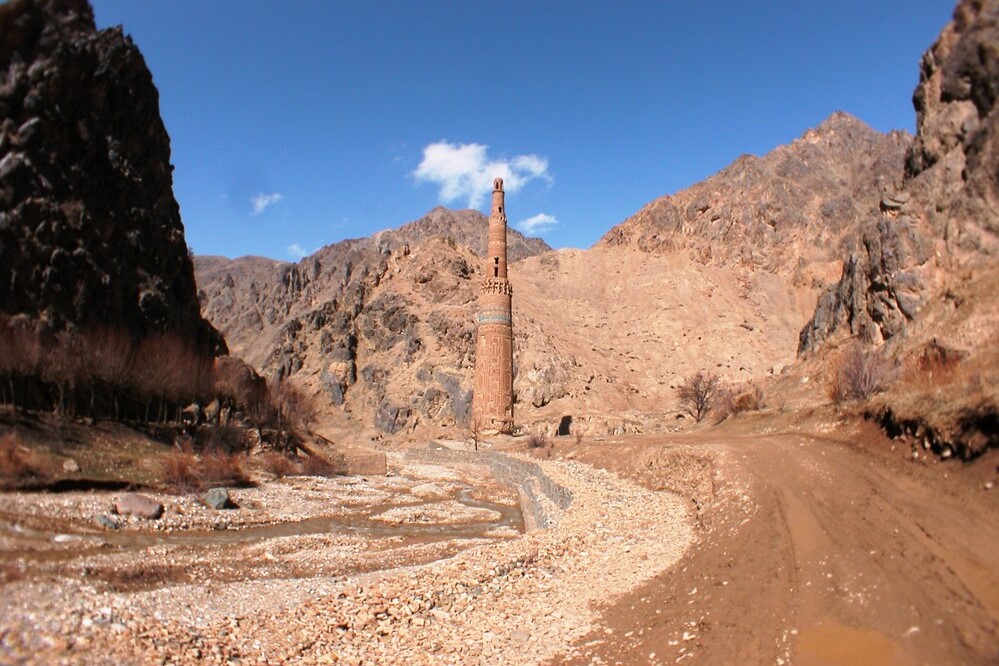
The 65m-tall Minaret of Jam is a graceful, soaring structure, dating back to the 12th century. Covered in elaborate brickwork with a blue tile inscription at the top, it is noteworthy for the quality of its architecture and decoration, which represent the culmination of an architectural and artistic tradition in this region. Its impact is heightened by its dramatic setting, a deep river valley between towering mountains in the heart of the Ghur province.
Brief synthesis
At 1,900 m above sea level and far from any town, the Minaret of Jam rises within a rugged valley along the Hari-rud River at its junction with the river Jam around 215km-east of Herat. Rising to 65m from a 9m diameter octagonal base, its four superimposed, tapering cylindrical shafts are constructed from fired bricks. The Minaret is completely covered with geometric decoration in relief enhanced with a Kufic inscription in turquoise tiles. Built in 1194 by the great Ghurid Sultan Ghiyas-od-din (1153-1203), its emplacement probably marks the site of the ancient city of Firuzkuh, believed to have been the summer capital of the Ghurid dynasty. Surrounding remains include a group of stones with Hebrew inscriptions from the 11th to 12th centuries on the Kushkak hill, and vestiges of castles and towers of the Ghurid settlements on the banks of the Hari River as well as to the east of the Minaret.
The Minaret of Jam is one of the few well-preserved monuments representing the exceptional artistic creativity and mastery of structural engineering of the time. Its architecture and ornamentation are outstanding from the point of view of art history, fusing together elements from earlier developments in the region in an exceptional way and exerting a strong influence on later architecture in the region. This graceful soaring structure is an outstanding example of the architecture and ornamentation of the Islamic period in Central Asia and played a significant role in their further dissemination as far as India as demonstrated by the Qutb Minar, Delhi, begun in 1202 and completed in the early 14th century.
Criterion (ii): The innovative architecture and decoration of the Minaret of Jam played a significant role in the development of the arts and architecture of the Indian sub-continent and beyond.
Criterion (iii): The Minaret of Jam and its associated archaeological remains constitute exceptional testimony to the power and quality of the Ghurid civilization that dominated the region in the 12th and 13th centuries.
Criterion (iv): The Minaret of Jam is an outstanding example of Islamic architecture and ornamentation in the region and played a significant role for further dissemination.
Integrity
Since the building of the Minaret around eight hundred years ago, no reconstruction or extensive restoration work has ever taken place in the area. The archaeological vestiges were surveyed and recorded in 1957 when the remains were first discovered by archaeologists. Subsequent surveys and studies have led only to simple precautionary stabilization measures to the base of the Minaret. Thus, the attributes that express the Outstanding Universal Value of the site, not least the Minaret itself, other architectural forms and their setting in the landscape, remain intact within the boundaries of the property and beyond.
Authenticity
The authenticity of the ensemble of the Minaret of Jam and the vestiges that surround it has never been questioned. The Minaret has always been recognised as a genuine architectural and decorative masterpiece by the experts and an artistic chef-d’oeuvre by the aesthetes. Its monumental Kufic inscriptions testify to the remote and glorious origin of its builders as well as giving evidence to its early dating (1194). No reconstruction or extensive restoration work has ever taken place in the area.
Protection and management requirements
The legal and institutional framework for the effective management of the Minaret and archaeological remains (70ha with a 600ha buffer zone), is regulated by the Department of Historic Monuments on behalf of the Ministry of Information and Culture of the Islamic Republic of Afghanistan. The specific law under which the monument and its landscape are protected is the Law on the Protection of Historical and Cultural Properties (Ministry of Justice, 21 May 2004) which is in force and provides the basis for financial and technical resources.
The property will be removed from the List of World Heritage in Danger when its desired state of conservation is achieved in accordance with Decision 31 COM 7A.20. This must include the increased capacity of the staff of the Afghan Ministry of Culture and Information who are in charge of the preservation of the property; precise identification of the World Heritage property and clearly marked boundaries and buffer zones; assurance of the long-term stability and conservation of the Minaret; assurance of site security, and a comprehensive management system including the development and implementation of a long-term conservation policy.
Proposals for the protection of the Minaret and its environs are under scientific discussion. They would seek to monitor erosion of the riverbanks adjacent to the Minaret, any further movement in the level of inclination of the monument along with any degradation in the historic fabric in general, and mitigate any adverse observations with appropriate programs of stabilization and conservation measures where necessary. Measures for the protection and monitoring of the wider archaeological site are currently under review and an approved program of research and public awareness raising is likely to be instigated in the long term.
Press TV correspondent in Ukraine Johnny Miller says he has been placed on a “kill list” by Ukrainian ultranationalists following his revelations about Ukrainian atrocities against pro-Russian children and other civilians in the Donbas region.
Reporting from the war-torn country on Friday, Miller said that the neo-Nazi group wants him dead following his repeated reports about Ukrainian forces’ violence in the east of the country.
In an interview with Press TV, Miller said that he was placed on the kill list after he sent a journalistic inquiry to the website that had published a kill list of hundreds of people.
“Actually I contacted the website for a statement, which is normal in journalistic standards, but they didn’t reply to my statement… rather, they put me on the list,” the correspondent said.
“It’s clear that some parts of Ukrainian society [are] witnessing some kind of Kafkaesque nightmare, when a journalist does a legitimate story about a kill list and they put him on the same list,” he added.
He warned that most of the people on the list, including a 13-year-old teenager who was interviewed by Miller, “have already been receiving threats of physical violence.”
“There is no doubt that this list does promote violence, and the killing of anybody on that list,” he noted, adding that there are “over 300 children” on that kill list right now.
Miller called on international organizations such as the UN to take down this list and said that it’s so shocking that there is no pressure from such organizations.
“There should be more pressure from western countries to take down this list, [which is] promoting violence against children and journalists through an extremist behavior and ideology.”
“The Ukrainian government has the power to take down this list; NATO countries have a huge influence over Ukraine, but it doesn’t seem to be any pressure to take down this list at the moment,” Miller said.
He said that in spite of Western media’s supposition, there is a considerable degree of “extremism” in Ukraine, which he has been trying to highlight through the years.
The development comes as a number of journalists have been killed in Ukraine after being put on the list.
Miller is famous for his revealing reports in the east of Ukraine since the Russian offensive started on Feb. 26.
In a damning report last month, Miller revealed that the Ukrainian army has been shelling civilians in the areas surrounding the Donetsk region, while accusing the Russian army of atrocities.
“The uncomfortable truth is that Ukraine is killing civilians, indeed its own civilians, as it has been doing so for the last eight years,” said Miller, who traveled to the Petrovsky district near the frontline in Donetsk to investigate the incidents.
Back in May, the Russian army also confirmed that Ukraine’s shelling killed and injured its civilians in the southern region of Kherson, pounding southern and eastern areas with missile strikes.
According to Russia’s RIA news agency, Ukrainian missile strikes hit a school, kindergarten, and cemetery in the villages of Kyselivka and Shyroka Balka in the Kherson region in early May.

5/5 (Masterpiece — but please consider the caveats below before procuring a copy)
(This review is a product of lengthy dialogues with my girlfriend, a graduate student in English, who devoured the work with great relish and enthusiasm. Her remarkable eye peeled away levels I didn’t even know existed and heightened my appreciation for this underread classic. I owe large portions of this review to her.)
Barry N. Malzberg’s Beyond Apollo (1972), the third of his novels I’ve read (Conversations, In the Enclosure, Guernica Night), is generally considered his best work (he won the inaugural John Campbell Award for best Novel). In a genre infrequently blessed with literary experimentation — of course, there are a few exceptions, Ballard’s The Atrocity Exhibition (1970), Joanna Russ’ The Female Man (1975), Russ’ And Chaos Died (1970), and John Brunner’s Stand on Zanzibar (1968) among others — I’m always more predisposed to works which are structurally/stylistically inventive and thought-provoking. Barry N. Malzberg’s Beyond Apollo more than fulfills both longings.
Beyond Apollo is a masterpiece; a multi-faceted rumination on repression; a virulent critique of the space program and America’s obsession with space; a metafictional labyrinth that can, at times, be infuriatingly undefined.
Brief Plot Summary and Discussion of the Character of Harry Evans
Beyond Apollo is not a plot driven work. A vague outline can be gathered by the ultimately cyclical 67 short chapters recounting memories, events, tellings/re-tellings/and re-tellings of re-tellings of said memories and events. Harry Evans, the only survivor of a two-man expedition to Venus, recounts his story in an endless series of re-tellings. The main crux of the novel surrounds the death of the Captain of the expedition whom Harry claims is insane (11).* Was it an accident? Was it due to some strange effect emerging from Venus? Did Harry kill him? Was it self-defense? If he did kill him, how (the trash dispenser, a brute attack)? Why (was it because of the captain’s sexual advances, was it over a game, etc)? Evans is interred in a psychiatric institution and interrogated by authorities over the voyage and the fate of the Captain.
Critics often focus their critique on the lack of resolution concerning what actually happened on the voyage. The reader speculates that Harry is the culprit but the “truth” is not obvious. However, there are many hints (discussed below) that suggest that the Captain isn’t a real person at all. Malzberg purposefully constructs the novel so that we’ll never know exactly what happened on the trip (even if one of the versions Harry describes is indeed what happened). Not only is our anti-hero the only one to return from Venus but also it is clear that he is purposefully obfuscating or does not know the truth. Perhaps he’s unconsciously obscuring his own memories or, paradoxically, trying to prove a point about the dangerous environment of the space program and has gone insane doing it. Evans has definitely been scarred either due to his experience onboard the vessel or on his disastrous previous mission to Mars. After each of his re-tellings claims that what he had previously said about Venus was a lie and that he’ll now tell the truth:
“‘Oh,” I say, “I forgot to tell you. I mean I lied to you the first time around and now I can’t bear to lie any more because I see how crucial the information is. The Captain never said anything about having nuclear devices.’” (40)
And:
‘”I’m convinced,” I say. “I don’t want to live in a tube; I want to see the sun again, to receive a commendation from the President, and someday even to remarry. Because you will agree, I really can’t live with this particular woman any more; we never got along. So let me confess: let me tell you. Venus, it turns out, is populated by an intelligent race of malevolent green snakes.’” ( 38-39)
Two “games” are played to find out the truth. On one level Evans is interrogated by Forrest (the psychiatrist) about the “truth” of the trip. In other chapters Evans and the Captain play a game while on the voyage about the reason behind the Venus mission in the first place:
“the Truth must be absolutely; there must be no hedging of lying; and the game will continue until each of use either answers three questions satisfactorily or refuses to respond, in which case the persion who has asked the question will be the winner. If there is any suspicion of lying, the one under suspicion will have exactly thirty seconds to prove his statement or lose” (28).
There are also dream conversations between Evans and the Captain (who may or may not be a manifestation of himself); dream conversations with dead relatives; dream conversations with Forrest; an unusual history of the space program up the the Venus mission; cryptograms; and lengthy interludes describing in detail Evans’ own sex life and Evan’s imagining of the Captain’s sex life.
Malzberg’s Metafictional Techniques
Malzberg’s fiction is heavily inspired by the rise of postmodernism in the mid to late 1960s (Borges, Beckett, Burroughs, Calvino, etc). Many of the 67 fragmented chapters are about the novel that Harry Evans writes about his expedition to Venus. The implication is that this 67 chaptered novel is indeed the version that Harry Evans wrote about the expedition of Venus.
“In the novel I plan to write of the voyage, the Captain will be a fall, grim man with piercing eyes who has no fear of space. “Onward!” I will hear him shout. “Fuck the bastards. Fuck control base; they’re only a bunch of pimps for the politicians anyway. We’ll make the green planet yet or plunge into the sun. Venus forever! To Venus! Shut off all the receivers now. Take no messages. Listen to nothing they have to say; they only want to lie about us to keep the administrators content. Venus or death! (11)”
The entire work is thus what Harry Evans presents about the expedition. In a novel that is obsessive about characters seeking the truth Malzberg layers the narrative with truth obscuring meta-narrative techniques. There are multiple points where Malzberg has Evans explain the technique regarding assessing the truth that should be used to approach the novel. Evans points out that novel he will write “will be able to apprehend the truth because throughout the whole sweep and scope of the book there will not be a single moment, a passage so precise and detailed that I will have to come to grips with myself and my true relation to the Captain” (110). Yet earlier, Evans explained that “what happened can be indicated only in small flashes of light, tiny apertures which, like periscopes, will illuminate some speck of an overall situation so large that none of us can comprehend it” (47). Thus, the scenes themselves are not specific or concrete enough to indicate exactly what happened between Evans and the Captain but does indicate the larger truth of the experience. But, the very fact that we are reading a novel written by the character in the novel about his own experience calls even this broad statement into question.
There are distinct moments in the narrative that feel “true” as with every novel with autobiographical inspiration. For example, a few lines in conversations with Forrest which aren’t in Evan’s dreams suggest a kernel of truth. Three such scenes imply that the Captain and Evans are the same person. First, Evans knows about nuclear devices on the spaceship that only the Captain knew (40). Of course, after Evans claims that the vessel had nuclear weapons that only the Captain knew about he claims that he “made up the part about his saying we have explosives. I made up all of it” (40). Later in the novel Forrest asks, “‘your latest and your last chance, Colonel,” he says, “to tell us what happens.” When he [Evans] hears the world colonel used for the first time in their relationship Evans twitches slightly but regains control of himself (61).” A colonel in the army and air force is the same rank as a Captain in the navy. The fact that the rank has such an effect on Evans suggests that he might indeed be the Captain. Likewise, in one of Evan’s many anagrams — (44). As with many of aspects of the novel, it is not entirely obvious that this is the “truth.”
Beyond Apollo is also a gendered critique on the hypermasculinity of the space program. Even though a great majority of sci-fi writers glorify the program and proclaim the positives of our obsession with exploration, there are many stories which discuss its flaws, the damage it has on families, how it manipulates young idealists: C. M. Kornbluth’s short story, ‘The Altar at Midnight’ (1952), James Gunn’s Station on Space (1958) are great examples. Malzberg’s goes beyond these earlier works and suggests that the space program makes hypermasculine machines out of men. This plays out in the extensive scenes between Evans and his wife: “We have been geared for efficiency. I begin to fuck her like a proper astronaut […]” (27).
Final Thoughts
For many sci-fi readers, this lack of concrete narrative and thus the necessary footing in order to glean “what is true/what actually happened”, will be off-putting. Added to his devious brew created by an unreliable narrator recounting for his interviewer the events of the voyage is a heavy dose of metafictional techniques and explicit (purposefully shocking) sexuality. Unless you are comfortable with this trifecta (and other postmodernist elements), I suggest avoiding his substantial corpus. For the braver readers out there who enjoy sci-fi with a literary, experimental, nihilistic turn, Malzberg’s ouvre is a veritable treasure trove.
A challenging and literary masterpiece…


 Igor's Blog