


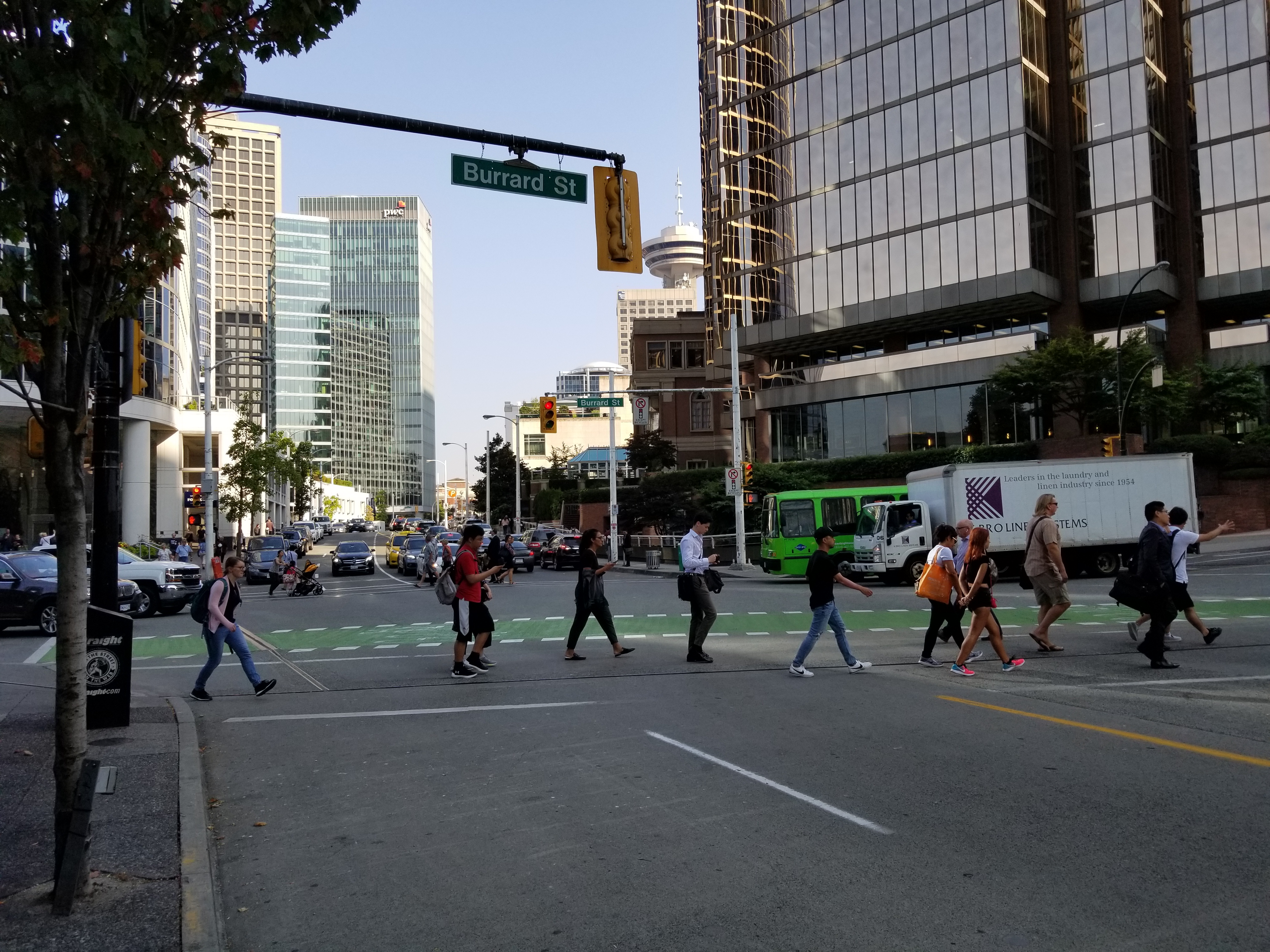
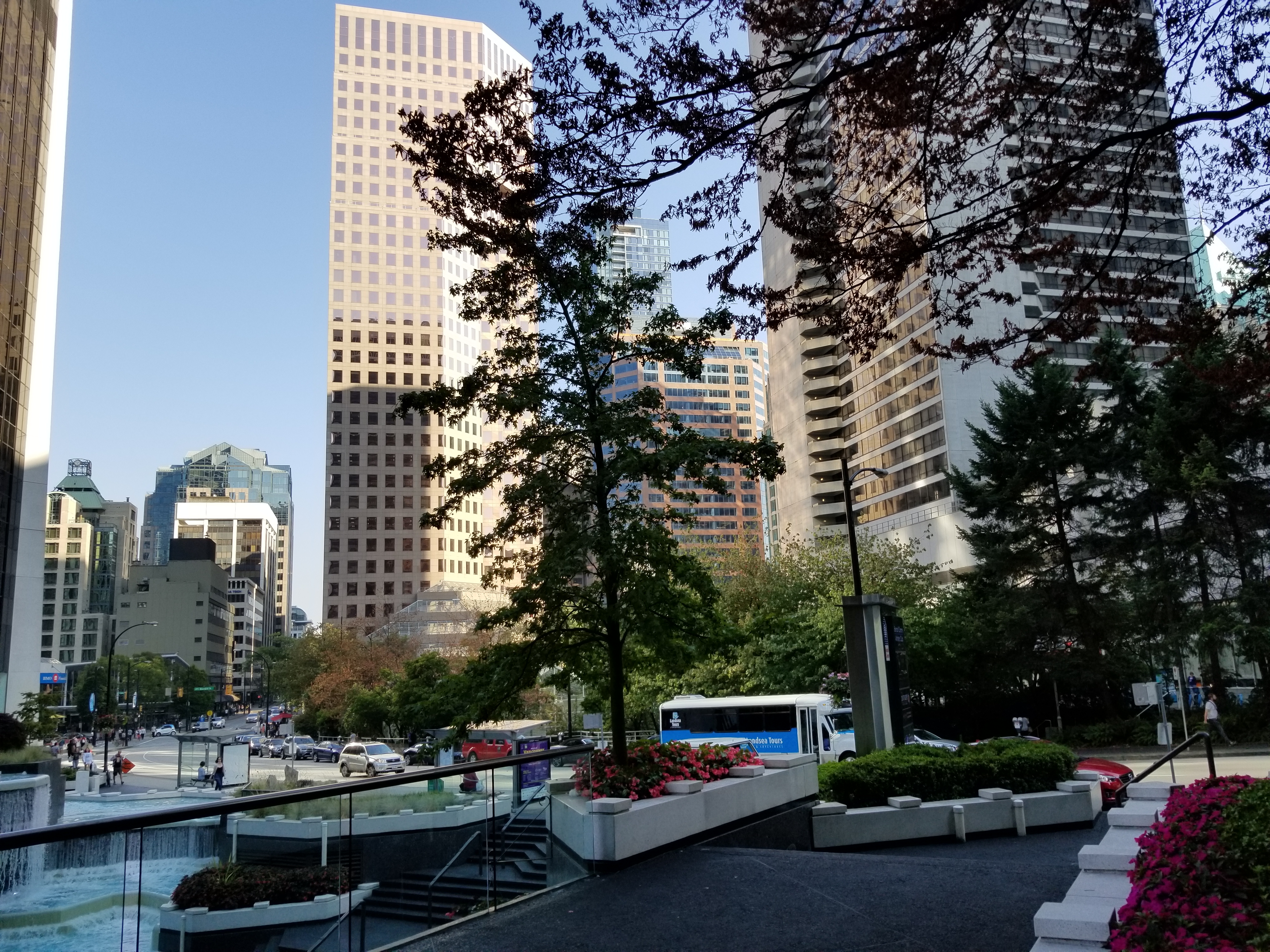


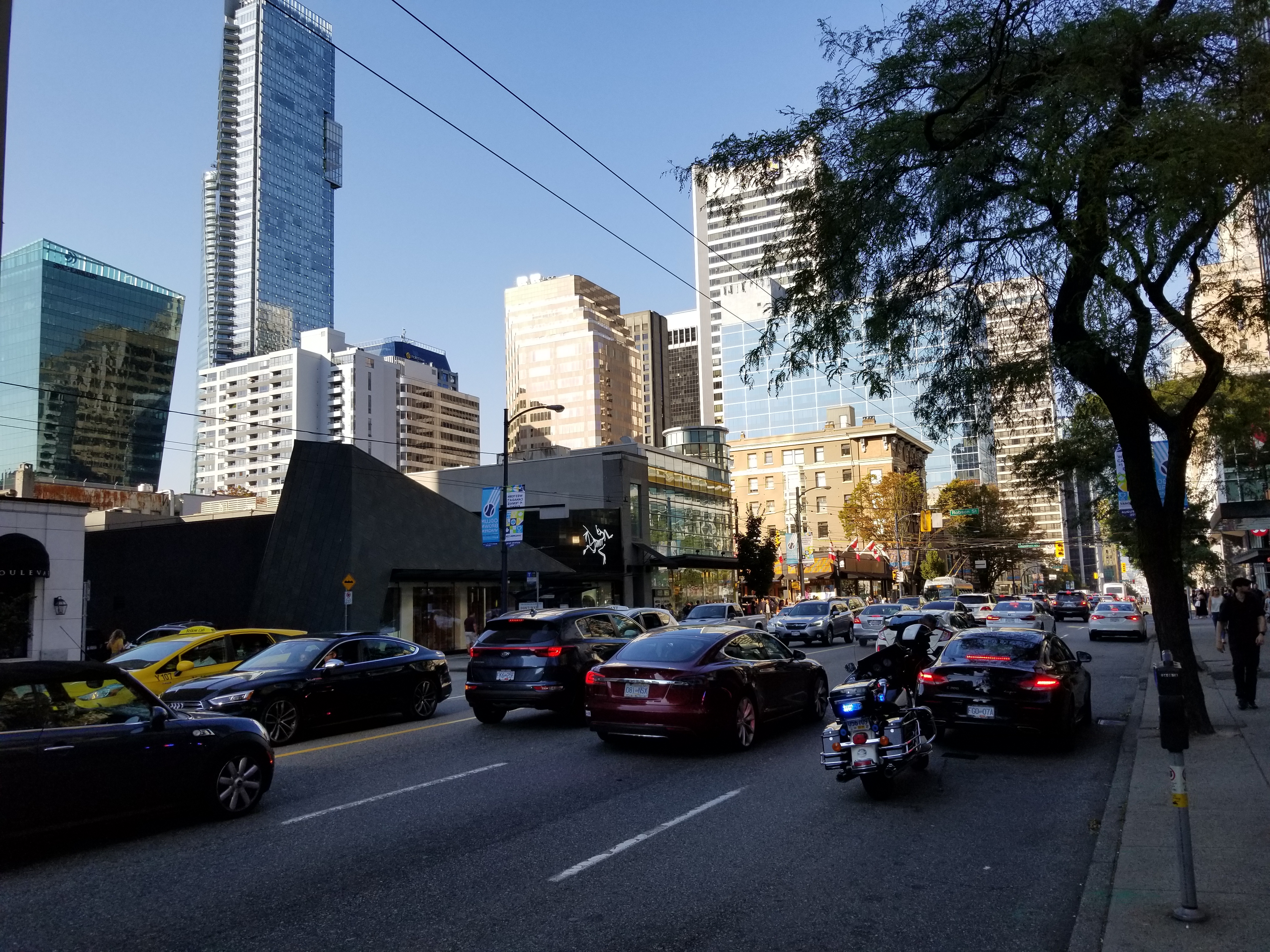
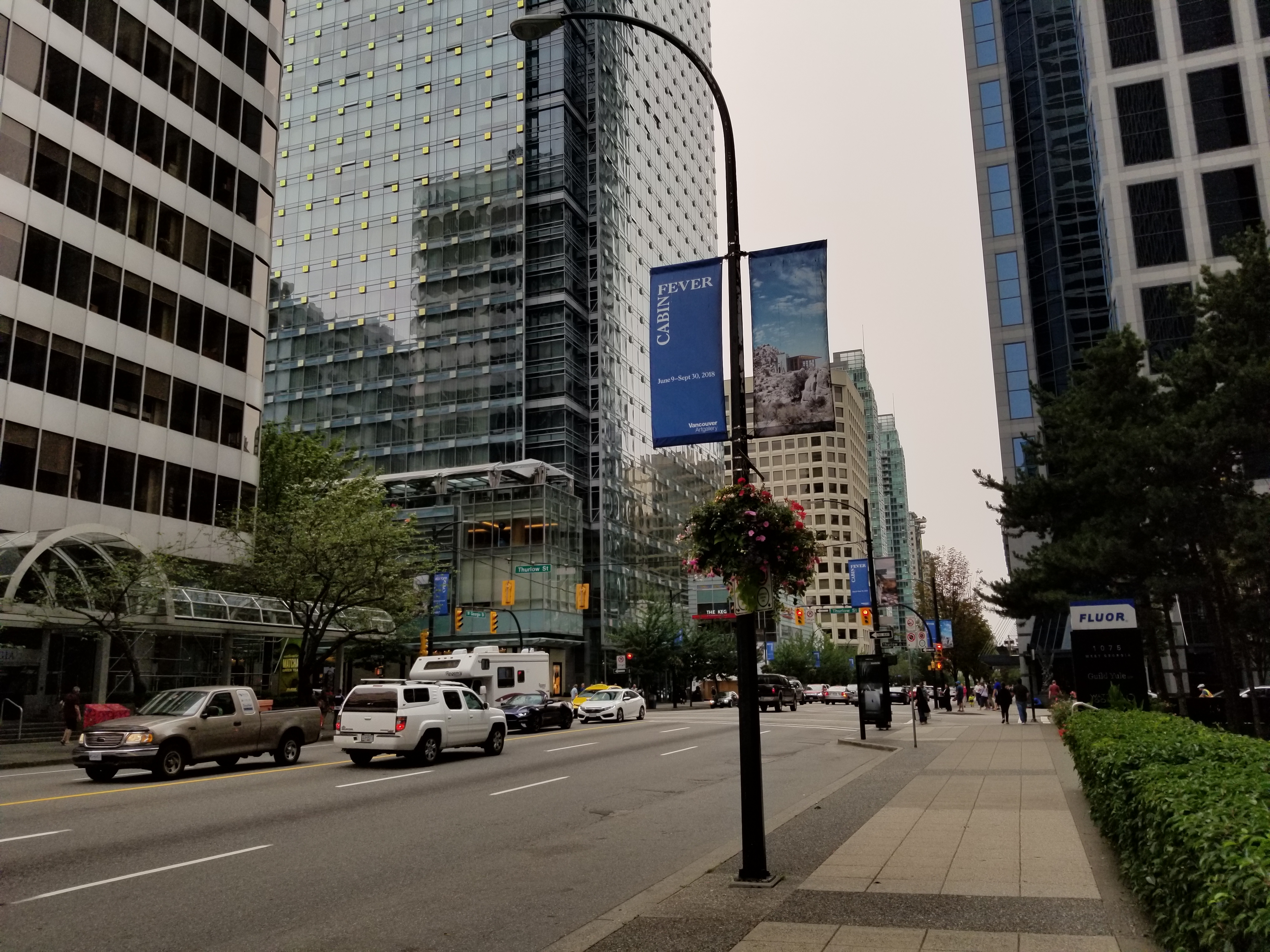

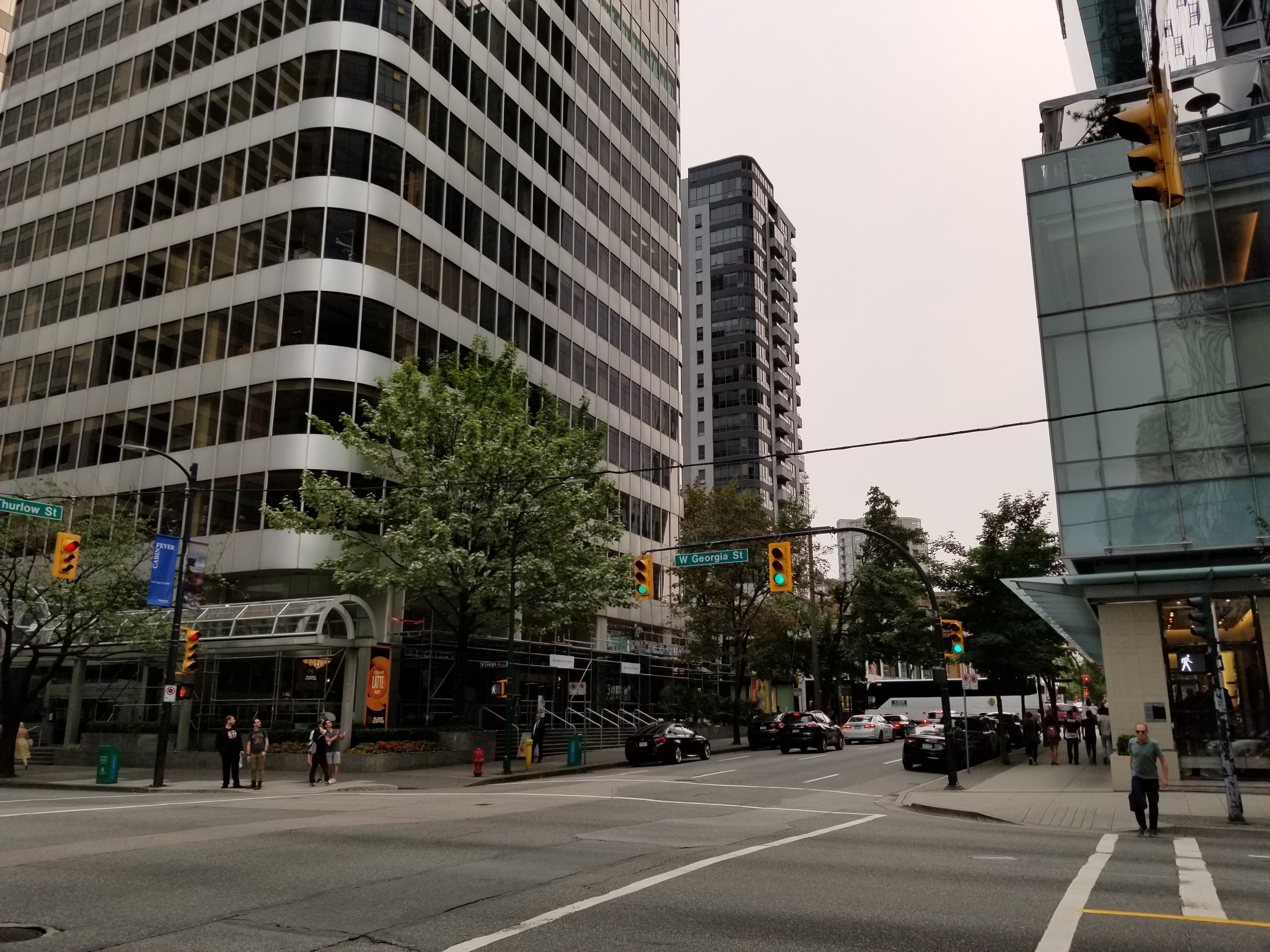
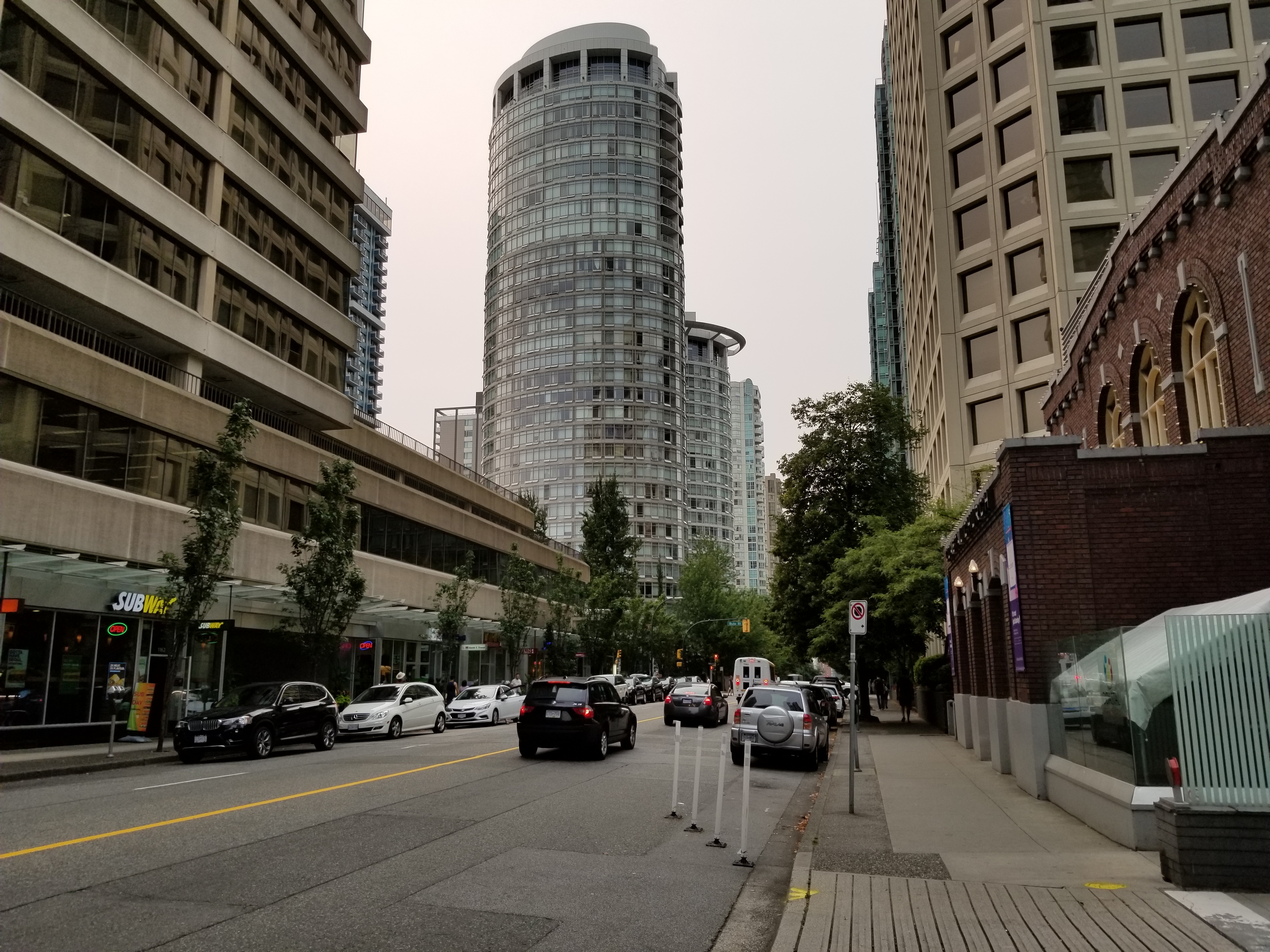
Georgia Street is an east–west street in the cities of Vancouver and Burnaby, British Columbia, Canada. Its section in Downtown Vancouver, designated West Georgia Street, serves as one of the primary streets for the financial and central business districts, and is the major transportation corridor connecting downtown Vancouver with the North Shore (and eventually Whistler) by way of the Lions Gate Bridge. The remainder of the street, known as East Georgia Street between Main Street and Boundary Road and simply Georgia Street within Burnaby, is more residential in character, and is discontinuous at several points.
West of Seymour Street, the thoroughfare is part of Highway 99. The entire section west of Main Street was previously designated part of Highway 1A, and markers for the ‘1A’ designation can still be seen at certain points.
Starting from its western terminus at Chilco Street by the edge of Stanley Park, Georgia Street runs southeast, separating the West End from the Coal Harbour neighbourhood. It then runs through the Financial District; landmarks and major skyscrapers along the way include Living Shangri-La (the city’s tallest building), Trump International Hotel and Tower, Royal Centre, 666 Burrard tower, Hotel Vancouver and upscale shops, the HSBC Canada Building, the Vancouver Art Gallery, Georgia Hotel, Four Seasons Hotel, Pacific Centre, the Granville Entertainment District, Scotia Tower, and the Canada Post headquarters. The eastern portion of West Georgia features the Theatre District (including Queen Elizabeth Theatre and the Centre in Vancouver for the Performing Arts), Library Square (the central branch of the Vancouver Public Library), Rogers Arena, and BC Place. West Georgia’s centre lane between Pender Street and Stanley Park is used as a counterflow lane.
East of Cambie Street, Georgia Street becomes a one-way street for eastbound traffic, and connects to the Georgia Viaduct for eastbound travellers only; westbound traffic is handled by Dunsmuir Street and the Dunsmuir Viaduct, located one block to the north.
East Georgia Street begins at the intersection with Main Street in Vancouver’s Chinatown, then runs eastwards through Strathcona, Grandview–Woodland and Hastings–Sunrise to Boundary Road. East of the municipal boundary, Georgia Street continues eastwards through Burnaby until its terminus at Grove Avenue in the Lochdale neighbourhood. This portion of Georgia Street is interrupted at several locations, such as Templeton Secondary School, Highway 1 and Kensington Park.
Georgia Street was named in 1886 after the Strait of Georgia, and ran between Chilco and Beatty Streets. After the first Georgia Viaduct opened in 1915, the street’s eastern end was connected to Harris Street, and Harris Street was subsequently renamed East Georgia Street.
The second Georgia Viaduct, opened in 1972, connects to Prior Street at its eastern end instead. As a result, East Georgia Street has been disconnected from West Georgia ever since.
On June 15, 2011 Georgia Street became the focal point of the 2011 Vancouver Stanley Cup riot.

Twitter users praised a 2011 InfoWars segment after it resurfaced on the platform on Monday.
The speech: Controversial radio host Alex Jones, who has been characterized as “almost certainly the most prolific conspiracy theorist in contemporary America,” blasted popular culture and boosted one of his own historical heroes — 16th-century Portuguese explorer Ferdinand Magellan — in the viral clip. This is unironically one of the best speeches delivered in the 21st century.
Jones has been banned from mainstream tech platforms like Facebook, YouTube, and Twitter since 2018, but has continued to deliver his fringe takes by way of his radio show and InfoWars website. As for Bieber, he is now a drug-free Christian family man.

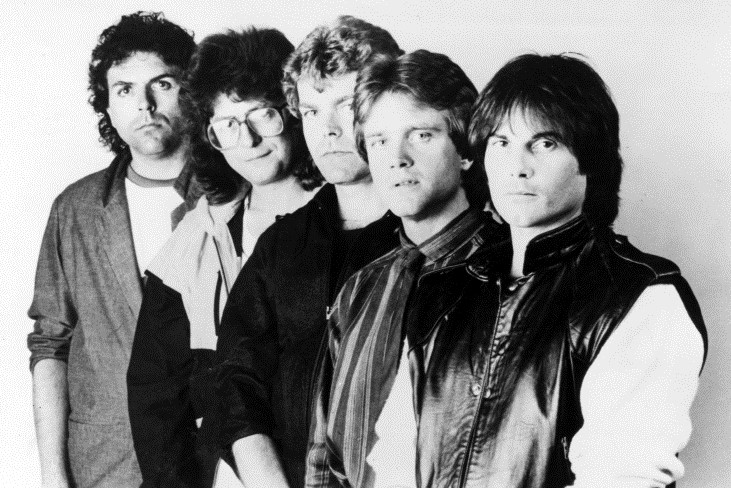
I am extremely biased when it comes to Survivor and especially this phenomenal 1984 AOR classic. Survivor’s music is like magic to me – it’s capable of instantly putting a smile on my face and lifting my spirits. I don’t think I can objectively review this album, because to me, this pure gold, titled “Vital Signs” has absolutely no weak point and it was definitely 100% matching what I love and seek for in music. So, I will just try to explain why I love this album so much and why is it one of the most essential albums of the 80s.
Dave Bickler, Survivor’s initial vocalist, had to be replaced due to vocal problems. Jimi Jamison joined the band and with his outstanding vocal abilities completely blew the roof off everyone. I often refer to him as the greatest rock vocalist. It’s such a shame that we lost him.
Every song, featuring on “Vital Signs” is an absolute melodic rock hit. It’s definitely not as hard as their previous albums; however that’s not a bad thing. On the contrary, the effective formula that combines peaceful acoustic guitar, gentle and emotional vocals, calming riffs and tender melodies is what make the album so brilliant. Harmony, instruments, rhythms, lyrics – they go together in such an unimaginably good style that for a moment there we forget that this is in fact a very commercially-crafted album. And here, I should say that there’s nothing wrong with being commercial, as long as what you do is tasteful and beautiful. “Vital Signs” (along with other 80s rock albums such as Bon Jovi’s “Slippery When Wet”, Def Leppard’s “Hysteria”, TOTO’s IV and many more) is one of the examples of a commercial but fabulous album!
Let’s talk about the songs.
The slow “The Search is Over” is the song that made me completely fall in love with Jimi’s voice. The lyrics are bringing you nothing but hopes and a strong desire to find your destined love. The lines “You followed me through changes and patiently you’d wait…’Till I came to my senses through some miracle of fate” are melting my heart…
“Popular Girl” is my favourite song from the record – it’s catchy, uplifting and so easy to sing along with. Most importantly, it creates a visual story inside your mind when you listen to. You can always recognize a good song if it activates your imagination. “She walks down the street, knocks ’em dead on their feet with a casual nonchalance…When she’s breaking your heart, she’s the state of the art…” – I mean this is just incredible!
“It’s The Singer Not The Song” is a track I truly wish more people would listen to and appreciate as much as I do. I mean, lyrically speaking this song just beats all the others on the record. “It’s the man behind the music…It’s the singer not the song” is an unforgettable line.
“High on You” was one of the first Survivor songs I’ve ever listened to. Needless to say it was love at first listen. I knew I would become a huge fan of the band from the first note… Romantic, harmonious and filled with such beautiful words and lovely keyboards – no wonder this song became one of Survivor’s major hits. “Piercin’ eyes, like a raven, you seemed to share my secret sin. We were high before the night started kickin’ in…” is my favorite line from the track…
Then we have the gentle “I Can’t Hold Back”; the building-up energizing “First Night”; the hard-rocker “Broken Promises”; the sweet ballad “Everlasting” and my second favorite song from the record – “I See You in Everyone” which even after the 1000th listen still gives me the chills…
Many people consider Survivor as a two-hit band (those two hits being “Eye of the Tiger” and “Burning Heart” from Rocky) but think again, fellas! Survivor are so much more than that. Also, after all those years I still cannot understand the constant comparison with Journey. Yes, both of those bands are the absolute “American-favourites”, however Survivor’s style and attitude is completely different and let’s not fight on who’s a better singer – Jimi or Steve, because “Vital Signs” makes it quite obvious, I think…
“Vital Signs” is a must-listen and a must-have record if you are a fan of melodic hard rock from the 80s. God bless Jimi and his one-of-a-kind voice…I truly miss you…

The hotly anticipated sequel to Top Gun, the 1986 movie that made Tom Cruise a star, is raking in cash, great reviews, and even Oscar buzz. Don’t be fooled — it’s the same glorified military recruitment video that the original was.
Is it even worth reviewing a grotesque pop culture phenomenon like Top Gun: Maverick?
Seems like everyone’s on board with this thing. Its premiere at the Cannes Film Festival concluded with a five-minute standing ovation. It’s breaking box office records. It’s been greeted with raves from almost every major film critic. And it’s no doubt on track to generate an even bigger military “recruitment bonanza” than the first Top Gun in 1986, which is only fair — the Pentagon worked closely with the filmmakers and poured a lot of resources into these two Top Guns.
And now entertainment journalists are floating the possibility of Academy Awards for Top Gun: Maverick. Not just nominations for the editing, sound, sound effects, and original song — all of which the ’86 Top Gun received. They’re talking Best Picture, and Best Actor for perpetual star Tom Cruise, or at least a career-capstone honorary Oscar, presumably for saving Hollywood.
Is it any use pointing out that the first Top Gun was a ludicrous piece of shit? That it was a functioning part of the Ronald Reagan administration’s insane military buildup and aggressive pro-war policies of the 1980s? Or that in a 1990 interview, playing dumb about the obvious way the Navy made use of the film, Tom Cruise refuted the idea of ever making a sequel?
Cruise: OK, some people felt that Top Gun was a right-wing film to promote the Navy. And a lot of kids loved it. But I want the kids to know that that’s not the way war is — that Top Gun was just an amusement park ride, a fun film with a PG-13 rating that was not supposed to be reality. That’s why I didn’t go on and make Top Gun II and III and IV and V. That would have been irresponsible.
But that was then, this is now, and Tom Cruise is about to turn sixty and wants to be a star forever. So a sequel to Top Gun looked good, not only to him but to the desperate film industry mavens trying to figure out some way to get audiences back into theaters en masse. The result is Top Gun: Maverick, every bit as vile and idiotic as the first film, but slicker, better edited, featuring more gripping action scenes, and now awash in tears of nostalgia for the 1980s when Hollywood was booming and “It’s Morning in America” was a slogan people actually believed in.
Of course, it wasn’t morning. It was a grim twilight with a hard polluted rain pouring down. And now it’s midnight, and we’re at it again with another Top Gun. Plus the new movie is somehow even more ludicrous than Top Gun I, which I didn’t think was possible.
It’s all about Captain Pete “Maverick” Mitchell, a US Navy test pilot who just won’t play by the rules, so he never gets promoted any further no matter how highly decorated and superhuman he is. We first see him in what seems to be his own personal airplane hangar, caressing his plane. Then he walks over to the living room installed right next to the plane — chairs and table and Turkish carpet and the whole domestic scene — which makes it look like he married his airplane, or at least they’re living together in a loving and committed relationship.
Then there’s the usual trouble with the Navy brass who can’t handle how Maverick won’t go by the book. First it’s Rear Admiral Ed Harris — hey, Ed, aren’t you a committed political lefty or something? — and then it’s Vice Admiral Jon Hamm trying to ground Maverick. But they can’t permanently sideline Maverick as long as his pal Admiral Val Kilmer, aka “Iceman,” protects him.
It seems Tom Cruise insisted that Val Kilmer be given the chance to return in the sequel, which makes for one big tearjerker reunion scene in the middle of the movie with the “Iceman” character, who once said adoringly to Maverick at a climactic moment of Top Gun, “You can be my wingman anytime.” If you’ve seen the autobiographical documentary Val, you know that Val Kilmer is in rough shape due to throat cancer and that he’s continued to earn money for many years after his career peaked by going to movie-nostalgia conferences and events and endlessly signing old Top Gun posters with the quoted line of dialogue every male fan asks him to write, “You can be my wingman anytime.”
Which is poignant in a whole different way, because Kilmer was a talented actor, and it’s a shame that he’s caught in the ’80s nostalgia trap too, primarily remembered for his small role as a preening flyboy in such a dumb film. Well — at least he’ll get a big paycheck out of Top Gun: Maverick.
As I felt my eye-twitch return while watching Top Gun: Maverick, I wondered if anyone else was dreading the idea that, as the entertainment industry remakes everything, there’ll be an ever-increasing focus on 1980s films, beyond even Firestarter, Dune, Blade Runner, Ghostbusters, and Road Warrior sequels or the death march of Batmans and Star Wars. If there has to be a wave of nostalgia, must it be for the 1980s, when there was also a wave of nostalgia for the 1950s, two of America’s most sickening decades when so much of our doom was sealed?
But like I said, there’s so much cheering and applause for Top Gun: Maverick, it drowns out any objections.
Anyway, more plot: Maverick gets in enough trouble that he’s sent to Top Gun training school as a teacher, an assignment he doesn’t want and isn’t qualified for but succeeds at brilliantly. He’s got to train a best-of-the-best-of-the-best squad to fly a mission so impossible, it’s laugh-out-loud funny. The mission involves attacking a nameless country, blowing up their uranium supplies before they can weaponize them, and flying away before they can counterattack. But every aspect of the mission requires the kind of absurd, supernaturally skilled heroics that form the basis of Tom Cruise’s star image — only in this film, he has a team of little Cruise-lings who all have to do as he does in order to perform miracles too.
It goes without saying that nobody is concerned in any way with the geopolitics of this, the question of the validity of the intelligence, the risk of instigating a war, and so on. The big concern is over which of the strutting young flying aces such as “Hangman” or “Warlock” or “Payback” will make the cut to do the mission, especially whether it will be “Rooster” (Miles Teller), son of “Goose” (Anthony Edwards) who died saving Maverick back in the first Top Gun.
As might be expected, Top Gun: Maverick sets out to make the salivating fans happy by recreating a lot of eye-poppingly awful scenes and moments from the first movie. There’s the opening scene of sunlit aircraft reverently tended by stalwart military men to the blaring notes of “Danger Zone.” Instead of homoerotic bonding over a beach volleyball game, in the sequel there’s homoerotic bonding over a beach football game, with two female flyers thrown into the mix and making no difference whatsoever. Thirty-six years later, Maverick still wears his aviator shades and his leather jacket and rides his Kawasaki Ninja GPZ900R motorcycle to his would-be girlfriend’s house, only it’s not Kelly McGillis playing her anymore. As McGillis notes, “I’m old and I’m fat, and I look age-appropriate,” so there’s no chance she’d get invited to return.
Instead, glamorously stick-thin Jennifer Connelly is on hand to provide the love interest. She’s a good match for Cruise, in that both have tight, gym-ripped, freeze-dried looks topped with salon-tousled masses of hair. They can both pass for a hot version of forty, in artful make-up and good light, which are the conditions in much of the movie. In the final scene, he walks out to embrace her where she’s lounging by a gratuitously fancy vintage silver Porsche that has never appeared in the film before but has to be there to remind fans of the vintage black Porsche that was the girlfriend-car in the first film. Connelly and Cruise look precision-made to perform in car ads together.
But never mind the car ad, which director Joseph Kosinski is highly qualified to do after his Halo 3 and Gears of War commercials. He’s really proven himself by making a very long, kinetic military recruiting ad. Whether it can beat the first Top Gun–instigated 500-percent increase in naval aviation recruitment remains to be seen:
“The movie came out on Friday and [we] haven’t seen a giant uptick yet just because it’s the weekend,” said Navy recruiter Lieutenant Caitlin Bryant. “But we’re looking forward to it.” Bryant says there was a noticeable bump even after the trailer first came out.




The session-hardened musicians already made a name for themselves with their debut release, but after the poor commercial performance of the succeeding catalogs, Hydra and Turn Back, Toto was pressured to make a redemption record or face the risk of being dropped by the current label, Columbia Records. Thus, they turned to the first album’s formula, tweaked the multi-genre format, and hired the help of outside artists like the Eagles bassist Timothy B. Schmit. Toto also opted to support the sole vocal work of Bobby Kimball by having the other members sing on various tracks as well.
Toto IV was a well-balanced album that featured the band at peak musicianship, with a more polished approach on orchestration and production. Top cuts in the album include the shuffle beat classic “Rosanna”, powered by Jeff Porcaro’s modified groove and features a jazz-rock arrangement. The power ballad “I Won’t Hold You Back” has Steve Lukather take charge of the emotive vocals as it plows through a sullen progression. The funky “Waiting For Your Love” is perfect for a disco-dance bop, and the titanic anthem – often overplayed – “Africa” has a sing-along chorus that made it such a pop classic throughout the years.
Toto IV just came in time to swoop the band’s hindquarters from total failure, and it’s no wonder that Toto got critical acclaim for its full-fledged musicianship and themes.
Gordon Brewer visits Japan, to gauge the state of the Japanese software industry. With Nintendo having already demonstrated that a Japanese corporation can quickly dominate the US video games software market, should the big American business software developers be worried? Gordon speaks with Charles Elliot of Goldman Sachs, Nintendo’s resident design genius Shigeru Miyamoto, Kazuhiko “Kay” Nishi of ASCII, author Thomas Zengage, Bill Totten of Ashisuto and Ken Sakamura – the Tokyo University Professor behind Japan’s ambitious TRON project. This clip is from The Money Programme, originally broadcast 25 March, 1990.
 Igor's Blog