Boris Yeltsin’s drunken face is still watching over Russia

I keep on thinking that my next post will be a list of my favorite anime, but I keep on making posts about something else instead. It seems that whenever I begin to write about something, it’s not easy for me to stop. This post too will be about something else. Since many of my followers follow my channel and my blog because of my videos and posts about history and sociology, some of them want me to post something about current events. Well, since I haven’t posted anything about current events for a while, I might as well do so now. The Canada convoy protest took place at the beginning of 2022, but some people still want to know what I think about it. I wasn’t keeping track of this protest, but I do know some of what happened in Ottawa. I have a few things to say about this so-called Freedom Convoy. This protest was simply a reaction to the mandates and the restrictions that got introduced in the country. In Canada, like in other Western states, capital and the government work together. Actually, I can even say that the government works for capital. Therefore, the mandates were enforced by the government and by businesses, especially by big business. As some people have said, COVID-19, the disease itself, is an artificial creation. The virus was probably created at the Lugar Research Center in Georgia, which is an American client state. The disease had been taken advantage of by Western oligarchs and by the World Economic Forum. Andrei Fursov, for example, made an hour-long program in which he talked about the WEF and about Klaus Schwab’s books. Before that, when the lockdowns got introduced, Fursov said that when an economic crisis appears in the capitalist system, capitalists usually attempt to organize a big war because wars result in population loss, in economic and social disruption, and then in economic recovery. But, nowadays, with all of the nuclear weapons that exist in the world, a big war would lead to catastrophes and even to the possibility that the instigators will be judged and executed. The virus and the lockdowns, according to Fursov, are solving some of the problems that a big war solves. The virus didn’t kill a large percentage of the population in Western countries because it wasn’t designed to be very deadly, but, together with the lockdowns and the so-called vaccines, it still caused some people to die. One of the big objectives for Western oligarchs in the last several decades has been population reduction, or at least a fall in the birth rate. It’s a typical oligarchical policy. Economic growth in Western states has been slowing down for the last several decades, but the population has continued to grow. And people without jobs or good prospects rebel. The larger the number of such people, the more dangerous they become for the establishment. So-called female empowerment, the promotion of gay relationships and marriage, and various distractions do have an effect, but they can’t lead to a big fall in the birth rate. Well, COVID-19 had been useful for the oligarchy in this respect. It didn’t cause a large number of deaths, but it still caused some deaths and it disrupted the economies of Western countries. There are reports pointing out that some rich people got even wealthier during the pandemic. Perhaps in the future a deadlier virus will be released. But it’s clear that the oligarchs don’t want to go that far yet. Anyway, since opposition to the mandates and to the restrictions in Western countries was mild and ineffective, nothing was changing and tougher mandates were being introduced. Fursov said that the people in the West, especially in Western Europe, have become so fearful and so obedient that he didn’t expect for any serious resistance to take place. In the last several months, Fursov also had a few tough words to say about people in the West. He said that if these people are told to get jabbed, they will get jabbed, and, if they’re told to hate Russians, they will hate Russians. He called them walking stomachs. Perhaps this means that he thinks of them as brainless. Leftist parties, at least the ones that still exist, didn’t do anything because, since the fall of the Soviet Union, they’ve been broken up, rendered innocuous, or completely demoralized by the establishment. Therefore, the task of resisting fell to some good old boys, like some of the truck drivers. Obviously, these people aren’t affected by the torrent of anti-leftist and anti-communist lies and propaganda, and they had the bravery and the resolve to travel to the capital and to make themselves heard, at least after they realized that their agitations on websites like Twitter have little or no effect. The authorities in Canada attempted to paint them as right-wing extremists, but they were only holding a peaceful protest. Eventually, there was a crackdown and the protesters got dispersed. Still, results were achieved. The Freedom Convoy and the peaceful protests that were taking place in other Western countries at the same time convinced the authorities and the WEF that it’s time to cancel the mandates and the restrictions in order to prevent more protests and unrest. The Canada convoy protest didn’t interest me much. I wasn’t for or against the protest. When the mandates and the restrictions were being enforced, they didn’t affect me much. But I’m glad that some of them got abolished because, after some time, they could have affected me in a serious and harmful way. Soon after the operation that’s called the COVID-19 pandemic came to an end, the war in Ukraine began. This war allowed the Western establishment to quickly shift focus to something else and to make many people forget about the virus and the hardships that were created because of it. The war in Ukraine has gone on pretty much the way I expected it to go. The Russians have had some successes, though probably not as many successes as they had hoped for. So far, the Russians have been successful in driving the Ukrainian Ground Forces and the Ukrainian Nazis out of the south-eastern provinces that had been under attack. These provinces are actually still under attack because the Ukrainians continue to fire missiles at the urban areas of these provinces, thus killing more people. The anti-Russian regime in Kiev, with Volodymyr Zelenskyy at the head, hasn’t given up because it receives military support, financial support, and intelligence support from the USA and from other NATO members. Because of this, the Ukrainian government and the armed forces have held out and have continued to resist the Russians. The Russians, of course, haven’t captured Kiev, and this is the big reason why the anti-Russian regime in Kiev has continued to resist. Perhaps it was never Vladimir Putin’s intention to capture Kiev. There was an offensive toward Kiev by the Russians at the beginning of the special military operation, as Putin has called the intervention, but the Russians pulled back not long after they got close to Kiev and began to focus only on liberating the south-eastern provinces. Perhaps the offensive toward Kiev was carried out in order to shock the Ukrainian government and the armed forces or perhaps it was carried out in order to pummel the Ukrainian armed forces in the north of Ukraine and to divert them from the south-eastern provinces. Or did the Russians really intend to capture Kiev but then pulled back after incurring unwanted losses? I don’t really know yet. Whatever the reason was, this offensive toward Kiev allowed the Western media (propaganda apparatus) to portray the Russian intervention as a real invasion and conquest of Ukraine by the Russians at the beginning of the intervention. The Russians probably never intended to capture Kiev because they wanted to avoid serious street fighting and because it was never their intention to conquer Ukraine. Frankly, I never thought that the Russians would be able to conquer Ukraine even if they had attempted to do so. The Russian Federation, which is pretty much a banana republic, still has little or no effective offensive power. Ukraine is also a banana republic, but at least it’s getting support from the West. It’s pretty obvious that Putin wants to continue to please the Europeans, especially the Germans, because they’re the big buyers of Russian raw materials, and these raw materials are very important because they’re the only large source of income for the Russian state and for Russian oligarchs. This is why Russian propaganda always features reports about the Russian gas pipelines to Europe and about Russian oil and gas exports. The Russians have almost nothing else to export. Therefore, the few interventions that Putin has conducted so far, his reactions to American imperialism and encroachment, have been limited and short. I think that he doesn’t want to conquer Ukraine because he doesn’t want to bring irreparable damage to Russian relations with the Europeans. At this time, and for the foreseeable future, he wants to continue to profit from Russian raw material exports to Europe. Therefore, he doesn’t want to be seen as a conqueror and as a real threat to the European Union. Of course, there’s also the fact that Russia is an oligarchical state that isn’t capable of conquering all of Ukraine and of holding on to it. But Putin couldn’t simply ignore the plight of the Russians that live in the south-eastern provinces of Ukraine. Accordingly, he launched his “special military operation” in February of 2022. I think that this operation hasn’t gone as well as he had hoped. David Petraeus, who has provided his analysis of the conflict, his hopes, and his deceptions, has pointed out that the Russians have lost more soldiers in the few months of fighting in Ukraine than the Soviets lost in the ten years of fighting in Afghanistan. I’d say that the losses of the Russians in Ukraine haven’t been massive. For example, the Soviets lost about 80,000 soldiers in the Battle of Berlin alone. Still, for a sickly, right-wing oligarchical state such as the Russian Federation, the losses have been heavy. The losses for Ukraine have been heavy too, but the Ukrainians have done a better job of mobilizing their forces and they’re fighting on home soil. Therefore, in September of 2022, Putin announced a partial mobilization. As some people have said, this is something that he didn’t want to do. This mobilization has produced a predictable reaction from the Russian masses. The Russians have begun doing what they do best, which is to surrender or to run away. It seems that many men in Russia began running to neighboring countries in order to evade the mobilization. After the Soviet Union collapsed, Russians have lost faith in the government and in the army, for obvious reasons. The new regime carried out many disastrous policies, and things haven’t improved much after Putin came to power. Naturally, the people in Russia are demoralized and they have little or no faith in the Russian authorities. Of course, Russians also don’t want to get killed or captured in Ukraine, where the Ukrainians engage in torture and in humiliating prisoners of war. Even before all of this happened, however, there were reports of thousands of wealthy Russians and Russian cultural figures fleeing Russia for the West, for Israel, and for other states when the intervention in Ukraine began. Many of these people disseminated anti-Soviet and anti-communist lies and propaganda, and they were pretty much pro-Western Russophobes that used to work and often live in Russia. The fact that there were many of them in Russia, the fact that many of them are famous, and the fact that many of them held high posts in Russia show what a sickly state Russia is. And the ones that have been able to flee Russia so far are only a portion of the pro-Western Russophobes that live in Russia. I wouldn’t go quite as far as to call the Russian Federation a basket case (or maybe I would), but it’s clear that there are many traitors and potential traitors in the country. The education system in Russia is bad, there is widespread poverty and misery, there is widespread corruption, there are widespread diseases, there is widespread alcoholism, Western culture and products are promoted and supported in Russia, Soviet culture and history are demonized, and the Russian economy is in the toilet, as some American “analysts” would say. And these are only some of the serious problems that exist in the Russian Federation. Well, what I’m getting at is that the poor performance of the Russian armed forces in Ukraine and the problems within Russia itself didn’t come as a surprise to me. Still, the intervention in Ukraine hasn’t been a complete failure so far. The Russians have at least succeeded in liberating the south-eastern provinces of Ukraine, where the Russians have been aided by local separatists. I think that Putin’s big mistake has been to use nationalism in order to rally the Russian masses. He should have used something more effective, like McDonald’s or The Coca-Cola Company, which are companies that have been operating in Russia since the very beginning of the 1990s. Russians would never fight and die for their country, especially for an embarrassing country that’s only thirty years old. Russians would, however, fight and die for a McDonald’s Big Mac, for a bottle of Coca-Cola, or for a Louis Vuitton bag. In fact, the flag of the Russian Federation should have featured a McDonald’s Big Mac, a Coca-Cola bottle, or Boris Yeltsin’s drunken face in the center. This would have been a flag that the Russians could have rallied behind. Unfortunately for Putin, these and many other Western companies have pulled out of Russia soon after the conflict in Ukraine began. I guess that all of that extensive privatization and all those attempts to favor Western companies haven’t worked out well. I didn’t plan on making another post about the conflict in Ukraine. This is something that I didn’t really want to do. However, I recently spent several hours on watching American news reports and interviews. This is unusual because I almost never watch the news. I was definitely entertained. The Americans sound hopeful now because they think that Putin has bitten off more than he can chew. A few of them even say that the recent failures of the Russians in Ukraine will eventually lead to the fall of Putin. Well, I don’t know about that. But the Americans certainly shouldn’t soften their offensive at this critical time. It seems that they realize this because they recently got Luke Skywalker to talk to Zelenskyy and to voice his support for the Ukrainian president. That’s good, but I personally would have preferred to see Optimus Prime talk to Zelenskyy and voice his support. Well, maybe Optimus Prime isn’t available at this time. However, Luke Skywalker shouldn’t stop after only one brief talk. He should repeat what he did in the good old days, when he destroyed the Death Star and vanquished the evil Galactic Empire. He should get in a TIE fighter and lead a squadron of TIE fighters piloted by Ukrainian Nazis all the way to the Kremlin in Moscow. Then he should open fire and blast the evil Putin right out of the Kremlin. Then he should land his TIE fighter near the Boris Yeltsin Presidential Center, where a crowd of pro-Western Russian neoliberals and Western news reporters will be waiting for him, and receive yet another medal for his heroism. I know that Luke is old now, but I’m sure that he’s capable of accomplishing such a mission. After all, he does have the Force on his side.

Ibn Rushd (Averroes) – Muslim Heritage

https://muslimheritage.com/ibn-rushd-averroes/

Ibn Rushd (Averroes) is considered as the most important of the Islamic philosophers. He set out to integrate Aristotelian philosophy with Islamic thought. A common theme throughout his writings is that there is no incompatibility between religion and philosophy when both are properly understood. His contributions to philosophy took many forms, ranging from his detailed commentaries on Aristotle, his defence of philosophy against the attacks of those who condemned it as contrary to Islam and his construction of a form of Aristotelianism which cleansed it of Neoplatonic influences. This short article outlines the main features of his life, thought and influence.

IBN RUSHD, abû ‘l-Walîd Muhammad ibn Ahmad, known as AVERROES, born in 1126 in Cordoba – died december 10, 1198 in Marrakech.

  1. Biographical outline

Ibn Rushd was a philosopher, physician and Islamic jurist of Muslim Spain. He spent a great part of his life as a judge and physician in Morocco and in the Andalus. He is also celebrated in medieval and Renaissance Europe for his commentaries on Aristotle and for his influence on the European medieval philosophy. Born into a family of prominent judges, he studied religious law, medicine, mathematics, and philosophy. In 1153 he was in Marrakech engaged in astronomical observations. Ten years later, the philosopher Ibn Tufayl (Abubacer) recommended him to the Almohad ruler, Abû Ya’qûb Yûsuf, who was seeking someone to write commentaries on Aristotle’s works. In the ensuing years he occupied the office of chief judge in Seville, then in Cordoba. In 1182 he was attached to the Almohad court in Marrakech as chief physician. He served Abû Ya’qûb until the latter’s death in 1184, and his son and successor, Ya’qûb al-Mansûr. Sometime after 1195, mainly for reasons of political opposition of some oppnonent scholars to Ibn Rushd, he fell out of favor with his patron and was exiled. He was reinstated, however, soon after and resumed his service in the court until his death.

  1. His corpus

A significative part of Ibn Rushd’s output consists in his commentaries on Aristotle. Besides the extant Arabic versions of these works, several of those writings have survived only in Latin or Hebrew translations after the loss of the original Arabic versions. The commentaries can be classified in three types: a short epitome or paraphrase (jâmi’) which presents just a summary of the subject; the middle commentary (talkhîs), an interpretive exposition, often including considerable expansions on the original, and finally the large or major commentary (tafsîr), where the original text is quoted and commented on sectionally. This monumental task of philosophical exegesis range over Aristotle’s entire corpus, including logic, natural philosophy, metaphysics, psychology, and other works. For some texts Ibn Rushd wrote all three types of commentaries; for others two or one. The exhaustively detailed study was applied only to the Posterior Analytics, Physics, The Heavens, The Soul and Metaphysics.

Ibn Rushd’s writings in medicine and astronomy shape his scientific contribution. His views in astronomy are exposed in his commentaries on Aristotle’s Heavens, in the epitome of Ptolemy’s Almagest (Mukhtasar al-majistî), and in a treatise on the motion of the sphere, Kitâb fî-harakat al-falak. The former was translated into Latin whereas the latter survived only in a Hebrew translation. The Mukhtasar displays an early version of Ibn Rushd’s project of a radical reform of Ptolemaic astronomy. But until a new astronomy is elaborated, he is resigned to follow the theory upon which the “experts of the art” do not disagree. Proceeding from the works of his predecessors, especially Ibn al-Haytham and Jâbir ibn Aflah, he denounced the non-scientific character of the Ptolemaic system with respect to the Aristotelian doctrine and raised objections against the hypotheses of eccentrics and epicycles.

Since the early XIIth-century, criticisms were leveled in the Andalus by the philosophers Ibn Bâja and Ibn Tufayl against Ptolemy’s theories. Ibn Rushd took up these objections and formulated the program of a new astronomy based on Aristotelian principles. His program was realized by the astronomer al-Bitrûjî (Alpetragius), who represented the heavens exclusively by nested homocentric spheres and perfect uniform circular motions around the Earth. However, his model was completely useless from a mathematical point of view, and it was neither numerically verifiable nor could it be used for predicting planetary positions.

Ibn Rushd’s medical production includes commentaries on some of Galen’s and Ibn Sînâ’s works, a treatise On Theriac, and a major medical work, Kitâb al-Kulliyyât (Book of Generalities), well known in its Latin version as the Colliget. The structure of the treatise was organized so as to produce a compendium of the art of medicine which would form a vital basis of knowledge acting as a springboard for more detailed investigations, and an aide-mémoire for those already versed in the subject. The text is oriented by the idea considering that in the field of medicine general truths lie beyond those gathered by observation, in the linking up of phenomena with their causes. As it is stated in Book I, the medicine reposes on demonstrations founded in natural philosophy, challenging the kind of medicine which is centered entirely on results. But when it comes to the treatment, the author founds his remedies on an inductive approach based on observing the effects of medicines.

  1. Defence of philosophy

The philosophical works of Ibn Rushd relate mainly to the defense of philosophy against the severe attack of the scholar Al-Ghazâlî (Algazel, d. 1111). They include Tahâfut al-Tahâfut (The Incoherence of the incoherence), a systematic response to al-Ghazâlî, and three closely related texts: Fasl al-maqâl (The decisive treatise), a defense of philosophy in terms of Islamic legal categories, al-Kashf ‘an manâhij al-adilla (Exposition of the methods of proof), presenting a theological system based on the interpretation of scriptural language, and al-Dhamîma (Appendix), a short tract where it is argued that the philosophers do not deny God knowledge of particulars.

Ibn Rushd did not present his philosophy as a system. His philosophical doctrine has to be reconstructed from his numerous works. This doctrine is rich and multifaceted enough to be summarized easily. A survey of two emblematic themes, his causal theory and his thesis of the relation of religion to philosophy, shall provide an idea on his practice of theoretical discourse.

Ibn Rushd developed his causal theory against al-Ghazâlî’s occasionalist doctrine embodied in the latter’s denial of necessary causal connection in nature. Al-Ghazâlî had claimed indeed that the world order has no inherent necessity, and the uniformity of nature is only a habit (‘âda) arbitrarily decreed by God who can disrupt it at will. In contrast to this occasionalist account, Ibn Rushd relies on a central metaphysical argument based on his concept of real essence, which intimately relates essence to causal action. Things, he maintains, “have essences and attributes that determine the specific action of each existent and by virtue of which the essences, names and definitions of things are differentiated.” If this were not the case, then all the existents would either become one existent or cease to exist altogether. For, if it is one, the question arises as to whether such an existent has or does not have a specific act (for example, whether or not fire has the specific act of burning). If the answer is that it has, then the existence of a specific act proceeding from a specific nature is acknowledged. If the answer is that it does not, then “the one is no longer one. But if the nature of oneness is removed, the nature of existence is removed and the necessary consequence is nonexistence.” For al-Ghazâlî, it is possible for fire to contact cotton without burning it. Ibn Rushd answers that this can happen only when there is an impediment, but this does not deprive fire of having the property of conflagration “so long as it retains the name and definition of fire.” Fire, to be fire, must have the property of burning something. A denial of this is not only a denial of objective truth, but a violation of the normal way we name things and speak about them.

Another important concern of Ibn Rushd was to prove the harmony between philosophy and religion, and hence to build a specific defense of philosophy. Al-Ghazâlî not only endeavored to refute the Islamic philosophers logically, but condemned them as infidels for affirming the world’s eternity, for their denial that God knows terrestrial particulars, and for their denial of bodily resurrection. The charge of infidelity was a serious one in terms of Islamic law. It was also a challenge to the deeply religious commitment of Ibn Rushd. In several of his writings, he defends the philosophers against the charge of infidelity. He begins by raising a more general question, namely, whether Islamic religious law allows or prohibits the study of philosophy. Basing himself on certain Qur’ânic statements, he argues that the study of philosophy is allowed, for philosophy is the proper study of nature that leads to the proof of the existence of God.

In Fasl al-maqâl, Ibn Rushd formulates a conception of philosophy which was in accordance with the Islamic teachings as it was considered as a rational view of creation which leads to the knowledge of the Creator. Thus formulated, philosophy becomes a valid path for discovery of truth which is also to be found in revealed texts. Because different individuals have different levels of comprehension, God speaks to humans through three kinds of discourses: dialectical, rhetorical and demonstrative syllogism.

The distinction between three levels of discourse and of the audiences to which they are addressed is an important device in Ibn Rushd’s attempt to contextualise philosophy in the Islamic environment. Hence, the philosophy can be practiced only by the demonstrative class, the members of which possess a specific capacity and training. The two other classes are capable of reasoning only on the dialectical or rhetorical levels. The scriptural statements are also divided into three classes: those that must be accepted liter¬ally because they have clear and unam¬biguous intent, those that should not be taken literally, and error in their metaphorical understanding or in their interpretation is permissible; finally, a class of statements that must be interpreted by each class according to its intellectual capacity. Error here again is permissible. It is within the framework of this theory of interpretation that Ibn Rushd defends the Islamic philosophers against the charge of infidelity. Their condemned doctrines relate to scriptural statements where error in interpretation is permissible. Furthermore, in practical matters, it is the consensus of the Muslim community that rules on whether or not an act constitutes infidelity. On this basis, Ibn Rushd shows that consensus in matters of theoretical belief is impossible.

  1. Influence

Despite his philosophical achievements, Islamic philosophy of the sort Ibn Rushd practiced did not survive after him. Actually, he did not have any significant Muslim disciple. In the world of Islam, his books were largely ignored, and several of his writings disappeared in their Arabic original versions. Fortunately, interest in his thought remained vivace among Jews and Christians, to the languages of whom his works were translated. By this way, his philosophical works as well as his commentaries on Aristotle were read all along the European middle ages and the Renaissance. As a result, a philosophical doctrine, known as the Averroism, emerged among his Latin and Hebrew followers.

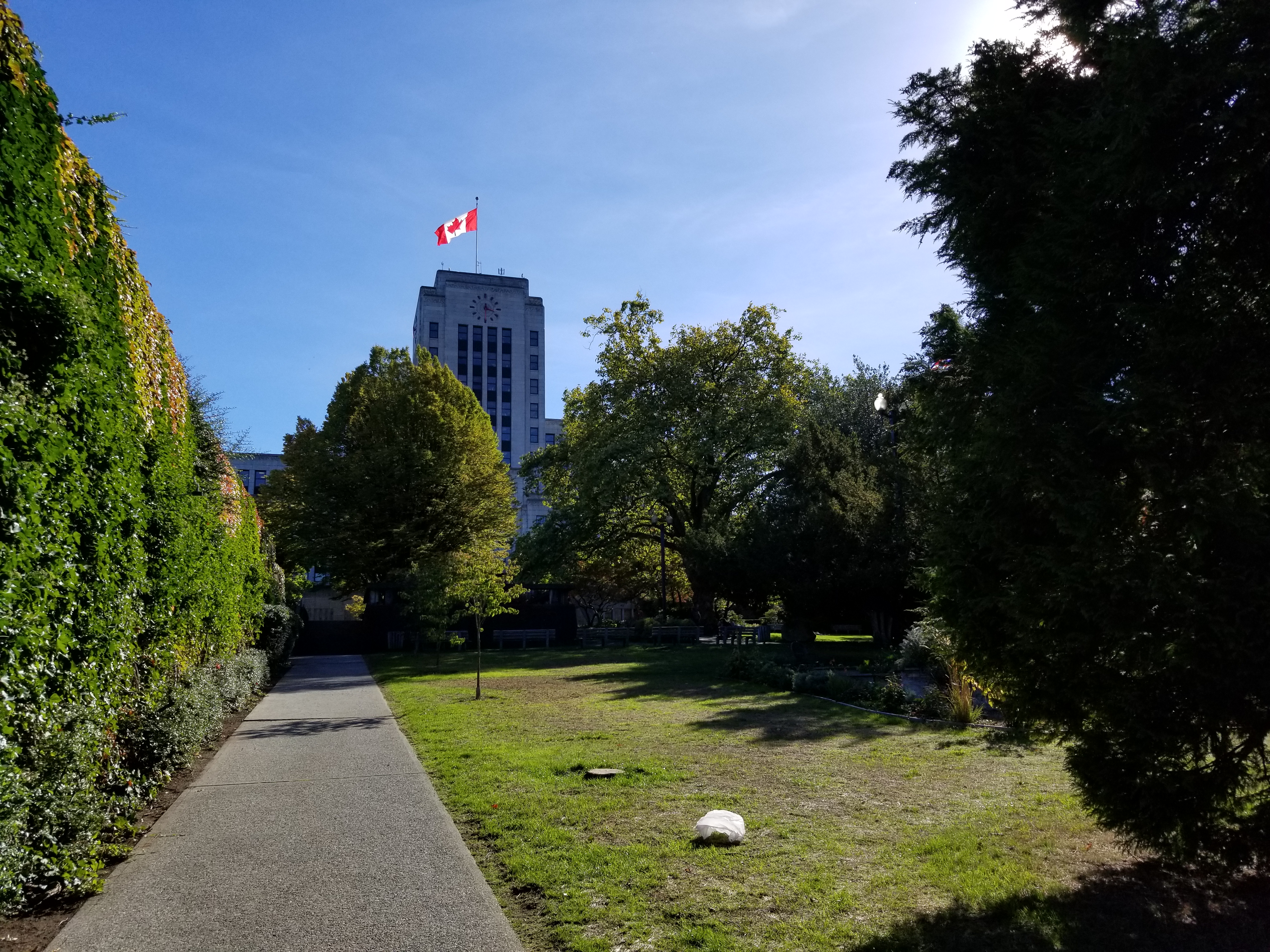
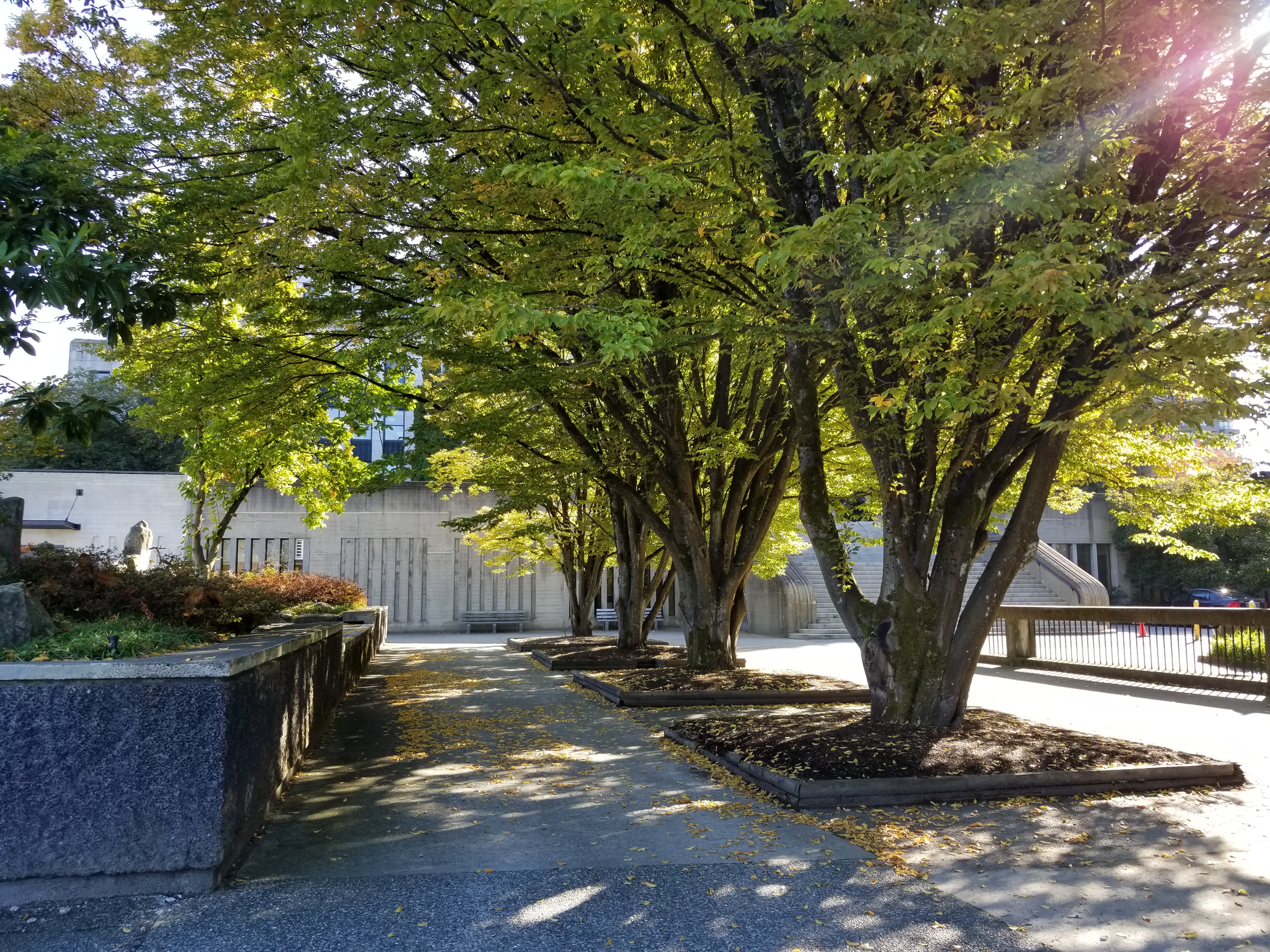
On Broadway in Vancouver. Summer of 2018.

Broadway is a major east-west thoroughfare in the city of Vancouver, British Columbia, Canada. In Vancouver’s numbered avenue grid system, it runs in place of a 9th Avenue, between 8th and 10th. The street has six lanes for most of its course. Portions of the street carry the British Columbia Highway 7 designation.

The route begins as “West Broadway” at the intersection of Wallace Crescent and 8th Avenue, in the affluent residential neighbourhood of West Point Grey, a few kilometres east of the University of British Columbia (UBC). Past Alma Street, Broadway takes over from 10th Avenue as one of Vancouver’s major thoroughfares, as it enters Greek West Broadway (or Greektown) section of Vancouver’s Kitsilano district. East of here are several blocks of generally trendy, upscale shops interspersed with low-rise apartment blocks and small supermarkets. The surrounding neighbourhoods generally consist of large, older homes dating from the early twentieth century, many of which have been subdivided into rental suites.

As Broadway approaches Arbutus Street, the commercial establishments become larger before transitioning into a mix of small to mid-size apartment blocks. East of Burrard Street, the apartment blocks get progressively taller, and commercial establishments larger and busier. Between Burrard and Main Street, Broadway can be considerably congested by vehicular traffic. Past Granville Street, Broadway yields completely to medium-to-large commercial structures and high-rise apartments and condominiums. Between Cambie and Main, the commercial establishments become smaller and somewhat more downscale.

At Ontario Street, two blocks west of Main, the route becomes “East Broadway.” After bisecting Main and Kingsway, traffic on Broadway eases somewhat, and the character returns to a mix of small-to-medium apartment buildings and commercial establishments, interspersed with older homes – all considerably less affluent than those to the west. At Commercial Drive, Broadway passes by the Commercial–Broadway SkyTrain Station. Past here for several blocks, the neighbourhood consists predominantly of older residential homes.

As Broadway travels east of Renfrew Street, the neighbourhood once again becomes mixed, with older homes to the north and larger industrial, commercial, and warehouse establishments to the south. Broadway finally ends at Cassiar Street, just short of the Vancouver-Burnaby boundary, where it becomes the Lougheed Highway.

Broadway was created at the turn of the 20th century, along with other gridded roads south of False Creek, to meet the needs of an expanding population in Vancouver. The name of the route was changed from 9th Avenue to Broadway in 1909, at the behest of merchants around Main Street (at that time the hub of Vancouver commerce), who felt that it bestowed a more cosmopolitan air. Commercial establishments originally spread out around the intersections of Cambie and Main Streets, while the character of the rest of the route remained predominantly single-family dwellings.

By the 1970s, the length of Broadway had become a major arterial route in Vancouver, conveying commuters from downtown to the neighbourhoods of the west and east sides. With the growth of UBC and the expansion of the Vancouver General Hospital (one block south of Broadway between approximately Oak and Cambie), traffic demands accelerated. In the 1990s, the agency then responsible for public transit in Greater Vancouver — BC Transit — introduced an express bus route, the 99 B-Line, to help reduce congestion. The Vancouver transportation plan for Broadway notes that congestion is such that the bus service is at capacity, and will not be eased until a new rapid transit line is built paralleling the street. It is anticipated that the SkyTrain’s Millennium Line will be extended to Central Broadway by 2021; the extension is expected to connect with Canada Line at Broadway-City Hall Station, at the intersection of Broadway and Cambie Street.

The Last of Us (2013)

https://levelskip.com/horror/The-Last-of-Us-2013-Review

The Last of Us, a 2013 survival horror roleplaying video game, is widely considered one of the best video games of this decade. Its developer, Naughty Dog, is known for several other video game franchises, notably Jak and Daxter, Crash Bandicoot, and Uncharted, but they shrivel in comparison to The Last of Us. Reasons for this judgment are plenty; not only is the story line beautifully deep and filled with fascinating verisimilitude, but the characters, gameplay, graphics, soundtrack, and all other features of the game make it an enjoyable, nearly perfect gaming experience.

Summary

The Last of Us is about a man named Joel smuggling a fourteen-year-old girl named Ellie across a post-apocalyptic United States. The world has been overrun by a virus that has turned people into zombie-like creatures dubbed “the infected”, and Ellie may hold the answer to a cure. At first, the two cannot stand each other but as the game progresses, so does their relationship as Ellie reminds Joel of his deceased daughter.

Story

To get right to it, this story is like a novel. In fact, it is often compared to Cormac McCarthy’s The Road. In a review for The Last of Us written for IGN, Colin Moriarty explains:

“The Last of Us is a near-perfect analog for The Road, a literary masterpiece written by Cormac McCarthy. Both present a hopeless, post-apocalyptic situation navigated by two characters – an adult and a child – with nothing but absolute despair surrounding them. Like The Road, The Last of Us is perpetually dangerous and unpredictable, and like The Road, what happened to get society to a point of rapid decay isn’t the focus. It’s the story of the characters at hand, and those characters alone, at the center of both plots. The beauty of The Last of Us when compared to The Road, however, is that it’s fully interactive, complete with all of the vulnerability, uncertainty and perpetual insecurity such a situation inherently provides.”

Clever jump scares balance the heart-wrenching emotional scenes and brutal fights in the game and at the end, the player is left feeling as if they were physically present for the entire experience. It helps that the characters are so dynamic; it is almost as if they are real people that the player is helping through this frightening situation, and the player becomes emotionally attached to them.

Characters

Ellie and Joel are very clearly fictional characters, but they are so realistic it is obvious that a large amount of time was put into their development. The same can be said for even the minor characters in the game; Tess, Marlene, and even Sam are given such fleshed-out personalities that are so realistic they can be attributed to a living person. In her review for Gamespot, Carolyn Petit describes the two main characters well:

“Perhaps nobody knows the dangers of loving others in this uncertain world better than Joel, the protagonist of The Last of Us. A hard, bitter man, Joel isn’t likable, but he is at least understandable, in large part because the dialogue in The Last of Us is so human and believable. And although that humanity comes through in all of the game’s major characters, it’s the teenager Ellie who is the game’s emotional heart. In contrast to Joel’s cynicism, Ellie is still capable of wide-eyed wonder. While Joel seems dead inside, Ellie is very much alive, and over the course of the game, neither Joel, nor you, can avoid growing attached to her.”

Having characters so realistic and so human makes the story that much more emotional for the player.

Gameplay

Gameplay is an important factor when reviewing any game, and The Last of Us handles it well. Choice-based gameplay allows for the player to have a more intense, interactive experience and the controls are basic enough for anyone to pick up a controller and learn to play. There are even choices when fighting; one can choose to sneak up on the infected and strangle them or stab them with a shiv, shoot them with a gun, shoot them with arrows, set them on fire, stun them with bricks, or simply sneak past them and avoid the confrontation completely. Minor puzzles that need to be solved and exploration of the numerous buildings in search of materials and weapons add even more variety to the mix, creating an overall fun and exciting experience.

Graphics

Graphics may not seem like a big deal, but imagine playing a game with a great story line and terrible picture quality. Fortunately, that is not a problem players of The Last of Us have to deal with. The graphics for this game are stunning, and it does not just stop with the characters and close environments. Unlike most roleplaying games, high graphics quality extends as far as the eye can see in any environment the player may be in. Not only does this make the game more realistic, but it makes it a more enjoyable experience; the art is beautiful to match the beautiful story line—and soundtrack.

Soundtrack

As if it is the icing on the cake, the music in The Last of Us (particularly the main theme) can make one emotional when they have not even played the game. The simple, acoustic guitar strums will remind any player of certain intense scenes and fill their heart with feelings of nostalgia and bittersweet sadness. The soundtrack alone can make a player want to replay the game, to experience the story one more time.

The Last of Us is a masterpiece in the video game world. Fans of The Road will find it an enjoyably interactive experience just as emotional as the novel it is often compared to, and will not regret spending their money on this game (or borrowing it from a friend). The Last of Us will rank high on lists for years to come and will forever hold a place in the hearts of players.

Best Neo-Noir Films of the 90s

Neo-noir is a style often seen in modern motion pictures and other forms that prominently utilize elements of film noir, but with updated themes, content, style, visual elements or media that were absent in films noir of the 1940s and 1950s.

40. A Kiss Before Dying (1991) – James Dearden
39. Point Of No Return (1993) – John Badham
38. Unlawful Entry (1992) – Jonathan Kaplan
37. White Sands (1992) – Roger Donaldson
36. Narrow Margin (1990) – Peter Hyams
35. China Moon (1994) – John Bailey
34. Devil In A Blue Dress (1995) – Carl Franklin
33. The Game (1997) – David Fincher
32. Bad Influence (1990) – Curtis Hanson
31. Desperate Hours (1990) – Michael Cimino
30. This World, Then The Fireworks (1997) – Michael Oblowitz
29. New Jack City (1991) – Mario Van Peebles
28. Twilight (1998) – Robert Benton
27. Rush (1991) – Lili Fini Zanuck
26. Payback (1999) – Brian Helgeland
25. Best Laid Plans (1999) – Mike Barker
24. Miami Blues (1990) – George Armitage
23. Blink (1994) – Michael Apted
22. The Spanish Prisoner (1997) – David Mamet
21. State Of Grace (1990) – Phil Joanou
20. Deep Cover (1992) – Bill Duke
19. King Of New York (1990) – Abel Ferrara
18. Mulholland Falls (1996) – Lee Tamahori
17. Lost Highway (1997) – David Lynch
16. The Hot Spot (1990) – Dennis Hopper
15. Basic Instinct (1992) – Paul Verhoeven
14. Red Rock West (1993) – John Dahl
13. A Simple Plan (1998) – Sam Raimi
12. Homicide (1991) – David Mamet
11. One False Move (1992) – Carl Franklin
10. Fight Club (1999) – David Fincher
09. The Last Seduction (1994) – John Dahl
08. The Limey (1999) – Steven Soderbergh
07. Bad Lieutenant (1992) – Abel Ferrara
06. After Dark, My Sweet (1990) – James Foley
05. The Usual Suspects (1995) – Bryan Singer
04. Seven (1995) – David Fincher
03. L.A. Confidential (1997) – Curtis Hanson
02. The Silence Of The Lambs (1991) – Jonathan Demme
01. The Grifters (1990) – Stephen Frears