Animal Group: Mammal Regions: Asia Sub-regions: South-Eastern Asia Countries: Indonesia
The famous Bali tiger is now an extinct subspecies that was found only on the island of Bali in Indonesia. It became the first tiger to go extinct in recent years and one of three subspecies that make up the tigers of Indonesia. Of the three, only the Sumatran tiger remains and it is dangerously close to becoming extinct itself. There was a close relationship between the Bali and Java Tigers which were probably one group until separated at the end of the last ice age when the oceans split apart the islands of Bali and Java. However, given the relatively narrow straits it is certainly possible that the tigers swam across on occasion.
Of the nine known subspecies of tigers, the Bali tier was the smallest and was about the size of a typical cougar or leopard. Males weighed about 200 pounds and were roughly 7 feet in length while females were smaller at roughly 150 pounds and just under 7 feet in length if you include the tail. Sporting short fur that was a dark orange and relatively few stripes, the most distinguishing features was the bar-type patterns on the head of the animal. Their underbellies sported white fur that really stood out more than any other tiger in existence because of their very dark orange fur on top. The curved line of the Bali tiger helped make it appear more graceful than some of its counterparts.
Habitat
Bali tigers lived in the forested areas of the island which limited their movements considerably. Their main sources of food were a number of creatures that lived on the island which included, but not limited to the following: Wild Boar, Rusa Deer, Indian Muntjac, Red Junglefowl, Monitor Lizards and Monkeys.
The Banteng which is also now extinct may have been prey for the tiger as well. The only predator of the tiger was humans who hunted them mostly for sport.
Reason for Extinction
The last known Bali tiger was killed on September 27th, 1937 which was a female. However, it is believed that the species itself lasted for another ten to twenty years after that incident before dying out. Although the Dutch who came to the island during the Colonial period did great destruction to their population due to their hunting methods, the natives on the island also hunted the tiger frequently as it was perceived as a dire threat.
There were a number of separate reasons that led to the extinction of the Bali tiger. The relatively small size of the island combined with the large hunting radius the tiger needed for food was arguably the most pertinent reason. Add to this the increase in human habitation combined with hunting the tiger helped push it to extinction. However, it must be noted that the limited amount of forestation on the island combined with the relative small size meant that the population of the Bali tiger was fairly small even before humans first arrived on the island.
This presentation by Mario Sousa – less than an hour in duration – will change your view of history. “Most sane and educated people accept that there were serious human rights abuses in the Soviet Union, during the Stalin period.” he says. The evidence is ‘everywhere’ – everyone says so, and there’s no smoke without fire, after all. But what is the evidence? And where does it come from?
Not that long ago President Obama said that Russia and President Putin had tried to influence the outcome of our election process and that it was “unacceptable” behavior for a nation to attempt to influence the democratic process of other nations. Forget for a second that his evidence was so laughable that the Department of Homeland Security, the agency that cobbled it together, posted a disclaimer on the first page of the report that said it didn’t stand by a single shred of “proof” in it’s own report:
“this report is provided “as is” for informational purposes only. The Department of Homeland Security (DHS) does not provide any warranties of any kind regarding any information contained within.”
Let’s also forget for a moment the troubling rise of the New McCarthyism in America and the lynch-mob mentality that goes along with it.
Russia did not attempt to influence our election. They did not “hack” the DNC, Hillary Clinton’s illegal private email server nor the email account of the perpetually corrupt John Podesta. Even if they did, which they didn’t, all they did was expose the truth about these three deeply tainted entities. No one has disputed the authenticity of the leaks. They stand as an accurate representation of the level of corruption that exists in the fake left that is the unDemocratic Party of America these days. This is a footnote that gets lost in the discussion far too often these days.
Which leads me to ask one simple question: since when is it considered “unacceptable” behavior to expose the truth about corruption at the highest ranks in the American political system?
Oh, that’s right. President Peace Prize made it a priority to wage war on whistle-blowers throughout the duration of his tenure.
For all the McCarthyite efforts being put forward by the breathless ladder-climbers of the corporate propaganda mills which pass for “news organizations” these days I am often awestruck by those who seem to wish to demand their guests present a kind of American exceptionalism when it comes to comparisons between this fake news story about Russia “hacking” our democracy and the altogether too real history of our State Department and the CIA doing the exact same thing to other countries across the globe. The hypocrisy is simply stunning. And that is when a guest has the audacity to bring up said history, which doesn’t happen very often.
No one can deny our long history of meddling in the political affairs of other countries on behalf of our “national interests” and you even find a few MSM outlets having to address this seemingly sticky bit of trivia every now and again:
“The U.S. has a long history of attempting to influence presidential elections in other countries – it’s done so as many as 81 times between 1946 and 2000, according to a database amassed by political scientist Dov Levin of Carnegie Mellon University.
That number doesn’t include military coups and regime change efforts following the election of candidates the U.S. didn’t like, notably those in Iran, Guatemala and Chile. Nor does it include general assistance with the electoral process, such as election monitoring.” L.A. Times, Dec. 2016
From the State Department to the CIA to NGOs like the National Endowment for Democracy or USAID, I think you would have an easier time listing all the elections in the world since WWII that the U.S. didn’t try to subvert or influence to suit their needs than then ones they did. It doesn’t matter the size of the country or their ranking on the global index of natural resource ownership. Take Haiti for instance. Or Palestine for that matter. They are hardly world leaders in anything, yet both little nations felt the brunt of our “democratization” efforts in ways that are both proven and disastrous to the citizens of those nations. Of that there is no doubt.
But what about Russia?
Now we can go back to the heyday of the neoliberalization of Russia if we want to and some suggest the Russian hacking might just be payback for the good-old Clinton days of spreading “democracy” by infecting various nations with the cancer of Milton Friedman’s “free market” ideology.
“Early 1996 Boris Yeltsin’s approval rate was in the single digits. He had carried out a presidential putsch, started a shambolic war in Chechnya and had helped oligarchs pillage the nation and brought the economy to its knees. July 1996 he was elected president for the second time. How did this happen?
Oh well, it just took one of the most unfair, costliest and most fraudulent election battles in the history of democracy. — All with the complicity of the United States which backed the Russian alcoholic in chief every step of the way (as it had during the ’93 coup) Russian Insider
It is no secret that the U.S.’s man in Moscow was the drunken puppet Boris Yeltsin. We installed him and we instructed him on how to neoliberalize the country, a process that was so entirely detrimental to the Soviet people they wanted to go back to communism before his first term in office was complete. The billionaires and the global bankers liked him though, so we sent some of Milton Friedman’s Chicago Boys and PR spin doctors to the country to help keep him in office. And if you think that quote from Russian Insider is biased and a conspiracy theory, just look up TIME magazine’s July 15th, 1996 cover page for a little more insight. It isn’t a conspiracy theory folks.
You can go back that far if you want, but I figure all we have to do is go back to their last election and see how we tried to influence it on behalf of the same “national interests” our political hacks have served since the beginning of time.
I would like to remind you of Hillary Clinton’s destabilization campaign in Russia circa Nov. 2011 through March 2012 and a little thing called “Pussy Riot”
Now I have written a great deal about these efforts of Hillary’s and I am not going to rehash all of it today. Here are a few choice articles you might want to review in order to get up to date on the REAL history of U.S./Russia democracy interference.
Destabilizing Russia – Clinton State Department Dusts off Color Revolution Model and Threatens Us All Dec. 8th, 2011 Destabilizing Russia – FOX News Caught Using Fake Video Of Riots Dec. 11th, 2011 American Everyman Imperialist War and Political Ticker Dec. 29th, 2011 Russian vs U.S. Elections Dec. 2011 Clinton Pushes For Regime Change Language in Resolution While Her Psyops Surge Feb. 4th, 2012 Russian Election Propaganda Covers Entire Spectrum of News Sources: Landmark Monitoring System Completely Ignored By Western Press March 5th, 2012 Clinton Finally Admits Putin Won the Russian Presidential Election Fair and Square March 8th, 2012
Back in those days Hillary Clinton was doing everything she could to influence the Russian democratic process and that is because Vladimir Putin was extremely popular among Russian citizens at the time. He was the symbol of the new anti-neoliberal revolution that took place once they finally got rid of our puppet Boris Yeltsin and the standard of living for many Russians improved greatly under his leadership. He arrested corrupt oligarchs who, along with their global partners in crime, attempted to fleece the entire country for every penny they could suck out of it while Yeltsin and the Chicago Boys ran the government.
Understanding that the parliamentary elections and the presidential elections were right around the corner, our NGOs started funding color revolution type destabilization campaigns (like Pussy Riot for starters) and Hillary installed a color revolution specialist as our ambassador to Russia (Michael Anthony McFaul)
“Want to know why so many Russians hated Boris Nemtsov? Here’s a video of him paying a visit on U.S. Ambassador to Russia, Michael Anthony McFaul, just after McFaul took office back in 2012. It’s well understood here and in Russia, that McFaul’s task was to attempt to instigate a color revolution in Russia from day one.
“Most Russia-watchers are diplomats, or specialists on security and arms control. Or Russian culture. I am neither. I can’t recite Pushkin by heart. I am a specialist in democracy, anti-dictatorial movements, and revolutions” (emphasis added). Michael Anthony McFaul
“(Hillary) Clinton noted that McFaul, who is a specialist in democratic transition – a Kommersant headline from January 11 touted him as a “color revolution specialist” – is uniquely suited for his new post, given Russia’s current climate.” Russia Profile
So in comes the color revolution specialist and one of the first to meet and greet the neoliberal scum, is Boris Nemtsov. Go figure.” Scott Creighton, March 1, 2015
Sending regime change specialists into targeted nations as our ambassadors was standard operating procedure for Hillary Clinton. She did it with Russia. She did it with Robert Ford in Syria in Dec. of 2010 just before the color revolution started over there. And she had a hand in selection Geoffrey R. Pyatt to take office in 2013 after she left the State Department. Soon after he took over, he started meeting with opposition leaders and the Ukraine color revolution was underway in Jan. of 2014.
This is what Clinton called “smart power”: going into various nations who don’t bow down to our “national interests” and getting some of the most deplorable, degenerate, out-of-power opposition leaders you can find to sign onto your regime change plan in exchange for a promise of future control. Future control under your thumb of course. Kinda like Boris Yeltsin.
In April of 2015 a Russian Federation council member explained it this way:
“Extremism is used as a geopolitical instrument, for reshaping the spheres of influence, overthrowing regimes undesirable for some countries by the means of organizing ‘color revolutions’,” Matviyenko said. “The West makes attempts to organize them [‘color revolutions’] in Russia as well,” she added. These efforts are directed at “discrediting the authorities and destabilizing the situation in Russia, and using both extremist elements and opposition for that,” the speaker noted.” TASS News
Smart power. Hiring terrorists and extremists to do the dirty work, the wet work, of overthrowing your enemies. Libya, Egypt, Syria, Thailand, Yugoslavia, Ukraine… all examples of “smart power” I suppose.
In the end, Hillary failed in Russia just like Obama has finally failed in Syria. She didn’t bring in the jackals though, like she did in Libya and Obama did in Syria. Russia is a nuclear state after all. More care must be taken in such circumstances. That’s one of the reasons they hired the Pussy Riot destabilization roadshow, called Proxy Poseurs by another writer a couple years ago.
Pussy Riot was perhaps the dumbest, most sophomoric bullshit destabilization psyop to ever get hatched by the neoliberal think-tanks that think they run the world. It was absolutely infantile in it’s conception and beyond pedestrian in it’s performance.
Protection Against Toxic EMF Damage – Smart Meter Covers
I wrote about their staged “beatings” scenes repeatedly in the run-up to the Russian elections. The fingerprints of George Soros and his ilk were all over it like those of a drunken uncle on his nieces underwear.
On February 20th, not even a month ago, I wrote about a poorly scripted and badly staged street-theater performance in Sochi performed by the Western backed agitation operation known as “Pussy Riot™ ”
Their hasty little performance was designed to demonize Russia under Putin since we all know, Russia under the neoliberal drunkard puppet Yeltsin was such a better place for the oligarchs and the international bankers.
It involved members of the “band” (if you wish to call them that) setting up under a Sochi Olympics sign in a parking lot and immediately being attacked by actors wearing what is supposed to look like Russian military or police uniforms.
The video was such a joke, it reminded me of that “news story” CNN did during the Gulf War where two reporters in a studio pretended to be reporting live from a hotel as scud missiles rained down on their heads. The first Pussy Riot™ video is almost as bad.
The latest Pussy Riot™ beating video is actually worse.” Scott Creighton, March 2014
For a broader understanding of the nature of our efforts to undermine democracy in Russia during those months, read the following:
Today’s Ridiculous Pro-Regime Change Propaganda – What’s Old is New Again “Pussy Riot” is re-Branding – Will Form “Human Rights” Group (a.k.a. “destabilization NGO”) Pro-Putin Rally Lambasts ‘Orange Trash’
With a recorded and unquestionable history like this, one could hardly blame Russia for trying to influence a U.S. election in which Hillary Clinton seemed to be the shoe-in candidate chosen by our own oligarchs. Turn about is fair play after all.
But they didn’t. Or at least, no one has presented a single shred of credible evidence to suggest they did at this point.
And after all, when you think about it, all someone really did was expose just how unqualified Hillary Clinton was for office. I mean it wasn’t like they hired a band of untalented misfit hookers to show their private parts in a church or something and then promote a global campaign against the outrage of them being arrested for doing so.
Whoever did it (my guess is a leaker from within and perhaps a branch of the CIA or even the NSA who were pissed off about the “Snowden” psyop?) simply told the truth, which I guess is a revolutionary idea these days and a treasonous one.
American exceptionalism aside, it is never acceptable when nations attempt to influence the democratic process of other countries though that has been the staple of our State Department’s diet since day one. And I know that it is all the rage these days to hate on Russia in both venues of the One Party System we laughingly call a democracy these days but I still cannot seem to get on board with that kind of bandwagon thinking.
No. Russia did not hack our democracy or attempt to thwart it like Hillary Clinton did back in 2012 to them. They didn’t have to. Hillary sucked so bad on her own, all they had to do was sit back and laugh and that probably pissed them off more than anything else.
Nadalia is a child of dark, one of the abyss spawn, a compounded quintessence of Manus and his Dark Soul. Like her sisters; Nashandra, Elana and Alsanna, Nadalia is a fragment of Manus’ emotions. She represents solitude and loneliness. Also like her sisters, Nadalia travelled from a foreign land in search of a King. She came to the land of the Old Iron King, but arrived too late, the King had already been killed and his castle subsumed by flame.
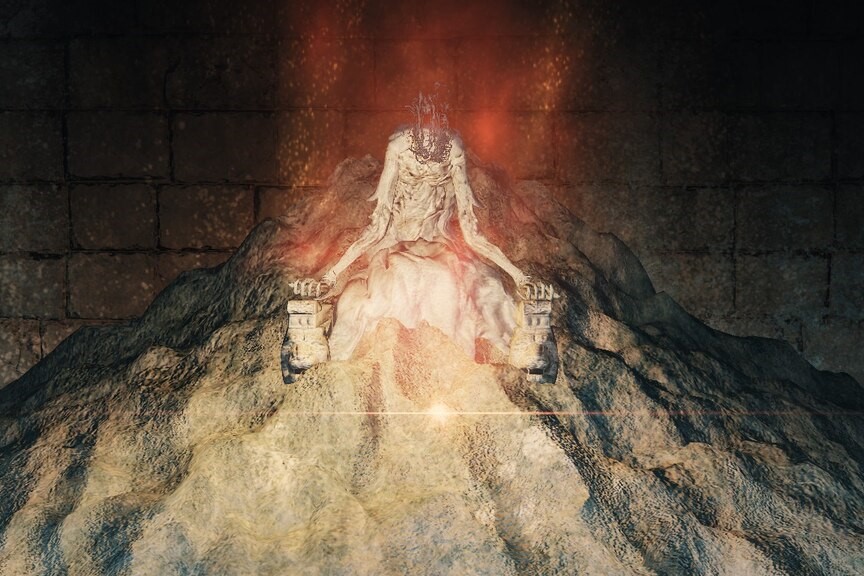
Nadalia entered the Old Iron King’s tower, the seat of his power and wandered its halls seeking her King. She came to the bottom of the tower, shaped like a gigantic kiln. She found the Old Iron King’s crown and his death was confirmed to her. Upon finding the land kingless, it is said Nadalia renounced her flesh. In the act of dancing, Nadalia was transfigured as smoke. It seems that her physical body was burnt up and that her actual being became smoke, fog and ash that infused the tower. Upon defeating the Fume Knight the remnants of her body can be found at the base of the Brume Tower, hunched over and ash-like. From this we can take it that she burned herself to death, in the act of dancing, the Bride of Ash was transfigured as smoke. The act of dancing is a metaphor for being burned alive. The same metaphor is used for the Pyromancy Dance of Fire where it says: “The fire seems to dance, and makes its victims dance with it.” So we can guess that she was burned alive in the chair we find her in, clutching the crown of the old iron king (note the theories section on why Nadalia might have done this – taken from Pariahdigm Shift’s youtube channel)
Having forsaken her flesh, Nadalia’s smoke enticed people to the Tower and it became known as Brume Tower which means “mist or fog”. Perhaps opportunists saw the tower’s smoke and presumed it was burning or had fallen, making it a beacon to the brave adventurers seeking to tap the replete stores of iron. But upon arriving at Brume Tower, all but the most steadfast were defeated, and their corpses were reanimated by the black fog, or left as ashen husks. The black fog of the tower brought the tower to life. Its statues became possessed and attacked any intruder, the soldiers of the Old Iron King were resurrected as defenders and the Ashen Idols began to appear.
The Ashen Idols were statues made of ash. Nadalia, having renounced her flesh, entrusted her soul to these statues and it was through them that she was able to defend the tower. Approach of these statues yields different results, some fill the area with pillars of black fire, enhance the strength of the defenders and some heal the defenders. The Idols resemble Nadalia, but often have 4 or more arms. They can only be destroyed by driving a smelter wedge into the heart, a process that splits the Soul of Nadalia from the Ashen Idol. It is interesting to note that the wedges are made of smeltered iron, as if the only means to the Bride of Ash’s heart was found in the iron the Old Iron King was so notorious for.
After some time it seems, a knight of Drangleic called Raime came to the tower. Raime was one of King Vendrick’s most trusted and powerful knights. He is described as an agile swordsman, who after his defeat at the hands of Velstadt, resigned his post and was considered a traitor. Raime came to Brume Tower in search of greater strength. When he arrived at the tower, he became infatuated with Nadalia, the Bride of Ash. Instead of choosing to expunge her from the tower as he could have done (most likely by destroying her Ashen Idols as we do), Raime chose to live alongside Nadalia and support her efforts. He became her champion of the Dark. It may have been that when he left Vendrick, Raime sought greater strength in which to defeat Velstadt, but upon becoming infatuated with Nadalia, he found a new purpose in life.
What Nadalia’s purpose is in the tower is unclear. It seems that the Sisters of Dark all seek power, and try to gather as many souls as possible. Alsanna may be an exception to this, but we know that both Nashandra and Elana seek power. Nashandra seeks the great soul that is strong enough to power the Throne of Want and Elana gathers souls in anticipation of revenge. Nadalia too may have transfigured herself for the purpose of drawing those with powerful souls to the tower, in hopes of collecting those souls. Alternatively, Nadalia is known as the augur of solitude, and perhaps she simply sought to be alone, which is a theory that does not account for the presence of Raime. Or perhaps Nadalia awaits her King and more specifically the Old Iron King. When we first destroy an Ashen Idol we hear some dialogue from Nadalia indicating that she may have us confused with the Old Iron King. To gain access to Brume Tower, one must defeat the Old Iron King so it may be that Nadalia senses that soul upon us or that we have gained it at some point and believes us to be the Old Iron King. But whatever the case, we are told that Nadalia condemned herself to a fate most wretched.
Marx Avenue (Russian: Проспект Маркса) is a highway in the center of Moscow, named after Karl Marx, that existed from 1961 to 1990. The avenue had a curved shape and went around the Kremlin from Dzerzhinsky (Lubyanskaya) Square to Borovitskaya Square. It was made up of three historical streets: Teatralny Proyezd, Okhotny Ryad and Mokhovaya Street. In the late 1970s and early 1980s, the General Plan for the Development of Moscow provided for the connection of Marx Avenue with the Ostankino Television Center by building a high-speed highway with the conditional name “Northern Ray”. It was planned to include Neglinnaya Street, Tsvetnoy Boulevard, Soviet Army Street and Sheremetyevskaya Street into the highway. The project was not implemented.
I keep on thinking that my next post will be a list of my favorite anime, but I keep on making posts about something else instead. It seems that whenever I begin to write about something, it’s not easy for me to stop. This post too will be about something else. Since many of my followers follow my channel and my blog because of my videos and posts about history and sociology, some of them want me to post something about current events. Well, since I haven’t posted anything about current events for a while, I might as well do so now. The Canada convoy protest took place at the beginning of 2022, but some people still want to know what I think about it. I wasn’t keeping track of this protest, but I do know some of what happened in Ottawa. I have a few things to say about this so-called Freedom Convoy. This protest was simply a reaction to the mandates and the restrictions that got introduced in the country. In Canada, like in other Western states, capital and the government work together. Actually, I can even say that the government works for capital. Therefore, the mandates were enforced by the government and by businesses, especially by big business. As some people have said, COVID-19, the disease itself, is an artificial creation. The virus was probably created at the Lugar Research Center in Georgia, which is an American client state. The disease had been taken advantage of by Western oligarchs and by the World Economic Forum. Andrei Fursov, for example, made an hour-long program in which he talked about the WEF and about Klaus Schwab’s books. Before that, when the lockdowns got introduced, Fursov said that when an economic crisis appears in the capitalist system, capitalists usually attempt to organize a big war because wars result in population loss, in economic and social disruption, and then in economic recovery. But, nowadays, with all of the nuclear weapons that exist in the world, a big war would lead to catastrophes and even to the possibility that the instigators will be judged and executed. The virus and the lockdowns, according to Fursov, are solving some of the problems that a big war solves. The virus didn’t kill a large percentage of the population in Western countries because it wasn’t designed to be very deadly, but, together with the lockdowns and the so-called vaccines, it still caused some people to die. One of the big objectives for Western oligarchs in the last several decades has been population reduction, or at least a fall in the birth rate. It’s a typical oligarchical policy. Economic growth in Western states has been slowing down for the last several decades, but the population has continued to grow. And people without jobs or good prospects rebel. The larger the number of such people, the more dangerous they become for the establishment. So-called female empowerment, the promotion of gay relationships and marriage, and various distractions do have an effect, but they can’t lead to a big fall in the birth rate. Well, COVID-19 had been useful for the oligarchy in this respect. It didn’t cause a large number of deaths, but it still caused some deaths and it disrupted the economies of Western countries. There are reports pointing out that some rich people got even wealthier during the pandemic. Perhaps in the future a deadlier virus will be released. But it’s clear that the oligarchs don’t want to go that far yet. Anyway, since opposition to the mandates and to the restrictions in Western countries was mild and ineffective, nothing was changing and tougher mandates were being introduced. Fursov said that the people in the West, especially in Western Europe, have become so fearful and so obedient that he didn’t expect for any serious resistance to take place. In the last several months, Fursov also had a few tough words to say about people in the West. He said that if these people are told to get jabbed, they will get jabbed, and, if they’re told to hate Russians, they will hate Russians. He called them walking stomachs. Perhaps this means that he thinks of them as brainless. Leftist parties, at least the ones that still exist, didn’t do anything because, since the fall of the Soviet Union, they’ve been broken up, rendered innocuous, or completely demoralized by the establishment. Therefore, the task of resisting fell to some good old boys, like some of the truck drivers. Obviously, these people aren’t affected by the torrent of anti-leftist and anti-communist lies and propaganda, and they had the bravery and the resolve to travel to the capital and to make themselves heard, at least after they realized that their agitations on websites like Twitter have little or no effect. The authorities in Canada attempted to paint them as right-wing extremists, but they were only holding a peaceful protest. Eventually, there was a crackdown and the protesters got dispersed. Still, results were achieved. The Freedom Convoy and the peaceful protests that were taking place in other Western countries at the same time convinced the authorities and the WEF that it’s time to cancel the mandates and the restrictions in order to prevent more protests and unrest. The Canada convoy protest didn’t interest me much. I wasn’t for or against the protest. When the mandates and the restrictions were being enforced, they didn’t affect me much. But I’m glad that some of them got abolished because, after some time, they could have affected me in a serious and harmful way. Soon after the operation that’s called the COVID-19 pandemic came to an end, the war in Ukraine began. This war allowed the Western establishment to quickly shift focus to something else and to make many people forget about the virus and the hardships that were created because of it. The war in Ukraine has gone on pretty much the way I expected it to go. The Russians have had some successes, though probably not as many successes as they had hoped for. So far, the Russians have been successful in driving the Ukrainian Ground Forces and the Ukrainian Nazis out of the south-eastern provinces that had been under attack. These provinces are actually still under attack because the Ukrainians continue to fire missiles at the urban areas of these provinces, thus killing more people. The anti-Russian regime in Kiev, with Volodymyr Zelenskyy at the head, hasn’t given up because it receives military support, financial support, and intelligence support from the USA and from other NATO members. Because of this, the Ukrainian government and the armed forces have held out and have continued to resist the Russians. The Russians, of course, haven’t captured Kiev, and this is the big reason why the anti-Russian regime in Kiev has continued to resist. Perhaps it was never Vladimir Putin’s intention to capture Kiev. There was an offensive toward Kiev by the Russians at the beginning of the special military operation, as Putin has called the intervention, but the Russians pulled back not long after they got close to Kiev and began to focus only on liberating the south-eastern provinces. Perhaps the offensive toward Kiev was carried out in order to shock the Ukrainian government and the armed forces or perhaps it was carried out in order to pummel the Ukrainian armed forces in the north of Ukraine and to divert them from the south-eastern provinces. Or did the Russians really intend to capture Kiev but then pulled back after incurring unwanted losses? I don’t really know yet. Whatever the reason was, this offensive toward Kiev allowed the Western media (propaganda apparatus) to portray the Russian intervention as a real invasion and conquest of Ukraine by the Russians at the beginning of the intervention. The Russians probably never intended to capture Kiev because they wanted to avoid serious street fighting and because it was never their intention to conquer Ukraine. Frankly, I never thought that the Russians would be able to conquer Ukraine even if they had attempted to do so. The Russian Federation, which is pretty much a banana republic, still has little or no effective offensive power. Ukraine is also a banana republic, but at least it’s getting support from the West. It’s pretty obvious that Putin wants to continue to please the Europeans, especially the Germans, because they’re the big buyers of Russian raw materials, and these raw materials are very important because they’re the only large source of income for the Russian state and for Russian oligarchs. This is why Russian propaganda always features reports about the Russian gas pipelines to Europe and about Russian oil and gas exports. The Russians have almost nothing else to export. Therefore, the few interventions that Putin has conducted so far, his reactions to American imperialism and encroachment, have been limited and short. I think that he doesn’t want to conquer Ukraine because he doesn’t want to bring irreparable damage to Russian relations with the Europeans. At this time, and for the foreseeable future, he wants to continue to profit from Russian raw material exports to Europe. Therefore, he doesn’t want to be seen as a conqueror and as a real threat to the European Union. Of course, there’s also the fact that Russia is an oligarchical state that isn’t capable of conquering all of Ukraine and of holding on to it. But Putin couldn’t simply ignore the plight of the Russians that live in the south-eastern provinces of Ukraine. Accordingly, he launched his “special military operation” in February of 2022. I think that this operation hasn’t gone as well as he had hoped. David Petraeus, who has provided his analysis of the conflict, his hopes, and his deceptions, has pointed out that the Russians have lost more soldiers in the few months of fighting in Ukraine than the Soviets lost in the ten years of fighting in Afghanistan. I’d say that the losses of the Russians in Ukraine haven’t been massive. For example, the Soviets lost about 80,000 soldiers in the Battle of Berlin alone. Still, for a sickly, right-wing oligarchical state such as the Russian Federation, the losses have been heavy. The losses for Ukraine have been heavy too, but the Ukrainians have done a better job of mobilizing their forces and they’re fighting on home soil. Therefore, in September of 2022, Putin announced a partial mobilization. As some people have said, this is something that he didn’t want to do. This mobilization has produced a predictable reaction from the Russian masses. The Russians have begun doing what they do best, which is to surrender or to run away. It seems that many men in Russia began running to neighboring countries in order to evade the mobilization. After the Soviet Union collapsed, Russians have lost faith in the government and in the army, for obvious reasons. The new regime carried out many disastrous policies, and things haven’t improved much after Putin came to power. Naturally, the people in Russia are demoralized and they have little or no faith in the Russian authorities. Of course, Russians also don’t want to get killed or captured in Ukraine, where the Ukrainians engage in torture and in humiliating prisoners of war. Even before all of this happened, however, there were reports of thousands of wealthy Russians and Russian cultural figures fleeing Russia for the West, for Israel, and for other states when the intervention in Ukraine began. Many of these people disseminated anti-Soviet and anti-communist lies and propaganda, and they were pretty much pro-Western Russophobes that used to work and often live in Russia. The fact that there were many of them in Russia, the fact that many of them are famous, and the fact that many of them held high posts in Russia show what a sickly state Russia is. And the ones that have been able to flee Russia so far are only a portion of the pro-Western Russophobes that live in Russia. I wouldn’t go quite as far as to call the Russian Federation a basket case (or maybe I would), but it’s clear that there are many traitors and potential traitors in the country. The education system in Russia is bad, there is widespread poverty and misery, there is widespread corruption, there are widespread diseases, there is widespread alcoholism, Western culture and products are promoted and supported in Russia, Soviet culture and history are demonized, and the Russian economy is in the toilet, as some American “analysts” would say. And these are only some of the serious problems that exist in the Russian Federation. Well, what I’m getting at is that the poor performance of the Russian armed forces in Ukraine and the problems within Russia itself didn’t come as a surprise to me. Still, the intervention in Ukraine hasn’t been a complete failure so far. The Russians have at least succeeded in liberating the south-eastern provinces of Ukraine, where the Russians have been aided by local separatists. I think that Putin’s big mistake has been to use nationalism in order to rally the Russian masses. He should have used something more effective, like McDonald’s or The Coca-Cola Company, which are companies that have been operating in Russia since the very beginning of the 1990s. Russians would never fight and die for their country, especially for an embarrassing country that’s only thirty years old. Russians would, however, fight and die for a McDonald’s Big Mac, for a bottle of Coca-Cola, or for a Louis Vuitton bag. In fact, the flag of the Russian Federation should have featured a McDonald’s Big Mac, a Coca-Cola bottle, or Boris Yeltsin’s drunken face in the center. This would have been a flag that the Russians could have rallied behind. Unfortunately for Putin, these and many other Western companies have pulled out of Russia soon after the conflict in Ukraine began. I guess that all of that extensive privatization and all those attempts to favor Western companies haven’t worked out well. I didn’t plan on making another post about the conflict in Ukraine. This is something that I didn’t really want to do. However, I recently spent several hours on watching American news reports and interviews. This is unusual because I almost never watch the news. I was definitely entertained. The Americans sound hopeful now because they think that Putin has bitten off more than he can chew. A few of them even say that the recent failures of the Russians in Ukraine will eventually lead to the fall of Putin. Well, I don’t know about that. But the Americans certainly shouldn’t soften their offensive at this critical time. It seems that they realize this because they recently got Luke Skywalker to talk to Zelenskyy and to voice his support for the Ukrainian president. That’s good, but I personally would have preferred to see Optimus Prime talk to Zelenskyy and voice his support. Well, maybe Optimus Prime isn’t available at this time. However, Luke Skywalker shouldn’t stop after only one brief talk. He should repeat what he did in the good old days, when he destroyed the Death Star and vanquished the evil Galactic Empire. He should get in a TIE fighter and lead a squadron of TIE fighters piloted by Ukrainian Nazis all the way to the Kremlin in Moscow. Then he should open fire and blast the evil Putin right out of the Kremlin. Then he should land his TIE fighter near the Boris Yeltsin Presidential Center, where a crowd of pro-Western Russian neoliberals and Western news reporters will be waiting for him, and receive yet another medal for his heroism. I know that Luke is old now, but I’m sure that he’s capable of accomplishing such a mission. After all, he does have the Force on his side.
Ibn Rushd (Averroes) is considered as the most important of the Islamic philosophers. He set out to integrate Aristotelian philosophy with Islamic thought. A common theme throughout his writings is that there is no incompatibility between religion and philosophy when both are properly understood. His contributions to philosophy took many forms, ranging from his detailed commentaries on Aristotle, his defence of philosophy against the attacks of those who condemned it as contrary to Islam and his construction of a form of Aristotelianism which cleansed it of Neoplatonic influences. This short article outlines the main features of his life, thought and influence.
IBN RUSHD, abû ‘l-Walîd Muhammad ibn Ahmad, known as AVERROES, born in 1126 in Cordoba – died december 10, 1198 in Marrakech.
Biographical outline
Ibn Rushd was a philosopher, physician and Islamic jurist of Muslim Spain. He spent a great part of his life as a judge and physician in Morocco and in the Andalus. He is also celebrated in medieval and Renaissance Europe for his commentaries on Aristotle and for his influence on the European medieval philosophy. Born into a family of prominent judges, he studied religious law, medicine, mathematics, and philosophy. In 1153 he was in Marrakech engaged in astronomical observations. Ten years later, the philosopher Ibn Tufayl (Abubacer) recommended him to the Almohad ruler, Abû Ya’qûb Yûsuf, who was seeking someone to write commentaries on Aristotle’s works. In the ensuing years he occupied the office of chief judge in Seville, then in Cordoba. In 1182 he was attached to the Almohad court in Marrakech as chief physician. He served Abû Ya’qûb until the latter’s death in 1184, and his son and successor, Ya’qûb al-Mansûr. Sometime after 1195, mainly for reasons of political opposition of some oppnonent scholars to Ibn Rushd, he fell out of favor with his patron and was exiled. He was reinstated, however, soon after and resumed his service in the court until his death.
His corpus
A significative part of Ibn Rushd’s output consists in his commentaries on Aristotle. Besides the extant Arabic versions of these works, several of those writings have survived only in Latin or Hebrew translations after the loss of the original Arabic versions. The commentaries can be classified in three types: a short epitome or paraphrase (jâmi’) which presents just a summary of the subject; the middle commentary (talkhîs), an interpretive exposition, often including considerable expansions on the original, and finally the large or major commentary (tafsîr), where the original text is quoted and commented on sectionally. This monumental task of philosophical exegesis range over Aristotle’s entire corpus, including logic, natural philosophy, metaphysics, psychology, and other works. For some texts Ibn Rushd wrote all three types of commentaries; for others two or one. The exhaustively detailed study was applied only to the Posterior Analytics, Physics, The Heavens, The Soul and Metaphysics.
Ibn Rushd’s writings in medicine and astronomy shape his scientific contribution. His views in astronomy are exposed in his commentaries on Aristotle’s Heavens, in the epitome of Ptolemy’s Almagest (Mukhtasar al-majistî), and in a treatise on the motion of the sphere, Kitâb fî-harakat al-falak. The former was translated into Latin whereas the latter survived only in a Hebrew translation. The Mukhtasar displays an early version of Ibn Rushd’s project of a radical reform of Ptolemaic astronomy. But until a new astronomy is elaborated, he is resigned to follow the theory upon which the “experts of the art” do not disagree. Proceeding from the works of his predecessors, especially Ibn al-Haytham and Jâbir ibn Aflah, he denounced the non-scientific character of the Ptolemaic system with respect to the Aristotelian doctrine and raised objections against the hypotheses of eccentrics and epicycles.
Since the early XIIth-century, criticisms were leveled in the Andalus by the philosophers Ibn Bâja and Ibn Tufayl against Ptolemy’s theories. Ibn Rushd took up these objections and formulated the program of a new astronomy based on Aristotelian principles. His program was realized by the astronomer al-Bitrûjî (Alpetragius), who represented the heavens exclusively by nested homocentric spheres and perfect uniform circular motions around the Earth. However, his model was completely useless from a mathematical point of view, and it was neither numerically verifiable nor could it be used for predicting planetary positions.
Ibn Rushd’s medical production includes commentaries on some of Galen’s and Ibn Sînâ’s works, a treatise On Theriac, and a major medical work, Kitâb al-Kulliyyât (Book of Generalities), well known in its Latin version as the Colliget. The structure of the treatise was organized so as to produce a compendium of the art of medicine which would form a vital basis of knowledge acting as a springboard for more detailed investigations, and an aide-mémoire for those already versed in the subject. The text is oriented by the idea considering that in the field of medicine general truths lie beyond those gathered by observation, in the linking up of phenomena with their causes. As it is stated in Book I, the medicine reposes on demonstrations founded in natural philosophy, challenging the kind of medicine which is centered entirely on results. But when it comes to the treatment, the author founds his remedies on an inductive approach based on observing the effects of medicines.
Defence of philosophy
The philosophical works of Ibn Rushd relate mainly to the defense of philosophy against the severe attack of the scholar Al-Ghazâlî (Algazel, d. 1111). They include Tahâfut al-Tahâfut (The Incoherence of the incoherence), a systematic response to al-Ghazâlî, and three closely related texts: Fasl al-maqâl (The decisive treatise), a defense of philosophy in terms of Islamic legal categories, al-Kashf ‘an manâhij al-adilla (Exposition of the methods of proof), presenting a theological system based on the interpretation of scriptural language, and al-Dhamîma (Appendix), a short tract where it is argued that the philosophers do not deny God knowledge of particulars.
Ibn Rushd did not present his philosophy as a system. His philosophical doctrine has to be reconstructed from his numerous works. This doctrine is rich and multifaceted enough to be summarized easily. A survey of two emblematic themes, his causal theory and his thesis of the relation of religion to philosophy, shall provide an idea on his practice of theoretical discourse.
Ibn Rushd developed his causal theory against al-Ghazâlî’s occasionalist doctrine embodied in the latter’s denial of necessary causal connection in nature. Al-Ghazâlî had claimed indeed that the world order has no inherent necessity, and the uniformity of nature is only a habit (‘âda) arbitrarily decreed by God who can disrupt it at will. In contrast to this occasionalist account, Ibn Rushd relies on a central metaphysical argument based on his concept of real essence, which intimately relates essence to causal action. Things, he maintains, “have essences and attributes that determine the specific action of each existent and by virtue of which the essences, names and definitions of things are differentiated.” If this were not the case, then all the existents would either become one existent or cease to exist altogether. For, if it is one, the question arises as to whether such an existent has or does not have a specific act (for example, whether or not fire has the specific act of burning). If the answer is that it has, then the existence of a specific act proceeding from a specific nature is acknowledged. If the answer is that it does not, then “the one is no longer one. But if the nature of oneness is removed, the nature of existence is removed and the necessary consequence is nonexistence.” For al-Ghazâlî, it is possible for fire to contact cotton without burning it. Ibn Rushd answers that this can happen only when there is an impediment, but this does not deprive fire of having the property of conflagration “so long as it retains the name and definition of fire.” Fire, to be fire, must have the property of burning something. A denial of this is not only a denial of objective truth, but a violation of the normal way we name things and speak about them.
Another important concern of Ibn Rushd was to prove the harmony between philosophy and religion, and hence to build a specific defense of philosophy. Al-Ghazâlî not only endeavored to refute the Islamic philosophers logically, but condemned them as infidels for affirming the world’s eternity, for their denial that God knows terrestrial particulars, and for their denial of bodily resurrection. The charge of infidelity was a serious one in terms of Islamic law. It was also a challenge to the deeply religious commitment of Ibn Rushd. In several of his writings, he defends the philosophers against the charge of infidelity. He begins by raising a more general question, namely, whether Islamic religious law allows or prohibits the study of philosophy. Basing himself on certain Qur’ânic statements, he argues that the study of philosophy is allowed, for philosophy is the proper study of nature that leads to the proof of the existence of God.
In Fasl al-maqâl, Ibn Rushd formulates a conception of philosophy which was in accordance with the Islamic teachings as it was considered as a rational view of creation which leads to the knowledge of the Creator. Thus formulated, philosophy becomes a valid path for discovery of truth which is also to be found in revealed texts. Because different individuals have different levels of comprehension, God speaks to humans through three kinds of discourses: dialectical, rhetorical and demonstrative syllogism.
The distinction between three levels of discourse and of the audiences to which they are addressed is an important device in Ibn Rushd’s attempt to contextualise philosophy in the Islamic environment. Hence, the philosophy can be practiced only by the demonstrative class, the members of which possess a specific capacity and training. The two other classes are capable of reasoning only on the dialectical or rhetorical levels. The scriptural statements are also divided into three classes: those that must be accepted liter¬ally because they have clear and unam¬biguous intent, those that should not be taken literally, and error in their metaphorical understanding or in their interpretation is permissible; finally, a class of statements that must be interpreted by each class according to its intellectual capacity. Error here again is permissible. It is within the framework of this theory of interpretation that Ibn Rushd defends the Islamic philosophers against the charge of infidelity. Their condemned doctrines relate to scriptural statements where error in interpretation is permissible. Furthermore, in practical matters, it is the consensus of the Muslim community that rules on whether or not an act constitutes infidelity. On this basis, Ibn Rushd shows that consensus in matters of theoretical belief is impossible.
Influence
Despite his philosophical achievements, Islamic philosophy of the sort Ibn Rushd practiced did not survive after him. Actually, he did not have any significant Muslim disciple. In the world of Islam, his books were largely ignored, and several of his writings disappeared in their Arabic original versions. Fortunately, interest in his thought remained vivace among Jews and Christians, to the languages of whom his works were translated. By this way, his philosophical works as well as his commentaries on Aristotle were read all along the European middle ages and the Renaissance. As a result, a philosophical doctrine, known as the Averroism, emerged among his Latin and Hebrew followers.
Assassin’s Creed Origins has just been unveiled, and it looks awesome. Join us at a brief look back into the Assassins Creed franchise and Ubisoft today.





 Igor's Blog