
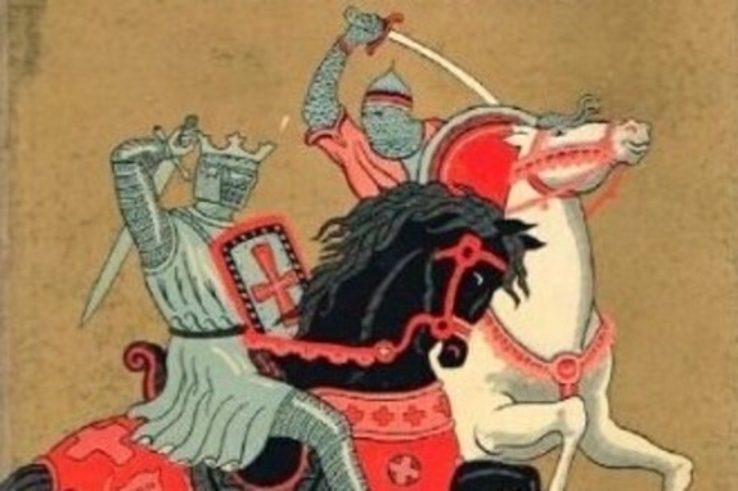
Harold Lamb perfectly contrasts the Islamic society of medieval times against that of the Europeans amidst the Crusades. He manages to bring out the best of both worlds at a time when they clashed violently for the control of the Holy Land. His portrayal of both sides is fair and just; I highly recommend this book to anyone seeking to expand their knowledge of this era.
The Crusades of the Middle East may not have lasted for more than two centuries but the fictionalization of events and distortion of facts to prove one’s side right and the other’s wrong, continued for centuries later and is even seen in modern times. Amidst such confusion and chaos, Harold Lamb’s two-volume masterpiece on the Crusades is a welcome relief for those who yearn for as accurate a picture as possible. He used information from both Muslim and Christian sources in order to present as complete a narrative as the resources at hand allowed him to.
So gripping is Lamb’s reconstruction of the ancient times that even though I initially only wanted to go through the segments describing Saladin’s exploits, as I traversed through the pages of this uncharted odyssey, I failed to keep myself from reading on until the book shook me off with “The End.” The description of the time, places, and people may border on the fictional side but the events detailed are all historically accurate for the most part, except for minor details that may have eluded the writer when he was working on this book. Considering that the internet was not as widespread and access to knowledge was not as unabated as it is today, we can certainly expect some details missing.
The second volume, aptly named “The Flame of Islam,” picks up from the events of the year 1169 CE, when Saladin rose to prominence in Egypt and started on a decades-long struggle to fight off the Crusades from the Holy Land and reconquer Jerusalem. For a significant portion of its length, the book details Saladin’s exploits in great depth and then carries on with the state of the Muslims after his demise in 1193 CE.
All the while, Lamb continues to shift perspectives and puts his readers in the shoes of the Latin knights and their kings, showing how these men went to all extents in their bid for survival. Every instance worth mentioning from both sides is detailed to such a fine level that the book could easily put to shame some of the most talented screenplay writers who have worked in the history niche. Lamb treats the opposing sides as humans rather than friends and foes, the narrative twists and turns, takes detours deep into Europe where it shares insights about the Crusader cause, and how the idea was misused for personal vendettas, leading to the failure of the knights in the Holy Land.
“The Last Stand” ends this chapter of history by detailing the events that followed the siege of Acre in 1291 CE. But a worthwhile chunk of reading also exists further ahead in the “Afterword,” which narrates how, by treachery, the Knights Templar, who had served the European cause for years, were subjected to fate parallel to that of the Spanish Inquisition, in their own country, under the canopy of their supreme leader, the Pope.
Such a well-explained account is sure to help anyone develop a strong grip over this era of history, and while the book may fade in comparison, in some areas, to modern texts, it is still very relevant and worth your time. I highly recommend it to any history aficionado.










Chris Stuckmann reviews Samurai Cop! A film so bad it’s unimaginably good!



Chris Evans appears to have corrected reports that he is set to reprise his role of Captain America in a future Marvel movie.
On Thursday, the 39-year-old actor simply tweeted ‘News to me’ just hours after it was reported by Deadline that he was nearing a deal to once again play Steve Rogers in the Marvel Cinematic Universe.
The online entertainment publication had revealed that it remains vague whether or not the deal has been closed but it is heading to the star returning in at least one Marvel project with the possibility of there being a second – so it seems Evans would beg to differ.
No doubt the news can be perplexing to many fans as Steve traveled back in time and became an old man at the very end of Avengers: Endgame.
However fans of The First Avenger should not get their hopes up for another Captain America film as insiders claim that is unlikely to be another installment of that franchise.
Apparently it will likely be closer to what Robert Downey Jr. did after Iron Man 3 as he appeared in Captain America: Civil War and Spider-Man: Homecoming.
The publication reported that things had changed in recent months and the idea of returning had been floated to Evans to see if there was interest and the two sides had came to an agreement at the beginning of this year.
Marvel did not respond to Deadline’s report.
The news may come as a surprise to many as he very publicly said goodbye to the character after wrapping Avengers: Endgame in October 2018.
At the time he took to Twitter to write: ‘Officially wrapped on Avengers 4. It was an emotional day to say the least. Playing this role over the last 8 years has been an honor.
To everyone in front of the camera, behind the camera, and the audience, thank you for the memories! Eternally grateful.’
Elderly Steve Rogers also gave Anthony Mackie’s character Sam Wilson AKA The Falcon the famous shield at the end of the 2019 film which was seen as a symbolic passing of the torch moment.
Evans apparently was not in the original plans for that scene as Mackie recently appeared on The Jess Cagle show on SiriusXM and made the revelation.
He said: ‘Well, it’s funny they actually wanted to cast an old dude to play Chris Evans. So they brought in like three actors. They’re like, none of these, like this, isn’t how Chris will look when he’s old. Like, he’s gonna, he’s like George Clooney. He’s going to be 95 and still like handsome, you know?
‘So they, they brought in a makeup team and prosthetics and makeup and made them into an old man. And how good of an actor Chris is it actually worked like he, he pulled it off with his voice and everything. He did a great job.’
Meanwhile, Evans has been keeping busy as he was recently announced to voice iconic Disney character Buzz Lightyear in an origin story film titled Lightyear set for release sometime next year.


A hint of trepidation arises whenever the “Powers That Be” decide that “Your Cool Thing” needs a bigger audience, primarily because “What They Like” and “Why You Like It” don’t always mesh. Take Fire Emblem, possibly the most hardcore of Nintendo’s franchises — not “hardcore” in the nonsense term of it appealing primarily to a traditional gaming audience, but because it is by its very nature a beautifully unforgiving beast. Expanding the base tends to mean dulling its claws, and the risk is that it’ll no longer sink them in as deep.
Why people fall off Fire Emblem’s tactical RPG train is one of the reasons others can’t wait to board: stakes are high and consequences of failure are real, all because of the novel notion that death is, get this, permanent. One wrong move in a hard-fought battle can bring the end of a unit. Perhaps a really important one that you’ve built a winning strategy with croaks, or one that is key in keeping all of your other units alive and stabbing gets a spear in the back. It’s like chess in that way, although flinging the game at the wall after frustrating defeat is a far more expensive endeavor (presenting a perfect opportunity to pick up that special edition 3DS you couldn’t justify buying before).
To love Fire Emblem is to feast up on the throne of Damocles, but not everyone wants to chow down with a sword over their brain. It’s clear that Nintendo would like more people to actually pay money for Fire Emblem: Awakening, so some of the series’ idiosyncrasies big and small are smoothed out or tweaked, including the option to switch off the whole eternal sleep thing — and without penalty at that. Doing so may fly in the face of what Fire Emblem fans love about Fire Emblem, but, after all, it’s only an option, tucked away safely in the likely healthier Casual mode you can choose to ignore. Or jump straight into. Who are we to judge?
If concessions like that are what it takes to continue to see high-caliber games of this ilk then Nintendo can tweak away; Awakening may be the most accessible Fire Emblem to date but retains its hardcore strategic faculties for those who are already very happy with the franchise, thank-you-very-much, and adds a whole bunch of other modern-day niceties on top of it that anyone can get behind. Damocles can have his delicious cake – and eat it, too.
The events of Fire Emblem: Awakening are set years past that of any other Fire Emblem entry, keeping its legacy at a distance far enough to prevent new players from feeling lost but with enough insider nudges to satisfy series veterans. After creating your character – named Robin by default – they are woken in a field by a group of soldiers led by Price Chrom of Ylisse. Robin doesn’t remember who they are or where they came from, but soon finds themselves joining Chrom’s cause in the role of tactician, fighting for the future of the kingdom. While we can’t say the overarching plot feels wholly unique – if we had a dollar for every time we’ve seen an amnesiac at the center of an RPG story, we’d be happily shacked up in the Bahamas by now – interest in Fire Emblem: Awakening’s tale of heroism and bravery against seemingly impossible odds is propelled in its near-entirety by the relationships between the game’s characters – all of which come with difficult-to-pronounce names. Stoic, heroic and witty to the end, each cast member – no matter how minor the role – has a strong presence and unique voice thanks to some really great writing.
Watching these personalities interact and build relationships is its own kind of reward off the battlefield, as are the gorgeous, fully voice-acted cut-scenes for key plot points, although this typically involves an awful lot of reading between skirmishes. Partial voice acting peppers the wealth of dialogue, where a character blurts something audible at the beginning of their lines, but this tends to be hit-or-miss affair as sometimes what a character says doesn’t align directly with the on-screen text. Still, it’s more interesting than just text and works often enough to grow on you. You can even switch the voice track to the original Japanese, if you’re so inclined.
There is certainly enough time for Fire Emblem: Awakening to grow on you as the campaign is quite lengthy, easily breaching 25 hours on a straight-shot through — indulging in the dozens of optional missions and side-scraps can tick up that clock significantly, not to mention the free SpotPass and paid downloadable missions slated to hit from day one. That’s a lot of strategizing, and in typical Fire Emblem fashion there is a great depth to fighting that never stops rewarding smart thinking or punishing lapses of judgment no matter how temporary. It can be frustrating to get knocked on your back at the end of a contentious fight, but then again, it was probably your fault anyway.
Each side takes turns moving their dozen or so units of assorted types around the map in a limited fashion, allowing one action per unit – move, attack, use an item and such. The battle mechanics build on a simple Rock-Paper-Scissors-type weapon triangle, and on top of that certain weapon types are more effective against assorted units. It sounds simple, but in practice requires a lot of careful consideration to maximize your turn – not only must you try to figure out the most powerful way to attack your opponent, but also ensure proper footing so you don’t get anyone killed when your enemy takes their turn. Successful routings require surveying the terrain, arming with the proper equipment and thinking two steps ahead. The campaign loves to toy with your emotions, often pitting you against what seems like an insurmountable enemy only to throw in an empowering twist somewhere down the line – or a devastating one, if you’re unlucky.
As units level up they grow stronger and more capable with their weapons, which in turn yields higher damages and resistances and allows the wielding of more powerful arms. You can change or upgrade a unit’s class or abilities with items and Miyagi them to their true potential. Key to this entry are character relationships; while they are fun to watch unfold off the battlefield, how chummy everyone is together matters even more in the thick of it. The buddy system reigns supreme in Fire Emblem: Awakening: placing units next to each other in battle allows them to influence stats like hit, dodge and critical rates, jump in to protect from a blow or themselves swoop in with an extra strike. The more that the same units fight together, the stronger their relationship becomes, which can be crucial in determining whether they live or die.
At the outset of a campaign you can pick between Casual and Classic rules, and once selected you cannot switch. When playing in Casual mode, death isn’t such a big deal: your units hit the sidelines for the rest of the battle but are happy to join in with the next fray. Without the fear of permanent loss this style of play allows for more reckless action, although suffering too many losses in one battle is a sure-fire way to not win. Classic is more demanding in this area as a dead unit is, as one might imagine in reality, really dead. A steady stream of new units prevents your roster from depleting too much, but losing a unit you’ve groomed and become attached to because of a poorly reasoned move is a good way to drive yourself crazy. There are none of Fire Emblem: Shadow Dragon’s Save Points on the maps so in Classic mode there is no saving while in battle; you can bookmark a fight and resume it later, but if you want to avoid a death then you’ll have to restart the chapter. Considering the stiff challenge of later portions of the game, restarting a map can become a frustratingly common occurrence – this is one of those games where your Activity Log and in-game timer will never align. In Casual mode you can save anywhere at any time, making deaths even less of a setback.
There are other tweaks to the mechanics that a newcomer might not notice but an old-timer will appreciate; legacy quirks have been ironed out by default to make for a smoother experience, like being able to approach an enemy unit before picking a weapon. Since there’s already so much on your tactician’s plate, anything to help make their life a little easier is very welcome, but grizzled veterans who hate change can switch off a bunch of settings to play the game they want.
Easy on the eyes for the most part, Awakening’s presentation is a real step above prior portable outings but not quite up there with the past few home console entries. The aforementioned CG cut-scenes have some of the best art design that we’ve seen on the handheld so far, beautifully bringing the world to life with vivid anime detail. Half of the exposition makes use of illustrated talking head-style exchanges with slightly tweaked facial expressions — the art is lovely and effective for its purpose but comes off a little static somewhere around the halfway point. The 3D portions are somewhat less detailed and impressive but they too get the job done, lending some much-needed dynamism to battles even if it takes some focus to get past how none of the characters appear to have any feet. The maps don’t generally look all that remarkable but fulfill their utilitarian purpose – were they any busier then they’d likely distract, after all, and the 2D sprites used relay information more clearly than a scaled-down polygonal model would on this screen. Plus they look neat and have a lot of personality, making it really easy to spot who is who out there.
Awakening’s wonderfully smooth campaign is paired with a suite of multiplayer modes in both local and StreetPass flavors. Alongside an ally in the same room, Double Duel has each player choose three friendly units from their campaigns to march into battle against an AI army, taking turns to send in a hero and buddy unit. Defeat nets you nothing, nor do your units stay dead here, but as it isn’t the same type of tactical combat as the rest of the game – more of a stat fight, really – there’s little risk involved, and thus a less fulfilling reward. Double Duel victories yield Renown to unlock bonus items and grow a scary number next to your name for StreetPass battles, the far more interesting social mode where you select an army of 10 to send out into the ether to do battle with, recruit or buy wares from visiting platoons. StreetPass Sorties take the place of online multiplayer, which is kind of a bummer to have removed for those who never seem to find themselves around fellow 3DS owners.
Conclusion
Fire Emblem: Awakening’s masterful tightrope walk between luring in curious onlookers and appealing to the hardest of cores is a sight to behold. It doesn’t matter whether you’ve been strategizing with Marth since the NES days or only know him as the weird blue-haired guy from Super Smash Bros: Fire Emblem: Awakening’s tale of heroism, colorful cast of characters and richly rewarding gameplay are sure to sink their talons in for a very long time. Who knows, with practice a beginner might even come around to the whole perma-death challenge thing. While the multiplayer options may be a little iffy depending on your circumstances, the sheer amount of quality content and replay value make this one icon sure to spend a long time on your 3DS menu. Have no fear: Fire Emblem: Awakening is here.
 Igor's Blog