If you’ve ever wondered what President Ronald Reagan would look like while riding a velociraptor, San Francisco artist Jason Heuser has you covered.
With creations ranging from Reagan shooting from the saddle of a dinosaur to Nixon fighting a sabertooth tiger, Heuser has built an impressive art collection of U.S. Presidents being, well, total badasses.
The digital artist goes by the name Sharpwriter on the DeviantArt website, where he posts his creations for people to view or print out and enjoy. He also sells full-size prints. We gathered up some of our favorites here, but he has many more at his DA gallery, which you should definitely check out.
As the adage goes, the poor stay poor while the rich get richer. For years, Russia has been regarded as a nation fraught with economic inequality- a land where the rich accrue more and more wealth each year while the poor descend further and further into squalor. Even in the advent of the burgeoning middle class, the growing disparity of wealth has contributed to a widening economic gap between Russia’s rich and poor residents.
Although an astounding 18 million Russians, or roughly 13 percent of the population, live below the official poverty line, having a collective income of $12.4 billion, the 97 wealthiest Russians jointly own $380 billion- nearly 31 times the collective income of the nation’s poorest individuals.
While 18 million residents grapple with the challenges of poverty, Vladimir Putin consistently vaunts the exclusive wealth of Russia. In a sense, Russia has exhibited economic growth. For instance, Moscow now houses more billionaires than New York City, the iconic American city that has long been esteemed as the metropolis of wealth and power of the Western World.
Although Putin boasts about the economic prosperity of the few wealthy elites, little effective action has been taken to curb the growing rates of poverty in Russia. For example, the estimated cost of living in Russia is approximately $210. However, the nation’s minimum wage is wholly insufficient at $155 per month.
Despite this harrowing fact, it appears that the 2014 Winter Olympic Games, set to be hosted in Sochi, has taken prominence over the rampant poverty in Russia. In 5a Akatsy Street, located in a neighborhood with deteriorating infrastructure, a brand-new multi-million dollar highway brazenly cuts through the surrounding poverty.
The glossy highway stands in salient contrast to the squalor of 5a Akatsy Street, a locale in which residents have barely sustained themselves without running water or a sewage system. While the Russian government sanctions the construction of stadiums and highways, the majority of Sochi residents live in dwindling, contaminated and neglected villages.
However, the juxtaposition of the ostentatious Olympic preparations in Sochi and the prevalence of squalor surrounding the slinky stadiums and magnificent mega-malls highlights a general trend that has been observed in Russian society, a dangerous trend in which in which the poor are vastly overlooked while the most wealthy are needlessly glamorized.
The American Party of Labor, and Marxism-Leninism in general, defines fascism as the open terrorist dictatorship of the most reactionary, most chauvinist and most imperialist elements of a ruling class exercised through a fascist political party or organization having a mass base.
The current era is one of a weakening U.S. imperialism, wedged as it is in between rising Chinese social-imperialism and a less powerful but important E.U. imperialism. Moreover, under the impetus of the U.S. industrialists’ wish to outsource manufacturing jobs overseas because of cheap labor costs, they have unwittingly laid the seed of a manufacturing boom in many otherwise under-developed parts of the world. These have developed their own infrastructures and now possess a trained proletariat that is poised to become an increasing challenge to U.S. industrial market share.
As Bill Bland previously stated while analyzing American capitalism in the era of the Watergate Affair, the Democratic Party had become the representative of financial capital – so-called “Yankee capitalists.”
The Republican Party had become the party of the advanced aerospace and technology industries, and the oil industry – the so-called “cowboy” wing of the capitalists.
The Great Recession of the 21st century is one where financial capital created a vortex of debt based on no real working class-produced assets, known to Marx as “mythical” or “fictional capital.” Accordingly, its political representatives Barack Obama and Hillary Clinton shored up its profits and gave Wall Street new lease on life. They intend to continue this path. The Democratic Party nailed the pseudo-socialist Bernie Sanders for his attempts to raise these issues. They have also sidelined the capable Elizabeth Warren for daring to disagree with the Clinton Dynasty.
The Republican Party has been unable to define a clear path forward. They are in a true crisis – not one just depicted as such by the bourgeois press.
Firstly, the dramatic surge in oil supply, and the challenges of liquid oil have been a challenge to the profits and power of one traditional stalwart of the Republican Party.
Added to which the high-tech service industry of this era, namely “Silicon Valley” and its denizens, have been until now fed by intellectual labor immigration from overseas, especially from India and China. But increasingly this sector has been under attack from E.U. challenges and labor unrest in China, where much of their products are made in the labor-hells of Guangzhou and Shenzen, etc. Finally, the recent FBI attacks can be seen as an attempt by the finance capitalists to undermine the Silicon Valley capitalists.
In this situation, the difficulties of the capitalist state are exacerbated by a rising unemployment rate, a move towards declining real wages, and the movement from below to raise the minimum wage.
All this has created an enormous pressure on the Republican Party. Hence the rise of the “Tea Party,” which represented the restless petty-bourgeois and elements of the disenfranchised white working class. But the “Tea Party” was not able to put a mass party together or to gain mass support. Hence, the rise of Donald Trump.
Donald Trump represents the interests of the most reactionary wing of the monopoly bourgeoisie, with the support of the petty-bourgeoisie and small producers, and trying to build a mass movement by penetrating into the working class as far as possible based on demagogy and right-wing populism.
Trump’s wealth is mainly based on the real estate market and service industries, run through the multinational conglomerate known as the Trump Organization.
A fascist dictatorship makes use of an organized social base, particularly among the petty-bourgeoisie. Fascism seeks to build its mass base primarily among the petty-bourgeoisie and lumpenproletariat, but also seeks to extend its influence as far as is possible into the working class and its organizations.
Let us look the facts straight in the eye: the Trump campaign is neo-fascist in character, adapted to the conditions of American monopoly capitalism.
It is a fallacy to think that a fascist movement only arises in response to a mass working class movement. The Italian fascists had already smashed Gramsci and the worker’s movement when it launched itself. Similarly in the USA, a real, mass working class movement is absent.
The objective of the turn to fascism is not to smash the organized working class, but to preempt it from developing.
Fascism has taken many forms historically dependent on the specific material conditions in the given nation in which it manifests. Being openly anti-rational, fascism in its initial stages is more a collection of attitudes formed by a particular world outlook than a coherent movement or organized party. Fascist ideology belongs to reactionary and radically right-wing sentiments that are amorphous by their very nature. The Trump campaign represents a proto-fascist movement rapidly developing in the direction of full-blown fascism, acquiring more and more of the characteristics of a fascist movement, even if the details of its program are constantly changing, full of inconsistencies and blatantly opportunistic. This opportunism is typical of fascist movements.
Signs of this include its repeated pledges to “restore American greatness,” talk of national decline and aggressive foreign policy, abusively racist and extremist rhetoric appealing to voters’ worst fears and prejudices, openly chauvinist attitudes towards women, and demagogic “anti-capitalist” propaganda. The xenophobic, rabble-rousing billionaire Trump has made mass mobilization his main goal, urging his followers to blame their economic troubles on Mexican immigrants and Muslims, exploiting ethnic stereotypes and fear of foreigners. He threatens to ban Muslim immigration, place Muslims on a national registry and murder the relatives of terrorists, even while he pays lip service to pseudo-radical “anti-capitalism,” attacking Wall Street for ruining the economy and making puppets out of mainstream politicians. Recently Trump has begun opening condoning and encouraging violence at his rallies, and a paramilitary known as the “Lion’s Guard” has formed around him.
Trump’s brand of atavistic, reckless American ultra-nationalism can only be defeated through militant, organized mass action in the streets of every city he attempts to speak at and at the Republican Convention itself. Should Trump win the nomination, revolutionary, progressive and mass organizations must prepare themselves for prolonged and intensified struggle.
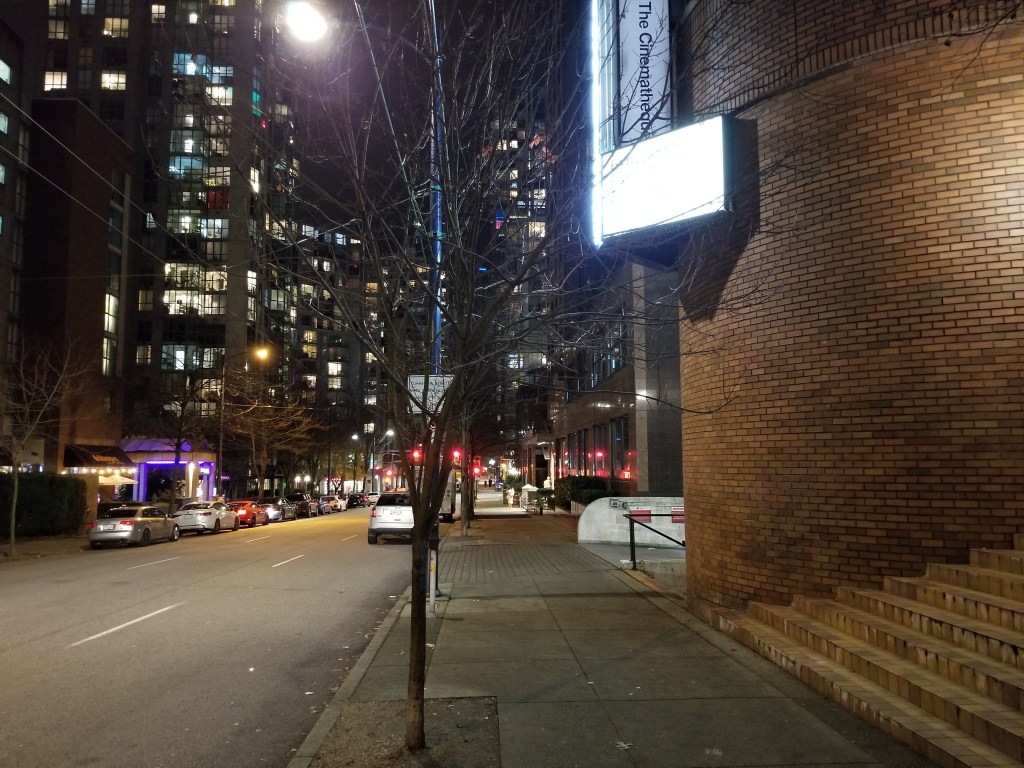
The Cinematheque (legal name: Pacific Cinémathèque Pacifique), founded in 1972, is a Canadian charity and non-profit film institute, media education centre, and film exhibitor based in Vancouver, British Columbia.
The organization’s mission is to foster the appreciation of the art and legacy of cinema, and to advance critical thinking and thoughtful education about the impact of moving-images and screen-based media in society.
The Cinematheque was one of several Vancouver cultural organizations to emerge from the vibrant avant-garde and alternative arts scene that developed on Canada’s West Coast in the late 1960s and early 1970s. An important hub of this activity was Vancouver’s Intermedia Society, a multidisciplinary collective, founded in 1967, of visual, performance, and media artists, including those interested in experimental, poetic, and “personal” cinema. In 1969, the Intermedia Film Co-op, a distributor and presenter of Vancouver-made independent film, emerged as an offshoot.
In 1971, Kirk Tougas, a young Vancouver filmmaker and film programmer and member of Intermedia, was asked by Werner Aellen, the director of Intermedia, and Tony Emery, the director of the Vancouver Art Gallery, to organize regular film screenings at the Art Gallery. With further institutional support from the National Film Board of Canada and its regional director Bruce Pilgrim, this led to the founding of the Pacific Cinémathèque as “as a film museum, archive, and showcase.” The organization was incorporated as a non-profit society in the Province of British Columbia in August 1972, with Tougas as its first director, a capacity in which he served until 1980.
Tony Reif, a Vancouver critic and curator of avant garde cinema, and now the owner of the Vancouver-based avant jazz record label Songlines, served as The Cinematheque’s film programmer through much of the 1970s. Jeff Wall, the Vancouver artist now internationally renowned for his large-scale photo-based work, served as a film programmer in 1975-76. Tom Braidwood, the filmmaker and actor who later played Melvin Fohike, one of the three “Lone Gunmen” on the television series The X-Files and its spin-off series The Lone Gunmen, was The Cinematheque’s manager in the early 1980s.
The Cinematheque was without a permanent home in its early years and used several local auditoriums for its public film screenings, including the old National Film Board of Canada theatre on West Georgia Street; the provincial government’s Robson Square facility in downtown Vancouver; and the Vancouver Museum in Vanier Park on Vancouver’s West Side.
In March 1986, The Cinematheque moved to its current home in the new, purpose-built Pacific Cine Centre at 1131 Howe Street, a facility developed to also house two other local film organizations, the Cineworks Independent Filmmakers Society (still a co-occupant) and Canadian Filmmakers Distribution West (since relocated, and now known as Moving Images Distribution). The Cine Centre was heralded as “Canada’s first cultural centre dedicated to the cinematic arts to house under one roof production and distribution facilities for independent filmmakers and exhibition facilities for the community at large.”
In a notorious incident of anti-institutional artistic vandalism, on March 28, 1986, during one of the Cine Centre’s official opening-week events, the filmmaker Al Razutis, while participating in a panel on experimental film practice, defaced the front wall of Cinematheque’s brand-new theatre by spray painting, below the movie screen, “Avant-garde spits in the face of institutional art.” This “direct action” performance was documented in the 1986 short film On the Problems of the Autonomy of Art in Bourgeois Society or… Splice, co-directed by Doug Chomyn, Scott Haynes, and Razutis.
The Cinematheque has been led since 1991 by Jim Sinclair, who holds the title of Executive and Artistic Director. Sinclair joined the organization in 1987, was appointed its program (now artistic) director in 1988, and named its executive director in 1991.
The Cinematheque conducted its public activities under the name “Pacific Cinémathèque” until 2012, when it began operating publicly as, simply (and without accents), “The Cinematheque.”
Team Andromeda’s latest Panzer Dragoon game is the finale of its trilogy on the Saturn and is, of all things, a role playing game. But what a role playing game it is. I’m sure many had doubts as to whether a straight up 3D shooter could actually translate to an RPG. But Team Andromeda has done it, and done it with style. They’ve wrapped up their trilogy and answered all of the questions left in mystery from the first two chapters in an incredible game that really defines the term, “cinematic RPG”.
The game spans 4 CD’s with many high-quality CG FMV cut scenes, and incredible voice acting. Thankfully, Sega decided to simply subtitle the original Japanese dialogue. Not only does this create an even greater sense of playing a game in an entirely different world, but also saves us from the usually awful English dubbing from American voice actors with no understanding of the characters or the emotions involved. The Japanese voice actors do a wonderful job and breathe real life into the hero, Edge, and the supporting cast. The cinemas are top of the line and are by far the best ever seen on the Saturn. The biggest improvement in the FMV is the excellent array of facial expressions on the characters. Characters no longer act like plastic toys that walk, but like real people.
The story is one of numerous twists and turns that keep you wondering and enthralled to the very end. You control Edge, a young mercenary in the hire of the Empire to protect one of the ancient ruins from the monsters and thieves that roam the world. The story opens with a monster appearing in the ruin Edge is helping to protect. In the ensuing battle with the beast, a strange artifact is uncovered. It is a beautiful girl enclosed in some kind of cocoon, hidden underground for ages. Before Edge can even begin to wonder what she’s doing there, a distress call that was sent out earlier is answered by a rebellious faction of the Empire led by Lord Craymen. Craymen’s henchmen kill Edge’s comrades and knock him unconscious. He awakens to see them leaving with the girl, and begins running after them. But before he gets very far he is shot and falls into a deep chasm.
He miraculously finds himself alive at the bottom of the chasm. He swims out of a large pool of water near the entrance to a hidden area underneath the ruin. Shortly, he is attacked by a countless number of monsters and his demise seems imminent. But he is saved at the last second by a dragon. This is the beginning of a unique bond and friendship that will lead Edge and the dragon on an incredible journey with an astounding climax that ties together all 3 Panzer Dragoon games and explains the purpose of the dragons and the mysteries of the towers.
The graphics in Panzer Dragoon Saga are wonderful, and at times simply breathtaking. It starts out rather slowly, flying through bare canyons and deserts, but when you reach areas like Georgius and Uru, you’ll find yourself simply staring at the screen with your jaw on the floor. The beauty and sheer creativity of many of the levels is incredible. Team Andromeda has not only created a living, vibrant world, but they’ve also given it a style that is unique to the series. You’ll see quite a few similar elements from the previous games, and many new surprises. The environments range from futuristic, to organic, to classical architecture from Greece, Rome and nomadic cultures. And at many times it is a combination of all of these together to create a unique look, which invokes a sense of the past, overlapped by nature and technology. It really has to be seen to get the sense of what I’m trying to convey with words.
The entire game is fully 3D and made up of textured polygons. They really pushed every ounce of power out of the Saturn’s 3D engine to create the look of the game. It makes for a very immersing experience. There are very few polygonal glitches and the game runs at a very smooth frame rate. There is some slowdown in spots when Edge is exploring a town and goes through an enclosed area. But it is brief and effects the gameplay not at all. There is excellent use of light sourcing in areas like the camp and the caravan at nighttime and excellent transparencies on some levels. The battle scenes run very fast and look wonderful. Some of the monsters look so amazing that it’s a shame you have to kill them. Your dragon’s Berserker spells are very impressive and use every graphical trick the Saturn has.
The music and sound are equally impressive. The music combines the same aspects as the graphics with classical arrangements supported by tribal drum beats with some futuristic sounding instruments to give that same sense of historical layering that you get from the graphics. All of the dialogue in the game is done with Japanese voice actors and English subtitles. I was very happy when I heard that this is what they were doing for the US version. Not only does it further enhance the feeling of being in a different world; the English dubs are generally awful and often ruin the experience. The Japanese voice actors did an incredible job, especially for the main characters of Edge and Azel. Every emotion is expressed wonderfully and it makes the characters seem so real that you begin to empathize with them during the game. Panzer Saga is a visual and aural masterpiece, and Team Andromeda deserves much praise for putting so much effort into making a world for us to play in.
The gameplay in Panzer Saga is equally impressive and is likely a glimpse into the future of the traditional RPG’s gameplay. I highly recommend using the Nights analog controller for this game as it works perfectly with it. You control the dragon’s flight with the pad and you can perform barrel rolls and fly anywhere you please in the area you’re in. By pressing the A button you bring up the lock on sights which you use to explore and examine various items and creatures. These can open items, battles or one of the many secrets hidden throughout the game. It’s well worth it to explore everything and look everywhere.
Most battles occur randomly as you’re flying around. The battles are run in real time and use a variation on the active time battle system of Squaresoft’s. It also incorporates movement during battles which is something that I’ve always felt should be used in traditional RPG’s. It adds a higher sense of realism as well as more complex strategies. The center of your battle menu is the radar display. Your dragon can move to four points around its enemies. Where to move is determined by the radar display. A green section is safe and you can stay there without fear of being attacked. A clear section indicates an area where you can be attacked by a weak enemy weapon. Red areas are to be avoided at all costs as they represent a powerful attack by the enemy. Next to the radar are your three charge bars. Depending on what type of attack you wish to make will determine how many bars you need to let charge. One bar allows a basic attack with your gun or the dragon’s homing laser’s. Two bars allow for a Berserker, or magic, attack. Your dragon has 6 berserk classes with certain spells in each class. Some classes are best against single enemies, others for large groups, and others for healing. You gain new berserk attacks as you gain levels, but two are earned by finding certain items during the course of the game and one class takes 3 charge bars to use. Every battle requires you to be on your toes and manage your attacks properly. It’s rare in an RPG to have random battles that are so much fun. Usually they become tedious rather quickly, but the pace of the ones in Saga keep you interested and always looking for more. They’re fun, and that makes a big difference in the gameplay.
At the end of each battle you receive a ranking based on your performance. The rankings go from Narrow Escape (the worst) to Excellent (the best). How you do determines how much experience and money you receive, and also whether you’ll receive an item. Some items are rare and can only be found by defeating a monster with an excellent rating. And after you gain a certain number of levels, your dragon will evolve into a new form with stronger lasers and statistics.
Panzer Dragoon Saga is a revolutionary RPG that combines elements from numerous genres into an incredible whole that could very well change the way RPG’s play in the near future. My gripes with the game are few and barely worth mentioning, but I would be remiss as a reviewer if I didn’t. The game is a bit too short. Total gameplay time is around 18 hours without cinemas. With all the cinemas it runs around 25 to 30 hours. The game didn’t feel unfinished or rushed; you just want it to last longer. A few more areas to explore and side quests couldn’t have hurt, but storage limitations were likely what prevented that.
Another problem was that it was a very easy game. Yes, there are a lot of secrets to find and plenty of replay value, but to finish the game doesn’t take much. I didn’t die once and I wasn’t trying to level up to become stronger than the enemies. A game doesn’t need to be mind numbingly hard, but some intense battles that are tough to win really increase a sense of accomplishment on completion of the game. And finally, the ranking system was fairly inconsistent. Most of the time I couldn’t understand why I received the rank that I did. I could take a ton of damage from an enemy and have to heal more than once in the course of the battle, and still receive an Excellent rank. Other times I could take no damage and not even be close to danger and receive a Close Call rank. It just rarely made sense and I still haven’t figured it out. The manual says that high ranks are given for fighting “efficiently”. What that entails, I do not know.
But all of those gripes are minor and don’t effect the experience negatively. This is an incredible game and one that every RPG fan should own. And hopefully it will hook many that never considered playing an RPG, and make them love the genre. RPG’s are experiencing a renaissance right now, and Panzer Saga is a Michelangelo in the genre. Team Andromeda is a rising star in the industry and are easily the equal of the greatest developers in the industry. You can tell when a developer really cares about making a great game, and it’s obvious everywhere you look in Panzer Saga that they love what they do.
Neo-noir is a style often seen in modern motion pictures and other forms that prominently utilize elements of film noir, but with updated themes, content, style, visual elements or media that were absent in films noir of the 1940s and 1950s.
40. Slam Dance (1987) – Wayne Wang 39. I, The Jury (1982) – Richard T. Heffron 38. Murphy’s Law (1986) – J. Lee Thompson 37. Body Double (1984) – Brian De Palma 36. 8 Million Ways To Die (1986) – Hal Ashby 35. The Border (1982) – Tony Richardson 34. Against All Odds (1984) – Taylor Hackford 33. The Dead Pool (1988) – Buddy Van Horn 32. True Confessions (1981) – Ulu Grosbard 31. Year Of The Dragon (1985) – Michael Cimino 30. Cop (1988) – James B. Harris 29. Sudden Impact (1983) – Clint Eastwood 28. Still Of The Night (1982) – Robert Benton 27. Mike’s Murder (1984) – James Bridges 26. Black Rain (1989) – Ridley Scott 25. Tightrope (1984) – Clint Eastwood 24. Sea Of Love (1989) – Harold Becker 23. Trouble In Mind (1985) – Alan Rudolph 22. Kill Me Again (1989) – John Dahl 21. Eyewitness (1981) – Peter Yates 20. Fatal Attraction (1987) – Adrian Lyne 19. Thief (1981) – Michael Mann 18. D.O.A. (1988) – Annabel Jankel 17. Lethal Weapon 2 (1989) – Richard Donner 16. Cutter’s Way (1981) – Ivan Passer 15. The Big Easy (1987) – Jim McBride 14. Jagged Edge (1985) – Richard Marquand 13. Dressed To Kill (1980) – Brian De Palma 12. To Live And Die In L.A. (1985) – William Friedkin 11. No Way Out (1987) – Roger Donaldson 10. Manhunter (1986) – Michael Mann 09. Lethal Weapon (1987) – Richard Donner 08. Angel Heart (1987) – Alan Parker 07. Prince Of The City (1981) – Sidney Lumet 06. House Of Games (1987) – David Mamet 05. Body Heat (1981) – Lawrence Kasdan 04. Witness (1985) – Peter Weir 03. Die Hard (1988) – John McTiernan 02. Blood Simple (1984) – Joel Coen 01. Blue Velvet (1986) – David Lynch






 Igor's Blog