
The Putin myth: why Russia is no economic superpower

Russia’s GDP was smaller than that of Texas even before the latest and most lethal sanctions imposed by Washington.
It has diminished further to Benelux proportions after the rouble’s 10 per cent crash this week, the steepest fall since the late Nineties.
Upon this slender economic base, Vladimir Putin’s Russia is posing as a world-class superpower, the new master of the Middle East, insisting on its “droit de regard” over the old Tsarist realms as if by natural right.
What is extraordinary is than anybody should believe in such posturing.
The harsher truth is that Mr Putin squandered the windfall wealth of the commodity supercycle and hollowed out what remained of the Soviet industrial base, leaving Russia’s Potemkin economy in a cul de sac.
He has succeeded (so far) in propping up his ally in Syria but this tells us little about the global balance of power. The Kremlin likes to dismiss Western sanctions as a flea bite. Not any longer. “The measures are turning into a tool of real economic war,” said Russian premier Dmitry Medvedev.
The US Treasury document announcing sanctions to punish “worldwide malign activity” is a comic read, but it is also mortal threat to the Putin oligarchy. It alleges that Oleg Deripaska, aluminium king and head of Rusal, “ordered the murder of a businessman”.
It cites allegations that Suleiman Kerimov from Polyus Gold laundered hundreds of millions of euro buying villas in France, “transporting as much as €20 million ($31.9 million) at a time in suitcases.”
Deripaska has described the sanctions as “groundless, ridiculous and absurd”.
What is new about these sanctions is that they target the pre-existing securities, and not just new issuance. This turns the named companies into international pariah, as Rusal is discovering. It has been blackballed from the London Metal Exchange. Its listed share price on the Hong Kong exchange has fallen 58 per cent this week.
It is a foretaste of what lies in store for Russia’s corporate elite as the Mueller investigation uncovers the whole ghastly truth about Kremlin cyber-aggression against the US political system. Whatever the White House may or may not want to do, the policy is being pushed by a wrathful Congress intent on avenging what some call a Russian Pearl Harbor.
No Americans can deal with sanctioned entities, and no Europeans can do so lightly without provoking the US Treasury under “secondary sanctions” clauses, if they have any commercial dealings with the US. Belgium-based Euroclear said immediately that it would comply.
Investors must now contend with the prospect that almost any oligarch could be targeted and that any Russian asset – including sovereign bonds – could be tainted and plunge in value overnight. This risks a collective rush for the exits since nobody wants to be trapped in a fire sale. Sberbank shares are down 17 per cent over the last two days even though it is not on the list.
Russian vice-premier Arkady Dvorkovich has promised to rescue sanctioned companies, implying that the state will cover the debts of private firms and state-owned companies if need be. Yet the Reserve Fund is exhausted and was shut down in December. Much of the residual $US67 billion Welfare Fund is committed. The Kremlin will have to tap the central bank’s $US453 billion portfolio of foreign reserves. “If the sanctions go on long enough and the circle expands, the cushion may not be enough” warned Vedomosti.
To be clear, the country is not facing an imminent financial crisis. The floating rouble acted as a shock absorber through the oil and commodity crash. Russia survived the trauma. What it faces instead is “neo-stagnation”, to borrow from former British ambassador Sir Andrew Wood. It is caught in a self-feeding cycle of decline as infrastructure crumbles and young brains leave.
The deep recession of 2015 and 2016 may be over but per capita income is stuck at $US8,800 and industrial wages are now lower than in eastern China – let alone Poland. The post-Soviet convergence with the West has stalled. There is no new growth model for the 21st century. The drastic plan of autarky and import substitution launched three years ago by President Putin to break dependence on commodities – 80 per cent of exports during the boom – has come to little. Reliance on foreign farm machinery was to be cut 56 per cent by 2020, and engineering equipment by 34 per cent. None of this is happening.
Russia is still hostage to oil and gas. Energy provides a tolerable living for now but US shale has entirely changed of global oil industry, capping each rise in prices with a surge of new drilling. It has become a structural headwind. Russia’s own production costs are rising as the old fields decline by 5 per cent a year in Western Siberia. The energy ministry warns that output could halve by 2035 unless there is a wave of investment.
The coming surge of US liquefied natural gas (LNG) has deprived Mr Putin of his pricing power in Europe. He was able to charge $US12 (MMBtu) in the glory days of 2012. Today his gas fetches around $US5.
By the mid-2020s, other powerful forces will be at work. Electric vehicles will probably have reached take-off; battery costs will have come down far enough to give wind and solar an edge over gas. By then the fossil industry will be looking tired.
Mr Putin wasted Russia’s oil bonanza from 2005 to 2014 on hubristic rearmament. The Stockholm International Peace Research Institute said the military budget rose 8.1 per cent in real terms in 2014 and another 15 per cent in 2015 when the economy was already contracting. Finance minister Alexei Kudrin resigned with a warning that it would ruin the country, and that is exactly what it did.
The Russian military added a fleet of new Su-34 long-range combat aircraft, and batteries S-400 surface-to-air missile systems, even as pauperisation spread. It coincided with the negligent disarmament of the West, made worse by Europe’s austerity overkill.
This misalignment created a window that Mr Putin has exploited. The window is about to close again. Russia can no longer afford the rent, and the West is rearming fast.
A nuclear-armed Sparta under a despotic leader with totalitarian propaganda tools can of course be very dangerous. But please don’t call Putinism a success.
The True History of Libertarianism in America: A Phony Ideology to Promote a Corporate Agenda
Before Milton Friedman was earning plaudits as an economic genius, he was a shill for the real estate industry and an early pioneer for big business propaganda known as libertarianism.
Every couple of years, mainstream media hacks pretend to have just discovered libertarianism as some sort of radical, new and dynamic force in American politics. It’s a rehash that goes back decades, and hacks love it because it’s easy to write, and because it’s such a non-threatening “radical” politics (unlike radical left politics, which threatens the rich). The latest version involves a summer-long pundit debate in the pages of the New York Times, Reason magazine and elsewhere over so-called “libertarian populism.” It doesn’t really matter whose arguments prevail, so long as no one questions where libertarianism came from or why we’re defining libertarianism as anything but a big business public relations campaign, the winner in this debate is Libertarianism.
Pull up libertarianism’s floorboards, look beneath the surface into the big business PR campaign’s early years, and there you’ll start to get a sense of its purpose, its funders, and the PR hucksters who brought the peculiar political strain of American libertarianism into being — beginning with the libertarian movement’s founding father, Milton Friedman. Back in 1950, the House of Representatives held hearings on illegal lobbying activities and exposed both Friedman and the earliest libertarian think-tank outfit as a front for business lobbyists. Those hearings have been largely forgotten, in part because we’re too busy arguing over the finer points of “libertarian populism.”
Milton Friedman. In his early days, before millions were spent on burnishing his reputation, Friedman worked as a business lobby shill, a propagandist who would say whatever he was paid to say. That’s the story we need to revisit to get to the bottom of the modern American libertarian “movement,” to see what it’s really all about. We need to take a trip back to the post-war years, and to the largely forgotten Buchanan Committee hearings on illegal lobbying activities, led by a pro-labor Democrat from Pennsylvania, Frank Buchanan.
What the Buchanan Committee discovered was that in 1946, Milton Friedman and his U Chicago cohort George Stigler arranged an under-the-table deal with a Washington lobbying executive to pump out covert propaganda for the national real estate lobby in exchange for a hefty payout, the terms of which were never meant to be released to the public. They also discovered that a lobbying outfit which is today credited by libertarians as the movement’s first think-tank — the Foundation for Economic Education — was itself a big business PR project backed by the largest corporations and lobbying fronts in the country.
It starts just after the end of World War Two, when America’s industrial and financial giants, fattened up from war profits, established a new lobbying front group called the Foundation for Economic Education (FEE) that focused on promoting a new pro-business ideology—which it called “libertarianism”— to supplement other business lobbying groups which focused on specific policies and legislation.
The FEE is generally regarded as “the first libertarian think-tank” as Reason’s Brian Doherty calls it in his book “Radicals For Capitalism: A Freewheeling History of the Modern Libertarian Movement” (2007). As the Buchanan Committee discovered, the Foundation for Economic Education was the best-funded conservative lobbying outfit ever known up to that time, sponsored by a Who’s Who of US industry in 1946.
A partial list of FEE’s original donors in its first four years— a list discovered by the Buchanan Committee — includes: The Big Three auto makers GM, Chrysler and Ford; top oil majors including Gulf Oil, Standard Oil, and Sun Oil; major steel producers US Steel, National Steel, Republic Steel; major retailers including Montgomery Ward, Marshall Field and Sears; chemicals majors Monsanto and DuPont; and other Fortune 500 corporations including General Electric, Merrill Lynch, Eli Lilly, BF Goodrich, ConEd, and more.
The FEE was set up by a longtime US Chamber of Commerce executive named Leonard Read, together with Donaldson Brown, a director in the National Association of Manufacturers lobby group and board member at DuPont and General Motors.
That is how libertarianism in America started: As an arm of big business lobbying.
Before bringing back Milton Friedman into the picture, this needs to be repeated again: “Libertarianism” was a project of the corporate lobby world, launched as a big business “ideology” in 1946 by The US Chamber of Commerce and the National Association of Manufacturers. The FEE’s board included the future founder of the John Birch Society, Robert Welch; the most powerful figure in the Mormon church at that time, J Reuben Clark, a frothing racist and anti-Semite after whom BYU named its law school; and United Fruit president Herb Cornuelle.
The purpose of the FEE — and libertarianism, as it was originally created — was to supplement big business lobbying with a pseudo-intellectual, pseudo-economics rationale to back up its policy and legislative attacks on labor and government regulations.
This background is important in the Milton Friedman story because Friedman is a founding father of libertarianism, and because the corrupt lobbying deal he was busted playing a part in was arranged through the Foundation for Economic Education.
According to Congressional hearings on illegal lobbying activities 1946 was the year that Milton Friedman and his U Chicago cohort George Stigler arranged an under-the-table deal with a Washington lobbying executive to pump out covert propaganda for the national real estate lobby in exchange for a hefty payout, the terms of which were never meant to be released to the public.
The arrangement between Friedman and Stigler with the Washington real estate lobbyist was finally revealed during a congressional review of illegal lobbying activities in 1950, called the Buchanan Committee. Yes, there was something called accountability back then. I only came across the revelations about Friedman’s sordid beginnings in the footnotes of an old book on the history of lobbying by former Newsweek book editor Karl Schriftgiesser, published in 1951, shortly after the Buchanan Committee hearings ended. The actual details of Milton Friedman’s PR deal are sordid and familiar, with tentacles reaching into our ideologically rotted-out era.
False, whitewashed history is as much a part of the Milton Friedman mythology as it is the libertarian movement’s own airbrushed history about its origins; the 1950 Buchanan Committee hearings expose both as creations of big business lobby groups whose purpose is to deceive and defraud the public and legislators in order to advance the cause of corporate America.
The story starts like this: In 1946, Herbert Nelson was the chief lobbyist and executive vice president for the National Association of Real Estate Boards, and one of the highest paid lobbyists in the nation. Mr. Nelson’s real estate constituency was unhappy with rent control laws that Truman kept in effect after the war ended. Nelson and his real estate lobby led what House investigators discovered was the most formidable and best-funded opposition to President Truman in the post-war years, amassing some $5,000,000 for their lobby efforts—that’s $5mln in 1946 dollars, or roughly $60 million in 2012 dollars.
So Herbert Nelson contracted out the PR services of the Foundation for Economic Education to concoct “third party” propaganda designed to shore up the National Real Estate lobby’s legislative drive — and the propagandists who took on the job were Milton Friedman and his U Chicago cohort, George Stigler.
To understand the sort of person Herbert Nelson was, here is a letter he wrote in 1949 that Congressional investigators discovered and recorded:
“I do not believe in democracy. I think it stinks. I don’t think anybody except direct taxpayers should be allowed to vote. I don’t believe women should be allowed to vote at all. Ever since they started, our public affairs have been in a worse mess than ever.”
It’s an old libertarian mantra, libertarianism versus democracy, libertarianism versus women’s suffrage; a position most recently repeated by billionaire libertarian Peter Thiel — who was Ron Paul’s main campaign funder in his 2012 presidential campaign.
So in 1946, this same Herbert Nelson turned to the Foundation for Economic Education to manufacture some propaganda to help the National Association of Real Estate Boards fight rent control laws. Nelson chose to work with the FEE because he knew that the founder of the first libertarian think-tank, Leonard Read, agreed with him on a lot of important issues. Such as their mutual contempt for democracy, and their disdain for the American public.
Leonard Read, the legendary (among libertarians) founder/head of the FEE, argued that the public should not be allowed to know which corporations donated to his libertarian front-group because, he argued, the public could not be trusted to make “sound judgments” with disclosed information:
“The public reporting would present a single fact—the amount of a contributor’s donation—to casual readers, persons having only a cursory interest in the matter at issue, persons who would not and perhaps could not possess all the facts. These folks of the so-called public thus receive only oversimplifications or half-truths from which only erroneous conclusions are almost certain to be drawn. If there is a public interest in the rightness or wrongness of corporate or personal donations to charitable, religious or education institutions, and I am not at all ready to concede that there is, then that interest should be guarded by some such agency as the Bureau of Internal Revenue, an agency that is in a position to obtain all the facts, not by Mr. John Public who lacks relevant information for the forming of sound judgments…Public reporting of a half-truth is indeed a significant provocation.”
So in May 1946, Herbert Nelson of the Real Estate lobby, looking for backup in his drive to abolish federal rent control laws on behalf of landlords, contacted libertarian founder Leonard Read of the FEE with an order for a PR pamphlet “with some such title as ‘The Case against Federal Real Estate Control’,” according to Karl Schriftgiesser’s book The Lobbyists.
What happened next, I’ll quote from Schriftgiesser:
“They were now busily co-operating on the new project which the foundation had engaged Milton Friedman and George J. Stigler to write. It was to be called Roofs and Ceilings and it was to be an outright attack on rent controls. When Nelson received a copy of the manuscript he wrote Read to say, “The pamphlet…is a dandy. It is just what I wanted.”
The National Association of Real Estate Boards was so pleased with Milton Friedman’s made-to-order propaganda that they ordered up 500,000 pamphlets from the FEE, and distributed them throughout the real estate lobby’s vast local network of real estate brokers and agents.
In libertarianism’s own airbrushed history about itself, the Foundation for Economic Education was a brave, quixotic bastion of libertarian “true believers” doomed to defeat at the all-powerful hands of the liberal Keynsian Leviathan and the collectivist mob. Here is how libertarian historian Brian Doherty describes the FEE and its chief lobbyist Leonard Read:
“[Read] would never explicitly scrape for funds… He never directly asked anyone to give anything, he proudly insisted, and while FEE would sell literature to all comers, it was also free to anyone who asked. His attitude toward money was Zen, sometimes hilariously so. When asked how FEE was doing financially, his favorite reply was, “Just perfectly.”… Read wanted no endowments and frowned on any donation meant to be held in reserve for some future need.”
And here is what the committee’s own findings reported—findings lost in history:
“It is difficult to avoid the conclusion that the Foundation for Economic Education exerts, or at least expects to exert, a considerable influence on national legislative policy….It is equally difficult to imagine that the nation’s largest corporations would subsidize the entire venture if they did not anticipate that it would pay solid, long-range legislative dividends.”
Or in the words of Rep. Carl Albert (D-OK): “Every bit of this literature is along propaganda lines.”
The manufactured history about libertarian’s origins, or its purpose, parallels the manufactured myths about one of big business’s key propaganda tools, Milton Friedman. As the author of The Lobbyists, not knowing who Milton Friedman was at the time, wrote of Friedman’s collaborative effort with Stigler:
“Certainly [the FEE’s] booklet, Roofs or Ceilings, was definitely propaganda and sought to influence legislation….This booklet was printed in bulk by the foundation and half a million copies were sold at cost to the National Association of Real Estate Boards, which had them widely distributed throughout the country by its far-flung network of local member boards.”
There’s no idealism here. The notion that libertarian ideas have captured the political imagination of millions in this country is a root problem: if we’re going to escape the corporate oligarchy that is running this country–their ideas can’t possibility be the alternative solution. This movement has to be recognized for what it is.
Angelina Jolie by Alex Jones
On Georgia Street in Downtown Vancouver. Autumn of 2015.


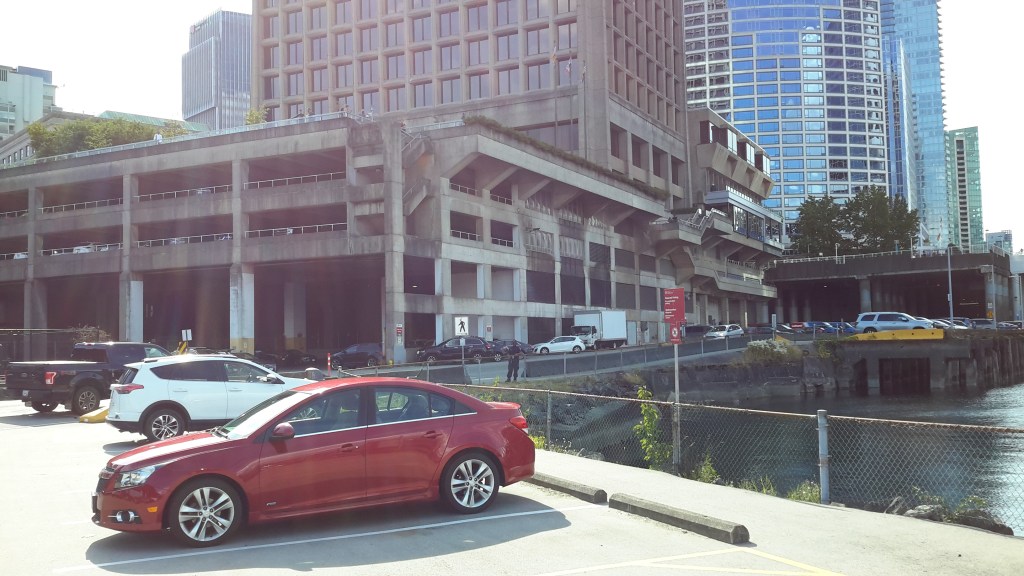


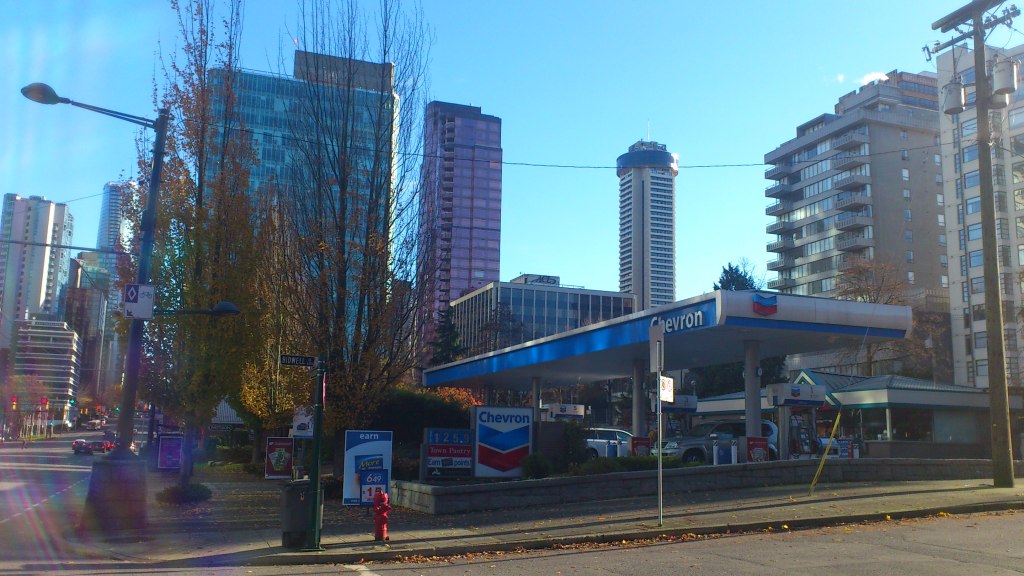
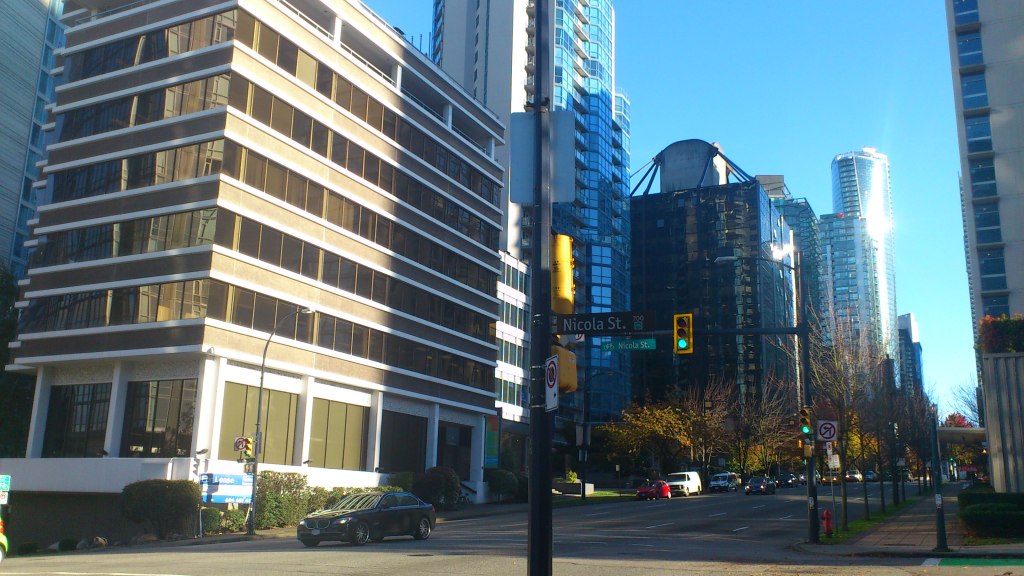
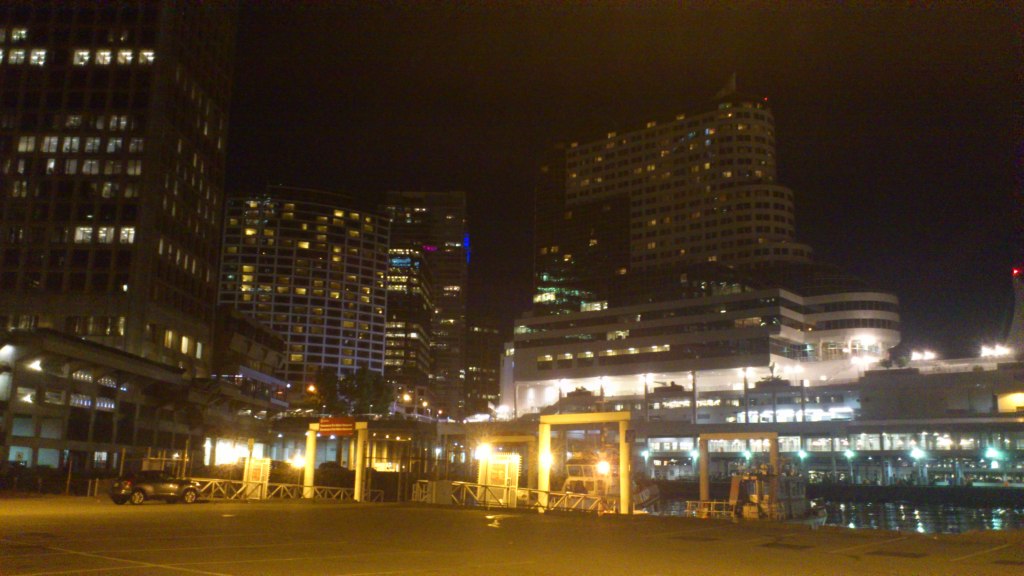

Georgia Street is an east–west street in the cities of Vancouver and Burnaby, British Columbia, Canada. Its section in Downtown Vancouver, designated West Georgia Street, serves as one of the primary streets for the financial and central business districts, and is the major transportation corridor connecting downtown Vancouver with the North Shore (and eventually Whistler) by way of the Lions Gate Bridge. The remainder of the street, known as East Georgia Street between Main Street and Boundary Road and simply Georgia Street within Burnaby, is more residential in character, and is discontinuous at several points.
West of Seymour Street, the thoroughfare is part of Highway 99. The entire section west of Main Street was previously designated part of Highway 1A, and markers for the ‘1A’ designation can still be seen at certain points.
Starting from its western terminus at Chilco Street by the edge of Stanley Park, Georgia Street runs southeast, separating the West End from the Coal Harbour neighbourhood. It then runs through the Financial District; landmarks and major skyscrapers along the way include Living Shangri-La (the city’s tallest building), Trump International Hotel and Tower, Royal Centre, 666 Burrard tower, Hotel Vancouver and upscale shops, the HSBC Canada Building, the Vancouver Art Gallery, Georgia Hotel, Four Seasons Hotel, Pacific Centre, the Granville Entertainment District, Scotia Tower, and the Canada Post headquarters. The eastern portion of West Georgia features the Theatre District (including Queen Elizabeth Theatre and the Centre in Vancouver for the Performing Arts), Library Square (the central branch of the Vancouver Public Library), Rogers Arena, and BC Place. West Georgia’s centre lane between Pender Street and Stanley Park is used as a counterflow lane.
East of Cambie Street, Georgia Street becomes a one-way street for eastbound traffic, and connects to the Georgia Viaduct for eastbound travellers only; westbound traffic is handled by Dunsmuir Street and the Dunsmuir Viaduct, located one block to the north.
East Georgia Street begins at the intersection with Main Street in Vancouver’s Chinatown, then runs eastwards through Strathcona, Grandview–Woodland and Hastings–Sunrise to Boundary Road. East of the municipal boundary, Georgia Street continues eastwards through Burnaby until its terminus at Grove Avenue in the Lochdale neighbourhood. This portion of Georgia Street is interrupted at several locations, such as Templeton Secondary School, Highway 1 and Kensington Park.
Georgia Street was named in 1886 after the Strait of Georgia, and ran between Chilco and Beatty Streets. After the first Georgia Viaduct opened in 1915, the street’s eastern end was connected to Harris Street, and Harris Street was subsequently renamed East Georgia Street.
The second Georgia Viaduct, opened in 1972, connects to Prior Street at its eastern end instead. As a result, East Georgia Street has been disconnected from West Georgia ever since.
On June 15, 2011 Georgia Street became the focal point of the 2011 Vancouver Stanley Cup riot.
Majestic Hollywood: Interview with Mark A. Viera

As pretty much every classic movie fan knows, the year 1939 is considered special, well, extraordinary really. Film historians refer to it as the greatest year in the history of Hollywood due to both the high quality and high attendance of the films that came out. With World War Two as an ever-looming threat and the economic pressures of the Great Depression almost at an end, it’s no wonder people flocked to the theaters in droves. Whether you wanted to escape down the yellow brick road with Dorothy, never go hungry again with Scarlett, or say goodbye to Mr. Chips, there was no shortage of great films for audiences to go and see. In celebration of the Golden-Era’s most Golden year, Mark A. Vieira has penned the book Majestic Hollywood: The Greatest Films of 1939. The book chronicles 50 of the year’s greatest films, including behind-the-scenes information, production highlights and stunning photographs that tell the stories of 1939.
I would like to extend my gratitude to Mark A. Vieira for taking the time to do this interview as well as to Running Press Publishers for supplying CMH with a copy of the book as well as the photos accompanying this post!
1.) With so much already written about Hollywood’s Golden Year, what inspired you to write Majestic Hollywood: The Greatest Films of 1939?
I wrote Majestic Hollywood for Running Press so you can celebrate the 75th Anniversary of these great films.
The book is full of tidbits that will help you enjoy them even more. Just reading the reviews is a treat. The film critic in 1939 had to review the film with its first-night audience; we can go back in time and feel what it was like to see a familiar classic for the first time.
Most importantly, I can finally answer the question “Why were so many great films made in one year?” Just because some company in 1989 said this was so doesn’t mean it was. I had to find out for myself.
2.) You clearly did your research for this book, covering the history and production of 50 classic films. Where did you begin your research? Did you start with individual films or simply the year itself?
When I write a book, I’m telling a story. To do that, I create a timeline. I started in 1938. I looked in the Los Angeles Times. And that’s where I found the answers to my big question. There were five reasons for the proliferation of quality films. The reasons were cultural, financial, and political. But you’ll have to read the Introduction to find out exactly what they were!
3.) Your book is filled with interesting facts and anecdotes about the films’ productions. While in the researching process, what was your favorite or most interesting discovery?
The Cowardly Lion costume in The Wizard of Oz had a zipper on its back, not buttons or another type of fastener.
4.) In the book, you mentioned the social/political conditions surrounding Hollywood that allowed for such a “Big Film” year in 1939. How much of your research centered on those conditions that created Hollywood’s Golden Year?
World politics was one of the reasons that the Hollywood studios pushed quality projects. They knew they were about to lose Europe to a major war, which meant a third of their revenue, so they planned big movies that could open with road shows and bring in big money right away.
5.) In 1939, Hollywood released hundreds of films. In you book you managed to narrow the list down to 50. What was the criterion for making the cut?
The list created itself; there wasn’t a lot of agonizing. The only one we found it hard to cut was Made for Each Other.
It was a pleasure working with an editor who knows so much about classic films and has a true enthusiasm for them. Cindy De La Hoz has, of course, written a number of landmark books of her own, so I’m lucky to have her as my editor.
6.) What would you consider Hollywood’s greatest achievement of 1939?
Trusting its audience with intelligent fare. Most of these films couldn’t be greenlighted in 2014. Watching them requires thought.
7.) What is your personal favorite film (or films) from 1939?
The Rains Came has become my favorite. From childhood both Union Pacific and The Wizard of Oz were real favorites. I didn’t see Gone With the Wind until I was sixteen, but it quickly joined my personal pantheon (My favorite non-1939 films are King Kong, Grand Hotel, The Scarlet Empress, The Sign of the Cross, and Portrait of Jennie.)
Back to the Future Part 3 (10/10) Movie CLIP – Your Future Is Whatever You Make It (1990) HD
Doc Brown (Christopher Lloyd) and Clara (Mary Steenburgen) say goodbye to Marty (Michael J. Fox) before flying away in a train.
The final installment in the Back to the Future trilogy picks up where the second film left off, but it casts off the dizzying time travel of the first two films for mostly routine comedy set in the Old West. Marty McFly (Michael J. Fox) receives a 70-year-old letter from his inventor friend, Doc Brown (Christopher Lloyd), who tells Marty that he has retreated a century in time to live out a relatively quiet life in the Old West. Doc Brown reveals that he hid his DeLorean car/time machine in an abandoned mine outside town, and when Marty does some research and discovers that the Doc died shortly after writing the letter, he decides to find the car, travel back in time, and warn the Doc about his demise. Meanwhile, the Doc, who has fallen in love with a local woman (Mary Steenburgen), realizes he can’t hide in the past from the problems he has caused to the time flow in the previous two adventures. He reluctantly decides to return to the present with Marty, but first, they have to find a way to get the DeLorean up to time-travel velocity with a broken fuel line and no gasoline.
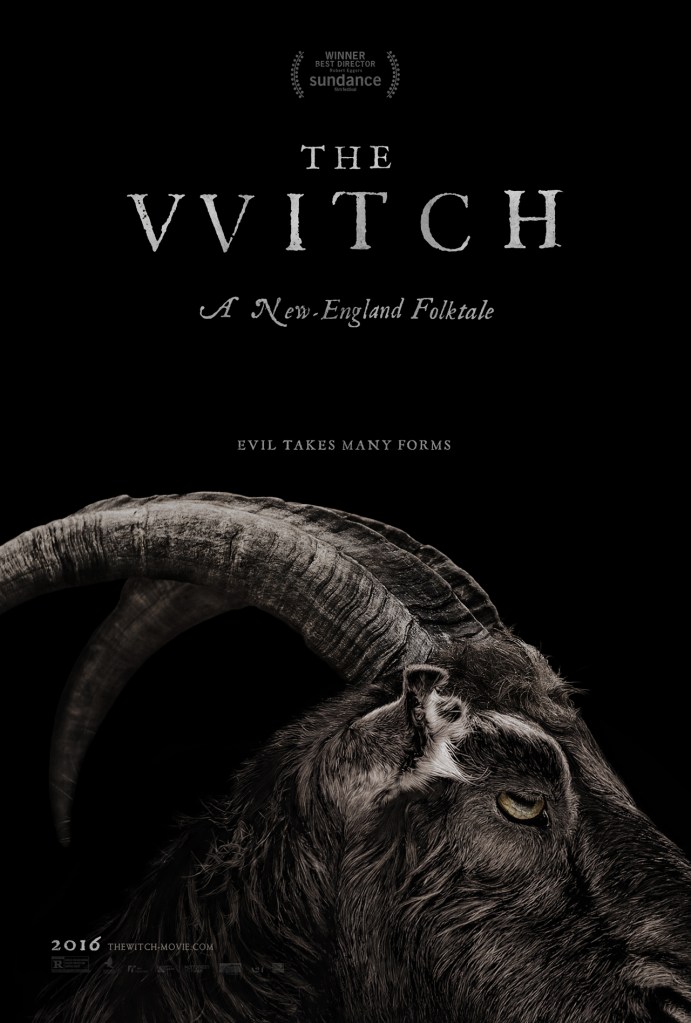
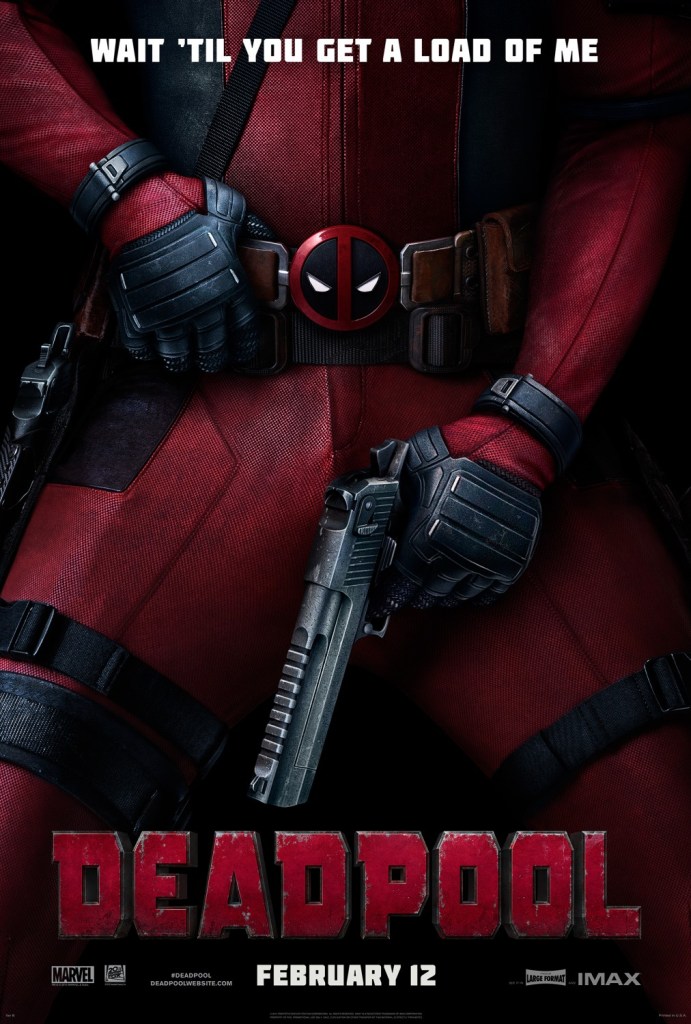
Just finished watching The Witch (2015) and Deadpool (2016)…
Fire Emblem: New Mystery of the Emblem (DS)

Fire Emblem: New Mystery of the Emblem is a remake of the second half of the SNES game, Fire Emblem: Mystery of the Emblem, which itself was a combined remake and sequel to the original Fire Emblem on NES. It’s a companion game of sorts to Fire Emblem: Shadow Dragon on DS as Shadow Dragon remade the events of the original and the first half of Mystery of the Emblem whereas this game remade the events of Mystery that took place after the events of the first game. To give a little more incentive to buy this game, though, it also bundles the four maps from the Satellaview streaming exclusive BS Fire Emblem: Archanean War Chronicles which aren’t (legitimately) playable any longer outside of this DS release.
The story picks up where Shadow Dragon left off. The Dark Pontiff Gharnef has been defeated and evil shadow dragon has been banished from this world. A new threat has emerged, however, as Hardin, the new emperor of the mighty Archanean Empire, has begun to act extremely out of character, ruling his realm with an iron fist and mercilessly crushing any dissent. It quickly becomes apparent that while the shadow dragon’s body was defeated, the evil of its soul continues to persist, casting a new cloud of darkness over the continent. It once again falls to Marth to muster his allies and face down this evil with swords, magic, and waifus.
The most significant change to the Fire Emblem formula that New Mystery of the Emblem introduced was the addition of Casual Mode. To some folks, this forever ruined Fire Emblem by making it approachable to casual players, but I disagree. I would call Casual Mode the single most significant addition to the series since the weapon triangle for that very reason – it makes accessible to less skilled or less patient players an incredible series. For that, I have a lot of respect for Mystery of the Emblem. The character portraits and battle sprites look absolutely fantastic for the DS. The DS was perfectly capable of decent looking 3D games, but New Mystery of the Emblem perfectly demonstrates how exceptional the DS is as a 2D system.
Everything about New Mystery of the Emblem has been streamlined since the SNES game it remakes. The menu system between battles is simple and intuitive, the conversations between characters that flesh out their characters have been expanded to show more of their personalities and interactions with one another, and the control in battle is simple to use and free of any waste. The screens are perfectly used to keep the focus on the action. The bottom screen always displays the battlefield while the top screen can be used to display either unit formation (hit points, items, etc) or a mini-map with the force strength of each side.
Fire Emblem: New Mystery of the Emblem is everything a classic Fire Emblem game should be. It takes everything that made Shadow Dragon great and improves it, and it takes most of the flaws Shadow Dragon had and fixes them. It’s a shame that this game never saw a Western release, but fortunately, an excellent fan translation exists if you can find a working ROM and a good DS emulator (or, as I did, load the patched ROM onto a micro SD card and play it on a real DS with an R4 card). The inclusion of the BS Fire Emblem maps is my favorite “extra” from any Fire Emblem game just because how difficult it is to find a working ROM of those maps, in general, let alone a ROM patched into English. For Fire Emblem fans, this game is an absolute must even if you have to use some dubious means to play it in English.
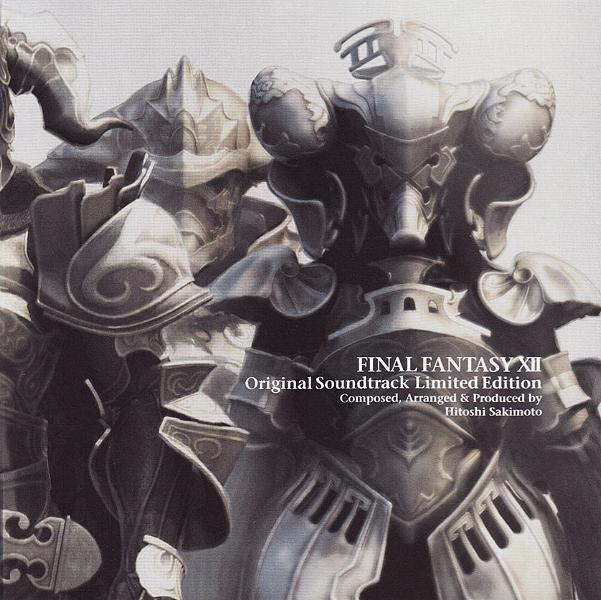
Now listening to Final Fantasy XII by Hitoshi Sakimoto and Casino Royale by David Arnold…

 Igor's Blog