
Now listening to Final Fantasy XIII-2 by Naoshi Mizuta, Masashi Hamauzu & Mitsuto Suzuki and Silk Degrees by Boz Scaggs…
In Davie Village in Downtown Vancouver. Autumn of 2018.


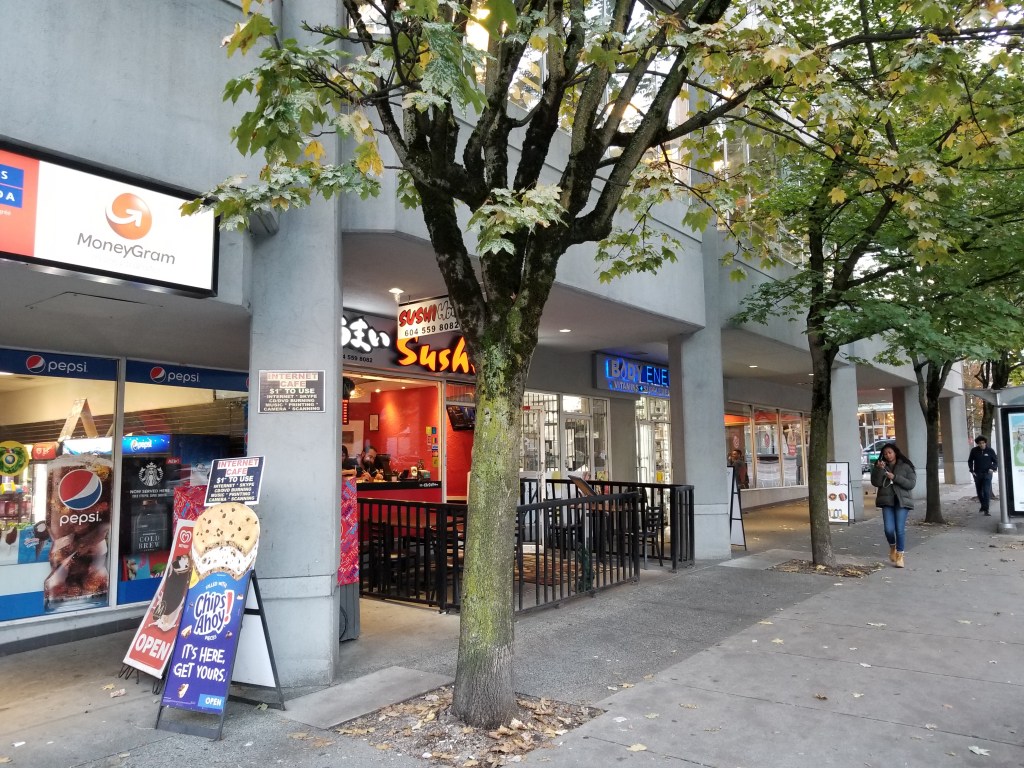

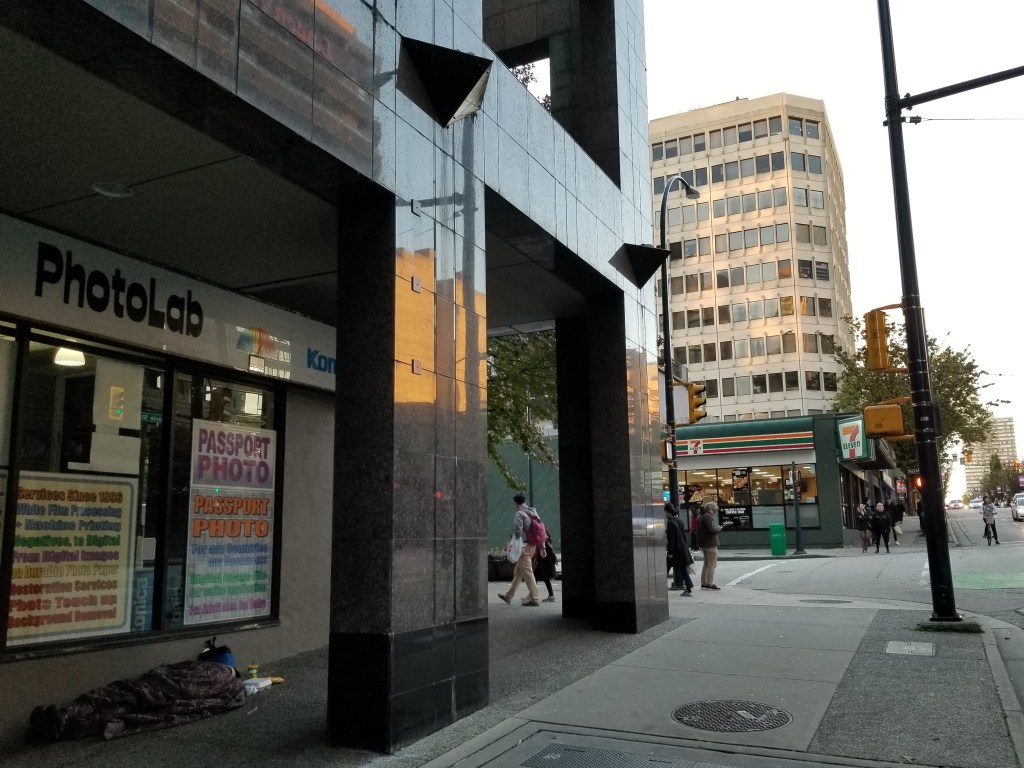
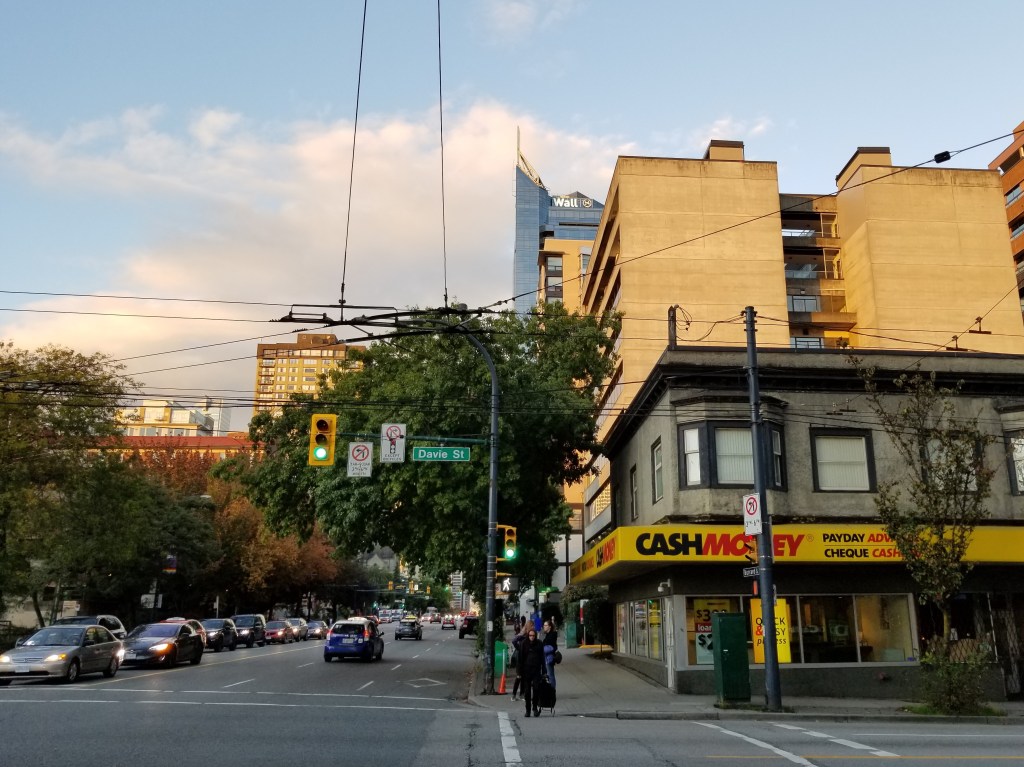

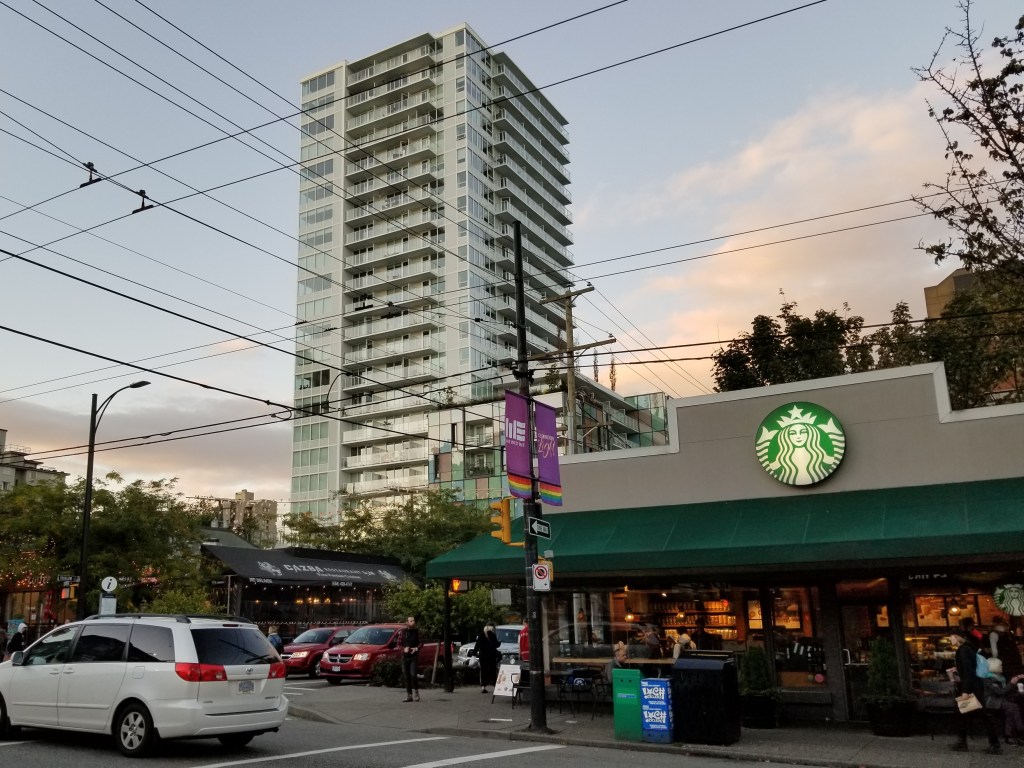

Davie Village (also known as Davie District or simply Davie Street) is a neighbourhood in the West End of Vancouver, British Columbia, Canada. It is the home of the city’s gay subculture, and, as such, is often considered a gay village, or gaybourhood. Davie Village is centred on Davie Street and roughly includes the area between Burrard and Jervis streets. Davie Street—and, by extension, the Village—is named in honour of A.E.B. Davie, eighth Premier of British Columbia from 1887 to 1889; A.E.B’s brother Theodore was also Premier, from 1892 to 1895.
Along Davie Street are a variety of shops, restaurants, services, and hotels catering to a variety of customers, in addition to private residences. The business with the most notoriety is Little Sister’s Book and Art Emporium (“Little Sister’s”), a gay and lesbian bookstore, because of its ongoing legal battles with Canada Customs that have received extensive national media coverage. Many businesses and residents along Davie Street and in the West End generally also fly rainbow flags as a symbol of gay pride, and many of the covered bus stop benches and garbage cans along Davie Street are painted bright pink.
The Village hosts a variety of events during the year, including the Davie Street Pride Festival which runs in conjunction with Vancouver’s annual Gay Pride Parade, during which sections of the street are closed to motor traffic.
Davie Day is also held each year in early September, to celebrate local businesses and the community itself. This Day is designed to build awareness and promote the surrounding businesses, and is focused around Jervis to Burrard Street.
The Davie Street Business Association coined the name “Davie Village” in 1999 and also commissioned banners from local artist Joe Average, which fly from lampposts in the district. The two-sided banners depict a rainbow flag on one side and a sun design by Average on the other.
Davie Village is also home to the offices of Xtra! West, a biweekly LGBT newspaper, Qmunity (formerly the Gay and Lesbian Centre) which provides a variety of services for the city’s lesbian, gay, bisexual, and transgender residents, and the Vancouver Pride Society, which puts on the annual Pride Parade and Festival.
Now reading Time magazine Vol. 124 No. 26: VCRs: Coining On Strong (December 24, 1984)…

This Is Marina City
The Portland Cement Association of Skokie, Illinois produced this film in 1965. Narrated by former WGN Chicago radio announcer Walt Newton, the 19-minute film describes how Marina City was planned, constructed, and utilized.
Just finished watching The Big Space Travel (1975) and Foxes (1980)…


Just finished watching The Babadook (2014) and Blue Jasmine (2013)…


The Naiads by Gioacchino Pagliei, 1881.

Why I HATE Remakes (And You Should Too)
I still remember the very first time. I played Silent Hill 2 I was standing with my friend in front of my giant CRT TV, as I watched James have his final Revelation and revealed the lore that he had been the one who killed Mary I was left completely Breathless. Then James left the room that he and Mary had shared into the hallway of the Lakeview hotel. And this song started to play That this moment I realized that Silent Hill 2 was undoubtedly. One of my favorite games I’d ever played that was probably seven years ago at this point, but I still come back in place on hell too about once every year, and every time I’m a stash at what an amazing game, it is. So you would think that when I heard that sound too, was getting a remake, I would be ecstatic but I wasn’t. I was just completely and I don’t really disappointed. I hate remakes and it’s not just because I’m some Boomer who wants to hate on new things. When I heard that silent 2 is being remade, it was like a stab in the heart. I stayed quiet though. Then I saw that both Persona 3. And Metal Gear Solid three were both being remade as well, instantly, I thought of all the people who would be robbed of playing the original versions of these amazing games. Countless people will play the remix and think they’ve gotten the true experience. And now there’s no need to play the original game. This is because remakes at their heart, our intended to replace the original game. They have never in any way promoted playing the original game, because why would they create it to supply the original game and make large video game developers more money. So I’m buying a used, copy of Metal Gear, Solid 3 for forty dollars, nice, Konami zero money and that’s why remix are made. Many people said that. They have played Resident Evil one, but ding deeper. How many of them have actually played the PS1 version versus the Remake that came out years later, if they have played the Remake, how many of them actually felt the desire to go and play? The PS1 version doesn’t even want to remake. Absolutely. So planted the original PS1 version, but this Fair base of thought, that remix can replace the original games, couldn’t be further from the truth. Fundamentally video games are a form of art, no matter what the idiotic Boomers say about them. They’re absolutely artistic Expressions that can touch people deeply. With that said, it’s a complete up front to their artistic expression to think that they need to be remade for modern audiences. Would it ever be suggested that the Mona Lisa be remade for modern audiences? Absolutely not. Well, some idiots, might try, but fundamentally art is a product of its time and that’s why it shouldn’t be completely remade from the ground up, to appease modern audiences. Looking at a good piece of art is like traveling back in time in video games are no exception to this. When you look up a PS1 game and that’s startup sound hums. And you see this scanlines on your CRT, it’s like being right back in the 1990s when we mixed place, the original game as they sell often do. We’re robbing Gamers of these amazing experiences. Even putting the experience of playing these old games. Aside, many remakes are just plain, not as good as the original games, many of them, cut huge, swaths of content from the original game. For example, the Resident Evil 2 remakes bee snares being complete. Carbon copies of the, a scenarios. Unlike in the original game where there’s completely new content, another example is the Resident Evil 3 remake completely cutting the clock tower, which was a huge part of the original game. Many remix also make completely unnecessary changes and fundamentally misunderstand the story that they’re presenting likely because these remixes are made by people who had no connection to the original games whatsoever these, same people are all. So always the ones who cannot help but inserting their own political opinions into their Twisted, version of the original game, every time I see a remake, I can’t help. But think of the countless hours of their heart and soul the original Dev team, put into making a work of art and now it’s all being erased by people who don’t understand the game at all the signal 2 remake hasn’t even come out yet. He had the original artwork is already being erased by remake artwork. The point is that the end of the day or should absolutely be preserved in its original form when Developers Create remakes in a misguided attempt to reimagine games for the modern audience there’s just simply so much to lose with so little to gain its never games that had a good potential but just weren’t executed right there. Being remade, it’s always the most critically acclaimed games of all time that regarded by many as masterpieces. Just look at the Metacritic for Silent Hill. 2, Persona 3 and Metal Gear Solid 3 remakes aren’t made to improve upon games that miss out on their potential. They’re created the cash in on brand recognition, the games are being remade. Nowadays are close to perfect and almost every way. So the fact that people are excited for these remakes is flabbergasting when a perfect game is remade. There’s so much to lose in story, Atmosphere music and gameplay with relatively so little the game and that game is pretty much only in the graphics Department. Do people really care about Graphics so much the most unimportant transitory part of a game. If Graphics mattered half as much as they’re made out to nowadays games, like Gotham Knights would be regarded as masterpieces but they’re not because Graphics mean absolutely nothing when it comes to how good a game actually is. When it comes to visuals, the art style of a game is so much more important than the actual graphical. Fidelity to be clear. It’s not bad to improve A Game’s Graphics. There’s no problem with something like a remastered when it’s done, right? The Silent Hill 2, enhanced Edition is regarded by many as a definitive way to play the game. And it’s basically a remaster at this point with how much they’ve improved the graphics from the original, but it remakes are not the same as a remaster. They shouldn’t even be called remakes when they’re really reimagining of the entire game. Most of the time. Nothing will ever make sense about why people would want games that are so close to Perfection completely reimagined from the ground up, why mess with perfection? Let’s be honest as well with blue team in charge of Silent Hill 2. There’s so much our probably messed up Carrie. I’m okay, both ever seen the project. There is some hope, the thing is that remix are paradoxical in and of themselves it makes little to no sense that people who actually enjoy these games would be calling them to be remade. These people really The games. If they truly love these games, they were just go back and play them if they really wanted to experience the game again. It really only makes sense to someone didn’t like the game that they would ask for it to be remade if they simply wanted better graphics. They were just have asked for a remaster if a person thinks that a game should be completely reimagined from the ground up. How can they call themselves a fan of that game? A remake will never just be a graphical Improvement. When again that’s 20 years old like Metal Gear, Solid 3 is remade, it’ll be changed in a myriad of ways. Besides the graphics that atmosphere General art design gameplay and thought process behind the game will be changed. Especially when the Mastermind behind the entire series is no longer involved in creating the games. The Paradox of remaking games is that because true fans of the game, love the game deeply, they would never want to change. If someone dislikes, the game and wants it to be remade, to fit their taste. How can they truly be a fan of the game yet, everyone knows that these remakes are not made for the real fans. These remakes are made for people who either pretend to be fans to fit in or a secondaries from something like dead by daylight. They saw the design of pyramid, head and thought he was cool looking, but never actually played the game because they have never given retro games. A chance. This is probably an overly harsh generalization there. Likely some people who also just kick caught up in the hype for the shiny new game. When I criticized the Dead Space remake, I got a lot of flack and it’s very likely. A lot of those people had indeed played the original even though the Dead Space remake changed May significantly were caught up in shiny new graphics and assisted that these crystals are wrong. That these are improvements. But if you need all these changes to enjoy the game, were they really even fans in the first place? The people making remakes Karen either about the games. They’re making nor the original fans of the series. The care only about money. This is why constantly in the phrase updated for the modern audience is thrown around. What about the original audience? Who love the game there? For the most part complete disregarded and the game was changed to the widest, possible modern audience. and stuff, I not a bad thing for games to appeal to a lot of people, but many games lose their core Vision, trying to appeal to a broad, modern audience, With something like Silent Hill 2. It’s a horror game. It’s meant to be scary. Scary games can be off-putting to many people. I’m not saying this will happen, but many times remakes lose their core Vision by trying to appeal to a broader audience and lose their true fans along the way, for example, Resident Evil 3, which is a scary horror game became just another action shooter. When I was remade Jill and Carlos blasted their way through the enemies and Nemesiswas a completely toothless villain that never wants to still fear, like he had in their original. Not only makes often lose their core vision for the game, but they often completely erase the context of the games. Since he makes her only made the most critically, acclaimed games the offense remake games that were sequels in a long series, the people who played Silent Hill, 2 remake loves zero contacts, as to what the town of Silent Hill even is. They’ll have no idea about the cult or what happened with the left side. If they do, explain this, it will be through an exposition dump. They have nowhere near the gravity of playing the original game. Something else that has almost never talked about is that the gravity of the twist at the end of Silent Hill, 2 is exacerbated, so much by having played the original Silent Hill. First. In Silent Hill, the protagonist is Harry Mason. And every man who is just searching the town for his adopted daughter, at the end of the game, he rescues his daughter from an evil cult. So when Gamers first started Silent Hill 2, they expected the same exact thing. Surely James was a good guy, just looking to save his missing wife from the cult as well. I’m not sure if it was just me, but never heard me that James could be, the bad guy that he could be the one who killed his wife. Until I watched that tape, I’m sure that my perception. There was largely influenced by playing Silent Hill one first. So, twist at the end of the game, truly was mine blowing for me the first time I played it and it was a masterful, subversion of the players expectations. I could go on about how remakes race, the contacts of games, the people who played Metal Gear, Delta as their first Metal Gear Game loves zero contacts to big bosses are who Assad is, and why they’re significant in any way and used to be that playing retro games as a badge of honor and Gamers were encouraged to start at the beginning of a serious, to understand the full context. Now, remix have taken over and they’re racing, both the original experience and the context of these great series as well, The worst part of remix though. Beyond question has to be the way that they’re creating stagnation within the gaming industry, when I saw the Silent Hill F trailer, I was so excited a new game in the Silent Hill IP so that looks fresh and original with a completely different, take on silent hill that I’ve never seen before. But was that what anyone was talking about? Of course it wasn’t, it was just people fawning over the Silent Hill 2 remake most gamers are likely forgetting that there was an error where critically acclaimed original AAA games were coming out monthly that are revolutionizing gaming games ever completely new IPS. I did things completely differently. Even Silent Hill 2 is a perfect example. The story of Silent Hill 2 was completely different than Silent Hill. One. This Monster’s eyes were completely different as well. In fact, there was so different that the game got some backlash when I first released in Japan. But these rest for absolutely worth taking as they give us some of the greatest games of all time, for great games to be made, creativity has to be allowed to thrive and developers need to allow new ideas to come to the Forefront. Nowadays though. Santa’s companies are so risk-averse that they prefer to just keep pumping out the same boring formulaic trash. They stick to remix because they know it’s a guaranteed return on investment the cash in on their brand recognition to rehash, the same games over and over. Again, gaming has become something that is dictated by the shareholders. And some of the creative minds as a cycle of rehashing. Old favorites continues and well, not only destroy Retro Gaming as more and more people decide to play remakes, and never give the original a chance, but it’ll also destroy the modern gaming industry. Gamers will get less and less original content and developers become more and more risk-averse. Scientists take the easy money from cashing on remakes instead of giving us new original games that could even be held in the same breath as a game like Silent Hill 2. Hey guys, thanks so much for watching. Let me know in the comments. What you think you enjoy remix or do you agree that they’re rooting. The gaming industry. If you liked the video make sure to like, comment, subscribe, if you just like to make sure to drop a dislike and leave a hateful comment as always, I love you boys. Thanks again for watching and I’ll see you boys next time.
- LuckyStrike1917
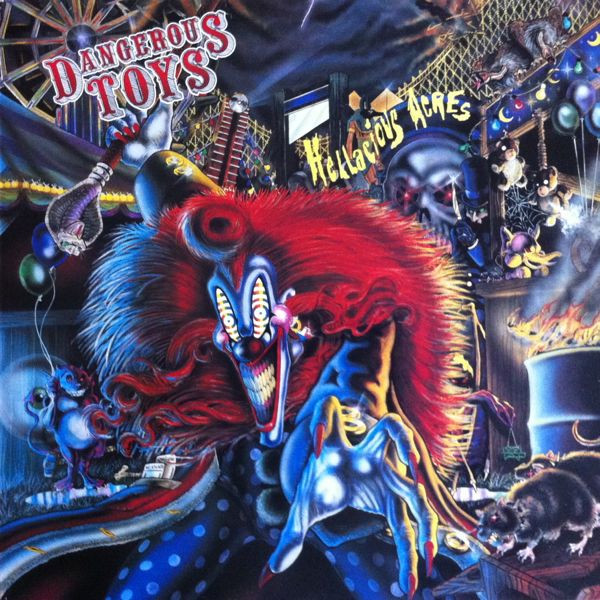
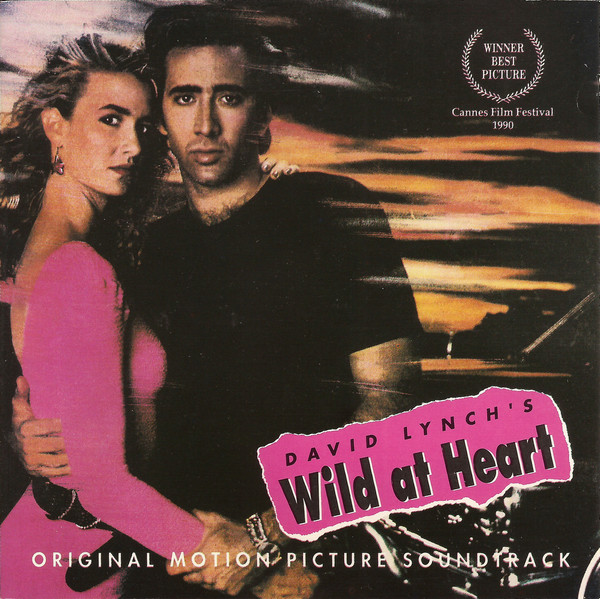
Now listening to Hellacious Acres by Dangerous Toys and Wild At Heart by various artists…
 Igor's Blog