Iran’s foreign minister has censured Washington for vetoing, for the third time, a UN Security Council resolution demanding an immediate ceasefire in the besieged Gaza Strip.
Hossein Amir-Abdollahian said “diplomatic catastrophe of the century” had taken place and the United States remains responsible for Israel’s savage campaign in Gaza since early October.
“Continued veto by the US administration clearly creates liability for the White House for the forged Israeli regime unceasing genocide in Gaza and war crimes in the West Bank, Palestine. The world must hold the US accountable,” the Iranian minister wrote in a post on X on Wednesday.
The United States used its veto power at the United Nations Security Council on Tuesday to block the draft resolution prepared by Algeria.
The draft rejected the “forced displacement of the Palestinian civilian population” and urged “all parties to comply with international law.”
Representatives of 13 countries at the 15-member Security Council voted in favor. Britain abstained.
The United States vetoed similar draft resolutions in October and December.
Washington has supplied the Israeli regime with more than 10,000 tons of military equipment over the past months of hostilities in Gaza.
Condemnations have poured in from across the world. Countries such as China, Russia, Saudi Arabia, and even Washington’s close allies, including France and Slovenia, have denounced the veto.
The Palestinian Ambassador to the United Nations Riyad Mansour has said the move was “absolutely reckless and dangerous.”
“The message given today to Israel with this veto is that it can continue to get away with murder,” he said in a statement to the Security Council.
Separately, Nasser Kan’ani, the spokesman for Iran’s Foreign Ministry, condemned the veto.
“The US measure … proved to the world once again that the US is not only not part of the solution to the crisis and humanitarian catastrophe in Gaza, but is the most important factor in the continuation of the crisis and the cause of its expansion to the region.”
Kan’ani said the veto “clearly confirms Iran’s accurate assessment since the beginning of the ongoing crisis in Gaza that the US is the main director of the war and the one preventing the end of genocide and the killing of Palestinian children and women in the Gaza Strip and the West Bank.”
The uncalculated measures, Kan’ani said, by the US at the Security Council and its repeated use of the veto power have endangered global peace and made the United Nations unable to fulfill its main objective of protecting international security.
“This has weakened the trust of governments and nations in the UN role in guarding international peace and security,” the Iranian official said.
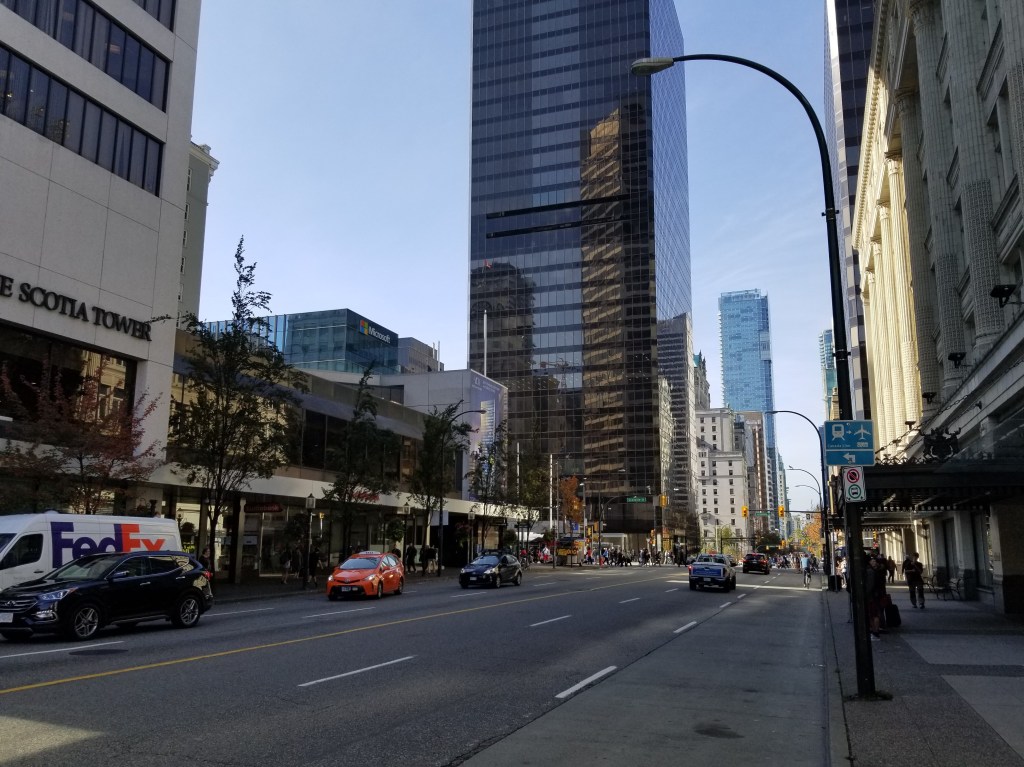
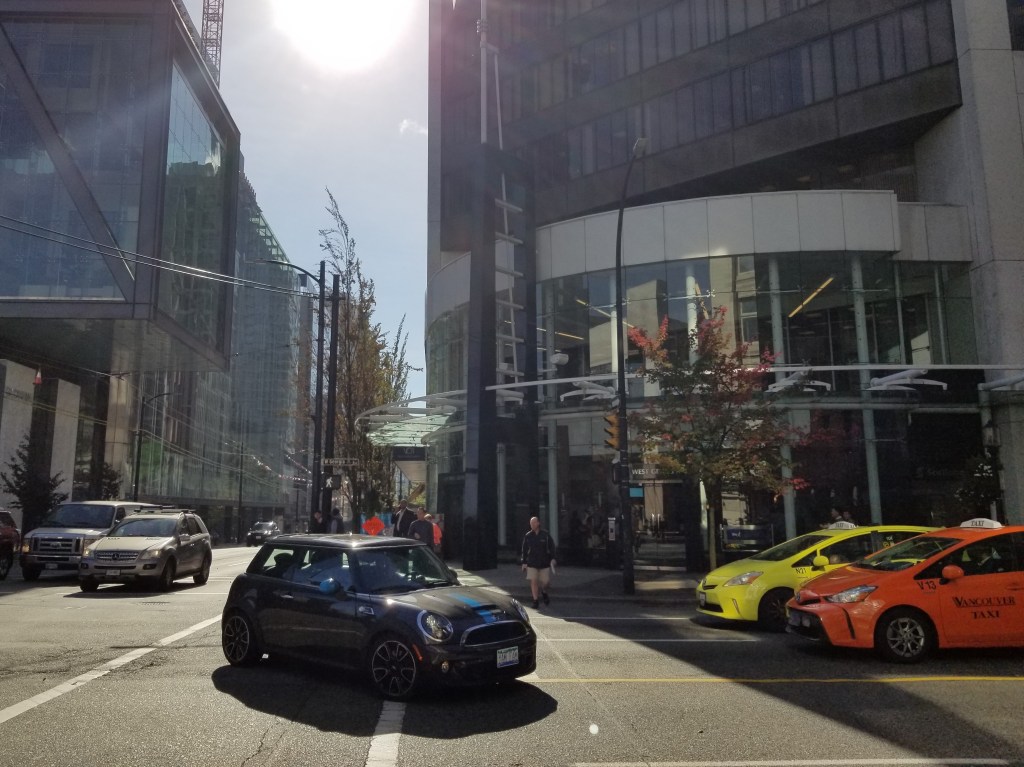
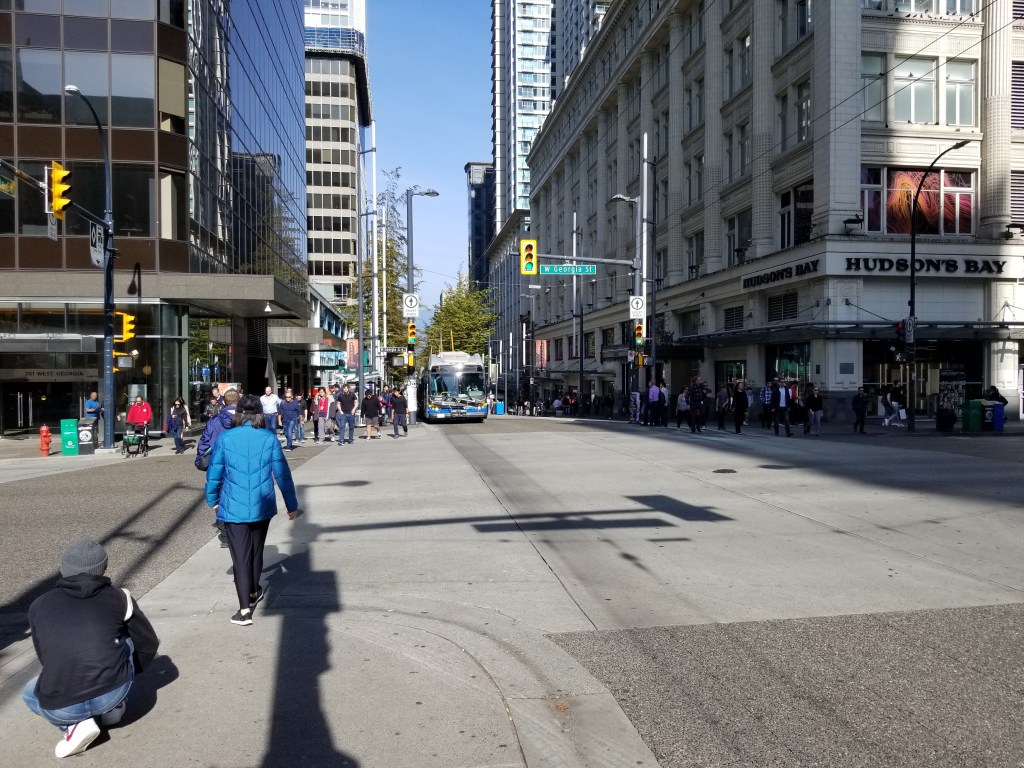
Georgia Street is an east–west street in the cities of Vancouver and Burnaby, British Columbia, Canada. Its section in Downtown Vancouver, designated West Georgia Street, serves as one of the primary streets for the financial and central business districts, and is the major transportation corridor connecting downtown Vancouver with the North Shore (and eventually Whistler) by way of the Lions Gate Bridge. The remainder of the street, known as East Georgia Street between Main Street and Boundary Road and simply Georgia Street within Burnaby, is more residential in character, and is discontinuous at several points.
West of Seymour Street, the thoroughfare is part of Highway 99. The entire section west of Main Street was previously designated part of Highway 1A, and markers for the ‘1A’ designation can still be seen at certain points.
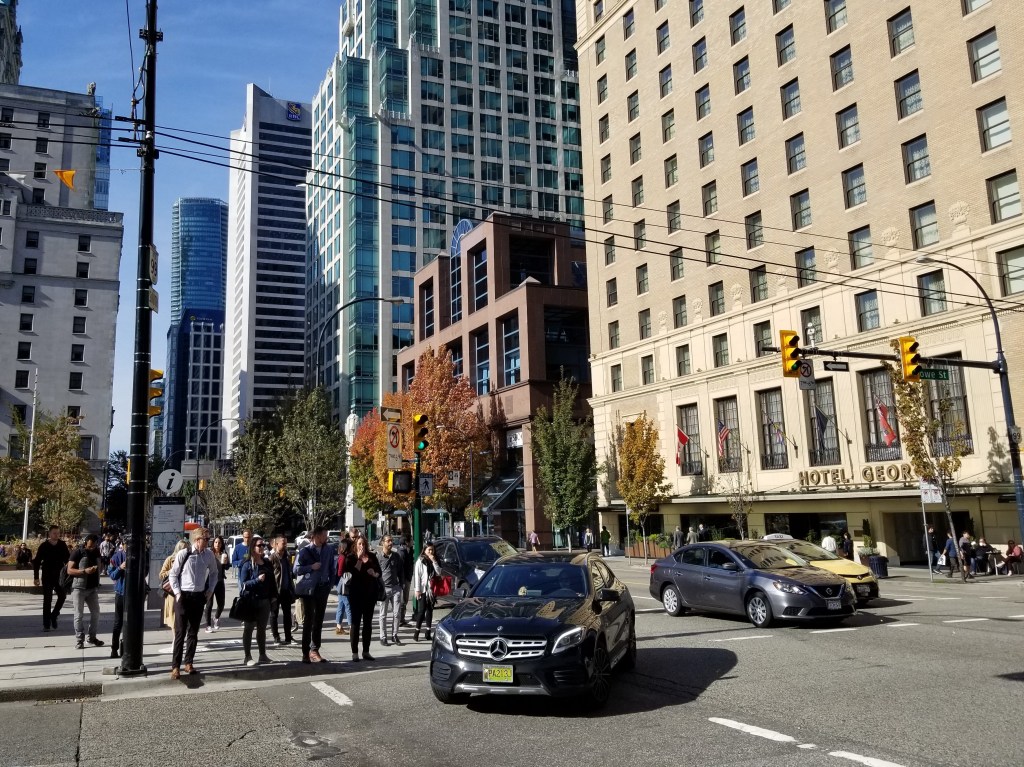
Starting from its western terminus at Chilco Street by the edge of Stanley Park, Georgia Street runs southeast, separating the West End from the Coal Harbour neighbourhood. It then runs through the Financial District; landmarks and major skyscrapers along the way include Living Shangri-La (the city’s tallest building), Trump International Hotel and Tower, Royal Centre, 666 Burrard tower, Hotel Vancouver and upscale shops, the HSBC Canada Building, the Vancouver Art Gallery, Georgia Hotel, Four Seasons Hotel, Pacific Centre, the Granville Entertainment District, Scotia Tower, and the Canada Post headquarters. The eastern portion of West Georgia features the Theatre District (including Queen Elizabeth Theatre and the Centre in Vancouver for the Performing Arts), Library Square (the central branch of the Vancouver Public Library), Rogers Arena, and BC Place. West Georgia’s centre lane between Pender Street and Stanley Park is used as a counterflow lane.
East of Cambie Street, Georgia Street becomes a one-way street for eastbound traffic, and connects to the Georgia Viaduct for eastbound travellers only; westbound traffic is handled by Dunsmuir Street and the Dunsmuir Viaduct, located one block to the north.
East Georgia Street begins at the intersection with Main Street in Vancouver’s Chinatown, then runs eastwards through Strathcona, Grandview–Woodland and Hastings–Sunrise to Boundary Road. East of the municipal boundary, Georgia Street continues eastwards through Burnaby until its terminus at Grove Avenue in the Lochdale neighbourhood. This portion of Georgia Street is interrupted at several locations, such as Templeton Secondary School, Highway 1 and Kensington Park.
Georgia Street was named in 1886 after the Strait of Georgia, and ran between Chilco and Beatty Streets. After the first Georgia Viaduct opened in 1915, the street’s eastern end was connected to Harris Street, and Harris Street was subsequently renamed East Georgia Street.
The second Georgia Viaduct, opened in 1972, connects to Prior Street at its eastern end instead. As a result, East Georgia Street has been disconnected from West Georgia ever since.
On June 15, 2011 Georgia Street became the focal point of the 2011 Vancouver Stanley Cup riot.
Nintendo Switch Online + Expansion Pack has just recently launched, giving subscribers access to Nintendo 64 and Sega Genesis games through emulation. A similar service was already available through the base subscription of NSO, which offered users NES and Super Nintendo games. Early adopters of the Expansion Pack subscription tier have already found some technical issues with the Nintendo 64 emulator technology that the Switch uses, meaning the service has failed to deliver on its ill-conceived, too expensive content package.
To be fair, the N64 and Genesis games are not the only differentiation between the Expansion Pack and the base NSO subscription. The Expansion Pass will also grant Animal Crossing: New Horizons players access to the Happy Home Paradise expansion when it launches on November 5. It also retains the perks of subscribing to the base NSO, including access to online play, the ability to purchase certain peripherals at additional cost, a handful of in-game cosmetic items, and the ability to play NSO-only games like Tetris 99 and Pac-Man 99.
However, Nintendo Switch Online is still rather short on functionality and exclusive content. It does not come close to offering the same features or member-exclusive deals as its closest competitors from Microsoft and Sony. Xbox Live Gold and PlayStation Plus are nearly equivalent in yearly price to Nintendo Switch Online + Expansion Pack, but the latter doesn’t offer dedicated usernames, built-in party chat, even lower sale prices for subscribers, or monthly free games (not to mention the entirety of the PS+ Collection on PS5). On top of NSO’s well-known shortcomings, the service’s premium model has now brought faulty emulations of its most anticipated feature: Nintendo 64 games.
Not long after the Nintendo 64 games went live alongside the NSO + Expansion pack, Twitter user Toufool posted a video demonstrating the input lag present when playing The Legend of Zelda: Ocarina of Time. A follow-up tweet shows a slow-motion comparison between Ocarina of Time on the Switch and the original version on the N64. When the discovery was shared to the NintendoSwitch subreddit, user Dacvak did a more comprehensive investigation, comparing the new NSO version of Super Mario 64 to that previously released for the Switch through the Super Mario 3D All-Stars collection, which also uses emulation for all three games.
Dacvak’s methodologically is admittedly rather rudimentary as far as technical tests go, using the slow-motion video capture on an iPhone 13 Pro, but the range of results gets the point across. Super Mario 3D All-Stars has an input lag for Super Mario 64 of somewhere between 112 and 137 milliseconds, while the new version of SM64 included in Nintendo Switch Online + Expansion Pack has an input lag clocking in somewhere between 150 and 167 milliseconds. According to Dacvak, “this means there is roughly a frame to 1.5 frames of additional latency in the NSO version.” One or two frames dropped from a button press to the corresponding action happening on screen isn’t a major concern, but it should be emphasized that this is a comparison to another emulated version of the game, not the original Super Mario 64 running on its intended hardware, which would likely have the lowest latency.
Another issue – one that’s perhaps more noticeable than input lag – is an apparent problem with rendering fog and reflections in the Expansion Pack’s N64 games. Twitter user stopskeletons shared a few screenshots comparing the water quality in Ocarina of Time, specifically the shallow pool in the Water Temple’s mini-boss room where the player fights Dark Link. Missing visual effects have completely changed the room’s aesthetic, with the new NSO version of Ocarina lacking all reflections in the water and fog that’s used to make the area appear boundless.
Digital Foundry’s John Linneman, who uses the handle dark1x on Twitter, suggests it’s the emulation tech itself that is responsible for the rendering issues, meaning it could have an effect on every title available through the Expansion Pack. Stranger still is the fact that Ocarina of Time has been emulated wonderfully by Nintendo in the past for the Wii and Wii U Virtual Consoles, though Linneman says the NSO emulator looks to be based on the one used for Super Mario 3D All-Stars. Nintendo Switch Online’s N64 games are presented in their native 4:3 aspect ratio rather than full screen, which helps preserve their dated graphics, but it’s all for naught if the emulator can’t properly display the games anyway.
These issues may sound like nitpicks, and relative to game-breaking bugs, they are, but the fact of the matter is Nintendo has charged consumers for a service and failed to deliver what was promised. These may be small complaints in the grand scheme of things, but increased latency and missing visual effects in games that are over two decades old make the Expansion Pack emulations objectively inferior to the originals they are adapting. The N64 and Sega Genesis games are the only offerings in the Expansion Pack until the Animal Crossing DLC launches on November 5, and it costs more than double the standard NSO subscription.
Issues like those above could easily be chalked up to simple oversights or unfortunate limitations in the emulation tech, but a failure to rework features that require the N64 Controller Pak, as documented by TriThreat98 on Twitter, begins leaning the whole situation in the direction of apathy toward the consumer. Without a Controller Pak, it’s impossible to save ghost times on the NSO version of Mario Kart 64. A Controller Pak goes in the back of a Nintendo 64 controller, and the ones specifically made for the Expansion Pack games don’t even have a slot for one. This is bordering on game-breaking since the entire time trials game mode is now useless in Mario Kart 64.
Those who don’t wish to pay another $50 (the same price as a yearly Expansion Pack subscription) for the Switch-compatible controller will also have to deal with Nintendo’s attempt to graft the Joy-Con button layout onto N64 games. As Twitter user Shiori_Ishimaru and Reddit user Enraric have pointed out, rearranging the layout for the N64 controls is almost nonsensical, since the right Joy-Con doesn’t have enough buttons by itself. Custom button mapping is also not possible for the NSO games, and the Switch’s system-wide re-mapping doesn’t solve the issue. Even more complaints have been compiled in a ResetEra thread, which includes delayed audio, frame rate drops, and various issues with music tracks.
Nintendo has taken its already lackluster online service, added these games which are riddled with issues, and charged more than double with the promise of DLC content being included at a later date. The second subscription tier for Nintendo Switch Online was anti-consumer enough, and now the poor execution of the only currently available content in the Expansion Pack is frankly inexcusable. Nintendo’s perennially full-priced games and unwillingness to fix Joy-Con drift are beside the point, but they are emblematic of a pattern in which the company has no regard for the consumer, with the Nintendo Switch Online + Expansion Pack N64 games debacle being just the most recent example.
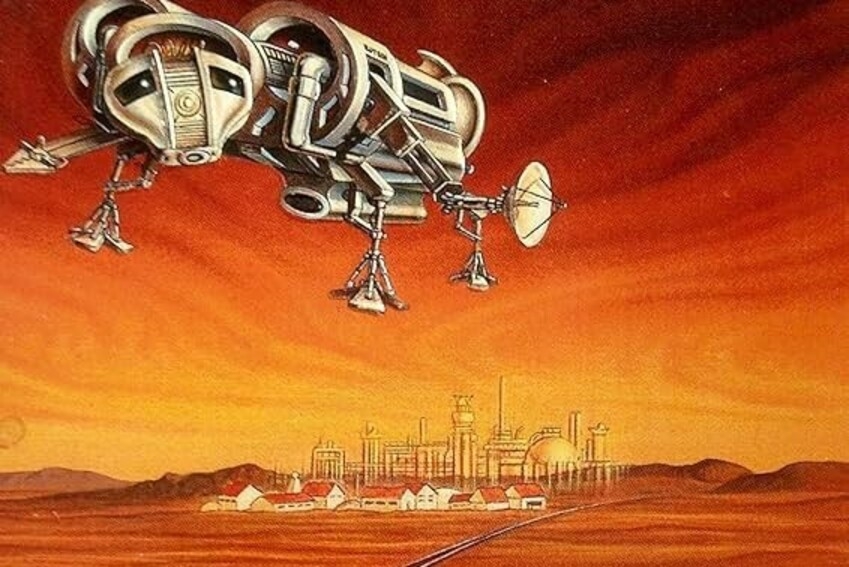
I figure this much: Ian McDonald’s Desolation Road starts with a green man crossing the desert, so this has to be the perfect book for Green Man Review. OK, the book calls him a “greenperson,” and the desert is on a Mars of the future, transformed by mankind’s effort, but you get the idea. Trailing this greenperson is Dr. Alimantando. He comes to a place along a railroad, where, almost accidentally, he settles and starts the community that he names Desolation Road. Soon after, more people begin arriving and, in short order, the community becomes a village, a city, a war zone and a ghost-town — all within 23 Martian years. That’s the story.
But the story is far more than that. The future will have its myths, legends, and fairy tales. Desolation Road, more than a straightforward novel, is a cycle of these tales with odd visitors coming to Desolation Road — some of them staying — and its children leaving for their own adventures throughout Mars. Along the way, the reader meets, among many others, cybernetic saints; a four-handed guitar player who has killed in a musical duel; and a master of deadly sarcasm. Besides Desolation Road, the story takes the reader across a futuristic, fantastical Mars, from the wicked city of Belladonna, where nearly any vice can be found, and Glen Miller owns a jazz bar, to the toxic, sulphurous lakes of Kershaw.
McDonald endows the Martian world with people and places, at once futuristic and archetypal. Sacred groves and forests are recalled by “the Forest of Chryse, the Ladywood, oldest of all the world’s young places, where St. Catherine herself planted the Tree of World’s Beginning with her steel manipulator.” The list of snooker opponents who fall to Limaal Mandella reads like a list of knights taken on and defeated by a great champion. The feel of Desolation Road comes close to matching Cordwainer Smith in creating new, but quite human, spiritualities in fantastical, futuristic settings — quite an accomplishment, in my judgment.
There is one problem with Desolation Road: There are so many characters that few get portrayed with the depth they deserve. For example, Rajandra Das, the hobo with an empathy with machines, has a nice scene at the start, is there almost to the end, but does very little in between — and most of that has nothing to do with his talent. Eva Mandella spends the novel weaving a tapestry of the history of Desolation Road, but is little more than a shadow in the background of the story. Even the characters who get more meat to their personalities — for example, the mystical, saintly Taasmin Mandella and her rational, champion snooker-player brother, Limaal — get far less attention than they deserve.
But this sort of annoyance is common to many a fine novel. Desolation Road has a feeling of a chronicle — a holy scripture, almost — and such narratives are rather given to such gaps. Furthermore, it is fair to say that the main character of this story is not any of the individuals in it, but rather the eponymous community. The result is a novel that is highly satisfying, but oddly unfulfilling. I liked it a lot — but I still want more.
Laura and Massimo’s ongoing sexcapades are less repugnantly rape-y than their first ‘365 Days,’ so there’s very little for the sequel to do.
LOL. So in a twist so unexpected they’ll hear you gasp in Warsaw, the second installment of Barbara Białowas and Tomasz Mandes’ adaptation of Blanka Lipińska’s “365 Days” trilogy drops today on Netflix, and it’s piping hot trash. Moreover, largely absent the first film’s outright offensive rape apologism — “Baby Girl” Laura (Anna-Maria Sieklucka) even refers to her erstwhile kidnapping as “sick” at one point, marking an empowerment arc as skimpy as her underwear — this time out there’s even less of what in screenwriting terminology is called a “reason” for the “story.”
Without the flimsy, regressive “Beauty and the Beast with Two Backs” structure of the 2020 megahit (still the most successful movie ever in terms of number of days spent at No. 1 on Netflix worldwide), Lipińska and co-screenwriters Mandes and Mojca Tirš, in need of something to fill the slivers of time between soft-focus shagging sessions, go back to the classics. Which in the “365 Days” universe does not mean Aeschylus, but “As The World Turns.” Or “General Hospital.” Or “All My Children.” Or basically any soap opera that aired long enough to resort to the most eyeroll-inducing of plot contrivances, which spoiler sensitivity mandates must not be revealed here, but, yes, it’s that one. You know the one.
So wait, can this mean that Laura survived the last film’s ending, a cliffhanger so uninspired it was set on a literal cliff? Reader, she did! The sequel opens with Laura on her wedding day receiving a visit from her Sicilian mafioso fiancé Massimo (Michele Morrone, the human incarnation of the smoldering ruins of Rome circa AD 64) before their nuptials. “You shouldn’t be here,” is the first line she speaks (in fairness she can rarely get a word in between the wall-to-wall rock balladeering of the soundtrack) as she coyly turns away from one of approximately 26 featured Mediterranean horizons. But unsolicited though Massimo’s arrival may be, her second line — “I don’t have panties” — suggests it’s hardly unexpected. Their subsequent sun-flared lovemaking confirms that while Episode One’s attempt on her life may have caused Laura to lose the pregnancy she’d never told Massimo about, it has not otherwise marred her rockin’ bod, nor even mildly inhibited her flexibility.
Enter Laura’s party-girl BFF Olga (Magdalena Lamparska), shrieking about bad luck and shooing Massimo away, just in time for Laura to redo her makeup, briefly don some knickers and slo-mo up the aisle to “Ave Maria.” Then the “November Rain”-video vibe gives way to a sexed-up Sandals resort commercial as the honeymoon passes in a blur of light bondage, pool sex and a truly hilarious game of erotic golf. They ride ponies on the beach at sunset. Laura goes brunette again. And then it’s back to the grind, as the newlyweds encounter such relatable newlywed issues as being bored while one’s spouse plots a rival family’s downfall and being distracted by the bulging tool belt of a scaldingly hot gardener (Simone Susinna, fair play to the casting agents for finding the only actor on earth who could make Morrone look merely quite handsome by comparison).
The gardener — OR IS HE? — is called Nacho, appropriately for such a tasty snack, and shows up just in time to be a tattooed deltoid to cry on for Laura, who is becoming a bit frustrated with being the kept woman of a sexually aggressive but emotionally repressed gangster who only deals in groin-based intimacy. It’s hardly surprising the couple have a communication problem, given that Polish-speaking Laura and Italian-speaking Massimo use ESL-weekend-course-level English as their love language, and both have clearly been too busy humping to keep up with Duolingo. Exclamations like “Get me out from here!” “How do I look like?” along with Massimo’s often indecipherable cadences and Laura’s mangled pronunciations of words like “guaranteed” suggest they’d be a lot better off if only their relationship, like their movie, came with closed-caption subtitling.
Then Laura discovers hubs being groinally intimate with his ex-girlfriend Anna (Natasza Urbanska) at a party. Flinging her phone into the sea, Laura, never one to engineer her own escapes, husks “take me away from here” to Nacho. They abscond to another paradise island and another paradise villa, differentiated from Massimo’s mainly because the furnishings are predominantly wicker. They have sex — or do they? Is it perhaps all a dream? The eternal gauziness of DP Bartek Cielica’s ’90s music-video cinematography, set to the omnipresent off-brand rock-pop contributions from incredibly overworked composers Patryk Komór and Dominic Buczkowski-Woytaszek, make it very hard to tell Laura’s softcore fantasies from Laura’s softcore reality.
But then, that’s the point here. The sex scenes are varied, at least in terms of location — honestly, you’ll never look at a putting green the same way. There’s a Christmas tryst in which Laura’s gift to Massimo is herself, trussed up in leather wristband restraints with “fuck me” somewhat redundantly emblazoned on them in gold, lying on a rumpled sheet alongside a cornucopia of sex toys — even one that is none-too-subtly inserted from a southerly direction right as the singer wails, “I wanna do bad things to you.”
But whatever marginally transgressive sex acts may be implied, it’s the black-and-gold vibrators and the bedsheets and Laura’s complicated lingerie that are really the focus of this tiresomely basic erotic fantasia: Like the “Fifty Shades of Grey” franchise that inspired this flagrant rip-off, the “365 Days” films are less about the sex than they are about the stuff. The suits and sunglasses, villas and jetskis, shopping montages and stripper heels, Lamborghinis and Corvettes. Long before “This Day” closes on its inevitable cliffhanger — this time genuinely one of the funniest slow-motion shootouts ever — it’s devolved into the lifestyle catalogue it was always destined to be, once the ick of its initial premise wore thin. Which is good news for franchise stakeholders eyeing future installments up to and beyond Lipinska’s third book, because dunderheaded rape-romance plots might get you to 365 days, but stuff? Stuff is forever.









 Igor's Blog