






Michelangelo, Pietà, 1498-1500, marble (Saint Peter’s Basilica, Rome) Speakers: Dr. Beth Harris and Dr. Steven Zucker.
The Pietà was a popular subject among northern european artists. It means Pity or Compassion, and represents Mary sorrowfully contemplating the dead body of her son which she holds on her lap. This sculpture was commissioned by a French Cardinal living in Rome.
Look closely and see how Michelangelo made marble seem like flesh, and look at those complicated folds of drapery. It is important here to remember how sculpture is made. It was a messy, rather loud process (which is one of the reasons that Leonardo claimed that painting was superior to sculpture!). Just like painters often mixed their own paint, Michelangelo forged many of his own tools, and often participated in the quarrying of his marble — a dangerous job.
When we look at the extraordinary representation of the human body here we remember that Michelangelo, like Leonardo before him, had dissected cadavers to understand how the body worked.

I’m still slowly playing Persona 4 again. That’s not surprising since it’s one of my favorite video games. I’ll briefly mention that the game has many clever details. For example, on September 6, you can speak to Teddie in your classroom. This is odd because he isn’t a student at your school. He says, “I’m busier than most of you, so I can’t come every morning. I mean, I have to eat breakfast, go back to bed, eat lunch, watch some TV… And that’s not even counting time for snacks! You might not think so, but coming here is pretty tough to fit into my schedule.” Another funny dialogue occurs at school on April 12, when Mr. Morooka says, “Awright, shut your traps! I’m Kinshiro Morooka, your homeroom teacher from today forward! First things first! Just ’cause it’s spring doesn’t mean you can swoon over each other like love-struck baboons. Long as I’m around, you students are going to be pure as the driven snow! Now I hate wasting my time, but I’d better introduce this transfer student. This sad sack’s been thrown from the big city out to the middle of nowhere like yesterday’s garbage. And he’s just as much of a loser here as he was there, so you girls better not get any ideas about hitting on him! Now listen up! This town is miles away from your big city of perverts and assholes, in more ways than one. You better not even think of getting involved with the girls here, let alone abusing them! But what do I know… it’s not like the old days. Even here, kids grow up so damn fast. Every time I turn my back, you’re fooling around on those damn phones, checking your life-journals and your my-places…” In fact, there’s plenty of interesting dialogue in the game. It’s often worth it to just listen to unimportant characters at school or elsewhere in the town. The director, Katsura Hashino, even said that there’s so much dialogue in the game that some of it had to be cut in order to fit the game on a disc. Much of the dialogue can be found at https://lparchive.org/Persona-4-Golden/. In addition, you can find and speak to some characters around town that are later revealed to be of much importance to the story. One example is Taro Namatame, who can be found in the Shopping District or on Samegawa Flood Plain. Moreover, when he’s there, the weather is usually sunny, there’s no music playing, and you can hear the sound of birds and crickets.
I recently finished reading the April 2008 issue of Play magazine, which existed from 2002 to 2010. This U.S.-based magazine focused on video games, manga, anime, and other media such as film and television, comics, and music. The two cover stories in this issue are about the ports of Death Jr. II: Root of Evil (2006) and Okami (2006) for the Nintendo Wii. The inclusion of the article about Okami is probably why I downloaded this issue from https://archive.org/ several years ago. At the beginning, there’s a paragraph about the announcement of Gears of War 2, which was released at the end of 2008. I had a mild desire to play Gears of War (2006) and its sequels for a long time, since it’s an “over-the-shoulder” third-person action game, like Resident Evil 4 (2005). I had a fantastic time playing Resident Evil 4 on my Slim PlayStation 2 and the Dead Space trilogy on my PlayStation 3 Super Slim. Now I can claim that I’ve completed two of the Gears of War games, on my Xbox 360. It’s too bad that these games aren’t available for PC, but I’m not clamoring for a release of these games for PC because when a game is ported to another platform, it’s usually as some kind of remaster nowadays, and I just hate remasters. Are the Gears of War games as good as the other great “over-the-shoulder” shooter games? No, they’re not. But I still had a very good time playing them, and they deserve to be listed among the greatest video games of all time. The gameplay is very simple. Because of this, it can be played and enjoyed by any meathead. And the story is about human meatheads that shoot at alien meatheads. Resident Evil 4, the video game that revolutionized shooters and had a massive impact on the video game industry, was directed by Shinji Mikami. I think that Mikami, like many other great video game designers, is autistic. Gears of War didn’t really revolutionize anything, but it does have its own style of gameplay, which separates it from other shooters in a minor way. This gameplay involves a cover system. That is, you don’t just stand and fire your guns in Gears of War. You, playing as Marcus Fenix, have to frequently take cover in order to recover health and to avoid enemy fire. This style of gameplay is actually quite entertaining once you get used to it. The graphics and the designs are generally excellent. I must admit that, like in the Dead Space games, I spent a lot of time simply standing and looking around at the scenery in the Gears of War games, though there are fewer good-looking and interesting things to look at than in the Dead Space games. The surroundings in the Gears of War games are usually ruined buildings, but they still have a certain charm because of the detailed designs and use of light. Perhaps the only real downside in the Gears of War games is that the story and the characters aren’t very interesting. The story is definitely not the main draw in these games. It is interesting from time to time. But, hey, in Gears of War 2, you get to kill a “giant worm” from the inside. That’s kind of cliche, but still “cool”. Anyway, the first cover story in the magazine is on page 10, and it’s about Death Jr. II: Root of Evil, which is a game that I haven’t played. Ten pages are dedicated to this game. I can’t really comment on this game since I haven’t played it, but it got a high recommendation from Play magazine, with the statement “If you have a Wii you need this game.” I did, however, play Death Jr. (2005) for the PlayStation Portable, which turned out to be an average shooter with an almost non-existent story, though I suppose that this game still has a certain charm. The article about Death Jr. II: Root of Evil is then followed by several articles about upcoming video games. The games mentioned are Iron Man, Lego Batman: The Videogame, Ninja Gaiden II, Fable II, Damnation, Disgaea 3, Castle Crashers, Bionic Commando Rearmed, Grand Theft Auto IV, Hail to the Chimp, and The Incredible Hulk. Then comes a review of Okami for the Wii, the first real review in the issue. This article was easily the biggest draw of the issue for me, and I must say that almost nothing else in the issue interested me or grabbed me, though I generally agreed with what the editors had to say. I included a short review of Okami in an earlier post of mine, after I completed the game for the first time. This is easily one of the best games for the PS2, and it’s one of my favorite video games. I haven’t played Okami for the Wii. Therefore, I can’t comment on how it compares to the original game for the PS2. Play magazine gave it a rating of 9.5 out of 10, stating the following. “Okami, to me, is one of the most important games of the past 15 years. Not because it features an elegant mythological story told through a tree spirit and a bug (sorry Issun), nor because it features a mute four-legged wolf god as a savior – although both points are worthy of a moment of silence for Clover Studios. What makes Okami so timeless is an art style that transcends technology. It looks as new today as it did in 2006. And it will look as new in 2010 as it does in 2008. In rare circumstances art can actually triumph over technology. Never has that rung so true as with Okami. But that’s only the beginning of this game’s towering achievement. It also set new standards in interaction via the celestial brush used in both the real-time battles and the practical world where the player wields the brush like a god, bearing sunlight, fruit and safe passage. How is it then that Okami became the final nail in Clover Studios’ coffin? After reinventing side-scrolling action with Viewtiful Joe and adventure with Okami, they were thanked with dismal sales. The face of the matter is that high-concept avant-garde games appeal to a relatively small (yet oh-so-appreciative) audience. It isn’t until later that the rest of the world catches up. It’s the Blade Runner effect all over again. The greatest science fiction movie ever created tanked out of the gate, but over time became a legend in filmmaking.” The review of Okami is followed by reviews of Universe at War: Earth Assault (8.5 out of 10), Condemned 2: Bloodshot (9.5 out of 10), Army of Two (8 out of 10), Viking: Battle for Asgard (9.5 out of 10), SNK Arcade Classics Vol. 1 (9 out of 10), Super Smash Bros. Brawl (10 out of 10), Castle of Shikigami III (7 out of 10), WWII Aces (2 out of 10), FIFA Street 3 (6.5 out of 10), Mana Khemia: Alchemists of Al-Revis (7 out of 10), The House of the Dead 2 & 3 Return (7 out of 10), Obscure: The Aftermath (7.5 out of 10), Turning Point: Fall of Liberty (5 out of 10), PixelJunk Monsters (9 out of 10), Sega Superstars Tennis (8.5 out of 10), Crisis Core: Final Fantasy VII (9 out of 10), God of War: Chains of Olympus (9 out of 10), Ninja Gaiden: Dragon Sword (9.5 out of 10), Rondo of Swords (8 out of 10), and Final Fantasy Crystal Chronicles: Ring of Fates (8 out of 10). I suppose that the editors of Play can be commended for reviewing a number of games for every console every month. The only game out of the ones mentioned that I’ve played and completed is God of War: Chains of Olympus. This happened recently, and I found the game to be enjoyable. Play wrote, “Had God of War: Chains of Olympus not begun to lose focus at the end and rely too much on recycled ideas, this unrivaled PSP game would be a contender to one-up last year’s awesome God of War 2. Confidently passed on to Daxter-developer Ready at Dawn while original series creator Sony Santa Monica stick to console, the God of War template is firmly intact, but it’s the subtle sensibilities of these fresh creators that make Chains of Olympus an even more rounded success. It’s not like that much has really changed fundamentally – a few added magic attacks are nifty but insubstantial – but there are enough stylistic flourishes and design choices that mark the game as something uniquely transformative for a Kratos adventure. God of War has gracefully pushed the PS2 to its limit in the past, so anything less on PSP is asking for trouble in the most obnoxious of gaming circles. No trouble here. There is not a moment in the presentation of Chains of Olympus that disappoints, there is maybe no better tech on the PSP. Add to the benchmark coding job an impressive level of artistry behind the Greek-mythology inspirations and you get a landscape both gorgeous and highly spirited. Credit a sweeping musical score for further layering on the thick mood.” When it comes to Crisis Core: Final Fantasy VII, Play wrote, “Last month, Nick Des Barres gave Play a thrilling preview of Final Fantasy VII: Crisis Core. Calling this game “console-quality gaming in the palm of your hand,” he promised that it would be the best part yet of the Compilation of Final Fantasy VII. Well kids, I come here today to confirm what Mr. Des Barres has set forth. Crisis Core is a full, complete, dignified game. It’s one of the few times in my life that I have played a portable title and lost touch with its material presence in my hands. Wrapped up in the presentation, engaged by the story, and startled by the music, I found myself playing a big game that just happened to be on a tiny screen. It’s so good that I wanted to get a PSP Slim just to be able to plug the bugger into my television at home – to anchor myself on my couch for a more robust experience. Crisis Core has been a system-seller in Japan. I hope it works the same way here.” The next article is about The World Ends with You (2007) for the Nintendo DS. It seems that this article was included only to praise the game and not to review it because the game was released almost a year before the issue came out and because no rating is given to the game in the issue. This isn’t a problem for me because The World Ends with You is one of the games that I’d like to play and because it’s a highly regarded NDS game. Play wrote, “If I was asked to cite one game that defines the NDS experience it would be The World Ends with You. No way this game gets made on console, and what a shame it would be if the spirit of true innovation was quelled during this vital turning point in gaming culture. Developed by the Kingdom Hearts team and Jupiter with character designs by Tetsuya Nomura and Gen Kobayashi (applause sign flashes), inspired by the aesthetics of Shibuya youth culture, it doesn’t get any more avant-garde, J-pop-vogue than this.” The next article includes thoughts and hopes about the upcoming Sonic Chronicles: The Dark Brotherhood for the Nintendo DS. Then there’s a long article about a revival of fighting games in 2008 and about the video games that were featured at the AOU 2008 trade show. The games mentioned and commented on are Street Fighter IV, Akatsuki Blitzkampf, Arcana Heart 2, BlazBlue: Calamity Trigger, Fate/unlimited codes, Mobile Suit Gundam: Gundam vs. Gundam Next, The King of Fighters ’98: Ultimate Match, The King of Fighters XII, Melty Blood Actress Again, Monster Ancient Cline, Samurai Shodown Sen, Sengoku Basara X, Tekken 6, and Virtua Fighter 5 R. After the article about Okami, this is my favorite article in the issue because it’s about a somewhat interesting event in the video game industry and because it features information that I didn’t know about before. Play wrote, “I’ve had a few months now to process the fact that we’re getting a Street Fighter IV. Initial media had me cautiously optimistic, and as much as I would have appreciated a high-definition, hand-drawn 2-D revival, my adult self knows that such a thing would not be appropriate for the Street Fighter brand in 2008. All that really matters is how it plays, and after having spent a combined four hours in line to play a total of two matches of SFIV, I can tell you that it is perfectly and quintessentially Street Fighter.” Then there are short articles about Tales of Destiny Director’s Cut, Warrior Epic, Blood Bowl, and Sacred 2: Fallen Angel. Then there’s an article about computer hardware and software. The issue came out when Windows Vista was still being used and when solid-state drives had yet to replace hard disk drives. I remember those days with some fondness now because at that time companies still tried to make electronic devices and laptops that looked distinct. Nowadays, almost all laptops, phones, and television sets look pretty much the same. And many great video games were still being released. Although I didn’t play video games at that time, let’s not forget that 2008 was the year of Braid, Burnout Paradise, Dead Space, Fable II, Fallout 3, Gears of War 2, Grand Theft Auto IV, Left 4 Dead, LittleBigPlanet, Persona 4, Rock Band 2, Spelunky, Street Fighter IV, Super Smash Bros. Brawl, and Valkyria Chronicles. Moreover, the economic crisis that began in 2008 had yet to reveal itself in full. Therefore, things weren’t yet as bad or as depressing as they are now. It was a time when Vancouver wasn’t being called a sh*thole by many people. At that time, if I had known that my favorite cinemas and stores would disappear in only a few years, I would have gone to those places more often. People don’t really miss something until it’s gone or until it becomes a rarity. Finally, at the end of the issue, there are several reviews of new films and television shows. The only reviews that interested me are of Appleseed Ex Machina and No Country for Old Men. It took a long time for me to finish reading this issue of Play magazine because I read it slowly. Although 2008 was a great year for video games, so far I’ve played only a few of the games that are mentioned in the issue, and almost nothing else interested me in the issue. Therefore, the issue can get only a mild recommendation from me, even if reading the issue was a bit of a nostalgia trip for me.
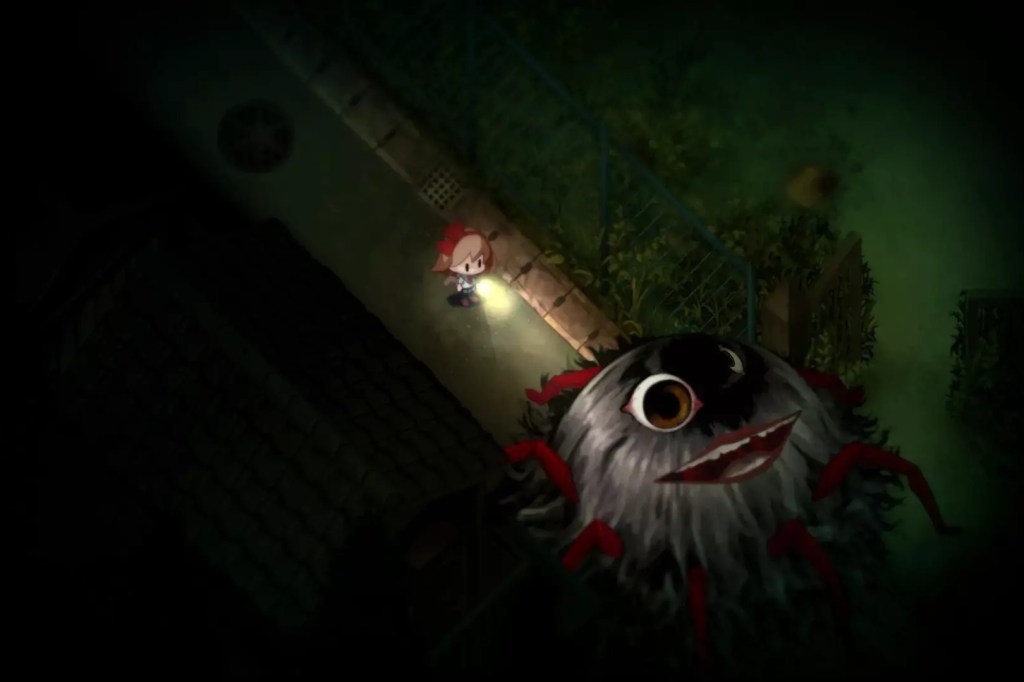
The town at night is empty, but its darkened streets aren’t completely free of activity. The shadowy dead stalk any who cross their paths, making going outside a task for only the bravest or most desperate people. When a young girl first loses her dog and then her sister disappears while looking for it, she has just the right combination of those two emotions to head out into the darkness after them. The ghosts are pure Japanese in origin, making them infinitely weirder than the “glowing translucent people” of western mythology, and when the sun sets they turn the town into a freakshow of shadows, specters, multi-legged demons, possessed items and other surprises waiting to jump out at a young girl who just wants her sister back.
Yomawari: Night Alone is a strange stealthy nighttime horror-adventure. It’s a mix of wonderful ideas, janky execution, emotional moments, and plenty of jump scares, set in a desolate open-world town and its surrounding areas. All the horror staples make an appearance- creepy schoolgrounds, haunted downtown area, shadowy shrines, abandoned factory, windswept rice fields, and plenty more all crawling with an assortment of the hostile undead. It’s dangerous out there, but the occasional Jizo statue acts as a temporary checkpoint (not, and this is very important, a save point, despite the text saying “quick save”) on the many, many times you get the poor girl killed off.
The nameless girl isn’t entirely defenseless, but it’s close. She mostly runs away from the ghosts, but hiding in bushes and signs works too. When running her stamina bar shrinks down at a pace that’s determined by how frightened she is, and when her heart is pounding with fear it dissipates almost instantly. For most ghosts this isn’t too big a deal, seeing as walking speed is just barely quick enough to keep her out of their grip, but there are a few encounters where this mechanic is maddening. The third chapter of the game see the girl running from the persistent ghost of a young woman who died after falling off a cliff, and it’s here that the game shows its controls are better suited to doing anything but action. The ghost’s attacks are quick enough that it’s easy to accidentally waste the tiny moment of Run that’s available before fear eradicates the stamina bar, making for a section that’s wildly aggravating. Thankfully it ends on a touching story note, but Yomawari is at its best when not putting its controls to the test.
Most of the time, thankfully, the girl is exploring the town, picking up keys and collectibles to help her on the way, all while using the flashlight to scout the ghosts ahead and plan the least confrontational way around. Some ghosts are always visible but most only show up in the beam of her flashlight. Their invisibility doesn’t make them any less dangerous, and that’s particularly tricky when they hang around more visible supernatural creatures who are triggered by light. Other creatures are more attuned to sound, requiring tiptoeing past, while still more ghosts just tool around minding their own business but utterly indifferent to mowing down whoever gets in their way. It’s a menagerie of the paranormal and if they aren’t overtly hostile then the best you can hope for is indifference.
Yomawari’s strongest point, in fact, is it’s personality, which shines through in every scene. The 2D art is gorgeous, easily overriding the stiff animations, and while the story is very light on the words it packs a strong emotional punch. I’m being purposefully quiet about a specific spoiler, in fact, but it shades the entire game with a sense of sadness for the girl who isn’t yet equipped to deal with her situation. She’s not out to save the world but rather find her dog and sister, and that’s a goal that’s easy to relate to despite knowing something the girl doesn’t.
Yomawari: Night Alone is a game that will be remembered more for its tone and story than gameplay, but that’s enough to recommend it. The PC port is clearly unoptimized from the Vita build, with issues like having to shoo the cursor off the screen every time you fire up the game, but the adventure of a little girl wearing a big red bow and a bunny backpack going out again and again into a haunted town is instantly engaging, hooking the player completely within the first couple of minutes. The variety of weird Japanese ghosts makes for a fantastically unique cast of threats and there are even plenty of harmless jump-scares just to keep you on your toes. While a bit rough and unpolished, Yomawari: Night Alone is a wonderfully spooky adventure that succeeds on pure heart.
Resident Evil 4 Remake is LAME and Everyone Will LOVE It. Resident Evil 4 is one of the greatest character action games of all time. Despite being branded as survival horror, or even a 3rd person shooter, the classic Resident Evil 4 we all know and love actually has much more in common with Shinji Mikami’s other beat em’ up classic, Godhand, than it does the other entries in the Resident Evil Franchise. When Resident Evil 4 Remake was announced two years ago, I was sure that the original gameplay of the game (the reason why the game has endured and been so compelling) will “updated” for modern gamers. I was right. After playing the Chainsaw demo for Resident Evil 4 Remake I cannot say I am surprised or even dissapointed, because I saw this train coming for years now.
In this video, I do recognize that I am in a minority when it comes to Resident Evil Fans and that my views on the game probably will only apply to a small sliver of the audience, but I think it’s imporant to discuss in depth, as I do, the combat and design changes that have taken place in this “update” because Resident Evil 4 Remake is another symptom in this trend of crushing unique combat and level design in favor of the bland and endlessly repeated standard action game model that we see today. Before even posting this video, I am sure I will read a pile of comments that will state that this game should be taken “on it’s own terms” and that holding it against the high standard of the original release is unfair or closed minded. To that I do want to say that if Resident Evil 4 Remake’s gameplay and design should be held on it’s own terms, why doesn’t it use it’s own design, it’s own marketing, and it’s own fanbase rather than plugging into an existing fanbase and then releasing a watered down fanfiction of the original? It’s a comprimise to begin with anyway as the Remake is trying to throw all these design ideas and mechanics into a blender and then hoping the final result turns out somehow better than the tightly designed original. Sure Capcom own the IP and copyright, but artistic merit is not bought and held in a legal department.
All that being said, I do understand that this Remake world is the universe we exist in, so I can understand why people will be interested in the game and will play it. I personally will play the full version of the game at some point, I’m sure it has a lot of fun moments the same way a cover song can be enjoyable to listen to. But the point I’m trying to get across in this video is that we currently exist in a very stale, lame, predictable gaming enviroment where even all time classics like Resi 4 are now being chewed up and spit out into digestible retreds. This video is not intended as a negative review outright, but since everyone else will talk about how perfect the remake is (I’m predicting) this vid will probably come across that way in comparison ha.
Resident Evil 4 Remake is going to come out on Steam (PC), PS4/PS5, and Xbox Series X. Apparently, the Xbox 1X owners, such as myself, are being left out in the cold because that console is cursed.
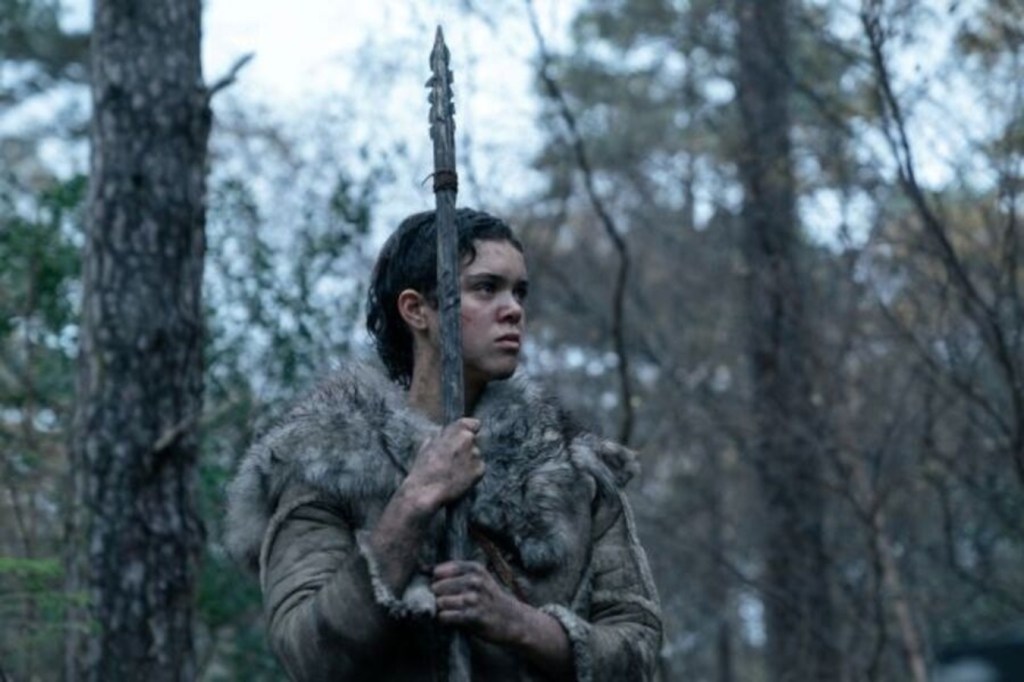
Crafting a survival horror based on the ancient world of prehistoric humanity sounds like a good idea. After all, surviving was pretty much the day-to-day business of being an early human. If you could get through the day with a bit of food in your belly and avoid being eaten up by a hungry predator or stung to death it was pretty good going. In short, it was a scary world, and horror was always just around the corner.
Terror in ancient lands offers plenty of scope for cinematic nightmares. The recent Adam Driver starring thriller 65 explored some similar territory, albeit much further back in time. Going back in our world’s time there are the early 1980s fantasy Quest for Fire and the very 60’s campy delights of One Million Years B.C. with Racquel Welch.
The major release of Out of Darkness (originally titled The Origin) delivers a tense and mysterious story rooted in the ancient world of 40,000 years ago. Based on the thoroughly researched idea of a band of early humans attempting to cross the big water to find new pastures to explore, Andrew Cumming’s film showcases the indomitable spirit of resilience.
The movie’s research team certainly did their work. As well as a detailed look at behaviour and group dynamics, there is even a unique language specially created for the film for the characters to communicate in. Inspired by the Basque language, which is thought by many experts to be the last remaining link to prehistoric languages present in Europe, the dialogue helps to place the story as taking place deep in the past.
Into this world a band of travellers – some family, plus a tough and wild ‘stray’ Beyah (Safia Oakley-Green) – set off in search of decent food and shelter. When they travel to a new world they find a gloomy atmosphere, fraught with danger and a stalking presence that seems to know their every move. Under the cover of darkness the mysterious enemy attacks, and starts taking them down one by one.
In this way, the movie operates like a deadly serious slasher movie. The unseen thing is picking them off, and when the youngest member of the tribe disappears, the story evokes ancient memories of children in peril legends. Without giving anything away, the movie – which I felt worked in its aim of imagining the confusion and motivation of early humans – shows off the need for understanding the Earth and its denizens to not just survive, but to flourish.
Out of Darkness is a fascinating update on the themes of survival in an unforgiving world. With richly captured cinematography, empathic group acting from the cast of new faces, and fluid action sequences, the movie places the audience in a cruel world where only the strong survive.
The real cue we can take from this ambitious tale is that the spirit of resilience in the human animal is still with us, and the adaptability we have shown to get this far is needed more than ever. Curiosity, compassion and imagination are all tools that still need to be honed to ‘make it’ as a species. The optimists among us will hope that we get there eventually.
Flickering Myth Rating – Film: ★ ★ ★ ★ / Movie: ★ ★ ★



There are many examples of children of foreign nationalities falling by the wayside in Japan, after arriving unable to speak the language and then struggling to fit in at school or in society.
But Sahel Rosa, 34, came to Japan from the chaotic aftermath of the Iran-Iraq War in the 1980s, and went on to become an actor and TV personality. She recently sat down for an interview with the Mainichi Shimbun, and reflected on the difficulties children from abroad can have when starting a new life in Japan, and the help she received which enabled her to succeed.
Mainichi Shimbun: Could you tell us a bit about the circumstances that led to you coming to Japan?
Sahel Rosa: I was born in 1985, in a small town in Iran. From age 4, I was living in an orphanage. A university student who came there are as a volunteer adopted me, and she became my mother. When she decided she would work in Japan, she took me with her, and I came here when I was 7. It was Aug. 13, 1993.
MS: Did you have any concerns then?
SR: I enrolled at Shiki Daisan Elementary School, a public school in Shiki, Saitama Prefecture (north of Tokyo), from the second term of second grade. I came in on a three-month holiday visa, so I was treated as an exchange student. The first thing that surprised me was that there were boys in the classroom. In Iran, where many people are Muslim, boys and girls study in separate schools until they reach university. I was also perplexed about wearing bloomers that showed my legs during P.E. lessons.
There were also differences in the way we communicated in standard situations. TV shows from Japan were shown on Iranian TV, and I watched a few of them. There was Oshin, Captain Tsubasa, Triton of the Sea, and Mito Komon. But they were all dubbed into Farsi, so I just thought everyone in the world spoke Farsi. In Iran, we speak using big hand and mouth movements, and it’s like we’re singing. Japanese people don’t tend to change their facial expressions too much when conversing, so at first I was scared because I thought they were angry.
MS: Did you manage to integrate at school?
SR: My classmates would all gather around my desk, and they’d try to communicate with me using gestures. They’d shout “Sahel” and then give me a thumbs-up and say “Good” in English. But, in Iran, a thumbs-up doesn’t mean good at all; it’s a gesture used to demean another person. Whenever someone would give me a thumbs-up with a smile, I’d think they were being rude to me, and I’d feel low.
But then I also did things that upset everyone. In Iran, when we want to say “Hey” to get someone’s attention, we make a kind a clicking sound with our tongue. When I did it when trying to make friends, the other children would get the impression that I had a bad attitude, or that I wanted a fight, and gradually people kept their distance from me. In class photos from the time, I’m standing on the edge looking down. I didn’t have a place where I felt comfortable. I didn’t understand a thing going on in classes, and at first I felt like I’d been abandoned there.
MS: According to a 1993 survey by the education ministry, the number of children “in need of Japanese language instruction” in elementary, junior high and high schools was reportedly around 10,450. That number is a fifth of today’s figures. With no educational framework in place, who did you learn Japanese from?
SR: My school principal. He was a kind, short teacher with glasses. He couldn’t bear to see me the way I was, and told me to come to his office. There, during the mornings until midday, he would teach me Japanese one-to-one. We didn’t use a textbook. For example, we would turn on a tap and touch the water, and I would mimic his pronunciation of the word for water. Through that method, I learned five new words each day.
The principal treated me as a friend. He would say, “I’m your friend. Wouldn’t it be good if we were able to talk to each other?” I felt like I wanted to speak with him more, too, so I went on absorbing more words. Like with riding a bicycle, being taught how to pedal is important. No matter how many times you fall over, if you know how to pedal you can take off again. As I showed people I was trying to communicate with the words I’d learned, even though I was making mistakes, my classmates started walking home with me after school. After about three months, I wrote about my experience with a jump rope. We had been on a field trip, and what had left an impression on me was when we all enjoyed doing this huge jump rope activity as a class.
MS: If your principal hadn’t taught you Japanese, what do you think would have happened to you?
SR: I don’t think I’d have come to love Japanese people. I wouldn’t have been able to make friends, and I’d have probably gone on misreading things as bullying. With my principal’s lessons, Japanese went from being something I perceived as a scary language to a polite and warm one. Language is a bridge that connects people.
If from the start I hadn’t been able to go to school, my life wouldn’t have turned out the way it has. When we came to Japan, my mother was married, but I didn’t get on well with my stepfather and they divorced. We were chased out of our one-room apartment in the middle of winter, and for two weeks I went to school while living in a park.
A school cook found out about our situation, and invited us to her house and gave us something to eat. She also asked a lawyer to help us apply for a visa that would mean we could stay in Japan, and even found work for my mother. If she hadn’t been there, we wouldn’t have escaped that park, and maybe have become people staying illegally.
When I was going to elementary school, the school got my textbooks, exercise books, notebooks, and pencils together for me. They even got me a school bag. For a foreigner who has just arrived in Japan, prices here are very high. It’s at the level where you have to think about buying a single can of juice. The principal and the others accepted us, and saved us. For that reason, now I feel like I want to give back to them, and as one way of doing that I continue to visit child welfare facilities and support refugees.
MS: It’s been more than 25 years since you entered that school, and in that time the number of foreign children coming to Japan has risen, but more than 10,000 of them are in “unsupported” situations where they don’t get the Japanese language education they need. What kind of support do you think would be best?
SR: If they attend classes while still not understanding the words, they’ll never get the knowledge they’re meant to. First, the important thing is to secure school courses focused on Japanese language teaching. When they go home, there’s no one who can explain their homework to them, and they don’t always have people in the neighborhood looking out for them, so the school needs to provide some kind of comprehensive framework, I think.
MS: Is there anything you want to say to the foreign children living in Japan today?
SR: Living in a country with a different language and culture to your own comes with a lot of struggles. The children working hard in the middle of all that can’t really be open about their worries and pain precisely because they are working hard on it. I was bullied when I was in junior high school, and there were times I thought I wanted to kill myself, but to my mother, who worked morning to night in a factory until she was exhausted, I would just lie and say, “School was fun.”
What I can say from that experience is that you don’t have to pretend to be strong. I learned afterwards, but in truth my mother also had her own concerns about living in Japan. If you really show your parents and the people around you your weakness, then by sharing your troubles, maybe a feeling that you can overcome them together will emerge.
—
Profile: Sahel Rosa
Born in Iran in 1985, she started her entertainment career when she was in high school, and made her radio debut on FM station J-Wave. Her performance in the short film “Cold Feet” won her the Best Lead Actress in a Foreign Language Film award at the 6th Milan International Filmmaker Festival. She is a goodwill ambassador for an international nongovernmental organization which aims to find all children a home, and she works to provide support and outdoor classes for children across the globe.
(Interview by Yuka Narita, City News Department)
 Igor's Blog