“Ghost Sweeper Mikami” is a 55-minute anime feature originally presented in 1994 as the final episode of the long-running Japanese television program of the same name. It seems fairly strange that it would take eight years for this highly entertaining production to make its way across the Pacific, but in this case we should be grateful that its American release is better late than never.
The eponymous heroine of “Ghost Sweeper Mikami” is a highly successful ghostbuster/exorcist who runs an independent agency that sweeps away the ectoplasmic nasties who haunt Tokyo. The buxom, red-haired Mikami is very much a woman of the go-go 1990s when it comes to accounts receivable, at one point commenting bitterly about a ghoulish foe: “I won’t live in a world where I can’t make a profit, and this guy’s bad for business.” Mikami’s staff consists of a motley bunch including the cowardly Yokishima (who is tied up to a flagpole as a bait for wandering ghosts), a mysterious blue-haired girl who floats through the air, a humorless priest who destroys ghosts with Billy Graham-worthy recitations from the Gospels, and a blonde dude who may or may not of vampiric heritage (the film is a bit vague on his roots and talents). However, Mikami is clearly the brains and brawn of the operation, knocking down her otherworldly opponents with the same vigor and enthusiasm that she tallies her earnings (the latter effort causes the priest to comment sourly: “She has a bad case of yen on the brain”).
Into this unlikely world comes the spirit of a 17th century samurai, who presents Mikami with a special lance designed to kill the resurrection of a Nosferatu who recently came back from the dead with the intention of taking over Japan. The behemothic Nosferatu, assisted by a white spider transformed into a pale assassin with arachnoid powers that make Spider-Man look like a horsefly, run amok and begin to upset Japanese capital by turning many of its inhabitants into flesh-eating zombies. Mikami, aided primarily by the samurai’s spirit (most of her team are trapped in a hospital overrun by zombies) takes on the Nosferatu in a spectacular battle that hops across the Tokyo skyline.
Admittedly, this is a great deal to pack in less than hour’s running time and “Ghost Sweeper Mikami” moves at breakneck speed to accommodate its wild plotline and bizarre characters; at certain times, this is not so much a movie as it is an adrenaline rush. The film is also blessed with wild over-the-top visual comedy and sarcastic humor that pokes fun at the excessive nature of both anime and science-fiction. Characters gets sliced, smacked, blown up, yelled at, and tormented with a fury that swings from manic to outlandish. At one point in the frenetic ebb and flow, Mikami pauses to observe her career landscape and wonders with mild confusion: “I don’t know why, but it feels like evil spirits are getting more powerful these days.”
At times, however, the film offers too much of a good thing. A pair of rival exorcists abruptly appear in mid-film to challenge Mikami’s pre-eminence, including one with the priceless moniker of Dr. Chaos, but they are quickly dispatched before their personalities can be established and their appearances ultimately make little sense. The aforementioned hospital which comes under zombie attack provides care to both humans and bizarre animals, though the latter creatures are never identified in any way. Perhaps it would help to be familiar with the television series from which the film is based, or at least the popular manga which was the original source of Mikami’s adventures, to understand some of the situations here.
Furthermore, it should be noted the animation here is not among the most challenging or imaginative. Even by the standards of television anime, “Ghost Sweeper Mikami” is often stiff and functional, with only a rare leap into the eye-catching (most notably the wild climactic fight). However, the film’s wit compensates for whatever shortcomings are evident in the animation, and “Ghost Sweeper Mikami” is a truly the one to call for busting up ghosts.
Is Canada a good place to live in? This video might surprise some of you. In it, I talk about how WHY LIVING IN CANADA SUCKS. Sorry! I go over 5 reasons why it’s really not a great place to live. If you’ve ever thought about living in Canada, or plan on moving there in the near future, do yourself a favor and watch this video! You might be surprised with what I have to say. The points I make are based upon my personal experience and research I have done on the subject.
A still from Trigun (1998), directed by Satoshi Nishimura
First of all, now that autumn is upon us, it’s beginning to rain almost every day again in Vancouver, and I’m beginning to miss the warm and sunny summer weather. The summer of this year and the summer of last year, however, had some surprisingly hot days. There were even a few days when I was losing so much water because of sweating due to the heat that I rarely had to go to the bathroom. I don’t remember it being this hot even when I lived in Los Angeles, California. Still, I do miss the sunny summer days. Since there are a few things that I can write about, I’ll be making a post at this time, though, yet again, I didn’t think that I’d be making a post so soon after my last post. I already mentioned in an earlier post that I’ve been taking serrapeptase capsules (serratiopeptidase), but this medicine hasn’t had the effect that I thought it would. My fatigue and my inability to think well most of the time are some of my most important health problems. I mean, I’m only a few decades old, but I feel like an old man most of the time, and this isn’t anything new because I’ve been feeling like this since I was a teenager. When I began taking serrapeptase capsules every day, it seemed to me that they’re the solution to some of my health problems because there was a noticeable beneficial effect right away. Thanks to these supplements, I began to have more energy and I began to think better. This happened in the first several days. But this superior state quickly subsided and hasn’t returned, though I continued to take the capsules every day. The inscription on the bottle with the capsules, however, doesn’t say anything about the capsules boosting a person’s energy. It says that the capsules are for relieving pain and swelling. The bottle that I purchased has capsules with 90,000 SU. There are also capsules with 60,000 SU or 120,000 SU available. I bought empty clear capsules separately and then emptied half of every serrapeptase capsule into an empty capsule so that my daily dose would be about 45,000 SU. I did this because I didn’t want the capsules to have a strong effect on me immediately. So, serrapeptase didn’t turn out to be the miracle drug that I thought it is, though it still has its benefits. Fortunately, several months ago, I found out about another medicine. It’s called ashwagandha (withania somnifera). My mother bought ashwagandha powder and recommended it to me. The inscription on the packet that she gave to me says that a teaspoon of ashwagandha powder should be consumed, but my mother proposed that I take only a fraction of that dose per day. After doing this for a few days, I didn’t notice any beneficial changes to my state, but I still purchased a bottle with ashwagandha capsules on the internet for myself soon after that. I don’t like to accept medicine or advice from my mother because she’s an abusive and controlling (neurotypical) woman who knows almost nothing about my health problems. Still, she does have a large collection of herbs and medicine, and it’s thanks to her that I found out about ashwagandha, though what actually helps me isn’t the ashwagandha powder that she showed me but the ashwagandha capsules that I bought. Since I didn’t think that ashwagandha is anything special, the bottle continued to sit on my table and I instead continued to consume serrapeptase capsules every day in the hope that they’ll improve my state. After a few months had passed, and after I realized that the serrapeptase capsules aren’t having the effect that I want, I decided to finally begin taking the ashwagandha capsules every day. The inscription on the bottle says that two capsules should be consumed every day, but I decided to take one capsule per day, at dinner time. And I continued to take my probiotics and serrapeptase capsules at breakfast time because they still have their own beneficial effects on me. The ashwagandha capsules improved my state immediately. They provided me with the energy that I thought serrapeptase capsules would continue to provide me with. I was actually kind of struck by how much better they make me feel. Thanks to the ashwagandha, I can think better and I have the energy that I need. Ashwagandha helps me to sleep better too. Since I have ADHD, I can have serious problems with sleeping normally. I already made a post in which I tried to remind myself about the importance of easing off in order to think more clearly so that I’d be able to act better in public. The ashwagandha capsules, however, allow me to do this effortlessly because they provide me with the energy that I sorely lack. The inscription on the bottle says that ashwagandha helps with resistance to stress and increased energy, and this is indeed the case. Moreover, ashwagandha doesn’t lose its beneficial effect with prolonged use. So, ashwagandha is the closest thing so far to a miracle drug that I’ve discovered. I just regret the fact that I didn’t begin taking these capsules right away and instead let the bottle sit unopened on my table for at least a few months. In addition, I continue to take my probiotics and serrapeptase because I think that they contribute to making me feel even better. Perhaps in the future I’ll try taking serrapeptase capsules with more than 45,000 SU in order to find out of this will have a better effect on me, but ashwagandha supplements seem to be the best thing that I have at this time, though it’s worth mentioning that what helps me is not the ashwagandha powder that my mother gave to me but the ashwagandha capsules that I bought myself. These capsules contain black pepper for increased absorption. The powder by itself has a considerably weaker effect. Well, the fact that I need special supplements and other medicine in order to feel better shows how hard it can be for an autistic person to function well in this neurotypical society that we live in. I found out that I have autism at the end of the summer of 2023. Since then, I’ve found out about some crucial things when it comes to my health. These findings are perhaps the most important findings that I’ve ever made. But autism isn’t my only serious condition. I have ADHD (attention deficit hyperactivity disorder) too. Having just one of these conditions can be very detrimental for some people. But I have both of them. I’m not surprised that autistics are called sufferers because I know first-hand that having autism means having a life of frequent suffering. Neurotypicals just don’t have to deal with the things that autistics have to deal with.
My health has been perhaps my top preoccupation in the last year, and I haven’t been using the internet for much else. Using the internet has become a somewhat unpleasant activity for me. I already mentioned in an earlier post that a website like YouTube is something that I don’t really like using anymore because it’s now crammed with propaganda and with dumb, useless, and even offensive content. YouTube is now a website that I visit almost entirely only when I search for specific things. Monetization has made YouTube even worse than American television, in some ways. And the internet as a whole has become an obnoxious money-making establishment. Almost every website that I visit has tons of advertisements now. These ads slow down or even freeze my web browser whenever I visit a website. Good informative websites are disappearing or becoming harder to find. What is easily accessible is only what the establishment wants people to see. I must say that the American authorities have succeeded in putting the internet under tight control in the last decade or so thanks to companies like Google and thanks to restrictions and copyright claims. But using the internet for watching new television shows and films has become a lot more convenient. That’s obvious. Cobra Kai (2018) and The Boys (2019) are the few new shows that I’ve been watching in the last several years, but I must admit that I haven’t done a good job of keeping up with these television series. I still haven’t seen season 5 of Cobra Kai and season 4 of The Boys. I’ve done a better job of keeping up with the shows that Marvel Studios has been releasing. I’ve taken a break from watching Dallas (1978) in the last year, though I’ve already reached season 9 of the show. I’ve been spending a lot more time recently on continuing to watch the Japanese tokusatsu shows that I have in my collection. I’ve already seen a good chunk of B-Fighter Kabuto, Juukou B-Fighter, Mobile Cop Jiban, Special Rescue Police Winspector, Seijuu Sentai Gingaman, Denji Sentai Megaranger, Kousoku Sentai Turboranger, Taiyo Sentai Sun Vulcan, Kamen Rider W, and Kagaku Sentai Dynaman. I’m so glad that there are people out there that create subtitles for these and other Japanese shows. These television series simply make me feel good when I watch them. I’m not surprised that there were many “otaku” in Japan in the 1980s and the 1990s because the excellent and original television series, anime, manga, and video games that were being made at that time are definitely worth collecting. In addition, I recently got hooked on watching Trigun (1998) and A Different World (1987). Trigun is an anime series that I’ve known about for a very long time, though I began watching it for the first time only recently. I found out about A Different World a few years ago thanks to an internet article. Having finished to read ‘Mysteries of the Past’ (1977) by Joseph J. Thorndike Jr. several months ago, I think that it’s worth complimenting this book now. The book claims to probe enigmas in the company of the best experts who have ever examined the evidence, with the benefit of the soundest scientific thinking. There are many, many things in this book that I found to be interesting, and it features excellent photographs on almost every page. The following quotation is from the chapter ‘What caused the collapse of the Maya?’. “The Maya, or at least the priestly and educated classes, were as profoundly intellectual in their approach to life as any people who ever lived. Their great genius was astronomy, their obsession was time. They devised a concept of universal time, and a method of keeping track of it, that is (so far as we understand it) as grandiose as any achievement in Western philosophy. They believed, as we do, that time had an infinite span: their calendar reached millions of years into the past, encompassing more than one creation. As astronomers they accurately calculated the length of the solar year (365.2420 days was their figure, as compared with our slightly more precise count of 365.2422), and in the sixth century A.D., at Copan, they recorded their correction for the 365-day year – a thousand years before Europe caught up to its calendrical inaccuracies and adopted the present Gregorian calendar with leap year. The Maya understood the movements of the moon, the sun, Venus, and possibly the other planets. Their mathematics included the concept of zero – a notion not adopted in Europe until the fifteenth century.” And the following quotation is from the chapter ‘How has climate affected history?’. “Shortly after 7 A.M. on June 30, 1908, early rising farmers, herdsmen, and trappers in the sparsely settled vastness of the central Siberia Plateau watched in awe as a cylindrical object, glowing with an intense bluish-white light and trailing a fiery tail, raced across a clear blue sky toward the northern horizon. At 7:17, over a desolate region of bogs and low, pine-covered hills traversed by the Stony Tunguska River, it disappeared; instantly, a “pillar of fire” leaped skyward, so high it was seen hundreds of miles away; the earth shuddered under the impact of a titanic explosion; the air was wracked by thunderous claps; and a superheated wind rushed outward, setting parts of the taiga on fire. At a trading post forty miles from the blast, a man sitting on the steps of his house saw the blinding flash and covered his eyes; he felt scorched, as if the shirt on his back were burning, and the next moment he was hurled from the steps by a shock wave and knocked unconscious. Four hundred miles to the south the ground heaved under the tracks of the recently completed Trans-Siberian Railway, threatening to derail an express. And above the Tunguska region a mass of black clouds, piling up to a height of twelve miles, dumped a shower of “black rain” on the countryside – dirt and debris sucked up by the explosion – while rumblings like heavy artillery fire reverberated throughout central Russia. Since seismographs and barographs everywhere had recorded the event, the entire world knew that something extraordinary had occurred in the Siberian wilderness. But what? Scientists conjectured that a giant meteorite must have fallen, exploding from the intense heat its impact generated. On hitting the ground, such a body would, theoretically, have blown out a huge crater like the one in Arizona, three-quarters of a mile square, left by a meteorite that fell fifty thousand years ago, but the Siberian “impact site” turned out to be a dismal swamp, with no trace of a meteorite to be seen. Nevertheless, for want of a better explanation, scientists continued to ascribe the cataclysm to a meteorite, and Leonid Kulik, a mineralogist who headed government-sponsored expeditions to the Tunguska in the early 1920s and again in 1938-39, searched for evidence to support this view. Although this search proved fruitless, Kulik uncovered a wealth of information about the blast. Near the swamp into which the meteorite had supposedly plummeted, scorched trees, stripped of branches, still stood, but around this weird “telegraph-pole” forest, except where intervening hills had shielded them, every tree within fifty miles had been blown flat, its trunk pointing away from the swamp. From this – and from his failure to find even a small impact crater – Kulik concluded that the meteorite had never reached the ground but had exploded two or three miles up in the air. During World War II Kulik was captured by the Germans and died a prisoner. The riddle he had worked to solve was forgotten. In August 1945, however, certain Russian scientists were abruptly reminded of it by the atom-bombings of Hiroshima and Nagasaki, events which seemed uncannily familiar in both their manifestations (the fireball, the searing thermal current, the towering “mushroom” cloud) and their effects (the instantaneous and near-total destruction, the radiation burns on living flesh, the accelerated growth of new plant life, even the “telegraph-pole” appearance of scorched and branchless trees standing below the point at which an atom bomb was detonated). Could the Siberian blast have been atomic? In 1958 a Russian engineer-turned-writer, Aleksander Kazantsev, published a story-article pinning that disaster on Martians killed on their way to Earth by cosmic rays or meteorite bombardment; their ship, with no one at the controls, hurtles into our atmosphere at reduced speed and burns up from friction, triggering a chain reaction in its atomic fuel that sets off the explosion. Few informed readers by then still accepted the meteorite theory, and some, particularly younger men and women, found Kazantsev’s hypothesis persuasive, but others rejected it in favor of an earlier alternate explanation, according to which the head of a comet had penetrated the atmosphere at such high velocity that the heat thus generated had caused the comet to blow up. (Skeptics pointed out, however, that a comet could hardly have approached Earth without being seen). In the end, we do not know what caused the cataclysm in Siberia. We may never know.”
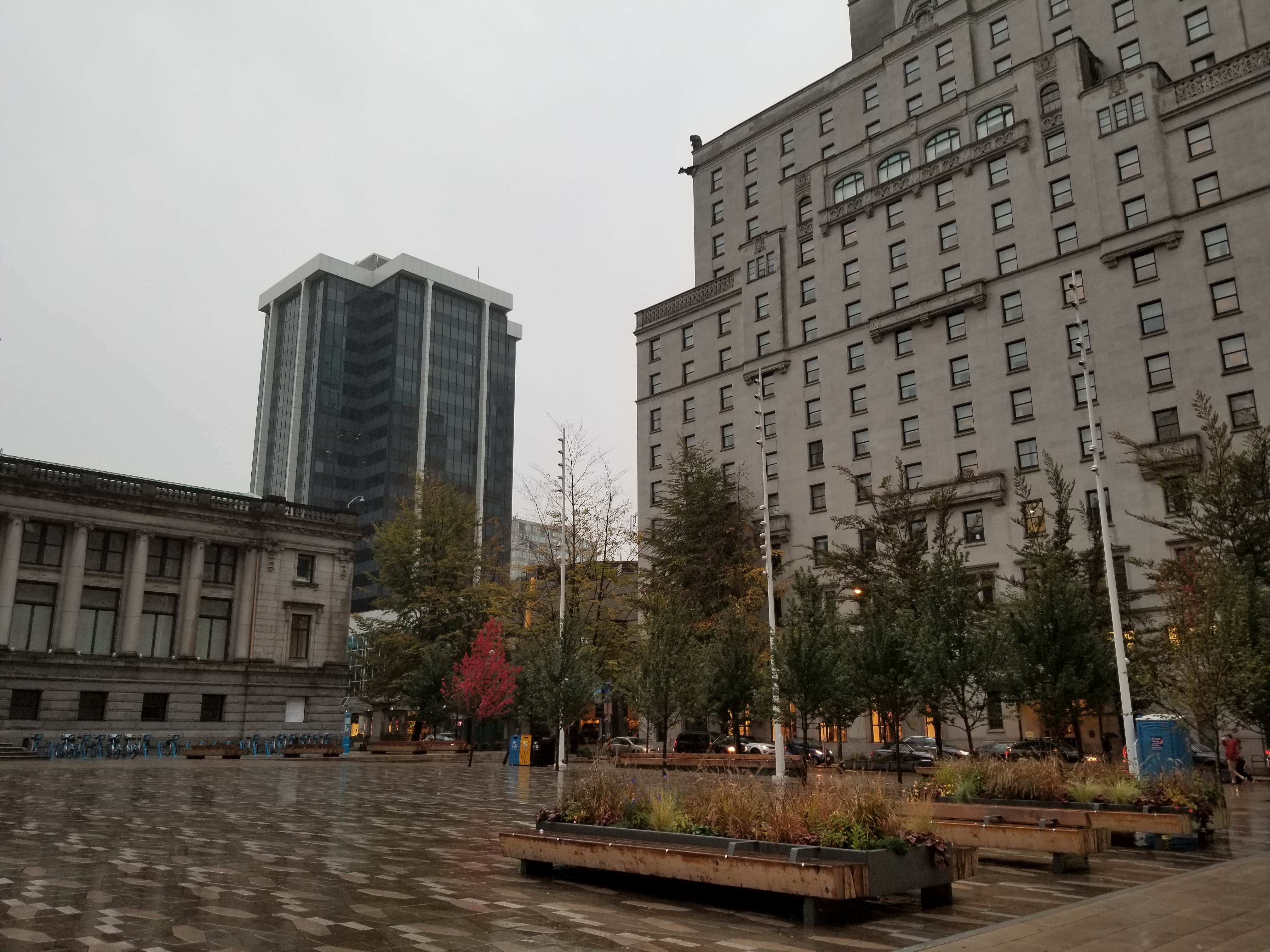
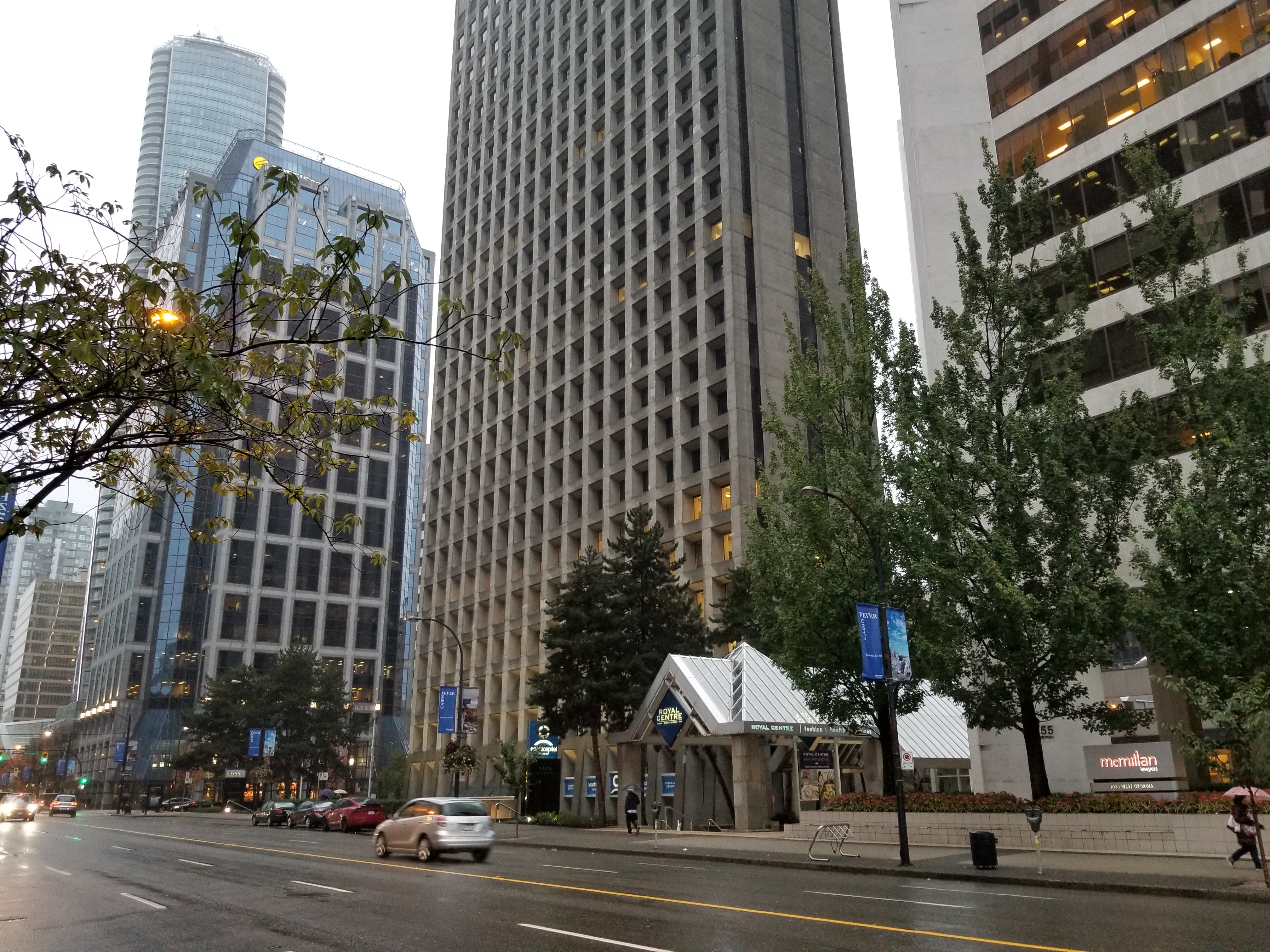
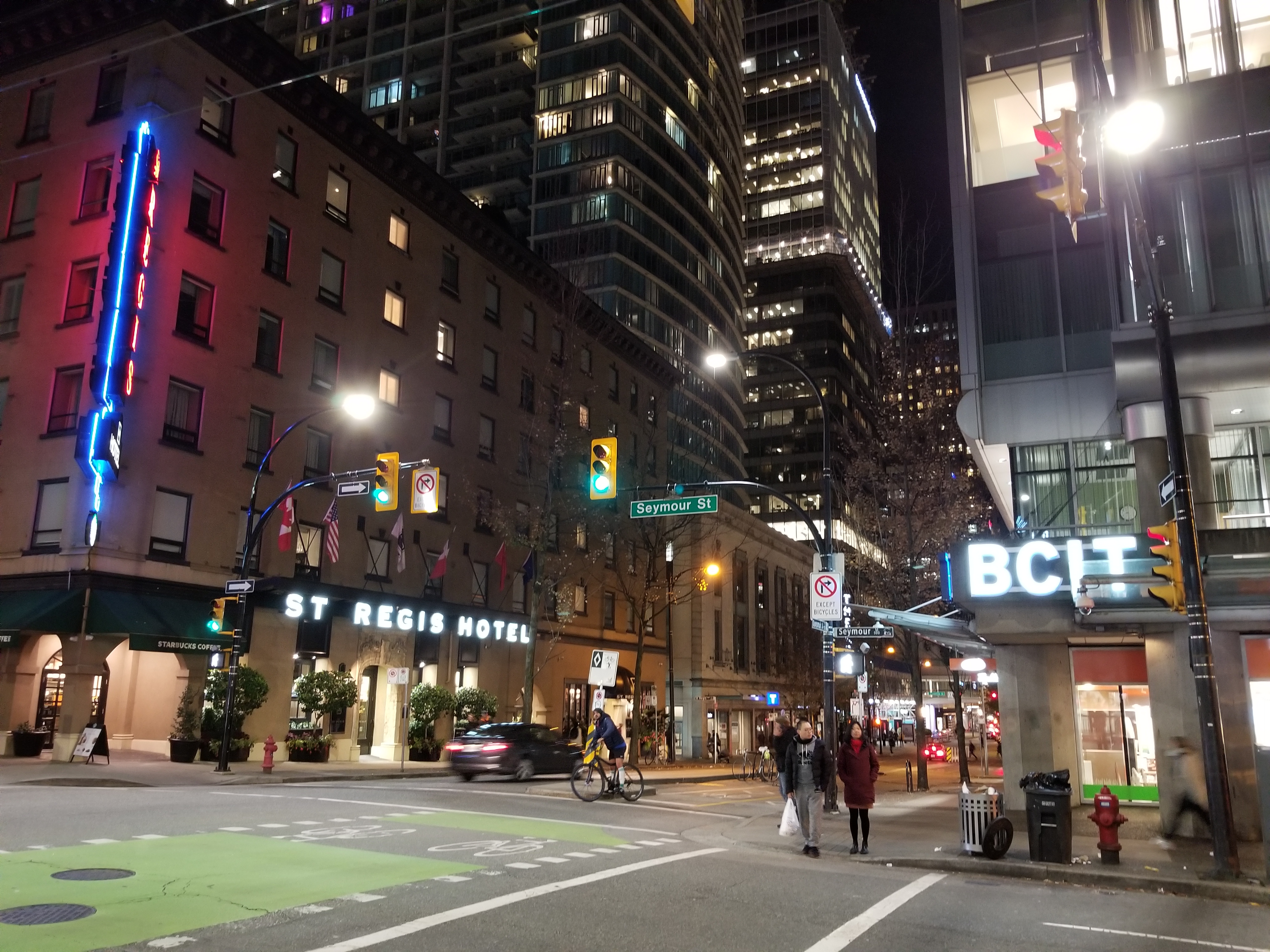
Georgia Street is an east–west street in the cities of Vancouver and Burnaby, British Columbia, Canada. Its section in Downtown Vancouver, designated West Georgia Street, serves as one of the primary streets for the financial and central business districts, and is the major transportation corridor connecting downtown Vancouver with the North Shore (and eventually Whistler) by way of the Lions Gate Bridge. The remainder of the street, known as East Georgia Street between Main Street and Boundary Road and simply Georgia Street within Burnaby, is more residential in character, and is discontinuous at several points.
West of Seymour Street, the thoroughfare is part of Highway 99. The entire section west of Main Street was previously designated part of Highway 1A, and markers for the ‘1A’ designation can still be seen at certain points.
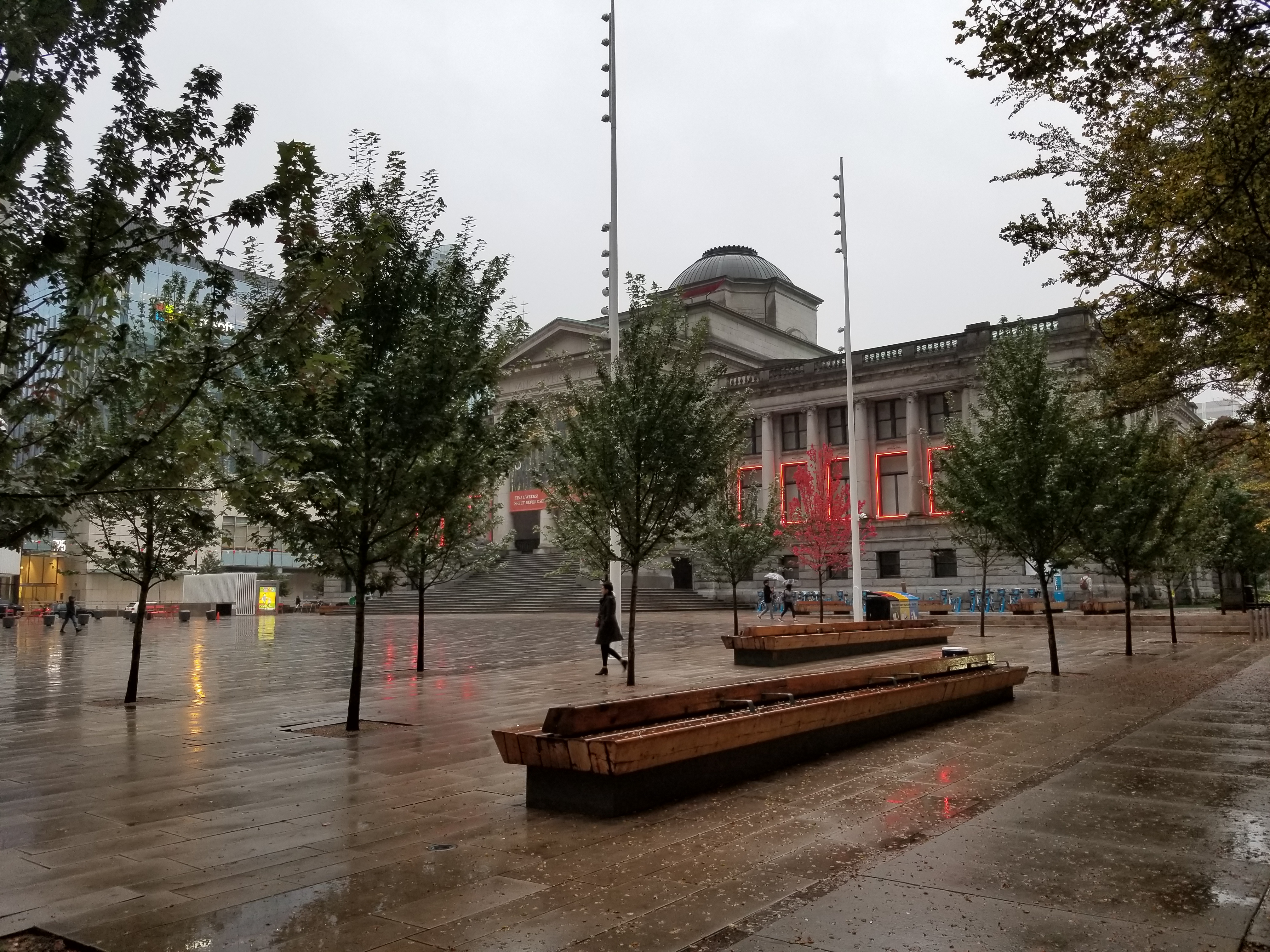
Starting from its western terminus at Chilco Street by the edge of Stanley Park, Georgia Street runs southeast, separating the West End from the Coal Harbour neighbourhood. It then runs through the Financial District; landmarks and major skyscrapers along the way include Living Shangri-La (the city’s tallest building), Trump International Hotel and Tower, Royal Centre, 666 Burrard tower, Hotel Vancouver and upscale shops, the HSBC Canada Building, the Vancouver Art Gallery, Georgia Hotel, Four Seasons Hotel, Pacific Centre, the Granville Entertainment District, Scotia Tower, and the Canada Post headquarters. The eastern portion of West Georgia features the Theatre District (including Queen Elizabeth Theatre and the Centre in Vancouver for the Performing Arts), Library Square (the central branch of the Vancouver Public Library), Rogers Arena, and BC Place. West Georgia’s centre lane between Pender Street and Stanley Park is used as a counterflow lane.
East of Cambie Street, Georgia Street becomes a one-way street for eastbound traffic, and connects to the Georgia Viaduct for eastbound travellers only; westbound traffic is handled by Dunsmuir Street and the Dunsmuir Viaduct, located one block to the north.
East Georgia Street begins at the intersection with Main Street in Vancouver’s Chinatown, then runs eastwards through Strathcona, Grandview–Woodland and Hastings–Sunrise to Boundary Road. East of the municipal boundary, Georgia Street continues eastwards through Burnaby until its terminus at Grove Avenue in the Lochdale neighbourhood. This portion of Georgia Street is interrupted at several locations, such as Templeton Secondary School, Highway 1 and Kensington Park.
Georgia Street was named in 1886 after the Strait of Georgia, and ran between Chilco and Beatty Streets. After the first Georgia Viaduct opened in 1915, the street’s eastern end was connected to Harris Street, and Harris Street was subsequently renamed East Georgia Street.
The second Georgia Viaduct, opened in 1972, connects to Prior Street at its eastern end instead. As a result, East Georgia Street has been disconnected from West Georgia ever since.
On June 15, 2011 Georgia Street became the focal point of the 2011 Vancouver Stanley Cup riot.
There’s something rotten at the heart of Vladimir Putin’s Russia.
Massive open-air landfills and the pollution they bring are stirring tensions across Russia, provoking some of the most sustained protests since Putin came to power almost two decades ago. Thousands of people have defied police bans to march against planned landfill openings, blaming the mounting piles of garbage for health problems and foul-smelling air.
One hotspot is the Aleksinsky landfill near the town of Klin, northwest of Moscow, where locals held a peaceful demonstration last week. The towering mound of rotting, putrid garbage about the height of a six-story house sits just 400 meters from a school. “When the smell from the dump is bad, parents keep their kids at home,” said a woman who declined to be quoted by name and whose teenage son attends the school. “The children get ill a lot.”
Originally designed as a dump for locally produced garbage, the open air landfill, which stretches over an area covering some 32,000 square meters — equivalent to roughly four-and-a-half football pitches — has been used since 2014 to dispose of millions of tons of untreated and unsorted waste that is trucked in daily from Moscow.
Locals complain that the often overpowering stench from the garbage causes headaches, nausea and other health issues, while eco-activists have reported dangerously high levels of nitric oxide and hydrogen sulfide in the air. Kombinat, the garbage disposal company that manages the landfill, insists the dump complies with all safety regulations and poses no health risk.
Critics are unconvinced. “What are we leaving for the children? For the future? Dirty air, dirty water, and dirty soil?” said Tatiana Bakhmetyeva, an eco-activist who attended the rally. Other protesters say pollution from the landfill is a violation of their right to a clean environment, which is enshrined in Russia’s much-abused post-Soviet constitution.
Just 4 percent of Russia’s waste products are recycled or reused, according to Greenpeace. (That’s compared to over 50 percent in European countries such as Germany and Switzerland.) Almost all of the country’s remaining refuse — around 70 million tons a year — is simply dumped in huge landfills that are frequently located dangerously close to residential areas. These landfills cover a total area of land that is four times larger than Cyprus. In 10 years, ecologists say, that area will double in size, unless urgent steps are taken.
A new tax hike on garbage collection introduced on January 1 is also contributing to growing discontent. “They raised taxes, but the [garbage] problem hasn’t gone away,” said Denis Volkov, the deputy head of the Levada Center, an independent pollster in Moscow. “This is not just an ecological problem, but a social one, too.”
So far, Putin, whose approval ratings have taken a fall thanks to a wildly unpopular increase in the national pension age and falling living standards, doesn’t appear to be in a rush to change things. When pressed in December on the country’s poor record on recycling and waste reduction, he brushed off concerns, saying that implementing effective policies to minimize the amount of toxic garbage building up in Russian landfills would “require a huge investment and time.”
Klin’s residents aren’t the only ones to be angry. Over the past 18 months, protests over the pollution spewing from overflowing trash dumps have taken place in around a dozen towns near Moscow.
Protesters allege the landfills are controlled by a “garbage mafia” made up of Kremlin-linked officials. Last year, a company headed by Igor Chaika, the son of Yury Chaika, Russia’s prosecutor general, won a €500 million contract to handle waste disposal in the region surrounding Moscow.
The “garbage protests,” as they have been dubbed by Russian media, are indicative of a major challenge for the Kremlin — identifying potential hotspots for discontent and resolving conflicts when they emerge — said Tatiana Stanovaya, a commentator for the Carnegie Moscow Center think tank.
In many cases, she said, regional governors are wary of entering into dialogue with protesters because they are afraid of being seen as weak, or even sympathizing with opposition groups, who have been dubbed traitors to Russia by Putin and other Kremlin-linked figures.
“Without a radical change in the approach to governing, there will soon be numerous mass protests in Russia’s regions, some of which will be crushed,” said Stanovaya.
“In essence, Russia is moving toward a crisis of Putin’s model of political governance, which is ceasing to function in the face of the growing alienation of the authorities from society.”
Similar demonstrations have also been held in Siberia and Russia’s far north. Earlier this month, in Arkhangelsk, a city in northern Russia, up to 5,000 people took part in one of the region’s biggest ever unsanctioned protests to oppose the construction of a landfill intended for garbage from Moscow. Protesters carried signs that read “The North Is Not A Dump!” and marched on the city governor’s office. Police detained around 20 people on charges of taking part in an illegal protest.
The protests haven’t always been peaceful. Last year, in Volokolamsk, near Moscow, furious locals turned on officials after toxic gases from a nearby open-air landfill poisoned almost 200 people, including scores of children. When Yevgeny Gavrilov, the Volokolamsk district’s top official, arrived at the local hospital, he was struck several times on the head by irate residents. Andrei Vorobyov, the governor, fled the scene after chunks of ice were hurled in his direction. In May, the driver of a truck taking garbage to the landfill in Volokolamsk was targeted by an unknown gunman, but escaped with minor injuries.
The handful of officials who have dared to lend their support to the protesters’ cause have paid a heavy price for their defiance.
In 2017 and 2018, Alexander Shestun, the head of the Serpukhov district near Moscow, angered the Kremlin by allowing eco-activists to hold protests against a local landfill. He also used his Mercedes to prevent trucks from taking garbage to the dump.
Shestun was summoned to the Kremlin, where officials from the FSB security service and presidential administration threatened to have him jailed on trumped-up charges if he did not stand down as head of the Serpukhov district, according to secretly recorded audio that he uploaded to YouTube.
“They will steamroll you, and you will have bad f***ing problems. You’ll go to jail. Don’t you want to live?” a man Shestun identified as an FSB department chief can be heard saying. (The eco-protests weren’t the only reason the Kremlin wanted Shestun out; he was also embroiled in a row with powerful officials over plans to reclassify Serpukhov as a municipal precinct.)
In June, armed police raided Shestun’s family home and arrested him on fraud charges. He has been in custody ever since and faces up to 10 years in prison if found guilty of the charges, which he says are revenge for his refusal to follow orders. His family have posted a number of video appeals to Putin, but the Kremlin has not responded. Shestun is currently on hunger strike in protest, and was hospitalized last week after losing consciousness.
Pyotr Lazarev, who was mayor of Volokolamsk when protests against the landfill began in the town, has also suffered for his willingness to side with eco-activists. After he gave the green light to protest rallies, and even took part in several himself, his home was raided by police and he was warned by “criminals” to stay out of the row over the landfill, he told Russian media last year. He stepped down as mayor in October, citing problems with his health.
Back in Klin, eco-activist Yelena Polyakova said the pungent local landfill is as much a problem for the local administration as it is for local residents.
The mound of trash, she said, makes a mockery of officials’ attempts to attract foreign tourists to a house museum dedicated to Pyotr Tchaikovsky, the 19th century classical composer, who wrote some of his final works in the town.
“Can you imagine Mozart’s house museum in Salzburg standing next to an enormous pile of crap?” Polyakova asked.













 Igor's Blog