









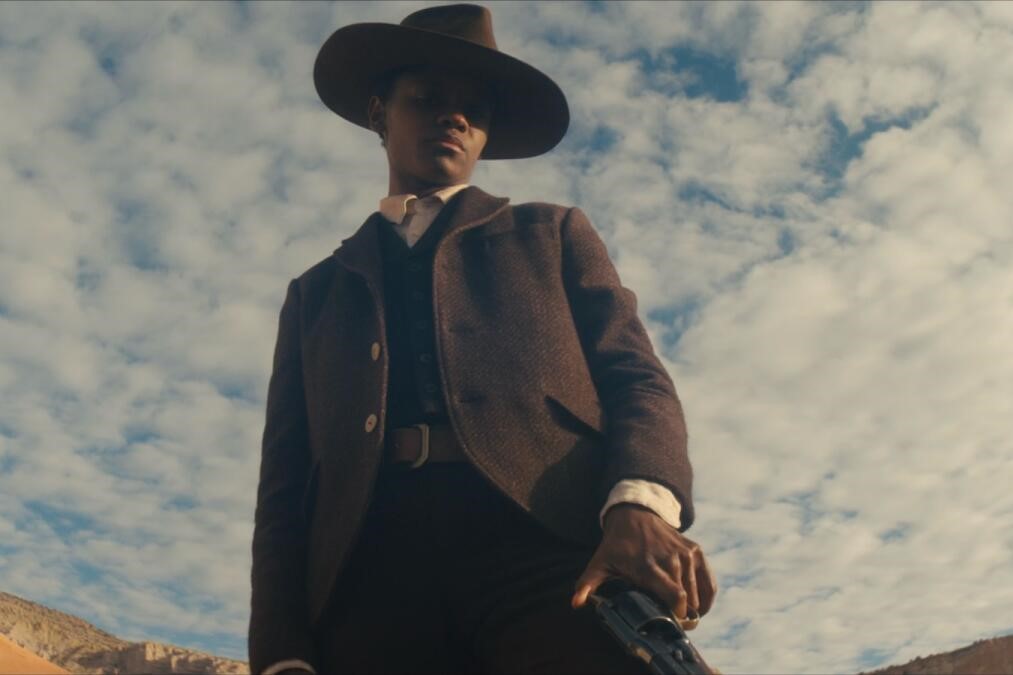
Surrounded is the latest in a long line of black themed Westerns that stretches from early efforts like The Bull-Dogger and Harlem on the Prairie through John Ford’s Sergeant Rutledge and Blazing Saddles. Blacksploitation star Fred Williamson had a string of horse operas, such as Take a Hard Ride and the provocatively titled Boss N*gger, one of three films he made to use that word in the title. More recently we’ve had Django Unchained and Murder at Yellowstone City, neither of which impressed me. Can this unhyped and unheralded entry in the genre deliver the goods?
Five years after the end of the Civil War former slave and Buffalo Soldier Moses “Mo” Washington (Letitia Wright, Black Panther: Wakanda Forever, Aisha) is traveling west. Mo has a secret, two of them in fact, one is the deed to the parcel of land they’re traveling to. The other is that Mo is a woman who has been passing as a man since she signed up for the Army.
This leg of her journey is not going well, despite paying for a ticket she’s forced to ride outside on the stagecoach’s buckboard, the era’s equivalent of the back of the bus. She’s obviously angry but keeps quiet, willing to put up with it in order to get her trip over with. Fate has other plans however and the stage is attacked by Tommy Walsh (Jamie Bell, Man on a Ledge, Rocketman) and his gang.
Mo’s skill with a gun is instrumental in foiling the attack and capturing Walsh. But in the process, the stagecoach, and Mo’s deed, go over a cliff. The survivors leave Mo to guard Walsh while they head back to town to get the sheriff. But as night begins to fall it becomes obvious that the desert isn’t as empty as it would appear.
Director Anthony Mandler has one previous feature, Monster, and music videos for everyone from Drake to Muse on his resume. Writers Andrew Pagana and Justin Thomas are similarly inexperienced with features. Pagna has written some shorts and TV shows while Surrounded marks Thomas’ first credit.
But their lack of experience hasn’t prevented them from making Surrounded a tight film that delivers both action and suspense. Much of the film is a two-character piece centering around Walsh’s attempts to gain his freedom. He first tries intimidation and then when that doesn’t work he tries a different approach, trying to convince Mo that they’re alike, outcasts due to circumstances beyond their control. Mo is wary, knowing she shouldn’t trust him but he certainly sounds convincing.
Wright and Bell both deliver excellent performances that put the viewer in the same place as Mo, trying to decide if Walsh is sincere and can be trusted. In his last role, the late Michael Kenneth Williams (Hap and Leonard, Lovecraft Country) also delivers a solid performance as Will Clay, another character whose motives may not be what they first appear to be, a theme that runs through Surrounded.
Hanging over all of this is the knowledge that the surviving members of Walsh’s gang are out there somewhere and will be coming back and, whether Walsh is sincere or not will have to be dealt with one way or another. A climactic gunfight is a Western staple and Surrounded delivers an excellent one that isn’t afraid to get messy and bring in tree branches and a large rock as well.
Surrounded sat on a shelf for two years before being released direct to digital, and that’s a shame because apart from the film’s overall quality, the cinematography by Max Goldman, another music video veteran, is stunning and deserved to be seen on a big screen. The desert vistas look like something out of a classic Western with the addition of several striking drone shots.
After sitting through so many subpar Westerns recently Surrounded was just what I needed. It’s a well written and well acted film with plenty of suspense punctuated by often brutal action. If you’re a fan of the genre you’ll want to see it.

Greta Garbo the iconic actor was the most famous personality with female autism. Karen Swenson’s (1997) biography of Greta Garbo is a master work of biography.
Background
She grew up in poverty and was always obsessed with money to the end of her life. As a child she was a shy, daydreamer and preferred to play alone. She had good enough parents. Greta was a hypersensitive child, easily upset but imaginative, (Swenson, 1997). She had social relationship issues and was a loner. Even at an early age, there was evidence of sexual identity diffusion. She preferred, ´tin soldiers to dolls´, (Swenson, 1997). Children with ASD often crawl under tables for a long time and she did this. She was an eccentric child. She engaged in repetitive questioning. Greta described herself as an ´awful´ child, (Swenson, 1997). She painted a lot as a child. She was controlling and dominating at school and was also very oppositional. She had difficulty separating fact from fiction as persons on the ASD spectrum often have. She was intelligent and had a strong sense of right and wrong but was always enigmatic. She could sing and used to beg for money from passers-by as a child. She was somewhat of a risk taker and Swenson, (1997) noted her attempts at ´tight rope walking´. She also had narrow interests; the stage and acting. She began acting using friends early in life. There was also a kind of adult/child about her. In adolescence she was ´jealous, possessive, controlling, distrustful, opinionated, hypercritical and self-analytical´, (Swenson, 1997). She worked in a barber shop initially and then in a department store, her supervisor describing her as ´ambitious, quiet´ with a major capacity for ´self-restraint´, (Swenson, 1997). She was very self-contained. She began modelling at the age of fifteen years. It was noted that she had eyes which said ´go away and leave me alone´ (Swenson, 1997). She went on to acting school and was unpredictable and tended to arrive late. For classes in Hollywood, her head felt ´confused and over-crowded´, (Swenson, 1997).
Acting
The actor, Rex O’Malley said ´she doesn’t act, she lives the roles´, (Swenson, 1997). This is what actors with autism are able to do. Because of her identity diffusion, it was probably easier for her to immerse herself completely in her roles. She was an instinctive actor. She could see the world through the eyes of a child, which is very important for an actor and for autism. Somehow, her autism allowed her to express her ´smouldering sexuality´, (Swenson, 1997). Her bisexuality allowed her to appeal to men and women. She had an extraordinary charisma, as actors with autism sometimes have; for example, Orson Welles (Fitzgerald, 2015). In the movies she had an ´air of removal from the context in which she was presented´, (Schickel, 1990). This was due to her autism, and she was also described by the critic Young, (Schickel, 1990), as the ´remote entity of her spirit´. The film, ´The Single Spaniard´ had a title card ´I am walking alone because I want to be alone´, (Gronowicz, 1990).
Narrow interests
She was always obsessed with money and ended up with over $50 million due to her work and good investments. She loved to ride horses and swim alone. She liked to mix privately with the jet-set and was a reclusive socialite in later life. She was totally fixated on movies and early on had been interested in trolls occult issues and the visual arts. She became later, an art collector.
Personality
She was extremely egocentric and narcissistic. Schickel (1990) noted her singularity and her quest for immortality as well as being a ´silent and withdrawn person´.
Depression
She was very moody and could change her mood very rapidly but was largely on the depressive side. She had a kind of low-grade depressive ´personality´. She saw psychotherapists and also diet specialists as well as ´an astrologer and a psychic´, (Swenson, 1997). She also had suicidal ideas.
Sexual identity diffusion
She was androgynous. She liked to be associated with persons with homosexuality. It was suggested that she got one man with male homosexuality to have physical relations with her, (Schickel, 1990). She was psychologically bisexual. She said at the end of her life, ´I’m a finished man´, (Swenson, 1997). She told Tennessee Williams, (Swenson, 1997), that she wanted to make a film ´if the part was not male or female´ and Williams described her as ´hermaphroditic´ and that she had this ´cold quality of a mermaid´. Indeed, she said herself ´I am a misfit in life´ (Swenson, 1997) and also Swenson noted that she was ´a part man, woman´. She tended to use ´masculine terms´. Some people regarded her as ´asexual´, (Swenson, 1997). Greta said ´I have a great longing for trousers´, (Swenson, 1997). She was certainly very attracted to gay men, possibly because of her androgyny and sexual identity diffusion. She had a long relationship with Mercedes de Acosta. Mercedes stated that Greta wasn’t ´so far, a lesbian but might easily be one´, (Swenson, 1997). Indeed, Greta said ´I’m a good man´, (Swenson, 1997). Swenson, (1997) noted that Garbo’s over-powering eroticism reflected the duality of a profane masculine side and a spiritual feminine one´. She was largely ´a self-directed actress´, (Swenson, 1997). ´Sailor´ was a favoured term for her male, usually bisexual friends. She did go to a gala event dressed as Hamlet and was very interested in Dorian Grey by Oscar Wilde. In active love scenes she would take ´the dominant, masculine position´, (Swenson, 1997). She said herself she was ´sexually indifferent´, (Swenson, 1997). Greta said that she was not ´all that womanly´, (Swenson, 1997). She liked to wear male clothes. She was a contradictory figure and her friend, Mercedes described her as having, ´a sort of despotic attitude (with) high handedness … with a certain tenderness´, (Swenson, 1997).
Sensory and motor issues
She was hypersensitive to noise. She had a ´near existential acceptance of pain´, (Gronowicz, 1990). She also had an ´odd gait, rather mannish, rather predatory´.
Non-verbal behaviour
She had an autistic penetrating stare. Brown (Gronowicz, 1990), her director, said that ´there was something behind them that could reach out and tell the audience what she was thinking´. She had a rather autistic, mysterious face. In early photos, she showed ´a nearly expressionless Greta … with her eyes downcast …´ (which added) ´mystery and allure´, (Swenson, 1997). She also had ´haunting eyes´ and according to Louise Brooke, a gaze ´so intense and so eloquent´, (Swenson, 1997). Greta said that she liked the German people because ´they do not touch you´, (Swenson, 1997). She was a massive observer and would simply observe the sea and nature. She had a tendency to pace back and forth. Fellini, (Swenson, 1997), said that she had ´the austere looks of a cloistered empress. She was always an unreachable living myth´. She was obsessed about growing old and her face growing old, and she quoted George Bernard Shaw, who said ´only a fool celebrates getting older´, (Swenson, 1997). The actor John Gielgood, (Swenson, 1997) described her as having a ´child-like expression´ but ´empty, aimless´. Ingmar Bergman, (1988) stated that when he met her after her retirement ´her mouth was ugly, a pale slit surrounded by transverse wrinkles. It was strange and disturbing´. She was also somewhat of a refusenik and she ´smiled – a secretive, ironic inwardly directed smile´, (Gronowicz, 1990). She had preservation of sameness and worked with the same people repeatedly and was controlling and dominating.
Language and Greta Garbo
She was noted often to talk in film script dialogue, which is characteristic of persons on the spectrum. John Gielgood said that she had ´no idea of conventional courtesies´ and tended to talk ´bluntly´, (Swenson, 1997). Richard Cortez, an actor only slightly exaggerated when he said ´she never talks at all, so to speak´, (Swenson, 1997). She often used to speak in the third person, for example, ´we must go´. She rarely used ´I, me, mine´. She tended to speak in short sentences. People in Hollywood noted that there was ´a stillness about her´ and she had ´no desire to make small talk´, (Swenson, 1997). The photographer Cecil Beaton noted her talking ´without any of the polite, preliminary (talk) of strangers´, (Swenson, 1997). Another person with autism who used to do this was Ludwig Wittgenstein who had autism, (Fitzgerald, 2004). A neighbour, Jeanette McDonald said that she was ´anti-social´, (Swenson, 1997). She was hard to communicate with and would often abruptly leave social gatherings. She engaged in a lot of self-talk as persons with autism often do.
Personality
A journalist described Garbo was ´an incomparable, indescribable, inscrutable enchantress´, (Swenson, 1997). She was also described as being ´scatter-brained´, ´a witch´, ´a Scandinavian Sphinx´ and a ´Hollywood hermit´, (Swenson, 1997). Swenson, (1997) also noted her ´apparent indifference´ and ´maverick reputation´, as well as being ´naïve and impressionable´. Gronowicz (1990) noted Daniel Boorstin’s formulation of her as ´someone known for her unknown-ness´. She was aware that she was not ´normal, like other people´, (Swenson, 1997). Many people felt she was just posing, but she was not. This was her true autistic personality. She was a contradictory personality and one director stated that ´I never saw anyone so sensitive to emotional impulses as Garbo´, (Swenson, 1997). There is a myth that people with autism lack empathy, but this is simply a myth. She was perverse and callous in the way she interacted with other women’s husbands. There was an obsessive-compulsive element to her, and she was a compulsive walker. She could be perverse in her comments when she said to one dress designer who worked with her for a long time, ´you know, I never really liked most of the clothes you made for me´, (Swenson, 1997). She was also referred to as ´the divine one´, (Swenson, 1997). The magazine, Variety, (Swenson, 1997), stated that ´Garbo is the strangest personality of all … (in) this extensive screen colony´. Variety also went on to state that ´there is no chink in her magnificent armour of aloofness´. A society hostess noted that ´she just sat in a corner and seemed to be lost´, (Swenson, 1997). For most, she was the mystery woman.
Social relationships and Garbo
Lew Ayres, a colleague, (Swenson, 1997), described her as a ´removed woman´. She was very anxious socially and found it hard to manage, even a Sunday lunch in the garden. When things got stressed, she would say to one of her partners Gilbert ´I think I’ll go home´, (Swenson, 1997). She often went off alone swimming, walking and was a naturally solitary person. She was regarded as having a ´mystic barrier´, (Swenson, 1997). She became a kind of autistic wanderer later in life, a reclusive wanderer and indeed, once described herself as a ´wandering Jew´ and was ´restless everywhere´, (Swenson, 1997). She was highly contradictory in her attitudes to relationships and stated ´it’s hard and sad to be alone, but sometimes its even more difficult to be with someone´, (Thorpe, 2019). In later life, she said that she regretted ´not getting married´ and she said that this was the ´greatest (regret) of them all. A clear second was her failure to conquer her shyness´, (Swenson, 1997).
Post-retirement
She spent long years post-retirement, ´killing time´ and passing time with the idle rich and famous – a lost autistic soul. Billy Wilder, the director, (Swenson, 1997), stated that in her retirement she was, ´frightened of pictures … of social appearances and contact with people´. Physical aging particularly of her face became a huge issue for her and she was constantly putting a handbag or whatever up in front of her face when she was photographed later in life. She remained ´the eternal stranger´.
Conclusion
Greta was one of the most famous actors in the world. She was an unusual person, an enigmatic person and neither she nor the people around her realised that she had autism, which would have explained her behaviour.

When you come out of the bathroom, and Hitler has stolen your seat.
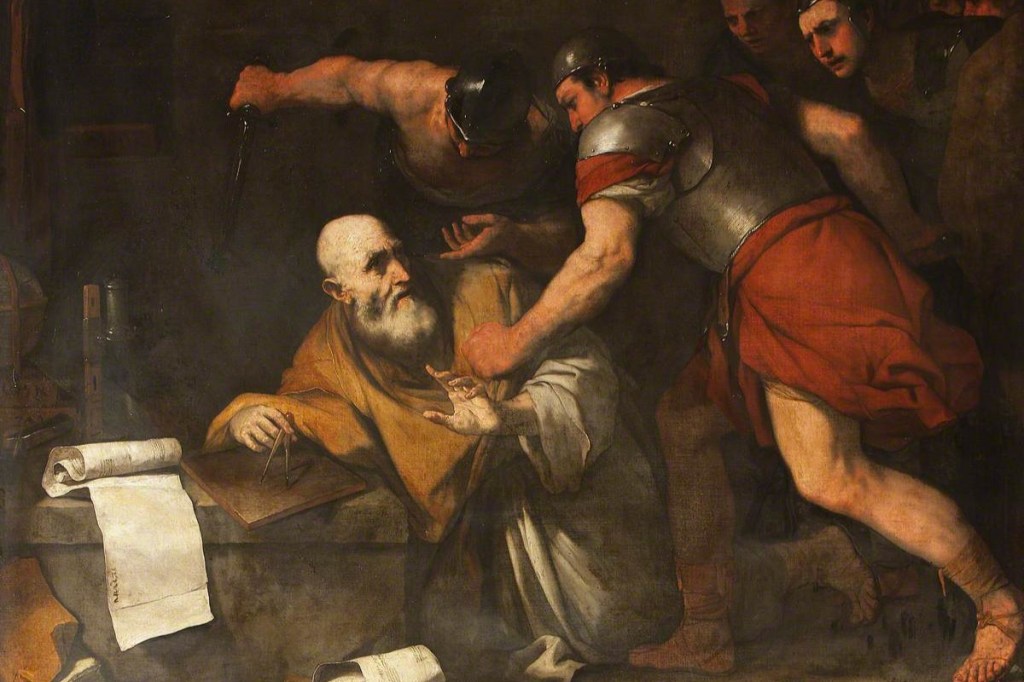
Archimedes, the great Greek mathematician and inventor, elucidated plane and solid geometry, arithmetic, and mechanics. He was a solitary, eccentric figure and appears to have possessed some traits that suggest he may have exhibited autism/Asperger Syndrome.
Life History
Archimedes was born in Syracuse, Sicily. His father was the astronomer Pheidias, and he is said to have been related to Hiero II, tyrant of Syracuse. “He was one of the greatest mechanical geniuses of all time, if not the greatest when we consider how little he had to go on” (Bell, 1986, p. 29).
He spent most of his life in Syracuse. According to Strathern (1998), “Archimedes appeared to have lived a normal eccentric life of a mathematician. Quiet, solitary, and quietly potty — with only the occasional spectacular incursion into the public arena” (p. 72).
After Syracuse was captured during the Second Punic War (despite the deployment of Archimedes’s mechanical expertise in its defense), he was killed by a Roman soldier. There are two stories of the exact circumstances of his death: (a) that he was working on a circle in the sand and said to the soldier, “Don’t disturb my circle”; and (b) that he refused to go to see the Roman consul Marcellus until he had worked out a mathematical problem, whereupon the soldier became angry and killed him.
Work
In mechanics, Archimedes defined the principle of the lever and is credited with inventing the compound pulley. He also invented an ingenious screw that was used as a water pump. The Archimedes screw remains in use in the Nile Delta to this day, and the same principle is used for raising grain and sand when loading bulk carriers.
Plutarch stated that Archimedes “Did not deign to leave behind him any written work on such subjects (practical engineering abilities and inventions) … he regarded as sordid and ignoble the construction of instruments, and in general every art directed to use and profit, and he only strove for those things which, in their beauty and excellence, remained beyond all contact with the common needs of life” (Strathern, 1998, p. 25). Calculus, which developed out of his method, has been described as the most useful mathematical tool ever invented for describing the workings of the real world (Bell, 1998).
Some are of the opinion that Archimedes did in fact use integral calculus in his treatise On Conoids and Spheroids, which expands geometry beyond the rigidity imposed upon it by Plato and his mystical attitude toward forms. (Plato believed that forms or ideas were the ultimate reality out of which the world was made — a development from Pythagoras’ belief that “all is number.” Plato believed in God and geometry.)
Possible Indicators of Asperger Syndrome
Like many mathematicians, Archimedes tended to relate to other mathematicians (e.g., Conon of Samos). A famous legend tells that he jumped out of the bath and ran without clothes through the streets shouting “Eureka! Eureka!” (“I have found it!”). This relates to Archimedes’s principle that a floating body will displace its own weight in fluid. According to Strathern (1998), “Archimedes was a lonely sort of eagle” (p. 29).
Narrow Interests and Obsessiveness
Archimedes was fascinated by pure mathematics. He put in long and arduous hours of theoretical work, which established him as the finest mathematical mind for almost two thousand years to come.
Any individual who spends most of his waking life in obsessive mental activity attracts wild anecdotes, and Archimedes was no exception. According to Plutarch, “He was so bewitched by thought that he always forgot to eat and ignored his appearance. When things became too bad his friends would forcibly insist that he had a bath, and make sure that afterwards he anointed himself with sweet smelling oils, yet even then he would remain lost to the world, drawing geometric figures” (Strathern, 1998, p. 27). Plutarch stated that Hieron II, the king of Syracuse and a friend and relation of Archimedes, was not happy with this kind of behavior and “emphatically requested and persuaded (Archimedes) to occupy himself in some tangible manner with the demands of reality” (Strathern, 1998, p. 29).
According to Bell (1986), Archimedes is a perfect specimen of the popular conception of what a great mathematician should be. Like Newton, he left his meals untouched when he was deep in his mathematics.
Idiosyncrasies
In addition to narrow interests and pervasive obsessiveness, Archimedes demonstrated a number of idiosyncrasies. According to Bell (1986),
In one of his eccentricities Archimedes resembled another great mathematician, (Karl) Weierstrass (1815-1897). According to a sister of Weierstrass, he could not be trusted with a pencil when he was a young school teacher if there was a square foot of clear wallpaper or a clean cuff anywhere in sight. Archimedes beats this record. A sanded floor or dusted hard smooth earth was a common sort of “blackboard” in his day … Sitting before the fire he would rake out the ashes and draw in them. After stepping from the bath he would anoint himself with olive oil … and then, instead of putting on his clothes, proceed to lose himself in the diagrams, which he traced with a fingernail on his own oily skin. (p. 30)
Conclusion
Although the relevant information on Archimedes’s life is somewhat scanty, it would appear that the great mathematician may have met the criteria for Asperger Syndrome.

Hawkeye is a playful, freewheeling show from Disney Plus.
This year has been a lot. That’s why, this Thanksgiving, I’m thankful for Hawkeye.
Marvel’s latest Disney Plus series is a fun, free-wheeling action show energized by scene-stealing Hailee Steinfeld, who joins grouchy archer Jeremy Renner for some good, honest comfort viewing. Its snackable action makes it the opposite of Disney’s other big holiday release, the super-long Beatles documentary Get Back.
The first two episodes of Hawkeye stream on Disney Plus on Nov. 24. The remainder of the six-episode series then arrive each Wednesday until Christmas, which means you could save them up for a festive binge. On the cozy side, Renner returns as archery-themed Avenger Clint Barton (aka Hawkeye) just trying to get back to his loving family in time for Christmas. And if you’re sick of your family’s nonsense, maybe you’ll vibe with the complicated familial dynamics encountered by his new sidekick Kate Bishop, whose fairytale life comes complete with a wicked stepfather.
The show opens with a focus on Kate, a new character to our screens who is already a part of the Marvel Cinematic Universe: She’s one of the many unseen ordinary people whose lives have been touched — and not for the better — by the superpowered shenanigans unfolding on big screens through the past decade. Even the opening titles focus on Kate, deftly sketching in her backstory as she grows into Steinfeld, star of True Grit, Dickinson and Bumblebee.
On the scale of imagination from earthbound punch-ups to cosmic flights of fancy, WandaVision and Loki were dementedly ingenious trips to the more surreal reaches of Marvel lore, while The Falcon and The Winter Soldier was a much more meat-and-potatoes action story. Inspired by writer Matt Fraction and artist David Aja’s entertainingly grounded 2012 comic, the Hawkeye series is way down at the earthier end of the Marvel weirdness spectrum, dealing with all-too-human heroes, family politics and grubby street crime. The enjoyment comes not from brain-battering cleverness but from the show’s energy: The fight scenes fizz with kinetic energy, and the whole thing is carried by lead actors sparking off each other.
Kate is a rich kid with a chip on her shoulder, much to the exasperation of her mom, played warmly by Vera Farmiga (last seen in Sopranos prequel The Many Saints of Newark). Kate’s also a talented martial artist and archer, not to mention a Hawkeye super-fan. The best thing about the show is the classic buddy pairing between the enthusiastic youngster and moody mentor, with Steinfeld and Renner sparking off each other to amusing effect.
Hawkeye himself, meanwhile, is drawn back into the violent underworld searching for the suit he wore while temporarily rebranding as violent vigilante Ronin during the Blip (the years when Thanos wiped out half of the galaxy’s population, including Hawkeye’s wife and kids). The New York setting flits from high-society murder mystery to street-level punch-up in a way that will strongly remind fans of a previous attempt to bring the MCU to the small screen: Daredevil.
Back in 2015, Daredevil was the start of an unprecedented and at the time pretty audacious experiment, ushering in a series of four interlinked Netflix shows starring Marvel heroes yet to appear in the MCU. Daredevil, Jessica Jones, Luke Cage and Iron Fist (plus spinoff The Punisher) were gritty action dramas set in New York City’s shadows, and Hawkeye is more like them than anything else in the whole MCU. There’s even a long-take fight sequence that recalls the showpiece one-shot punch-ups in Daredevil (excuse me while I step out to watch those on YouTube).
Back again. In the first two episodes, Hawkeye is generally more lighthearted than the somber Netflix shows, which were absorbing but cumulatively became a bit of a drag. On paper, Hawkeye has a tortured-hero thing going on, but here’s the thing about the whole Ronin business: It doesn’t work. Clint’s loss is supposed to have driven him to betray his morality as a vicious killer. Unfortunately, that isn’t really what Endgame showed us. Thanks to Marvel’s family-friendly tone and all the other massive amount of stuff that had to be fitted into the film, all we actually saw on screen was Clint getting a crap haircut and beating up some yakuza. Which is literally what a superhero usually does (dispatching gangsters, that is, although silly haircuts are also pretty common). OK, so he sliced people up with a sword, which is frowned upon in superhero circles, but we only know Clint was supposed to have crossed some moral line because he wouldn’t shut up about it.
More affecting is Clint’s sense of loss for Natasha Romanoff, aka Black Widow, lost fighting Thanos in Endgame. This summer’s Black Widow movie served as a belated moment in the spotlight for Scarlett Johansson, and it also adds a layer to Renner’s relatively uncomplicated character. Which ties into Black Widow’s post-credits scene, suggesting the series will bring together two scene-stealing new recruits as Steinfeld and Black Widow’s breakout Florence Pugh are set to face off.
Overall, Hawkeye isn’t a tortured antihero searching for redemption, he’s still just affable Jeremy Renner trundling around looking grumpy. And the show mostly knows this, sticking him into action scenes that are more playful than perilous. Episode 2 in particular has both Clint and Kate engaged in mock combat that’s fun to watch rather than hazardous to their health, a jaunty twist on the gritty action-scene-every-episode formula.
Combined with little snippets of silliness like the comical villains the Tracksuit Mafia and a musical about Steve Rogers and the Avengers (which gets plenty of screen time in episode 1), Hawkeye makes a fun festive treat. Comparisons with Daredevil and its ilk are a reminder that for many fans there were just too many of those shows, giving them the dubious distinction of making the MCU feel inessential. With a whopping 14 further Marvel series confirmed for Disney Plus, it feels like fans could be overwhelmed again.
But don’t worry about that this holiday season. Just stuff yourself full of turkey and some warmed-up Hawkeye.
Heyyy, what’s happening~ I’ve been asked for years to do a video with ONLY otoscope, and I finally got around to it 🙂 I present to you: ALL OTOSCOPE. I kept the intro short & sweet so you have as much otoscope time as possible. The sound in this video is more intense than I usually go for, but not in an overbearing sort of way and I’ve marked out the more intense parts in the timestamps! Hope you enjoy 😀
 Igor's Blog