


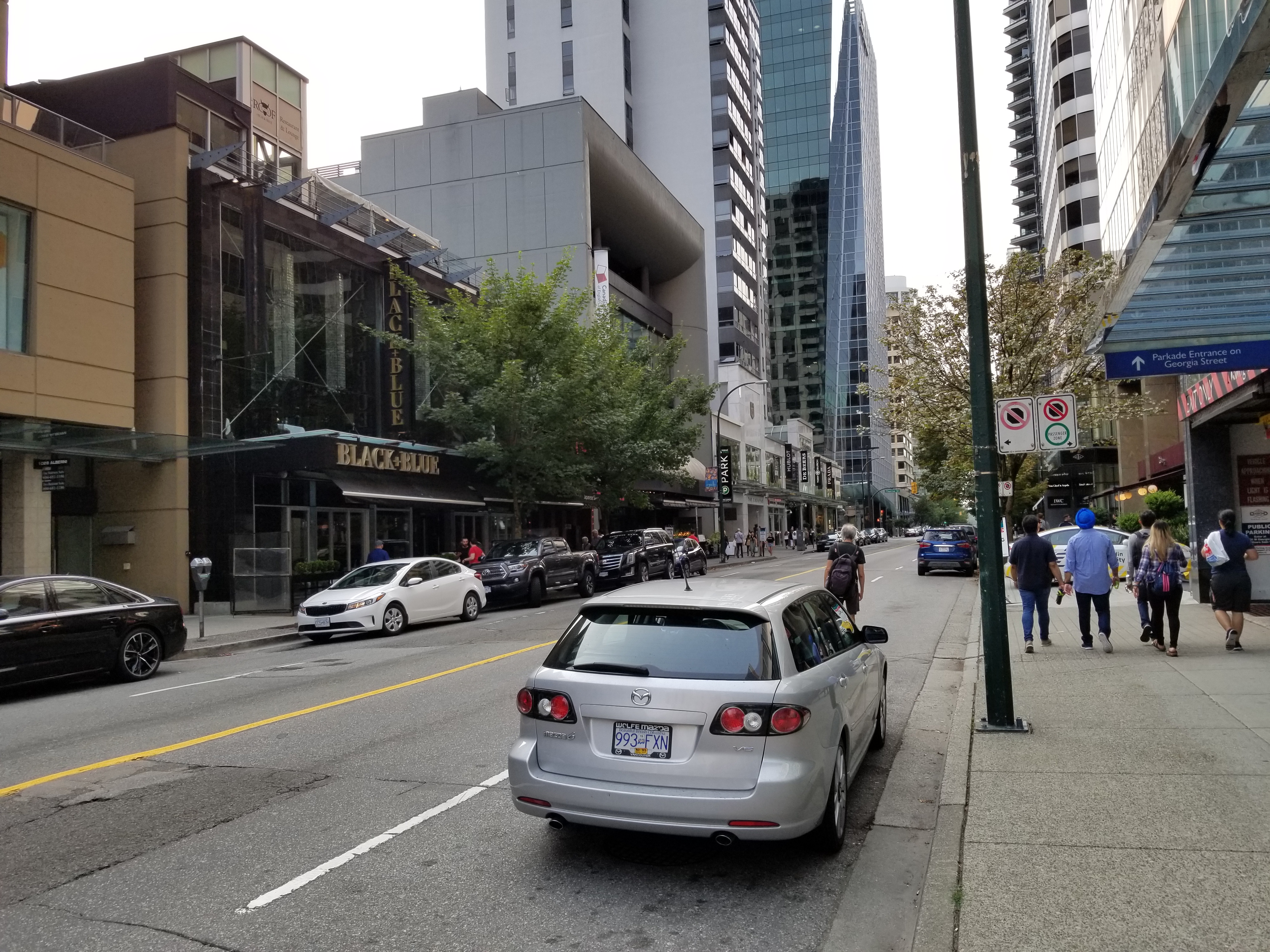









Georgia Street is an east–west street in the cities of Vancouver and Burnaby, British Columbia, Canada. Its section in Downtown Vancouver, designated West Georgia Street, serves as one of the primary streets for the financial and central business districts, and is the major transportation corridor connecting downtown Vancouver with the North Shore (and eventually Whistler) by way of the Lions Gate Bridge. The remainder of the street, known as East Georgia Street between Main Street and Boundary Road and simply Georgia Street within Burnaby, is more residential in character, and is discontinuous at several points.
West of Seymour Street, the thoroughfare is part of Highway 99. The entire section west of Main Street was previously designated part of Highway 1A, and markers for the ‘1A’ designation can still be seen at certain points.
Starting from its western terminus at Chilco Street by the edge of Stanley Park, Georgia Street runs southeast, separating the West End from the Coal Harbour neighbourhood. It then runs through the Financial District; landmarks and major skyscrapers along the way include Living Shangri-La (the city’s tallest building), Trump International Hotel and Tower, Royal Centre, 666 Burrard tower, Hotel Vancouver and upscale shops, the HSBC Canada Building, the Vancouver Art Gallery, Georgia Hotel, Four Seasons Hotel, Pacific Centre, the Granville Entertainment District, Scotia Tower, and the Canada Post headquarters. The eastern portion of West Georgia features the Theatre District (including Queen Elizabeth Theatre and the Centre in Vancouver for the Performing Arts), Library Square (the central branch of the Vancouver Public Library), Rogers Arena, and BC Place. West Georgia’s centre lane between Pender Street and Stanley Park is used as a counterflow lane.
East of Cambie Street, Georgia Street becomes a one-way street for eastbound traffic, and connects to the Georgia Viaduct for eastbound travellers only; westbound traffic is handled by Dunsmuir Street and the Dunsmuir Viaduct, located one block to the north.
East Georgia Street begins at the intersection with Main Street in Vancouver’s Chinatown, then runs eastwards through Strathcona, Grandview–Woodland and Hastings–Sunrise to Boundary Road. East of the municipal boundary, Georgia Street continues eastwards through Burnaby until its terminus at Grove Avenue in the Lochdale neighbourhood. This portion of Georgia Street is interrupted at several locations, such as Templeton Secondary School, Highway 1 and Kensington Park.
Georgia Street was named in 1886 after the Strait of Georgia, and ran between Chilco and Beatty Streets. After the first Georgia Viaduct opened in 1915, the street’s eastern end was connected to Harris Street, and Harris Street was subsequently renamed East Georgia Street.
The second Georgia Viaduct, opened in 1972, connects to Prior Street at its eastern end instead. As a result, East Georgia Street has been disconnected from West Georgia ever since.
On June 15, 2011 Georgia Street became the focal point of the 2011 Vancouver Stanley Cup riot.

The United Kingdom’s Ministry of Defence on Sunday listed some of the setbacks that the Russian military is experiencing in Ukraine amid its ongoing invasion, adding that those failures are “likely to endure.”
“The forward deployment of commanders has exposed them to significant risk, leading to disproportionately high losses of Russian officers in this conflict,” the ministry said in a tweet. “This has resulted in a force that is slow to respond to setbacks and unable to alter its approach on the battlefield. These issues are likely to endure given the relative lack of operational command experience of the officers promoted in place of those killed.”
The British Defence Ministry also said that senior commanders were prompted to go onto the battlefield likely to personally lead operations due to “difficulties in command and control” and “faltering Russian performance on the front line.”
“However, it is not clear that the presence of these commanders on the battlefield has led to a refined or altered operational concept. Flawed planning assumptions and failures in sustainment continue to undermine Russian progress,” the ministry added.
Meanwhile, officials have suggested that Russia is not progressing in its war. On Wednesday, the Pentagon’s press secretary John Kirby said during a briefing that Russia is not achieving its desired goals.
“All I can tell you is that the Russians have not made the kind of progress in the Donbas and the south that we believe they wanted to make. We do believe they’re behind schedule. We do believe it’s been slow, and at every turn, they have met a stiff Ukrainian resistance,” he said.
Kirby also suggested that Russian precision-guided missiles have missed their targets in Ukraine possibly due to “technical issues,” adding that “it certainly could be Ukrainian defenses, or it could just be incompetence on the part of operators.”
The United States estimated that Russia’s failure rates in Ukraine are as high as 60 percent for some of its precision-guided missiles, three unnamed U.S. officials with knowledge of the intelligence, told Reuters in March. However, the U.S. officials didn’t mention evidence to back this assessment and didn’t provide details about the exact reasons behind the high missile failure rates.
Former NATO commander, James Stavridis said last week that Russia has shown “amazing incompetence” in Ukraine.
“In modern history, there is no situation comparable in terms of the deaths of generals,” he said during a radio interview on WABC 770 AM. “Just to make a point of comparison here, the United States in all of our wars in Afghanistan and Iraq…in all of those years and all of those battles, not a single general lost in actual combat. On the Russian side, in a two-month period, we have seen at least a dozen, if not more Russian generals killed. So amazing incompetence.”
Stavridis also said that Russia’s military has the “inability to conduct logistics” and “battle plans.”
However, Russia seems to believe otherwise when its Ministry of Foreign Affairs said in March on its Twitter account that its operation in Ukraine is going “according to plan.”
Newsweek reached out to the Russia’s foreign affairs ministry and its defense ministry for comment.
The Russian military invaded Ukraine on false or otherwise flawed assumptions about the Ukrainian military, and Western views of the Russian military were often equally as wrong. Senior U.S. military officers and government officials believed the Russian military would quickly destroy Ukrainian resistance, with some officials speculating that Kyiv would fall within seventy-two hours. Instead, the attack on Kyiv stalled, with the infamous forty-mile convoy becoming the climax of Russian logistical and planning failures that led to the embarrassing withdrawal from Kyiv in late March. Perhaps the West fell prey to the Russian information campaigns that have been demonstrated during military campaigns over the years, such as Russian involvement in the Syrian Civil War or the “Little Green Men” in Crimea. Military analysts ultimately believed that the Russian military had reformed after Defense Minister Anatoly Serdyukov’s 2008 “New Look” reforms.
The invasion of Ukraine has shown some of the operational design flaws that were endemic and characteristic of the post-Soviet Russian military, which Serdyukov’s reforms were meant to address. Poor force design and employment, flawed intelligence and reconnaissance, uncoordinated command and control, and systemic logistical problems still run across all levels of Russian command. The overabundance of Russian missteps in local conflicts since the fall of the Soviet Union should have helped analysts see the Russian military’s shortcomings. Even though they are not exhaustive, a brief look at these shortcomings may have helped shape a different Western perception of the Russian military before the invasion.
Ukraine 2022
Once hostilities broke out in Ukraine this February, the Russian military was plagued by poor intelligence and reconnaissance capabilities, just as it was in past conflicts, highlighting a recurring problem. For example, according to open-source reporting during the now well-known counteroffensive in Kharkiv, the Russian military often lost track of Ukrainian brigade elements, leading to the successful Ukrainian rout of Russian forces in the region. Specifically, by the summer of 2022, the manning situation had become so dire in some parts of the sector that the 45th Guards GRU Spetsnaz Brigade, which was the Russian Airborne Forces (VDV) and the GRU’s premier deep reconnaissance unit, had one battalion manning defenses southwest of Izyum and a second battalion manning defenses in northernmost part of northeast Kherson Province. This left the entire Russian force in the region effectively blind. Russia has also lost 148 reconnaissance unmanned aerial vehicles during the war.
At the start of the special military operation (SMO), Russian motorized rifle battalions appeared to operate at between 65 to 75 percent. Shortages in manpower only became more dramatic, leading to the call for partial mobilization in September. Throughout the summer, manning issues worsened because Russian leader Vladimir Putin would not approve mobilization and because the General Staff and the Ministry of Defense’s ad hoc, ninety-day reservist-based solutions kept expiring. By August, members of the 152nd Guards Missile Brigade, an Iskander Brigade from Kaliningrad, were performing infantry functions in a quasi-attempt to hold part of the 11th Army Corps’ defensive line northwest of Izyum. Perhaps most surprisingly, the training of Russian forces appeared to be underdeveloped, even among more elite forces like the naval infantry, VDV, and Spetsnaz.
Russia’s command and control continues to be equally dreadful. Reports suggest that the Russian military did not have a theater commander in Ukraine until late April, when now-relieved Gen. Aleksandr Dvornikov was appointed to lead Russian forces in theater. Up to that point, each Combined Arms Army operated independently through its axes of advance, with little overall coordination. Coordination amongst military units seemed haphazard, with Rosgvardiya—National Guard forces—sometimes in the lead of Russian formations. Russian commanders appeared to have vast communication issues, which may have led to some of these Russian commanders being targeted and killed by Ukrainian troops. In a now-famous video, 90th Guards Tank Division members operated unsecured on their secured system, and their communications were intercepted in an ambush in eastern Kyiv and broadcast worldwide.
Moreover, secure communications have not worked because ERA, the Russian cryptophone introduced in 2021, relies on ground-based 3G and 4G infrastructure. Additionally, the GRU’s Strelets reconnaissance, command-and-control, and communications system, which also uses 3G and 4G technology, was disrupted early in the invasion. Russia has lost 201 command posts and communication stations since the onset of hostilities, making command and control difficult across the battlefield.
Chechnya I
In 1994, the Russian military, a force inherited from the Soviet Union, was in chaos. Officers had not received pay for months, and the Russian economy struggled to convert from a state-planned economy to a capitalistic market economy. During the organizational upheavals that quickly followed, Russia plunged its military into a battle with a determined and flexible enemy, some of whom had served in the Soviet Armed Forces and had Soviet equipment at their disposal. The same Russian egotism that led to predictions in February of Kyiv falling within days was also abundant in Grozny, with then-Russian minister of defense Gen. Pavel Grachev bragging that Grozny would fall in two hours.
After a series of failed and forceful attempts to dispose of Dzhokhar Dudayev, Chechnya’s president and a former Soviet Air Force general, Russia deployed a contingency force to Grozny, which proved disastrous. Kremlin security officials believed Dudayev and his army to be a disorganized criminal element that would be subdued on the sight of the first Russian tank, failing to grasp true Chechen aims and capabilities. Russian tactics were organized more on a display of force than a movement to contact. Intimidation and coercion were the main objectives. Detailed planning for the military intervention in Chechnya did not begin until two weeks before the operation, which had consequential effects throughout the entire twenty-one-month operation.
A Soviet and Russian adage for force generation—“Personnel: check! Equipment: check!, Training: optional”—lives strongly inside Russian planners’ minds. At the time of the attack on Grozny, Russian forces had not conducted divisional or regimental field training since before the collapse of the Soviet military. Most Russian battalions were manned at 55 percent, and not a single Russian regiment was manned at full strength. Russian units were casually constructed, and a considerable quantity of Russian soldiers were conscripts; none had trained together before going into the streets of Grozny. In the 81st Brigade, 90th Guards Tank Division, forty-nine out of the fifty-six platoon commanders had been at the military academy weeks before the beginning of hostilities. 50 percent of the men who hastily assembled for operations in Grozny had never fired a shell from their tank. Russian commanders suffered communication breakdowns at the platoon, company, and battalion levels. They were often forced to transmit over clear radio, allowing Chechen fighters to monitor their transmissions and insert false messages to confuse Russian forces.
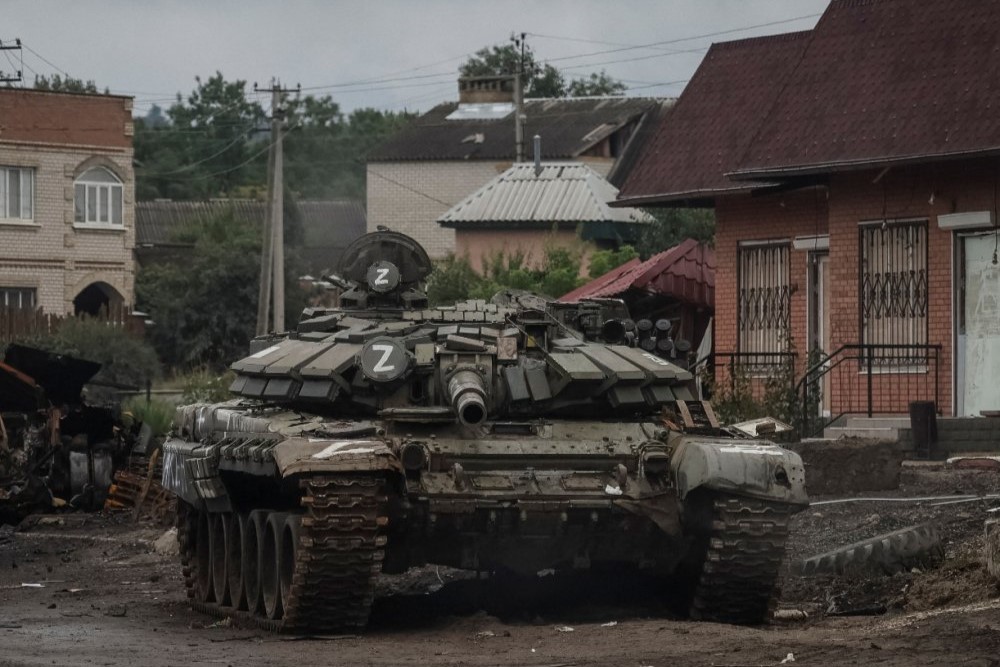
As the Russian military began operations into Grozny, Russian commanders committed their armor forces without infantry support. Instead of pinpointing primary efforts and objectives, Russian troops advanced in three separate, isolated, and mutually unsupported columns. In an identical fashion to the war in Ukraine, where hundreds of videos show Russian tank formations operating alone in cities or villages, the Russians suffered catastrophic losses as tanks and personnel carriers entered the city and became apparent targets for Chechnya hunter-killer teams. As the battle of Grozny waned, 102 out of the 120 Russian infantry fighting vehicles and twenty of the twenty-six tanks that had entered the city were wiped out. The 1st battalion of the 131st Motorized Rifle Brigade entered the city with 1,000 soldiers; by January 3, as it entered the city center, the unit had lost 800. Russia also failed to block off the city, as Soviet (and later Russian) doctrine, learned after World War II, prescribed.
The Chechnyan and Ukrainian invasions in 2022 share some resemblances. Both saw inadequately staffed units, poor use of combined arms leading to catastrophic effects on the armored force, and inadequate intelligence collection—amplified by endemic corruption—resulting in a misconception of the enemy. Just like in Chechnya, Russian security forces painted an erroneous picture of realities, leading military planners to underestimate Ukrainian troops. Much like in Grozny, Russian armor entered cities without infantry support. Weakly executed reconnaissance meant that Russian commanders headed blindly into Grozny. Russian forces did not know Chechnyan strongholds in the city and, therefore, blindly committed frontal troops instead of bypassing them. This underscores further command and control problems that date back to 1995.
Georgia
By 2006, the Russian military was training for a confrontation with Georgia with large-scale military exercises in the North Caucasus Military District that looked like a dress rehearsal for an attack on Georgia. After a Georgian military attack on the breakaway region of South Ossetia, Russia attacked Georgia on August 8, 2008. The geography and military disparity between Russia and Georgia during the conflict resulted in unsurprising outcomes. However, a closer look shows evidence of Russian shortcomings similar to those in Chechnya and Ukraine.
According to Gen. Nikolai Makarov, chief of the Russian General Staff, only 17 percent of the ground forces units were combat-ready. Only 5 of the 150 regiments in the Russian air force were combat-ready, and half of the Russian fleet could not leave port. Russian contract soldiers did not perform well during the operation, with most of the fighting being conducted by special-purpose forces, such as Russian airborne or Spetsnaz troops. The Russian air force’s failure to suppress Georgia’s limited air defense capabilities and its difficulties identifying friend or foe raise questions about its effectiveness.
During the five-day war, command and control proved to be a critical shortcoming for Russian forces. Makarov had been appointed to his post weeks before the invasion, and the Main Operations Directorate of the Russian General Staff, a key position in direct control of the Georgian operation, did not have a commanding officer during the war. District-level commanders did not have complete control of the air force. Instead, the air force was directed by Gen. Alexander Zelin, the air force’s commander, using a cell phone from his office in Moscow. Communication systems were obsolete, with many being from Soviet-era stocks. During one of the battles on August 8, it was reported that General Anatoly Khrulyov, the 58th Combined Arms Army’s commander, had to use a journalist’s cell phone to communicate with his forces because communication with his units was unavailable. Russia was so surprised by the timing of the attack on South Ossetia that the Russian General Staff was in the process of moving to a new location on August 8.
Intelligence, reconnaissance, and surveillance were equally dreadful for Russian forces in the Georgian campaign. Russia was both blind and deaf during the conflict. For example, on the afternoon of August 9, a Russian convoy of thirty infantry fighting vehicles encountered elements of the Georgian 3rd Infantry Brigades reconnaissance company. According to the book The Tanks of August, both the Russians and the Georgians were taken by surprise, and the ensuing firefight killed three Russians and eight Georgian soldiers, destroyed twenty-five out of thirty vehicles, and seriously wounded Khrulyov, along with several Russian journalists.
Conclusion
Poor command and control, reconnaissance and intelligence, logistics, force employment, and training have led to a weak showing for the Russian military in Ukraine. Military analysts failed to see the Russian military for what it is: a military that still lacks basic military training, suffers from crippling manpower shortages and inadequate Soviet-era equipment, and, at times, is poorly led. Assumptions of Russian military dominance were mainly based on Russian capabilities vis-à-vis Ukraine and the belief that most of Russia’s military reforms since 2008 had fixed institutional problems that manifested in Chechnya and Georgia. This turned out to be false, and Russia is suffering from the same mistakes today as it did in 1995. We should not have been surprised by Russian performance in this conflict, and it seems that Russia cannot escape its history.








 Igor's Blog