The right to destabilize is singular: A farewell to Max Blumenthal and Hillary’s propagandists

https://nomadiceveryman.blogspot.com/2019/10/the-right-to-destabilize-is-singular.html

Max Blumenthal has said “enough is enough” and taken his little pen and walked away from his staff position at Al Akhbar English over what he claims is their editorial tolerance of “Assad apologists”. According to Max in an article on his website explaining his decision to leave in a huff (The right to resist is universal: A farewell to Al Akhbar and Assad’s apologists) “the apologia for Assad and his crimes has reached unbearable levels.”

I once had a great deal of respect for Max Blumenthal. His work on the Palestinian issue has been courageous to say the least. But now I have to say farewell to Max and remove his link from my blogroll. His disingenuous and downright dishonest efforts to prop-up the progressive Assad demonetization train turns my stomach and I will never be able to post a single thing he writes without having to question the man’s integrity.

Yeah, it’s that bad. Max Blumenthal is an outright liar. No one, and I mean NO ONE with his resources and experience in the Middle East could miss the boat so badly on this topic without doing so deliberately unless he was a total and complete idiot. And Max is not an idiot. He is however, the son of Sidney Blumenthal who was a long term adviser to Bill Clinton (during the destabilization of Yugoslavia as coincidence would have it) and then a campaign adviser to Hillary Clinton who expected to serve in her State Department before Rahm Emanuel put his foot down for some reason. Max’s daddy is also reportedly a close friend of Tony Blair. Just thought I would throw that in for good measure.

Yes, Max Blumenthal is a liar. And I will now show you how I came to that conclusion. As to the why, well… you be the judge.

  1. The Tal al Zataar Guilt by Association Ploy

Max starts off his article condemning Al Akhbar and Bashir Assad with a rather odd quote. He’s attempting to demonize the Assad regime by referencing the Tal al Zataar refugee camp massacre when Syria came in to supposedly defend the camp, but in fact they were quite brutal toward the Palestinian refuges.

First of all, this occurred in 1976 when Bashir al Assad was all of 11 years old. Trying to use that incident to demonize Assad would be tantamount to linking Barack Obama with the 1968 Chicago Democratic Convention fiasco and riots simply because he is a democrat and from Chicago. Assad had nothing to do with al Zataar so it has no bearing on this issue what-so-ever except to poison the well as it were, a typical troll propaganda tactic that I would have expected Blumenthal to be well above using. But there it is just the same.

The other aspect of the al Zataar massacre that Max seems to have forgotten is that it took place during the Lebanese Civil War and those Palestinians weren’t simply innocent fugees hanging out hoping for CHANGE… they were actively involved in fighting around their camp and they were actively involved in fighting the Lebanese and Christian Phalangist forces.

There is no doubt that the result was a slaughter and that Syrian forces took part in it, but in reality it’s a bit more complicated than the Sesame Street version that Max tries to present in his article. So he’s starting off his article on a rather disingenuous note and he continues in the same vein throughout the rest of it.

  1. Max’s Clintonista Daddy

Max Blumenthal is NOT a self-made man. His writing career is a direct result of his being the off-spring of Sidney Blumenthal, a long time adviser to the Clinton White House and then a personal adviser to Hillary Clinton during her run for president back in 2008. Among other globalist rags, Max writes for the Huffington Post and Salon. His daddy wrote for all the same institutions and was even Washington bureau chief for Salon.com.

In fact, Blumenthal’s daddy wrote copy for the Clinton administration and handed it out to the press for them to regurgitate back in the late 90′s. That was his job: Propagandist in Chief for the Clinton administration. Then he just happens to go work for the same institutions that he was feeding bullshit to for years taking his son along with him for the ride.

Also interesting about his father is the fact that he is a HUGE proponent of the so-called “third way” movement across the globe. More on that later.

Odd isn’t it? Here we have Max, prodigal son of a lifelong Clintonista, taking a stand for a destabilization campaign primarily being run by none other than Hillary Clinton. Small world, huh?

One credible critique of Bashir Assad is the fact that he inherited his presidency from his father back in 2000. But honestly, how is that different than George H. W. Bush (his daddy was Prescott. Look it up Max), George W Bush, Rand Paul or even Max Blumenthal himself?

Well, here’s one difference: even the neocon warmongers had to admit that Assad enjoys the support of just over 55% of the population of Syria. The MAJORITY WANTS ASSAD TO BE PRESIDENT.

Blumenthal never mentions that in his “scholarly” article.

But if we are looking at the crimes of the father in order to demonize the son, Max has some penance to serve as well.

  1. Max’s Horrible Facts: Worthy of “Activists Say” Journalism

The vast majority of the so-called “evidence” Max uses to demonize the Assad regime has been long since discredited. There is no doubt about this. In fact, he actually tells Paul Jay at the Real News Network that he gets his info from “activists” and associated “journalists” embedded with the CIA backed terrorists. Here are just SOME of Max’s so-called “facts” and his admission of where he gets them. Take a look.

“The Assad regime was running an institution of torture in prisons. Possibly 100,000 people are in prison right now. And this makes Israel look like, you know, a champion of human rights.” Max Blumenthal

“I can not disagree with anyone who claims that the United States and the Saudi royals aim to ratchet up their regional influence on the backs of the shabby Syrian National Council while Israel cheers on the sidelines” Max Blumenthal

“This is a point where, by all accounts, the Assad regime had killed as many as 10,000 people in order to remain in power, possibly 13,000, according to people I know inside Syria who’ve come out.” Max Blumenthal

“But, I mean, it (Houla Massacre) was part of their campaign of suppression inside Syria, to crush what I consider to be a legitimate attempt at removing a dictator.” Max Blumenthal

“I started really paying attention to the coverage closely on the website, and mainly the opinions following the Houla massacre, which was by all accounts (really? read the German study yet Max?) carried out by shabiha affiliated with the Assad regime, to the embarrassment of the Assad regime.” Max Blumenthal

“…a regime that’s ideologically hollow that represents nothing beyond a fascistic security apparatus, married to (and sometimes literally, in some cases) a rich neoliberal business class…” Max Blumenthal

“But I made a personal decision based on my own values and based on the accounts that I was getting from Syrian activists, from Syrian intellectuals, and from journalists I respect who have been inside Syria, who’ve been in Homs, who’ve been with the revolution in Syria. And, I mean, these are people I trust.” Max Blumenthal

To completely dissect the virtual cornucopia of hardcore disinformation that Max spews on the subject of the Syrian “uprising” would take forever and most of the readers here are already well aware of the various studies and facts that have come to light over the last month or so that proves Max completely wrong on all these accounts. I will still delve into them a little since I am sending Max a copy of this article.

First: Israel isn’t standing on the sidelines cheering the destabilization campaign as Max mistakenly characterizes their involvement. They’re an ACTIVE PARTICIPANT with a GREAT DEAL on the line (Golan Heights? Water rights? oil and Natural Gas exploration two weeks ago?) which is something that you would imagine Max would be well aware of.

Second: “by all accounts” Syria has not killed 13,000 Syrian civilians. However, if by saying “by all accounts” you are talking about the Syrian “opposition” supported by the CIA (admitted and covered by the New York Times and others) and their Mockingbird Press Corps (like the institutions Max’s daddy works for) then of course, that would be “by all accounts”. Of course, expecting Max to understand this is an assumption and I may be giving him too much credit.

Third: The Houla Massacre was conducted NOT by the Assad regime but rather by the opposition in an attempt to demonize the Assad regime and ferment support for an all out invasion. Even the National Review knows that.

“As quietly as possible, BBC world news editor Jon Williams has admitted that the coverage of last month’s Houla massacre in Syria by the world’s media and his own employers was a compendium of lies.

Datelined 16:23, June 7, Williams chose a personal blog to make a series of fairly frank statements explaining that there was no evidence whatsoever to identify either the Syrian Army or Alawite militias as the perpetrators of the May 25 massacre of 100 people.” WSWS

Max… come on. How could you have POSSIBLY missed that one? John Pilger gets it. Why can’t you?

“The threats against Syria, coordinated in Washington and London, scale new peaks of hypocrisy. Contrary to the raw propaganda presented as news, the investigative journalism of the German daily Frankfurter Allgemeine Zeitung identifies those responsible for the massacre in Houla as the ”rebels” backed by Obama and Cameron.” John Pilger

The Free Syrian Terrorists have been conducting a terrorist bombing campaign, assassinations, and kidnappings all across Syria for months. Burhan Ghalion, head of the Syrian Transitional National Council recently said they need MORE TERRORISM in Syria, not less.

The latest massacre is already attributed to them and the others involved.Here, take a look at the handiwork of the so-called “activists” that Max Blumenthal supports. What if the Tea Party activists in America piled up the corpses of cops and soldiers and Obama supporters like this on the streets of Maine or Tennessee so they could film them being desecrated like this? What do you think Blumenthal’s take on that would be?

In fact, your daddy’s friend Hillary Clinton has also admitted that “al Qaeda” is inside Syria helping them destabilize the country. Now why the hell would they do that?

Well, I guess it’s ok for Max to support the efforts of the Syrian Freedom Fighters. If Lyin Joe Lieberman is on board, how much of a lie could it be?

Forth: Tossing out buzz words like “neoliberal business class” in order to try to sway the in tune progressives to your side is beyond tasteless. There is NOTHING, and I do mean NOTHING about the Assad regime that is neoliberal. The vast majority of the industry in Syria is nationalized or run by the state. This is part of what makes the overthrow of Assad so appealing to the neoliberals. They can PRIVATIZE everything and hand it over to their crony buddies in big business. They have NOT opened their doors to hot money speculators NOR have they privatized their central banking system. The education system is based on the FRENCH model not the for-profit Chilean style created by Augusto Pinochet and now being implemented by Barack Obama here in the states. Claiming Assad is a neoliberal is ridiculous and a pathetic (and obvious) attempt to sway a certain segment of the population to your side of the fence without a SHRED of evidence.

And by the way, I also noticed you offered not one single link to support ANY of your claims in your article on your site. I guess that speaks volumes as well.

Lastly: We already know who the so-called “activists” are and who’s paying them. We know that the National Council is nothing more than a group of opportunists and neoliberal puppets looking to cash in like their counterparts down in Libya did. We also know what “embedded journalists” are so your “evidence” is beyond pathetic and you know it as well. Which is probably why you offered no links to prove a single claim you make. Hell, even Stratfor has admitted that the “activists” in Syria are fabricating stories about the situation there. And Max still buys into it?

I wonder if one of Blumenthal’s credible sources happens to be Rami Abdelrahman from the London based Syrian Observatory for Human Rights. After all, they were the very first to assign blame for the Houla Massacre on Assad and the shabbiha…

“The shabbiha (Assad’s militiamen) broke into three houses overnight and slaughtered a family of five — the father, wife and their three children, a family of seven in another house and a eight in a third,” dissident in exile Rami Abdelrahman, who heads the British-based Observatory, told the news service. MSNBC

Of course, Rami Abdelrahman doesn’t actually exist. He’s a propaganda construct exposed a long time ago…

Firstly, there is NO individual by the name of Rami Abdul Rahman. This is just an alias that was being used by all SOHR members and mainly by the founders of the SOHR when articles were being originally published. SOHR

Again, maybe that is why Max doesn’t offer links or quotes to support his condemnation of Assad. I wonder if his daddy did while he was handing out propaganda to the press corp back in his Clinton days?

  1. Max Plays Both Sides of the Issue

Throughout Max Blumenthal’s article and his interview on the Real News network, he continually tries to play both sides of this issue while always continuing to make the argument that even though this is CLEARLY a destabilization campaign and even though there are terrorists committing atrocities in Syria and trying to blame them on the regime, Assad must be removed from power because he’s a bad man committing the atrocities against the “legitimate” uprising.

Blumenthal does this simply because he DOES understand that the vast majority of evidence is out there showing that what this is is an external aggression being waged against a sovereign state, illegally mind you, and he can’t possibly generate support like they did before the evidence came out.

Like in Libya, this is a small group of individuals in Syria who understand that there is a great deal of money to be made if they play ball with the imperialists and help them overthrow the legitimate government of Syria. It’s that simple.

Of course you could have a small group of people within a nation who want to change it’s ruling party if you factor that in. But what Blumenthal NEVER mentions is the fact that Assad has made SEVERAL concessions to the nation and implemented SEVERAL key changes to how the country is run. He also fails to mention the fact that the majority of the people of Syria support Assad (just like the majority of the people of Libya supported Gadhafi). These FACTS simply never factor into Blumenthal’s equation.

Conclusion

I have to admit, I was quite surprised by Max Blumenthal’s take on all of this. Perhaps I shouldn’t have been. I never took the time to look into his family history and how he got his start writing for institutions like Salon, Al Jazeera English, and the Huffington Post. I took him at face value thanks to his work on the Palestinian rights issue. That oversight is on me and I hope that this… correction… is not too late.

Unfortunately I have to conclude that Max is in bed with his daddy who is in bed with the Clintons on this one. I guess eventually while the Mockingbird Press allows you to build up credibility over the years, a time will come when you have to sit in front of Paul Jay and spew senseless propaganda to pay for your birthright entitlements in the neoliberal class of “third way” centrists.

To his credit though, it does look like Max was a little sickened by what he was doing during the Real News interview. I guess the globalist shill hat doesn’t feel so good sitting upon his head. I hope that when the Obama administration starts the bombing campaign and kills scores of Assad supporting innocent Syrians, our little entitled friend Max has a couple of sleepless nights to pay for his role in helping gin up left wing support for it.

Anyway, for whatever good it does, Max Blumenthal is off my blog-list and I will never post a link to anything he does again. Cus he’s a liar and a fraud who sold out the Syrian people for god knows what.

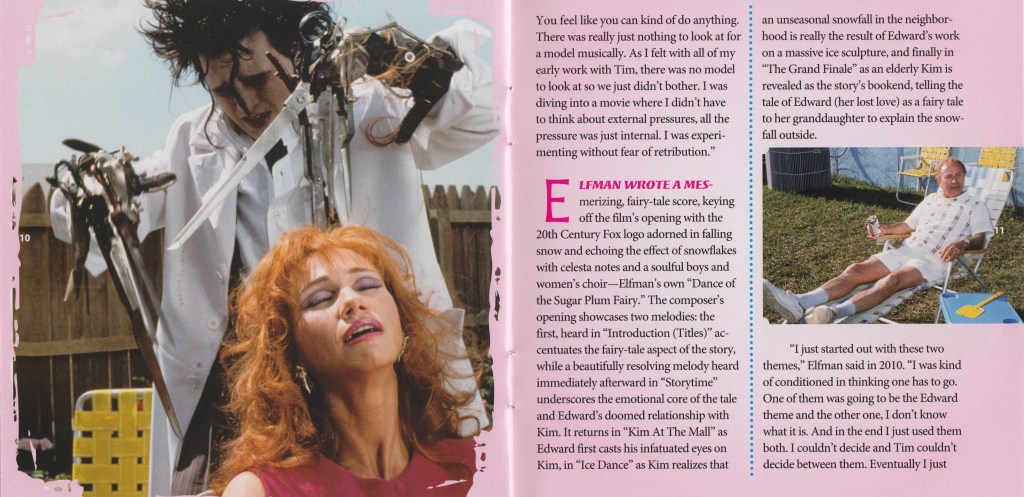
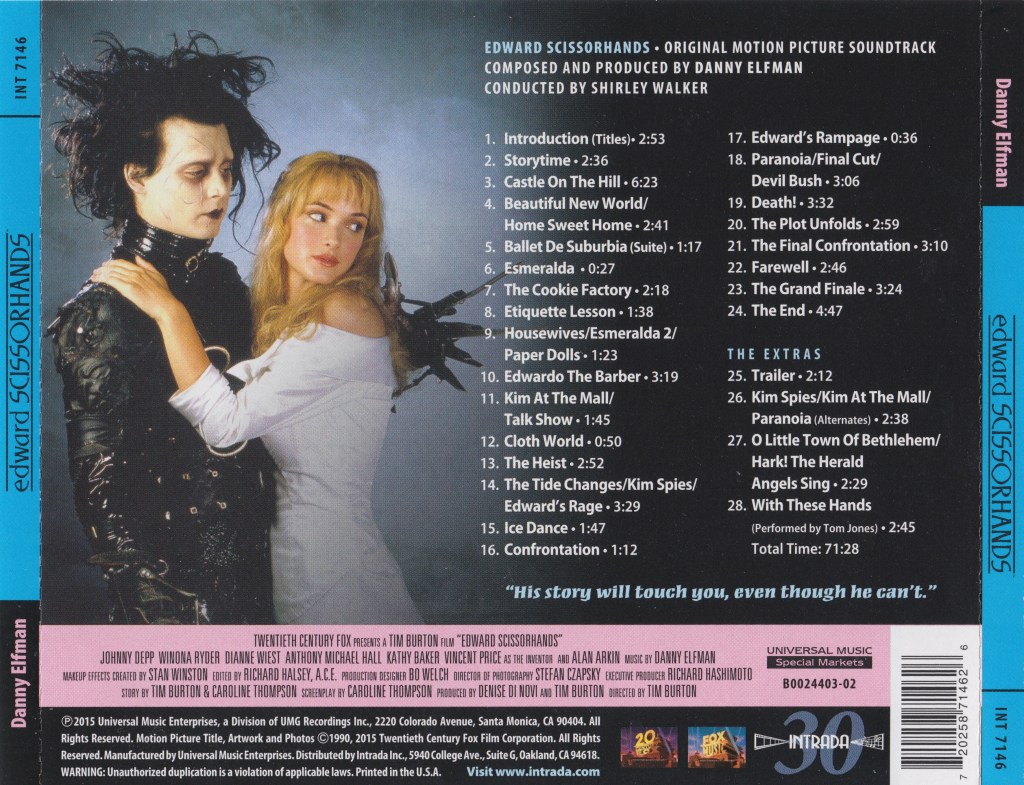
Edward Scissorhands by Danny Elfman

Emotionally rich, grand Danny Elfman soundtrack for famed 1990 Tim Burton fantasy romance with dark overtones finally gets expanded treatment! Johnny Depp plays Edward in nervous, moving fashion, Vincent Price wraps his own legendary career as The Inventor, Winona Ryder plays beautiful romantic lead Kim Boggs, Kathy Baker enacts comic neighbor Joyce. Tale is by turns spellbinding and eccentric, haunting and romantic. Danny Elfman tackles multiple musical challenges by covering every base: ideas are tuneful, melodic, quirky, exciting, inventive, powerful, grand, intimate – and ultimately haunting. Main theme alternates between major harmonies, minor ones as upwards-leaning melody unfolds in gently yearning fashion. With gentle arpeggio figures, transparent orchestrations, boys choir in the mix, this theme remains one of Elfman’s most heartfelt and endearing. Even in its most passioned, sweeping orchestral/choral perorations, this theme remains tender and romantic, colored with a tinge of tragedy. Beautiful writing! Numerous thematic ideas cover all those other bases, from comic hair-cut scenes to dramatic chase scenes, from wistful nostalgic overtones to crescendoing scares. Yet no matter how far out Burton and Elfman take things, incredibly haunting love story kindles all other elements throughout. Expanded edition available courtesy UMG & 20th Century Fox. Production by Nick Redman, audio restoration, assembly by Mike Matessino & Neil Bulk, detailed notes by Jeff Bond, package design by Joe Sikoryak. Absolutely winning score! Danny Elfman composes, Shirley Walker conducts orchestra, adult choir, Paulist Choristers Of California. CD available as part of Intrada INT series!

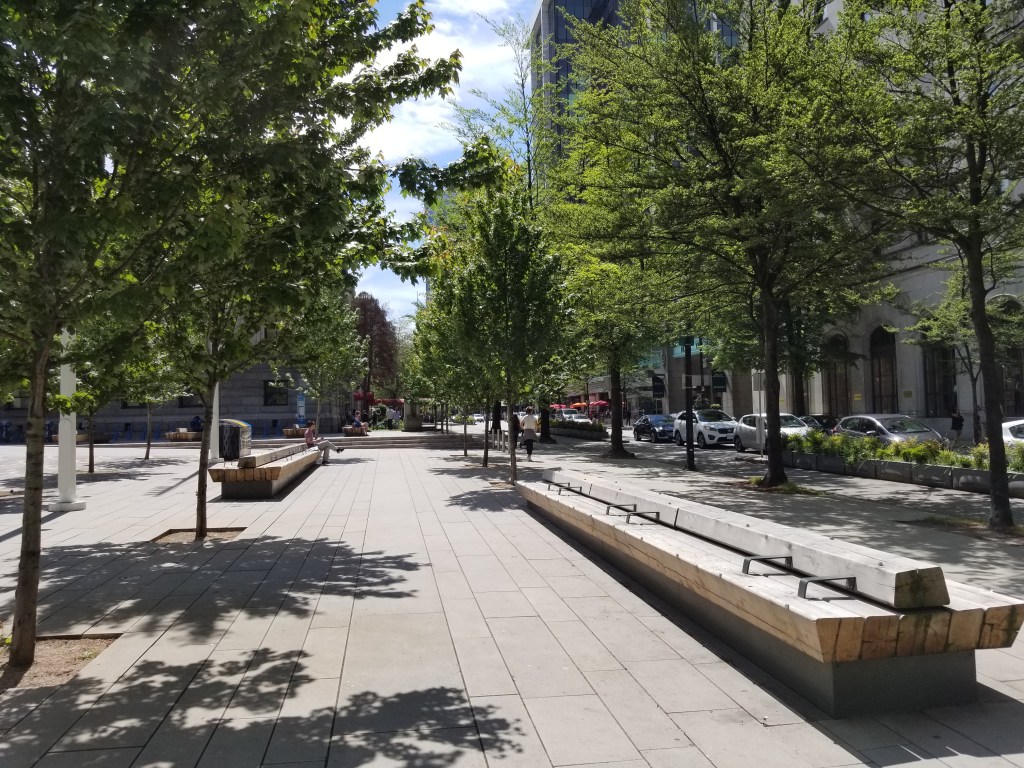
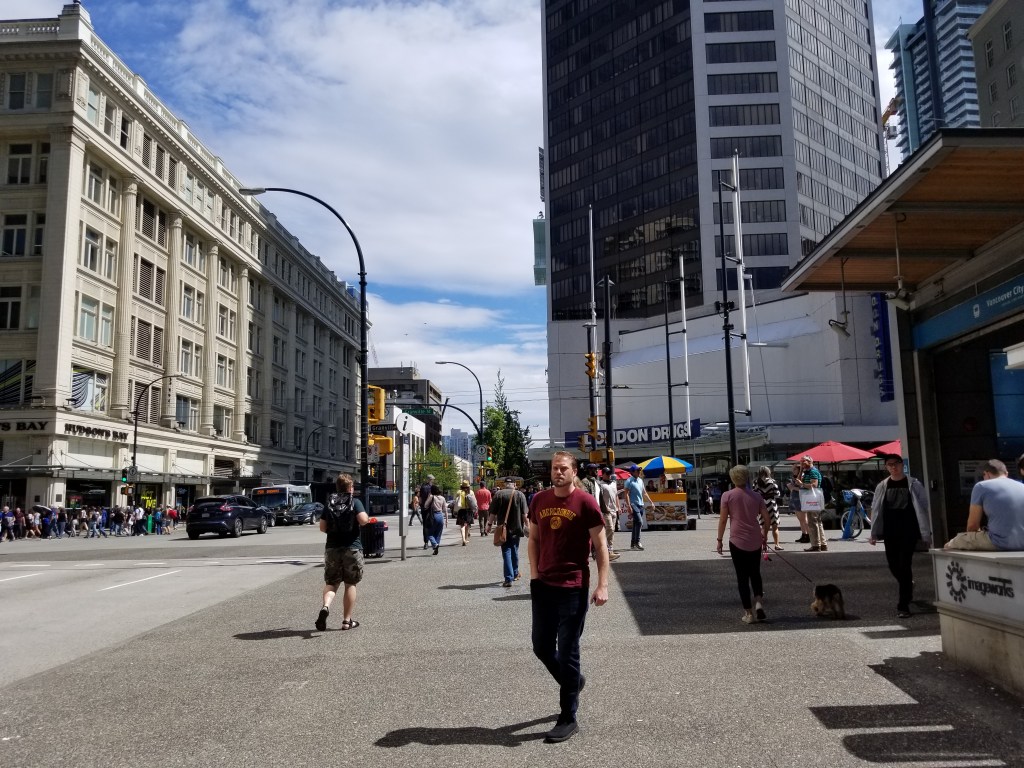
On Burrard Street in Downtown Vancouver. Summer of 2019.

Burrard Street is a major thoroughfare in Vancouver, British Columbia, Canada. It is the central street of Downtown Vancouver and the Financial District. The street is named for Burrard Inlet, located at its northern terminus, which in turn is named for Sir Harry Burrard-Neale.

The street starts at Canada Place near the Burrard Inlet, then runs southwest through downtown Vancouver. It crosses False Creek via the Burrard Bridge. South of False Creek, on what used to be called Cedar Street before the completion of the bridge in 1932, the street runs due south until the intersection with West 16th Avenue.

The intersection of Burrard Street and Georgia Street is considered to be the centrepoint of Downtown Vancouver, along with the more tourist-oriented and upscale shopping-spirited intersection of Burrard Street and Robson Street to the south. At and due northeast of the centre is the heart of the Financial District. Further down closer to Vancouver Harbour stands the historic Marine Building, an Art Deco masterpiece, opened in 1930, two years before the Art Deco pylons of the Burrard Bridge at the opposite end of the street. Finally at the Harbour lies Canada Place and the Vancouver Convention Centre.

Nearer to Burrard Bridge is located St. Paul’s Hospital, established on Burrard Street in 1894.

Burrard Street served as the dividing line between the two district lots laid out on the downtown peninsula in the second half of the 19th century: District Lot 185 (now West End) and District Lot 541 (granted to the Canadian Pacific Railway). The two grids were oriented differently, with the result that only every third northwest-southeast street in DL185 actually continuing southeast beyond Burrard into DL541. Burrard currently serves as the boundary between West End and Downtown, as defined by the City of Vancouver.

Burrard Street is served by SkyTrain’s Burrard Station, located underground between the intersections with Melville and Dunsmuir Streets in the heart of the Financial District. Along the downtown portion, there is a bike lane on the southwest-bound direction towards the Burrard Bridge.

The Architectural Work of Le Corbusier, an Outstanding Contribution to the Modern Movement

http://whc.unesco.org/en/list/1321/

Chosen from the work of Le Corbusier, the 17 sites comprising this transnational serial property are spread over seven countries and are a testimonial to the invention of a new architectural language that made a break with the past. They were built over a period of a half-century, in the course of what Le Corbusier described as “patient research”. The Complexe du Capitole in Chandigarh (India), the National Museum of Western Art, Tokyo (Japan), the House of Dr Curutchet in La Plata (Argentina) and the Unité d’habitation in Marseille (France) reflect the solutions that the Modern Movement sought to apply during the 20th century to the challenges of inventing new architectural techniques to respond to the needs of society. These masterpieces of creative genius also attest to the internationalization of architectural practice across the planet.

Brief synthesis

Chosen from the work of architect Le Corbusier that survives in eleven countries on four continents, the sites in seven countries on three continents, implemented over a period of half a century, for the first time in the history of architecture attest to the internationalization of architectural practice across the entire planet.

The seventeen sites together represent an outstanding response to some of the fundamental issues of architecture and society in the 20th century. All were innovative in the way they reflect new concepts, all had a significant influence over wide geographical areas, and together they disseminated ideas of the Modern Movement throughout the world. Despite its diversity, the Modern Movement was a major and essential socio-cultural and historical entity of the 20th century, which has to a large degree remained the basis of the architectural culture of the 21st century. From the 1910s to the 1960s, the Modern Movement, in meeting the challenges of contemporary society, aimed to instigate a unique forum of ideas at a world level, invent a new architectural language, modernize architectural techniques and meet the social and human needs of modern man. The series provides an outstanding response to all these challenges.

Some of the component sites immediately assumed an iconic status and had world-wide influence. These include the Villa Savoye, as an icon for the Modern Movement; Unité d’habitation in Marseille as a major prototype of a new housing model based on a balance between the individual and the collective; Chapelle Notre-Dame-du-Haut for its revolutionary approach to religious architecture; the Cabanon de Le Corbusier as an archetypal minimum cell based on ergonomic and functionalist approaches; and the Maisons de la Weissenhof-Siedlung that became known worldwide, as part of the Werkbund exhibition.

Other sites acted as catalysts for spreading ideas around their own regions, such as Maison Guiette, that spurred the development of the Modern Movement in Belgium and the Netherlands; the Maison du Docteur Curutchet that exerted a fundamental influence in South America; the Musée National des Beaux-Arts de l’Occident as the prototype of the globally transposable Museum of Unlimited Growth which cemented ideas of the Modern Movement in Japan; and the Capitol Complex that had a considerable influence across the Indian subcontinent, where it symbolized India’s accession to modernity.

Many of the sites reflect new architectural concepts, principles, and technical features. The Petite villa au bord du Léman is an early expression of minimalist needs as is also crystallized in the Cabanon de Le Corbusier. Le Corbusier’s Five Points of a New Architecture are transcribed iconically in Villa Savoye. The Immeuble locatif à la Porte Molitor is an example of the application of these points to a residential block, while they were also applied to houses, such as the Cité Frugès, and reinterpreted in the Maison du Docteur Curutchet, in the Couvent Sainte-Marie-de-la-Tourette and in the Musée National des Beaux-Arts de l’Occident. The glass-walled apartment building had its prototype in the Immeuble locatif à la Porte Molitor.

A few sites inspired major trends in the Modern Movement, Purism, Brutalism, and a move towards a sculptural form of architecture. The inaugural use of Purism can be seen in the Maisons La Roche et Jeanneret, Cité Frugès and the Maison Guiette; the Unité d’Habitation played a pioneering role in promoting the trend of Brutalism, while the Chapelle Notre-Dame-du-Haut and the Capitol Complex promoted sculptural forms.

Innovation and experimentation are reflected in the independent structure of concrete beams of the Maisons de la Weissenhof-Siedlung, while pre-stressed reinforced concrete was used in the Couvent de La Tourette. In the Capitol Complex, concern for natural air-conditioning and energy saving led to the use of sunscreens, double-skinned roofs, and reflecting pools for the catchment of rainwater and air cooling.

Standardisation is seen in the Unité d’Habitation de Marseille, a prototype intended for mass production, while the Petite villa au bord du Lac Léman set out the standard for a single span minimal house, and the Cabanon de Le Corbusier presented a standard, minimum unit for living. The modulor, a harmonic system based on human scale, was used for the exterior spaces of the Complexe du Capitole, which reflect the silhouette of a man with raised arm.

The idea of buildings designed around the new needs of ‘modern man in the machine age’ is exemplified in the light new workspaces of Manufacture à Saint-Dié, while the avant-garde housing at the Cité Frugès, and the low-rent Maisons de la Weissenhof-Siedlung, demonstrate the way new approaches were not intended for a tiny fraction of society but rather for the population as a whole. By contrast, the Immeuble Clarté was intended to revolutionise middle class housing. The Athens Charter, as revised by Le Corbusier, promoted the concept of balance between the collective and the individual, and had its prototype in the Unité d’habitation, while the Capitol Complex, the focal point of the plan for the city of Chandigarh, is seen as the most complete contribution to its principles and to the idea of the Radiant City.

Criterion (i): The Architectural Work of Le Corbusier represents a masterpiece of human creative genius, providing an outstanding response to certain fundamental architectural and social challenges of the 20th century.

Criterion (ii): The Architectural Work of Le Corbusier exhibits an unprecedented interchange of human values, on a worldwide scale over half a century, in relation to the birth and development of the Modern Movement.

The Architectural Work of Le Corbusier revolutionized architecture by demonstrating, in an exceptional and pioneering manner, the invention of a new architectural language that made a break with the past.

The Architectural Work of Le Corbusier marks the birth of three major trends in modern architecture: Purism, Brutalism and sculptural architecture.

The global influence reached by The Architectural Work of Le Corbusier on four continents is a new phenomenon in the history of architecture and demonstrates its unprecedented impact.

Criterion (vi): The Architectural Work of Le Corbusier is directly and materially associated with ideas of the Modern Movement, of which the theories and works possessed outstanding universal significance in the twentieth century. The series represents a “New Spirit” that reflects a synthesis of architecture, painting and sculpture.

The Architectural Work of Le Corbusier materializes the ideas of Le Corbusier that were powerfully relayed by the International Congress of Modern Architecture (CIAM) from 1928.

The Architectural Work of Le Corbusier is an outstanding reflection of the attempts of the Modern Movement to invent a new architectural language, to modernize architectural techniques, and to respond to the social and human needs of modern man.

The contribution made by the Architectural Work of Le Corbusier is not merely the result of an exemplary achievement at a given moment, but the outstanding sum of built and written proposals steadfastly disseminated worldwide through half a century.

Integrity

The integrity of the series as a whole is adequate to demonstrate the way Le Corbusier’s buildings reflect not only the development and influence of the Modern Movement but the way they were part of its transmission around the world.

The integrity of most of the component sites is good. At Cité Frugès, within the property, new buildings on three parcels of the site – one of which included a standardised house by Le Corbusier, which was destroyed during the war – are inconsistent with the architect’s concepts. At Villa Savoye and the adjacent gardener’s house, integrity is partly compromised by the Lycée and sports fields built on three sides of the original meadow that surrounded the villa in the 1950s. The setting of this site is fragile. At the Maisons de la Weissenhof-Siedlung, war-time destruction and post-war reconstruction has led to the collective integrity of the model settlement being affected by the loss of ten houses out of twenty-one.

At the Chapelle Notre-Dame-du-Haut, where Le Corbusier’s structure was built over a centuries-old pilgrimage site, the integrity of the site has been partly compromised by a new visitor centre and a nunnery near the chapel that cut Le Corbusier’s structure from its contemplative hillside setting.

At the Immeuble locatif à La Porte Molitor, a new rugby stadium has been constructed right in front of the glass façade of the apartment block.

Authenticity

The series clearly demonstrates how it adds up to more than the sum of its component parts.

For most of the individual component sites, the authenticity is good in relation to how well the attributes of the site can be said to reflect the overall Outstanding Universal Value of the series. At Cité Frugès, on three plots traditional houses were constructed replacing Corbusian structures, while elsewhere in the urban landscape, there is a partial loss of authenticity through neglect and interior changes. At l’Unité d’habitation, the fire of 2012 destroyed a small part of the building. This has now been totally reconstructed to the original design, but with some reduction in authenticity. The authenticity of the existing Capitol Complex could be impacted if either or both of the governor’s palace or the museum of knowledge were to be constructed, an eventuality that has apparently been discussed.

At the Musée National des Beaux-Arts de l’Occident, the original intention for the forecourt of the Museum appears to be as a wide open space. Forecourt planting in 1999 tends to detract from the presentation of the building, its key views and the setting.

Recent developments at Chapelle Notre-Dame-du-Haut have partly compromised the authenticity of the site in terms of its ability to convey Le Corbusier’s ideas. At the Immeuble locatif à La Porte Molitor the new stadium has detracted from the ability of the glass walls of this site to convey its value, although without diminishing its authenticity.

In terms of materials, some sites have been restored and partly reconstructed in recent years, after neglect or disfigurement. Overall, the modifications can be seen to be reasonable and proportionate.

Protection and management requirements

Many of the components received early protection, mostly in the two decades following Le Corbusier’s death. Some, like the Maisons de la Weissenhof-Siedlung in Stuttgart and the Unité d’habitation in Marseille, were given protection during Le Corbusier’s lifetime. The nomination dossier sets out for each component the relevant forms of legislative protection. All component sites are protected at a national/federal level and their buffer zones are adequately protected by either legislation or planning mechanisms. Given the importance of detail and setting for these 20th century buildings, it is crucial that their protection is sufficiently encompassing and sensitive to allow for protection of interiors, exteriors, context and setting.

In most of the sites, conservation measures are appropriate and are based on long-standing conservation experience and methodology. Conservation work is programmed and entrusted to specialists with high levels of skill and expertise. Conservation treatment is combined with regular maintenance, including the involvement of inhabitants, local communities, and public associations. There are conservation issues in the Chapelle Notre-Dame-du-Haut. There is now an urgent need to implement the agreed conservation programme. There is also an urgent need for a Conservation plan to be prepared for the Capitol Complex.

A Standing Conference has been established for the overall series and will coordinate the management of the property, advise States Parties and implement actions for promotion and enhancement of the property. An Association of Le Corbusier Sites has been set up to bring together all the local authorities in whose territories sites have been nominated. Its main objectives are coordination, raising public awareness, sharing conservation experience, overall coordination and management of the series, and implementation of management plans for each of the component sites. The involvement of the expertise of the Fondation Le Corbusier – that has the moral rights over Le Corbusier’s oeuvre – is crucial for appropriate management and conservation of the series, especially in those cases where the properties are in private hands other than the Fondation. Within France, Switzerland and Argentina coordinating committees have been set up to oversee the management of sites in those countries.

What remains unclear is how dialogue is undertaken between countries in relation to sensitive development projects. There would be a need for contributing States Parties to have knowledge of, and opportunities to comment on, proposed development in a component site that might compromise the value of the overall series.

Local management plans have been drawn up for each component site. These have been implemented on a partnership basis between owners and the cultural, heritage and planning departments of the local authorities in whose area they are sited. At the Chapelle Notre-Dame-du-Haut, the management system needs strengthening to ensure the security of the site. At the Maison du Docteur Curutchet a municipal decree for the expansion of the buffer zone and active protection of its environment has been sanctioned.

Given the special problems associated with the conservation of 20th century architecture, a continuous involvement of (inter)national specialists on the conservation of Modern architectural heritage is also essential. In Switzerland the federal administration can call such specialized experts for advice to support the local conservationists (and has done so already). A similar approach is highly recommended for other countries.

The current staffing levels and levels of expertise and training are high in all sites and mechanisms to allow liaison between sites have been put in place. Nonetheless, there appears to be a need for more capacity building on the processes of impact assessment and a need to formalise and clearly define conservation approaches and procedures across the series.

Model monitoring indicators developed for two properties in Switzerland will be developed for the rest of the series by the end of 2016.

Sorry America, Ukraine isn’t all about you

https://pando.com/2014/05/14/sorry-america-the-ukraine-isnt-all-about-you/

As the Ukraine crisis tips further into full-scale bloodbath and civil war, we seem to be getting more clueless than we were before this crisis started. That’s a pretty low bar to measure against, and the consequences of our cluelessness about what’s driving the various sides could be catastrophic for everyone.

One of the biggest problems is that everyone who riffs on Putin and Ukraine frames their analysis through a very narrow, Americanized lens, as if the only thing on everyone’s minds out there is us, America. Either Putin is behaving evilly because he fears America’s empire of liberty and freedom; or Putin is behaving perfectly rationally because the evil American empire has bullied Putin into a corner, forcing him to annex Crimea and support pro-Russian separatists.

Other Anglo-American “experts” frame Putin’s actions as if we’re all playing a sophisticated version of Risk. In this framing either Putin is driven by some genetic need to revive old Russian imperialism, conquering lost territory because he’s been so pained all these years, like a man reaching for a missing limb; or conversely, Putin apologists say he’s legitimately securing a buffer region to protect Russian interests from American-Western encroachment.

All of these versions have truth to them, but they all share one huge blind spot: What role does domestic Russian politics play in Putin’s policies in Ukraine? For that matter, how does domestic Ukrainian politics inform interim leader Turchynov’s or Yarosh’s moves?

Every hack knows that “all politics is local” — but we rarely apply this adage to understanding the politics of the rest of the world. The reason in Russia’s case is obvious: We don’t understand that part of the world, and aren’t much interested in it either, except insofar as they provide proxy ammo to our own domestic political spats. Our best and brightest foreign policy elites never strayed far from the warped hick mindset of that Vietnam War colonel in Full Metal Jacket:

“We are here to help the Vietnamese, because inside every gook there is an American trying to get out.”

It’s much easier analyzing Kremlin policy in Ukraine on the assumption that America is always on Putin’s mind in his every decision — because hell, we’re on our minds 24/7, obviously we must be on everyone else’s minds too.

To understand Putin’s moves in Ukraine from a domestic standpoint, go back to the start of Putin’s return to the Kremlin, announced in late 2011, effective early 2012. His return to the presidency from his prime minister’s perch has been nothing at all like Putin’s first eight years in the Kremlin. His base is vastly different now than 1999-2008. Then, his base was primarily Russia’s urban liberals and bourgeois elites. Putin lost them in 2011; his base is now Russia’s Silent Majority.

Putin’s politics have changed accordingly.

Let’s go back, briefly, even further to 1999-2000, when Putin first rose to power. The forgotten ugly truth is that Putin came to office with the enthusiastic support of Russia’s liberals — the St. Petersburg (neo)liberals, and also many of the most prominent Moscow intelligentsia liberals. Putin’s political mentor in the 1990s was the liberal mayor of St. Petersburg, Anatoly Sobchak — Putin was his deputy mayor and his muscle. More important are Putin’s old ties to the neoliberal “St. Petersburg Clan” that designed and supervised Russia’s brutal market reforms under Yeltsin. The St. Petersburg clan was led by Anatoly Chubais, USAID’s favorite Russian (and Larry Summers’ too, who famously called the Chubais Clan running Yeltsin’s disastrous economy “The Dream Team”).

When Putin first rose to power, not only Chubais but the whole cadre of Petersburg free-market liberals supported Putin as the Pinochet who would protect and promote free-market reforms in Russia. Chubais praised Yeltsin for resigning from the Kremlin and appointing Putin in his place:

“It is a brilliant decision, extremely precise and profound, and apart from anything else, very brave.”

Putin’s economic team was stacked with Petersburg liberals — German Gref, Alexei Kudrin, Andrei Illarnionov (now with the CATO Institute) —and the main liberal political party, SPS, threw its support behind Putin’s first election for president in 2000.

But it wasn’t just free-market Petersburg Clansmen who supported Putin. Anti-Fascist Youth Action (AYA) leader Pyotr Kaznacheyev joined the Kremlin as an economic advisor until 2005 (today he’s a partner at an oil and mining consultancy). And Yevgenia Albats, the leading critic of KGB abuses during the 1990s and author of the book “The State Within a State: The KGB and Its Hold on Russia” threw her support behind Putin half a year after he launched his brutal war in Chechnya, and urged other liberals to set aside their fears (and principles) to back Putin as well. In Albats’ “Does a KGB Resume Make Putin a Stalin?” Albats wrote:

“I cannot help noticing that much of the judgment heaped on Putin for his KGB past resembles much of the judgment that was heaped by the KGB itself on many Soviet citizens — myself included — back in the bad old days.

“Those who know Putin well almost universally describe him as an exceptionally honest man, modest in his private life and deeply religious.

“Let’s give Vladimir Putin a chance. Let’s not relegate him to a corner where he’ll have no reason to prove he can do better than many expect him to. Let’s leave Russia some hope.” Today, as you might expect, Yevgenia Albats is one of Putin’s fiercest liberal critics. As are so many other liberals who backed Putin’s takeover of the Kremlin, but later turned against him when Putin turned out to the “wrong” sort of Pinochet — the Pinochet who didn’t need their services.

Losing the support of the insular Moscow liberal intelligentsia wasn’t a political problem for Putin when he left office in 2008, because their grievances didn’t catch on with the booming yuppie class in Moscow and a handful of other big cities. In a country as culturally top-down as Russia, it’s hard to overemphasize just how important it was for Putin to keep the liberal intelligentsia’s political opposition contained and marginalized, lest it infect the young “manager class”: The legions of politically apathetic PR flaks, corporate managers, lawyers, techies and so on.

The important thing to remember is this: Russia’s liberal intelligentsia and its big city yuppie class is small in numbers, outsized in influence and importance…. and hated by the rest of Russia. And there’s a lot to hate: intelligentsia liberals and Moscow yuppies are elitist snobs on a scale that would turn anyone into a Bolshevik. They even named their go-to glossy “Snob”— and they meant it. It’s not just the new rich who are elitist snobs — liberal journalist-dissident Elena Tregubova’s memoir on press censorship interweaves her contempt for Putin with her Muscovite contempt for what she called “aborigines,” those provincial Russian multitudes who occupy the rest of Russia’s eleven time zones. Tregubova flaunted her contempt for Russia’s “aborigines,” whom she mocked for being too poor and uncivilized to tell the difference between processed orange juice and her beloved fresh-squeezed orange juice. I’m not making that up either.

Tregubova’s contempt is typical for the liberal intelligentsia. Stephen Cohen quoted well-known Russian liberal intellectuals blaming the misery and poverty of post-Soviet Russia on the Russian masses who suffered most: “the people are the main problem with our democracy” said one; another blamed the failures of free-market reforms on “a rot in the national gene pool.” Alfred Kokh, a Petersburg liberal fired by Yeltsin for taking bribes from banks while heading the privatization committee, openly relished the misery suffered by the Russian masses after the 1998 financial markets collapse forced millions into subsistence farming for survival:

“The long-suffering Russian masses are to blame for their own suffering…the Russian people are getting what they deserve.”

What this means politically is eleven time zones of untapped resentment, surrounding an island of wealth and liberal elitism—Moscow.

Wealth inequality the real problem: Russia has the worst wealth inequality in the world.

Most living Russians still remember the Soviet era, when wealth inequality was so minute it was measured in perks rather than yachts. That’s what the Russians mean when they tell pollsters they preferred the Soviet Union days and rue its collapse. Lazy hacks interpret those polls as proof that Russians are still evil empirelings, for the sheer evil joy of having a Warsaw Pact to boast about. Rather than the obvious: Russians lived longer and easier under Soviet rule, then started dying off by the millions as soon as capitalism was introduced, when poverty exploded and they found themselves in the most unequal country on earth.

[And it’s not just Russians: In a Gallup poll late last year, a majority of Ukrainians said that the collapse of the Soviet Union was more harmful (56 percent) for Ukraine than beneficial (23 percent).]

To an outsider, these are all problems that need solutions. But to a political animal like Putin, this huge pool of human resentment and nostalgia is a potential power base: Russia’s Silent Majority. Although Putin has thrown them plenty of bones over the years, the Kremlin never fashioned an entire politics around the Silent Majority, in part because it never had to. The thinking has been that no matter how desperate and resentful the Russian “aborigines” in the provinces get, they’ll never pose a serious threat to Kremlin power. Moscow’s liberals and its “manager class” were taken far more seriously as a class.

Putin’s surprise decision in 2007 naming as his Kremlin successor a Petersburg liberal, Dmitry Medvedev, showed how important the liberal/yuppie demographic was in Putin’s political calculations. Everyone had expected Putin to name a figure tied to the security services, the “siloviki,” if only to protect himself. His choice of the liberal, well-liked Medvedev was not simply because Medvedev didn’t threaten Putin; he also reflected a Russia that liberals wanted: cultured, civilized, European, raised in an elite central district in St. Petersburg. For awhile it worked; many liberals and big city yuppies were impressed, pleased, and harbored hopes that Medvedev could be won over to their side, seeing him as naturally one of theirs. Keeping the big city liberals happy, or at the very least from turning against him, remained a key plank of Putin’s politics.

That fantasy — that Medvedev was anything but Putin’s yes-man, or that his Kremlin perch meant that Russia was now plausibly European, was shattered for good in late 2011, when Putin announced that the jig was up: He was switching places with Medvedev and moving back into the Kremlin, and the only thing remaining was for Russia to rubber stamp his decision with a ritualistic vote.

That domestic political calculation changed in December 2011, when tens of thousands of young Muscovites took to the streets in the “manager class revolution,” protesting Putin’s crude way of re-installing himself in the Kremlin. They were outraged at the way Putin made fools of them — all those years, Putin had insisted Russia was “civilized” and democratic in its own Russian way — part European, part Russian — which is exactly what the “manager class” needed to hear and to believe. They travel a lot to the West. It’s hard to explain just how existentially important those trips to the West are to the “manager class.” The “manager class” could hold their heads up while traveling around Europe during the first Putin term, because on paper at least, Putin did things by the book. When he stepped down and nominated Medvedev to take his place, it was further confirmation that Russia wasn’t as far from “civilized” Europe as the liberal opposition claimed.

But when Putin made that announcement that he was switching seats with Medvedev, the awful reality hit home to the urban “manager class” that they’d been duped. And they were outraged. I remember the explosion of raw yuppie rage on the Russian Internet those first few days after Putin’s announcement, though I didn’t fully appreciate how serious that Muscovite yuppie outrage was at first. They were talking as if Putin had declared war on them. He had certainly humiliated them; worse, the Europeans would judge the travel-mad “manager class” like they live in Boratastan. Putin humiliated them, and that humiliation wouldn’t ever go away until Putin was gone. Suddenly, Moscow urbanites flooded social media with rage against Putin, openly declaring war. I thought they were blustering. Yuppies don’t take to the streets, Russian yuppies least of all.

Putin’s announcement came in October 2011. Two months later, fraud-riddled elections sent tens of thousands of young Muscovites out on the streets battling with riot police. It wasn’t so much the vote fraud — every Russian election since Yeltsin stole the 1996 presidential elections has been rife with vote fraud, within limits of plausibility, and December 2011’s Duma vote fit in that rough category. The outrage was over the humiliation of having your despot shove his despotism in your bourgeois face. The New York Times headlined their story: “Boosted By Putin, Russia’s Middle Class Turns On Him.”

During the mass yuppie protests in Moscow, I remember one telling moment that gave some insight into the Kremlin’s new political strategy. Legions of pro-Putin youths started pouring into Moscow, and locals started warning of provocateurs come to start violence and invite a crackdown. But in one video I watched, a confrontation in Mayakovskaya Square between the Moscow yuppies and the pro-Putin youths, the Muscovites all started yelling and laughing realizing that the pro-Putin youths were from the despised provinces. You could tell by their clothes, their haircuts, their nervous out-of-place expressions on their faces. The rich Muscovites chased them away; the provincial Putin tools skulked back to their shitty buses, for the long journey back to their wretched provincial apartment blocks.

It’s hard to know when Putin decided to run a Nixon strategy and appeal to Red State Russia but I’m pretty sure he was as shocked as anyone by the scale and rage in those first anti-Putin protests in December 2011.

This is a long background way of getting to the point that I want to make about understanding Putin by way of “all politics is local.” Putin lost the crucial big city yuppie class. They’re gone for good. There are a lot of ways an autocrat in a nominally democratic country can respond to that. Putin has chosen a new politics appealing to the Russian Silent Majority, and that means appealing to their resentments, heating up the culture wars between liberal Moscow and the slower, fearful masses in the rest of those eleven time zones. To exploit the huge differences between the Moscow liberals and yuppies opposed to Putin, and the rest of the country that resents them.

The Silent Majority has waited at least two decades for payback, and now it’s on, and it’s not pretty. It’s why Putin targeted Pussy Riot. We Westerners loved them; they were heroes to us, brave punk rock babes fighting the Man and getting jailed for being punk. In our world, that’s cool. But in Russia, Pussy Riot was completely despised by nearly everyone, across class and regional lines. One poll after they were jailed showed only 6 percent of Russians supported Pussy Riot; the poll could not find a single respondent who said they respected the jailed band members.

By exploiting Russian disgust for Pussy Riot and equating the opposition movement with Pussy Riot, Putin was able to conflate the liberal opposition with a decadent, alien art troupe whose purpose seemed to be to humiliate Russia and mock their culture. Nixon couldn’t have dreamed up a more perfect symbol of his opponents.

The Nixon Strategy also explains why, after all these years, Putin suddenly targeted Russia’s gays for a vicious culture war campaign. In the Russian Red States, the violent, cruel state-managed homophobia — in which a leading TV anchor told his audience that gays’ hearts and organs should be burned and buried deep underground — was red meat, an acknowledgment at last that Russia’s Silent Majority matters. And the more Moscow yuppies and Westerners berated Russia for attacking gays, the more the Silent Majority identified with the Kremlin.

And that brings me to Putin and Ukraine. It goes without saying that Putin didn’t plan this crisis to happen — he already had his man in power in Kyiv. But Putin did exploit the situation, turning a major humiliating defeat in February into a massive political victory within Russia by doing what the Silent Majority would’ve wanted Putin to do: Redress grievances, air out resentments nonstop against the West and against west Ukraine fascists, and screw whatever the West thinks.

There’s not much comfort here for any side in the West when you frame Putin’s actions through local politics. Here, in our proxy war way of framing Ukraine, either Putin’s a crazy evil empire-r looking to reestablish his empire, meaning we better stop him now; or Putin’s merely reacting defensively to our aggression (or, according to the faulty thinking of a lot of people sick of American interventionism, Putin is heroically defying the US Empire, acting as a counterweight).

What he’s doing is shoring up his new political base while tightening the screws on whatever remained of liberal freedom in Russia, taking control of the Internet, seizing control of the handful of opposition online media sites, and ramping up the culture war against liberals, gays, the decadent West… The fact that we, the US and EU and a few billionaires, funded violent regime change groups in bed with west Ukraine fascists and Russophobes has only made Putin’s domestic job easier. You can see it in the aftermath of the Odessa fire massacre that killed over 40 pro-Russian separatists: It shut up even Navalny.

The liberal-yuppie elites’ momentum is over. Putin’s popularity among the rest of the country has never been higher.

So if Putin is neither the defiant counterweight hero or the neo-Stalinist imperialist, but rather playing a Russian version of vicious Nixon politics, what should the West do?

That’s easy: Stay the Hell out of Russia’s way for awhile, its version of Nixon politics is just beginning, and it’s going to get uglier. Russia has a history of turning inward in ways that will strike us as feral and alien, something the abandoned Silent Majority will welcome, but no one else will. (Our sanctions only helped speed up that process of inward isolationism.)

America’s Silent Majority was crazy enough in the Nixon years: the Silent Majority cheered Nixon on when college students were gunned down on campuses; 80% of Americans sided with Lt. William Calley, the officer in charge of the My Lai massacre.

Sorry Ukraine, but you’re screwed. This is barely about you; it’s about us. It always is.

The Great War – Right Is More Precious Than Peace

https://rutube.ru/video/c6b49ea9b7d87327ef29bea17f3c37a0/

United States enters the war. US foreign policy in early 20th century. Non-interventionism at war’s start, swings of public opinion, industrial production favouring the Allies. Wilson’s re-election and the declaration of war on Germany, prompted by the Zimmermann Telegram and unrestricted submarine warfare. Preparations for war, conscription, General Pershing’s arrival in Europe.

The Great War is a 26-episode documentary series from 1964 on the First World War. The documentary was a co-production of the Imperial War Museum, the British Broadcasting Corporation, the Canadian Broadcasting Corporation and the Australian Broadcasting Commission. The narrator was Michael Redgrave, with readings by Marius Goring, Ralph Richardson, Cyril Luckham, Sebastian Shaw and Emlyn Williams. Each episode is c. 40 minutes long.