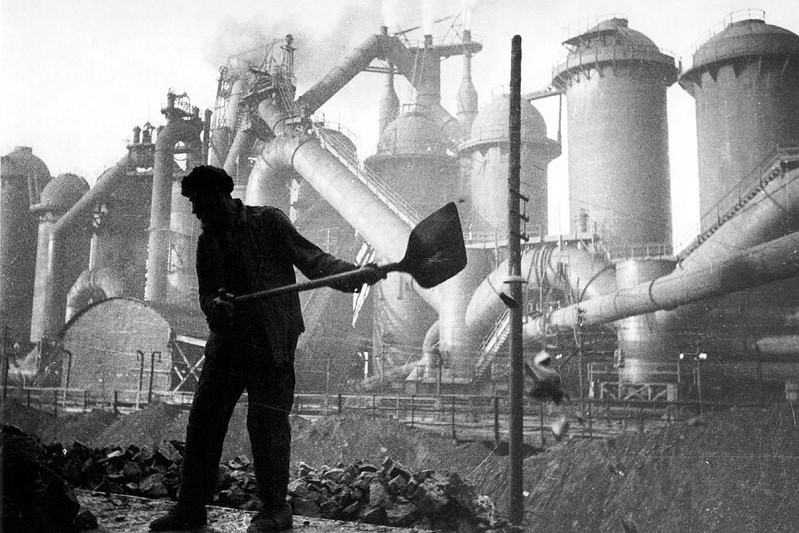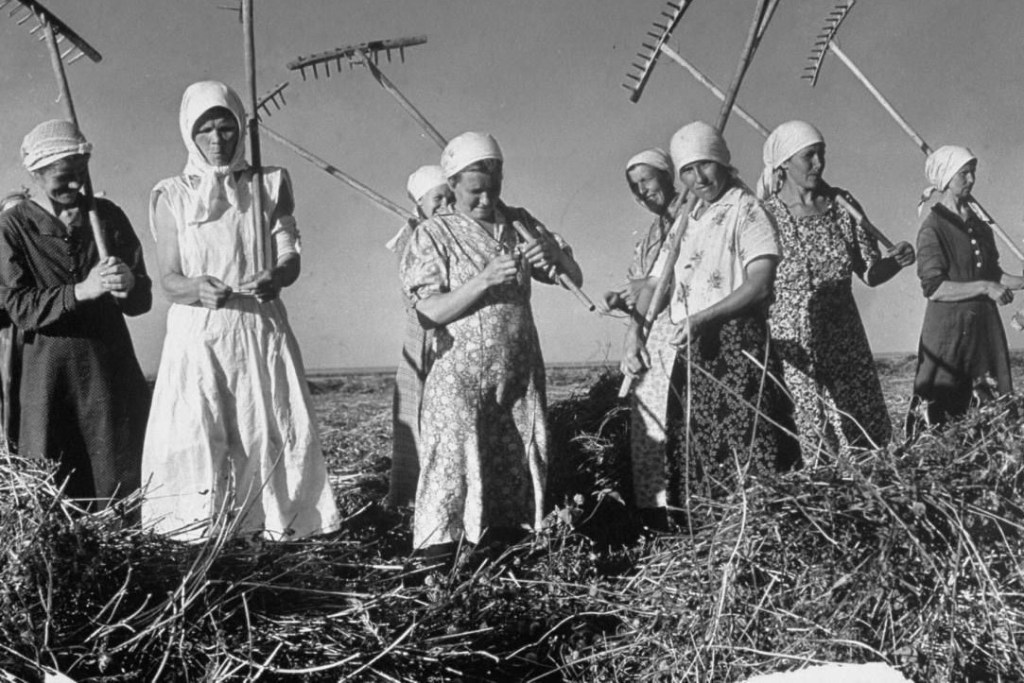
The “Holodomor” and the Film “Bitter Harvest” are Fascist Lies

https://www.counterpunch.org/2017/03/03/the-holodomor-and-the-film-bitter-harvest-are-fascist-lies/

(Author’s note: In this article I rely heavily on the evidence cited in the research of Mark Tauger of West Virginia University. Tauger has spent his professional life studying Russian and Soviet famines and agriculture. He is a world authority on these subjects, and is cordially disliked by Ukrainian nationalists and anticommunists generally because his research explodes their falsehoods. )

The Ukrainian nationalist film “Bitter Harvest” propagates lies invented by Ukrainian nationalists. In his review Louis Proyect propagates these lies.

Proyect cites Jeff Coplon’s 1988 Village Voice article “In Search of a Soviet Holocaust: A 55-Year-Old Famine Feeds the Right.” In it Coplon shows that the leading “mainstream” anticommunist Western experts on Soviet history rejected any notion of a deliberate famine aimed at Ukrainians. They still reject it. Proyect fails to mention this fact.

There was a very serious famine in the USSR, including (but not limited to) the Ukrainian SSR, in 1932-33. But there has never been any evidence of a “Holodomor” or “deliberate famine,” and there is none today.

The “Holodomor” fiction was invented in by Ukrainian Nazi collaborators who found havens in Western Europe, Canada, and the USA after the war. An early account is Yurij Chumatskij, Why Is One Holocaust Worth More Than Others? published in Australia in 1986 by “Veterans of the Ukrainian Insurgent Army” this work is an extended attack on “Jews” for being too pro-communist.

Proyect’s review perpetuates the following falsehoods about the Soviet collectivization of agriculture and the famine of 1932-33:

  • That in the main the peasants resisted collectivization because it was a “second serfdom.”
  • That the famine was caused by forced collectivization. In reality the famine had environmental causes.
  • That “Stalin” – the Soviet leadership – deliberately created the famine.
  • That it was aimed at destroying Ukrainian nationalism.
  • That “Stalin” (the Soviet government) “stopped the policy of “Ukrainization,” the promotion of a policy to encourage Ukrainian language and culture.

None of these claims are true. None are supported by evidence. They are simply asserted by Ukrainian nationalist sources for the purpose of ideological justification of their alliance with the Nazis and participation in the Jewish Holocaust, the genocide of Ukrainian Poles (the Volhynian massacres of 1943-44) and the murder of Jews, communists, and many Ukrainian peasants after the war.

Their ultimate purpose is to equate communism with Nazism (communism is outlawed in today’s “democratic Ukraine”); the USSR with Nazi Germany; and Stalin with Hitler.

Collectivization of Agriculture – The Reality

Russia and Ukraine had suffered serious famines every few years for more than a millennium. A famine accompanied the 1917 revolution, growing more serious in 1918-1920. Another serious famine, misnamed the “Volga famine,” struck from 1920-21. There were famines in 1924 and again in 1928-29, this last especially severe in the Ukrainian SSR. All these famines had environmental causes. The medieval strip-farming method of peasant agriculture made efficient agriculture impossible and famines inevitable.

Soviet leaders, Stalin among them, decided that the only solution was to reorganize agriculture on the basis of large factory-type farms like some in the American Midwest, which were deliberately adopted as models. When sovkhozy or “Soviet farms” appeared to work well the Soviet leadership made the decision to collectivize agriculture.

Contrary to anticommunist propaganda, most peasants accepted collectivization. Resistance was modest; acts of outright rebellion rare. By 1932 Soviet agriculture, including in the Ukrainian SSR, was largely collectivized.

In 1932 Soviet agriculture was hit with a combination of environmental catastrophes: drought in some areas; too much rain in others; attacks of rust and smut (fungal diseases); and infestations of insects and mice. Weeding was neglected as peasants grew weaker, further reducing production.

The reaction of the Soviet government changed as the scope of the crop failure became clearer during the Fall and Winter of 1932. Believing at first that mismanagement and sabotage were leading causes of a poor harvest, the government removed many Party and collective farm leaders (there is no evidence that any were “executed” like Mykola in the film.) In early February 1933 the Soviet government began to provide massive grain aid to famine areas.

The Soviet government also organized raids on peasant farms to confiscate excess grain in order to feed the cities, which did not produce their own food. Also, to curb profiteering; in a famine grain could be resold for inflated prices. Under famine conditions a free market in grain could not be permitted unless the poor were to be left to starve, as had been the practice under the Tsars.

The Soviet government organized political departments (politotdely) to help peasants in agricultural work. Tauger concludes: “The fact that the 1933 harvest was so much larger than those of 1931-1932 means that the politotdely around the country similarly helped farms work better.” (Modernization, 100)

The good harvest of 1933 was brought in by a considerably smaller population, since many had died during the famine, others were sick or weakened, and still others had fled to other regions or to the cities. This reflects the fact that the famine was caused not by collectivization, government interference, or peasant resistance but by environmental causes no longer present in 1933.

Collectivization of agriculture was a true reform, a breakthrough in revolutionizing Soviet agriculture. There were still years of poor harvests — the climate of the USSR did not change. But, thanks to collectivization, there was only one more devastating famine in the USSR, that of 1946-1947. The most recent student of this famine, Stephen Wheatcroft, concludes that this famine was caused by environmental conditions and by the disruptions of the war.

Proyect’s False Claims

Proyect uncritically repeats the self-serving Ukrainian fascist version of history without qualification.

  • There was no “Stalinist killing machine.”
  • Committed Party officials were not “purged and executed.”
  • “Millions of Ukrainians” were not “forced into state farms and collectives.” Tauger concludes that most peasants accepted the collective farms and worked well in them.
  • Proyect accepts the Ukrainian nationalist claim of “3-5 million premature deaths.” This is false.

Some Ukrainian nationalists cite figures of 7-10 million, in order to equal or surpass the six million of the Jewish Holocaust (cf. Chumatskij’s title “Why Is One Holocaust Worth More Than Others?”). The term “Holodomor” itself (“holod” = “hunger”, “mor” from Polish “mord” = “murder,” Ukrainian “morduvati” = “to murder) was deliberately coined to sound similar to “Holocaust.”

The latest scholarly study of famine deaths is 2.6 million (Jacques Vallin, France Meslé, Serguei Adamets, and Serhii Pirozhkov, “A New Estimate of Ukrainian Population Losses during the Crises of the 1930s and 1940s,” Population Studies 56, 3 (2002): 249–64).

  • Jeff Coplon is not a “Canadian trade unionist” but a New-York based journalist and writer, The late Douglas Tottle’s book Fraud, Famine and Fascism, a reasonable response to Robert Conquest’s fraudulent Harvest of Sorrow, was written (as was Conquest’s book) before the flood of primary sources from former Soviet archives released since the end of the USSR in 1991 and so is seriously out of date.
  • Walter Duranty’s statement about “omelets” and “eggs” was not said “in defense of Stalin” as Proyect claims but in criticism of Soviet government policy:

But — to put it brutally — you can’t make an omelette without breaking eggs, and the Bolshevist leaders are just as indifferent to the casualties that may be involved in their drive toward socialization as any General during the World War who ordered a costly attack in order to show his superiors that he and his division possessed the proper soldierly spirit. In fact, the Bolsheviki are more indifferent because they are animated by fanatical conviction. (The New York Times March 31, 1933)

Evidently Proyect simply copied this canard from some Ukrainian nationalist source. Garbage In, Garbage Out.

  • Andrea Graziosi, whom Proyect quotes, is not a scholar of Soviet agriculture or the 1932-33 famine but an ideological anticommunist who assents to any and all anti-Soviet falsehoods. The article Proyect quotes is from Harvard Ukrainian Studies, a journal devoid of objective research, financed and edited by Ukrainian nationalists.
  • Proyect refers to “two secret decrees” of December 1932 by the Soviet Politburo that he has clearly not read. These stopped “Ukrainization” outside the Ukrainian SSR. Within the Ukrainian SSR “Ukrainization” continued unabated. It did not “come to an end” as Proyect claims.
  • Proyect cites no evidence of a Soviet “policy of physically destroying the Ukrainian nation, especially its intelligentsia” because there was no such policy.

A Triumph of Socialism

The Soviet collectivization of agriculture is one of the greatest feats of social reform of the 20th century, if not the greatest of all, ranking with the “Green Revolution,” “miracle rice,” and the water-control undertakings in China and the USA. If Nobel Prizes were awarded for communist achievements, Soviet collectivization would be a top contender.

The historical truth about the Soviet Union is unpalatable not only to Nazi collaborators but to anticommunists of all stripes. Many who consider themselves to be on the Left, such as Social-Democrats and Trotskyists, repeat the lies of the overt fascists and the openly pro-capitalist writers. Objective scholars of Soviet history like Tauger, determined to tell the truth even when that truth is unpopular, are far too rare and often drowned out by the chorus of anticommunist falsifiers.

Sources: Mark Tauger’s research, especially “Modernization in Soviet Agriculture” (2006); “Stalin, Soviet Agriculture, and Collectivization” (2006); and “Soviet Peasants and Collectivization, 1930-39: Resistance and Adaptation.” (2005), all available on the Internet. More of Tauger’s articles are available at this page: https://www.newcoldwar.org/archive-of-writings-of-professor-mark-tauger-on-the-famine-scourges-of-the-early-years-of-the-soviet-union/

See also Chapter I of my book Blood Lies; The Evidence that Every Accusation against Joseph Stalin and the Soviet Union in Timothy Snyder’s Bloodlands Is False (New York: Red Star Press, 2013), at http://msuweb.montclair.edu/~furrg/research/furr_bloodliesch1.pdf

On the 1946-47 famine see Stephen G. Wheatcroft, “The Soviet Famine of 1946–1947, the Weather and Human Agency in Historical Perspective.” Europe-Asia Studies, 64:6, 987-1005.
Wealth and poverty in modern Russia

https://www.wsws.org/en/articles/2005/03/russ-m11.html

Since the beginning of the year, protests have been under way, primarily by pensioners, against the transformation of social benefits into substantially smaller cash payments. (See: “Russia: wave of protests against welfare cuts,” 27 January, 2005; and “Russia: Putin lays siege to social benefits,” 21 September, 2004.)

Government propaganda has sought to attribute the spread of protests to problems in the implementation of the new laws on social security benefits, while insisting the laws themselves are necessary and inevitable. However, protests by pensioners are only the tip of the iceberg. The underlying cause of growing discontent is the enormous degree of social inequality that has resulted from the introduction of capitalism in the former Soviet Union.

In his New Year speech, President Vladimir Putin maintained that the social situation of most Russians had improved over the previous year. Just a few days later, however, the outbreak of protests indicated what broad sections of the population thought about this question.

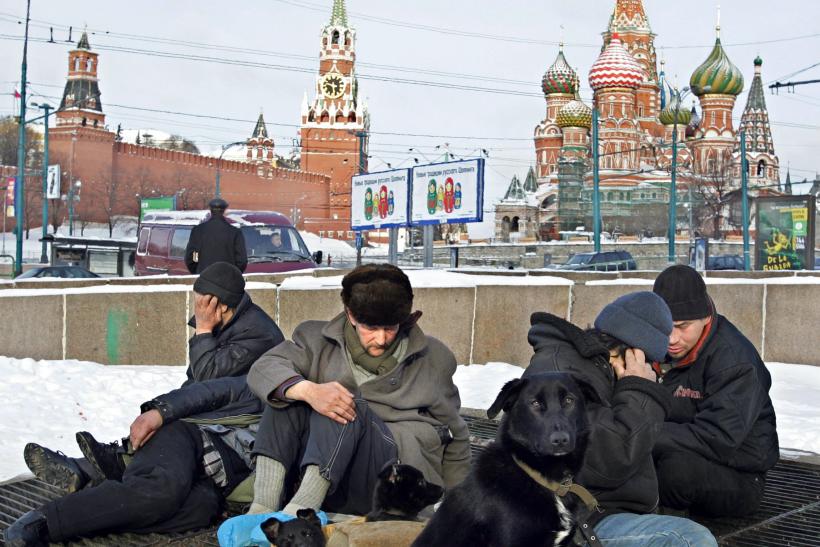
Even a cursory examination of the social situation in modern Russia reveals a deeply divided society. An array of statistics documents the reality of two different worlds that hardly come into contact with one another. One—the world of wealth and luxury—is inhabited by an insignificant minority. The other—the world of social decline and an arduous struggle for life’s necessities—is inhabited by millions upon millions.

Figures showing the distribution of wealth reveal the glaring nature of this social polarisation. According to government data, the incomes of the very richest members of Russian society are 15 times those of the poorest—one of the highest levels of social inequality to be found among the world’s leading countries. In Moscow, this difference is 53-fold.

Below the poverty line

According to figures published by the World Bank at the end of last year, 20 percent of the Russian population lives below the poverty line, which is defined as a monthly income of 1,000 roubles (less than 30 euros, or $38).

The great majority of Russian families are teetering on the edge of poverty. The World Bank has calculated that an average decrease in income of 10 percent would produce a 50 percent rise in the poverty rate. The majority of the poor in Russia are to be found among working families headed by adults with average technical professional training, and in families with children.

Most of the poor workers are employed in the public sector, including teachers, physicians and low-ranking civil servants. The occupations with the lowest incomes—including those employed in the health services, such as nurses and medics—are of great social importance. The poor living conditions of those employed in these sectors contribute to a decline in the structures upon which a functioning society is based.

The well-off receive greater privileges and benefits than the poor or the near-poor. The World Bank writes that medium-level social allowances (with the exception of those for children) paid to the relatively rich exceed those received by poorer social layers.

Russia’s National Statistics Office officially classifies a total of 31 million people (22 percent of the population) as poor. Other surveys, however, place the poverty rate at 40 percent or higher.

The All-Russian Centre for Living Standards published the following figures for the varying degrees of poverty:

At the end of 2003, average monthly income was calculated at 2,121 roubles (60 euros/$77 a month), with those who are employed receiving 2,300 roubles (65 euros/$83) and pensioners receiving 1,600 roubles (45 euros/$58). Those whose income falls below these levels are defined as poor. A second category, those who are badly off, includes families where per-capita income lies between 2,121 and 4,400 roubles (60-126 euros/$77-$161). A significant section of the population can be found in these two categories.

The Centre for Living Standards regards the “middle layers” as households with a per-capita monthly income of between 4,400 roubles and 15,000 roubles (126-430 euros/$161-$550). By Western standards, this level of income would represent poverty.

Pensioners and young people constitute the poorest sections of Russian society. The Social Opinions Fund has found that practically no young people (just 1 percent) are saving for their old age. Two thirds of young people who were asked said they could not afford to buy anything. Young people living in the countryside or in small cities are at greatest risk of being poor. In contrast to Western countries, where poverty is often concentrated in the large cities, the poor are more frequently found in Russia’s villages and towns.

Families with children are exposed to the constant danger of poverty, particularly those with two, three or more children.

Children from families with low incomes have substantially decreased chances of going on to gain an apprenticeship after graduating high school. Only 15 percent of children from poor families go to the more specialised technical colleges and universities. A low level of education is an important factor in the persistence of poverty.

The poor are more frequently ill or succumb to alcohol. The incidence of tuberculosis in Russia is 10 times higher than in Europe.

Scientists have calculated that since the beginning of the 1990s, some 8 million Russians have died prematurely. The mortality rate has risen one-and-a-half times over the same period. In 2003, it reached a high point at 16.4 deaths per 1,000 inhabitants.

The average Russian man can presently expect to live only to 58. That means married women, on average, are widowed for 15 years. This is due both to women’s greater life expectancy and to the younger age at which women marry.

Despite the adversities of everyday life in the Soviet Union, for most people the social situation was substantially better than that which exists in contemporary Russia. Today, the minimum wage covers only 27 percent of what is needed to sustain an adult of working age; the child benefit covers just 3 percent of necessary expenditure for a child; and the minimum pension covers only 46 percent of the minimum expenditure of a pensioner.

In the Soviet Union, the minimum wage amounted to one-and-a-half times the minimum required consumption. Russia’s minimum wage would have to be trebled to cover the minimum level of consumption.

A serious struggle against poverty is impossible without a real reform of the educational system and health service. Both would have to be made accessible to broad layers of the population. However, the tendency is in the opposite direction.

For increasing numbers of Russians, it is becoming clear that further capitalist “reforms” will not improve their situation.

The wealthy end of the spectrum

Then there is the other Russia. It finds its personification in figures like Roman Abramovich, governor of the remote region of Chukotka (just across the Bering Strait from Alaska) and owner of a controlling interest in the Russian oil giant Sibneft. He is considered the richest man in Britain, where he now resides. Two years ago, he acquired the English soccer club Chelsea for an astronomical sum.

Russia is ranked third in the world for the number of billionaires, and thirteenth for having the largest enterprises.

Taken as a whole, the fortunes of Russia’s billionaires amount to nearly half as much as the total value of the largest Russian enterprises. By comparison, in the US, this sum amounts to 6 percent.

The greatest part of shareholdings in the largest Russian enterprises can be found in the hands of this tiny social layer. According to the World Bank, in 2003, the 23 largest business groups account for 57 percent of all of Russia’s industrial production.

Forbes magazine has calculated that, measured against the economic output of the country ($458 billion), there are more billionaires in Russia (36) than anywhere else in the world. The total assets of these 36 richest Russians amounts to $110 billion—24 percent of the country’s economic output.

Most of the Russian billionaires and multimillionaires control raw materials and their associated industries. According to Forbes, this applies to 66 of the 100 richest Russians. The 34 others have gained their wealth from new business fields—above all, telecommunications, construction, food production and retail trade.

The incomes of the top managers are also incomparably greater than those of the ordinary citizen or pensioner. Gaseta.ru cites data showing they receive annually between $1 million and $3 million.

The president of Lukoil gets $1.5 million. If the business achieves certain goals, he enjoys a bonus of $2.2 million. The vice president gets $800,000 annually, with up to $1.1 million in bonuses. The picture was the same at Yukos, until it was liquidated by the state.

In large-scale enterprises like the United Mechanical Engineering Works and the Tyumen oil company, basic executive salaries amount to $500,000 and more. Oleg Deripaska, the boss of the Basis Element aluminium producer, paid taxes of $294 million in 2001 on his income in the Siberian Republic of Khakassia. His pay constituted 10 percent of the total income of the republic.

The “new Russians,” as they are sometimes called, often live abroad, where they can be found in the most expensive hotels, clubs and restaurants. They possess racehorses, yachts and mansions. Practically every billionaire has his own yacht and airplane. They particularly enjoy buying expensive antiques and jewelery, as well as purchasing real estate in the most expensive areas of Europe’s capitals. A special attraction for them is London.

Russians constitute a third of all foreign investors on the London property market. Over the past 10 years, the number of British visas given to Russians has increased eightfold. Of 250,000 Russians living in London, 700 are multimillionaires.

New Year celebrations are the high point of profligate consumption for the Russian nouveaux riches. The International Herald Tribune reported recently that some 20,000 Russians “wallowed in luxury, ate, drank and went shopping” in the elite boutiques of the ski resort of Courchevel, which lies in a snow-covered corner of the French Alps. In this spa resort can be found four-star hotels like Les Grandes Alpes, where a room costs between 550 and 1,250 euros ($704 and $1,600) per night. In the hotel restaurant, one can drink wines for a mere 1,750 euros ($2,239) a bottle. A new suite opened in the hotel Byblos des Neiges recently that measures 220 square metres and costs 6,500 euros ($8,318) a night.

The International Herald Tribune writes that Russian ski teachers are being employed to cope with the wave of Russian tourists in Courchevel, where Russian advertisements can be seen everywhere. “This is wonderful business for us,” explained the owner of one local four-star hotel.

This is the reality behind the invocations of “national unity” proclaimed by the Putin government. It is no wonder that ordinary Russians increasingly demonstrate their discontent and protest against the worsening of their situation. These protests will inevitably continue and intensify under conditions in which the government lacks any solution for Russia’s mounting social problems.

2010 | Reelviews Movie Reviews

https://www.reelviews.net/reelviews/2010

The 16-year wait between the 1968 opening of 2001: A Space Odyssey and the 1984 release of 2010 doesn’t represent the longest interval between a movie and its direct sequel (that distinction probably belongs to Gone With the Wind/Scarlett, although some would disqualify the pairing because the second installment was a TV mini-series). However, for fans of Stanley Kubrick’s inimitable science fiction classic, it was more than long enough. Even before one frame of 2010 was committed to celluloid, filmmaker Peter Hyams had accepted a huge challenge (the kind that many in Hollywood would find daunting): continue the story begun by Kubrick in a way that answered some of the questions without in any way cheapening the original.

As 2001 was Kubrick’s child, so 2010 belongs to Hyams, who took on four key duties: screenwriter (basing his script on Arthur C. Clarke’s novel), director, producer, and cinematographer. (For those keeping count, that’s one more hat than Kubrick wore.) Comparisons, however unfair, are inevitable. It’s impossible to craft a follow-up to one of the cinema’s most thought-provoking and impressive motion pictures without generating a litany of comments and criticisms. Based on published interviews with Hyams at the time of 2010’s release, he was well aware of the potential quagmire he had entered into, but his appreciation for the original was such that his greatest desire was for the sequel to do Kubrick’s film justice.

One question that arises is whether or not it is better to have seen 2001 before viewing 2010. For most two-part stories, this isn’t an issue, but this is not an ordinary situation. Those who have not seen 2001 will come to 2010 will some background deficiencies, but they will also not have any preconceived notions about style and tone. My guess is that these uninitiated viewers may appreciate 2010 more than stalwart 2001 aficionados because they will accept the second feature on its own terms. Kubrick’s shadow looms large over 2010 and the movie often seems to be struggling to escape from underneath it. The hypnotic quality that characterized 2001 is not present here; 2010 is a relatively straightforward space adventure story that extends the storyline but nothing more.

2010 picks up nine years after 2001. In the interim, not much has changed. The Discovery is still out near Jupiter – a cold, silent tomb for the disconnected HAL 9000 as it circles the planet in a slowly decaying orbit. The moon monolith has been brought from the lunar surface to Earth, but scientists are no closer to unlocking its secrets than they were a decade earlier. Meanwhile, both the Soviet Union and the United States are planning manned missions to Jupiter with the intention of exploring the monolith out there. The Russians’ space ship will be ready earlier, so it makes sense for a few Americans to be on board so that Discovery’s records and memory banks can be accessed. But tensions are high between the two superpowers as a crisis off the coast of South America escalates to where it could be the precursor to World War III.

Through a feat of diplomatic wizardry, politicians from both sides agree to allow three American scientists on board the Soviet space craft Leonov. Joining the Russian crew are Dr. Heywood Floyd (Roy Scheider), the former head of the space agency who blames himself for the Discovery debacle; Walter Curnow (John Lithgow), the engineer who designed Disovery; and Dr. Chandra (Bob Balaban), the creator of HAL. The commander of the Leonov, Tanya Kirbuk (Helen Mirren), is a stern, no-nonsense woman who is initially hostile to Floyd and his associates. However, in a time-honored tradition, as the Americans and Soviets work together to solve the mysteries of the outer Solar System, they form friendships and bonds of trust – even as the political situation between the two nations worsens.

During the course of the film, the solution to the riddle of the monolith is unveiled (although the aliens who created it remain an invisible presence). We learn its purpose and understand how this ties into the prehistoric version on Earth and the one on the moon. HAL is re-activated and rehabilitated, and we are given a somewhat unconvincing explanation about what precipitated his breakdown. (Conflicting orders caused him to turn paranoid and determine that the mission could be carried out without any human involvement.) Everyone is suspicious of HAL once Chandra turns him on again, but the computer proves to be helpful and self-sacrificing. Since HAL’s demise in 2001 represented that film’s emotional pinnacle, it’s nice to see the artificial intelligence get a second chance. Astronaut Dave Bowman (once again played by Keir Dullea), now a ghostly mouthpiece for the aliens, makes a cameo appearance – more, I suspect, out of a need to solidify the connection between 2001 and 2010 than out of any plot necessity. The message he delivers is important, but it could have easily been conveyed in another manner.

2010 ties up a number of loose threads, but it doesn’t resolve everything. The nature of the “star child” is untouched. And it’s still not clear how much responsibility Floyd bears for HAL’s psychosis. Despite the character’s protestations of innocence in 2010, there is evidence in 2001 that he may have known more than he’s letting on. 2010 doesn’t ask many new questions – it’s not that kind of movie – and the film ends with a straightforward, in-your-face moral. Oddly, the message of peace in 2010’s closing moments contradicts something from 2001, where the influence of the monolith leads man to his first act of overt violence.

A few of the casting choices are worth exploring. Obviously it’s nice to see Keir Dullea and hear Douglas Rain again. These two actors give 2010 the feeling of being in familiar territory. Roy Scheider has replaced William Sylvester in the lead role; Sylvester may have been the right age for the character in 2001, but he was too old (and probably too obscure) to re-create the part 16 years later. Scheider’s low-key but authoritative approach works for this script. The character is suposedly the same, but there’s little synergy between the two interpretations. John Lithgow, representing another name for the marquee, successfully keeps his manic tendencies in check. Helen Mirren would have been better if she hadn’t been required to sport a ridiculous Russian accent (one that makes her sound like Natasha from “Rocky & Bullwinkle”). And, for those who like trivia, Candice Bergen has small speaking part as SAL 9000 (HAL’s “sister”), although she uses the alias “Olga Mallsnerd” in the end credits.

Most of the space sequences are effective. While the Kubrick’s lethargic pace has been replaced with something more energetic, 2010 doesn’t speed along. There’s a lot of exposition, which means lengthy passages of dialogue, some of which are clever. (I liked Curnow’s observation that, while in space, he misses the color green. With no plant life in space or on the ship, there’s no green.) The visual effects are as good as, although not noticeably better than, those used in 2001. Perhaps the most impressive task of the special effects team was to re-create the Discovery much as it appeared in the earlier film.

In terms of sound and music, Hyams’ approach is completely different from Kubrick’s. No longer is space a soundless vacuum. Now, we can hear engines and other assorted noises. (Although Hyams gets around the thorny issue of whether we hear an explosion by staying within the confines of the Leonov when it happens.) And, with the exception of Richard Strauss’ “Also Spoke Zarathustra”, which plays over the opening and closing credits, Hyams relies upon an original score for 2010 rather than adopting Kubrick’s approach of applying classical music. (This is probably a good move; anything else would have seemed like a copy.)

2010’s biggest misstep is the Cold War backdrop (an element that was not contained in Clarke’s novel). An attempt by Hyams to make the film relevant to audiences viewing it 1984, the U.S./Soviet tensions circa 2010 now seem ill-conceived and out-of-place, especially considering that the USSR no longer exists. Granted, Hyams can’t be blamed for his inability to see into the future, but the movie’s reliance upon “current events” dates 2010 in a way that was never the case for 2001. It’s also a pretty tired plot element that has been done better elsewhere. Consider James Cameron’s The Abyss, which also employed alien intervention to urge peace between nations – that’s a case where the message folds nicely into the overall storyline, rather than seeming tacked-on, as it does in 2010.

Now that enough time has elapsed since the release of 2010 for outraged 2001 fans to calm down, it can be seen that, while there was no decisive creative reason for Hyams’ sequel to exist, it’s not a bad movie. The features form two largely independent aspects of the same story. Kubrick uses science fiction as a gateway to mystical meditation; Hyams uses it conventionally. Each picture is capable of being viewed separately (enough background is given during the opening sequence of 2010 to elminate the most obvious sources of confusion), although I’m not certain why anyone today would be interested in watching 2010 without having previously seen its more famous predecessor. (Incidentally, I expect interest in 2010 to increase early next year, after 2001 is re-released in theaters to celebrate real-time having caught up with the title.) For those who prefer a “double feature” approach, 2010 continues 2001 without ruining it. The greatest danger faced by filmmakers helming a sequel is that a bad installment will in some way sour the experience of watching the previous movie. This does not happen here. Almost paradoxically, 2010 may be unnecessary, but it is nevertheless a worthwhile effort.

Arabian Oryx Sanctuary

http://whc.unesco.org/en/list/654/

The Arabian Oryx Sanctuary is an area within the Central Desert and Coastal Hills biogeographical regions of Oman. Seasonal fogs and dews support a unique desert ecosystem whose diverse flora includes several endemic plants. Its rare fauna includes the first free-ranging herd of Arabian oryx since the global extinction of the species in the wild in 1972 and its reintroduction here in 1982. The only wild breeding sites in Arabia of the endangered houbara bustard, a species of wader, are also to be found, as well as Nubian ibex, Arabian wolves, honey badgers, caracals and the largest wild population of Arabian gazelle.

The World Heritage Committee deleted the property because of Oman’s decision to reduce the size of the protected area by 90%, in contravention of the Operational Guidelines of the Convention. This was seen by the Committee as destroying the outstanding universal value of the site which was inscribed in 1994.

In 1996, the population of the Arabian Oryx in the site, was at 450 but it has since dwindled to 65 with only about four breeding pairs making its future viability uncertain. This decline is due to poaching and habitat degradation.

After extensive consultation with the State Party, the Committee felt that the unilateral reduction in the size of the Sanctuary and plans to proceed with hydrocarbon prospection would destroy the value and integrity of the property, which is also home to other endangered species including, the Arabian Gazelle and houbara bustard.

Soviet and Russian Inequality: Was the Soviet System Pro–Poor?

https://blogs.warwick.ac.uk/markharrison/entry/soviet_and_russian/

In August this year Filip Novokmet, Thomas Piketty, and Gabriel Zucman circulated a new working paper, “From Soviets to Oligarchs: Inequality and Property in Russia, 1905-2016” (NPZ 2017a, b). This paper makes several advances, including a novel estimate of the evolution of Russians’ offshore wealth.

To situate the subject briefly, Cold War scholarship has left us a substantial literature on income inequality under communism. Bergson (1944), Yanowitch (1963), Wiles and Markowski (1971), Pryor (1972), Wiles (1974, 1975), Wädekin (1975), Chapman (1977), McAuley (1977), and Matthews (1978), each made valiant attempts, sometimes extending to piecemeal comparisons over countries and over time. “Considering the obscure data with which they had to work,” a survey by Schroeder (1983) remarked, “Western investigators display a large degree of agreement.” Measured by the decile ratio, the distribution of official incomes in the Soviet Union was becoming more equal over time and was substantially more equal than in the developed market economies then available as comparators. Schroeder noted, however, that Western researchers could not access data on the Soviet distribution of illegal incomes, or on privileged distribution of goods and services including accommodation and health care.

More recently, Lindert and Nafziger (2014) made an advance in another direction, examining inequality in Russia before and after the Soviet era. They concluded that pre-tax income inequality in 1997, although likely understated by official reports, was greater than in 1904.

Finally, a new paper by Allen and Khaustova (2017) examines Russian real wages in the long run. This paper does not address income inequality directly but allows inferences to be drawn from comparing real wages and productivity in industry. They find that real wages stagnated from the 1860s to 1913 (in St Petersburg, the capital, and Kursk, a provincial centre) or showed modest gains (in Moscow) but lagged everywhere behind productivity, suggesting a movement from wages to profits and income from wealth. After the troubled wartime and revolutionary period, the 1920s brought large real wage gains. These were short-lived, evaporating in the famine-led inflation of the early 1930s.

Novokmet and co-authors (NPZ) are the first to have tried to measure wealth and income inequality in Russia over the whole twentieth century. And, as many readers will be aware, their paper is part of a much larger collaborative project, the World Inequality Lab and the associated World Wealth and Income Database, one that aims to measure inequality in many countries over hundreds of years.

According to NPZ, the share of the top 10 per cent in pre-tax income distributed to adults in Russia was 47 per cent in 1905. The share fell to 22 per cent in 1928, increased modestly to 26 per cent by 1956, and began to fall gently back again, reached a low of 21 per cent in 1980. (The Soviet-era years observed are 1928, 1956, and then roughly every second, third, or fourth year to 1988, when annual observations begin.) By 1996 the top 10-per-cent share had returned to the 1905 level and remained in that vicinity through 2016. NPZ comment: “our benchmark estimates suggest that inequality levels in Tsarist and post-Soviet Russia are roughly comparable. Very top income shares seem if anything somewhat larger in post-Soviet Russia.”

Measured by the top 10-percent income share, Russia today appears in the World Inequality Lab database in the same inequality band as the United States and China. Income inequality is reported as greater in a few countries: Turkey, India, South Africa, and Brazil. All north and west European countries that are represented in the database are more equal than Russia. But all are smaller than Russia in population, and a larger population will always tend to show greater inequality, because unequal economic outcomes are promoted by heterogeneity of all kinds, and heterogeneity is inevitably increasing in population size.

In its time the Soviet Union, in contrast, was apparently one of the most equal countries in the world. This is particularly striking, considering the large size of the Soviet population, 288 million by 1991. Other countries in the WID dataset with top 10-percent shares of 26 per cent or below at any time from 1917 to 1991 are few, and they are also much smaller in population: Australia, Denmark, Mauritius, Italy, New Zealand, Norway, Portugal, Sweden, and Taiwan. Of all these countries, only Italy’s population had reached 57 million by 1991, and Taiwan’s 20 million.

These results are broadly consistent with the earlier research described above. They confirm that income inequality in Russia after the Soviet era was comparable to before the Revolution, if not greater; that the distribution of Soviet official incomes was markedly more equal than in most market economies at the time and today, and in Russia beforehand and today; and that, within the Soviet era, inequality followed a modest Kuznets curve, rising, then falling.

Seen in this light, Soviet institutions and policies appear distinctly pro-poor. Before we take that as settled, however, there are three issues that point the other way.

First, in the Soviet era the poor might have gained relatively, but the chief factor in this was impoverishment of the rich. What the rich lost was not transferred to the poor, or was given only temporarily before the state grabbed it back, as clearly implied by Allen and Khaustova (2017). NPZ measure inequality by shares of income distributed to adults. In the Soviet era, the share of income not distributed to adults, but retained by the state, became unusually large. As a first approximation, household consumption fell from around 80 per cent of GDP in 1913 to around 50 per cent in 1940 and through the postwar period. By implication, what the rich lost was diverted into government administration and investment and defence projects; it was not passed on to the lower income strata. If there was an initial transfer to the poor, it was confined to the 1920s, and was then cancelled in the Great Breakthrough of Stalinist collectivization and industrialization.

Second, the Soviet state did not take only from the rich. It took also from the poor, including the poorest. This applied particularly in the years from 1928 to 1956, a period for which the NPZ dataset has only gaps. While I cannot find full explanation on this point, the NPZ dataset (like most Cold-War scholarship) seems to rely on reports of the distribution of official wage earnings to capture Soviet-era inequality. Wage earnings accounted for less than one third of Soviet household incomes in 1928, just over 60 per cent in 1937, and nearly 70 per cent in 1956 (Kashin and Mikov 2004: 17, 23, 34). The largest category of households excluded from reports of wage earnings were collective farmers – the great majority of Soviet farm workers – who received an uncertain dividend, not a wage. If that is the case here, then the rural poor are left out of account. (Forced labourers are also left out. There were millions of these from the 1930s to the 1950s. But they are a small omission compared with many tens of millions of collective farmers.)

Narrative accounts of rural food shortages and periodic famines indicate that rural poverty contributed substantially to Soviet-era inequality before the 1950s (e.g. Davies and Wheatcroft 2004). After that time, the compensation of collective farmers moved gradually, but never completely, towards public-sector standards.

Finally, as NPZ acknowledge, under Soviet arrangements, persistent shortages and privileged distribution decoupled consumption inequality from income inequality. In the Soviet Union everyone had an income, but not everyone could spend it on the same terms. A privileged class of insiders – the party elite and the employees of key production and service establishments – who had access to relatively high-quality goods and services at prices fixed below the market-clearing level without waiting. Others had limited access to staple goods and services, for which they either waited in line or paid a higher, sometimes illegal price. As long as the poor had money they could not spend, or faced higher prices to spend it, it is possible and even likely that consumption was distributed more unequally than income. This contrasts with the pattern that has been found to prevail in market economies, where consumption inequality is generally less than income inequality. But comprehensive data on Soviet consumption inequality would seem far more difficult to come by than income data, so this may well remain a conjecture.

Consumption inequality was important not only for ex post evaluation of economic welfare under Soviet arrangements. It was of central importance to the political economy of the time. During the 1930s, as Paul Gregory (2004: 76-109) has noted, Stalin received regular reports of discontent and falling effort among the workers in the provinces and intervened from time to time to improve their condition. When he did so, he did not order their wages to be raised because, in a supply-constrained economy, this would only have lengthened local queues. Rather, he ordered consumer goods in short supply to be redirected to the towns and factories where dissatisfaction was rising, so that the workers could more easily spend their wages.

The existence of unofficial incomes in the Soviet era only adds complexity to the problem. We guess that unofficial incomes were substantial but of time-varying size. Anecdotes on who received them are plentiful. The Soviet central bank compiled annual estimates of their aggregate size (Kashin and Mikov 2004), but we continue to lack (and may never find) data on their distribution. Thus, it is impossible to say whether their net effect was to increase or reduce the extent of inequality of different kinds.

To summarize, the extent to which Soviet institutions favoured the poorest in society is easily overstated. The impact of the Bolshevik Revolution was to flatten the distribution of wages. On that official measure income inequality fell sharply. But non-wage earnings were likely distributed more unequally than wages. Unofficial incomes also mattered; how they mattered is unclear. Consumption inequality mattered too, and arguably mattered more than income inequality. Most likely, consumption inequality did not fall to the same extent. Whereas consumption inequality in market economies is relatively stable, it is possible that Soviet consumption inequality was volatile, spiking in particular years of crisis.

Any judgement on new work must be preliminary, but my thoughts so far are as follows. NPZ (2017) is a substantial contribution. It is not the first word on the subject, and it will not be the last word either. It turns a new page and sets a new challenge.

My Bad Japanese Homestay Experience

Hope you liked hearing about my experiences, not sure if you can tell in the video but it’s quite a hard thing for me to talk about. It was quite a big step for me to go abroad by myself for the first time and this experience was really stressful for me.

I’d really like to stress that everyone else on the course had a great time at their homestay, it was a really valuable experience for the people I spoke to – some of them are even going back to visit their homestay family this year! Nowadays I’m not at all mad at the family, although the way they treated me seemed quite harsh, it could be due to cultural differences – I’m sorry for causing them any inconvenience/upset (they probably complain about the English girl they had to kick out too, it wasn’t the homestay either of us wanted and that is sad). The most upsetting part for me was my treatment from the man from the homestay company. I was really taken aback, every Japanese person I’d spoken to so far was so polite and this man was so horrible to me! It was really shocking to be called a ‘horrible young lady’ when all I’d done was had an allergic reaction! I thought he’d be more understanding, but what can you do!

Although it did knock my confidence a bit, it didn’t ruin my whole trip. I still had a really lovely time in Japan, it’s a really beautiful country and I really enjoy the learning the language.