Ring by Kōji Suzuki – Book Review – Kristopher Cook

https://kristophercook.com/ring-by-koji-suzuki-book-review/

My first taste of Japanese horror came in the late ’90s when films such as The Ring and The Grudge burst onto the mainstream. They were quickly adapted into American remakes and trundled around looking to milk every penny possible.

It’s looking back on this film, and Audition, that made me want to start reading J-Horror in its original format; literature.

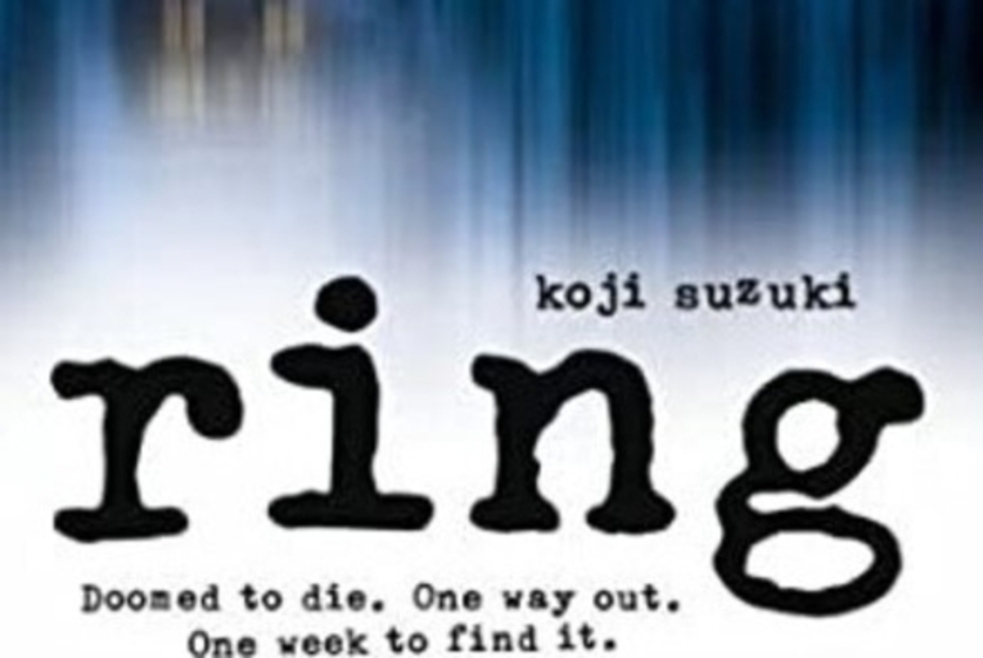
What better place to pick-up then with Ring by Kōji Suzuki?

Published in 1991, Ring became known first for its ’95 television film, released in Japan, then worldwide upon the release of the 1998 film adaption by Japanese horror director, Hideo Nakata, who also directed Dark Water; written by Suzuki.

One significant change in the film is how the tape works to build tension, but more on that later.

Ring is the first of a book trilogy that features: Spiral (1995) and Loop (1998).

Taking on a more of a thriller genre, Ring uses the tension of an imposing deadline to add suspense to the drama.

This was not what I was expecting going into it; however, it was a welcoming surprise.

Press Play

The main protagonist Kazuyuki Asakawa is a journalist with a down-trodden reputation, working for a Japanese newspaper.

After he witnesses the mysterious death of a teenager on a motorbike, and the death of his wife’s niece on the same day, he throws his investigative instincts into the ring (see what I did there?) to find a link.

Along with his best friend Ryuji Takayama, they discover a videotape in a sports centre that his niece stayed at just over a week ago. After watching the cursed tape, they must find the meaning behind it, why it involves the ghost of Sadako and how they can break the curse.

Both characters aren’t exactly likeable, Ryuji even going as far as exclaiming he once got drunk and raped a girl; however, this does lead to a good read when they are together, even if it’s mostly built on the tension between them.

The book uses the videotape as a means of transporting the Ring Virus on to those who watch it. Seven days later, they’ll suffer a heart attack if they haven’t broken the curse.

For obvious reasons, the film uses the character of Sadako Yamamura, known for her long black hair and eerie presence. She climbs out of the TV and scares the viewer to death. This approach offers a much more supernatural ghost-story which was more commonplace at the time.

Personally, I think both have their merits and mesh well with their chosen media format.

A character that kills people by climbing out of a TV set would be difficult to pull off in a book because it’s such a visceral representation; whereas the books imposing countdown on the seven-day rule adds additional drama to every aspect of the plot.

How will he survive? Will he pass it on to others? How did it come about in the first place?

These are all questions that seemingly have answers, but with little time to find them.

Lost in Translation

As is the case with a lot of Japanese books, it does suffer from a few direct translation issues. I’m not sure if this is because the Japanese language is straightforward, or whether the turns of phrases don’t really exist in the English language, but either way, it’s not a game-breaker.

Closing Thoughts

Ring is an excellent suspense-horror that offers high tension, but also appropriate character development and effective plot speed. The only downside is the lead characters not being overly likeable. This slightly takes away from caring about their impending dooms.

Otherwise, this is a brilliant book for those looking to get into J-Horror, as well as those who’re already deep into the genre.

Mobile Suit Zeta Gundam

https://theanimeacademy.wordpress.com/the-library/the-stacks-m/mobile-suit-zeta-gundam/

Tomino “Kill ‘Em All” Yoshiyuki strikes back at his own creation after five years of dormancy with this first sequel to Mobile Suit Gundam. You can say that he struck back with one heck of a vengeance. Zeta Gundam is a lot darker, a lot grittier and a whole lot more epic than its predecessor.

The staple of any good Gundam series is, of course, the story and the characters. Alliances, relationships, promises… all these are made and broken. As far as characters, almost every cast member gets his or her time in the spotlight and manages not to waste any of it. They show their strengths, weaknesses, nightmares, dreams, everything; you really get to know these characters. This adds more to the already exciting battle scenes (since everyone is already trying to kill one another). And as mobile suits fights and lives are lost, the background music makes it all seem somewhat beautiful.

Again, this series is a sequel, so one might need to know a few names, places and terms, but they mention them enough to get the relevance across. My only main gripe with this series is that it purposefully leaves itself for the sequel, Double Zeta. Though it’s not a bad way to keep the epic going, I still think that this series could have stood alone without one.

I suggest anyone who wants to get into Gundam, needs an action fix or loves hard-boiled science-fiction and drama to watch this series. And don’t worry, it’s “monotonous-bishounen“-free!

Homages & Influences – COWBOY BEBOP

https://www.rfblues.com/Omake/Influences/

Session #1 – Asteroid Blues

MUSICIAN: ANTONIO CARLOS JOBIM
Character Name Homage: Senile Old Men
FILM: DESPERADO
Character Design Influence: Asimov & Katerina
Scene Influence: Bar shoot-out
FILM: BONNIE & CLYDE
Scene Influence: Asimov & Katerina’s last stand

Session #2 – Stray Dog Strut

SONG: STRAY CAT STRUT
Title Homage
PUPPET SHOW: PUNCH AND JUDY
Character Name Homage & Design Influence: Big Shot Hosts
Way Of The Dragon
FILM: WAY OF THE DRAGON
Referenced In Dialogue
FILM: GAME OF DEATH
Scene Influence: Spike VS Hakim

Session #3 – Honky Tonk Woman

SONG: HONKY TONK WOMAN
Title Homage
FILM: POKER ALICE
Referenced In Dialogue
ALBUM: ZIGGY STARDUST AND THE SPIDERS FROM MARS
Location Name Homage: Casino is named Spiders From Mars
MUSICIAN: CHARLIE PARKER
Referenced In Dialogue

Session #5 – Ballad Of Fallen Angels

SONG: FALLEN ANGELS
Title Homage
LANDMARK: NOTRE DAME CATHEDRAL
Location Influence
FILM: THE KILLER
Scene Influence: Church shoot-out
FILM: THE CROW
Scene Influence: The fall of Spike

Session #6 – Sympathy For The Devil

SONG: SYMPATHY FOR THE DEVIL
Title Homage

Session #7 – Heavy Metal Queen

MYTHOLOGY: TERPSICHORE THE MUSE
Character Name Homage: VT (Victoria Terpsichore)
ACTOR: WOODY ALLEN
Location Name Homage: Woody’s Ice Cream Parlor
Character Design Influence: Decker

Session #8 – Waltz For Venus

COMIC BOOK CHARACTERS: HUEY, DEWY AND LOUIE
Character Name Homage: Shuttle Hijackers
FILM: ENTER THE DRAGON
Scene Influence: Spike’s kung-fu lesson

Session #9 – Jamming With Edward

ALBUM: JAMMING WITH EDWARD
Title Homage
FILM CHARACTER: HAL (FROM 2001: A SPACE ODYSSEY)
Character Design Influence: MPU
Celebrity: Uri Gellar
Character Name Homage: Uri Kellerman

Session #10 – Ganymede Elegy

TELEVISION CHARACTERS: BAKER AND PONCH (From CHiPs)
Character Design Influence: Baker Ponchorero

Session #11 – Toys In The Attic

SONG: TOYS IN THE ATTIC
Title Homage
MOVIE: ALIEN
Plot Influence

Session #14 – Bohemian Rhapsody

SONG: BOHEMIAN RHAPSODY
Title Homage

Session #15 – My Funny Valentine

SONG: MY FUNNY VALENTINE
Title Homage
Referenced In Dialogue
USS Enterprise NCC-1701-B
FILM: USS ENTERPRISE NCC-1701-B
Subtle Homage: A cryo-chamber shares the same number
MYTHOLOGY: BACCHUS THE GOD OF WINE
Character Name Homage: Doctor Baccus
Referenced In Dialogue
FAIRY TALE: SLEEPING BEAUTY
Referenced In Dialogue
Closing Sentence Homage
FAIRY TALE: BEAUTY AND THE BEAST
Closing Line Homage

Session #16 – Black Dog Serenade

FILM: CON AIR
Plot Influence

Session #17 – Mushroom Samba

SONG: WATERMELON MAN
Character Design Influence: Mellon Man
FILM: COFFY
Character Name Homage/Design Influence: Coffee
FILM: SHAFT
Character Name Homage/Design Influence: Shaft
FILM: DJANGO
Character Design Influence: Shaft, coffin dragging
SONG: STAIRWAY TO HEAVEN
Referenced In Dialogue

Session #18 – Speak Like A Child

SONG: SPEAK LIKE A CHILD
Title Homage
FOLKTALE: URASHIMA TARO
Referenced In Dialogue
FAIRY TALE: THE TORTOISE AND THE HARE
Subtle Homage: Carrier company mascots
TELEVISION: BEVERLY HILLS 90210
Scene Influence: Video Expert watches a similar show

Session #19 – Wild Horses

SONG: WILD HORSES
Title Homage
LEGEND: BABE RUTH (GEORGE HERMAN RUTH)
Character Name Homage: Starship Pirates
ACTOR: JAMES DOOHAN
Character Name Homage: Doohan
TELEVISION CHARACTER: MILES O’BRIEN (FROM STAR TREK)
Character Name Homage: Miles
TELEVISION CHARACTER: REG BARCLAY (FROM STAR TREK)
Character Name Homage: Reg the parts dealer
FILM: STAR TREK: FIRST CONTACT
Plot Influence
SPACE SHUTTLE: COLUMBIA
Scene Influence: Used to rescue Spike from Earth’s atmosphere

Session #20 – Pierrot Le Fou

FILM: PIERROT LE FOU
Title Homage
Character Name Homage: Tongpu (Mad Pierrot)
COMIC BOOK CHARACTERS: THE JOKER AND THE PENGUIN
Character Design Influence: Tongpu (Mad Pierrot)
SONG: ON THE RUN
Scene Influence: Tongpu’s origin

Session #21 – Boogie-Woogie Feng-Shui

FILM: THE BLUES BROTHERS
Character Design Influence: Blue Snake Mobsters

Session #22 – Cowboy Funk

CRIMINAL: THEODORE “TEDDY” KACZYNSKI (UNABOMBER)
Character Design Influence: Ted Bower (Teddy Bomber, TB)
PICTURE BOOK: COWBOY ANDY
Character Design Influence: Andy Von De Oniyate
Referenced In Dialogue
LEGEND: MUSASHI MIYAMOTO
Character Design Influence: Musashi The Bounty Hunter (Andy)
Referenced In Dialogue

Session #23 – Brain Scratch

CRIMINAL: MARSHALL APPLEWHITE
Character Design Influence: Doctor Londes
CULT: HEAVEN’S GATE
Plot Influence
VIDEOGAME CHARACTER: LARA CROFT
Subtle Homage: Similar-looking standee in toy store

Session #24 – Hard Luck Woman

SONG: HARD LUCK WOMAN
Title Homage
FILM: COOL HAND LUKE
Scene Influence: The eating of the eggs

Session #25 – The Real Folk Blues (Part I)

ALBUM: THE REAL FOLK BLUES
Title Homage
SHORT STORY: SNOWS OF KILIMANJARO
Referenced In Dialogue

Session #26 – The Real Folk Blues (Part II)

FOLKTALE: HYAKUMANKAI IKITA NEKO
Referenced In Dialogue
FILM: A BETTER TOMORROW II
Scene Influence: The storming of the Red Dragon Headquarters
SONG: CARRY THAT WEIGHT
Closing Line Homage

Session XX – Mish-Mash Blues

SONG: QUE SERA SERA
Segment Title Homage
SONG: WALK THIS WAY
Segment Title Homage
SONG: YOU CAN’T ALWAYS GET WHAT YOU WANT
Segment Title Homage
MUSICIAN: ARETHA FRANKLIN
Segment Title Homages
SONG: INSTANT KARMA
Segment Title Homage
SONG: SUGAR MOUNTAIN
Segment Title Homage
SONG: IF SIX WAS NINE
Segment Title Homage
SONG: MY FAVORITE THINGS
Segment Title Homage
SONG: UNFINISHED SYMPATHY
Segment Title Homage
SONG: WHOLE LOTTA LOVE
Segment Title Homage
SONG: DAYDREAM BELIEVER
Segment Title Homage
FILM: LOOK BACK IN ANGER
Segment Title Homage
SONG: IT’S ALL OVER NOW, BABY BLUE
Segment Title Homage

The Movie – Knockin’ On Heaven’s Door

SONG: KNOCKIN’ ON HEAVEN’S DOOR
Title Homage
VIDEOGAME: RALLY X
Subtle Homage: Lee Samson plays a similar game
FILM: DIRTY HARRY
Character Design Homage: Spike
FILM: CAPRICORN ONE
Scene Influence: Biplanes rescue mission

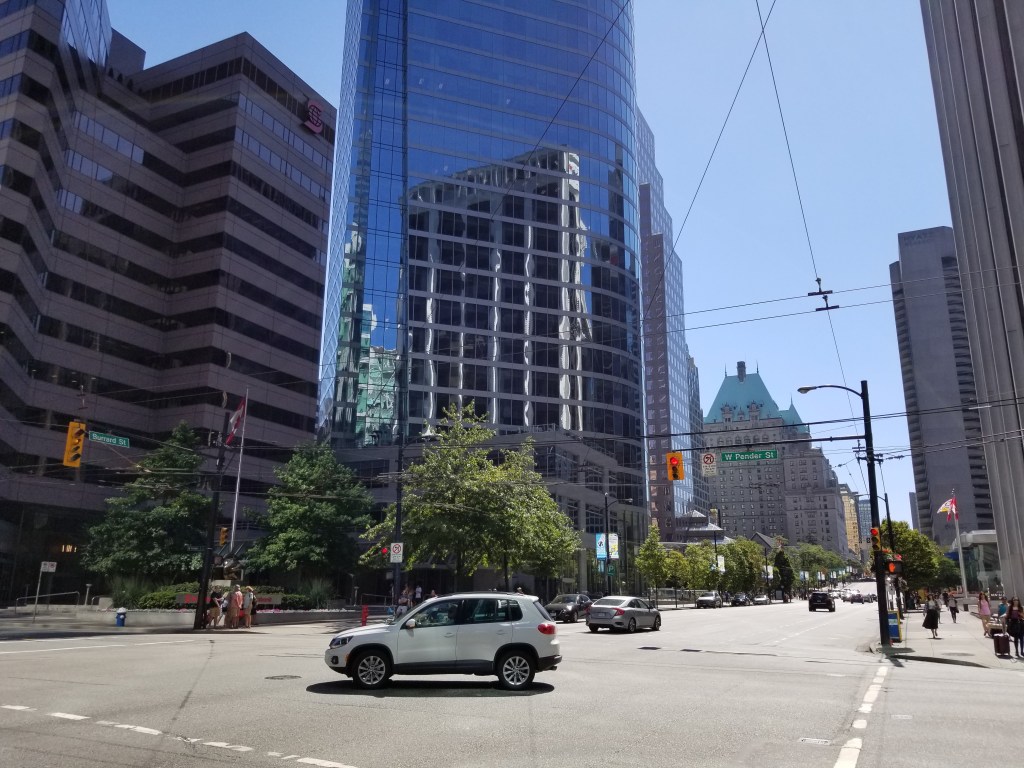
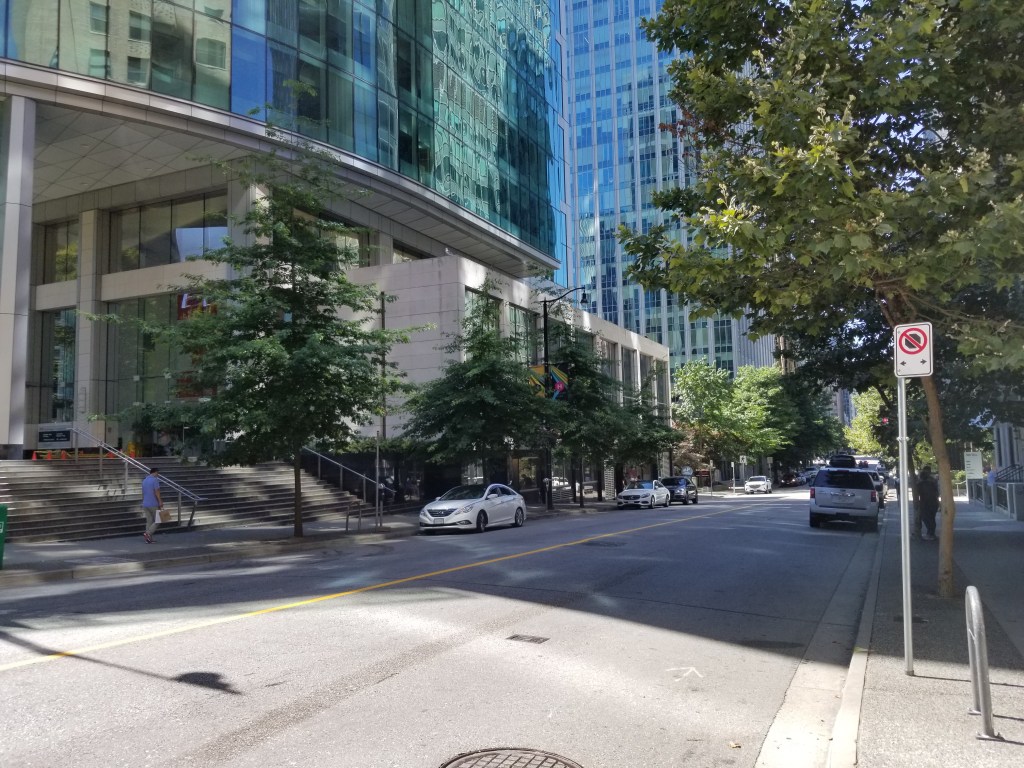
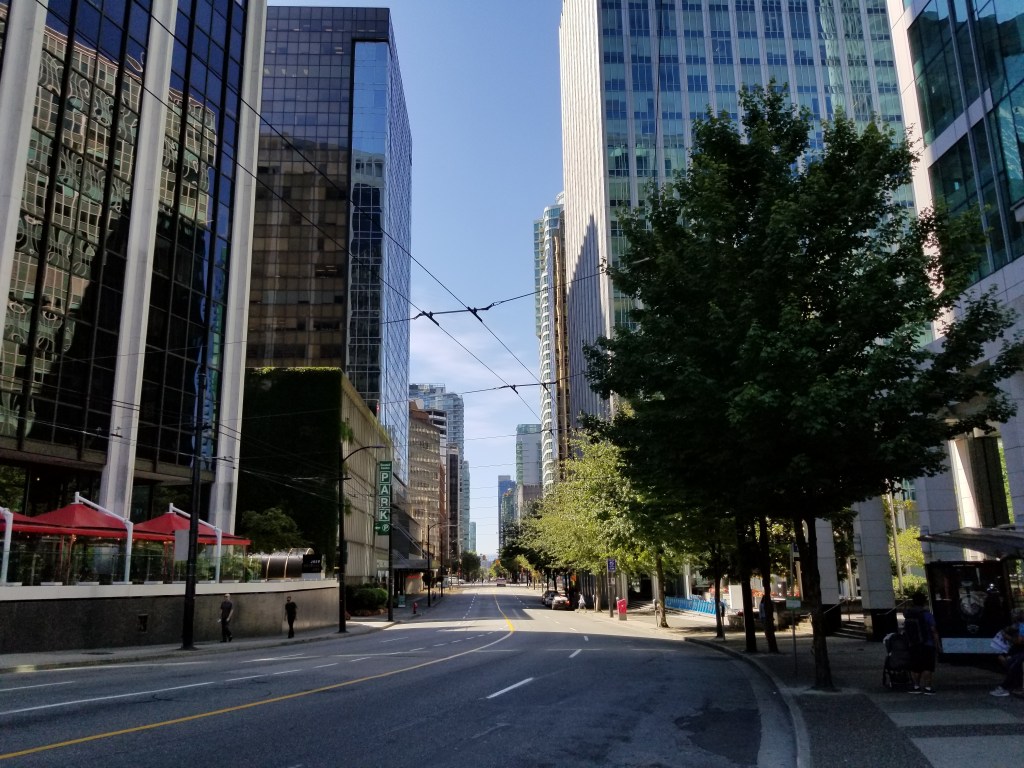
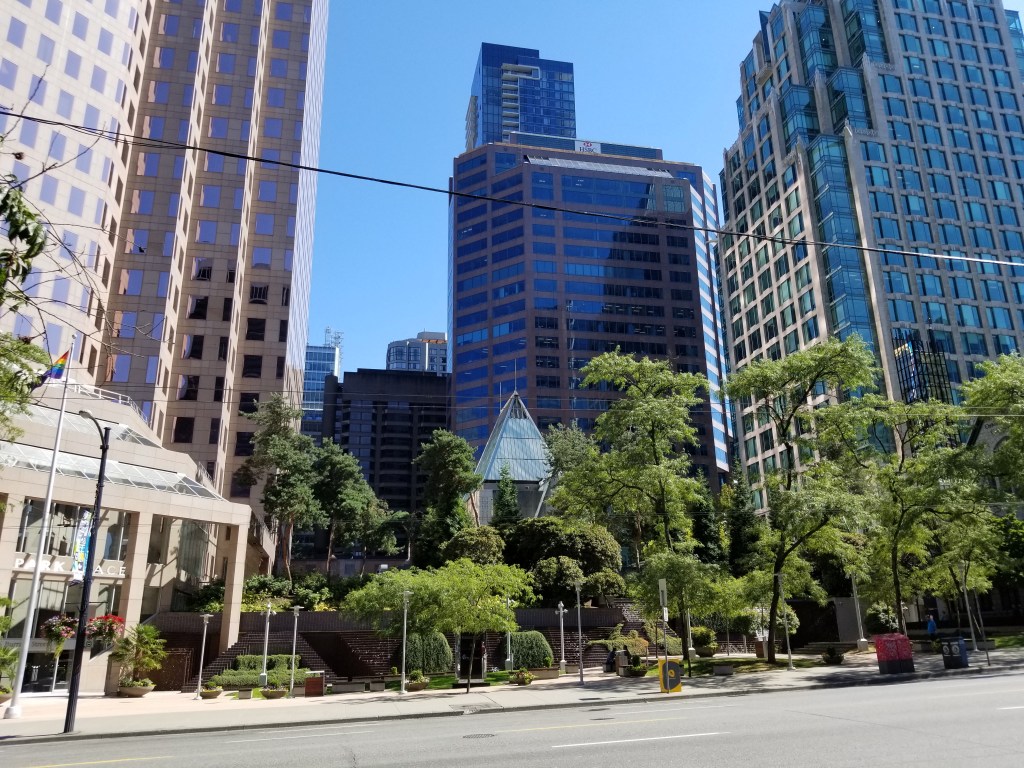
Near Burrard station in Downtown Vancouver. Summer of 2018.

Burrard is an underground station on the Expo Line of Metro Vancouver’s SkyTrain rapid transit system. The station is located in Downtown Vancouver on Burrard Street, where Melville and Dunsmuir Streets meet, and is the western terminus of the R5 Hastings St that provides service to Simon Fraser University.

The station serves Vancouver’s financial district and is within walking distance of the Coal Harbour and West End neighbourhoods. The station is accessible via the surface from Art Phillips Park or via the underground shopping centres of the Royal Centre and Bentall Centre skyscraper complexes.

Burrard station opened in 1985 and is named for nearby Burrard Street, which in turn is named for Sir Harry Burrard-Neale. Prior to the opening of the Canada Line in 2009, Burrard station was the northern terminus of the 98 B-Line and was served by a number of bus routes that provided service to Vancouver’s southern suburbs of Delta, Richmond, Surrey, and White Rock. In 2016, bus service to the eastern suburbs of the Tri-Cities was discontinued when the Millennium Line’s Evergreen Extension opened.

In May 2018, preliminary plans were revealed to renovate and expand Burrard station. On July 13, 2021, TransLink announced that it would close the station for two years beginning in early 2022 to allow construction for the rebuild.

The structure housing the surface station entrance was designed to resemble Victorian-era British railway stations, with a peaked glass roof. The station was designed by the Austrian architecture firm Architektengruppe U-Bahn.

When originally opened, the station’s only underground passage was to the Bentall Centre skyscraper complex. A connection to the Royal Centre complex was constructed some years later, while an anticipated underground passage to the Park Place skyscraper across the street was never built. The construction of a new east entrance to the station, at the southeast corner of the intersection of Burrard and Dunsmuir, was considered as part of upgrades to the station included in TransLink’s 10-Year Vision, but the cost of such an addition was higher than expected and TransLink turned to reviewing options to improve the existing entrance.

Like Granville, the station was built inside the Dunsmuir Tunnel and has a distinctive platform design. The inbound track (to Waterfront) is stacked on top of the outbound track (to King George and Production Way–University), with the inbound platform being one level above the outbound platform.

Burrard station is one of four SkyTrain stations on the Expo Line that serve Downtown Vancouver. It has connections with many TransLink bus routes in Metro Vancouver; these buses serve the city of Vancouver, Burnaby, the city and district of North Vancouver, and West Vancouver.

Kids Have Fallen Into Gorilla Enclosures In The Past But With Different Endings

Before the Cincinnati Zoo tragedy involving a little boy and a giant gorilla, there have been other, similar encounters that ended without the primate being shot to death. In 1986, a 5-year-old boy named Levan Merritt fell into a gorilla enclosure and was knocked unconscious. A silverback gorilla named Jambo stroked the boy’s back as if to soothe him. In 1996, a 3-year-old boy tumbled more than 20 feet into the gorilla exhibit. She placed him near the cage’s door and stepped back as zookeepers picked up the child.

15 Best Books From the Defunct ‘Star Wars’ Expanded Universe

https://www.thewrap.com/the-best-books-from-the-defunct-star-wars-expanded-universe-photos/

Even though we’re in a new era of ”Star Wars,“ it’s always good to look back at where we’ve been in the long history of ”Star Wars“ novels. After Disney bought LucasFilm and got the ball rolling on new “Star Wars” movies, they wiped clean the entire Expanded Universe of narratively connected novels, comics and video games from the official “Star Wars” timeline. Gone, yes, but not forgotten. Among all the novels that were published over three decades, there’s still plenty of gems to be found in the defunct Expanded Universe.

  1. “Tales From Jabba’s Palace” (1996)

The “Star Wars” universe, being massive and full of oddities, was really well served by a series of short story anthologies like this, which also happens to be the best one. It explores a lot of the strange things we saw in Jabba’s palace in “Return of the Jedi,” and it’s never afraid to get real weird — which in this case, at least, is a great thing.

  1. “Outbound Flight” (2006)

Functions as a prequel to Timothy Zahn’s Thrawn trilogy, finally detailing the Outbound Flight mission we’d heard mentioned so many times for over a decade — and it turned out to be a lot more involved than we’d thought. “Outbound Flight,” which occurred during the events of the prequel trilogy, involved a group of Jedi Masters and a number of colonists taking an expedition beyond the galaxy in search of extra-galactic Force users — but on their way out they flew through the Unknown Regions of the galaxy, and ran afoul of some of the more unsavory alien civilizations there. And also Thrawn, whose species of blue near-humans hails from that part of space.

  1. “Edge of Victory: Conquest” (2001)

Late in the run of the Expanded Universe came single longform stories published as a series — the longest of these was the “New Jedi Order,” about a race of religious fanatic aliens called the Yuuzhan Vong invading the galaxy. “Conquest” was the eighth in that series, and it was the first, ah, humanizing look at the Yuuzhan Vong society. It turned out that, like any other society, the Yuuzhan Vong has its downtrodden folks who don’t like the murderous establishment, and teenage Anakin (youngest son of Han and Leia) carries out a dangerous mission with one such downtrodden soul.

  1. “Isard’s Revenge” (1999)

This “X-Wing” one-shot novel is essentially the payoff to the entire long history of the elite Rogue Squadron that was told over a number of novels and comic books. Every loose end tied off and many stories, including some not part of the Rogue arc, re-contextualized in a really interesting way. “Isard’s Revenge” is the kind of story that can only happen within a massive universe with a detailed history — it’s the kind of story that makes a lot of old bad storytelling feel like it was worth it.

  1. “Han Solo and the Lost Legacy” (1980)

One of the most fascinating aspects of the “Star Wars” Expanded Universe was how the early authors were kinda making up how everything worked and casually establishing hugely important things. Though, it was obvious nobody knew what they were doing and most of the books were pretty terrible as details were filled in at random. The three “Han Solo Adventures” were released in 1979 and 1980 — and they work because they tell small stories rather than the sort of galaxy-shaking narratives we would see every couple months throughout the ’90s. “Lost Legacy,” the third one, sees Han going after the fabled treasure of Xim the Despot at the edge of the galaxy. It’s a great story, and an early emblem for the flexibility of “Star Wars” as a setting.

  1. “Hand of Thrawn” duology (1997)

Grand Admiral Thrawn has been dead for a decade, and the New Republic is on the verge of an official peace accord with the beaten-down remnants of the Empire. But Thrawn’s legacy, and plans he’d set in motion long before threaten that peace. This is why nerds love Thrawn so much. In the Expanded Universe, he casts a shadow that — though it’s a different kind of shadow — is nearly as long as that of Darth Vader and the Emperor.

  1. “Wedge’s Gamble” (1996)

The second book in the “X-Wing” series recounts the Liberation of Coruscant by the New Republic a few years after “Return of the Jedi.” It’s a seemingly impossible task — the Empire is still extremely well armed, and Corsucant is protected by an impenetrable energy shield. So they clandestinely send in the new Rogue Squadron, which had been rebuilt with squad members had a number of other martial skills beyond being great pilots. The Rogues are tasked with bringing down the planetary shield by whatever means possible, and as they’re on a deadline, this thing gets hairy as hell.

  1. “Dark Force Rising” (1993)

I don’t hold up Timothy Zahn’s Thrawn trilogy with the sort of reverence a lot of fans do, but the middle book, “Dark Force Rising,” is really great. Grand Admiral Thrawn has reunited much of the remains of the Empire and is ripping the New Republic a new one. Then a wild card enters the fray: the mythical Katana Fleet, 200 massive droid-controlled dreadnoughts that had disappeared from known space due to a computer error during the Clone Wars decades earlier. By chance it’s been found, and it’s a race to see which side can claim them first — because the Katana fleet would seriously tilt the balance of the war.

  1. “Enemy Lines” duology (2002)

Late in the “New Jedi Order,” famed Rebel hero Wedge Antilles is charged with holding the planet Borleias from the Yuuzhan Vong, and it’s one hell of a thing. Massively outgunned, Wedge pulls a whole lot of seat-of-your-pants gambits out of his ass — and this pair of books, authored by the late Aaron Allston, is full of great and witty dialogue of the sort you just never got from other “Star Wars” authors. I treat “Enemy Lines” as a singular entity because the two sort of function as a single book split in half.

  1. “Cloak of Deception” (2001)

During the years when the prequel trilogy was released, a lot of novels and comics were commissioned more or less just to clean up the many narrative problems with those films. In “The Phantom Menace,” for example, fans complain about all the talk of trade routes and taxes — but the real problem was just that we didn’t understand what any of it meant just from the movie. Enter “Cloak of Deception,” which gave the Trade Federation’s beef with the Republic exactly the context it needed and by extension improving that bad movie in a real way.

  1. “Wraith Squadron” (1998)

The story of the Wraiths is unique among “Star Wars” stories in a lot of ways. It follows famed Rebel pilot Wedge Antilles as he assembles a hybrid starfighter/foot soldier squadron of emotionally unstable washouts — in hopes that such a group might approach apparently normal war scenarios in really unpredictable ways, and that’s exactly what happens. It’s the most human of all the “Star Wars” stories, full of truth.

  1. “Revenge of the Sith” (2005)

In a stroke of brilliance, LucasFilm had one of its best “Star Wars” authors, Matthew Woodring Stover, write the novelization of “Revenge of the Sith.” It’s so good it might trick you into remembering fondly the awful movie on which it’s based. It’s also notable as a film novelization because it leans heavily on the Expanded Universe, with other books being referenced heavily. And that’s why it qualifies for this list — a lot of stuff here isn’t part of the canon anymore.

  1. “Starfighters of Adumar” (1999)

The late Aaron Allston authored many of the best Expanded Universe stories, and “Starfighters of Adumar” is where really got to cut loose. Wedge Antilles and pals Tycho, Hobbie and Janson, are sent as diplomats to a newly discovered planet full of people who pretty don’t give a shit about anyone who isn’t a fighter pilot. It’s incessantly funny and weird — a great little side story that’s as witty as they get in this universe.

  1. “Iron Fist” (1998)

The Wraiths, now a unit with some missions under their belts, go undercover as a mercenary pirate gang in hopes of being hired by the biggest Imperial threat at that time, the Warlord Zsinj. It’s harrowing as hell, and an escalation of the themes established in “Wraith Squadron,” as the group struggles (and often fails) to keep it together mentally.

  1. “Traitor” (2002)

The peak of the “New Jedi Order,” and where the purpose of its overall narrative arc was revealed. In the ’90s, the “Star Wars” Expanded Universe got really moralistic and stuffy, and “Traitor” was a total refutation of that approach. It’s the darkest “Star Wars” story ever written, but it serves a positive agenda in the end: Maybe the Force isn’t black and white and the Jedi don’t need to stand around wondering about the moral implications of every little thing they do. It was a really great change for storytelling in the “Star Wars” universe.