We thought “Batman and Robin” would forever prevent superhero films from aping ’60s-era camp.
Taiki Waititi didn’t get the memo.
The director’s “Thor: Love and Thunder” veers dangerously close to full-on Pow! Bam! Zoom! If you thought Waititi’s “Thor: Ragnarok” pushed the MCU’s comedic elements too far, you ain’t seen nuthin’ yet.
And it’s a terrible choice Waititi abandons mid-movie. By then, it’s too late.
We reunite with Thor (Chris Hemsworth) in the middle of a God-life crisis. He’s bored, distracted and unable to rouse himself for anything save superheroics. We learn this from a cheeky backstory told by Waititi’s Korg, the craggy creature whose increased presence is a sign of Waititi’s clout.
Translation: No one on set told the director he’s pushing the silliness too far.
The story itself is feather-light and beneath the once-mighty MCU. We learn that Thor’s old flame, Jane Foster (Natalie Portman, game for all the silliness), is suffering from Stage 4 cancer, a plot line played for yuks early on.
A vague promise made by her old beau transforms her into Thor (Lady Thor? Mighty Thor? Thorina?), a female Asgardian who wields Thor’s old Mjolnir. The new Thor, along with old-school Thor and King Valkyrie (Tessa Thompson, having a blast between the goofy asides) must battle a new threat, Gorr the God Butcher.
That’s Christian Bale, giving a performance that doesn’t belong in this movie. He’s terrifying, a monstrous brute who rises above his limp back story and motivation. Tonally, he’s all wrong for “Love and Thunder.”
What were Waititi and co-writer Jennifer Kaytin Robinson thinking?
Who thinks it’s funny that Thor speaks to his weapon as if it were a new lover jealous of Mjilnor? And the less said about Russell Crowe’s appearance here, the better.
Pow! Bam! Cringe!
Need more tonal screwups? A key plot point focuses on kidnapped children, something the screenplay often plays up for snickers.
Waititi’s wonderful “Jojo Rabbit” turned Hitler into a comic character and squeezed laughs out of Nazi terror tactics. So he knows how to balance uncomfortable material with humor.
He fails at the task here. Completely.
Since this is Marvel Phase 4 we know the woke won’t be left behind. We’re reminded that King Valkyrie is a lesbian, twice, and another character’s back story involves two Dads who procreate.
Just know these details are vital to the story and, if left out, would see the entire film collapse upon itself.
Somewhere along the way “Thor: Love and Thunder” realizes you can’t reconcile the farcical first half with Gorr’s menace. So the film all but throws the humor out, focusing on the Thor/Jane relationship and generic superhero mischief.
That’s just as jarring, and the switch doesn’t come with bravura action scenes or anything that trumps “Raganrok’s” spin on the MCU.
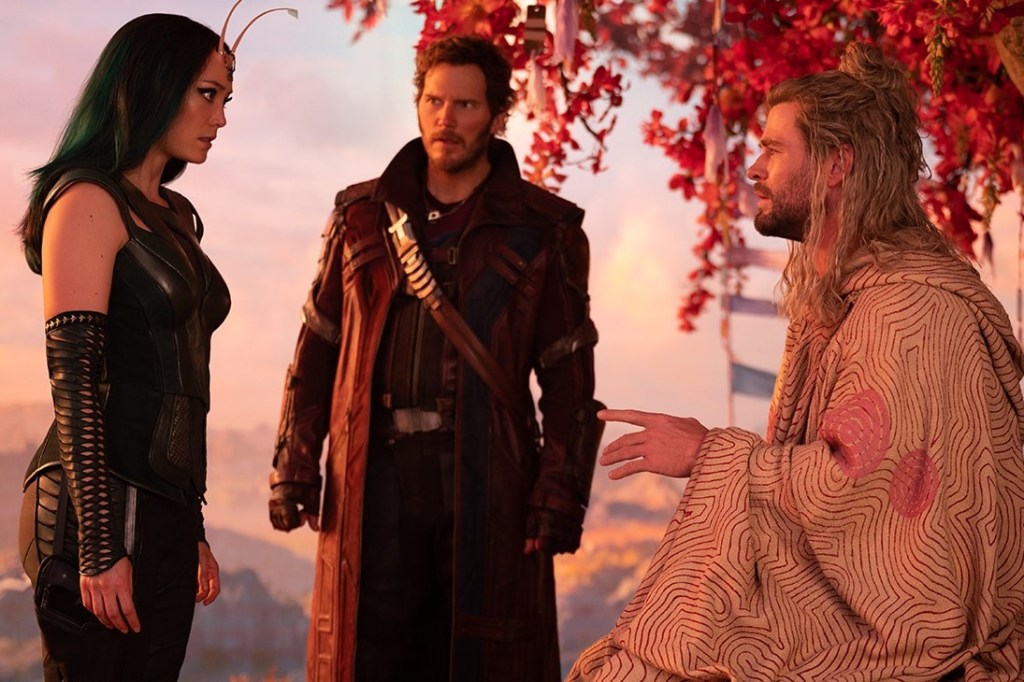
In fact, “Ragnarok” proved superior in so many ways, and that’s before you realize “Love and Thunder” squanders a Guardians of the Galaxy group cameo.
How is that even possible?
Maybe Waititi has Patty Jenkins Syndrome. The “Wonder Woman” director delivered a grand superhero romp in 2017, and then followed it up with one of the worst films in recent memory, “Wonder Woman 1984.”
Did her ego get too big for the set? Was she given too much authority behind the scenes? We’ll never know, but it’s fair to ask similar questions of Waititi after watching “Love and Thunder.”
Something went seriously wrong between “Ragnarok” and “Thunder,” and the mystery behind it might be more entertaining than the film itself.
HiT or Miss: “Thor: Love and Thunder” is a crushing disappointment, doubling down on “Ragnarok’s” comedic beats without the wit and style to make them soar.
Monolith Soft has made plenty of bold claims about Xenoblade Chronicles X. It’s talked up the size of the planet as being five times that of Xenoblade Chronicles, stated that any landscape you see is there to be explored, and promised that there are not only dozens of hours of legitimate gameplay, but hundreds. Often that sort of talk is based on half-truths and bluster, yet in this case it’s absolutely true. This is as grand an RPG adventure that we’ve ever seen, and is an integral part of the Wii U’s library.
It is also, despite the minor addition of X to its title, a very different beast to its predecessor. There are underlying mechanics and structures that are similar, some recurring species, and veterans of the Wii title will have a happier time early on adjusting to its complexities, yet don’t consider this to be a shiny HD iteration of the original’s core content. This is an entirely fresh title from Monolith Soft, and as a result should be immediately appealing to RPG fans with a Wii U that relish a heavily involved adventure, but also those that fell in love with the last-gen effort – or its New 3DS re-release – and want something new to tackle.
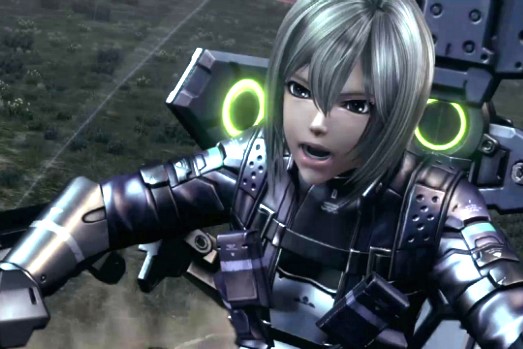
Before all else you create your character, and the toolset to do this is actually rather decent, though Monolith Soft is yet to truly master facial animations. We do rather like the idea that ‘Special’ hair basically means ‘random spike’ that makes the character look like they’ve rolled out of bed, but there’s ultimately scope to create a man or woman that’s either serious or bizarre. Our character has fashionably long hair and a Nightwing-style eye mask, while we combined the boyish superhero look with the daftest and most overly masculine voice available. We went for a goofy option, then. There are some nice moments for fans in this area, too, with Shulk’s voice-actor being an option, though your chosen voice only barks occasional commands in battles.
The story then begins with your protagonist being found by Elma, a key character in the plot. You’re in a corner of Primordia, the area of the Planet Mira most commonly seen prior to launch and the location of New LA, the human settlement that’s sprung forth from the wreckage of a dramatic crash already seen by those following story trailers. That first trek towards New LA is a wonderful moment, with the scale of the world and its handsome landscape being immediately striking. Visually the world of Mira is a significant improvement from Monolith Soft’s previous work, showing a substantial leap not only in utilising hardware capabilities but also in design flair.
The story that unfolds is fairly nuanced courtesy of the overall mission structure. Core Story Chapters represent the key moments of progression along with multiple twists, and within themselves portray a struggle for survival, with mysterious foes of various kinds plotting the demise of the human race. Yet that overarching storyline – which we won’t spoil – is only a small part of the overall narrative at play here.
The true setting and tale is constructed partly through your own exploration and freedom of play, and in a loose structure in which Monolith Soft prods you towards completing some necessary grinding. The next level below Story Missions are Affinity quests, which can’t be cancelled after they’ve begun – which early on can lead to occasional frustrating roadblocks if you struggle to find specific items, for example – and below those challenges are a huge number of Normal and Basic missions. Those latter two types are shorter and more flexible, and you’re allowed to stack up to 20 of these lesser missions at a time to tackle at your leisure.
Story Chapters often require you to reach a certain character level and to discover a percentage of specific regions, for example, and likewise Affinity missions will necessitate a level and – sometimes – a degree of affinity with a specific character. A lesson we learned, too, is that unlocking these key missions or the smaller equivalents can also require some old fashioned networking and exploration. New LA itself is split into multiple segments, and simply running around can trigger discoveries and allow you to stumble across missions not visible in the BLADE mission panel – that’s the organisation you join that’s at the heart of the storyline.
What all of this delivers is an experience with an intoxicating degree of freedom. Occasionally there are disappointing moments, such as an Affinity quest that requires you to find particularly rare items – swallow your pride and seek help in walkthroughs when stuck, we had to look around resources from the Japanese release. These can cause legitimate agitation, yet when you find a flow and start to naturally engage with the game’s world it’s a hugely rewarding process. Filling in the map of the enormous and seamless planet Mira is a wonderful sensation, and the moment you discover a new area or continent is always a thrill. You gradually come to recognise characters, too, and what may begin as another simple low-key mission can occasionally evolve into what would be – in many games – a notable part of the story.
The effect of this is a steady development of the lore of New LA, the planet Mira and its varied inhabitants as dozens of hours roll by. You may explore a mysterious beacon and discover a new alien race that becomes an ally of New LA, or set off an entire sub-story about xenophobic humans that want to rid the city of alien races that have immigrated in order to forge alliances, share technology or seek protection. We’ve come across plotlines that spread over multiple standard missions and address themes such as religious beliefs clashing with logical reasoning, desperation at the plight of the colony, love stories and even material greed. Not all subplots hit the mark but many do, and it’s an extraordinarily broad and dynamic world as a result.
Key to this sense of place is broader exploration, of course, and with that comes plenty of combat. To start with the former, early on you’ll be on-foot a great deal, and an early priority is simply to stretch out onto the planet’s various territories – or those you can reach, anyway – and lay down data probes. These probes provide some of your Fast Travel options, but also unlock information on surrounding areas and generate consistent resources at regular intervals. In their basic form they generate money and Miraniam – the latter being a vital natural resource – but can be spruced up with different types of probes earned through clearing missions and levelling up. This is a meta-game of its own, as you assess different probe sites, determine the best mining options and even aim to chain types together.
This is the primary function of the GamePad’s map, ultimately. Though a small mini-map is on the main TV display the controller is a key part of the journey here; whether assessing the map to figure out unexplored sites or to view vital information on the hexagonal segments of the main view, it’s an effective way to utilise the extra screen. The downside, though, is that the very idea of useful off-TV play is a no-go; even though it’s technically an option, it’s an awkward implementation that means you’re lacking vital tools and information. Likewise using the Wii U Pro Controller still means the GamePad should be nearby, reminding us of a similar habit when playing Pikmin 3 with a Wii Remote and Nunchuk. Ultimately we stuck with the GamePad and TV combination, and this is a game that definitely makes the Wii U’s chunky controller feel natural.
It’s to the credit of Xenoblade Chronicles X and its intoxicating world that we discovered just how poor the GamePad’s battery is, however. When trekking across Mira’s five enormous areas we saw the controller’s blinking red light of doom very often, with a few hours at a time passing remarkably quickly. Either get a better battery for your GamePad or plug it into the mains, otherwise you’ll be scrabbling for the power as often as we were.
When adventuring through Mira, meanwhile, you’ll also be involved in plenty of combat. With levelling up so integral to the experience your focus is often on a blend of finding new areas and picking fights with local animals or established foes of your level or under. Early on it’s necessary to be pretty careful, as stumbling across a powerful villain can see you knocked out and back to the most recent landmark within a moment. After dozens of hours you can afford to be bold but, in the early stages, much time is spent taking long routes around deadly enemies.
Once in combat there’s a return of the real-time Arts system seen in Xenoblade Chronicles, albeit with a slightly different dynamic and without a secondary layer of attacks and buffs as per the Monado moves. In this case Arts are more closely tied to your Class type and even what weapons you have equipped, with the latter being a factor when you finally get into a Skell. Buried within menus are multiple progression trees for combat classes that can dictate how you set about fighting enemies deep into the game; in general you can be an all-rounder, a combative fighter leading the line or a supportive sniper from distance. It’s certainly possibly to rank up in multiple classes, yet we focused on one once we’d found a favoured style.
With each segment of the tree having its own set of 10 levels to gain you learn individual sets of Arts, and beyond that you can than choose from a wider list of them and use ‘Battle Points’ to level them up for your character and those in your party. That adds a layer of extra choice even within a chosen Class tree, as you can opt for moves that buff and debuff the enemies, stack your active batch with moves that are offensive and direct, or a mix anywhere in-between.
Finding a style and mastering your Arts, and their placement in your HUD, is imperative to success. The real-time system, for those unfamiliar with Xenoblade Chronicles on Wii, involves using the D-Pad to select Arts as the battle rages. Where this entry shakes up the combat is in the tempo and visceral impact of the battle; your automated attacks as you position yourself around the foe can be alternated between melee and guns, each with cooldowns. While considering that and selecting Arts – perhaps sweeping behind the enemy to use an attack most effective from that position – there are also focus commands that you issue or are barked by your colleagues.
It becomes imperative to listen to your teammates; they may Topple the enemy and ask you to use melee attacks, and the related Arts will flash – just for a few seconds – to indicate that they’ll have greater impact. Successfully executing the move can buff or give health to the team in addition to applying more damage, and also sometimes prompts a rapid quick-time button press to boost the move and your team further. This all happens consecutively and quickly, while your brain is scrambling to react to the flow of the battle and consider strategies.
The effect is undoubtedly exciting when involved in tense, evenly matched battles, delivering a dramatic form of real-time strategic action. When levelled up and blasting away weak indigens – the animals and wildlife of Mira – the quickfire nature is beneficial, while on the flipside climactic battles can stretch on for 15-20 minutes and beyond, with all of the aforementioned mechanics coming into play as you frantically juggle all of your responsibilities.
The sense of scale only increases, too, especially once you pick up your first Skell. Typical of this game you’ll probably be past the 20 hour mark before you even have the opportunity to pick up one of these mechs, and even that is preceded by a set of tasks that included a borderline ludicrous – and irritating – set of quests. Skell proficiency has its own levelling system – of course – and early on it’s wise not to behave as if you’re in an indestructible Transformer. If a Skell is destroyed you lose one of three ‘Insurance’ policies to get it repaired, and after that you’re paying a lot of money to get the machine back.
Initially you can’t even fly the Skell – that waits until far later in the game, around the 40 hour mark and beyond in our case. It can transform into a ground-based vehicle from the off, though, and its impressive leaps allow you to reach new terrain and thus explore more of the world along with all its related benefits. Its combat mechanics are also unique, in that its Arts are accessible and varied depending on what weapons you buy and equip, from rocket launchers to beam swords and more extravagant items beyond. Skells also have a wonderful ability to ‘Bind’ foes at useful moments, paralysing them for 10 seconds while your teammates weigh in.
Once flying Skells are unlocked you truly feel fully equipped to approach the end game and the most deadly foes. Even so, the latter story missions are resolutely locked until you level up a great deal, and perhaps rightfully so. The joy should be in the exploration and adventure, the unscripted and flexible nature of the game’s storytelling, to the point that Story Chapters are simply part of the end goal, not the primary and overriding purpose in themselves.
Everything we’ve covered are the offline aspects, in which you tackle the vast planet that’s refreshingly clear of invisible walls, embark upon diverse challenges and get to know – and team up with – a sprawling cast of characters. Monolith Soft has integrated plenty of online features, however, which serve as background noise for the most part. For one thing your choice of BLADE Division early in the campaign places you within that group on a global level. There are eight choices that largely reward different exercises – discovering territory, winning battles, completing missions, collecting items etc – depending on their focus, so you can choose one to match your style; importantly you can change career at any time with no real impact on your character.
In the online segment, though, this translates to Division Rewards, and if you’ve opted for the ‘Conquest’ option when booting the game up – other options allow you to stick to online play with friends or focus on the solo campaign – you can embark on special quests. In one form timed Squad quests appear regularly when out in Mira that can be tackled by you and your compatriots from around the world, and earning Squad Tickets and Medals opens up the ability to head to a special console and choose unique arena challenges. These can be Time Attacks (where you try to set the quickest global time with your AI team) or specific Squad Missions (with AI or online teams) that are unlocked with a Division’s progress. Time Attacks can be replayed and are ideal for harvesting experience points, while the varying Squad Missions are a one-time clearance.
Taking on these Squad Mission challenges with others online can certainly be fun, but also lucrative in terms of experience points and materials. We were also able to test out one ‘Nemesis’ battle, which involve enormous creatures that appear as limited-time challenges to tackle co-operatively online or with your AI partners, in Skells of course. The one we attempted was an enormous dragon-like level 60 creature; needless to say it didn’t go well. These are evidently a pinnacle of challenge and reserved for those levelled up to a significant degree, but could undoubtedly provide significant add-on value once all other content and levelling up is done.
Disabled prior to publication of this review were SCOUT Reports, which seem like a fancy phrase for Miiverse posts; Nintendo clearly didn’t want early leaks flooding the social network. The concept of leaving helpful messages around the world will be nice to see in action.
Away from the direct online action you can choose to see or ignore notifications showing the achievement unlocks and progress of others in your Division, and better yet avatars of strangers and friends alike will appear around the world. These can be recruited into your team of four for 30 minute windows, and on at least one occasion a tricky story mission was cleared with a little extra help from our online friends.
When you consider the sheer depth of Xenoblade Chronicles X and its structure, right down to developing competing Arms Manufacturers and looking after party member’s equipment or buying them their own Skells, you’re faced with an extremely complex experience; sub menus seem to have their own sub menus. Compared to its predecessor this entry doesn’t quite introduce mechanics or present them as clearly, partly through UI design but also due to the fact it’s simply got more layers and details to address. Nevertheless, all of what we’ve outlined above – and more besides – does start to fall into place eventually, though we suspect most players will have spells of head-scratching and confusion.
As noted in our preview, at times complexity can make way for over-complicated aspects, at least until you figure out the tricks of the trade. Occasionally fetch quests – including some that are mandatory to progress the story – can be problematic, and there are also difficulty spikes in battles. Thankfully Story missions will reduce the difficulty of a boss after three failed attempts, yet even with this mechanic there can be bottlenecks that block progress for a time. It’s not a frequent occurrence, but poorly thought out battles or overpowered surrounding minions that weigh in on a scripted battle can lead to long stretches of repeated battles; multiple hours can be lost in overly difficult segments that don’t feel particularly fair. Thankfully you do at least keep experience points earned during lost battles, which is helpful in the everlasting quest to level up that bit more.
These setbacks in the experience are the exception rather than the rule, it should be said, and for the most part the world, its inhabitants, dangers and ecosystem seem well tuned to allow steady, methodical progress. We have no reason to doubt claims there are well over 100 hours of content here, and it’s to the credit of Xenoblade Chronicles X that it seems worth the time; not only to see the story to its conclusion but also to play through the many optional Affinity and standard missions. Add online co-op battles and this is a title with a staggering volume of content.
We should close with recognition of the presentation values, too, in which Monolith Soft has gone well beyond the standards it set with its last-generation effort. We’ve already praised the Mira setting a great deal, yet its strength is in visual beauty in addition to its underlying sense of life. From mountainous Earth-like territories with sparkling waters and fantastical forests, to a sprawling arid desert, an alien territory of white earth and a foreboding volcanic region, even the five respective areas have diverse miniature eco-systems and changes in landscape within themselves. On top of that there are some terrific creature designs, with some that are alien in nature and others that are stylish evolutions of real animals. While some textures and character animations are a little messy up close, the wider world looks outstanding. When traversing Mira, particularly airborne in a Skell, this is visually unlike and beyond anything else on Wii U.
Sound design also deserves a nod; the soundtrack is very different from the grandiose and orchestral efforts of Xenoblade Chronicles. Yet the mix of rock, occasional rap, dramatic balladry and occasional returns to a sweeping orchestra fit the futuristic sci-fi setting and storyline well. The voice acting is far more hit-and-miss, though, with some good efforts and others that are rather cringe-worthy in their excessive approach to the artistic brief. Granted, it’s not easy to voice a creature such as the vegetable-like Nopon without sounding silly, but at times attempts at camp humour don’t succeed. Ultimately, though, the voice acting serves its purpose and gets the job done.
Conclusion
Xenoblade Chronicles X is as sprawling, diverse, complex and entrancing as we hoped. It utilises the Wii U’s capabilities not only to produce a beautiful world, but shows how something as simple as a map on the GamePad screen can be invaluable. What’s most impressive is the dynamism and impression of freedom in play – level caps and grinding are naturally part of the equation, yet they’re managed within a structure where even small missions or Affinity quests greatly enhance the narrative and sense of place. To truly experience the story of this human colony and the vast planet Mira requires exploration and patience, and Monolith Soft has found an impressive balance in bringing its vast range of gameplay systems and mechanics together.
Occasional bottlenecks are infrequent and easily overcome in the broader experience, and overall Xenoblade Chronicles X delivers a hugely impressive RPG adventure. It’s an enormous accomplishment for Monolith Soft and an irresistible part of the Wii U library.
Constance Wu returned to Twitter for the first time in nearly three years to announce her new book, “Making a Scene,” and to reveal she attempted suicide following the backlash that erupted against her in 2019. Social media was outraged at Wu after she expressed frustration over her ABC sitcom “Fresh Off the Boat” being renewed.
“I was afraid of coming back on social media because I almost lost my life from it: 3 years ago, when I made careless tweets about the renewal of my TV show, it ignited outrage and internet shaming that got pretty severe,” Wu writes in a statement. “I felt awful about what I’d said, and when a few DMs from a fellow Asian actress told me I’d become a blight on the Asian American community, I started feeling like I didn’t even deserve to live anymore. That I was a disgrace to AsAms, and they’d be better off without me. Looking back, it’s surreal that a few DMs convinced me to end my own life, but that’s what happened. Luckily, a friend found me and rushed me to the ER.”
Back in 2019, Wu reacted with frustration over the news that her ABC sitcom “Fresh Off the Boat” had been renewed for another season. The actor tweeted at the time: “So upset right now that I’m literally crying. Ugh. F—-” and “F—ing hell.” When a user congratulated her on the renewal, calling it “Great news,” Wu commented back: “No it’s not.”
Wu went on to clarify her comments, saying she was upset in the moment because the “Fresh Off the Boat” renewal meant she’d have to turn down a passion project. She noted her television role had become “easy and pleasant,” and she was looking for further challenges, which she felt the new project would have provided.
“It was a scary moment that made me reassess a lot in my life,” Wu writes about her suicide attempt. “For the next few years, I put my career aside to focus on my mental health. AsAms don’t talk about mental health enough. While we’re quick to celebrate representation wins, there’s a lot of avoidance around the more uncomfortable issues within our community. Even my tweets became a subject so touchy that most of my AsAm colleagues decided that was the time to avoid me or ice me out. I’ll admit it hurt a lot, but it also made me realize how important it is to reach out and care for people who are going through a hard time.”
Wu wrote at the end of her statement: “After a little break from Hollywood and a lot of therapy I feel OK enough to venture back on here (at least for a little bit). And even though I’m scared, I’ve decided that I owe it to the me-of-3-years-ago to be brave and share my story so that it might help someone with theirs.”
Stephen King is a renowned author of the horror and thriller genre. With a collection of over 50 novels, roughly 200 short stories, and over 15 film adaptations, King is, without a doubt, one of the most successful authors of all time.
The first Stephen King book I ever read was Christine when I was thirteen. It was my mother that first suggested I read the book. King is her favorite author and as a young teenager, I desired something more challenging to read instead of the classic tween novels from authors such as Andy Griffiths. She suggested this book to me because it was the first Stephen King book that she read when she was around my age, and it is one of the less grueling and psychopathic novels by King that would help me wean myself into the genre.
Christine was first published in 1983 by Viking Press. The story surrounds a bright red 1958 Plymouth Fury that has something very different and very special about it since it first came off the production line. The car originally belonged to a man named Ronald D. LeBay who endured a series of family and close friend’s deaths during the time that the car was in his ownership. After many years he decided to free himself from the Plymouth, and sold the car for $250 to a young college student named Arnie Cunningham.
Arnie is forced to store the car in a do-it-yourself mechanics shop because his family, and even his best friend, severely dislike the car. As he spends time repairing the care he becomes disconnected and cynical yet gains more self-confidence. The appearance of both the car and Arnie change dramatically overtime. Seemingly impossible repair jobs get fulfilled, though they don’t seem to be done by the pimple-faced and pale young Arnie who now seems to have a flawless completion and more adult appearance. Arnie and the car become more and more connected with each other and he names her Christine.
Arnie becomes ultimately obsessed with Christine, becoming withdrawn towards everyone in his life including his girlfriend and parents. Dennis, Arnie’s best friend, learns that there is more to the deaths related with Christine, especially in the past when it belonged to LeBay. He pieces together the notion that LeBay may have deliberately sacrificed his own daughter to make Christine a receptacle for his spirit because he forcefully took her into the car when she began chocking on a hamburger. Dennis becomes increasingly concerned for Arnie, especially when he learns of all the deaths that have occurred within Christine. As time goes on, an increasing number of car-related deaths occur within the small town.
Within the novel, there are various car-related mini poems, usually at the beginning of each chapter. These are excellent little breaks in the story and they are all matched with the era, adding to the ambiance of the novel. It is well written, using direct colloquialism to piece together each character’s personality. It is also graphically detailed to bring further drama and suspense to the story.
After reading Christine I became captivated by King’s writing and genre. I have had a love for the author ever since. Christine is certainly an excellent starting place for any new King reader, and a definite book to add to your to-read list if you are already enchanted by King’s works.