
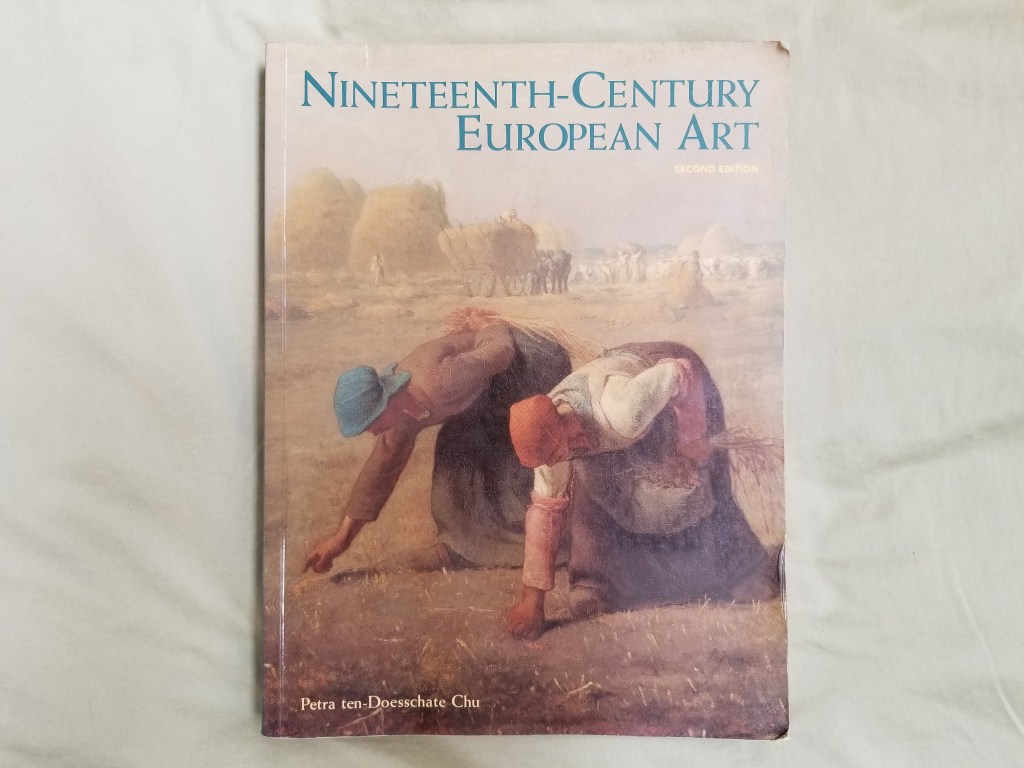
Now reading Nineteenth Century European Art by Petra ten-Doesschate Chu…
“[N]obody who has read a business magazine in the last few years can be unaware that these days there really are investors who not only move money in anticipation of a currency crisis, but actually do their best to trigger that crisis for fun and profit. These new actors on the scene do not yet have a standard name; my proposed term is ‘Soroi’.” Paul Krugman 1999
You can’t make this stuff up. You just can’t.
Billionaire speculator and vulture capitalist George Soros (family changed their name from Schwartz in 1936) has penned an Op Ed praising the outcome of the recent IMF serving color revolution in the Ukraine. For a man who famously hates anti-Semitism, it seems rather odd that he would be aligning himself with the rise of the neo-Nazi nationalist parties in the Ukraine. But then again, Soros (Schwartz) has always been more about the money than he was about his religious identity. That’s probably because money is his religion.
Not only is Mr. Soros (chosen name means “designated successor” or “next in line” in Hungarian) busily rewriting the history of this bloody conflict in his new Op Ed, he’s actually serving as an apologist for the neo-Nazi’s brutal violence which ultimately brought down the elected government of the country and now is positioning itself to wipe out what they consider to be enemies of the true Ukrainian state; Jews and other leftists.
“This is Oleh Tyahnybok, he has claimed a “Moscow-Jewish mafia” rule Ukraine and that “Germans, Kikes and other scum” want to “take away our Ukrainian state.”
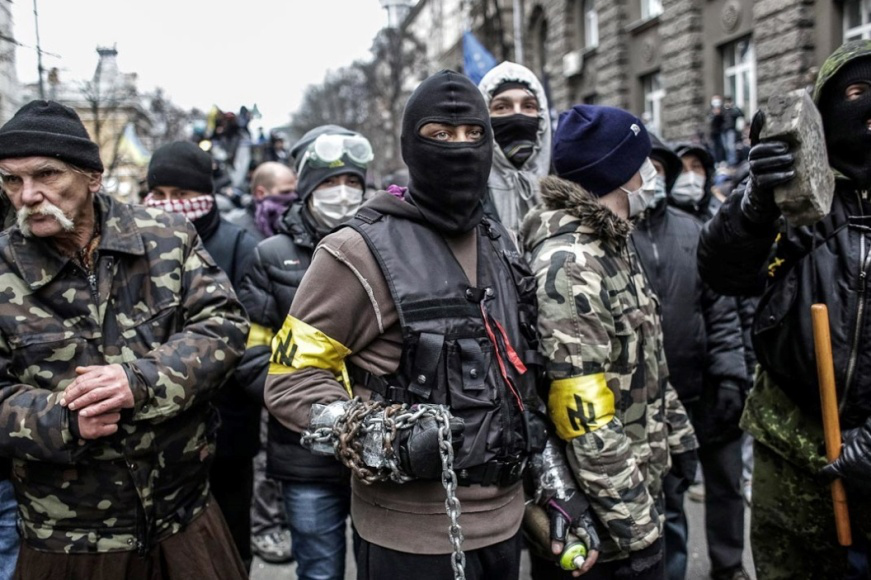
“This is their old logo, a Wolfsangel rune (on yellow armband), a common symbol for European neo-Nazi organizations. It was also the symbol of the Patriots of Ukraine, a paramilitary organisation Svoboda went hand in hand with until 2004.”
“a group of citizens armed with not much more than sticks and shields made of cardboard boxes” George Soros
During the early stages of the violence, at least 6 police officers were killed by Soros’ heroic violent thugs. Can you imagine what the body count would have been in New York if 6 cops had been killed by Occupy Wall Street protesters? If they had been hurling firebombs at police lines?
Al Jazeera has an interesting article about the rise of the ultra-nationalists on the march in Western Ukraine the other day. This is an 85 year old party of Nazi sympathizers who fought FOR Hitler back in the days when George Soros’ family was changing their name from Schwartz.
Some Jews, understandably fearing these developments, are advising their congregations to leave Kiev and the country altogether if possible.
Do you see the Confederate Flag hanging in this Ukrainian government building after the neo-Nazi’s took over? I do. What do you think that is all about?
Very little is being mentioned in the press or the White House about the Nazi nature of the fascist turn of events in the Ukraine right now. You have to look hard to find any remotely mainstream mentions of it, but they do exist.
Meanwhile, George Soros is helping the left feel better about focusing on, shall we say, more tangible aspects of this crisis:
… True to form, the EU under German leadership offered far too little and demanded far too much from Ukraine. Now, after the Ukrainian people’s commitment to closer ties with Europe fueled a successful popular insurrection, the EU, along with the International Monetary Fund, is putting together a multibillion-dollar rescue package to save the country from financial collapse…
… I established the Renaissance Foundation in Ukraine in 1990 – before the country achieved independence. The foundation did not participate in the recent uprising, but it did serve as a defender of those targeted by official repression. The foundation is now ready to support Ukrainians’ strongly felt desire to establish resilient democratic institutions (above all, an independent and professional judiciary). But Ukraine will need outside assistance that only the EU can provide: management expertise and access to markets…
… Ukraine would thus open its domestic market to goods manufactured or assembled by European companies’ wholly- or partly-owned subsidiaries, while the EU would increase market access for Ukrainian companies and help them integrate into global markets.
I hope and trust that Europe under German leadership will rise to the occasion. I have been arguing for several years that Germany should accept the responsibilities and liabilities of its dominant position in Europe.” George Soros
Is it ironic that Mr. Soros, a self-proclaimed life-long enemy of all things anti-Semitic, would back this neo-Nazi uprising in the Ukraine while calling for the German conquest of Europe or is he carefully positioning himself to “fit in” with the new fascist brown-shirt management of the country? Is he that stupid or that smart?
Either way, he’s clearly a Mammon worshiping opportunist looking to fill his pockets on the back of yet another tragic crisis and it doesn’t matter to him that Jews and leftists in general in Kiev are packing their bags and heading for the nearest border. When there’s blood in the water, the Soroi swarm. That’s just their nature.
UPDATE: True to form, first thing they do, the neoliberals are ready to push punitive IMF austerity adjustments on the people of the Ukraine, taking full advantage of the manufactured crisis.
After his nomination, Yatseniuk told parliament that Ukraine faced threats to its territorial integrity and promised to pursue European integration. He said: “Our country is on the brink of economic and political collapse …There is no other way out for us than to take extremely unpopular decisions” Guardian

Povarskaya Street (Russian: Поварская улица), known from 1924–1991 as Vorovsky Street (улица Воровского), is a radial street in the center of Moscow, Russia, connecting Arbat Square on Boulevard Ring with Kudrinskaya Square on the Garden Ring. It is known informally as Moscow’s Embassy Row, and is home to the finest mansions built in the 1890s and 1900s. Povarskaya Street also houses the Supreme Court of Russia and the Gnessin State Musical College. Most of Povarskaya Street lies in the Arbat District; its northern side near Kudrinskaya Square is administered by the Presnensky District.

Fritz Haber (December 9, 1868 – January 29, 1934) was a German chemist who received the Nobel Prize in Chemistry in 1918 for developing a method of synthesizing ammonia using atmospheric nitrogen. This process in turn could be used to manufacture fertilizers, explosives, and various other nitrogenous chemicals. During World War I, this method kept the German army well supplied with ammunition. In addition, Haber headed the German effort to produce chlorine and other poisonous gases. After the war, he worked toward reintegrating the research of German scientists into the world community.
Despite Haber’s high standing in German science, his life was marked by profound tragedies. His first wife, unhappy with her marriage and with his work on chemical weapons, committed suicide in 1915. His second marriage, which lasted ten years, ended in divorce in 1927. After Adolf Hitler seized power in Germany, the Nazis forced him to leave the country in 1933 because of his Jewish background, and he died in the process of emigration. Many of his relatives and other Jews were killed by the Nazis in concentration camps, gassed by Zyklon B, invented by scientists at the institute he had led. Later, his son Hermann committed suicide.
Biography
Haber was born in Breslau, Germany (now Wrocław, Poland) to Siegfried and Paula Haber. His mother died in childbirth. His father was a prominent chemicals merchant in the town. He attended St. Elizabeth’s School in Breslau in his early years, during which time he developed an interest in chemistry. From 1886 until 1891, he studied at the University of Heidelberg under Robert Bunsen, at the University of Berlin in the group of A. W. Hofmann, and at the Technical College of Charlottenburg under Carl Liebermann. Before starting his own academic career, he worked at his father’s chemical business and in the Swiss Federal Institute of Technology in Zürich with Georg Lunge.
Teaching and research
For a period, Haber was uncertain about the direction of his career, but worked for a short time with Ludwig Knorr at the University of Jena, with whom he published some early research. In 1894, he accepted an assistantship under Hans Bunte at the Karlsruhe. In 1896, he was promoted to assistant professor, after the publication of his thesis on the oxidation of hydrocarbons. In 1898 he was granted an associate professorship, and in the same year published a text on electrochemistry. He married Clara Immerwahr in 1901, herself a chemist who had aspirations of accomplishment in the field. In 1906, Haber was made full professor of chemistry and electrochemistry, and director of an institute devoted to the study of these subjects. He remained there until 1911 when he assumed the directorship of the Kaiser Wilhelm Institute for Physical and Electrochemistry in Berlin, where he remained for 22 years.
Haber devoted much of his time to research in electrochemistry. He invented a glass electrode and studied energy loss in steam engines and electric motors. He also explained the structure of the flame of a Bunsen burner, demonstrating the different reactions that occur in the flame’s core and in its outer sheath.
Synthesis of ammonia
The work for which he is best known, the production of ammonia gas from atmospheric nitrogen, did not begin until 1905. In that year, he published a book on the thermodynamics of gases that contained information on the production of ammonia at temperatures exceeding one thousand degrees centigrade, using iron as a catalyst. He improved this process, in collaboration with Robert Le Rossignol, by having the reaction take place at pressures of 150 to 200 atmospheres, and at a more practical temperature of five hundred degrees Celsius, using the element osmium as a catalyst. In 1909 Haber and Rossignol demonstrated this process to BASF, the chemical manufacturer. The company was persuaded of its feasibility, and assigned two scientists, Carl Bosch and Alwin Mittasch, to make improvements. Osmium, a rare and costly metal, was replaced by iron alloyed with a variety of compounds. By 1913 industrial facilities were producing several tons of ammonia per day using Haber’s methods.
World War I
The Haber process was perfected just before Germany went to war with neighboring European countries and the United States. Ammonia could be used as a starting material for the production of high-yield explosives, and Germany’s war effort was considerably enhanced by its ability to produce armaments from atmospheric nitrogen, particularly when supplies of mineral nitrates that it had depended on for the same purpose were cut off due to the blockade of German shipping by the Allied forces.
Haber at this time became engaged in the production of chemical weapons and supervised the use of chlorine gas against Germany’s adversaries, even though most nations, including Germany itself, had signed a treaty banning the arming of projectiles with poison gas. The Germans circumvented this restriction by using gas canisters on the ground, and relying on the wind to spread the gas. The use of these weapons had only mixed success, and Germany’s advantage quickly disappeared as all sides began to produce chemical weapons and gas masks for the protection of troops.
In 1915, Haber’s wife Clara, who had expressed dissatisfaction with her marriage and her career and disappointment with her husband’s work on chemical weapons, committed suicide. This did not dampen Haber’s enthusiasm for the war effort. In his studies of the effects of poison gas, Haber noted that exposure to a low concentration of a poisonous gas for a long time often had the same effect (death) as exposure to a high concentration for a short time. He formulated a simple mathematical relationship between the gas concentration and the necessary exposure time. This relationship became known as Haber’s rule.
Haber defended gas warfare against accusations that it was inhumane, saying that death was death, by whatever means it was inflicted.
In 1917 Haber married Charlotte Nathan and the couple had two children before the marriage ended in divorce in 1927.
Later Career
Immediately after the war, Haber received the 1918 Nobel Prize in Chemistry for his work on the synthesis of ammonia. The Haber-Bosch process was a milestone in industrial chemistry because it provided a way to produce nitrogenous products—such as fertilizers, explosives, and chemical feedstocks—without relying on natural deposits, especially sodium nitrate (caliche), of which Chile was a major producer.
Haber made efforts to reintegrate the work of German scientists into the world community in the aftermath of World War I. He was able to obtain funding from the Rockefeller Foundation for some of these scientists. For six years beginning in 1920, he devoted himself to extracting gold from sea water to help Germany pay back its war debts. He found, however, that the percentage of gold was too small to make the process economically viable. During the same decade, scientists working at his institute developed the cyanide gas formulation Zyklon B, which was used as an insecticide, especially as a fumigant in grain stores, and also later as a tool of mass execution in the German death camps of World War II.
Some believe that Haber continued research into chemical armaments after World War I, using another scientist as a front.
When Adolph Hitler tightened his grip on Germany and began his crusade against the world’s Jews, Haber began to feel increasing pressure to step down from his position as director of the institute. He was prohibited from hiring Jewish staff, a restriction that finally sealed his break with the German government. During this time, his life was tumultuous and filled with uncertainty. He remarked in his last year in Germany:
I fight with ebbing strength against my four enemies: insomnia, the economic claims of my divorced wife, my lack of confidence in the future, and awareness of the grave mistakes I have committed…(Lehrer, 2000).
Haber left Germany in 1933, having secured a position in Cambridge, England, but upon his arrival found that British scientists still harbored hostility toward him for his work during World War I. He then received an invitation to join an institute in Palestine, but poor health precluded his acceptance of the position. He died of heart failure, aged 65, in a hotel in Basel, on his way to a convalescent retreat in Switzerland.
Haber’s immediate family also left Germany. His second wife Charlotte, with their two children, settled in England. Haber’s son Hermann, from his first marriage, immigrated to the United States during World War II. He committed suicide in 1946. Members of Haber’s extended family are said to have died in German concentration camps.
Portrayal in drama
A fictional portrait of Haber’s life, and in particular his longtime relationship with Albert Einstein, appears in Vern Thiessen’s 2003 play, Einstein’s Gift. Thiessen portrays Haber as a tragic figure who strives unsuccessfully throughout his life to evade both his Jewish background and the moral implications of his scientific contributions.
Legacy
Haber’s tremendous contribution to the welfare of humanity in terms of the production of fertilizer is balanced on the negative side by his support of the German war effort in World War I and the many lives that were lost as a result. His change of heart came as Hitler began a crackdown on Jewish scientists, which offended even Haber’s thick-skinned sensibilities. He was in no danger himself, as his record of support for the German war machine established credentials that even Hitler could not deny. His failing health, and the hostility his armament work engendered in the scientific community at large, prevented his full rehabilitation. But unlike some of his colleagues, such as Max Plank and Werner Heisenberg, he withdrew his support from Nazi-controlled Germany of the 1930s. In his personal life, he left a trail of misery in the form of a wife and a son who committed suicide, a divorce and the deaths of relatives in concentration camps through the technological innovations that he pioneered.

Ten years ago Final Fantasy VII came out for the PlayStation and was instantly hailed as one of gaming’s greatest achievements to date. It wasn’t the only game in the series to come out within the next few months leading into 1998 though. Final Fantasy Tactics came out in January, a few months after Final Fantasy VII, and completely flew under the radar. Final Fantasy VII wasn’t all at fault for this though. Final Fantasy fans weren’t typically used to the strategy RPG genre so they generally weren’t interested. Strategy RPG fanatics picked it up though, because it was developed by the same person responsible for the fantastic Ogre battle series, Yasumi Matsuno, as his first project for Square. Whether you were one that picked up the original Final Fantasy Tactics or not, Square Enix is giving you a second chance with Final Fantasy Tactics: The War of the Lions for PSP.
If you have never played a strategy RPG before, you might want to do a little background check on them. I advise this because Final Fantasy Tactics is hard to learn for newcomers at times, and can be quite difficult in the early going if you don’t understand the game. Those who have played a strategy RPG before will fare much better in getting used to the rhythm and flow of the game. Final Fantasy Tactics is actually pretty straight forward once you get used to it, which just might take a few failed attempts in the early going to achieve. Of course, those who have already played this game know what it is I’m talking about. For those that have played this game, there is plenty new content here to give you reason to re-purchase this game though. You may just find yourself coming out of this with an entirely new perspective on the game than you did on the PlayStation.
The first notable thing that is improved upon is the English translation. The original had some awkward “Engrish” moments where typos and sentences that didn’t make much sense took the player completely out of it. This is all fixed here. Square Enix tossed the old translation completely out the door and has redone it from scratch. The first things people will notice who have played the game is that many of the names of characters, items, jobs, and abilities have been changed for the better. Algus is now Argath, breaking is now rending, and Lancer is now Dragoon. Many of the things changed help Tactics fit more into its series traditions (like Fire 2 now being Fira). These changes might be a turn-off for some purists, but as long as you come into it knowing the experience will be better, it really shouldn’t matter. It helps the game fit more into the style of a traditional Final Fantasy game. While the changes to these areas of the translation shouldn’t be complained about, I can see reason as to why some would complain about the dialogue. I personally loved it and felt it made the overall atmosphere of the game that much sweeter, but there will definitely be that crowd that just “doesn’t get it.” This is because Square Enix went with a more Shakespearean approach to make it fit the tone of the story and setting. Those who aren’t accustomed to this old style of language will probably protest this completely, but for the overall quality of the game, it completely helps it.
Improvements to the story are definitely a great thing for this game, since it is one of the best stories in the series. The story always keeps you on your toes with emotional resonance not matched by many video games. However, it is clear that if all Square Enix would have changed is the story then I wouldn’t be warranting a purchase of this game to people. War of the Lions also has new content never seen in the original version. Two brand new classes were added into this PSP version, which include the onion knight and dark knight respectively. These classes derived from the first game in the series to feature job classes, Final Fantasy III, and help round out the stellar system used in the original Final Fantasy Tactics. Also added was a new multiplayer feature that enables players to pit each others teams of characters against each other vis-a-vis the ad-hoc system of the PSP, as well as co-op missions similar to those in Final Fantasy Tactics Advance. In these missions is where you can get equipment not sold in the game as well as some of the stronger equipment early on. The only thing is that you need to make sure your partner is around your level because if either of you is higher than the other (we are talking about 5-10 levels or higher) you will be at a complete disadvantage in the co-op missions because the enemies level is that of the highest character used. You need to be aware of this for the player vs. player mode as well because most likely the higher level will win. Of course, there are a few things added in to the player vs. player so that it isn’t just a traditional battle (like being able to lock swords and having to rapidly tap a button faster than the other to win the sword clash). One disappointment with the multiplayer though, is the fact that there is no online mode. Even still the multiplayer is very solid and worth trying out if you have a friend with the game.
The biggest thing that has been added to the game though, is the brand new animated cutscenes. They are absolutely gorgeous to behold and are used for the biggest story pieces in the game. Not only does it have this, but the cutscenes even feature voice-acting. The voice-acting is stellar and really brings out the best of each of the characters involved in the story. It adds more drama and suspense than ever before. This, to me is the biggest draw to bring back those who have experience this game before. The in-game graphics haven’t really changed that much, still featuring the PlayStation era graphics, but they absolutely still fit the bill nicely. The sprites are very well animated for the story sequences to bring out the emotion of the characters, and all the 3-D effects that are mixed in go well with the art design. The soundtrack to the original Final Fantasy Tactics was a riveting, engaging piece of work that really helped the game bring drama to the story, as well as soothing to your ears during battle with extremely hummable and excellent music. The same can be said for the PSP version as well because it sounds identical to the original version in nearly every way. The soundtrack is easily one of the best in the series. The sound effects are largely the same to, except for a few changes that most probably won’t even notice.
There are a few things that haven’t been improved though, that easily should have been. The original Tactics for the PlayStation had some slow-down when trying to perform the more powerful spells and abilities and nothing has changed on the PSP. There is actually a more substantial amount of slowdown in this version compared to the original. Even worse is the fact that the animations and sound effects are less in synch than they were in the original. The camera in the original also didn’t always give you the best view of the battlefield and there were some amounts of frustration from that. This still has not been remedied in this remake. None of these are problems are truly game-breaking, but Square Enix easily could have spent a little more time on these small problems to make the overall experience a better one.
Despite the fact that Final Fantasy Tactics is a decade old game, I still feel that it is absolutely one of the finest RPG experiences you can find. There are some things that Square Enix could have ironed out, but Final Fantasy Tactics is still, in my mind, the definitive strategy RPG experience of its time. Whether you have already played the game or not, you simply can’t go wrong with this modern classic remake.

I thought this was a better-constructed story than in Dragon Wing, but I also think it could only have been done in the second book of the series. In the first book, we wanted to know about Haplo. I think we get a better idea in this book, however, because nothing goes according to his plans. From the moment he sets foot on Pryan, the world of fire (or heat or energy, to be more precise), he is constantly playing catch-up to the events.
The other idea that works well here is Zifnab. Although there was humor in the first book, none of the characters, including Alfred, was the fool, like Simkin from the Darksword Chronicles, and Fizban (hmm… note the inverse spelling) from the Dragonlance Chronicles. I have always loved inside references, which is one of the reasons I like the Star Wars expanded universe so much. Zifnab is ripe with internal and external references. I thought he was a Sartan, but it appears that he is a life form beyond Sartan. Later in the series, he will declare that he is God. I wonder, given the name association with Fizban, if that’s not far from the truth. He is able to poke through Haplo’s magic without the typical Sartan rune magic -at least none that is visible, he knows of Haplo’s coming well before he even enters the Death Gate to this world, and he knows about OUR world, as well as other fantasy worlds.
Zifnab talks several times about Fizban and Gandalf (the grey, because he smokes!). The dragon at one point says he should have gone to Pern! Zifnab talks about speaking with George Lucas, the space shuttle heat shield tiles and Challenger explosion, tries to christen Haplo’s ship Enterprise (“all rights reserved”), the Millennium Falcon and others. It’s quite hilarious reading his lines. He is a lot like Fizban, in that he is always falling asleep or disappearing at the most inopportune moments (letting the lower life-forms exercise their own powers without becoming reliant on him), forgetting his magic (he seems to have a similar fireball spell he can’t remember, like Fizban), singing songs like “over the rainbow” and being quite absent-minded. He is one of the most loveable characters! As I’ve said in my review of Dragon Wing, I don’t remember Haplo’s dog, but here Zifnab says he knows the secret of the dog! I can’t wait to hear this one revealed. I find it interesting that the dog tries to protect the lesser races and Zifnab against Haplo, even though it is most loyal to the Patryn.
Other characters include the elf siblings Paithan and Aleatha, both prodigal children to their older sister Cassandra, who runs the weapons business and the family. Then there are Roland and Rega, human siblings who are buying the weapons. They are all full-fledged characters, fully developed and fun to read about. Then there is the dwarf Drugar, out for revenge on all of them.
The threat in this book is not eternal war, as in Dragon Wing. Instead, mighty giants, blessed with Sartan rune-magic in its most elemental form, are roaming the land, killing all they find, looking for their lost “citadels”. Distant human lands have already fallen to them before the story starts. The dwarves want to buy the elven weapons from Roland and Rega for protection, but Paithan arrives late, and Roland and Rega don’t really know the way to the dwarf kingdoms, so it takes even longer to arrive. By the time they do, all is destroyed. Paithan and the humans are captured by the giant Tytans, but Drugar helps them escape, because he wants them to see the destruction of their own people before he kills them himself.
Retreating through the human lands, they do see it in chaos, and eventually the tytans overwhelm them. Instead of coming to their aid, elven archers fire upon the terrified humans. Haplo arrives in his ship in time to rescue Paithan, Roland and Rega, and encounters the Tytans firsthand -and they overwhelm him, even with his powerful magic.
Haplo was caught by surprise in a number of ways by Pryan. Through the Death Gate, he encountered four suns surrounding him. When he decided to move beyond them, he spent days or weeks in empty space -but it wasn’t space, it was the air in the center of the world, for Pryan is a solid shell on the outside, with a hollowed-out inside, with the vegetation growing on the inside of the shell. There is so much energy that it is difficult in most spots to find the ground (except for the dwarves, who live underground). The elves live in the treetops, and on mossy plains or by lakes in the mossy plains. The humans prefer open plains without much tree cover. Haplo starts to second-guess himself and his master and his magic. He sees stars in the sky, and we get a little more information about the new worlds. From what the Lord of the Nexus has read in the Sartan books, none of the worlds have stars or moons. I wonder, then, if the new worlds exist in our reality any more, or if they still exist in our solar system.
When Haplo arrives at Cassandra’s house, he is met by Zifnab, who accosts him with the news that he will be taking refugees to the stars. He doesn’t believe it, but accepts Zifnab’s suggestion that he go out and rescue Paithan. When the Tytans attack the elven settlement, Haplo sets a trap to gain knowledge of whatever is in its mind, hopefully to find out where the Sartan have gone, for he recognizes the Sartan rune magic in them. He nearly dies in the assault, but is saved by Zifnab’s dragon (I guess the human “intelligence” about the Tytans was wrong, because it stated that even Dragons raced away in fear of the Tytans -instead, the Tytan ran away in fear).
Then begins another long trip through the sky, as everybody nearby takes shelter in Haplo’s ship to escape the stars. I question Zifnab’s planning here, as the variety he picks to save from the Tytans is so small that the three races will die out in a generation. One dwarf, a handful of humans (including at least one brother and sister), and a handful of elves, also including at least one brother and sister. To add to that, Roland and Aleatha are sexually attracted to each other, and Rega and Paithan are already romantically involved. I wonder how factual is the “fact” that the two races cannot interbreed. Thus the genetic variety is left to a single elven servant family of elves and few human slaves.
On the way, a war almost starts on Haplo’s ship, and he is reduced to the role of mediator or baby sitter, something to which he is not accustomed. I can tell he wouldn’t have made a very patient parent. We get lots of flashbacks to his time in the Labyrinth, including a romantic interest, and the division of runners (individuals who try to get through the gates) and squatters (groups of people who band together for protection and move much more slowly). The girl wants to raise a family, which would mean at least temporarily (for several years) joining a group of squatters. Haplo, in stereotypical male fashion, freezes at the thought. He never sees her again.
When Haplo’s ship arrives at the “star”, he makes the discovery that it is actually still on Pryan, just on the other side of the globe. Arriving at the shining city, he takes the opportunity of the strife between the races to sneak out and enter it, learning about Pryan the way he learned about Arianus. Pryan seemed to work a little better than that world, except for the undying light and the extreme heat. The Sartan had planned to use the excessive energy on the other worlds, for example to power the Kicksey Winsey, but they apparently died out before that could happen.
They built shining cities that could magically darken so the people living within could experience night. But instead of completing their grand design, they were reduced to the role of babysitters of the races, trying to end squabbles and wars, just as Haplo did on his ship. And, of course, they started to fade. I wonder if it is God’s price, to make them pay for destroying the world He created and making four more out of its parts. I don’t recall much about The Seventh Gate at all, except I believe there is an answer.
The humans, elves and dwarf leave Haplo’s ship and move toward the city. They meet Haplo leaving as they arrive, but can’t get in because the city was magically locked. In a hilarious but telegraphed piece of acting, the dragon eats Zifnab and roars at the group until Drugar figures out that he has the key to the city in his rune charm. Like Haplo, I wonder where the dwarves learned about the runes. He is astonished that they could grasp such things. Was it Zifnab, or did the Sartan of old teach the lesser races, like they endowed the Tytans? I don’t recall if that question is answered. In the end, Zifnab and the dragon talk about their performances, with Zifnab quoting Gandalf from Moria (“run, you fools!”) and the dragon wondering how much longer he could have stayed there salivating and growling before the dwarf figured out how to open the gates.
Haplo’s world is starting to shatter. He thinks he knows all about himself and the worlds he will visit, and especially about the Patryns and Sartan. But he is learning that there are things he doesn’t understand, and that his Lord could be mistaken about some things. It will take two more books before he really shatters, but I see the cracks beginning, even though he has regained his sense of superiority and almightiness by the end, as he leaves to go back to the Nexus.
Speaking of the Nexus, we get one chapter in that place before Haplo goes through Death’s Gate. In it, he nearly flies into the Labyrinth. If his ship could get in, I wonder if it could get out again, and if he could rescue anybody from within. Presumably anybody who enters could not get out again without a lot of trouble.
Finally, the only person I can think of who could be on the cover of this book would be Haplo, but where are the runes on his hands?
Otherwise, I can’t have enough praise for this book. It doesn’t have the gritty style that characterizes books written these days, and that just adds to its charm. I am already loving this series, again.


https://moviemusicuk.us/2016/03/10/highlander-michael-kamen/
Despite only being a modest hit when it was first released during the early months of 1986, Highlander has gone on to be a cult classic, and is now considered one of the most influential and well regarded sci-fi action movies of the decade. Directed by Russell Mulcahy, the film stars Christopher Lambert as Conor MacLeod, born in Scotland in the year 1518, who gradually discovers that he is an ‘immortal’, one of many such men who are destined to fight one another across time, and who can only be killed by complete decapitation. When one immortal decapitates another, the survivor receives a transfer of power called a “quickening,” and eventually, after all the immortals have battled until there is only one left alive, the last survivor will receive “the prize” of immense knowledge about the nature of the universe. After receiving training and education from Spanish nobleman Ramirez (Sean Connery), a fellow immortal, MacLeod gradually battles his way to 1980s New York, where he lives under the assumed identity of an antiquities dealer named Russell Nash. However, a string of beheadings in the city brings MacLeod into contact with NYPD detective Brenda Wyatt (Roxanne Hart) and – worst of all – the evil immortal Kurgan (Clancy Brown), who will stop at nothing to claim the Prize for himself.
The score for Highlander was written by the up-and-coming Anglo-American composer Michael Kamen, whose fledgling career was still on the rise following his scores for films such as The Dead Zone and Brazil, and the British TV series Edge of Darkness. At the behest of producer Peter Davis, Kamen worked closely with Brian May of the rock band Queen in creating the score; Kamen wrote the majority of the orchestral material while May wrote the film’s love theme, “Who Wants to Live Forever,” and the rest of the band wrote several additional songs for the film’s soundtrack, including “A Kind of Magic” and “Princes of the Universe”. Their collaboration was very successful – Kamen was able to seamlessly include May’s melody into his score at appropriate moments, while the songs themselves went on to be chart hits, especially in the UK, where “A Kind of Magic” peaked at #3.
Unfortunately, the film’s poor box office performance caused the planned soundtrack album to be cancelled. Queen’s songs were released on their 1986 album, “A Kind of Magic,” but the vast majority of Kamen’s score remains unreleased to this day. The only legitimate release of Highlander’s score music is via the 1995 album Highlander: The Original Scores, released by the German label Edel, which features five tracks of Kamen’s score along with selections from Stewart Copeland’s score for Highlander II: The Quickening, and J. Peter Robinson’s score for Highlander: The Final Dimension.
The five Kamen cues – “The Highlander Theme,” “Rachel’s Surprise/Who Wants To Live Forever,” “The Quickening,” “Swordfight at 34th Street,” and “Under the Garden/The Prize” – show a composer who is clearly still honing his craft. Despite the performance of the National Philharmonic Orchestra, much of the Highlander score feels very raw, as though Kamen was trying too hard to impress his employers with a vast array of flourishes, changes of tempo and style, and densely orchestrated action sequences. This is something that Kamen was guilty of quite a bit during the early years of his career – Kamen himself, when reflecting on his earlier works, once called his score for The Adventures of Baron Munchausen ‘overwhelmingly baroque and ornate’ – and some may find his writing here lacks the smoothness and clarity of some of his later works.
Despite this, there is still a great deal in Highlander to recommend. Kamen’s main Highlander theme is memorable – a two-note fanfare, echoed by a six note response in the horns – and it plays throughout much of the score. It’s a quintessential Kamen motif, with chord progressions and rhythmic ideas that those who have followed his career will recognize, and it gives MacLeod a noble, heroic identity. Kamen allows the theme to pass around his orchestra freely, from strings to brasses, and he augments his ensemble with electronics, a female solo vocalist, and even some region-specific instrumentalists, including bagpipes and a mandora, a type of medieval mandolin or lute.
The performance of Brian May’s love theme in “Rachel’s Surprise/Who Wants To Live Forever” is simply gorgeous, sweeping and sentimental, performed by a bank of tremolo-heavy strings. “The Quickening” is equally pretty, with elegant string phrases, light woodwind accents, and interpolations of the Highlander theme which play against a more dance-like motif for his friend and mentor, Ramirez. “Swordfight at 34th Street” is full of swash and buckle, with the tinkling mandora playing off a series of timpani runs and horn fanfares that recall the similarly buoyant writing heard in later scores like Robin Hood: Prince of Thieves and, oddly, Mr. Holland’s Opus. The final cue, “Under the Garden/The Prize,” has more of a sense of danger to it, with more dissonant writing for piano clusters and stark, stabbing strings. Heraldic variations on the Highlander theme build up to the climax, a cacophony of overlapping horns and cymbal clashes.
Over the years, several bootlegs of the score have emerged on the secondary market, the best of which combines the five tracks from the Edel album with five additional score tracks, an instrumental version of “A Kind of Magic,” three Queen songs, and a re-orchestrated version of “There Can Be Only One” taken from the 1998 compilation album Michael Kamen’s Opus. While I usually do not condone bootlegs, I would nevertheless recommend finding a copy if you are able, at least until a legitimate version is released. There are some superbly rousing variations on the Highlander theme in “The Castle – Anno Domini 1518” and “Training Montage,” a longer statement of Ramirez’s theme in “Ramirez Arrives,” a brutal action sequence in “Forge Battle/There Can Be Only One,” and an especially moving piece in “Heather’s Death,” highlighting some lovely interplay between harp and strings, and a surprisingly effective electric guitar variation on the “Who Wants to Live Forever” theme.
Considering the cult success of Highlander, with its multitude of sequels and it’s unfathomably long-lasting TV spinoff starring Adrian Paul, it’s a real shame that Michael Kamen’s score is not better known than it is. In many ways, Highlander is the genesis of the action style Kamen perfected in later scores like Robin Hood: Prince of Thieves and The Three Musketeers, and both the intelligent thematic writing and the florid orchestral arrangements illustrate perfectly why so many hold him in such high regard. This score is a prime candidate for a La-La Land, Intrada, or Varese Sarabande re-release, if the original source material can be located, and should that ever happen I would unhesitatingly recommend picking it up.