DALLAS: The Complete Series (Lorimar, 1978-1991) Warner Home Video

https://nixpixdvdmoviereviewsandmore.blogspot.com/2018/06/dallas-complete-series-lorimar-1978.html

The term ‘cliffhanger’ might very well have been invented for David Jacob’s Dallas (1978-1991). Overnight this prime time soap opera became a sensation, then, even more unexpectedly, an American institution. For 13 years, audiences were hooked on the salacious comings and goings of good ole Texas folk, the uber-wealthy ranch and oil barons, the Ewings and the downright dirty and devious business dealings of its unloved heir apparent, John Ross Jr., more affectionately known throughout the greater Dallas/Fort Worth area as J.R. (Larry Hagman in a career-defining role). Originally scripted with a focus on the family’s younger brother, Bobby (Patrick Duffy), and a period of adjustment within the Ewing clan after he wed Pamela (Victoria Principal), the daughter of their arch rival, Digger Barnes (intermittently portrayed by David Wayne for the 1978 mini-series, Keenan Wynn, during Dallas’ 1979–1980 run, and finally, David Marshall Grant after 1986), Dallas’ plots quickly shifted gears to J.R. after Larry Hagman elected to slightly alter the character as originally written. Instead of either entering or exiting a scene with a perpetual, beady-eyed scowl, Hagman chose to infuse the character with a deliciously sinister grin, twinkle in the eye, and, light chuckle (shades of Richard Widmark’s Tommy Udo); thus, typifying the unapologetic and unscrupulous womanizer/wheeler-dealer. J.R. was so transparently corrupt, he quickly became TV’s most fascinating villain we all loved to hate. Indeed, when at the end of Season Two the writers were suddenly perplexed how to paint themselves out of a narrative corner, creator David Jacobs casually suggested, “Why don’t we just shoot the son of a bitch?” – an inspired notion.

Season Two’s cliffhanger, ‘Who Shot J.R.?’ became a cultural phenomenon by accident (more on this later); the press, having a feeding frenzy over the possible list of suspects. Jacobs ordered absolute secrecy on the closed set, to the extent where alternate endings were created to confuse even the cast, featuring every major character presumably to have pulled the trigger. Although officially launched in the Fall of 1979, Dallas would come to typify all that was good, gaudy, and insincerely flawed about the American perspective on life, love and the rather ruthless pursuit of plasticized happiness throughout the spend/spend 1980’s. Dallas may not have invented the soap opera, but it honed and mined its time-honored precepts, centralizing fundamental human frailties to fan the ratings flames, and, with a penchant for raw human desire, lust, greed, deception, steamy sex and violent death, presented as luridly palpable fodder for the masses. From today’s even further jadedness – ultra-raunch having long ago overtaken glamorous sex appeal, Dallas seems downright bucolic to utterly quaint. The iconic world inhabited by J.R., Bobby, Pam, Miss Ellie (Barbara Bel Geddes) and their ilk now plays like an epilogue to another nearly forgotten time, largely removed from our own. The sexual mores, vices, and the corruption in big business in particular, hold up. Only now, they have acquired a patina of acceptability, posing the question; ‘as a society…have we evolved, or simply become far too cynical to recognize the strength of Dallas’ artistic sentiment?’

David Jacobs’ initial inspiration was a TV series based on the art films of Ingmar Bergman – particularly, ‘Scenes from a Marriage’. Pitching the idea to Lorimar executive, Mike Filerman was a no-go. But Filerman had another project for Jacobs to tackle – ‘No Down Payment’. It proved the beginning of a lucrative professional friendship, or, as Jacobs later mused, “I wanted to do art. Mike wanted to do trash, and together, we did television!” So, Filerman and Jacobs wrote a synopsis about four California families living in a cul-de-sac. CBS liked the idea, though not enough to produce it – yet. Eventually, the project would find a home as Knots Landing. But for now, CBS encouraged Filerman and Jacobs to ‘think big’ – along the lines of a made-for-TV saga to star Linda Evans, who was already under contract. The writer/producer team eventually lit on an idea to transform Shakespeare’s Romeo and Juliet into a modern day western set in Texas; the Capulets and Montagues transformed into mortal enemies – the Barnes and the Ewings.

Jacobs submitted his draft of the, as yet, ‘untitled’ project to Filerman. Recognizing it as more of an ensemble piece, Filerman decided it lacked the potential to interest Linda Evans. But he sent it along to CBS on spec anyway, casually re-titling it, ‘Dallas’ – a decision that initially horrified Jacobs, as he had never been to Dallas and knew nothing of its social climate. Ironically, CBS liked Dallas enough to commission a 5-episode mini-series. So, Fiberman and Jacobs set about casting their project; the entire shoot expected to get underway in just six weeks. First to be contacted was Steve Kanaly who immediately took an interest in the part of the wily ranch hand, Ray Krebbs. In the pilot, the character of Ray was a lusty reprobate, messing around with the Ewing’s underaged granddaughter, Lucy (Charlene Tilton) and scheming with J.R. to break up Bobby’s marriage to Pam as she was formerly his girlfriend. Also, up for the part was actor, Ken Kercheval. Producers would pass on Kercheval for Ray. But the actor was not entirely out of luck. In fact, he was handed yet another plum ‘part in a suit’ as Pam’s sullen brother and attorney at law, Cliff.

Producer, Leonard Katzman hired Camille Marchetta and Arthur Bernard Lewis to iron out the narrative wrinkles in Jacob’s synopsis. Ironically, all three were from Brooklyn and had never been to Texas. Nevertheless, this trio captured the essence of a city and a state as wide-open to the possibilities for a total transformation into pop icons, reinvigorating their tourist trade and putting Texas on the international list of celebrity. Interestingly, the bulk of Dallas’ cast would be culled from largely unknowns or actors whose first, second or even third stab at small screen immortality had miserably failed. Applying a bit of the time-honored Southern Gothic principles to their familial saga, Marchetta, Lewis and Jacob’s went in search of their ‘Romeo’ lead. They eventually agreed on 28-year-old beefcake, Patrick Duffy who had just completed his brief run as TV’s failed underwater superhero, The Man from Atlantis (1977-78). Cast opposite this muscular star was another 28-year-old, Victoria Principal who, like Duffy, had seen her earlier career aspirations quickly fizzle. Unlike Duffy, Principal had achieved notoriety of a different kind, appearing in a spread in Playboy Magazine.

Seventeen-year-old Charlene Tilton, whose acting resume was practically nonexistent, nevertheless landed the part of the sexually charged nymph, Lucy. To anchor the series, as Eleanor Southfork Ewing (affectionately ever-after known to all as Miss Ellie) the ever-loyal but strong-minded matriarch of this feuding clan, producers turned to 55-year-old Barbara Bel Geddes, whose career dated all the way back to the mid-1940’s, with successful runs on Broadway. Although Bel Geddes had originated the feisty role of Maggie in Cat on a Hot Tin Roof, in the movies at least, she was oft cast as a rather placid ‘second-string’ and pure-of-heart love interest, sadly, never to get her man. Opposite Bel Geddes was another screen veteran, Jim Davis as head of the family, Jock – at age 67, decidedly, the elder statesman of the group. For the part of Sue-Ellen Shivers/Ewing, a former beauty queen brought low via her marriage to the chronically philandering J.R., Katzman hired 38-year-old Linda Gray, whose only real claim-to-fame then was as a transsexual in the short-lived sitcom, All That Glitters (1977).

Although no one could have guessed it at the time, Dallas’ meteoric success would come to rely almost exclusively on one actor’s fame. Forty-six-year old Larry Hagman’s acting career had begun in 1950: small roles – mostly in theater, and tent show musicals. After serving his country from 1952-56, Hagman redoubled his efforts to break through to popular appeal. But his determination was not immediately rewarded; his off-Broadway bit parts gradually earning him modest notoriety and the inevitable segue to slightly more substantial supporting parts on Broadway. He made his TV debut in 1957; a largely forgettable spate of live appearances that led to a few more in some high-profile movies. Then, in 1965, Hagman solidified his popularity with TV audiences in the effervescent supernatural/comedy series, I Dream of Jeannie. At the end of that series successful run in 1970, Hagman once again found himself unemployed, and seemingly unemployable – producers unable to see beyond the character of Maj. Anthony Nelson. ‘Jeannie’s’ syndication helped to keep Hagman’s name alive during this fallow period until 1978, when he was offered two series simultaneously; the lead on The Waverly Wonders, or the relatively minor part of J.R. Ewing in Dallas.

Weighing his options, Hagman wisely concurred that any show headlined by Bel Geddes and Davis could only turn out to be a winner. Despite what was then perceived to be his diminutive contributions to the series, Hagman had an ‘in’. He was the only actor to have actually hailed from Fort Worth. He was also quite certain from the outset that it was better to appear in support, as part of an ensemble in a hit, than as the headliner of a flop. Virtually all of Dallas’ ‘stars’, with the exception of Larry Hagman, were signed to 7-year contracts at a bargain basement price of $7500.00 per episode; provided Dallas was a hit. Although Hagman’s salary weighed slightly more, it was hardly a king’s ransom – even, for its time. To ingratiate himself to the cast, Hagman turned up at the first rehearsal for the pilot in full Texas regalia; ten-gallon, buckskin and cowboy boots, toting a saddle bag full of champagne to lighten the mood. While the character of J.R. (or lack thereof) would quickly develop a general contempt for his fellow man/woman, Hagman’s behind-the-scenes persona proved the antithesis of his alter ego; a joyous bon vivant, eager to buck up his co-stars and work like mad to ensure the show’s success.

Leonard Katzman assumed a very personal responsibility for overseeing Dallas. Indeed, it has been suggested virtually every character adopted some of Katzman’s own personal traits; several of the writers suggesting a lot of the show was autobiographical, Katzman weaving his life experiences into the overriding narrative arc. For the actors, Katzman was both a man of action and the real authority figure to whom everyone relied upon. He also wisely assessed early on that part of the series’ success would be predicated on its location. Hence, no back-lot facsimile would do. While, in years yet to come, Dallas would increasingly rely on a blend of footage shot in Texas, with interiors mostly lensed back in Hollywood, on soundstages at the old MGM studio facilities (now belonging to Lorimar), for its final seasons, virtually episodes were recorded on indoor recreations of Southfork – both exteriors and interiors – to keep costs down. But for now, cast and crew were shunted off to Dallas in the winter of 1977, enduring frigid temperatures and the discomfort of working in an area unaccustomed to ‘Hollywood folk’. Interestingly, the ranch house that would ultimately become as much a part of TV-land iconography and integral as any character on the show, at least in the pilot, was not the sprawling Duncan Forest Ranch near Plano, but rather, the Southern antebellum-styled Cloyce Box Ranch near Frisco, Texas. A rift with the owner during the shooting of the 5-part mini-series forced Katzman to reconsider alternative locations after production wrapped. Tragically, the ornately styled mansion, once situated on an impressive 70 acres of wide open spaces, would be decimated by fire in 1987.

Although spirits ran high, despite some hellish weather, once shooting of the pilot wrapped in March, cast and crew returned to Hollywood, disbanding to look for other work. The general consensus was that Dallas was so wildly different from the usual programming on television, it would not survive its mid-season run and was likely to quickly fade into obscurity. But nothing could have been further from the truth. Dallas’ debut in prime time was hardly met with excitement. Audiences were not watching. And worse, Texans feared those that did tune in were getting the wrong impression about their fair state; populated by a bunch of gun-toting yahoos, raking in big money and living audacious lives steeped in sin and corruption. Lest we forget, it had been only a scant 15 years since the real city of Dallas played host to one of the most shocking chapters in American political history: the bizarre assassination of President John F. Kennedy. Worse for Dallas – the show – or so it would seem, the critics were watching. Although most eviscerated the first episode in the mini-series as salacious tripe, the buzz generated by their negative publicity ironically helped to invigorate audiences’ interest. By the end of the 5th episode, CBS had committed Lorimar to 13 more episodes of Dallas. Cast and crew were quickly reassembled and sent back to Texas.

Rescheduling the show from Sunday to Saturday, then finally, Friday nights at 9pm, Dallas suddenly took off. Early on, Katzman and Jacobs made the executive decision to write ongoing story lines. Up until Dallas, prime time dramas usually featured an all-inclusive narrative – one per week that did not hinge on either the episode that preceded it or led into the one yet to follow. As eager as the show’s stars were to make Dallas click with fans, some were initially not happy with the way the franchise was shaping up. Linda Gray, in particular, felt as though the women were being under-utilized. To her delight, Katzman agreed, reshaping Sue Ellen’s marriage to J.R. into the confrontational crux of the program. Sue Ellen would strike back at her husband by having an extra-marital affair with his arch nemesis, Cliff Barnes. Season One’s cliffhanger finale proved a real barn-burner as a pregnant Sue Ellen, unsure whether the baby inside her belongs to J.R. or Cliff, is involved in a horrifying car wreck that sends mother and baby to the hospital for an emergency Caesarean; audiences left to contemplate several pivotal plot points over the show’s summer hiatus.

Learning the newly born son is, in fact, his, J.R.’s tender acceptance of the baby at the beginning of Season Two marked a turning point in audiences’ empathy for this otherwise irredeemable mischief maker. Although Leonard Katzman may have been the head honcho on the set, he answered first and exclusively for each executive decision made to advance the series, to Lorimar’s President, Philip Capice. For better or worse, Katzman and Capice rarely saw eye to eye on the daily asset management of their hit show. As Lorimar’s Chief Executive Officer, Capice understood the business solely through the advertising profits to be derived from a show’s popularity in the Nielsen’s. And in the Fall of 1979, no one could argue with Dallas’ runaway success. In hindsight, it is easy to see how and why Dallas became so wildly popular. In 1979, America was a nation on the brink of an economic crisis; the oil embargo, sky-rocketing mortgage rates and abysmal unemployment statistics contributing to an overwhelming sense of ennui and genuine concern that these hard times would never end. And into this very bleak reality came Dallas – an escapist fantasy about millionaires leading their own unhappy lives in uber-moneyed playgrounds; a daydream and honeyed elixir of entertainment for the beleaguered nation.

In an inspired executive decision, Capice urged Katzman to come up with a spinoff series; Katzman refurbishing the premise for Knots Landing, now to prominently feature the Ewing’s cast-off middle brother, Gary (David Ackroyd) and his reconciled wife, Valene (Joan Van Ark). As their love child, Lucy was left in the care of Miss Ellie and Jock on Dallas while Knots Landing continued to exploit its own drama with an entirely different roster of performers. Meanwhile, Dallas fever hit the nation. Dismayed with the lack of direction of his character, actor Steve Kanaly planned to ask for a release from his contract just as Dallas was hitting its stride. Encouraged by Larry Hagman to stick it out, Hagman and Kanaly conspired on a subplot pitched to Katzman. What if Ray Krebb’s was actually Jock’s illegitimate son? Producers loved the idea. But it did put a queer spin on the initial romance between Ray and Lucy who, now, were actually related. As the 1979-80 season neared its end, CBS made an unusual requested. Invigorated by Dallas’ #6 rating in the Nielsen’s, the network wanted to extend the season by 4 additional episodes, leaving Katzman and his writers frantic to come up with a different cliffhanger than the one as originally planned. At some point, the frustrated team conspired on what would ultimately become one of the most infamous finales in television history.

More than 50 million viewers in the U.S. (a number only topped by the audience tuning into the Super Bowl, with 250 million more around the world) watched on the edge of their seats as Larry Hagman’s dastardly alter ego took a pair of bullets to the chest at the end of Season 3. Putting the fictional event into perspective, in 1980, national headlines for the ‘Who Shot J.R.?’ episode, dwarfed reoccurring news coverage about Russians invading Afghanistan, the devastating eruption of Mt. Saint Helens and the American hostage crisis in Iran. But behind the scenes, ‘Who Shot J.R.?’ came with unanticipated consequences for Lorimar. Displeased with his inability to successfully renegotiate his contract, Larry Hagman let it be known in the press he was perfectly willing not to return to Dallas in the Fall – unless, of course, his salary expectations were met. It was blackmail – pure and simple; Hagman adopting J.R.’s penchant for playing fast and loose with the big boys in Hollywood. Hagman’s hardball tactics initially infuriated Katzman. Despite having orchestrated a series of ‘would-be’ plotters, all of whom had motive and opportunity to want J.R. Ewing on a cold slab, Katzman knew that without Larry Hagman’s venomous J.R., Dallas was just another piece of prime time real estate, teetering on the brink of cancellation. So, negotiations ensued. Hagman hit Lorimar hard and they, in turn, threatened to recast his part with another actor. To his credit, Hagman never flinched, even encouraging Lorimar to try and pull off such a stunt, knowing very well they could never succeed.

And thus, Hagman – at the last possible moment, no less – agreed to return for Season Four at a pay scale of $75,000 per episode. This not only made him the envy of the cast but also one of the highest paid actors in all of television history. He also scored a percentage on all Dallas merchandise being sold to promote the show. A Screen Actor’s Guild strike delayed Dallas’ return by several weeks, elevating the mania over ‘Who Shot J.R.?’ to new heights. During the summer hiatus, speculations ran the gamut into the absurd. Even Jarod Martin, who had briefly played Sue Ellen’s second lover, Dusty Farlow, before being unceremoniously deposed in a fiery plane crash, was recalled to the show, despite his seemingly untimely end. His character was miraculously resurrected, rewritten from hunky rodeo star to wheelchair-bound impotent – decidedly, a changed man. Truth be told, J.R. had ticked off a lot of people in Seasons Two and Three. So, there was certainly no shortage of suspects for his murder – at the top of the list; Cliff Barnes. As Katzman had ordered takes of every major co-star doing the deed, none could be assured they were not the failed assassin, and thus, total secrecy of the real would-be killer was maintained until Dallas returned in the Fall of 1980. For the record, Sue Ellen’s sister, Kristin Shepard (played by Mary Crosby), with whose affections J.R. had toyed before dropping her cold, was the guilty culprit.

Nearly 80 million viewers tuned in to Episode #3 to discover this cleverly concealed truth. For many, it was the end of a long wait; the strike, delaying the revelation until mid-November. For all intent and purposes, Dallas was unstoppable. But only mid-way though the shooting schedule, the cast was dealt a terrible blow when 70-year-old Jim Davis revealed he had inoperable brain cancer. To his credit, and despite excruciating chemotherapy sessions that left him physically depleted, Davis missed only one episode during the 1980-81 season. But on April 26, the actor succumbed to his illness. Despite the inevitable, producers had yet to figure out how they were going to write his character out. Electing not to recast the part with another actor, Katzman instead had his writers kill off Jock, while presumably on a routine helicopter flight overseeing potential oil wells in South America. In a subsequent episode, Bobby and J.R. flew to the swampy site of the wreck, diving for clues and reporting back to Miss Ellie that Jock’s locket had, in fact, been recovered. By the end of Season Four, Dallas was the #1 show in America – a top spot it would continue to hold throughout the mid-1980’s, its fan base snowballing to epic proportions. Writers wrote ever-evolving and complex narrative arcs with impressively connective tissue that kept fans coming back for more. The show was irresistible and trendsetting. And its appeal was not only felt from shore to shore but copied around the globe. To say Dallas was an international phenomenon is not an overstatement; its over-the-top story lines and larger-than-life characters seen as the cultural custodians for the Reagan-omic era.

In the city of Dallas, residents who at first had been very apprehensive about the show’s ability to play up to stereotypes, suddenly became aware how Dallas had transformed their beloved city and state into the epicenter of class and culture; Duncan Forest Ranch, a tourist destination rivaled only by the Alamo. While cast members basked in the afterglow of success, co-star, Victoria Principal took her instant fame to even greater heights, publishing several workout and self-help books that became immediate best sellers; contradicting Gore Vidal’s rather pithy claim, the actress had to read at least a thousand books to be considered ‘lowbrow’. At the apex of this worldwide mania, Barbara Bel Geddes announced the 1983-84 season would be her last as the maternal Miss Ellie. For decades, rumors have run rampant over the reasons why Bel Geddes called it quits. Certainly, the bypass operation she had undergone the previous year did much to slow down the 61-year-old actress. So too, was it speculated Bel Geddes had simply tired of being locked into a reoccurring role. Perhaps, she simply wanted more money to play the part – a request that would most certainly have been denied at the time, as Dallas producers kept extremely tight reigns on the show’s weekly budget. Whatever the reason, Bel Geddes departure left room for speculation. Would she be replaced or killed off? At one point, it appeared as though Larry Hagman’s real-life mother, Broadway legend – Mary Martin, would step into Miss Ellie’s shoes. Instead, producers hired Donna Reed.

Entering the role, Reed had distinct ideas about strengthening the character’s appeal, shaping Miss Ellie along the lines of the wives of oil barons she had known while growing up in Oklahoma. These ladies were often perceived as the real ‘power behind the throne’. Initially signed to a one-year contract, producers extended the lease by two more years as Reed came in to replace Geddes for the 1984-85 season. In the previous year, Miss Ellie had wed Clayton Farlow, Dusty’s uncle (played with aplomb by Hollywood veteran, Howard Keel). And while the Dallas cast had accepted Keel almost without question, warming up to a new ‘mama’ took some time. Arguably, they never did. This much is for certain: audiences never did. The casting of Reed proved a misfire; Bel Geddes’ matronly appeal jarringly replaced by an almost stately glamour. Quite simply, it didn’t work and audiences did not respond well to this ‘new’ matron of Southfork. Worse, as shooting progressed, Reed distinctly suspected someone was trying to force her to quit. She was deprived of her ‘key light’ and photographed in the most unflattering way for several episodes, exaggerating a more haggard appearance. Reed often left the set close to tears; a chronic upset that Katzman tried to assure the actress was not worth it.

By the end of the 1984/85 season, Dallas was about to lose yet another cast member when Charlene Tilton was informed her contract would not be renewed. Katzman allayed the actress’ dismay – somewhat – assuring she had done nothing to bring about her dismissal. The character of Lucy had simply run its course. Naturally, this did little to make the situation better. And Dallas was rocked with another casting crisis when Patrick Duffy publicly announced he too would be departing the series. While Dallas could afford to lose a secondary character like Lucy, the show without Bobby – the perfect foil and sparring partner for J.R. – was quite simply inconceivable. Katzman did everything he could to stave off Duffy’s self-imposed retirement; the actor making it quite clear he had had enough of playing second fiddle to Hagman’s J.R. The real problem with this decision was that without the squeaky-clean Bobby Ewing to play off of, Hagman’s lascivious schemer became the de facto heir to the family business – unfettered in his treacheries. Meanwhile, having witnessed Donna Reed in ‘her’ role, Barbara Bel Geddes made it known she wanted to return to Southfork. What to do? The 1985 cliffhanger shook Dallas fans to their core. After a season of marital upheaval, compounded by a liaison between Bobby and the sultry, Jenna Wade (Pricilla Presley) Pam and Bobby had reconciled, only to have Bobby run down outside of Pam’s home in a mysterious hit and run. As the family gathered by his bedside, Bobby’s vitals flatlined, leaving no room for the prospect he had somehow survived his ordeal. At the end of taping this dour cliffhanger, Katzman reflected – it was time for him to leave the show; his creative differences with Lorimar President, Capice having reached an impasse.

But as Dallas moved on without Bobby Ewing, Patrick Duffy quickly discovered his desire to pursue ‘other’ projects were as ‘dead in the water’. Meanwhile, Donna Reed learned, while on a vacation in Paris with her husband, she too had been terminated; an executive decision made in secrecy that some continue to regard as utterly disgraceful. What no one knew at the time was Reed was gravely ill, having been diagnosed with pancreatic cancer. As Barbara Bel Geddes marked her triumphant return to Southfork, Reed quietly retreated from the legal haranguing over the remaining two years left in her contract, and then, on Jan. 14, 1986, died from her illness. Having suffering through the anxiety of a whole season without Bobby Ewing, writers quickly inveigled Pam with a new love interest, Mark Graison (John Beck). They also elected to take several of the series alumni in a completely different direction. For starters, it was decided Ray and his wife, Donna Culver (Susan Howard) should adopt a baby with Downs Syndrome. Writers also softened J.R. Perhaps, partly in response to the AIDS crisis, his womanizing was suddenly out. By the end of the 1986 season, J.R. had devoted himself completely to Sue Ellen, the wife he had emotionally tortured into chronic bouts of alcoholism, deprived of any spousal warmth or even moderate caring, by openly indulging with numerous other partners, and finally, had prevented from running off to marry several other men who might have been better for her.

Alas, these ‘new and improved’ story lines were not exactly what Dallas fans were seeking, and their lack of interest was reflected in a sudden dip in the show’s ratings. For the first time, Dallas’ popularity slipped; surpassed by ABC’s smash soap, Dynasty. The success of Dynasty was not lost on producers, who quickly reasoned part of that show’s meteoric rise was due to the fact it appealed more readily to women – the ‘other half’ of the audience Dallas had pretty much ignored with its male-driven story lines. Actress, Barbara Carrera was brought in to play the part of a ruthless Greek shipping magnet, Angelica Nero – a move that infuriated Larry Hagman. Also, to counterbalance the Dynasty effect, veteran Hollywood costumer, Travilla was hired to glam-up the gals on Dallas. Alas, Travilla was no Nolan Miller (Dynasty’s resident couturier) and the results on Dallas were an extraordinarily garish fashion parade, adding grotesquely mannish shoulder pads to virtually every outfit and teasing the hair of co-stars Linda Gray and Victoria Principal in particular to the point where it began to laughingly resemble a lion’s mane. Worse, the entire nation was still in withdrawal after witnessing Bobby’s death. Patrick Duffy would later recall being constantly approached by tearful fans in parking lots, still unable to separate him from his fictional alter ego.

Meanwhile, Larry Hagman took on Phil Capice in a very public rebuke of his executive producing skills, giving several interviews to TV Guide and People Magazine in which he bashed Capice’s changes to the show and even went so far as to infer Capice had absolutely no talent and no business to have forced Leonard Katzman out of the producer’s chair. Hagman’s clout was at its zenith, and he wielded it like an angry child swinging a baseball bat. Lorimar agreed, offering Katzman the title of Executive Producer, quietly ousting Capice from his ceremonial post. Capice would never return to television. Meanwhile, Katzman went to work rectifying the damage that had been done to his brain child during the interim. And Hagman, true to form, invited Patrick Duffy to his Malibu home for a little tête-à-tête in which the riot act was read. At the end, Duffy agreed he would like to return to Dallas. The trick, of course, was how to do it. Everyone had seen Bobby die. Lorimar offered Duffy a cool million signing bonus and $7500 per episode. Out of desperation, Katzman finally resolved the issue of how to bring Bobby Ewing back to Southfork. Not just his death, but virtually the entire season had been nothing more than a dream; Pam, awakening to find Bobby, and not Mark Graison in the couple’s shower. To keep Bobby’s return a secret from the press, Katzman had Duffy shoot a bogus Irish Spring commercial in the shower, leaking tapes to the press as a distraction.

Even as Patrick Duffy’s return to Dallas sparked giddy excitement among his ardent fans, real-life tragedy conspired to deprive the actor of his triumphant comeback. Duffy’s parents, Terrance and Marie had owned a tavern in Boulder, Montana called The Lounge when they were murdered by a pair of drunken teenagers toting shotguns. The thieves made off with $97 and a bottle of whiskey in a stolen Volkswagen, only to be apprehended barely two hours later. By the time Duffy flew to Montana, the press had already arrived – eager for a sound bite. To its credit, the good people of Boulder stood with Duffy in his grief, effectively ordering the media to leave their city and the star alone as he grappled with their thought-numbing loss. After a brief mourning, Duffy returned, ready to work. But by now, Dallas had begun to show its age. It had been nine seasons since the Ewings altered the prime time television-viewing landscape, and, the plot lines were beginning to get stale. Dallas was one of the most-expense shows to produce. With the dip in ratings, cost-cutting measures needed to be applied. Pruning of the cast was just the beginning to offset the ever-increasing salaries of Larry Hagman, Linda Gray and Patrick Duffy – the three stars without whom the series could not survive…or so it was perceived.

Steve Kanaly was the first casualty at the end of Season 10; his departure, followed by Victoria Principal in Season 11 and then, shockingly, Linda Gray in Season 12; Gray’s one request, to Katzman – she wanted Sue Ellen to depart with grace and dignity. Katzman concurred. Sue Ellen Ewing would exit J.R.’s life, a sadder, but infinitely wiser, and far richer gal – executive of her own company and with a rich new husband on her arm; a very stylish farewell indeed. Inadvertently, Katzman was not nearly as kind to J.R. – affording him a new, and much younger bride, Cally (Cathy Podewell) and infusing the aging cast with ‘fresh blood’ – newcomers who, alas, lacked the staying power to click with fans that, like the fictional characters, had also matured along the way, enough to appreciate the elder statesmen (and women) of the franchise. By the 1990-91 season, Dallas had slipped in the ratings to a point of no return, coming in at #61. As cast and crew assembled to shoot the 2-hour finale for Season 13 – a variation on the ‘never been born’ scenario inspired by It’s A Wonderful Life (1946), Katzman let Patrick Duffy in on a little secret. He already knew the show was not being picked up by CBS in the fall. Predictably, Katzman ended the series with – what else? – a cliffhanger; a despondent J.R., putting a pistol to his temple, and then, off camera, the sound of a gunshot.

When Dallas went off the air it left a huge void in television’s prime time programming. The slick and stylish soap had debuted first and outlived virtually all of the competition that came after it: Dynasty (1981-89), Dynasty II: The Colbys (1987-88), Hotel (1983-88), and, Falcon Crest (1981-90). Only Dallas’ spinoff, Knots Landing would endure, ending its series run in 1993. Patrick Duffy rebounded almost immediately, finding renewed life on television as the doting father on the joyous family sitcom, Step by Step (1991-98), opposite another TV alumni, Three’s Company’s Suzanne Sommers. Now retired, Larry Hagman was quietly enjoying the good life when doctors informed him his decades of high-living had severely compromised his liver. Although Hagman effectively went ‘cold turkey’ on his alcohol consumption, the damage was irreversible. A cancerous tumor was discovered on the diseased organ and Hagman went on the list of patients in desperate need of a new liver. Miraculously, a donor was found in time and Hagman, ever the trooper, underwent surgery, staging a remarkable recovery. In 1996, fueled by a nostalgia for certain beloved TV franchises of the late seventies and early eighties, CBS gambled on a 2-hour Dallas reunion movie to bolster their sagging mid-summer ratings. J.R. resurfaced, wilier and more scheming than ever. The movie was a sizable hit with audiences, prompting CBS to roll the dice again in 1998 on another reunion movie. This time, ratings were not high enough to justify a third visit to the same well. Indeed, in the interim, the world of the primetime soap had been distilled into variations relying on a much younger cast (Beverly Hills 90210 – 1990-2000, and, Melrose Place – 1992-99) with hipper problems and a lot more sex.

For all intent and purposes, Dallas – the original series – had officially hung up its spurs in 1991. Texas, America, and indeed, the world, had seen nothing like it. But with an end to the Reagan era, the momentum for monied happiness that had fueled the series was gone and so were the thrills. The movies that came afterward were but an epitaph to this electrifying moment in television history when cable TV had yet to proliferate and ruin any series’ chances to ever again dominate the Nielsen ratings as Dallas had done for nine out of its thirteen-year run. At its zenith, Dallas commanded nearly sixty percent of TV’s viewing audience on Friday nights; an unheard proliferation that both reflected and helped to shape America’s cultural fabric and social attitudes throughout the late 1970’s and foreshadow virtually all of the 1980’s. There has never been, nor will there ever likely be another Dallas. Much as the ambitious 2012 reboot endeavored to resurrect the glory days of yore, Dallas (2012-14) was a wan ghost flower of its predecessor. The real-life death of Larry Hagman at the end of the first season put a genuine damper on the franchise. Arguably, nothing could overcome this loss. Dallas without J.R. Ewing? Please…and get serious!

Dallas has long been available on DVD from Warner Home Video. Were that I could sing its praises. But Dallas on DVD looks about as ugly and uninspired as anything currently available on home video. It is a real pity no one at Warner recognizes what they have in their possession is more than just another television franchise; but rather, a cultural touchstone. Not only is Dallas the quintessential prime time soap opera, in many ways, its lasting contribution to television ranks very much as small screen art of the highest order. Binge-watching 13 years of Dallas, one can definitely bear witness to its rise to prominence and, sadly, follow its decaying trajectory after Season 9. Today, under similar circumstances, no network would allow any franchise to continue beyond Season 10. And certainly, the last three years of Dallas are hardly up to par for what had once been a programming powerhouse. But Warner’s DVD transfers of virtually all these seasons – and the movies that followed – ranks as some of the spottiest remastering in the business. For starters, Seasons 1-5 exhibit varying issues with color density, color fading and very weak contrast.

Dallas was shot on film – not tape – so overall image fidelity ought to have been much more solid than this, with some instances of remarkable, if intermittent, image clarity. But what’s here frequently suffers from gate weave and wobble during splices and jump cuts. Unfortunately, age-related artifacts are everywhere, and, at times, not only consistent, but consistently heavy and distracting. Clearly, these episodes received a lot of play time over the years. The iconic opening credits fare the absolute worse, looking as though they have been fed through a meat grinder; riddled in a barrage of nicks, chips and scratches, with severe color fading. At times, the image here looks like an old, bleached out 16mm Kodachrome. Certain episodes do not fare much better – the entire palette adopting a green/beige lean with pasty flesh tones. Warner Home Video has added insult to injury by going the quick n’ dirty route, housing these episodes on ‘flipper discs’ that have proven, with time, to come with their own onslaught of technical glitches.

We are not talking about an obscure television franchise unworthy of the necessary care to resurrect it from oblivion. We are speaking of Dallas – the grand-daddy of all night-time soap operas. Quite simply, respect is due and, regrettably, has yet to be paid. In a perfect world, Dallas would have already made the leap to Blu-ray by now. But no, and for shame! The audio herein is 2.0 Dolby Digital mono and mostly adequate for this presentation, with a slightly muffled characteristic from time to time and a few minor instances of hiss and pop. Nothing as egregious as the picture quality and, owing to its source material, largely forgivable, I suppose. I will say this for Warner’s efforts – they have invested a lot of time and energy culling together vintage featurettes, as well as producing a handful of exclusive extras, cumulatively to cover the Dallas phenomenon from every conceivable angle. The extras are comprehensive and very much appreciated. But they do not excuse the horrendous video quality on display here.

There are so many fine performances in Dallas, so many iconic moments and inspired cliffhangers, to simply offer up the whole affair in barely tolerable DVD quality seems more an insult to fans and a series that, despite its absence from public view in syndication on TV, still commands our respect and is able to rekindle fond memories from those old enough to have experienced this iconic chapter in TV history the first time around. What can I tell you? It was the eighties – a fabulously garish and glitzy decade where anything went and everything seemed possible. Dallas fed into the national verve for better times on the horizon and proved, unequivocally, that the wealthy – although living by a decidedly different set of rules – nevertheless, were never entirely content with their lot in life. In preparing this review, I have read far too many postmortem epitaphs on Dallas, unflatteringly describing it as ‘a relic’ best left to rose-colored reflections that, in actuality, veered more closely to ‘trash’ than ‘art’ – as Jacobs had feared at the start of his alliance with Katzman. And yet, those quick to label the franchise as such are quietly forgetting that while trash is quickly expelled from the public consciousness, Dallas has never entirely left ours for a single moment since it went off the air. Mention just the call letters, ‘J.R.’ in mixed company and almost anyone today will instantly know to whom you are referring.

The longevity of the series – particularly as, outside of the 2012 reboot, it has largely remained out of sight since 1991, is impressive to say the least. Dallas lives on, perhaps because it speaks to a broader, more heartily lived decade where optimism reigned supreme. Dallas was larger-than-life, as America in the 1980’s sincerely hoped to be – and for many – was, that shining beacon on the hill, so described by President Ronald Reagan. As the yellow rose of Texas, Dallas has long since proven a perennial blossom in television’s firmament; a moniker for a way of telling grandiose stories on a sprawling canvas, with intelligence, wit, and a little sex thrown in for good measure. Audiences of their day loyally tuned in to find out what came next in this familial saga. With the advent of home video, mercifully, we can rediscover what all the fuss was about for ourselves. But Dallas deserves far better than these tired ole DVD’s. Will it ever receive its due? And what are the consequences to our small screen cultural heritage if it does not? Hmmm. These are questions I sincerely hope future generations never have to address. For now, all that remains of those gala days in Texas are these badly worn transfers. If there is a petition to be signed for the preservation and restoration of Dallas on home video, then let us sign it – today! Permit yours truly to lead this charge! Yee-haw, from Texas! Y’all come back now, y’hear?

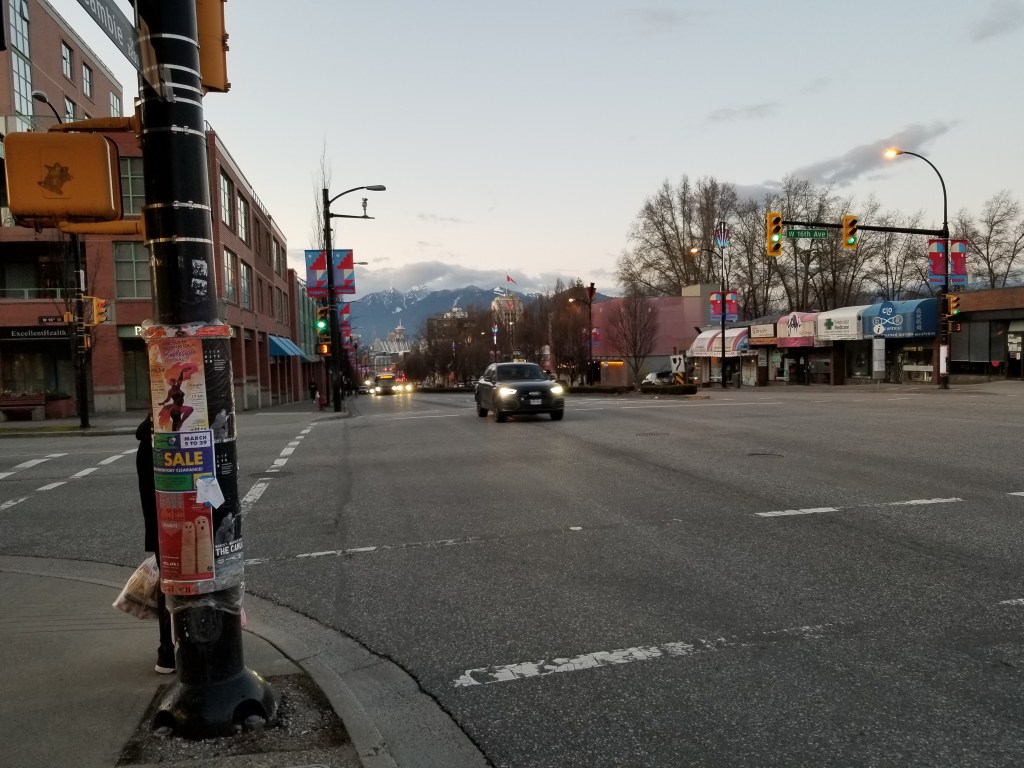
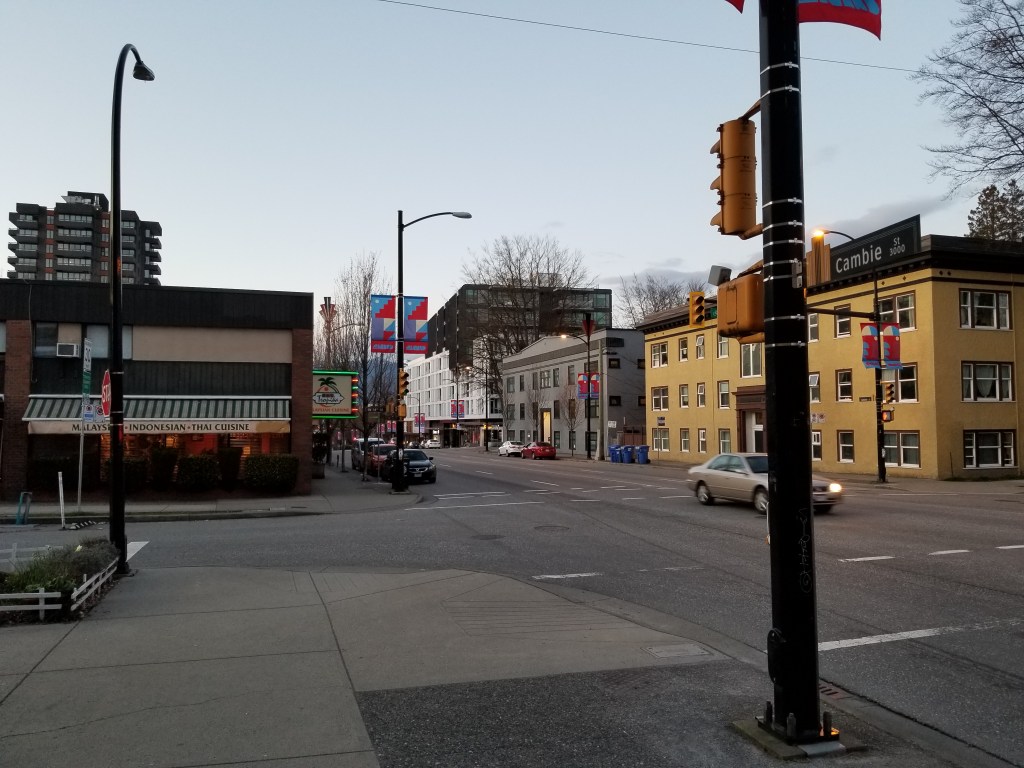
On Georgia Street in Downtown Vancouver. Summer of 2019.

Georgia Street is an east–west street in the cities of Vancouver and Burnaby, British Columbia, Canada. Its section in Downtown Vancouver, designated West Georgia Street, serves as one of the primary streets for the financial and central business districts, and is the major transportation corridor connecting downtown Vancouver with the North Shore (and eventually Whistler) by way of the Lions Gate Bridge. The remainder of the street, known as East Georgia Street between Main Street and Boundary Road and simply Georgia Street within Burnaby, is more residential in character, and is discontinuous at several points.

West of Seymour Street, the thoroughfare is part of Highway 99. The entire section west of Main Street was previously designated part of Highway 1A, and markers for the ‘1A’ designation can still be seen at certain points.

Starting from its western terminus at Chilco Street by the edge of Stanley Park, Georgia Street runs southeast, separating the West End from the Coal Harbour neighbourhood. It then runs through the Financial District; landmarks and major skyscrapers along the way include Living Shangri-La (the city’s tallest building), Trump International Hotel and Tower, Royal Centre, 666 Burrard tower, Hotel Vancouver and upscale shops, the HSBC Canada Building, the Vancouver Art Gallery, Georgia Hotel, Four Seasons Hotel, Pacific Centre, the Granville Entertainment District, Scotia Tower, and the Canada Post headquarters. The eastern portion of West Georgia features the Theatre District (including Queen Elizabeth Theatre and the Centre in Vancouver for the Performing Arts), Library Square (the central branch of the Vancouver Public Library), Rogers Arena, and BC Place. West Georgia’s centre lane between Pender Street and Stanley Park is used as a counterflow lane.

East of Cambie Street, Georgia Street becomes a one-way street for eastbound traffic, and connects to the Georgia Viaduct for eastbound travellers only; westbound traffic is handled by Dunsmuir Street and the Dunsmuir Viaduct, located one block to the north.

East Georgia Street begins at the intersection with Main Street in Vancouver’s Chinatown, then runs eastwards through Strathcona, Grandview–Woodland and Hastings–Sunrise to Boundary Road. East of the municipal boundary, Georgia Street continues eastwards through Burnaby until its terminus at Grove Avenue in the Lochdale neighbourhood. This portion of Georgia Street is interrupted at several locations, such as Templeton Secondary School, Highway 1 and Kensington Park.

Georgia Street was named in 1886 after the Strait of Georgia, and ran between Chilco and Beatty Streets. After the first Georgia Viaduct opened in 1915, the street’s eastern end was connected to Harris Street, and Harris Street was subsequently renamed East Georgia Street.

The second Georgia Viaduct, opened in 1972, connects to Prior Street at its eastern end instead. As a result, East Georgia Street has been disconnected from West Georgia ever since.

On June 15, 2011 Georgia Street became the focal point of the 2011 Vancouver Stanley Cup riot.

Final Fantasy Origins – Review

https://badrpgreviews.wordpress.com/2015/03/08/final-fantasy-origins/

Final Fantasy Origins is a compilation of the first two games in the highly popular and influential RPG series released by Square in 2002 in Japan, and 2003 in the West. Not only were people drawn to the fact that both FF1 and FF2 had the graphics completely overhauled, it was also the first time that FF2 was seen outside of Japan. While it has been 10 years since this release and both games have been ported and further enhanced multiple times, what still draws people to this compilation is that these are the versions closest to the originals in terms of gameplay. They are also the only version you can play on your TV. What about the PSP enhanced ports you can connect to your TV? The games also feature a retranslated script, and also allows creatures and spells to be fully spelled out, as the text limit is much larger. Also mythological based items and monsters were correctly named as well.

Since this contains two games, both of them will be reviewed separately.

Final Fantasy

Originally released in 1987 in Japan and in 1990 in the US, it’s one of the earliest console RPG’s, and also one of the most influential in the beginnings of console RPG’s.

You play as the Heroes of Light, a group of 4 warriors, whose name and class you pick yourself, arrives at Castle Cornelia and the king tests your worth as the legendary heroes by rescuing Princess Sara who has just been kidnapped by the evil knight Garland. After saving her, the king repairs the bridge to allow your heroes access to the rest of the continent, and later the rest of the world.

Each warrior carries a darkened crystal, and your goal is to defeat the 4 evil fiends that hinder the power of the crystals, and banish darkness from the world.

While pretty generic and very thin compared to today’s standards, this was considered an epic in storytelling for video games in 1987. So while not as heavily story driven as later games, the adventuring aspects of the game was what gives it the appeal. So while the game won’t impress you much with its outdated nature, it’s fun to experience something that was considered revolutionary for its time.

A very textbook example of a traditional console RPG (well it did help write it) there isn’t really anything to explain that nobody already knows about. Though this does feature updates from the original game. One of the biggest updates that we take for granted today is auto-retargeting. In the original, when one character kills a monster and someone was already targeting it, your character will miss. So with auto-retarget, when the monster is killed before your turn, it will automatically attack different monster.

Also the mechanics were fixed so some of the spells actually work, and weapons and armor with special effects also actually work. They also added in a standard inventory menu instead of having each character hold the items. There’s even two difficulty modes: easy and normal. normal mode is the gameplay of the original, and easy mode gives you more experience, increased stats after level up, and lower prices at the stores. So if you’re looking for a challenge, then normal is for you, but easy is recommended if you want to spend less time grinding, and have a less headache.

One of the biggest downsides to this game is the random encounter rate, which is extremely high, regardless of which difficulty level you chose. On average, it takes about 3-5 steps (usually less) to get attacked, and it gets really irritating after awhile. This slows down trekking through every dungeon very heavily, and at times discouraging to find all the treasure in them when you’re getting attacked every 3 seconds. It feels really silly when you’re in a medium sized room with a bunch of treasure chests and you get attacked about 5 times just to open up 5 treasure chests in the same room. Dashing does not affect the random encounter rate, so if you’re using the dash option, then attacks will happen much more frequently as those 3-5 steps now take less time.

Another silly feature is how the spells don’t have much consistency. The spells give you a number range, and the spells will randomly work within that range, and they do not get stronger when you level up. So Ice 2 says “40-160 damange”, so in your first turn, it will inflict 150 damage, but it’s highly possible that in your next turn, it will cast 45 damage. This gets irritating in battle when you’re attacking a group of enemies and multi-target spells do various damage where one monster gets max damage, and the one next to it gets minimum damage. It can also get aggravating in boss battles as well, especially when you’re casting a level 3 spell and it did less damage than the level 2 spell.

Even though Origins was a very late PS1 game, and released after the PS2 had already been out, they intentionally made the game’s graphics look similar to the SNES. Probably to keep it similar in visuals to the SNES remakes of 4-6. So while not visually as impressive as FF8 or FF9, they’re still not an eyesore, and do look incredible compared to its NES counterpart. Dungeons and towns are much more detailed, and even the character and monster sprites look nicer. Also even the fiends look more terrifying as the NES versions looked kind of derpy.

The music has some very classic tunes, as it’s where the recognizable Final Fantasy Prelude and the victory theme got their starts.

Final Fantasy is a classic game for anyone who is a fan of retro RPG’s, especially with one of the earliest in the genre. Though definitely not groundbreaking for today’s standards, it’s a nice game to play for those who are either interested in playing a piece of history, or are just big Final Fantasy fans and want to play every game. Though while its random encounter rate is unnecessarily high, it’s still a nice experience.

Final Fantasy II

Originally released in 1988, Final Fantasy II features a handful of differences compared to the previous game, and are also the first appearances of Cid and Chocobos, with both appearing in every Final Fantasy game onward.

You play as four youths: Firion, Maria, Guy and Leon, whose town has just been attacked by the empire of Palamecia and the game begins with the four of you being attacked. Three out of the four escape and join a resistance group, and you then embark on a quest to receive new equipment and rescue other members of the resistance to stand up to the empire.

While definitely a step up compared to the previous game, it’s still a bit archaic for modern standards. It does seem more fleshed out than the previous games, and even some of the characters have more prominent roles in the game, unlike in the previous game where you meet them once and that is the end of the story.

It features many standard RPG gameplay and mechanics, but the unique feature of this game is that it ditches the experience points system. So to increase any kind of stat or skill, one must repeatedly use it to more or less “level” up. So if you want stronger magic, keep casting that spell over and over, and to increase your health and defense, let your character take a lot of damage. At times this can be a clusterfuck, and at times can be more time consuming than with the traditional leveling up system. It’s also ridiculously easy to abuse, as you can easily increase your character’s HP by making your own characters attack each other. While your characters can equip any weapon in the game, you have to repeatedly use certain weapons until they can actually inflict damage with it. Your characters do come with default weapons, so sometimes it’s easier to just stick to those.

The random encounter rate is a bit high, but definitely a step up from FF1, and the game does feature a more balanced battle system.

Another unique feature of this game is the “learn” system. Throughout the course of the game, you will learn a secret phrase or password, and using this will progress the game, as using the phrase will allow access to things like an airship, or someone will give you a special item.

Not much else to say that hasn’t been said with FF1 as it features many of the same updates.

Like the previous game, it features a rearranged soundtrack, though the soundtrack isn’t considered a classic like the original, largely due to the original game not being released, but does feature some solid tracks.

While personally my least favorite in the series, and I don’t really like this game that much, that’s not to say it’s a bad game. Like the original game, this is definitely a game for retro RPG fans, and someone who wants to play all the FF games. The appeal of this version is that fans get to play the first release of the game to the West, and a version that one can enjoy on their TV as opposed to a handheld.

Brutal photos show the grim life of Kiev’s children left ‘abandoned’

https://www.thesun.co.uk/living/2878522/prostitution-drugs-and-life-on-the-streets-brutal-black-and-white-photos-show-the-grim-life-of-kievs-children-left-abandoned-after-communism/

As Ukraine leaves its communist past behind, around 800,000 children have been abandoned and left without a home.

FORCED into prostitution and struggling to survive on the street, these brutal pictures show the homeless children of Kiev who have been left abandoned after communism.

As Ukraine transitions from its communist past to a free market economy thousands of children have been left without a home and have turned to drugs and sniffing glue as a way of stopping them from feeling hungry.

A staggering 10 per cent of the country’s population are abandoned youngsters and often face abuse at the hands of the mafia and even each other.

Ukraine was formerly part of the Soviet Union and faced communist rule from 1922 until independence in 1991.

During this time, the state made provisions for all children, even if facilities were lacking.

However 25 years after the fall of communism with Ukraine moving towards a free market, children are being abandoned as families cannot afford to look after them.

Now it has left thousands of them on the streets and struggling to survive with many of them shunning life in government-run shelters.

They say they would rather be on the streets where they can beg passers-by for cash and also take drugs.

Among those living on the streets is 14-year-old Denise Selivanov who has been living on the streets for four years.

He often inhales glue in his temporary home – a bridge overpass on a busy railway line but he considers himself lucky after escaping with four of his friends after an early morning police raid that netted 18 children that were living there.

Also on the streets is 16-year-old Natasha Dzhuley, who has turned to prostitution and as a result has become pregnant.

She was beaten by her pimps in what her friend Ruslana believes was a warning to other prostitutes to stay in line.

While Sasha, 16, is forced to steal in order to get by and also takes to the streets to beg for money.

The punishment for these children who get caught stealing varies from beatings and arrest, to having the sewers set alight where they become unsuitable for the children to sleep in during the harsh winters.

Meanwhile Ukraine is facing fresh uncertainty as rebels backed by Russian president Vladimir Putin claim Ukrainian troops are preparing a massive assault on areas held by pro-Russian forces.

It comes after last year when as many as 40,000 Russian troops were reported to be massing on the country’s border with Ukraine – prompting fears of a new military invasion.

Killing Strangers: Benghazi and the Blumenthal Trio

https://nomadiceveryman.blogspot.com/2019/09/killing-strangers-benghazi-and.html

On Sunday there was an article published on the Huffington Post which details how two major Canadian banks with a vested interest in the Keystone pipeline had paid Hillary Clinton large sums of money for various speaking engagements.

The story itself wasn’t that ground-breaking considering it’s well documented that Hillary Clinton is bought and paid for and has been since day one and it was actually Ron Brynaert of Gate News who first broke the story of her relationship with these banks back on May 17 of this year.

What caught my eye was the bi-line. The article was written by Russ Grim and … Paul Blumenthal. He has the same last name as Sidney Blumenthal, the long-time Clintonista hatchet-man and “message shaper” who just happens to be in the spotlight right now over his emails to Hillary regarding the color revolution and subsequent neoliberalization of Libya and that little messed-up psyop known simply as “Benghazi”.

What are the odds of that? Upon further investigation it turns out the Blumenthal rabbit hole on this one runs deep. Real deep. And the staggering implications are spreading across public domain.

The story of Benghazi and the Blumenthal trio is out there and it can’t be recalled. All you have to do is pay attention.

All My Sons

The first step in understanding what is happening with this story is to figure out who Paul Blumenthal really is which is not an easy task. To that end, I sent him a Twitter message asking if he was Max’s brother and Sidney’s son. At the time of publishing this article, he has yet to reply.

Paul Blumenthal has a Tumblr page in which he states he writes for the Huffington Post and DJed at Wonderland Ballroom and the Looking Glass Lounge. Both are in Washington D.C. where Sidney has made his primary residence for quite sometime.

Sidney Blumenthal’s Wiki page mentions the fact that he has two children and names one of them as Max Blumenthal, which we already know. It doesn’t mention the name or the sex of the other. Any other references to his biography tend to omit specifics on his kids with the exception of Max since his identity is already well known. Considering his close personal ties to the Clinton machine and his insider status in D.C., that’s completely understandable.

Max Blumenthal’s Wiki page only mentions Sidney and the fact that he has “one brother” and that’s it.

When you look at photos of Max and Paul side by side there is a slight resemblance. And by “slight” I mean to say they are nearly identical.

In a brief bio from Governing.com, Paul Blumenthal mentions that he “learned everything he needed to know from growing up in Washington D.C.”

Paul got his start blogging with the Soros sponsored “Sunlight Foundation” which he worked with for 5 years until leaving in 2011 to work for the Huffington Post.

So I don’t think there is any question: Paul Blumenthal is Max Blumenthal’s brother and the son of Sidney Blumenthal.

So why is that important?

A View From the Bridge

On Sept. 11, 2012, something that appeared to be an attack on a secret CIA compound took place in Benghazi, Libya which supposedly claimed the lives of U.S. Ambassador J. Christopher Stevens and Sean Smith. Two CIA contractors, Tyrone S. Woods and Glen Doherty were reportedly killed hours later in a follow-up attack on another secret CIA compound less than a mile away.

“Operations conducted by, with, or through irregular forces in support of a resistance movement, an insurgency, or conventional military operations.” FM 3-05.201, (S/NF) Special Forces Unconventional Warfare (U) 28 September 2007

The CIA and elite counter-terrorist operators from America’s Delta Force had been in Benghazi since the start of the color revolution back in February of 2011. As a standard unconventional warfare operation, indigenous personnel were recruited, armed and trained to carry out acts of sabotage and terrorism in the country in order to destabilize Libya and make it ready for regime change which is what happened officially on the day their beloved leader, Colonel Muammar Gaddafi, was murdered in cold blood by a group of assets working on behalf of Hillary Clinton’s State Department.

Hillary’s giggling acceptance of credit for that illegal extrajudicial homicide is an extraordinarily embarrassing moment in the history of this nation which has produced many others in the past and since.

An iconic image of the “battle for Benghazi” (as the press quickly named it) shows a typical “bad guy” doing a typical pose in front of a fiery scene. There is the one hand raised in mocking victory and the other carrying the cliche AK-47. The image itself is a modern-day standard of propaganda comparable to others of the same style and purpose.

The images posted above are of staged scenes. They are propaganda designed to illicit a response in the viewer. Specifically, in the American viewer. And that response is designed to be disgust mixed with enough rage and fear to allow for a temporary suspension of disbelief in the viewer just long enough for them to openly support military action in a country far far away. This is how those who craft unconventional warfare create legitimacy.

4-16. Significant moral and legal considerations often exist in a UW effort. Legitimacy is the most crucial factor in developing and maintaining international and internal support. Without this support, the United States cannot sustain assistance to an irregular force. Without recognized legitimacy and credibility, military operations do not receive the support of the indigenous population, the U.S. population, or the international community.” Army Special Operations Forces handbook on Unconventional Warfare – 2008

It’s marketing. Using an emotional context to sell a product. The product in this case is war, occupation, suffering and death.

We have never been told what really happened in Benghazi on Sept. 11, 2012. From the start the White House and the State Department concocted lies, one after the other, to explain and justify what happened. Our understanding of this operation has always been that of an uninformed consumer. And that is as it was intended.

Our view has always been obstructed until recently.

No Villain

Slowly over time, the pieces of the Benghazi puzzle, the “Innocence of the Muslims psyop” as I call it, began to fall into place.

In Aug. of 2013, we came to find out there were dozens of CIA assets and agents on the compound the night of the attack and they were doing everything they could to keep that information a secret. They didn’t want anyone to know what they were doing there.

Sources now tell CNN dozens of people working for the CIA were on the ground that night, and that the agency is going to great lengths to make sure whatever it was doing, remains a secret. CNN has learned the CIA is involved in what one source calls an unprecedented attempt to keep the spy agency’s Benghazi secrets from ever leaking out. CNN

In May of 2013, I myself revealed that back in May of 2012, a few short months prior to the “battle for Benghazi”, 45 major US corporations got together to map out their 3.5 billion dollar investment plan for Africa. What they needed was stability so they also needed a pretext to send more troops and weapons to AFRICOM.

May, 2012 – “The New Alliance was announced in conjunction with the G8 meeting last Friday. Under the scheme, some 45 corporations, including Monsanto, Syngenta, Yara International, Cargill, DuPont, and PepsiCo, have pledged a total of $3.5 billion in investment in Africa. The full list of corporations and commitments has just been released, and one of the most notable is Yara International’s promise to build a $2 billion fertilizer plant in Africa.” How the US Sold Africa to Multinationals Like Monsanto, Cargill, DuPont, PepsiCo and Others

I was not alone in my assessment of the importance of the Benghazi psyop.

“This major crisis in all the countries will be a justification for more boots on the ground the same way they’re ready to go into Libya now…It becomes a pretext to kill more Muslims, to steal more resources,” member of Dignity, Human Rights and Peace Randy Short, Sept. 15th 2012

On Sept. 21, 2012, I wrote about a major motive in the Benghazi psyop, the privatization of Libya’s universal healthcare system.

Keep that in mind as we move forward.

The State Department’s story began falling apart immediately as their spokesman continued to push it for lack of a better narrative.

Days afterward, the White House and State Department were in panic mode and demanded reporters stop asking them questions about the biggest story since 9/11 until they could fix the message.

“All aspects of the attack, including what led up to it, its causes, the identity of the perpetrators, and the circumstances surrounding the death of Amb. Chris Stevens and the other three Americans,are off limits for reporters.” Foreign Policy mag

The “spontaneous reaction to the film “Innocence of the Muslims” story, the narrative that the White House and the State Department were desperate to maintain was contradicted by all the facts on the ground. Even our installed “president” of the new neoliberal Libya wasn’t buying it:

“The way these perpetrators acted and moved — I think we, and they’re choosing the specific date for this so-called demonstration, I think we have no, this leaves us with no doubt that this was pre-planned, determined,”

It was planned, definitely, it was planned by foreigners, by people who entered the country a few months ago, and they were planning this criminal act since their arrival,” Libyan President Mohamed Yousef El-Magariaf

There was no spontaneous protest against the film. Our assets, CIA assets, Ansar al-Shariah, who were employed by the city of Benghazi to provide security (and therefore employed by the State Department and CIA by extension) sealed off the street hours before the “attack” and another client thug group, the February 17th Martyrs Brigade, who were employed by the CIA to provide security for the compound itself, packed up their things and left the scene hours before as well, leaving the gate to the compound unlocked for easier access.

“It began around nightfall on Sept. 11 with around 150 bearded gunmen, some wearing the Afghan-style tunics favored by Islamic militants, sealing off the streets leading to the U.S. Consulate in Benghazi. They set up roadblocks with pick-up trucks mounted with heavy machine guns, according to witnesses.

The trucks bore the logo of Ansar al-Shariah, a powerful local group of Islamist militants who worked with the municipal government to manage security in Benghazi, the main city in eastern Libya and birthplace of the uprising last year that ousted Moammar Gadhafi after a 42-year dictatorship.

There was no sign of a spontaneous protest against an American-made movie denigrating Islam’s Prophet Muhammad. But a lawyer passing by the scene said he saw the militants gathering around 20 youths from nearby to chant against the film. Within an hour or so, the assault began, guns blazing as the militants blasted into the compound.” Washington Post

Considering the fact that these “terrorists” were CIA and State Department assets assigned to protect our puppet government in Benghazi, it’s easy to understand the next revelation that came out not long after the “attack” and that was that U.S. Special Forces, working with AFRICOM at the time, were essentially ordered to stand down in spite of the fact that we had a Predator drone flying overhead in Benghazi that night recording everything that happened. They therefore knew of the attack in real time and even witnessed the group blocking off the streets and the other group packing up and leaving well in advance of the “attack”

“Mr. Hicks testified this morning that the stand down order for the rescue team in Tripoli came from either AFRICOM or SOCAFRICA. General Ham. leader of AFRICOM, may have been in Washington DC at the time.”

“AFRICOM leader General Carter Ham was never given the order to secure the consulate in Benghazi. This is what the general told Rep. Jason Chaffetz after the 9-11 Benghazi terror attack. That means only Barack Obama or Defense Secretary Panetta, the two men above the AFRICOM commander, never ordered an operation to secure the consulate.” Gateway Pundit

“The United States had an unmanned Predator drone over its consulate in Benghazi during the attack that slaughtered four Americans — which should have led to a quicker military response, it was revealed yesterday.

“They stood, and they watched, and our people died,” former CIA commander Gary Berntsen told CBS News.” New York Post

That last line is the most telling. And the most damning.

Why wouldn’t they want the terrorists, the enemy stopped? Because they weren’t the enemy. There were no villains in Benghazi on the night of Sept. 11, 2012.

The Reason Why

The pretext for the “attack”, the motive, is important. It has to be believable that a spontaneous protest against a silly film turned ugly unexpectedly and that is why four people died and Obama was ultimately forced to put boots on the ground in Libya and other African nations in order to quell and uprising against our puppet regimes.

Without that pretext, people will start to wonder about the event itself and thus their precious “legitimacy” is lost.

Enter “Sam Bacile” and “The Innocence of the Muslims”

On Sept. 12, 2012, Max Blumenthal wrote an article in which he claimed the motive for the attack against the compound in Benghazi was Muslim outrage against a short film called “Innocence of the Muslims” crafted by a self-proclaimed Jew named Sam Bacile.

It’s interesting to note that earlier this month it was revealed that Hillary Clinton forwarded a link to this article on the afternoon of Sept. 12 to a colleague less than two hours after Max posted it. It is not known how she came to find this article or who sent to her in the first place. That part of the story has been redacted.

Max quickly went around the TV circuit doing interviews telling folks about “Sam Bacile” and the video which supposedly sparked the outrage.

Max quickly became a front-man for the narrative. A false narrative.

Max never revealed his source for his conclusions in his article titled “Meet The Right-Wing Extremist Behind Anti-Muslim Film That Sparked Deadly Riots” and there’s very good reason for that: the source most likely was his father, Sidney Blumenthal, who was on the payroll of the Clinton Global Initiative as a “message shaper” at the time and working in Libya for the State Department, communicating with Hillary Clinton and teamed up with with a former CIA psyops specialist and a retired General from the Pentagon who spent 2002 going to any news station that would have him lying about weapons of mass destruction and Yellow Cake from Niger.

Blumenthal’s team’s mission was simple: help make Libya safe for various U.S. businesses and specifically one which looked to profit from the privatization of the healthcare system.

But more on that in a minute.

Let’s talk about “Sam Bacile” and “The Innocence of the Muslims” first.

While Max was running around helping to sell the official story during the initial days of the unofficial investigations into what happened in Benghazi that night, folks like myself weren’t buying it.

It didn’t take long for people to figure out “Sam Bacile” was really a long-time FBI informant named Nakoula Basseley Nakoula who made the film much earlier under the name “The Innocence of Bin Laden” as a honeypot trap for the feds in California in an effort to lure dimwitted patsies to it’s viewing in L.A.

The original title was “The Innocence of Bin Laden,” which the filmmaker expected would attract an audience of radical Islamists who would become disillusioned about their faith after watching, Klein said.

“Sam had a crew of people passing out fliers around the dangerous mosques in California, trying to get these folks who love Osama Bin Laden who would come to cheer Osama Bin Laden,” Klein said. “But the movie was going to expose all the stuff that Muhammad really did, like murder and pedophilia and stuff like that.” San Fransisco Chronical

“With an Arabic interpreter standing by, Nakoula told Snyder about his decision to inform. He explained, “I decided to cooperate with the government to retrieve some of these mistakes or damage happened. I want to cooperate with the government that they can catch with this other criminals who is their involvement.”

“A variety of documents filed in the U.S. District Court case were sealed at the request of prosecutors and Nakoula’s lawyer. The sealed records–from the transcript of Nakoula’s change-of-plea hearing to sentencing memoranda–appear to indicate that his plea agreement with the government included some form of cooperation.” The Smoking Gun

In late 2010, Nakoula was released from prison due in part to his promise to cooperate with federal authorities.

In early 2011, he started casting for a film he called Desert Warrior at the time. In Aug. of 2011 they shot the film.

Flyers started popping up in various Muslim stores and mosques in the L.A. area advertising a film called “The Innocence of Bn Laden” in early June of 2012.

The screening, only one day, was held on June 23rd at the Vine Theater in Hollywood. No one showed up. The honeypot trap failed to produce any “radical Muslims” for the Justice Department who we must assume put Mr. Nakoula up to this in the first place.

Another viewing was scheduled for June 30th at the same location, another bite at the apple I suppose, but a Hollywood blogger rose concerns about the film on the 29th at city council meeting and the second showing was cancelled.

Later the film would be slightly reworked and uploaded to Youtube by “Sam Bacile” on July 1st, 2012. It had been voluntarily blocked by Youtube and Google in both Egypt and Libya long before the “attack” of Sept. 11th.

The “Innocence of bin Laden” honeypot crafted by the feds and created by one of their informants had failed to produce any results. But it was about to serve a secondary purpose as the reborn ‘Innocence of the Muslims” psyop.

After all, unconventional warfare needs legitimacy so the attack on the Benghazi compound needed a motive.

They just didn’t want anyone to look too closely at it.

Mr Peter’s Connections

Back in March of this year, Hillary Clinton found herself in hot water once again. It was discovered that she was supposedly unable to provide all the emails from her time as Secretary of State due to the fact that she illegally used a private email service and a personal system of servers so that she could eventually hide much of her communications during her run as Sec. of State from the public record.

Yet again, another crime on the part of the Clinton Royal Family goes unpunished.

The story rekindled a bit of interest in an earlier one in which the hacker Guccifer supposedly stole a cache of emails from long-time Clinton hatchet-man Sidney Blumenthal and published them at Gawker.

The dispatches from Blumenthal to Clinton’s private email address were posted online after Blumenthal’s account was hacked in 2013 by Romanian hacker Marcel-Lehel Lazar, who went by the name Guccifer. Lazar also broke into accounts belonging to George W. Bush’s sister, Colin Powell, and others. He’s now serving a seven-year sentence in his home country and was charged in a U.S. indictment last year.

The contents of the memos, which have recently become the subject of speculation in the right-wing media, raise new questions about how Clinton used her private email account and whether she tapped into an undisclosed back channel for information on Libya’s crisis and other foreign policy matters. Gawker, March 2015

Since then a couple of reporters from the New York Times started taking a closer look at those emails from Sidney’s private account and the story they tell is indeed a fascinating one.

The story derived from the vast collection of emails and carefully explained by the New York Times is one of how Sidney Blumenthal was being paid $10,000 a month by the Clinton Global Initiative for “message guidance” while at the same time serving Hillary in the State Department as an adviser in Libya.

It also details Sidney’s partners down there at the time. A former CIA psyops specialist of over 25 years (Tyler Drumheller) and a retired general from the Pentagon who spent 2002 helping promote every lie the Bush administration could come up with to justify the Iraq invasion of 2003 (Mr. Grange).

Mr. White declined to answer follow-up questions about what role Mr. Blumenthal was playing in the business venture. But Mr. Grange described Mr. Blumenthal as an adviser to Mr. White’s company, along with two other associates: Tyler Drumheller, a colorful former Central Intelligence Agency official, and Cody Shearer, a longtime Clinton friend.

“I just know that he was working with the team to work on business development,” Mr. Grange said of Mr. Blumenthal.

In the spring of 2011, Mr. Blumenthal, Mr. Drumheller and Mr. Shearer were helping plan what was to be Mr. Grange’s first trip to Libya, according to emails stolen by a Romanian hacker and published by Gawker and ProPublica in March. Mr. Blumenthal said he had been advised not to comment on the correspondence because the theft remained under investigation by the F.B.I. New York Times

The story about Mr. Blumenthal’s business ventures in Libya on behalf of Clinton’s business elite friends has been slowly making it’s way around the “interwebs”. It was featured on the WSWS on May 21 and 5 days ago on the 28th of May the headline at Politico was about how the CGI was paying Sidney $10,000 a month while he was serving as Hillary’s eyes and ears on the ground in Libya with his crew of psyops creators.

On May 27th, the Daily Caller exposed a couple of communications between Sidney and Hillary directly related to the Benghazi “attack” and how he was helping “guide the message” at the very beginning:

In the hours after the deadly terrorist attack on Clinton’s consulate, Sidney Blumenthal rushed political guidance to the secretary.

“During the afternoon of September 11, 2012 new interim President of Libya Mohammed Yussef el Magariaf spoke in private with senior advisors, including the members of the Libyan Muslim Brotherhood, to discuss the attacks by demonstrators on U.S. missions in Tripoli and Benghazi,” Blumenthal reported to Clinton in a memo dated Sept. 12 at 12:50 a.m

“During this session, a senior security officer told Magariaf that the attacks on that day were inspired by what many devout Libyans viewed as a sacrilegious internet video on the prophet Mohammed originating in America. The Libyan attacks were also inspired by and linked to an attack on the U.S. mission the same day,” Blumenthal said. Daily Caller, May 27, 2015

Keep in mind, Blumenthal’s statement at that time is in direct contradiction of the quote by the president of the country which I posted above which clearly states he did not think there was any protest at all and said the attack had nothing to do with any video.

Also keep in mind that Hillary then started sending links to Sidney Blumenthal’s son’s article which falsely described the motive for the attack to be anger at the video “The Innocence of the Muslims”

Where did Hillary get the link from originally? That part is redacted.

Max Blumenthal spent that day feverishly promoting the obscure film’s role in the Benghazi violence. Daily Caller, May 27, 2015

Needless too say, Sidney Blumenthal was suddenly getting a lot of attention as the guy at the center of a rather conspicuous psyop just a couple days before one of his sons, Paul, wrote that distraction piece about Hillary Clinton and the Keystone pipeline.

Perhaps the best accounting of the Blumenthal trio of psyops professionals and their relationship to Hillary Clinton during the pacification of Libya leading up to the Benghazi psyop comes from Propublica back in March of this year. But ultimately, they all seem to miss the point. They can achieve that desired goal by omitting all the other details surrounding the Benghazi psyop that I carefully and painstakingly laid out above.

“Contacted by ProPublica and Gawker, Drumheller’s attorney and business partner Danny Murray confirmed that Drumheller “worked” with Blumenthal and was aware of the hacked emails, but declined to comment further.

Shearer said only that “the FBI is involved and told me not to talk. There is a massive investigation of the hack and all the resulting information.” The FBI declined to comment.

Blumenthal, Grange, and Kikhia all did not respond to repeated attempts to reach them. Nick Merrill, a spokesman for Clinton had no comment on Blumenthal’s activities with Drumheller.

Whatever Blumenthal, Shearer, Drumheller, and Grange were up to in 2011, 2012, and 2013 on Clinton’s behalf, it appears that she could have used the help” Propublica

Death of a Salesman

It is widely understood now that Amb. Stevens played a crucial role in the funneling of weapons from Libya to our other destabilization campaign taking place around the same time in Syria. It’s also been stated that the secret CIA compound where this “attack” took place was in fact the staging area for those weapons.

In March 2011 Stevens became the official U.S. liaison to the al-Qaeda-linked Libyan opposition, working directly with Abdelhakim Belhadj of the Libyan Islamic Fighting Group—a group that has now disbanded, with some fighters reportedly participating in the attack that took Stevens’ life.

In November 2011 The Telegraph reported that Belhadj, acting as head of the Tripoli Military Council, “met with Free Syrian Army [FSA] leaders in Istanbul and on the border with Turkey” in an effort by the new Libyan government to provide money and weapons to the growing insurgency in Syria.

Last month The Times of London reported that a Libyan ship “carrying the largest consignment of weapons for Syria … has docked in Turkey.” The shipment reportedly weighed 400 tons and included SA-7 surface-to-air anti-craft missiles and rocket-propelled grenades.

Reuters reports that Syrian rebels have been using those heavy weapons to shoot down Syrian helicopters and fighter jets.

The ship’s captain was “a Libyan from Benghazi and the head of an organization called the Libyan National Council for Relief and Support,” which was presumably established by the new government. That means that Ambassador Stevens had only one person—Belhadj—between himself and the Benghazi man who brought heavy weapons to Syria. Business Insider

What better way to scrub an illegal weapons transfer program than to have it’s primary location burned along with all the records and it’s main manager “killed” in the process?

The Creation of the World and Other Business

So what was Sidney Blumenthal and his pack of raging psyops crafters doing in Libya in the first place?

Is it a coincidence that one of his partners in crime down there was a man who ran clandestine operations for the CIA for 5 years before he retired and the “attack” took place on a secret CIA compound that was literally packed full of CIA assets at the time?

Where did Sidney really come up with the story about the “Innocence of the Muslims” video being the motive behind the attack if it didn’t actually come from the president of the newly neoliberalized Libya and who gave that info to his son Max so he could run with the story all over the alternative press in the early early stages of the coverage of the ‘attack’?

Who told Clinton about Max’s article?

And why is it that just as Max and Sidney are being pilloried in the public domain, Paul Blumenthal decides to basically copy someone else’s work on Hillary’s connection to Canadian banks and publish it on yet another so-called “alternative” site?

What you are seeing is the craft of “message guidance” as it is wielded by a professional by the name of Sidney Blumenthal.

Sidney uses every asset to him in order to control the narrative. In this case, on several occasions, it seems he is more than willing to employ his own children in his various campaigns. He used Max when he wanted to push the false narrative of the video motive and it would seem he is using Paul now in an attempt to shift the focus off himself and the entire Benghazi psyop.

People like Sidney believe they can control the way the public perceives the world around them and when they fail they usually face catastrophic consequences.

How much of a leap is it to wonder about this little Blumenthal trio in Libya and how long before more start to wonder if the story continued to grow?

Is it possible that:

Grange used his Pentagon connections and arranged a stand-down of AFRICOM

Drumheller set up the CIA assets who posed as “protesters” and attacked the abandoned compound

and Blumenthal provided the “message guidance” needed to explain it all in a way that served their interests

Sidney, Max and Paul. The Blumenthal trio. Shaping the world around us as much as they can. But sometimes the best laid plans of mice and men run off course a bit. And that’s why we’re here. To serve as The Crucible in which their forged falsifications are melted away revealing the core components of their Big Lies.

Harun al-Rashid – New World Encyclopedia

https://www.newworldencyclopedia.org/entry/Harun_al-Rashid

Hārūn ar-Rashīd (Arabic هارون الرشيد also spelled Harun ar-Rashid, Haroun al-Rashid or Haroon al Rasheed (English: Aaron the Upright or rightly-guided) (c. 763 – 809) was the fifth and most famous Abbasid Caliph. Ruling from 786 C.E. until his death in 809 C.E., his reign and the court over which he held sway are immortalized in, The Book of One Thousand and One Nights. His competent government was greatly aided by his choice of able administrators. Hārūn is regarded as having been a wise and just ruler, an enlightened patron of the arts who ruled over a generally open and tolerant court. This was a period of flourishing scholarship often referred to as the Golden Age of Islamic Civilization. This was also a time when much Greek learning was being copied into Arabic, much of which, lost to Europe, would later reach Europe via Islamic Spain.

Biography

Hārūn was the son of al-Mahdi, the third ‘Abbasid caliph (ruled 775–785), and al-Khayzuran, a former slave girl from Yemen, a woman of strong personality who greatly influenced the affairs of state during the reigns of her husband and sons.

Hārūn was strongly influenced by the will of his mother in the governance of the Islamic empire, until her death in 789. His vizier (chief minister) Yahya the Barmakid, his sons, and other Barmakids were also the main controlling forces in the administration.

The Barmakids were a Persian family that had become very powerful under al-Mahdi. Yahya had aided Hārūn in obtaining the caliphate, and he and his sons enjoyed the caliph’s high favor until 798, when, in a turnaround, he threw them into prison and confiscated their land. The cause assigned to that incident was as follows:

Yahya’s son, Ja’far ibn Yahya, was a great friend of Hārūn’s. The caliph enjoyed having his sisters Abbasa and Jafar join him at times of recreation, but Muslim etiquette did not permit them to interact so informally with one another. In order to facilitate their spending time in one another’s company, Hārūn arranged for a marriage between his friend and his sister, on the understanding that it was not to be a true marriage, but purely nominal. Yet according to some versions of the story, Abbasa entered Ja’far’s bedroom in the darkness, masquerading as one of his slave girls. She secretly gave birth to a child whom she sent off to Mecca. One of her maids, with whom she was quarreling, knew the secret and publicized the scandal. Hārūn heard the story while on a pilgrimage in Mecca and ascertained the tale was probably true.

On his return shortly thereafter, he had Ja’far executed, and his body was dispatched to Baghdad. There it was divided in two and impaled on either side of a bridge. It’s remains were visible for three years, when Harun, happening to pass through Baghdad from the East, gave command for the remains to be taken down and burned. Upon his death, Ja’far’s father and brother were both cast into prison.

The aforementioned story is usually regarded as nothing more than fiction. The reason for the fall of the Barkamids was more likely due to the fact that Barkamids were behaving in a manner Hārūn found disrespectful (such as entering his court unannounced) and making decisions of relevance to the state without consulting him first.

Hārūn became caliph when he was in his early twenties. On the day of accession, his son al-Ma’mun was born, and another, named al-Amin was born shortly thereafter. The latter was the son of Zubaida, a granddaughter of al-Mansur (founder of the city of Baghdad); so he took precedence over his older brother, whose mother was a Persian slave-girl. Hārūn began his reign by appointing very able ministers, who carried on the work of the government so well that they greatly improved the condition of the people.

It was under Hārūn ar-Rashīd that Baghdad flourished into the most splendid city of its period. Many foreign rulers paid tribute to the caliph, and these funds were used for architecture, the arts, and a luxurious life at court.

Hārūn built a palace in Baghdad, far grander and more beautiful than that of any caliph before him. He established his court and residence there and lived in great splendor, attended by hundreds of courtiers and slaves. Later in his life, he moved and set up his court at Ar Raqqah, in the north of Syria. He did this ostensibly to hold what was perceived as a disloyal Syria in check, in spite of his attachment to Baghdad, where he never actually resided again.

Hārūn ar-Rashīd was very anxious that his subjects be treated justly by the officers of the government, and he was determined to hear out any complaints. He is said to have occasionally disguised himself at night and gone through the streets and bazaars, listening to the talk of those whom he met and asking them questions. In this way he learned whether the people were contented and happy.

Hārūn was a great patron of learning, poetry, and music. He was a scholar and poet himself and whenever he heard of learned men in his own kingdom, or in neighboring countries, he is said to ahve invited them to his court and treated them with respect. The name of Hārūn, therefore, became known throughout the world. He had diplomatic relations with China and with Charlemagne. It is said that a correspondence took place between him and Charlemagne and in 802, Harun sent him a present consisting of silks, brass candelabra, perfume, slaves, balsam, ivory chessmen, a colossal tent with many-colored curtains, an elephant named Abul-Abbas, and a water clock that marked the hours by dropping bronze balls into a bowl, as mechanical knights—one for each hour—emerged from little doors which shut behind them. The presents were unprecedented in Western Europe and may have influenced Carolingian art. Charlemagne was awarded permission to send financial aid to the Christians of Palestine. On the one hand, Hārūn demanded that Christians wear distinctive clothes but on the other he employed Christians and Jews in significant positions and is said to have loved his Christian physician, Gabriel Bukhtichlo, as if he were a member of his own family.

In military matters, Hārūn was an excellent soldier and demonstrated this ability at a young age when his father was still caliph. He later commanded an army of 95,000 Arabs and Persians sent by his father to invade the Eastern Roman Empire, which was then ruled by the Empress Irene. After defeating Irene’s famous general, Nicetas, Harun marched his army to Chrysopolis (now Üsküdar in Turkey) on the Asiatic coast, opposite Constantinople. He encamped on the heights in full view of the Roman capital.

The Empress saw that the city would certainly be taken by the Muslims. She therefore sent ambassadors to Harun to arrange terms; but he sternly refused to agree to anything except immediate surrender. It is reported that then one of the ambassadors said, “‘The Empress has heard much of your ability as a general. Though you are her enemy, she admires you as a soldier.’ These flattering words were pleasing to Hārūn. He walked to and fro in front of his tent and then spoke again to the ambassadors. ‘Tell the Empress that I will spare Constantinople if she will pay me seventy thousand pieces of gold as a yearly tribute. If the tribute is regularly paid, Constantinople shall not be harmed by any Muslim force.'” The Empress agreed to these terms. She paid the first year’s tribute; and soon the great Muslim army set out on its homeward march. The tribute of gold that the Empress Irene agreed to pay Hārūn was sent regularly for many years. It was always received at Baghdad with great ceremony. The day on which it arrived was made a holiday. The Roman soldiers who came with it entered the gates in procession. Muslim troops also took part in the parade. When the gold had been delivered at the palace, the Roman soldiers were hospitably entertained, and were escorted to the main gate of the city when they set out on their journey back to Constantinople.

In 802, Nicephorus I usurped the throne of the Eastern Empire. He sent ambassadors with a letter to Harun to tell him that the tribute would no longer be paid. The letter contained these words:

“The weak and faint-hearted Irene submitted to pay you tribute. She ought to have made you pay tribute to her. Return to me all that she paid you; else the matter must be settled by the sword.”

As soon as Hārūn had read these words, the ambassadors threw a bundle of swords at his feet. The caliph smiled, and drawing his own sword, or scimitar, he cut the Roman swords in two with one stroke without injuring the blade or even turning the edge of his weapon. Then he dictated a letter to Nicephorus, in which he said: “Hārūn ar-Rashīd, Commander of the Faithful to Nicephorus, the Roman dog: I have read your letter. You shalt not hear but you will see my reply.”

Hārūn was as good as his word. He set out with a large army intent on punishing the emperor. He laid siege to Heraclea, a city on the shores of the Black Sea, and in a week forced it to surrender. Nicephorus felt forced to agree to pay the tribute.

However, scarcely had the caliph reached his palace in Baghdad when the emperor again refused to pay. Hārūn, consequently, advanced into the Roman province of Phrygia in Asia Minor with an army of 15,000 men. Nicephorus marched against him with 125,000 men. In the battle which followed, the emperor was wounded, and 40,000 of his men were killed. After this defeat, Nicephorus again promised payment of the tribute, but once again failed to keep his promise. Hārūn vowed that he would kill the emperor if he should ever lay hands upon him. But as he was getting ready to march once more into the Roman provinces, a revolt broke out in one of the cities of his own kingdom; and while on his way to suppress it he died from a chronic illness. He is said to be buried in Tus.

Timeline

766: Hārūn is born, the son of Caliph al-Mahdi and the Yemeni slave girl al-Khayzuran.

780: Hārūn is the nominal leader of military expeditions against the Byzantine Empire.

782: Hārūn is nominal leader of a military campaign against the Byzantine Empire reaching as far as the Bosporus. A peace treaty is signed on favourable terms. Harun receives the honorific title ar-Rashīd, named second in succession to the caliphal throne and also appointed governor of Tunisia, Egypt, Syria, Armenia and Azerbaijan.

786: Hārūn’s brother al-Hadi dies under mysterious circumstances—it was rumored that his mother al-Khayzuran was responsible. Hārūn becomes the new caliph and makes Yahya the Barmakid his Grand Vizier—but al-Khayzuran exercised much influence over the politics.

789: Al-Khayzuran dies, leaving more of the effective power in the hands of Hārūn.

791: Hārūn wages war against the Byzantine Empire.

800: Hārūn appoints Ibrahim ibn al-Aghlab governor over Tunisia, making him a semi-autonomous ruler in return for substantial yearly payments.

803: Yahya dies, and even more of effective power comes in the hands of Hārūn.

807: Hārūn’s forces occupy Cyprus.

809: Dies while traveling in the eastern parts of his empire. al-Amin succeeds him as caliph.

Hārūn is widely considered the greatest of the Abbasid caliphs, presiding over the Arab Empire at its political and cultural peak. Consequently, Islamic literature (the work of ibn Kather, for example) has raised him to the level of an ideal figure, a great military and intellectual leader, and even a paragon for future rulers to emulate. His best-known portrayal in the West, in the stories of the Thousand and One Nights, has little basis in historical fact, but does show the mythic stature he has attained over time.

Popular culture and references

Future U.S. President Theodore Roosevelt, when he was a New York Police Department Commissioner, was called in the local newspapers “Haroun-al-Roosevelt” for his habit of lonely all-night rambles on the streets of Manhattan, surreptitiously catching police officers off their posts, sleeping, or otherwise engaged in restaurants or brothels.

The character Jafar, in Walt Disney’s animated motion picture, 1992’s Aladdin, is vaguely based on Hārūn’s vizier’s son.

The comic book The Sandman issue 50 featured a story set in the world of the Arabian Nights, with Hārūn ar-Rashīd as one of the protagonists. The story, entitled “Ramadan,” is included in the collection The Sandman: Fables and Reflections.

The two protagonists of Salman Rushdie’s 1990 novel, Haroun and the Sea of Stories, Haroun and his father Rashid Khalifa were clearly named after the Caliph.

Hārūn ar-Rashīd figures in the third chapter of James Joyce’s Ulysses, in a dream of Stephen Dedalus, one of the protagonists: “Wait. Open hallway. Street of harlots. Remember. Haroun al Raschid. I am almosting it.”

Harun al-Rashid is also celebrated in the 1923 poem by W.B. Yeats, The Gift of Harun al-Rashid, first published as part of The Dial in 1924.

In Quest for Glory II, the sultan who adopts Devon Aidendale as his son, is named Hārūn ar-Rashīd. He is often seen prophesizing on the streets of Shapeir as The Poet Omar.

Henry Wadsworth Longfellow wrote a poem which started “One day Haroun Al-Raschid read/A book wherein the poet said/Where are the kings and where the rest/Of those who once the world possessed?”

Over 20,000 tons of diesel spilled in Russian Arctic river

https://www.wsws.org/en/articles/2020/06/06/arct-j06.html

On May 29 an accident at a power plant near the northern Siberian city of Norilsk led to a massive spill that released 23,000 tons of diesel into the environment, most of which has drifted into the Ambarnaya River. It is one the greatest environmental catastrophes to ever occur in the Arctic, and is being compared to the Exxon Valdez spill of 1989, when about 39,000 tons of fuel flooded into the waters off the coast of Alaska.

The company which owns the plant, Norilsk Nickel, stated that the accident likely occurred because thawing permafrost caused an oil tank to collapse. According to Norilsk, the tank rested on 30-year-old pillars. An area of 350 sq kilometers (135 sq miles) has been contaminated. The Ambarnaya is now crimson red.

Special booms could contain the spill. However, Alexei Knizhnikov from the World Wildlife Fund Russia warned, this “doesn’t mean that toxic elements have not gotten into the water of the lake [Pyasino]. Unfortunately, the most poisonous elements of diesel fuel are aromatic compounds like benzol, toluene, ethyl benzene, xylene, which will massively mix with water. It is impossible to collect them using oil booms.”

Environmental groups have noted that cleaning up the spill is difficult because of its scale and the geography of the river, which is located in a remote and swampy area. According to Oleg Mitvoi, the former deputy head of Russia’s environmental agency Rosprirodnadzor, there has “never been such an accident in the Arctic zone”. The clean-up, he said, could take between five and ten years, and cost up to $1.5 billion.

The criminally slow response by both the company Norilsk Nickel and regional authorities has dramatically amplified the scale of the disaster.

Even though the catastrophe occurred on May 29, regional authorities did not take any action until two days later on May 31, when images of the spill had spread on social media. Authorities claimed that they were not aware of the incident until oil oozed onto a highway, causing a car to catch fire.

Sergey Verkhovets from Greenpeace Russia said that in the case of such a catastrophe two days is “a very long time.” He also stated that the company had been reckless in its exploitation of natural resources under conditions where thawing permafrost—a result of global warming—has dramatically transformed the ecological landscape.

Verkhovets warned that the impact of the oil spill would be felt for “many years to come”, further polluting the already damaged water systems in the region. The indigenous population, which depends on these rivers for its livelihood, will be particularly impacted.

“We are talking about dead fish, polluted plumage of birds and poisoned animals”, he said. Authorities have assured the population that the oil has not polluted the ground water, but whether this is true or not is far from certain. About 175,000 people live in the nearby city of Norilsk.

On June 3, Russian president Vladimir Putin, in a highly-staged televised address, chided the company and declared a federal state of emergency. A federal investigation was initiated and state television made a point of showing the foreman at the power plant being led off to jail in handcuffs. He is being made the main scapegoat of the disaster, and is being charged for violating environmental protection rules. He may face up to five years in prison.

In reality, however, it is the government and Norilsk Nickel that bear primary responsibility.

Norilsk Nickel is one of the largest producers of nickel, platinum and copper in the world, and one of the most influential and valuable in Russia. The multi-billion state-owned company has been at the center of intense struggles between Russian oligarchs since the destruction of the Soviet Union and restoration of capitalism. It is now headed by Vladimir Potanin, who is worth over $25 billion, and is close to President Vladimir Putin. In a statement on Friday, Potanin claimed the company would pay for the clean-up of the disaster.

Environmental protection regulations in Russia are notoriously poor, and systematic violations by companies are routinely overlooked by state authorities. Four years ago, an accident at another plant of Norilsk Nickel in the region resulted in an oil spill that turned another river red and transformed an area twice the size of Rhode Island into a “dead zone.” The company was fined less than $1,000, which made clear signal that it had nothing to fear in case of future disasters.

The catastrophe on the Ambarnaya underlies the dangers bound up with the “new scramble for the Arctic” by the major powers and corporations. Rapidly warming temperatures have made the exploitation of raw material resources in the region much more dangerous from an environmental standpoint, but also more alluring for major corporations.

At the same time, the Arctic, which is of major economic and geostrategic significance to Russia, has become a central arena of the US imperialist drive to encircle Russia. This further heightens the danger of military and environmental catastrophes.

As part of the standoff with the US, Russia launched a floating nuclear power plant in the Arctic Sea late last summer. The ship has been called a “nuclear Titanic” and “floating Chernobyl” by environmental groups that warn of the potentially catastrophic consequences of any accident on board. Just a few months before the launching of the floating nuclear power plant, a fire on a Russian nuclear submarine in the Barents Sea killed 14 high-ranking Russian navy officers. An aide to the commander of Russia’s navy later ominously warned that, “With their lives, they saved the lives of their colleagues, saved the vessel and prevented a planetary catastrophe.”