Baleen whales comprise the Mysticeti, one of two suborders of the mammalian order Cetacea, the other suborder being the Odontoceti, or toothed whales (dolphins, porpoises, and various whales). Baleen whales are characterized by having baleen plates for filtering food from water, rather than having teeth. They also differ from toothed whales in that they have two blowholes rather than one. Baleen whales also are known as whalebone whales or great whales.
Baleen whales are the largest whales, and include the world’s largest animal, the blue whale (Balaenoptera musculus). Filter feeders, they are generally seen as gentle animals, a sighting of which adds to the wonder of nature for humans. Their grace, intelligence, and massive size has led to their being celebrated in art, music, and literature. Yet, they have also been hunted excessively and have greatly declined. For example, blue whales were abundant in nearly all oceans until the beginning of the twentieth century, but over the course of forty years, were hunted nearly to extinction. Pressures continued to harvest whales even when the numbers were severely declined, but the human responsibility to better understand and conserve these animals had led to various protective measures by the late twentieth century.
The suborder Mysticeti contains four families and fourteen or fifteen species. The scientific name derives from the Greek word mystax, which means “mustache.”
Overview
Whales are members of the order Cetacea, which also includes dolphins and porpoises. Whales are the largest mammals, the largest vertebrates, and the largest known animals in the world. Like all mammals, whales breathe air into lungs, are warm-blooded, breast-feed their young, and have hair (although very little). Unlike fish, which breathe air using gills, whales breathe air through blowholes that lead into their lungs.
Cetaceans are divided into two suborders:
The baleen whales (Mysticeti) are characterized by baleen, a sieve-like structure in the upper jaw made of the tough, structural protein keratin. The baleen is used to filter plankton from the water. Baleen whales are also characterized by two blowholes.
The toothed whales (Odontoceti) have teeth and prey on fish, squid, marine mammals, and so forth. This suborder includes dolphins and porpoises as well as whales. An outstanding ability of this group is to sense their surrounding environment through echolocation. Toothed whales have only one blowhole. In addition to numerous species of dolphins and porpoises, this suborder includes the Beluga whale and the sperm whale, which may be the largest toothed animals to ever inhabit Earth.
Living Mysticeti species have teeth only during the embryonal phase. Fossil Mysticeti had teeth before baleen evolved.
Anatomy
Baleen whales are generally larger than toothed whales, and females are larger than males. This group comprises the largest living known animal species, the blue whale.
As in all whales, the body is fusiform, resembling the streamlined form of a fish. The forelimbs, also called flippers, are paddle-shaped. The end of the tail holds the fluke, or tail fins, which provide propulsion by vertical movement. Although whales generally do not possess hind limbs, baleen whales sometimes have rudimentary hind limbs; some even with feet and digits. Most species of whale bear a fin on their backs known as a dorsal fin.
Beneath the skin lies a layer of fat, the blubber. It serves as an energy reservoir and also as insulation. Whales have a four-chambered heart. The neck vertebrae are fused in most whales, which provides stability during swimming but at the expense of flexibility.
Baleen whales have two blowholes, causing a V-shaped blow. The shapes of whales’ spouts when exhaling from the blowholes after a dive, when seen from the right angle, differ between species. Whales have a unique respiratory system that lets them stay underwater for long periods of time without taking in oxygen.
Ecology
In spite of their enormous mass, baleen whales are able to leap completely out of the water. Particularly known for their acrobatics are the humpback whales, but other baleen whales also break through the water surface with their body or beat it loudly with their fins. The reason for these habits is not known for certain.
In contrast to toothed whales, baleen whales are unlikely to echo-locate. Instead, they are able to produce high volume sounds in the infrasonic range. The calls of the largest whales can be heard several hundred kilometers away. Unique are the songs of the humpback whales, consisting of complex sequences that may slowly evolve over years. They are probably used for courting.
From the eleventh to the late twentieth centuries, baleen whales were hunted commercially for their oil and baleen. Their oil can be made into margarine and cooking oils. Baleen was used to stiffen corsets, as parasol ribs, and to crease paper.
Evolutionary history
Early baleen whales first appeared as far back as the Early Oligocene, or perhaps the latest Eocene (39-29 million years ago). Early baleen whales did not have (or had very little) baleen, and still had teeth obtained from their ancestors. Among them was Janjucetus, a baleen whale with sharp teeth that hunted fish, squid, large prey such as sharks, and probably dolphin-like cetaceans. This hints that early baleen whales were predatory and eventually evolved into the gentler, toothless whales known today. The first toothless baleen whales probably appeared in the Early or Middle Miocene, from a toothed ancestor that adapted from eating small fish or other creatures to, eventually, feed by filtering.
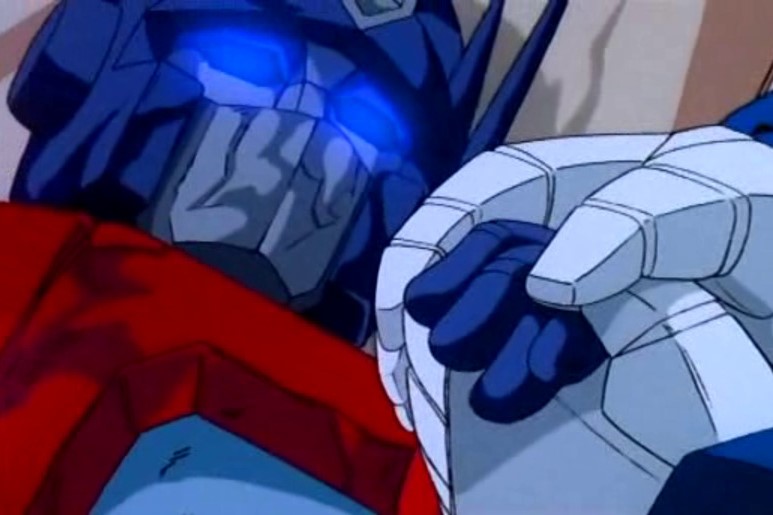
The anecdote that I think most faultlessly sums up everything there is to say about The Transformers: The Movie, a 1986 feature cartoon adapted from a television series based upon a toy line, is that the Hasbro toy company executives who paid for it and were very excited to see it usher in a new product line were completely unprepared for the outrageous backlash from upset fans and their parents when the series’ main character, a space robot who turns into a semi truck, was killed at the break between the first and second acts (the parents also had a separate backlash, when a film that could not possibly be more narrowly aimed at the 10-and-under set, in addition to killing off a beloved character, had another character yell “oh, shit!”). This tells us the two most important things: first, obviously, that the Hasbro people had absolutely no interest in this film as anything whatsover other than product. It has been noted many times that American children’s television animation in the 1980s, much more that at any other period in history, was dominated by advertisements: many of the best-loved cartoon series were thinly-veiled toy commercials and sometimes “thinly-veiled” would be paying them a compliment. The Transformers, which aired 98 episodes between 1984 and 1987 (the film was released, and took place, between the second and third seasons), is not the most egregious of these, though it may be the most recognisable, and certainly has had the longest cultural footprint.
None of which should distract from the point: it is a toy commercial, and anything else it might do was a second-order priority in comparison. For Hasbro and their Japanese partners at Takara, the reason to do a movie was less for the sake of the movie, than for having a grand-scale clearance event ushering out the old toys and announcing the even better new toys that you could go right to the store and buy on your way home from the theater. That anybody would care about this toy commercial enough to bother having a backlash at all was simply not part of their calculation. So that’s what we’re dealing with: not merely a product for which artistry wasn’t expected, it is maybe fair to call it a product from which artistry was deliberately banished.
The other thing the anecdote tells is that, despite, this, people did care, and there was a backlash because of just how much people cared. So surely there must be something going on here.
And for sure, there’s definitely something. I’m not going to pretend that The Transformers: The Movie isn’t precisely what it is: it’s selling a product. One cannot help but notice the way that every character is referred to by their given name repeatedly, especially when we’re meeting them for the first time, the better to remember which one is which when Mom is helping you look on the higher store shelves. Not to mention that the new toys are all introduced, while the old toys simply show up as though we’ll know exactly who they are. Having long since mislaid the ancient memories that would tell me exactly who they are, I confess to finding much of The Transformers almost mystifying in how damn little sense it makes; it’s a constant barrage of visual, auditory, and narrative information that feels like it’s sweeping us away on a tidal wave more than presenting a chain of events for us to follow. In principle this must work out properly, since I’m certain that this didn’t bother me as a five-year-old, but all these years into adulthood, I am more just kind of stunned and dazzled – not even in a bad way – by the unrelenting speed with which the 84-minute feature races through plot points and new narrative sequences.
So while I can say that the story (credited to only one writer, Ron Friedman, but clearly this must have been the work of many notes from many executives in boardrooms on both sides of the Pacific) broadly describes how the Autobots, the good alien robots that mostly transform into land vehicles, are forced to temporarily pause their war with the Decepticons, the bad alien robots that mostly transform into air vehicles, because of the arrival of a robot that transforms into a planet that eats other planets, I am not completely certain that I could tell you how every single piece of the film fits into that arc. I can at least tell you that it does so without belaboring itself, which is why this is still an improvement over the series of similarly hectic but also achingly long movies directed by Michael Bay starting in 2007 with Transformers and ending ten years later with Transformers: The Last Knight (though I would put it below 2018’s prologue/coda Bumblebee). Plus, The Transformers: The Movie generally has clear visuals showcasing its robot-on-robot action, which is another reason to push it above the Bay movies.
That’s starting to get us in the direction of what actually does work about the film, which is mostly that director Nelson Shin and Toei’s animation director Morishita Kozo appear to have been fairly unique in that they seem to have taken it seriously. Shin had worked on The Transformers, both with the Korean studio AKOM Production, Ltd, the company he founded, and with the better-heeled Japanese studio Toei Animation, who handled the bulk of the animation on this project, and The Movie was the first time he and AKOM had real money to play with (it had a budget somewhere around six times what it cost to produce the equivalent number of minutes of the show). This means, please understand, that the movie cost in the neighborhood of $5 million, which even in 1986 dollars was a ludicrously tiny amount of cash. But it was a lot for a toy commercial that had all of its production done in Korea and Japan as a money-saving venture, and Shin clearly viewed it as a license to push himself and his animators to the edge of their abilities. The result is surely the best-looking, most ambitious of all the cheap-ass animated features of the 1980s. Certainly, it mops the floor with fellow Hasbro toy adaptations My Little Pony: The Movie (which preceded it into theaters by a couple of months) and G.I. Joe: The Movie (which, in light of the terrible financial losses of both My Little Pony and The Transformers, end up going straight to video in 1987). There’s no obvious reason for this – those two films were mostly made by the same production teams drawn from Toei and AKOM (though My Little Pony was created on an extraordinary time crunch). But they were both directed by Americans, and I wonder if that’s part of the difference: in those films, the animation was clearly just being done to fill an order, whereas with The Transformers, Shin got to have a real creative voice.
A limited creative voice, to be sure (again, toy commercial), but it seems to have been enough. The Transformers: The Movie isn’t the finest work of animation that you could see coming out of East Asia in 1986 (for reference, that was the year that Miyazaki Hayao directed the first Studio Ghibli production, Castle in the Sky), but one gets the sense that Shin and Morishita wanted to create something special. This is a shockingly kinetic film: the virtual camera flings itself through spaces that seem to twist and turn along with our perspective, moving around characters who have been drawn with a startling amount of shading and texturing. Some of these moments are there to add realism; some are there to emphasise the dramatic turns of the story, as one particularly complicated turn that moves down to the ground, and pivots slightly around a character as he makes a decision to movie into the next phase of the action. Sometimes, I assume, it’s just because it looks extremely cool, and allows Shin to show off the giant robots to look as iconic as the comic book superheroes that, in a sense, they were (comics published by Marvel were part of the overall Transformers multimedia empire, and Marvel is in fact a co-producer on this film).
Whatever motivates its, the fact remains that The Transformers: The Movie is the unquestionable high-water mark of visual sophistication and ambition for anything produced by television animation’s Axis of Terror in the 1980s: DIC Entertainment, Filmation, and Sunbow Entertainment (the latter of which handled all of Hasbro’s animated properties, including The Transformers). It invests in creating an elaborate sci-fi world, set in the unimaginable future of 2005, 20 years later than the first two seasons of the show; it treats that world as the backdrop for busy visual setpieces, especially in the first third of the movie or so. It wants to be taken seriously as a science-fiction action epic, bless its dear heart. This explains, I imagine, the elevated stakes involved in straight-up killing the protagonist and introducing swears; and perhaps the wall-to-wall heavy metal and rock soundtrack (some of which has gone on to become a generational touchstone) that frequently threatens to overwhelm the whole movie as some kind of strange music video. It also explains the film’s astonishingly packed cast of famous people who obviously didn’t know what the fuck they were doing. These include Judd Nelson, Robert Stack, Eric Idle, Leonard Nimoy (who had the cheesy sci-fi background to kind of know what he was doing, and so he gives by far the best performance of the “names”), and notoriously, as the planet-eating robot himself, Orson Welles, in the final performance of his lifetime, when his voice had become so ravaged that he had to have his performance heavily distorted in post production. Which raises the question of why bothering to hire him at all. Unsurprisingly, the best work is done by actual professional voice actors, notably series mainstays Peter Cullen (who opens the movie by having a conversation with himself, and it’s adorably unconvincing), Frank Welker, and Chris Latta. Cullen’s work as the fatherly robot Optimus Prime is the heart and soul of the whole franchise, and I am sure it’s more due to his rich purring voice than anything else that the character’s death was such a big deal; this isn’t a franchise built to have emotional resonance, and any amount it has comes from that man’s vocal chords.
At any rate, the attempts to “open up” The Transformers: The Movie as an ambitious work of animation clearly didn’t pan out: the film lost money and killed off Sunbow and Hasbro’s dreams of feature films, and you’ve probably never heard about Nelson Shin or his AKOM Production unless you like to watch the end credits of bad-looking episodes ’80s and ’90s American animated television shows. But it’s always a nice treat when something that had no reason to be any good at all puts in that unnecessary effort. Simply put, this looks good, and parts of it are visually exciting, and for a non-Disney animated feature in the mid-1980s, that’s pretty huge.
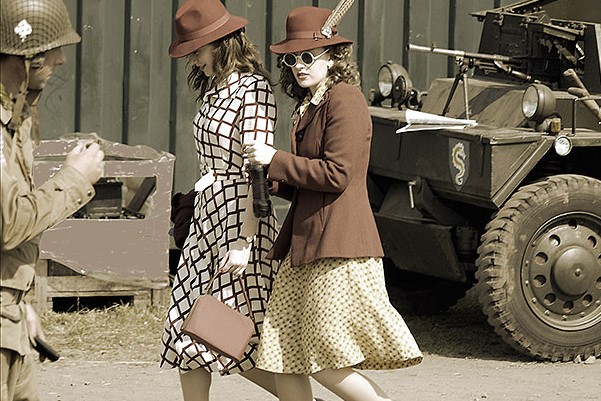
Comic line, making fun of the US Army in Europe in WWII. There was a good humoured banter between the GIs that were stationed in Britain prior to and during WWII and the British citizenry. The GIs had a come-back – calling the Brits, “underpaid, undersexed and under Eisenhower”.
Conditions were harsh in Britain in the early 1940s and there was also an undercurrent of unease that was conveyed by the phrase, especially amongst British men, who resented the attraction of GIs, with their ready supply of nylons and cigarettes, amongst British women. The English artist Beryl Cook, who was in her late teens at the time, later made this observation in a broadcast interview: ‘food was scarce, but we supplemented our income by a little impromptu whoring with the GIs – we all did it’. What was meant by whoring there isn’t clear and it may just have been a reference to flirtatious dalliance in exchange for nylons and chocolate. Indeed, many of these liaisons were love matches rather than commercial transactions, as the thousands of marriages between US servicemen and British women (the GI brides) is evidence of.
The line was also used in Australia, in much the same context, although appearances of it in newspapers there post-date those in Britain and the USA.
The phrase was popularized by Tommy Trinder (1909-1989), a well-known and well-liked English comedian (seen here with Phil Silvers). His version of the line which, although he gave it wide circulation was probably coined by someone else, was “overpaid, overfed, oversexed and over here”. Other variants also appeared at the time, for example “oversexed, overpaid and overbearing”.
Strangely, since there can’t have been anyone over the age of ten in Britain at the end of the war who wasn’t familiar with the phrase, it appears very seldom in print. The earliest reference I have found is in a US newspaper The Miami Daily News, April 1944:
In London the story is being told of an American official who was anxious to discover the nature of the British complaints against the American soldiers based there. He finally asked one Britisher: “What do you think is wrong with the American soldiers?” The Britisher answered: “Well, they’re overdressed, they’re overpaid, they’re oversexed, and they’re over here.”
Given that the expression is British it must have been in use there prior to it finding its way to America. It can’t have been much earlier though as the USA didn’t enter the war in Europe until 1943.
There’s a lot about the Pokémon series that makes it interesting to discuss, but the thing that stood out to me above all else when I played through the original instalments – Red Version and Blue Version – was how impressive of a technical accomplishment they are. I love to see great things achieved in the face of major limitations, and for games, limitations don’t get much more major than being developed for the original Game Boy – a handheld platform from 1989 with a black-and-white, 160×144 screen that was already seven years old at the time of these games’ release. Not only did these games go on to collectively become the best-selling game on the platform bar the pack-in port of Tetris and kick off one of the biggest pop culture phenomena the modern world had ever seen, but they also manage to be fleshed-out, fully-featured titles that hold up even to this day thanks to solid battle mechanics, a varied and detailed world, and, at the core of it, really good creature designs that pull a fair chunk of the weight in making me want to explore that world.
Sure, there are some sub-par designs in the mix, but the major advantage that Red and Blue have over their successors is the concentration of Pokémon that are not only interesting and full of enough personality to make me want to use them, but also fit within a coherent style well enough that you’ll never run into something and feel like you’ve stepped into a whole new game. This is a problem that a lot of players, new and old, seem to have with the most recent instalments – any specific period of the series’ lifespan carries with it a distinct style, and where later games mash together a selection of them from different games, this pair have the original 150 and that’s it. Even if there’s a weaker character design in there, it at least fits in with those around it in a way that means that even if it’s ugly or boring, it’s never jarring. I love how much the Kanto Region’s cast of characters work well together in this way, but even more than that I love how every bit of personality that is conveyed through these colourful designs is done with tiny, low-resolution and totally immobile sprites. Every time an exciting new species appears it activates a little neuron in the 10-year-old boy brain that’s never far from the surface of my own, and it all just speaks to how much Game Freak’s art team was able to do with so little that even after playing all of the series’ 3D titles, I still get so much joy out of these tiny sprites and their horrible screeches.
This would all be for naught if Red and Blue weren’t fun games, and bar a few little frustrations (including some that the series never quite shook off), they are. It feels far less like a game that can be mastered than the later entries, given the scarcity of items and the limited variety of techniques that each Pokémon can actually learn. Most of the roster have their effectiveness tied to the availability of TMs – rare, single-use items that teach a single, powerful attack to a compatible Pokémon, which incentivises thoughtful planning and forces you to agonise over who you actually want to have in your party of six.
Most of the game’s enemies are pushovers, and all except for the recurring ‘rival’ use entire teams of a single type, meaning that fights aren’t so much about tactically switching Pokémon to maintain a favourable matchup as they are about coming in with a balanced enough team that you always have somebody who can completely sweep the opponent’s team with little hassle. I’ll admit that this is my biggest frustration with these games. I cultivated a team of six fairly powerful guys, and although I didn’t go with the ones that everybody knows are ridiculously strong (think Alakazam, Snorlax, etc.), I still found myself absolutely pounding through every boss until the very end. This is obviously a side effect of the rock-paper-scissors concept being developed alongside the game itself, which is also clearly the reason why almost every boss in the game specialises in a type, but it really does make longer areas like the late-game water routes or the Team Rocket hideout feel like a chore, as each is just a long series of battles against trainers whose entire teams will be swept easily by the same handful of attacks.
The thing that’s always gotten me excited about these games is the sense of exploration, though. Not only in the literal sense – although Red and Blue do have a nice set of dungeons and abandoned buildings just waiting to be spelunked – but also in the sense that you always get to feel like you’re discovering something new. The Kanto Region is carefully laid out in such a way that certain areas – like the sprawling central metropolis of Saffron City – are locked off until you’ve sufficiently explored the surrounding plains, and you’d be surprised by how much variety a series of rural roads can have, even on the Game Boy. Every location, no matter how commonplace or unassuming, manages to feel like a new experience to the last, to the point where you can identify a location from a screenshot with no other information, despite the fact that the game uses a very limited set of assets. Another thing that helps is the way that despite mostly just spouting a random line about the area you’re in or a fourth-wall breaking gameplay tip, NPCs will occasionally gift you with incredibly valuable items or offer to trade you for a rare and powerful Pokémon. These people are sprinkled just thickly enough throughout Kanto’s population that it feels worthwhile to explore every nook and cranny of cities just in case something spectacular might be waiting in a random house. This also helps to make the player feel like they’re doing something in the game’s populated areas, where battles are few and far between and wild Pokémon are virtually absent.
This leads me into the final, most subjective thing that I want to discuss about this game, and that’s the way it dealt with dishing out legendary Pokémon. If you’re not familiar, a legendary Pokémon is an incredibly powerful Pokémon that usually appears in a single, scripted encounter and then can’t be found elsewhere. Where later games incorporate these encounters into the story or even just give you the Pokémon as a reward for finishing side content, Red and Blue simply have their four legendaries sitting around in the deepest part of four different caves. Nobody tells you that they’re in there, so the only reason you would encounter them is if you were exploring for exploration’s sake, and finding one of these guys for the first time fires off the greatest dopamine hit my lizard brain has ever experienced, especially given the exhilarating and challenging battle that you’ll need to carefully plan out if you want to have any hope of snagging one of these bad boys.The legendary encounters are the brightest feather in Red and Blue’s cap, and that’s honestly a cap I like a great deal, because it’s a cap that’s about exploration and discovery above all else. Playing these games can be bittersweet given how comfortable its successors have gotten with linear corridors and the complete stripping out of anything remotely challenging, but if you’re into this kind of game enough to be willing to try something as dated and technically limited as this, I do genuinely think that this is one of the best games on the Game Boy. It’s easy to see why this game exploded the way it did and why the cultural ramifications of that explosion are still being felt today.
When it comes to what has been happening since 2019, I think that I’m ready to share what I know. First of all, what has been happening comes as no surprise to me. I’ve already made a few posts of my own about what has been happening in the West and about what will happen. My first post about the goings-on in Western Civilization is from 2019. My post about the goings-on in Russian Civilization is already several years old because it’s from 2017. In these two posts, I applied the knowledge that I have gained when I read Carroll Quigley’s books. Explaining what has been happening in Russia was easier than explaining what has been happening in the West. When it comes to the West, I wrote that what is happening is the continuing decline of American political domination of the West. It has been 2 years since then, and I can say that my opinion about what is happening in the West hasn’t changed. I think that this process of decline of American political domination will possibly last for several more decades. I compared the USA to the Abbasid Caliphate not because I think that American power will decline exactly like Abbasid power did but because I think that the process is similar. That is, I think that the USA won’t quickly collapse like the Soviet Union did. In the case of the USA, the decline and loss of power has been, and will be, more prolonged, in my opinion. Western Civilization will still have its ups and downs in the future, but the major policies will no longer be set by Washington. At the moment, people in the West are simply living through one of the downs. It appears to me that the COVID-19 pandemic is a reality, but it has been blown out of proportion by the authorities in Western states and by the authorities in the many other states in the world that can be called economic and cultural colonies of the West. The establishment is taking advantage of the pandemic and lying to the masses. This isn’t really anything new. They’ve always been deceiving the masses about many things, but the measures that are being taken now haven’t been seen for quite some time in the West. COVID-19 itself may not have originated in China. Some people say that it’s a creation of the Americans. Conspiracy theorists, anti-Semites, and other right-wing reactionaries have been having a field day because of the COVID-19 pandemic. They finally have something that they can scream about, while thinking up new conspiracies, because what has been happening is very unusual. The COVID-19 pandemic is probably the biggest thing since the “September 11 attacks”. The measures that have been imposed by the authorities upon the masses are unpleasant. Anyway, I’m not really surprised by any of this. All of this is just another detail of the crisis that has been developing since 2008. All of this is just a part of the continuing decline of American political domination of the West. As Quigley explained in his books, the latest major crisis in Western Civilization began in 1929, when industrial capitalism became a structure of vested interests. If the current Age of Conflict in Western Civilization continues, and I think that it will, more severe things than the COVID-19 pandemic will follow. Here’s a passage from Quigley’s book ‘Tragedy and Hope’, in which he mentions what happened during the first Age of Conflict in Western Civilization, when feudalism became a structure of vested interests:
“From all this came the first period of expansion of Western Civilization, covering the years 970-1270. At the end of this period, the organization of society was becoming a petrified collection of vested interests, investment was decreasing, and the rate of expansion was beginning to fall. Accordingly, Western Civilization, for the first time, entered upon the Age of Conflict. This period, the time of the Hundred Years’ War, the Black Death, the great heresies, and severe class conflicts, lasted from about 1270 to 1420. By the end of it, efforts were arising from England and Burgundy to conquer the core of Western Civilization.”
The crisis that began in 1929 was alleviated for several decades after 1945 because of the gains of American monopoly capitalism during and after World War II and because the USA began to dominate Western Civilization politically. Because of the two so-called world wars, British political domination of Western Civilization had been replaced by American political domination. But, since industrial capitalism hasn’t been functioning as an instrument of expansion since 1929 in the West, these gains of the USA were only temporary because a real instrument of expansion no longer exists in Western Civilization. American imperialism hasn’t been bringing big profits to the West since the plundering of the former Soviet Union in the 1990s. If the USA has no big imperialist gains, if it doesn’t impose its institutionalized capitalist system upon new territories, it goes into an economic depression, along with the rest of the West. I suppose that this is why I call the USA an empire, and the USA has been functioning like this since the 1930s. Reaganomics, for example, didn’t benefit the USA in any big way, and it actually harmed the USA in several ways. The economic crisis that became evident in the 1970s continued when Ronald Reagan was president, and the reason why things weren’t as bad as they could have been is because the national debt of the USA tripled during Reagan’s presidency. The money was borrowed primarily from Japan at that time. This is something that Immanuel Wallerstein mentioned in his books. I don’t consider Wallerstein to be as good a writer and thinker as Quigley, but his books are still worth reading. Information about this is also available in Paul Kennedy’s book ‘The Rise and Fall of the Great Powers’. Nowadays, the national debt of the USA is much larger, thus making the USA the largest debtor in the world by far. What really helped the USA for a few decades after Reagan’s presidency was the collapse of the Soviet Union. Of course, you won’t find such information in the USA because of all of the censorship and propaganda.
The Russian Federation might have better prospects than the USA. Because Russian Civilization has been in an Age of Conflict since 1900, this means that it hasn’t had an instrument of expansion since 1900. Soviet imperialism and Soviet political domination of Russian Civilization brought growth and successes for several decades, but the Soviet Union began to go into decline in 1965 and it collapsed after 1985. One of the states that emerged from this collapse is the Russian Federation. It’s by far the largest state on the territory of the former Soviet Union. Since the Russian Federation has no instrument of expansion, it has experienced serious economic and social difficulties from the beginning. The Russian Federation can still have serious economic growth, but, in order for this to happen, it has to engage in imperialism and become an empire. In the 1990s, under the oligarchical dictator Boris Yeltsin, the Russian Federation was a client state of the USA. Things began to change when Vladimir Putin came to power. It seems that, under Putin, Russia wants to at least be a regional power. Of course, the biggest obstacle to Russian ambitions in the region at this time is the USA, which has surrounded Russia with military bases and with unfriendly states after the collapse of the Soviet Union. In this situation, it’s hard to say if Russia will be successful in its aspiration of becoming an empire. A new empire that will control the territory of Russian Civilization, like the Soviet Union did, will of course emerge in the future, but the question lies in whether or not this empire will be created by the regime that appeared in the Russian Federation in the 1990s. If the current Russian regime manages to outlast the USA, and the decline of American power, it will have opportunities to engage in some real imperialism and to conquer the small states that surround it. However, the recession of American imperialism might also bring new challenges because, instead of dealing with one very powerful empire in decline, Russia will possibly have to deal with several hostile, aggressive, surrounding states. Such a situation will bring new challenges and not only new opportunities. Therefore, if the regime in Russia perseveres, if it doesn’t get overthrown, and if it does engage in some real imperialism, it will have a future. But these are big ifs. The standard of living in Russia is, of course, considerably lower than in the USA and in other Western states. By Western standards, most people in Russia are very poor and miserable. Incredibly, life in some other post-Soviet states, like Ukraine, is even worse than in Russia. The Russians had the highest standard of living in their history when the Soviet Union existed. For example, there appears to be a reason why Nikita Khrushchev said, “We will bury you” to the Americans. When he said this, the economy of the Soviet Union was growing by about 8% a year. This growth rate wasn’t as impressive as the growth rate that existed during the rule of Joseph Stalin, but it was still impressive. The Soviet economy was growing faster than the American economy when Khrushchev was in power, and I suppose that this fact explains why Khrushchev had so much confidence. If this growth had continued, the Soviet Union would have indeed buried the USA. But the Soviet Union began to go into decline after Leonid Brezhnev came to power. Naturally, after the collapse of the Soviet Union in 1991, and after Russia became an economic colony of the West, the standard of living in Russia fell dramatically. The economic crisis that began in the West in 2008 and the sanctions that have been imposed on Russia by the West after what happened in Ukraine in 2014 have taken a toll. Life in Russia has become even more difficult. Naturally, Putin, as a capable politician, has tried to distance himself from Yeltsin because Yeltsin is very unpopular among the Russian masses, but this doesn’t change the fact that he has simply become the head of the oligarchical regime that Yeltsin established. In recent years, the policies and the propaganda of the Russian establishment have become even more reactionary than before. In this way, when it comes to policy, the current Russia reminds me of the Russian Empire in the 19th century. The Russian Empire was a right-wing state that was reacting to what was happening in the West. In the West, the Russian Empire was seen as a backward and oppressive state. The Russian Federation is also a right-wing state that’s reacting to what is happening in the West, and it’s being described as backward and oppressive by people in the West. In order to distract the Russian masses from the problems and the poverty in the country, Russian propaganda aims to show that things are getting worse in the West and that they have been getting worse for quite some time. This is true. Things have been getting worse in the West. But this doesn’t change the fact that life in Russia is still much worse than life in the West. In my opinion, at this time, Russian propaganda can be divided in three big parts. It’s anti-Western, it’s pro-Western, and it’s also anti-Soviet. It’s anti-Western because Western countries are, for the most part, enemies of Russia and because the West is still seen by some opposition figures in Russia as an example of “liberalism” that can be followed. The Russian establishment does, however, want to have normal relations with some European states because of Russia’s significant trade relations with these states. Most of these trade relations got established when the Soviet Union existed. For example, Germany buys a lot of the natural gas that is sold by Russia. This is why the Russian establishment goes along with the anti-Soviet lies, such as the Katyn massacre, that get fabricated in the European Union. Russian propaganda is pro-Western because Russia is an economic colony of the West and because it’s an oligarchical state that’s incapable of doing much on its own. Except for nationalism and the Orthodox faith, the regime in Russia has nothing to offer to the Russian masses at this time. In culture and in the economy, the regime and the oligarchy are simply trying to copy what exists in the West, especially what exists in Europe. In such a depressive atmosphere, it’s not surprising that there’s much corruption, discontent, debauchery, and treachery. The situation in Russia can be compared to the situation in China before the Mongols conquered China or to the situation in India before the Mughals conquered India. And, of course, Russian propaganda is also anti-Soviet because Russia has an oligarchical, right-wing regime with no successes of its own and because life in the Soviet Union was considerably better, even when the Soviet Union was in decline. Still, even with all of these problems, the regime in Russia might have a future if it holds out and doesn’t get overthrown. The Russian establishment is betting on the most reactionary and the most right-wing elements in the political establishment of the USA. This is happening not only because Russia itself is a reactionary, right-wing state but also because members of the Democratic Party are openly hostile toward Russia. Some members of the Republican Party, which has other oligarchical backers, relate to Russia much better. Naturally, relations with Russia improved somewhat after Donald Trump became president, but it appears that Trump got kicked out of the White House by the opposition in a kind of coup d’etat at the beginning of 2021. Andrei Fursov, for example, said that Trump won the 2020 United States presidential election and that the vote results were falsified in favor of Joe Biden. I don’t know if this is true or not, but I think that it’s very much possible. The oligarchical backers behind Biden are skilled at conducting coups and propaganda. Another interesting thing that Fursov said recently is that the Soviet leadership went along with the American moon landing hoax because the Soviets got certain financial gains in the West in exchange for their compliance. In addition, Fursov said that the Americans had to retreat from Vietnam in 1975 because of the Soviet Union, that it was the Soviet Union that defeated the USA in Vietnam. After the collapse of the Soviet Union, and without support from the Soviet Union, Vietnam fell before the feet of the Americans without a struggle.
The 1965-1966 Buicks were created when the company was in the midst of a renaissance. It was running a solid fifth in the industry sales race on the strength of steadily building volume, trends that would continue through the rest of the decade. Its product line had cars to cater to a variety of customers whose wants might include economy, passenger room, racy performance, or stylish luxury.
Of course, the notion of “renaissance” suggests a revival, a restoration of what was. Just a decade before, in the heady year of 1955, there was Buick — decidedly medium-priced Buick — all the way up to third in sales behind perennial mass-market leaders Chevrolet and Ford.
Nearly three-quarters of a million Buicks were produced for the 1955 model year, the crest of a wave that had been rising for several years. But it wouldn’t last, not under the weight of questionable styling and dubious quality.
Then, too, an economic recession that began picking up steam in late 1957 kept many potential car buyers on the sidelines. Buick produced just 241,908 of its 1958 models, its slowest year since 1948, when it was still making warmed-over prewar cars.
Sales figures in each of the next two years were a bit better, but they weren’t improving at the same rate as those of some other makes. In 1960, when it built 254,000 cars for the model year, Buick slumped to ninth, its worst industry ranking since 1905.
General Motors wasn’t content to let its cornerstone division flounder. New managerial blood arrived in the spring of 1959 when Edward Rollert, who had an extensive manufacturing background, was named to head Buick. By 1962, production was up to 400,000 cars and Buick was fifth in sales. Two years later, output totaled more than 500,000.
Buick was accomplishing this growth with an expanding array of vehicles. As per industry trend, the product line began to diversify in the early 1960s. In 1961, the small-car craze of the day was addressed at Buick by the Special, one of General Motors’ “senior compacts” that grew up into the new intermediate class for 1964.
Then, too, there was the striking Riviera that arrived in 1963 to enter the “personal car” field first staked out by the Ford Thunderbird.
But despite the rise of these and other new market brackets, the various divisions of the Big Three automakers still relied on their full-size “standard” cars to generate most of their sales. Buick was no exception.
More than half of its production in each model year from 1961 to 1964 was made up of the standard cars. This pattern was destined to continue into 1965-1966, when a beautifully restyled family of full-sizers was launched to offer Buick customers the choice of value, performance, or luxury they required. To learn about the first of these cars, the LeSabre, continue on to the next page.
1965-1966 Buick LeSabre
The “small car” in the lineup was the 1955-1966 Buick LeSabre. It was three inches shorter than the Wildcat and 7.3 inches shorter than the Electra 225. (Still, it was almost a foot longer than most of the mid-size Specials and Skylarks.) The name had been in the lineup since 1959, when Buick replaced all the series titles that had served it since the 1930s.
The 1965 version wore completely new styling that gave a wider appearance and included softer lines. General Motors styling chief William Mitchell pushed through the new theme for the LeSabre and other GM cars with which it shared bodies.
Essential features of the general design (which some have said were the best of the Mitchell era) were a “kick-up” beltline and rounded contours deftly punctuated by sharp bodyside creases that kept the look from going too soft. On two-door hardtops, roofs arced gently toward flat rear decks.
Each full-sized Buick series had its own grille design in 1965. The LeSabre’s extruded aluminum grille consisted of horizontal slats backing a bright “cross.” LeSabres carried three simulated “portholes,” a longtime Buick styling trademark, on each front fender.
Three LeSabre models were available: two- and four-door hardtops, and a four-door sedan. The LeSabre Custom version had those three styles, plus a convertible. Buick advertised the 1965 LeSabre as its lowest-priced full-size car, but like its larger brothers, it was still a Buick in luxury and ride.
Seats in base models featured a combination of Bartine cloth and leather-grained vinyl. Custom four-doors used a plusher Bimini cloth-and-vinyl upholstery.
The standard powertrain for the LeSabre was a 210-bhp, 300-cid V-8 engine and three-speed synchromesh transmission. This engine used a single two-barrel carburetor and had a 9.0:1 compression ratio. A higher-compression four-barrel “Wildcat 335” version of this engine — with 250 bhp and 335 pound-feet of torque — was optionally available. So was Buick’s Super Turbine variable-pitch torque converterautomatic transmission.
Underneath each full-size Buick was a new perimeter frame that replaced the X-type design of the 1961-1964 models. A ball-joint independent suspension with a link-type stabilizer bar served up front. At the rear was a four-link setup. Coil springs were used at all four corners.
LeSabre’s standard wheels were 15×5.50 steel discs, with oversize tires optional. Like the Wildcat and Electra 225, LeSabre had a 25-gallon fuel tank. A cross-flow radiator and longer-life exhaust systems were new features on all big Buicks. Other standard equipment in 1965 included self-adjusting brakes with finned drums, an instrument-panel safety pad, armrests front and rear, and dual horns. Extra-cost items included, among other things, power assists for steering, brakes, windows, and seats; air conditioning; a choice of three radios; and a no-slip rear axle. Buick referred to each of its 1966 offerings as “the tuned car.” That year’s LeSabre featured only minor styling changes. The grille now consisted of a fine mesh over which ran a pair of thin horizontal bars. In back, larger taillights cut into the decklid and bumper for a “barbell” look. The big news for LeSabre in 1966 was more power. The 300-cube V-8 was replaced by a 340-cid engine that produced 220 bhp in standard tune or, for an extra $26, 260 bhp with a four-barrel carb. Numerically lower final-drive ratios were instituted as well.
LeSabre model offerings remained unchanged. New standard-equipment features included back-up lights and an outside rearview mirror.
The middle size of this Buick lineup was the Wildcat. Continue on to the next page to learn more about the 1965-1966 Buick Wildcat.
1965-1966 Buick Wildcat
Beginning in the 1930s with the Century, Buick had become known for producing spirited cars that blended its biggest engine with its lightest bodies. That job fell to the 1965-1966 Buick Wildcat.
The Wildcat made its debut during 1962 as a sportier bucket-seat version of the Invicta two-door hardtop. The Wildcat became a three-car series of its own the following season. Production topped 84,000 cars in 1964, the year a four-door sedan joined the line, and the Wildcat certainly looked like one of the division’s better ideas of the decade.
For 1965, the Wildcat became even more of a crossbreed between the lower-cost LeSabre and the high and mighty Electra 225. Formerly built to LeSabre dimensions, the Wildcat now moved up to the Electra’s 126-inch wheelbase.
But it did retain an elongated version of LeSabre styling. Specific appearance details started with a deep-set die-cast grille divided into two horizontal sections, and Buick’s tri-shield logo in a chromed ring at the center. Big ventlike strakes on the front fenders were the Wildcat’s interpretation of the famous “VentiPorts.”
The line again contained four models — four-door hardtop, four-door sedan, two-door hardtop, and convertible — but the Wildcat family still managed to grow. There were now base, DeLuxe, and Custom versions, the DeLuxe and Custom defined by increasingly nicer upholstery and interior fittings. Only the DeLuxe subseries included all four body types; the base range had no convertible and the Custom lacked a sedan.
Performance remained the Wildcat’s calling card. Power choices began with the “Wildcat 445” V-8, so named because of its torque output. This 401-cid evolution of Buick’s Fifties-vintage “nailhead” V-8 made 325 bhp at 4,400 rpm. It featured a four-barrel carb and 10.25:1 compression.
Beyond that, there were two mightier engines, a 340-bhp “Wildcat 465” and a 360-horse “Super Wildcat.” These were both 425-cid V-8s that spun out 465 pound-feet of torque. However, the Super Wildcat, which had been developed for the Riviera, featured two four-barrel carburetors, a chrome-plated air cleaner, cast-aluminum rocker-arm covers, and dual exhausts.
The three-speed column-lever stickshift was standard, with a four-on-the-floor manual and Super Turbine automatic as options. (Both optional engines had to be ordered with either the four-speed or automatic.) The Super Turbine transmission used in Wildcats incorporated two planetary gear sets instead of the one found in automatics destined for LeSabres.
For an extra outlay of cash, a Wildcat could be made into even more of a muscle car with items like heavy-duty springs and shocks, the limited-slip differential, a tachometer, Buick’s distinctive chromed five-rib sports wheels, and — in convertibles and hardtop coupes — bucket seats and a floor console. There was a choice of four axle ratios for manual-shift cars; five for those with the automatic.
In 1966, Wildcat styling adopted the same taillight revisions seen on the LeSabre. The grille continued the cut-back motif of the previous year, but the central shields-in-a-ring device was replaced by a vertical center bar. In addition, there was now a stand-up hood ornament. The faux vents on the front fenders were restyled as well.
The standard Wildcat engine in 1966 was the 325-bhp 401 V-8, with the 340-horse 425 optional. The dual-quad powerplant was no longer available for Buick’s big Wildcat. Neither was the four-speed manual transmission.
With the demise of the DeLuxe subseries, the base Wildcat added a convertible. There was an interesting, if obscure, performance package, though. For $255, the purchaser of a Wildcat two-door hardtop or convertible could add the Gran Sport High Performance Group.
It included an upgrade to a 340-bhp engine spiffed up with a chromed air cleaner, aluminum valve covers, and dual exhausts. Other package components were heavy-duty suspension parts, a 3.42:1 “posi” axle, and a choice of whitewall or redline 8.45×15 tires. Gran Sport badges were found inside and outside the cars.
When legendary Mechanix Illustrated writer Tom McCahill marked the 20th anniversary of his frank car tests in the February 1966 issue, he put a Wildcat Gran Sport hardtop through its paces.
“Uncle Tom” ran it 0-60 in 7.4 seconds, cracked 125 mph for top speed, and pronounced it “without a doubt the most comfortable and best Buick I have ever driven. Even the suspension, which is pretty sloppy on some other models, is beefed up on the Gran Sport series, making the car highly maneuverable and a lot safer.”
Still, from the 26,054 Wildcat hardtop and convertible coupes built in 1966, only 21 Gran Sports are believed to have been produced.
The next model in this Buick lineup was the Electra 225. To learn about the 1965-1966 Buick Electra 225, see the next page.
1965-1966 Buick Electra 225
The 1965-1966 Buick Electra 225 was the ultimate in Buick models. Introduced to the Buick lineup in 1959 as the successor to the Roadmaster, its numerical suffix referred to the overall length in inches of the body.
While not quite 225 inches long in 1965 (though darned close), the “deuce and a quarter” was still definitely Buick’s top of the line in size, luxury, and cost. The Buick catalog put it this way: “When you’ve arrived, there’s no harm in letting other people know it … [Electra 225] is a true luxury car, inside and out. It’s big, it’s sleek, and it rides like a dream.”
Apart from greater length, rooflines and rear-quarter panels really made Electras stand out from other standard Buicks. The razor-edged roofs seen on 1962-1964 Electras were softened a bit, and rear roof pillars wrapped around slightly at the back to impart a hint of limousine-style privacy.
The look was still much more formal than that of LeSabre and Wildcat closed cars. The bodyside kick-up was the start of a long, straight line that terminated in bladelike extensions at the rear of the car. For emphasis, a thin band of brightwork topped the quarter panels.
Dave Holls was head of Buick design as the 1965s were coming together. Glenn Winterscheidt was in charge of the exterior studio. “I got into the Buick studio at the tail end of 1964, and I was doing porthole designs for the Wildcat,” Winterscheidt remembered.
He has fond memories of the design process for these Buicks, especially the Electra.
“At that time, we tried to make it look as long and wide as you possibly could,” he remembered. “We pulled the sheetmetal out to the corners. Dave Holls called it the ‘W-plan front end.’ [From above, the angles of the hood and fender ends form a “W”.] We didn’t have to make many compromises at that time. There was a maximum width before you had to put side markers on it, like a truck, and we pulled it out to that point. But the 1965 Electra profile in the rear was real crisp, and I liked that.
“I’m amazed when I see today how huge these cars were,” he continued. “In Southern California, where I live, there’s a foreign-car dealer across the street, and some of those cars are five feet shorter than the Electra.”
Bright ribbed moldings ran from the front-wheel openings to the back bumper along the lower section of the sides. Rear fender skirts also helped emphasize the Electra’s length. The die-cast grille looked much like that of the LeSabre, but a check pattern replaced the lesser car’s horizontal bars. Taillights ran completely across the rear beneath the decklid. Electra 225s were further distinguished from other Buicks by their four VentiPorts and unique wheel-cover style.
Electra 225s were offered as a base four-door hardtop, four-door sedan, and two-door hardtop. As in the other lines, a Custom subseries was also offered; it included the three closed models and added a convertible. For several years prior to 1965, the four-door sedan had been a six-window design. The new body was a four-window style with frameless door glass and a narrow B-pillar that gave it a near-hardtop appearance.
As on the LeSabre and Wildcat, the instrument panel was dominated by two large dials that flanked the steering column. The speedometer was in the dial on the left; indicator lights for oil-pressure, ammeter, and coolant functions were housed in the dial at the right. To the latter, Electras added a standard-equipment analog clock. Above them, a wood-grain appliqué ran the width of the dash in place of the brightwork applied to this area on LeSabres and Wildcats.
Upholstery in Customs was what Buick termed “a vinyl so soft you’ll find it hard to distinguish from real leather.” Base cars used Beaucrest cloth with leather-grained vinyl trim.
Standard conveniences included power-assisted brakes and steering. Convertibles added power windows and two-way power front seats.
For 1966, Electra 225 offered the same seven models. General styling remained similar to that of 1965, but details were altered. While LeSabres and Wildcats gained .1 inch from end to end, the Electra actually shed .7 inch, falling to 223.4 inches overall.
Its grille was now a virtual copy of the LeSabre grille but for a red “Electra 225” badge on the driver’s side. There was a new standard wheel-cover design. Inside, the dash took on more horizontal flavor with a strip-type speedometer. Climate controls were shifted to the lower right of the speedometer.
Among the extra-cost options were cornering lights, an AM/FM stereo radio, air conditioning, tilt steering wheel, and a reclining front-passenger seat in cars ordered with bucket seats. All front seats were available with headrests. Vinyl roof coverings (in black or white) were also available.
Electra 225 engine choices in 1965 and 1966 matched those in Wildcats — even the dual-quad mill could be ordered in 1965. Only the Super Turbine automatic transmission was offered in Electras, though.
Buick production surged to 600,000 cars for model year 1965. It had to in order for the division to hang on to fifth place in the industry because 1965 was another record year. The family of full-size Buicks accounted for 55 percent of that total.
Almost 100,000 Wildcats were made in what would be the best year the series would ever see. The sales boom also served as an upbeat cap to Rollert’s management tenure. In June, he moved up to a corporate vice presidency. His successor in Flint was Bob Kessler, who had been general manufacturing manager.
Divisional output fell off by 41,278 units in 1966, enough to cost Buick a couple of spots in the sales standings. Approximately 31,000 of those losses were in the full-size field — nearly all from a decline in Wildcat orders.
Still, the LeSabre, Wildcat, and Electra 225 combined for more than half of the year’s Buicks. The loss proved a temporary setback. Demand (and market share) started turning up the next year, and, by 1969, Kessler and company were overseeing the production of 668,000 cars.
Like the Buicks of today, the styling of the 1965-1966 LeSabre, Wildcat, and Electra 225 was conservative, but it was definitely Buick. There was no mistaking what was coming at you down the road, or what you were trying to catch up to on the highway. To get a closer look at the 1965-1966 Buick, see the next page for specifications.