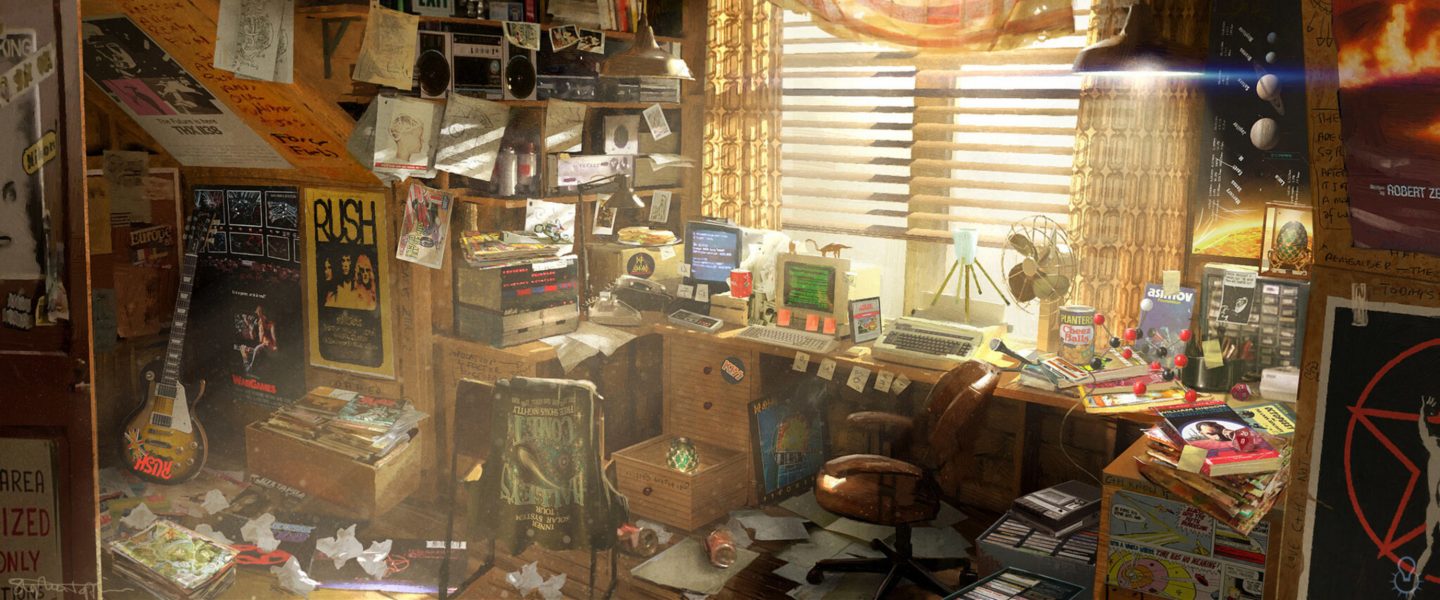

Lea Thompson in a Burger King commercial that aired during the 1982 World Series
Author: ulaghchi
PlayStation 3 is my Favorite Console from the Seventh Generation

Perhaps it’s time for a few updates. First of all, I’ve created playlists on my channel and on my blog in which I finally organized some of the music videos that I’ve posted. In these videos, I listed some of the popular music hits and singles from the 1960s to the 1990s. These videos with music singles are not among my most popular videos, but they are some of my personal favorite videos. There are already seventeen of them. This is somewhat impressive if you consider that each video is over 15 minutes in length and that each video features dozens of music singles. I’ll probably make a few more such videos in the future because there’s more music in my collection that I’d like to share and recommend. I especially like the covers that were made for music singles from the 1970s and the 1980s. Some of them are rather beautiful. And, of course, the pop music that was made in those decades is much better and more original than the pop music from the last few decades. Nowadays, it’s a little hard for me to believe that I was able to make seventeen such videos several years ago. Back then, before YouTube became completely corporate, before it became like American television, and before there was much censorship on YouTube, I had more confidence that my videos would be seen and liked. I had the time and the confidence to make videos almost every week. Of course, my channel has never been like a job or even like a serious hobby for me. I’ve never had the time, the stability, the means, or the desire to become a serious YouTuber. One of the reasons for this is that my family is working class and not middle class. For example, I didn’t have a computer or a video game console when I was growing up. And most of my videos aren’t about music, or films, or video games, or other such fluff that allows some people to earn money on YouTube. They’re about history, sociology, or politics. If such videos go against the narrative of the American establishment, YouTube blocks them or marginalizes them. For example, even several days ago, I noticed something strange going on with my latest video. I noticed likes appearing on this video and then disappearing. This happened about a dozen times. Naturally, there’s a strong possibility that YouTube is up to similar shenanigans when it comes to the number of views for videos. So, it appears to me that YouTube is trying to suppress the growth of my video. This video features information about China, which is one of the countries that are being demonized in the West. Another demonized country in the West is the Russian Federation. But such censorship isn’t anything new. I’ve already talked about censorship on YouTube in my earlier posts. Things like this have been going on for years and years already. Anyway, in my teenage years and in my early twenties, I often listened to music. Back then, I began collecting albums, and I now have a rather large music collection. Even now, I listen to music from my collection whenever I have the time. There are numerous books and lists on the internet about the albums that people should listen to. My personal favorite list is All-TIME 100 Albums by Time Magazine. I don’t like this magazine because it’s just another outlet for American propaganda, but I do like this music list. It’s not a very long list, and I like the selections. In addition to the 100 chosen albums, the critics made a short list of albums that almost made the cut. Unfortunately, I couldn’t find this short list on the internet, and I don’t remember all of the albums on it. But here are the albums that I do remember on the list. Appetite for Destruction by Guns N’ Roses, the Doors by the Doors, the Dark Side of the Moon by Pink Floyd, the Stranger by Billy Joel, and Blood on the Tracks by Bob Dylan. I prefer to listen to music when I’m not doing anything else and when I can focus my attention on the music that I’m listening to. Nowadays, however, I rarely have the time to do this. This is especially a problem for me because I can’t wear headphones due to my allergy problems. Therefore, most of my music listening time takes place while I’m cooking, doing something on my computer that’s not demanding, or even taking a shower. I don’t listen to music while I’m reading because I want to devote my full attention to what I’m reading. Occasionally, I also like to listen to ASMR videos while I’m doing something on my computer that’s not demanding.
There is one more thing that I wanted to clarify. When I wrote about my favorite video game consoles, I didn’t really mention the PlayStation 3. Therefore, some people thought that I don’t really like this console. This is not the case. I like the PS3 almost as much as I like the PlayStation and the PlayStation 2. In general, I like the seventh generation of video game consoles a lot. I like how the PS3 looks, especially the original model from 2006. I like its system software and its XMB interface. I like the fact that it plays Blu-ray discs, DVDs, and CDs. I think that it’s better at playing DVDs than the Xbox 360, which is another console that I own. And the PS3 that I own (the Super Slim model from 2012) has a lot of storage space. But, perhaps, more important than all of this is the fact that many good video games got released for the PS3. Of course, the number of great games that got released for the seventh generation of video game consoles is smaller than the number for the sixth generation. The PS2, for example, has a very large library of good games, and it’s also the best-selling video game console of all time, having sold over 155 million units worldwide. But there’s plenty to choose from the seventh generation too. I finished playing the The Last of Us about a year ago. I enjoyed playing this game very much. It’s not as great a game as Resident Evil 4, and it’s obvious that it was very much influenced by Resident Evil 4, but I would say that it’s still a great game. Once you get into the groove of this game, it’s hard to stop playing it. The story, which is about a gruff middle-aged Muslim man named Joel and his teenage wife Ellen Page making their way across a COVID-19-stricken America and killing many Americans on their way, is quite interesting. The visuals are often superb. The combat is quite entertaining. There’s very little to complain about. And this is only one of the games for the PS3. There are dozens and dozens of other good games for the PS3. In general, when it comes to deciding which games to play, I first look at the list of the video games considered the best on Wikipedia. This is my favorite list about video games. It’s not too long and I like the selections. Another reason why I like the PS3 very much is because of its PlayStation Store. You can buy PS1, PS2, PS3, and PlayStation Portable games on this store. When it comes to the PlayStation 4, I don’t even own one, though I could have bought one a long time ago if I wanted to. The PS4 was very successful in terms of units sold. It’s the second best-selling home game console of all time. But its library of great games is small. In general, in the eighth generation, the quality and originality of video games and consoles began to seriously go downhill. In fact, I was able to find articles on the internet about this issue, and some people complained that already in the seventh generation video games began to seriously get stale. When one thinks of the PS4, one thinks of Bloodborne and not much else. Also worth noting is that the PS4 is not compatible with any game for older PlayStation consoles. In addition, the console itself looks about as good as the black binder in which I store my paper documents. Even the hardcover book that I’m reading at this time looks better and more original than the PS4. So, Sony Computer Entertainment, a company that once dominated the home console market, that dared to innovate, and that released beautiful consoles like the PS2, the PS3, and the PSP Go (my favorite portable device), is now trying to stay afloat with the PlayStation 5 and is no longer in the handheld console market. Oh how I yearn for the good old days from 15 or 20 years ago. Well, sure, the situation for Sony, Nintendo, and Microsoft isn’t catastrophic. The PlayStation 5 and the Nintendo Switch are getting sold out all the time. But this isn’t happening because these consoles are just so awesome. This is happening because there’s still demand and because there’s nothing else to buy. By the way, the people at Nintendo undoubtedly learned from the mistakes that they made during the Wii U phase. Videos and articles about these mistakes can be easily found on the internet since there’s no shortage of gamers nowadays. Therefore, with the Nintendo Switch, Nintendo succeeded in attracting many second-party developers, third-party developers, and indie game developers. But I’m not one of those people that dislike the Wii U. It’s technically a better console than the Switch, and you don’t have to use the Wii U GamePad if you don’t want to. A Wii U Pro Controller can easily be purchased for the console. This is something that I did from day one of buying the console. Anyway, no matter what happens, people will continue to buy television sets, computers, phones, and devices for playing video games. So, is there anything else worth mentioning? Well, I sure am glad that an emulator like PCSX2 exists. Thanks to this emulator and to the emulator Dolphin, I can enjoy playing the many wonderful games that got made for the PS2 and the GameCube on my laptop. In fact, thanks to these and other emulators, my laptop and my phone are now my preferred gaming devices. If a perfectly fine PS3 emulator had also existed, I would have been fully satisfied. But, sadly, there’s not a single emulator that can emulate seventh generation video games well at this time. Well, fortunately, a small number of these games can be purchased on Steam or Good Old Games.
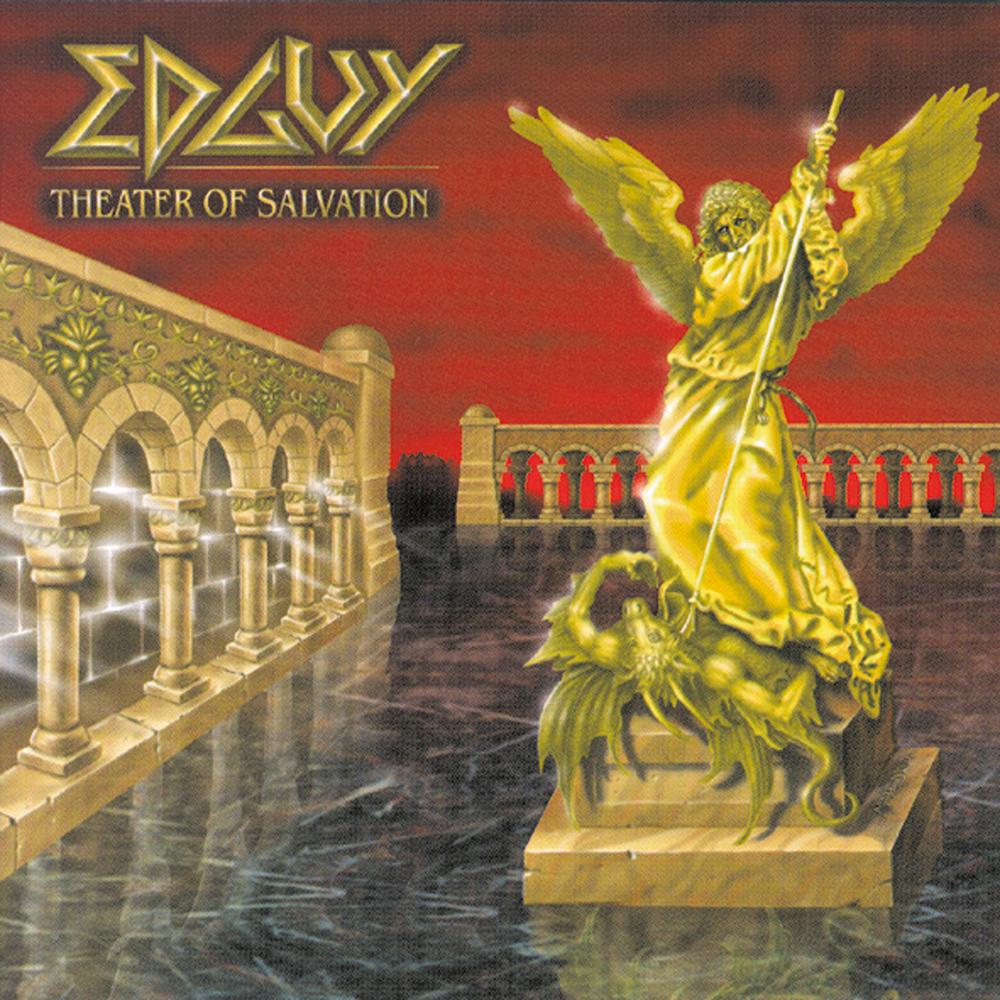
Now listening to Theater Of Salvation by Edguy and xx by the xx…

The Beautiful Lady Without Mercy by Frank Dicksee, 1901.

Proving Nazi Germany Capitalist… Again
Unceasingly we are bombarded with the claim that Nazi Germany was a socialist country simply because the world socialist was in it, or simply because there was a government. This of course is infantile and basically relies on a redefinition of capitalism to a system which doesn’t exist. Now we present this information from a post from Jacobin magazine.
Ukraine’s Prostitution
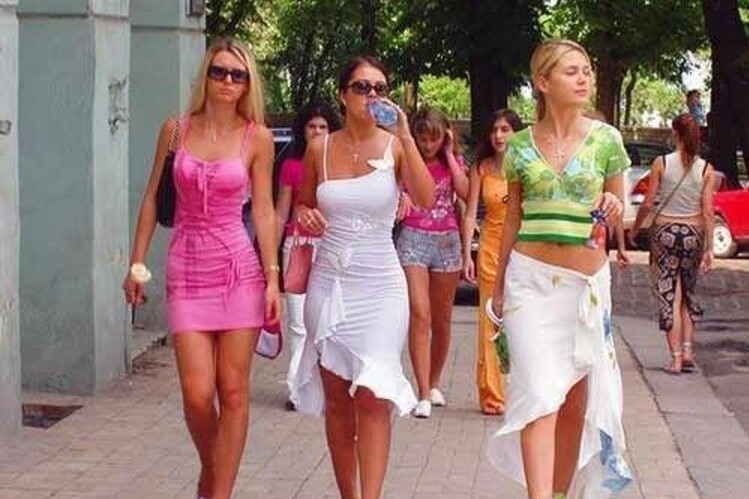
Ever since the collapse of the former Soviet Union in 1991, Ukraine has suffered from a booming sex trade. Estimated by police to be worth $1.5 billion last year, prostitution in Ukraine has been exacerbated by the international economic crisis, a weak Ukrainian national currency and fueled by cheap airfare and a free-visa policy for US and EU citizens, and so fosters a sex tourism industry that has persisted for many years. Although illegal, laws prohibiting prostitution have had little effect against criminal organizations and clients; instead, laws punish women working as prostitutes in Ukraine, a country that has experienced a national unemployment rate of 50%.
The severity of the Ukraine prostitution problem is clearly demonstrated by Ukraine’s role as having been one of the world’s largest exporters of women to the international sex trade, at one time worth in the vicinity of $5 to $22 billion. In 1998, it was estimated that more than 100,000 women, mostly minors, had be forced to work as sex workers in the West; at that time, 80% of Ukraine women who had went abroad for better opportunities and employment had no idea they would be forced into prostitution. However, in recent years forced human trafficking in Ukraine has given way to a new generation of women who voluntarily and knowingly enter prostitution, citing the fact that no other choices are offered to them in an environment of debilitating poverty.
This issue is so severe that Ukraine interior minister Yuriy Lutsenko declared on national television that “The country is becoming a paradise for sex tourism before our eyes.” The non-governmental women’s rights group FEMEN has held demonstrations loudly protesting that “Ukraine is not a brothel,” and, “Sex is not for sale.”
Modernist Architecture: 30 Stunning Examples

Modernist architecture may seem brutal, simplistic, and crude at times. But its different schools of thought have produced plenty of masterpieces that are regarded as architectural classics today. Take a trip around the world with our 30 stunning examples of modernist architecture that gave way to such incredible contemporary designs like Beijing National Stadium and Burj Khalifa.
Guggenheim Museum in New York
Guggenheim Museum is a work of the modernist Frank Lloyd Wright who followed a philosophy of organic architecture, such that worked in harmony with both environment and humanity. He designed more than a thousand structures including this New York Guggenheim Museum on Fifth Avenue. Solomon R. Guggenheim Foundation established in 1939 actually has a string of museums, but The Guggenheim in Manhattan is a modernist dream.
Neue Nationalgalerie in Berlin
Neue Nationalgalerie designed by Ludwig Mies van der Rohe was opened in 1968 demonstrating a collection of early 20th century art in Berlin. Its design is exactly how we see modernist architecture. Tons of glass, flat surfaces, cantilevering roofs, and absolute minimalism.
Barcelona Pavilion in Spain
Though built almost a hundred years ago, Barcelona Pavilion looks like a contemporary house we see being built in droves today. Interestingly enough its cantilevering roof, glass walls, and indoor/outdoor spaces conquered homeowners of both post-war period and now. Representative of Bauhaus movement, the pavilion was built for the 1929 International Exposition using travertine, marble, and red onyx. It’s super luxe!
Cube House in Rotterdam, Netherlands
The Cube House or Kubuswoningen is actually a set of smaller houses designed by Piet Blom in the 70’s. It’s an entire complex of cubic homes tilted at 45 degrees and perched on hexagon-shaped pylons to create more space at the floor level. Creating a village within a city, Cube House makes for an interesting place to live. If you are in Rotterdam, you can rent a cube apartment through Airbnb and feel it out for yourself.
Villa Savoye in Poissy, France
No article on modernist architecture would be complete without the Villa Savoye that is considered a classic modernist residence. Following the international style (no decorations, total minimalism), the renowned modernist architects Le Corbusier and Pierre Jeanneret went with simple lines and airy lower level created with the help of stilts. Transom-like windows cut through the boxy shape of the building while the circular roof additions house an outdoor lounge space and a roof garden.
Fallingwater Residence in Mill Run, Pennsylvania
Fallingwater Residence is another famous work of Frank Lloyd Wright. It was built on a waterfall 43 miles (69 km) southeast of Pittsburgh as a weekend retreat for the owners of the Kauffmann’s department store. Featuring modernism’s favorite parallel lines, the house looks like a liner with white water waves poppling from underneath it, amidst the lush green forest.
Villa Dirickz in Brussels, Belgium
Built the same year as the French Villa Savoye, Villa Dirickz is too a gorgeous representative of modernist architecture. White concrete, blocky shapes, and generous glass inclusions instantly make it pop against the green landscapes like some kind of a ship. Listed at $10,000,000 last year, the villa offers luxurious interiors and amenities like cinema, wine cellar, and a separate cottage for its caretaker.
Chicago Marina Apartments, Illinois
Chicago Marina Apartments have interesting history. Designed by Bertrand Goldberg back in 1959, the complex funded by the union of janitors and elevator operators was completed only in 1964. Besides the numerous living quarters both towers boast amenities like gym, theatre, swimming pool, bowlings, and restaurants – all of which cost around $36 million to build at the time.
Isokon Building in London
Isokon Building opened in 1934, comprising 34 flats and such amenities as shoe-shining and laundry. Combining streamline and modernism, the building is still being used as residential. Back in the day it housed intellectuals among which were numerous architects and Agatha Christie.
Devon House, Ada, Michigan
Continuing in his grandfather’s style Lohan Anderson built this perfect modernist retreat in 1992 among Michigan’s natural beauty. Even though it has a boxy shape, the design is complex and symmetrical, which brings some order to the beautiful chaos of the natural locale.
The Cite Radieuse, Marseille, France
One of Le Corbusier’s fundamental works that inspired a lot of works of modernist architecture is The Cité Radieuse that was built between 1947 and 1951. Though minimal, it features signature accents in a Bauhaus color palette (red, blue, and yellow). With 337 apartments of 27 types the residential building also boasts a paddling pool, a playground, and a roof terrace for lounging.
Luce Memorial Chapel in Taichung City, Taiwan
Standing on the campus of Tunghai University, Luce Memorial Chapel, named after an American missionary of the late 19th century, is an elegant building. Designed in collaboration between architects Chen Chi-Kwan and I.M.Pei, the seemingly small but gracious chapel offers 500 seats under walls stretching 19.2m (62.9ft) high. The building that cost mere $125,000 at the time has a faint streak of traditionalism, but it’s got that much more from modernism including walls of glass and materials at 90 degrees.
Chapel of the Holy Cross in Sedona, Arizona
Chapel in the Rock is another name of the Chapel of the Holy Cross in Sedona. Designed by the son of a famous architect Frank Lloyd Wright, the chapel was supposed to be built in Budapest but was moved to Sedona at the breakout of Word War II. At the cost of $300,000 the slightly trapezoid building was carefully inserted between the rocks with its facade stately demonstrating its purpose. Classic modernism!
United States Air Force Academy Cadet Chapel, Colorado
United States Air Force Academy Cadet Chapel conceived by Walter Netsch is located in Colorado Springs and stands tall piercing the sky with its 17 triangular spires. Comprising places of worship for Protestants, Catholics, Judaists, Muslims, and Buddhists the building also serves for various meetings.
Sanctuary of the Divine Mercy, Kalisz, Poland
Sanctuary of the Divine Mercy in Kalisz was designed in 1952, but its construction began only in 1977. Completed another sixteen years later the sanctuary looks unusual even for the time of its conception. There are no familiar simple and minimal lines and shapes, only brutal concrete and a patterned metal frame of windows.
Saint Anselm Church Creve Coeur in Missouri
Resembling the design of one influential Mexican restaurant, Saint Anselm Church Creve Coeur built in 1962 definitely stands out among the rest with its ruffled collar shape. These ruffles create a very beautiful interior where circular seating benefits from the natural light flooding the halls and opening up to the green outdoors.
Notre Dame du Haut, Ronchamp, France
Notre Dame du Haut is one of the most significant works of Le Corbusier apart Villa Savoye, of course, as it changed the look of modernist architecture towards more curvilinear design. The chapel that was completed in 1954 features an unusual ship-like shape that signifies the architect’s late style. Unlike many other churches and modernist buildings in general Notre Dame du Haut has very minute windows sitting deep within the building’s thick walls.
Hyvinkaan church in Finland
The New Church of Hyvinkää is serving the Evangelical Lutheran Church of Finland. Built in 1961 the pyramid-like structure seats 630 people and boasts an organ with 35 stops. Hyvinkään shows off a church shape simplified. Its minimal triangular design while simple still symbolizes a place of worship.
David S. Ingalls Skating Rink in New Haven, Connecticut
Yale Whale, as it is also known, looks more like a stingray with its curved roof and a cantilevering ‘tail’. Built by a Yale graduate Eero Saarinen the hockey rink is both simple and complex in concept and execution. Complete with wooden finishes, its facade looks unusually inviting and homely. Still there is some majestic lively vibe coming from the design.
Foire Internationale de Dakar, Senegal
Foire Internationale de Dakar looks like a modernist Mayan temple in the center of Senegal. Built in part as a pyramid the extraordinary complex is surrounded with boxy skyscrapers and general modernist minimalism. This reminds us of Frank Lloyd Wright’s Ennis House designed in a style of Mayan Revival but filled with modern minimalist sensibility.
Geisel Library in La Jolla, California
Geisel library started construction in 1968 and took $5 million to complete two years later. The looming work of William Pereira consists of multiple cantilevering levels that protrude and glistens with their smooth teeth of the wall-sized windows. With its 8 floors of space the library houses a collection of 7 million volumes along with a complete Dr. Seuss Collection.
UNAM Library in Mexico
Started in 1948 and opened in 1952 the library of the National Autonomous University of Mexico (or UNAM for short) is one of the most interesting modernist architecture examples built in the middle of the last century. Not because of its unusual shape or style, though, but thanks to the colorful tile murals showcasing Mexican history. Proposed and executed by a Mexican painter and architect Juan O’Gorman the murals tell a tale of Mexico’s pre-Hispanic and colonial past alongside depictions of the contemporaneous world and the university itself.
Dead Sea Visitor Center, Neve Zohar, Israel
This abandoned Dead Sea visitor center is a modest yet expressive example of modernist architecture. Its trapezoid walls wrap around each other, creating a rather welcoming atmosphere that no one now enjoys. We can appreciate its restrained beauty thanks to a photographer Nicolas Grospierre who for the last 15 years was busy gathering an atlas of modernist architecture all around the world.
Los Manantiales in Mexico City
In 1958 Felix Candela designed a masterpiece that would continue inspiring architects around the world till this day. His experiments with construction and thin-shell structures gave life to Los Manantiales, a restaurant in Xochimilco, Mexico city. Inspired by a form of a flower, the complex building consists of four intersecting hypars and blue glass windows opening up to a refreshing canal.
Palacio da Alvorada in Brasília, Brazil
Before Oscar Niemeyer fell for post-modernist style he earned a reputation as a modernist with his sleek designs, one of which is Palácio da Alvorada. The official residence for the President of Brazil was built between 1957 and 1958. Sprawling across the area of 75,000 sq ft (7,000 sq. m.) the residence has it all including a movie theater, a game room, and even its own medical center. The adjacent buildings also comprise a chapel and a heliport.
Northwestern National Life Insurance Building in Minneapolis
Northwestern National Life Insurance Building (now ING Reliastar Building) is a grand office block that echoes Gothic architecture with its beautiful slim columns and soaring arcs. Look past the facade (quite literally) and you’ll see elements typical of modernist architecture like glazed surfaces, simplicity of shapes, and open spaces designed for walking.
Sydney Opera House in Australia
Classified as expressionist, Sydney Opera House was started way back in 1959 and completed only in 1973. Winner of the 1957 international competition, architect Jørn Utzon authored the venue and oversaw its long-lasting construction. Famous for its sail-like shape, the opera house includes multiple venues that host more than a million people annually.
Seagram Building in New York
Though New York’s first skyscraper (Flatiron building) was designed in a style of Renaissance revival the rest came following the international style. Seagram building completed in 1958 was pure modernism. Minimal, simple, and functional. Stylish jet black structure fits right with the New York’s modernist architecture, although lacks in contemporary eco-consciousness. Its 38 floors rate mere 3 out of 100 in the Energy Star rating.
Haunting images of pre-Expo 86 Vancouver, before the ‘Glass City’ and million-dollar teardowns
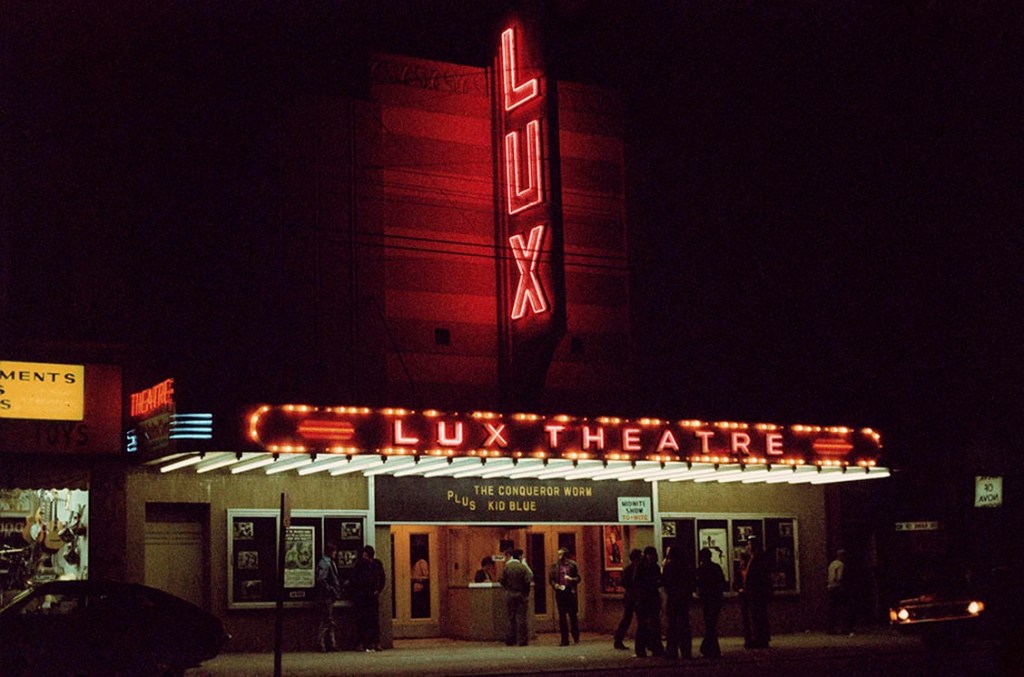
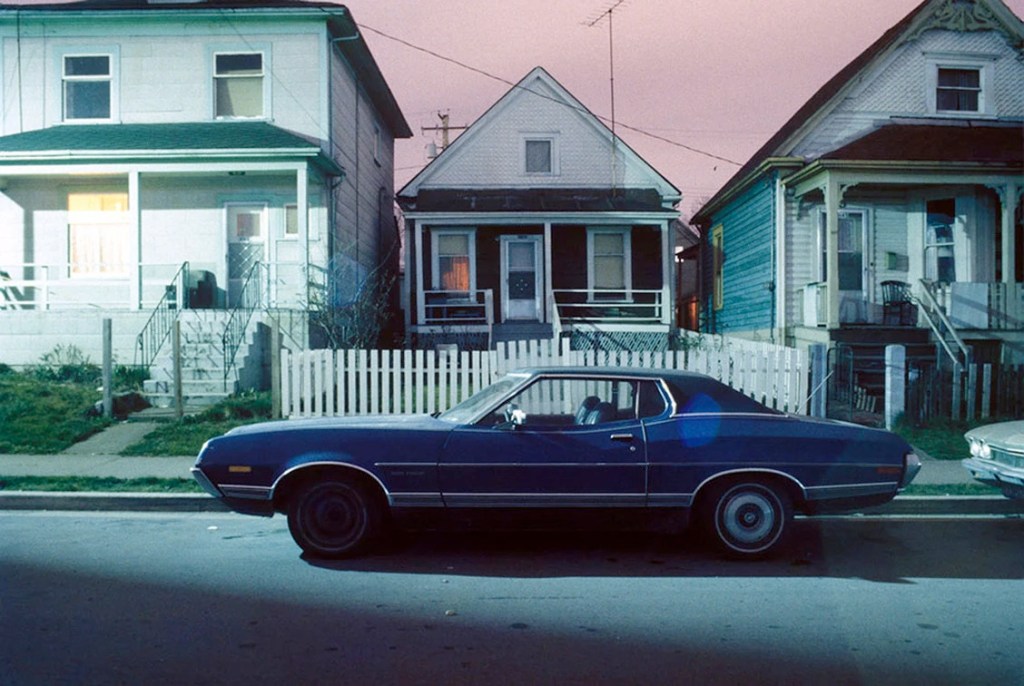
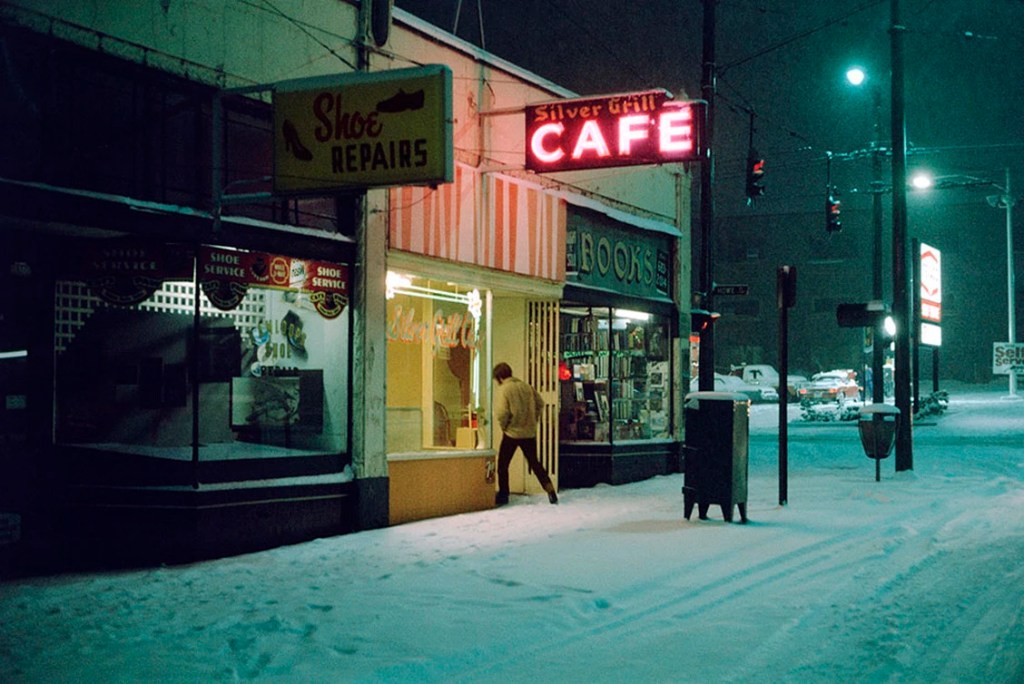
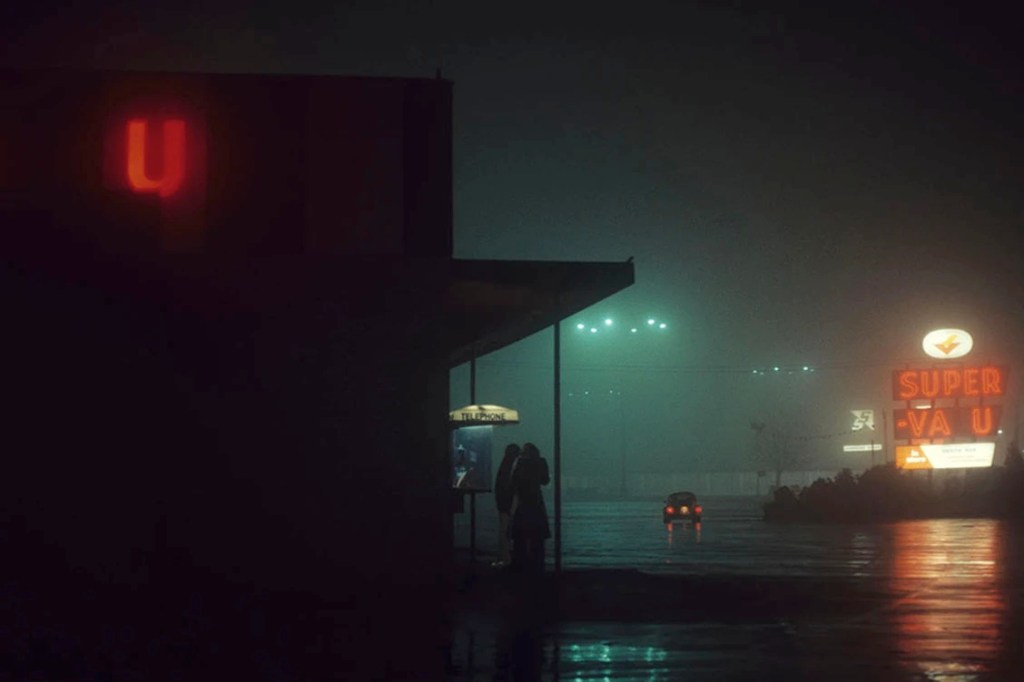
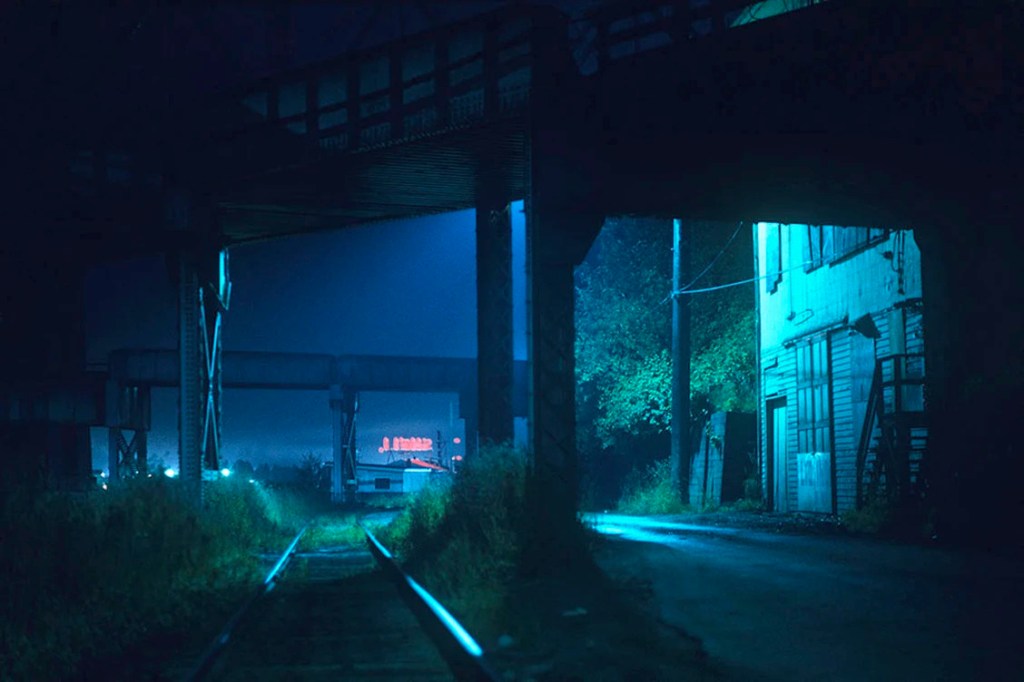
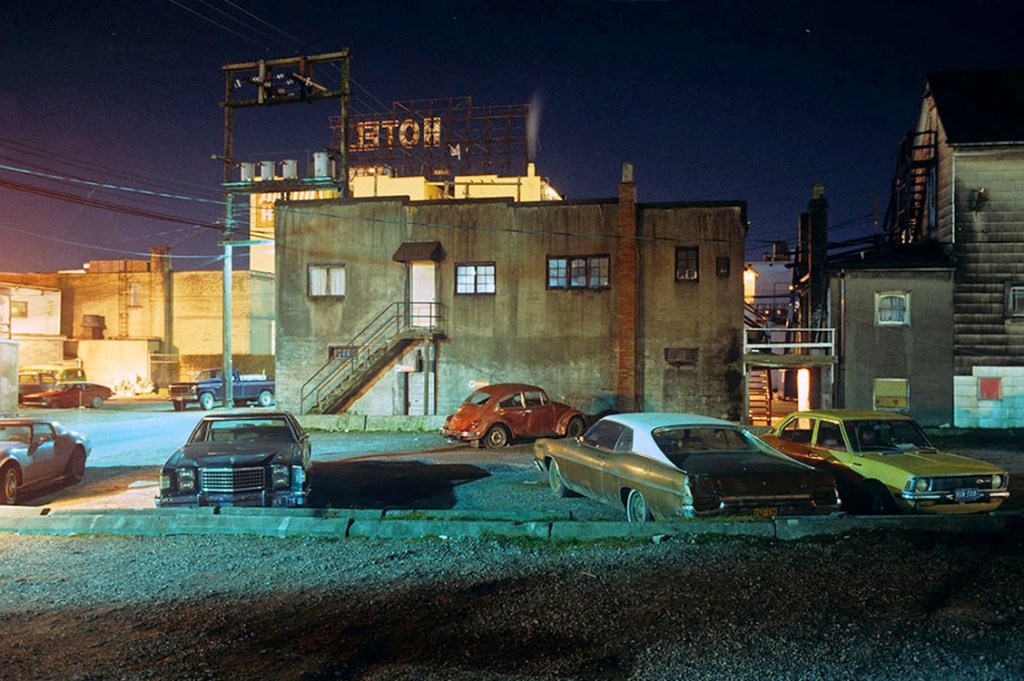
Wandering the city at night in the 1970s and 1980s, photographer Greg Girard captured an eerie Vancouver that has almost completely ceased to exist.
Before Expo 86, forests of glass condos and the birth of the million dollar teardown, Vancouver was a mid-sized port city where coffee was served up in greasy diners and the word “microbrewery” didn’t exist.
Photographer Greg Girard was there, capturing haunting images of a city just on the cusp of changing forever. Recently showcased at Vancouver’s Monte Clark Gallery, they’re also featured in his book Under Vancouver 1972–1982.
With permission from Girard, a selection of his photos are below.
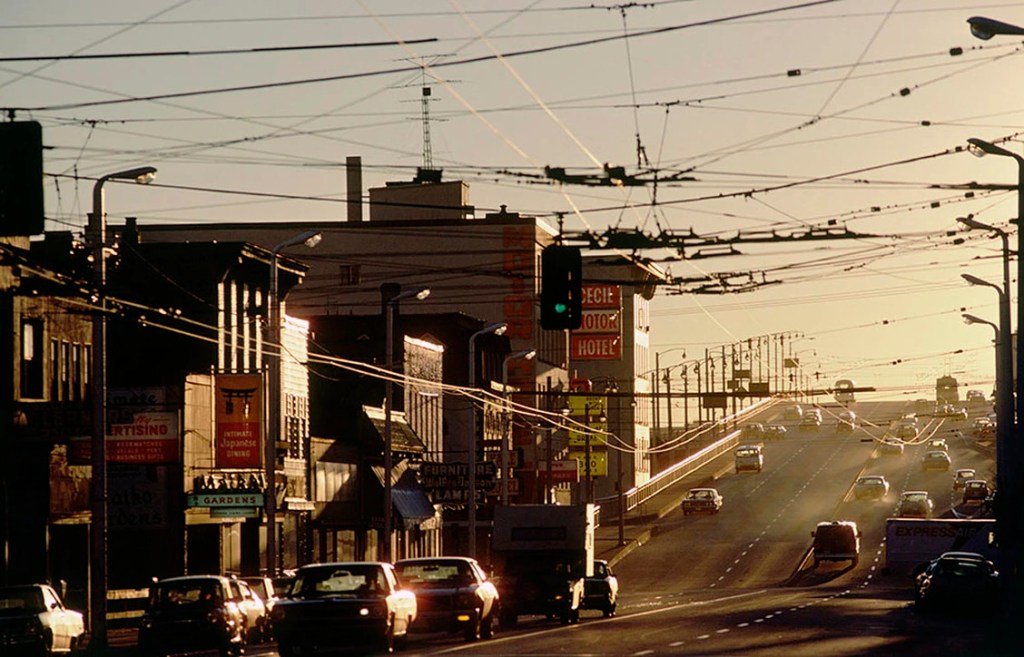
Granville Street Bridge, 1975
Just underneath the Granville Street Bridge, pictured in the background of this photo, Granville Island is undergoing its metamorphosis from a polluted industrial area into a waterfront tourist destination. One of the sharpest contrasts with modern Vancouver and its industrial predecessor is the city’s changing approach to False Creek, the inlet that is now one of the city’s signature features. But it was only as recently as the 1950s that city officials were seriously tossing around a plan to completely fill in the then-filthy waterway in order to free up more industrial land.
Parked Car (Gran Torino), 1981
When this image was taken, Vancouver real estate prices were in a tailspin. Real estate prices dropped by as much as 30 per cent in the early 1980s — a sharper decline even than housing prices in Fort McMurray, Alta. following the recent oil price collapse. The average price of a Vancouver detached home in 1980 was $177,000 ($350,000 in 2017 dollars). Meanwhile, the condo — a type of apartment that you could own — was still a new and unfamiliar entrant to the city’s real estate market.
Lux Theatre, 1974
This is the Lux Theatre, a movie house on East Hastings Street that occasionally did duty as a punk rock venue. The movie on the marquee, meanwhile, is The Conqueror Worm, a mostly forgotten B-movie starring Vincent Price. Although some variety of cinema had stood on the site since 1910, the market slowly dropped out from The Lux. In one of the final pictures of the theatre taken in the early 1990s it was desperately advertising $2.50 double features. Like many properties on East Hastings, the site is now home to a social services agency — a low barrier housing complex called The Lux.
Chinese Voice Daily News, 1982
The first thing to note is the dress: Men clad casually in suits. The second thing to notice is the two men on the right obtaining their news the same way humans have been doing for centuries; by looking at broadsheet pages pinned up in a newspaper’s front window. This photo was also taken only a few years before a momentous demographic change overtook the city’s Chinese-Canadian community. As Hong Kong prepared to revert from British to Chinese control, a wave of Hong Kongers arrived in the city, bringing entirely new food, consumption patterns and and cultural norms to the city’s Chinese areas.
Unpaved Parking Lot, 1981
In this particularly gritty image, a gravel parking lot hosts a collection of cars that all seem to have some kind of scrape or dents. With Canada gripped by recession in the early 1980s the downturn was felt particularly hard in British Columbia. Vancouver was also a much smaller city that it is today. In 1981, the City Vancouver was two thirds the size of its modern incarnation, while Metro Vancouver was less than half the size.
Car and Building, Franklin Street (1981)
A feature of modern Vancouver is how echoes of its working class origins continue to dwell alongside high-end restaurant patios and pristine bikeways. Perhaps nowhere is the contrast more striking than in the part of East Vancouver where this photo was taken. This would be near the modern day sites of the West Coast Reduction rendering plant and Hallmark Poultry Processors, a chicken slaughterhouse. With pricey condos and high-end coffee shops now dotting the area, the rendering plant endures frequent complaints over its bad smell — and has taken to sponsoring a local theatre to gain community favour. The chicken slaughterhouse, now has semi-regular animal rights protests outside its gates.
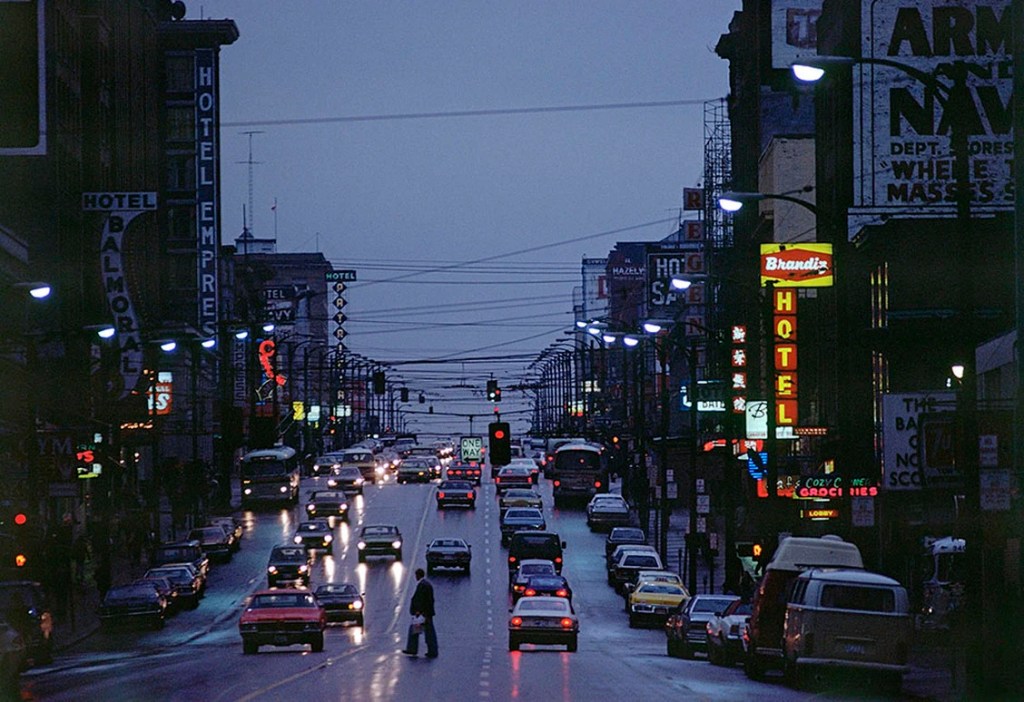
East Hastings Street (Dusk), 1975
Although he grew up in Burnaby, Girard often took these photos during weekend trips into Vancouver where he spend the night in a cheap Downtown Eastside hotel. The neighbourhood has been seedy almost from the moment of Vancouver’s founding, but three devastating developments would profoundly change it in the late 20th century: Harder drugs, the AIDs epidemic and deinstitutionalization of psychiatric patients.
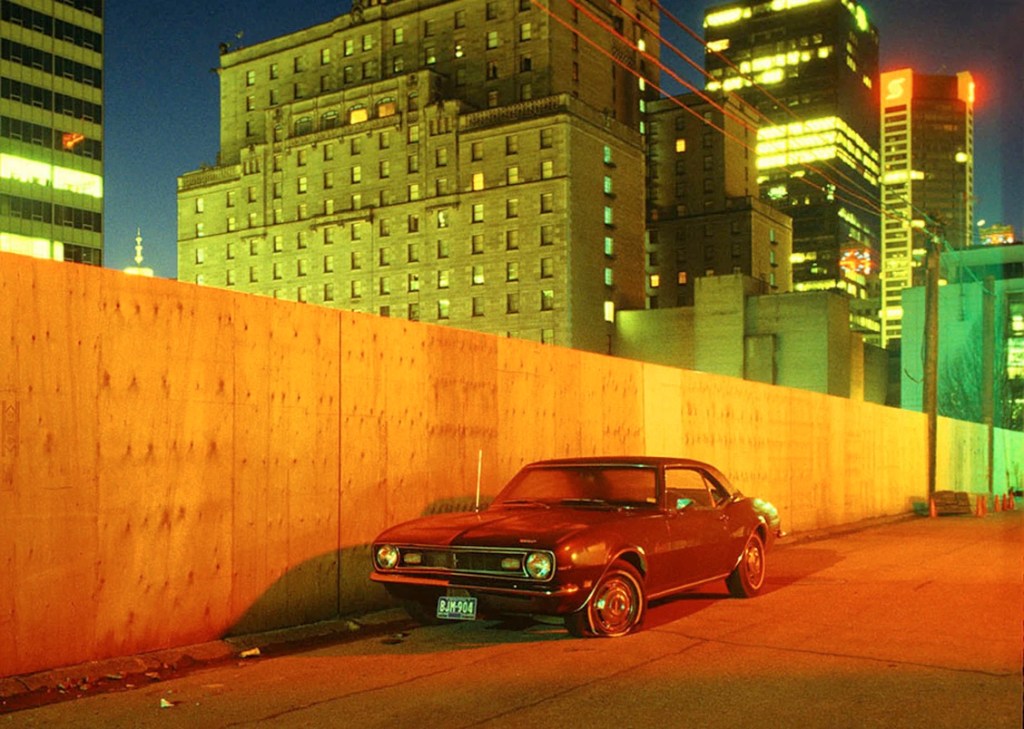
Camaro in Alley, 1981
Just behind this Camaro is the back of the Hotel Vancouver. Girard captured a seemingly desolate scene where a Camaro with a flat tire could sit seemingly forgotten in a downtown alley. Go to that alley now and it’s at the centre of one of Canada’s most high-traffic areas: With high end shopping, gourmet restaurants and towering glass condos on all sides. This was also snapped only a few month before the Vancouver Canucks would first advance to the Stanley Cup finals — marking the last time that the Canucks would make the Stanley Cup finals without sparking a devastating riot.
Silver Grill Café, 1975
Captured during a rare Vancouver snowstorm, this café was at 750 Davie Street, at the heart of what remains the city’s most recognizable “gaybourhood.” The site is now a condo tower, with another condo tower across the street. The café’s neon sign, meanwhile, is now an artifact at the Museum of Vancouver.
Super Valu, 1976
The misty parking lot of a Super Valu, complete with a solitary Volkswagen Beetle. This was still a time when Sunday shopping was banned in most parts of the Lower Mainland. And like any self-respecting retailer of the era, Super Valu had a neon sign, albeit with a malfunctioning “l.” Parts of downtown Vancouver once buzzed with whole forests of elaborate neon signs — until city hall effectively banned the signs in the late 1960s amid arguments that they looked “sleazy.”
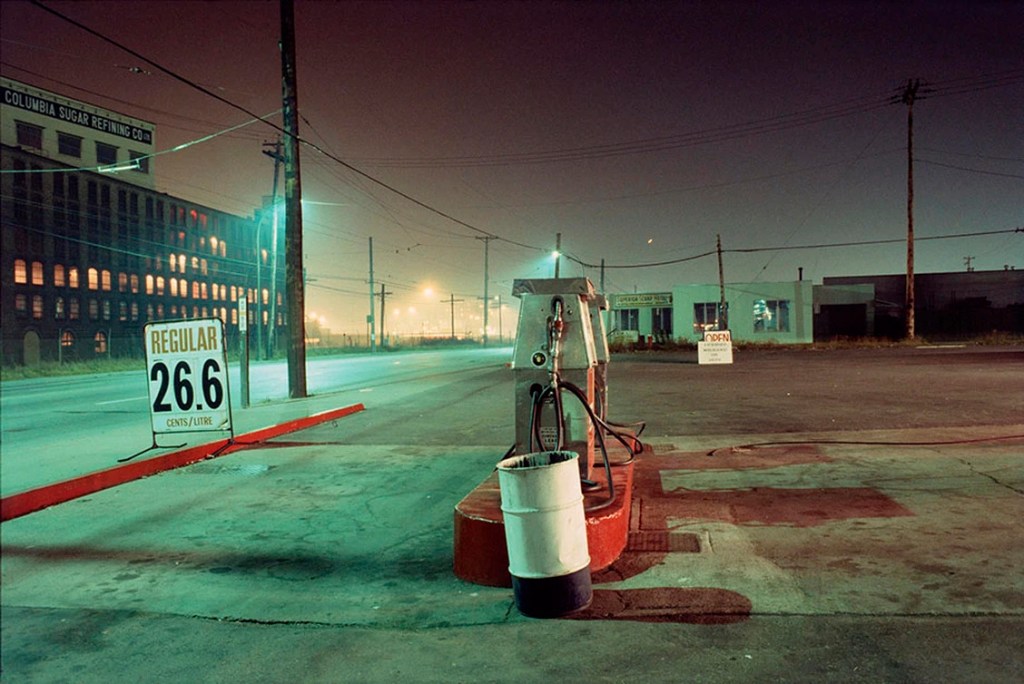
Gas Pumps Near Sugar Refinery, 1981
Obviously, the modern viewer will first note the price: 26.6 cents for a liter of gasoline. The pumps are also analog and unaffected by the prepay legislation that now governs B.C. gas stations. Behind it, however, is the British Columbia Sugar Refining Co., Vancouver’s oldest industrial site. Built in 1890, it’s still there — and it’s still refining sugar.
Tracks and Bridge, 1973
This is the oldest photo in this gallery, taken when Girard was still a teenager. As an official description of Girard’s Vancouver images has noted, this was an era before post-9/11 security concerns effectively sealed off Vancouver’s port and rail facilities. Port Metro Vancouver is now so thoroughly set apart from the life of the nearby downtown that it’s remarkably easy for many residents to forget it’s there.
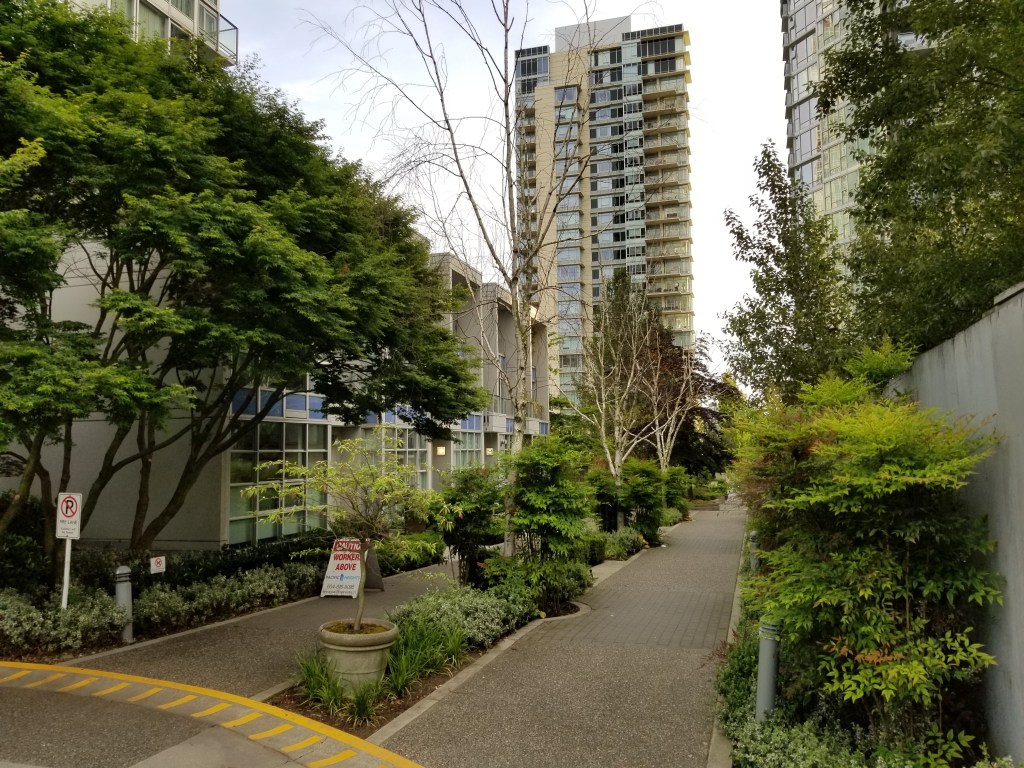
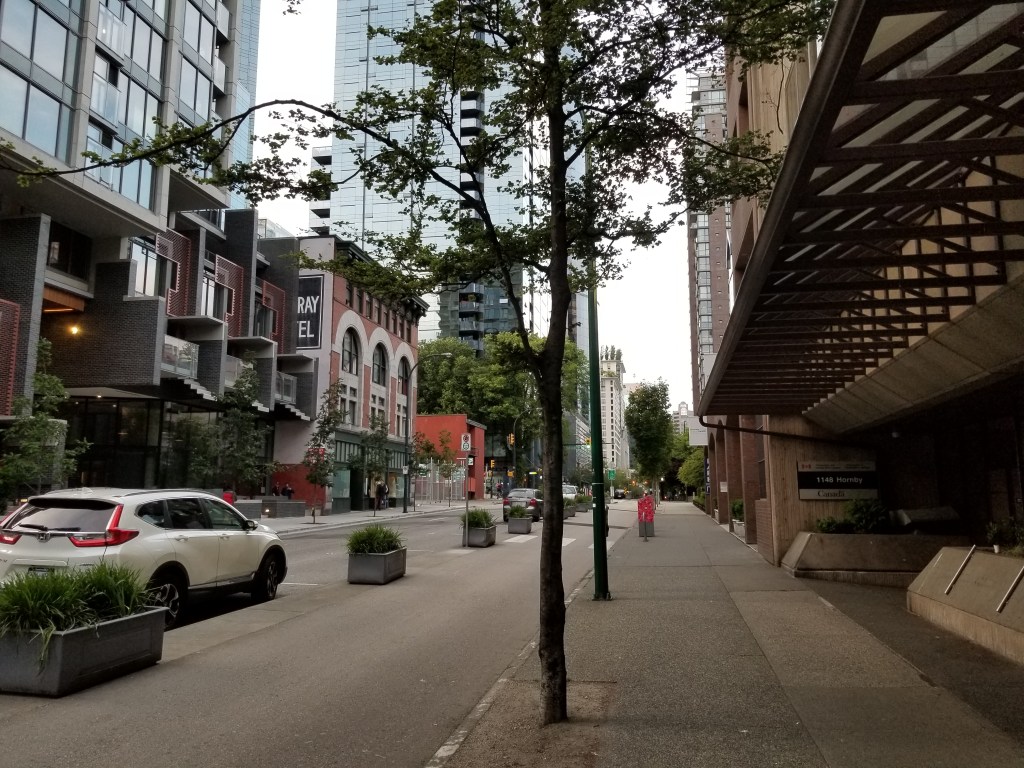
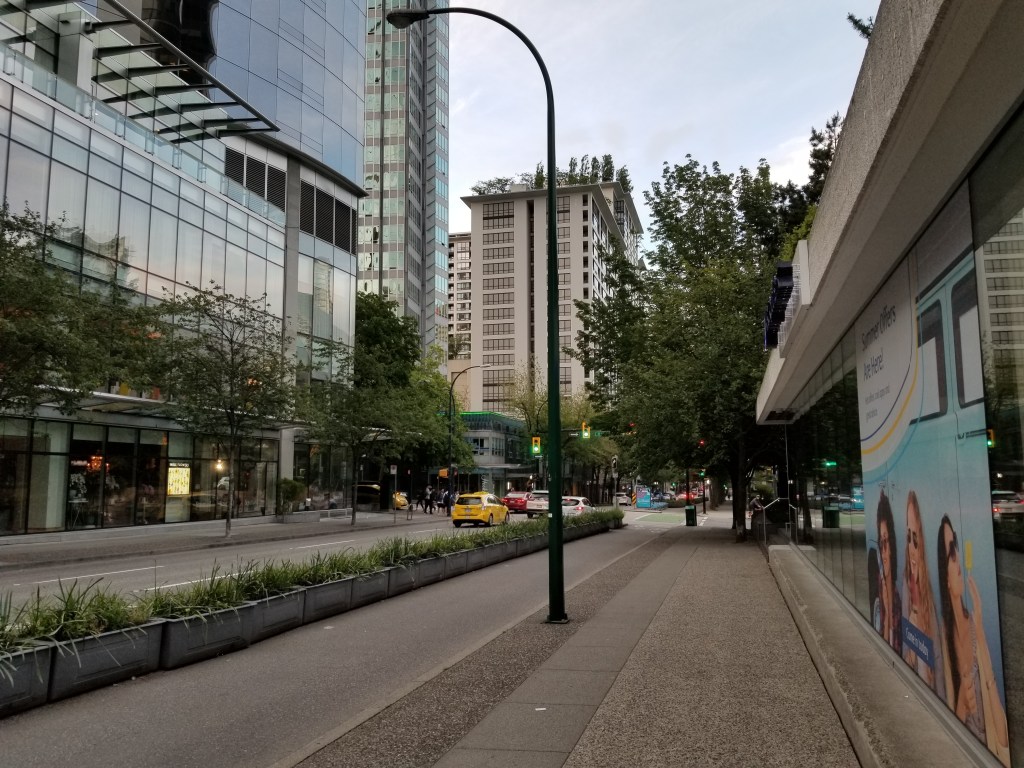
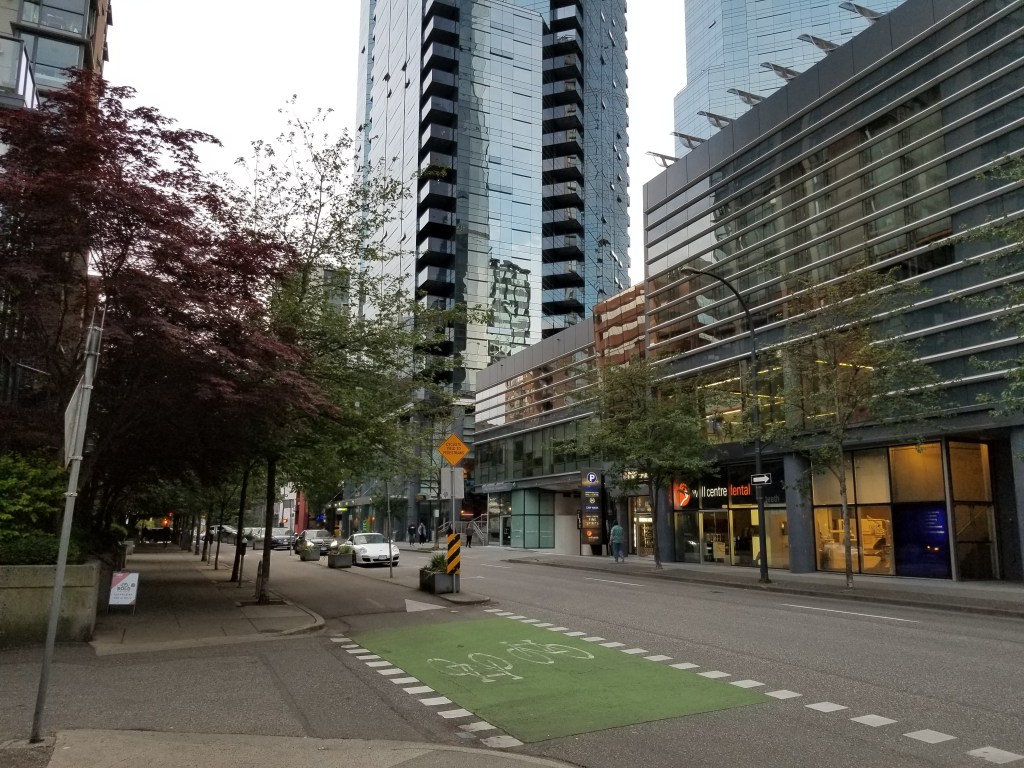
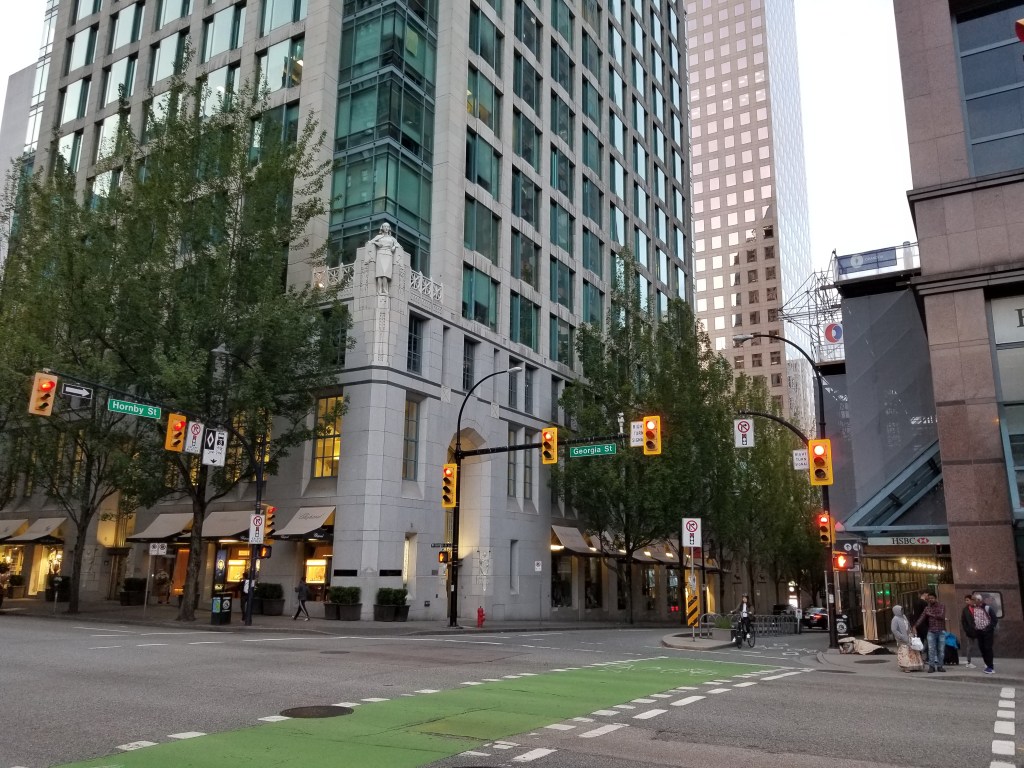
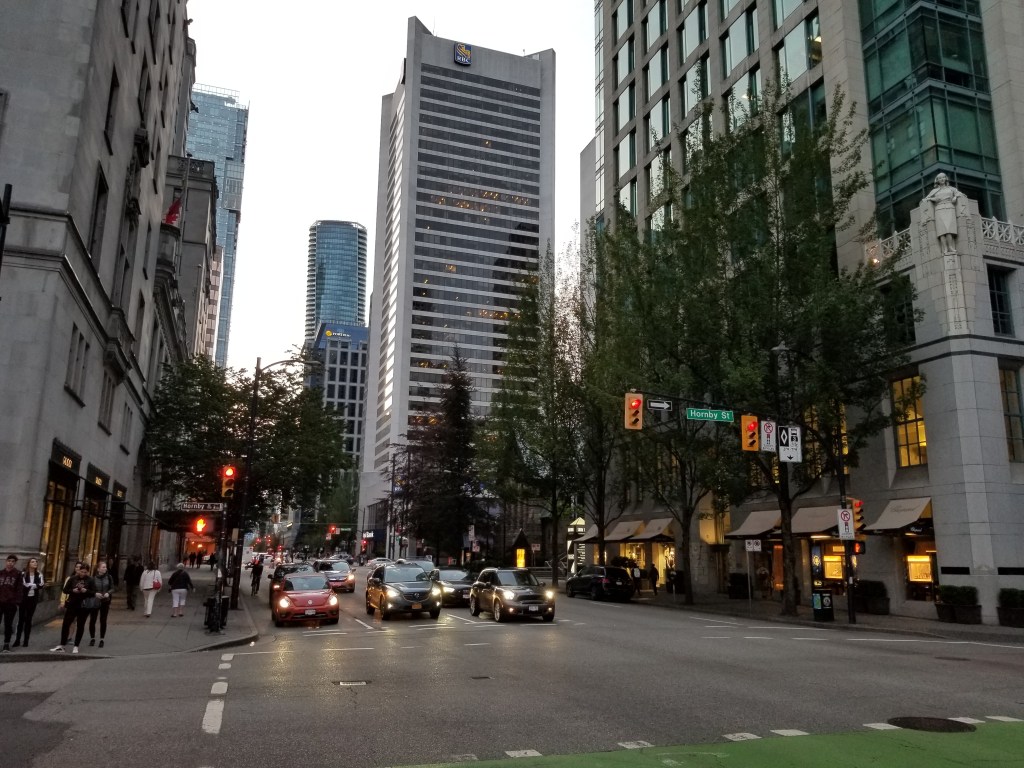
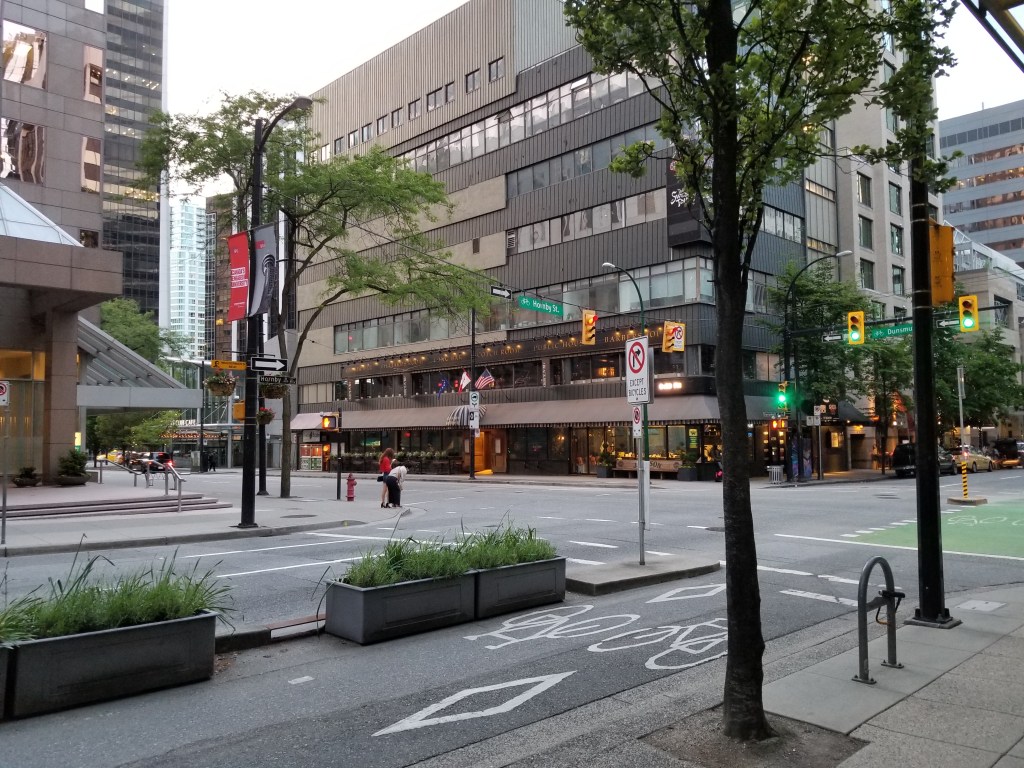
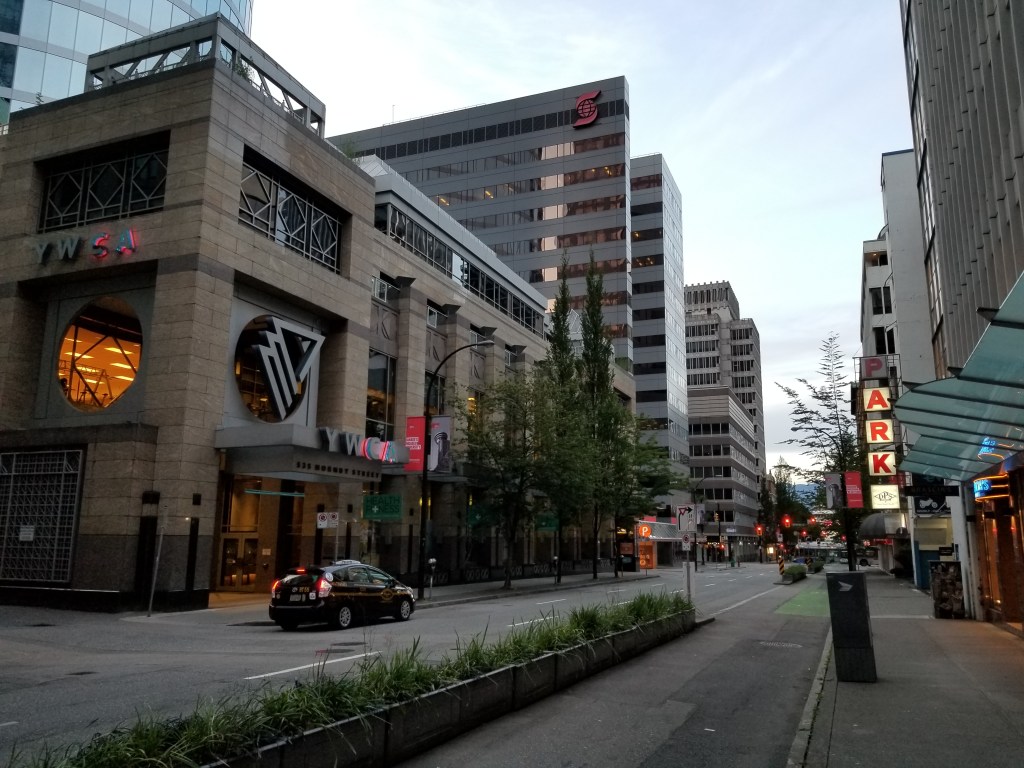
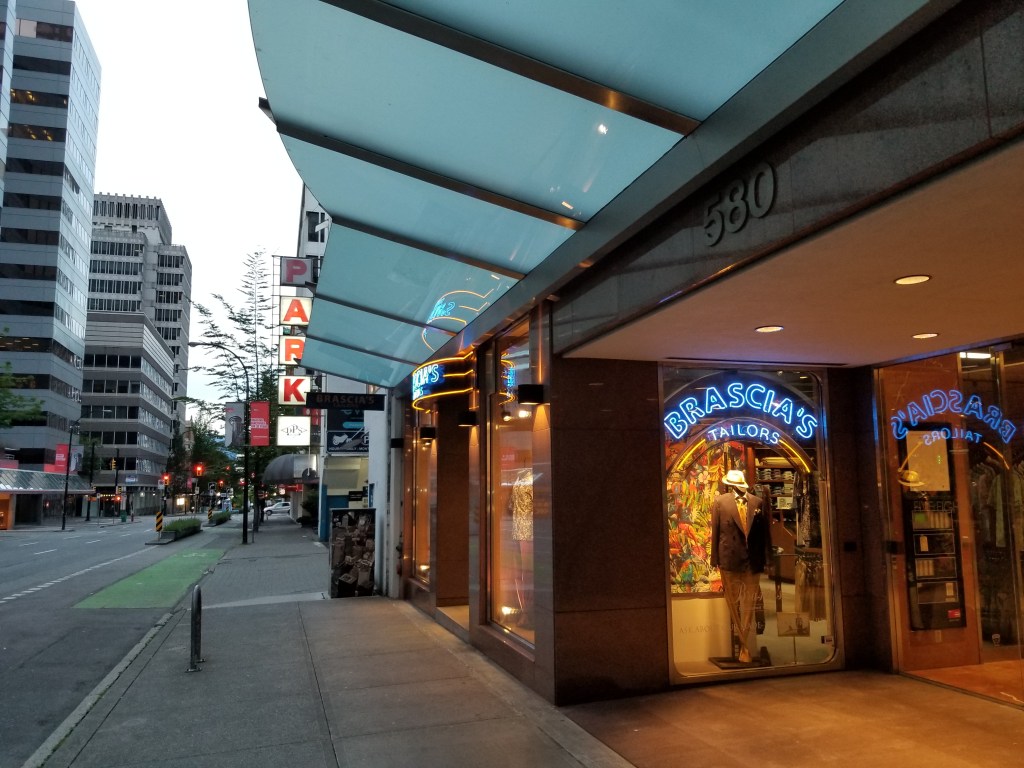
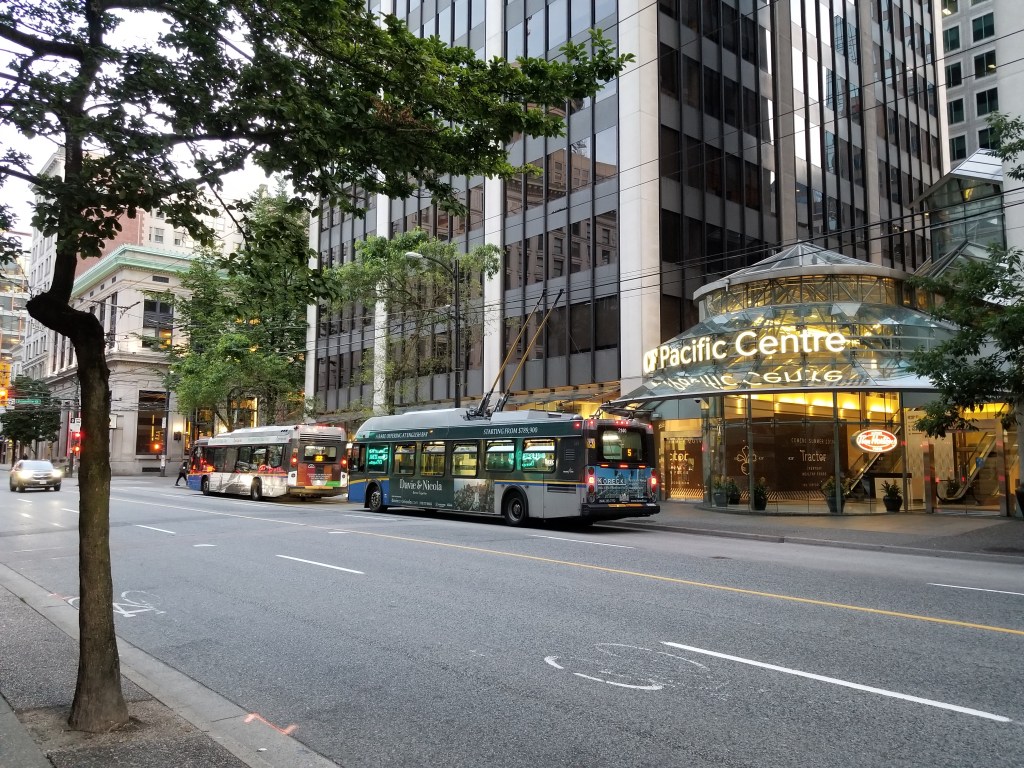
On Hornby Street in Downtown Vancouver. Summer of 2019.
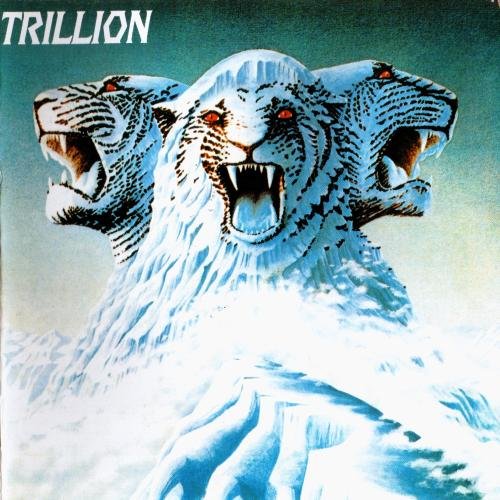
Now listening to The Razors Edge by AC/DC and Trillion by Trillion…