Leonardo was the ‘universal Man who personified the flowering of human achievement known as the Renaissance’, (Bramly, 1994). He painted the most famous painting in the world, Mona Lisa. He had problems with attention and concentration, often did not finish things. He was easily distracted. He had difficulty completing tasks. He was often moving from one activity to another. He moved a lot from place to place and was somewhat hyperactive. He showed a lack of motivation to complete tasks. He tended to move on a lot between art and science. He did move abruptly from one task to another, because this movement from one thing to another was what helped him to bring things together. White (2000) ‘the many confused strands of human knowledge and lent a logic and cohesion to what he understood of the world’. The ADHD was critical for him becoming a polymath. Indeed, he would be seen as primarily a scientist and secondly as a painter. Leonardo ‘got bored and distracted very easily, especially when a project became routine rather than creative’, (Isaacson, 2020). White (2000) sees Leonardo as an ‘untamable eccentric, a risk-taker, a man who strayed very close to the edge of heresy and necromancy, a man gifted in so many ways, it was almost impossible for him to settle upon anything that fascinated him or one skill above others’. Catani and Mazzarello (2019) discussed the issue of grey matter in Leonardi da Vinci: a genius driven to distraction. They pointed out that he had problems with ‘procrastination’, ‘time management’, was ‘constantly on the go’, ‘jumped from task to task’.
Writing:
Bramly (1994) stated that Leonardo ‘wrote backwards from right to left with inverted characters, so his manuscripts have to be read with a mirror … a trait commonly found in left handed people’. Schott (1979) proposed that ‘Leonardo’s language skills were lateralized to the more unusual right hemisphere’.
Parents:
His father had a child, Leonardo, outside of wedlock by a neighbour. His mother, aged 16, Catriona, later married a local farmer and moved to live locally. His father was a notary. His mother moved away from his grandparents when Leonardo was three years old. She was in the neighbourhood, nevertheless. His mother lived nearby after her marriage. Leonardo was somewhat a loner in following his own company. He was brought before a Court for sodomy – the case was dismissed. He might have been set up. He had identity diffusion. He was an anti-sexuality person. He was poor and showed poor financial management, as people with ADHD often do. His uncle, Francesco also helped with his early education (White, 2000). He did not have a formal university education which would have filled his head with scholastic nonsense. He was lucky to have avoided this. He was a highly successful apprentice painter. He was a fashionable dresser. He was a very independent student and independent person in later life.
Childhood:
Being born out of wedlock had serious implications for life chances, including education and work. Leonardo was brought up by his grandparents and had a ‘solitary childhood’ (White, 2000). Sigmund Freud wrote a very poor paper on Leonardo mentioning a vulture rather than a kite and giving a convoluted and bizarre explanation of Leonardo’s homosexuality and creativity. This did serious damage to psychoanalysis and still does today. His uncle, Francesco, who was ’16 years Leonardo’s senior, who lived for many years in the family home and was very close to Leonardo’ (White, 2000). Francesco made Leonardo very interested in landscape, which stayed with him throughout his life. Leonardo possibly got a basic education at a local school, but this is disputed. He was apprenticed to Verrocchio, a painter, around puberty.
Science work:
His method was to ‘consult experience first and then with reasoning, show why such experience is bound to operate in such a way’, (Isaacson, 2020). White (2000) sees him as ‘the first scientist’. He had antedated much later scientists, for example, Newton. He was an experimenter and engineer and always very autodidactic. He showed the characteristics of pure genius in his scientific work including engineering projects and mechanical projects. He was very interested in the overlap between disciplines in anatomy, architecture and mathematics. He was not interested in a ‘singular discourse like an autistic artist’. He was brilliant in every discipline he took an interest in. He could hyperfocus on work for a very long period, like Newton (Fitzgerald & O’Brien, 2007). He would even forget to eat. He did dissection of corpses and anatomical work.
Mona Lisa:
This is the most famous painting in the world. The lady with the enigmatic smile. Certainly, Leonardo himself was enigmatic. There is a question about whether Mona Lisa’s face reflects his enigmatic personality. Mona Lisa only became famous after it was stolen from the Louvre in Paris. Alan Yentob (Brooks, 2003), claims Mona Lisa was probably ‘pregnant’.
Leonardo wanted to ‘know everything’ and was massively observant. He suffered anxiety and depression. He was anti-authority. He had identity diffusion and was probably a practicing homosexual. He was fascinated by music, both composition and performance. He does not appear to have related well to the Medici, the rulers of Florence. This inhibited his career. He was somewhat arrogant and narcissistic and didn’t follow contracts he made, correctly. This led to conflicts including legal conflicts. Leonardo was ‘misanthropic’, had a ‘suppressed hatred for humanity’, (White, 2000). He saw humans as ‘latrine fillers’, (White, 2000). Paradoxically, he was detail focused in his own terms. He was hyperkinetic and ‘a ceaseless wanderer among the avenues and byways of knowledge’, (White, 2000). White (2000) points out that Leonardo was ‘paranoid, constantly afraid his ideas would be stolen, and his work plagiarized’ and employed ‘codes and ciphers’ in his notebooks. He saw the world and people as rather dangerous. He was a suspicious character. He felt safer and not threatened by a 10 year old boy, Sali, who he took on and kept with him for the rest of his life. Sali was early on, a conduct disordered boy but this interested Leonardo. He was more interested in understanding problems than continuing to sort them out to their conclusion. Leonardo was a kind of ‘magpie’, (White, 2000). Leonardo was a compulsive note-taker and list-maker. He had obsessive compulsive traits. He had no problem in working with tyrants and doing engineering work for them. Leonardo said, ‘I would prefer death to inactivity’, (White, 2000). Michelangelo (Arshad & Fitzgerald, 2004) was envious of Leonardo, (White, 2000). Michelangelo shouted an insult at Leonardo on one occasion. Leonardo developed a reputation for ‘unreliability’, (White, 2000).
Conclusion:
Leonardo da Vinci painted the most famous painting in the world, Mona Lisa. Michael White sees him as the First Scientist. Indeed, he seemed more interested in science then art. He was one of the greatest men of the Renaissance. He had neurodevelopmental disorders, (Fitzgerald, 2004) which are very common in great creators, including ADHD.
Michael Fitzgerald, Former Professor of Child & Adolescent Psychiatry
In general, I’ll be reserving this site for full blown novels, as you may have guessed given the title of the blog (I think it’s pretty self-explanatory). However, from time to time I will be exploring some collections, novellas and even short stories, as is the case with this particular installment. Don’t expect to see too many shorts reviewed, as I’ll only be touching down on those works that I feel are truly spectacular. Such is the case with John W. Campbell Jr.’s sci-fi/horror hybrid, Who Goes There?, which most are probably familiar with, whether they realize it or not. See, this eerie little tale serves as the source material for Christian Nyby’s thrilling motion picture, The Thing from Another World (1951) as well as John Carpenter’s far more faithful rendition, The Thing (1982).
While Nyby’s film strays quite far from John’s original story, Carpenter’s take on this one is extremely accurate, so you’ve got a great idea of what this story is about, assuming you don’t live under a rock and have seen The Thing. A group of researchers, stuck in the hazardous climate of Antarctica discover an alien space craft, and one of its inhabitants, frozen deep beneath the surface. A wealth of curiosity and a little thermite leaves the ship a lost commodity, but the alien being is unearthed, salvaged and ultimately taken to this group’s camp for a thorough examination. Scientific inquisitiveness leads to all out chaos when this creature is thawed, and proves to be a shape-shifting menace willing to travel great lengths to ensure survival.
The intensity of this story really resides in the suspense and paranoia that Campbell Jr. creates. There’s nowhere to run for this group, and the capabilities of the creature are far beyond that of mankind, which leaves a stranded band of men thoroughly outclassed, on both a physical and mental level. The impending doom that McReady, Garry, Blair, Clark, Copper and company, face manifests itself quickly, as complete distrust sweeps through the camp faster than a case of the flu. The men learn rather early that the creature is able to mimic the physical and emotional traits of just about any living entity, and that drives everyone in camp to call into question the true identity of the man beside him. Claustrophobic settings only intensify the edge of the story, as it becomes obvious that at the very least, one man has already been absorbed and mimicked by the alien, and he’s got virtually nowhere to go. But, who is The Thing, when will it strike, and has it somehow managed to spread further throughout camp than perceived? Not a soul knows, and that drives the reader about as loony as those who breathe within the pages. And believe me, a handful of these guys really plunge off the deep end.
The pace with which the story unravels is as fluid as one could request, and the mystery reaches a climax at the perfect point. McReady, though second in command, reads as the true hero of the story, while Blair plays the perfect counter: an over the top fanatic completely convinced that everyone in camp must be slaughtered in order to ensure the beast has no means of reaching civilization. In a sense, it forces readers to make a far more in depth examination of the characters within this tale: McReady seems to be the level headed one here, but Blair’s logic holds weight and his intent, though expressed in maniacal fashion, is actually pure and rather selfless. So who is the hero, and who isn’t? Who is the The Thing, and who isn’t? Can anyone escape this terrifying ordeal, or is this base camp destined to freeze to death? John W. Campbell Jr. delivers the answers, and a shitload of taut drama and visceral terror to boot.
If you’re a fan of either cinematic transfer (or even Matthijs van Heijningen Jr.’s “prequel”), and you’ve yet to read this story, I highly recommend it. There’s a suffocating quality (now that sounds like an oxymoron to me) to this tale that commands full attention, and leaves the reader (at least this one) on the cusp of constant panic, considering a seemingly unending level of anxiety. After getting to know the characters portrayed on film, it’s really rather rewarding to meet their original predecessors, as they more than live up to what fans of each feature have grown familiar with.
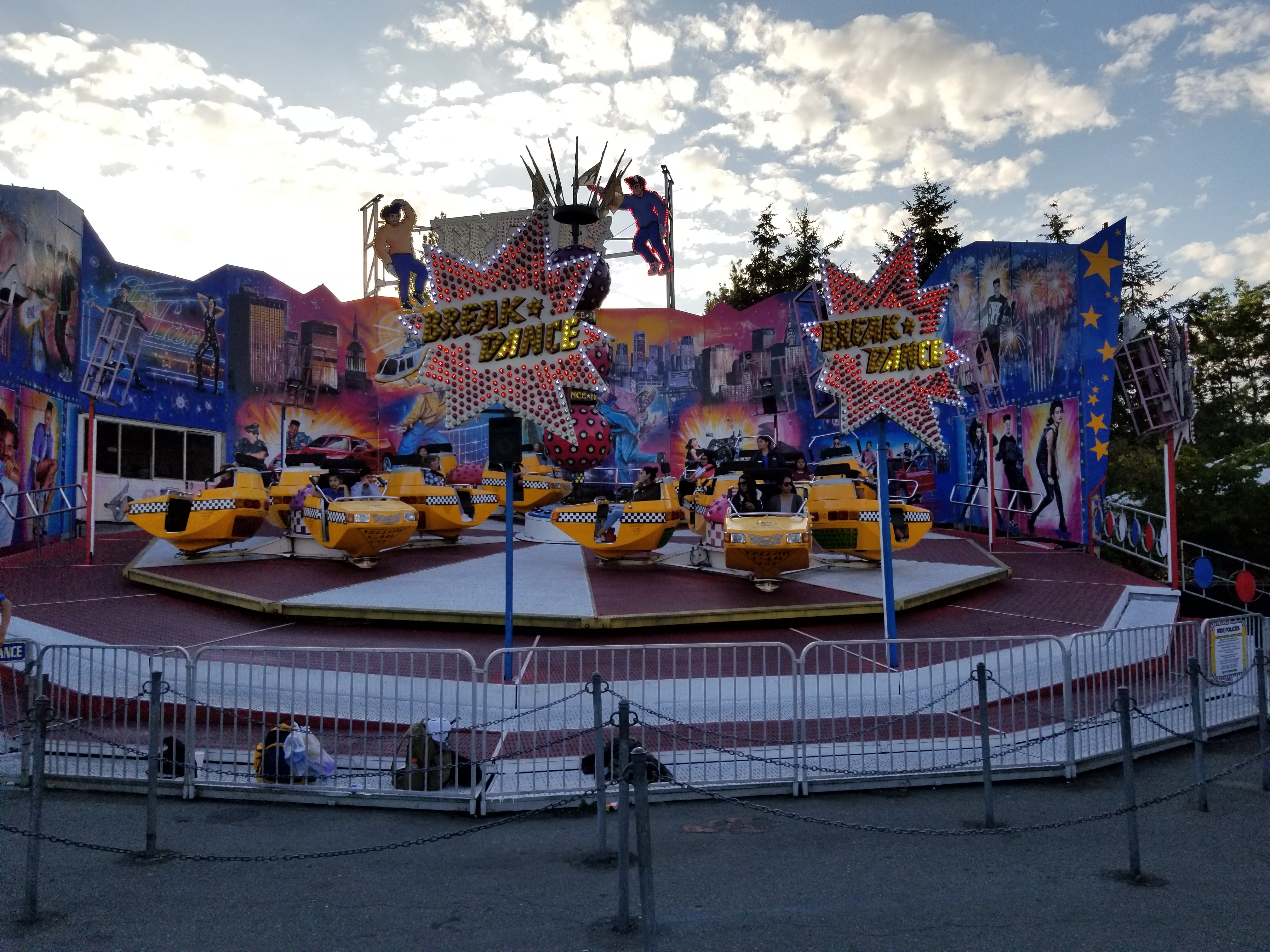
The Pacific National Exhibition (PNE) is a nonprofit organization that operates an annual 15-day summer fair, a seasonal amusement park, and indoor arenas in Vancouver, British Columbia, Canada. The PNE fair is held at Hastings Park, beginning in mid-to-late August and ending in early September, usually Labour Day.
The organization was established in 1907 as the Vancouver Exhibition Association, and organized its first fair at Hastings Park in 1910. The organization was renamed to the Pacific National Exhibition in 1946. During the mid-20th century, a number of facilities were built on the PNE grounds, including Pacific Coliseum and the PNE Agrodome. In 1993, the amusement park adjacent to the PNE, Playland, became a division of the PNE.
The Vancouver Exhibition Association (VEA), the predecessor to the Pacific National Exhibition organization was first formed in 1907; although the association was not incorporated until 18 June 1908. The VEA had petitioned Vancouver City Council to host a fair at Hastings Park; although faced early opposition from the city council and the local jockey club that used the park for horse races. However, the city council eventually conceded to the VEA’s request and granted the association a 5-year lease to host a fair at Hastings Park in 1909.
The VEA held its first fair at Hastings Park in August 1910. It was opened by then Canadian Prime Minister Sir Wilfrid Laurier as the Vancouver Exhibition. The biggest attractions of the two-week fair are its numerous shops, stalls, performances, a nightly fireworks show, and the exhibition’s Prize Home. From its beginnings, the exhibition was used as a showcase for the region’s agriculture and economy.
In the initial years of the Second World War, the fairgrounds saw an increased military presence. However, the exhibition itself was not cancelled until 1942, after the Canadian declaration of war against Japan was issued. From 1942 to 1946 the exhibition and fair was closed, and like the Canadian National Exhibition in Toronto, served as a military training facility for the duration of World War II. During this time, the exhibition barns that were used to house livestock, were used as processing centres for interned Japanese Canadians from all over British Columbia. The interned Japanese Canadians were later shipped away to other internment camps throughout British Columbia, and Alberta. The Momiji (Japanese word for Maple) Gardens on the PNE’s grounds serves as a memorial for the event. The barns used for the internment of Japanese Canadians are still used to house livestock during the annual fair, and serve as storage area to house some of the PNE’s property the rest of the year.
On 7 February 1946, the Vancouver Exhibition Association changed its name to its current moniker, the Pacific National Exhibition; and later reopened the fair to the public under that name in 1947. The organization was formally reincorporated as the Pacific National Exhibition in 1955.
The highest attendance at the fair was recorded in 1986, with 1.1 million guests visiting the PNE, most likely due to Expo 86 that was occurring at the time. In 1993, the amusement park adjacent to the PNE, Playland, became a division of the PNE organization.
During 1997-1998, the PNE grounds was transformed with the demolition of a number of buildings including the Food Building, Showmart and the Poultry Building. This gave way to the Sanctuary, a parkland setting with a pond. The pond restored part of a stream that once flowed in the park out to the Burrard Inlet. The city restored a large portion of the park. Many old fair buildings have been demolished and replaced by a more natural character. Although land was purchased in Surrey that was to become the fair’s new home, the PNE has since transferred ownership from the province to the City of Vancouver and will remain at Hastings Park. The PNE is a registered charity.
Two attractions at the PNE were named as heritage sites by the City of Vancouver in August 2013. The Pacific Coliseum and the Wooden Roller Coaster were added to the list.
In 2020, the fair went on hiatus due to the COVID-19 pandemic, alongside other agricultural and county fairs across Canada, including the Calgary Stampede, the Canadian National Exhibition, and K-Days.
In the early hours of February 20, 2022, a major fire broke out on PNE grounds, where multiple vehicles, tools and equipment, and buildings were destroyed as a result.
The PNE grounds contains several buildings and exhibition halls. The PNE Forum is a 4,200 square metres (45,000 sq ft) exhibition facility that is used for large displays and trade shows. Rollerland is a 1,840 square metres (19,800 sq ft) exhibition, banquet hall and venue for the Terminal City Roller Derby.
Two buildings on the PNE grounds are indoor arenas. The Pacific Coliseum is multi-purpose arena that holds 15,713 permanent seats, with provisions for 2,000 temporary seats for concerts and certain sports. The PNE Agrodome is a smaller indoor arena with 3,000 permanent seats, with provisions to expand up to 5,000 seats. Entertainment facilities includes the Garden Auditorium, a building that features a built-in stage and dance hall. The PNE grounds also feature amphitheatre with bench-style seating for 4,500 visitors.
Other buildings on the PNE grounds includes the Livestock Barns, a large multi-use facility, and the organization’s administrative offices.
Resident Evil 6 may be the most lavishly produced bad game in history.
Resident Evil 6 is a big-budget disaster on the order of the Star Wars prequels, a sprawling production that clearly required so many individual talents to bring it into being, you can’t help but wonder how the end result could have turned out so bad. Then again, the game tries to be so many things to so many different people, the image of a many-headed hydra thrashing violently beyond the control of its developers comes readily to mind. There are a few fleeting moments of greatness in Resident Evil 6, but you’ll likely spend so much time with your head in your hands that you’ll probably just miss them all.
Whatever else could be improved upon in this game is moot, since its fundamentals as a third-person action game are just plain badly implemented. After the great last couple of installments in the core Resident Evil franchise, it’s astounding that the basic act of playing RE6 doesn’t feel at least as good as it did in those games. On the surface, RE6 is made up of the same third-person shooting, button-prompt-driven melee combat, and inventory management, though it goes further in the direction of similar Western action games that focus on moving and shooting in tandem, largely at the expense of the series’ traditionally deliberate style of gameplay. But it doesn’t go far enough to produce a satisfying game of singular intent. In trying to have it both ways, clumsily mixing that more active style of shooter with vestigial elements of the series’ survival-horror past, and peppering the entire thing with excessive Quick Time events and nearly hands-off action set pieces, RE6 takes a tremendous step backwards in terms of basic playability.
The reasons for this are too numerous for any one review, but here goes. The character movement is awkward, the aiming and shooting are stiff, and your basic interactions with enemies feel unresponsive and grossly unsatisfying. With a laser sight that swims around wildly within the targeting reticle and enemies that sometimes feel like bullets are passing right through them, the shooting makes a lousy first impression. And don’t get me started on how clumsy the camera can get when you’re trying to move around in tight spaces, or about the game’s nasty habit of cutting back from a cinematic sequence with your camera angle pointed not only in a different direction than you left it, but also away from the thing you need to focus your attention on. The trusty old 180-degree turn from previous games sometimes turns only your character while leaving the camera stationary, exposing you to unnecessary risk as you then have to manually swivel the perspective around after you’ve wasted time expecting a basic game mechanic to work like it’s supposed to. Playing RE6 is like suffering the death of a thousand cuts, as one minor annoyance and unavoidable death after another chip away at your enjoyment.
Most of Resident Evil 6 is marred by a glaring lack of that video game critic’s old standby, polish. Every time you’re killed instantly by an unavoidable scripted event, it feels like a good opportunity to turn the game off and never turn it back on. Seriously, there were multiple times in more than one level where I or someone I was playing co-op with was killed by some timed event–say, a truck hurtling into the area from offscreen–that you just couldn’t avoid if you didn’t know it was coming, and often don’t even see coming if you don’t happen to have the camera pointed randomly in the right direction. The game rarely communicates what it wants you to do, leaving you in many of the game’s long, multi-phase boss fights to blindly waste ammo as you try to figure out whether you’re effectively doing any damage to an enemy that barely reacts visibly to your attacks.
There are other basic design issues that make the game feel like a chore, like the inability to stop time even while you’re trying to change your brightness or control scheme. You’re never even alerted to the existence of a cover system or dodge mechanics outside of loading-screen tooltips that, at least on the Xbox version I played through, were typically onscreen for less than a second. But the game sure does make a point of driving home how Quick Time events work in its laughable tutorial segment. It never even attempts to explain the quirks of ducking and rolling, which require you to use the same button combo in different ways, but it goes out of its way to make sure you know to push the stick down and hold the A button every time you need to run toward the camera through a barely-interactive scripted chase scene. That’s a telling example of the poor attention to detail here where basic playability is concerned.
To be fair, the more you play RE6, the more you’ll adapt to the long list of quirks that initially conspire to make the combat in this game a miserable experience. Eventually it becomes less miserable, but it never clicks and feels satisfying and engaging the way the best action games do. Think about the brightest lights in the genre on this generation of consoles. For me, it’s games like Infamous and Dead Space that give you immediate, absolute control over your abilities and impart the information for you to make split-second decisions about how to deal with any threat. Those games just feel right. Even at its best, playing RE6 feels like fumbling around blindly in the dark by comparison. The impression is of a game that underwent little to no playtesting, to see how actual human beings would respond to the mechanics and systems that make up the gameplay, and to refine and fix them in the places where they weren’t working.
As Resident Evil goes, this game’s justification for its own existence is questionable in the first place. Resident Evil 4 went to admirable lengths to upend the series’ longstanding fiction by bringing in new antagonists and a new location, and I felt like 5 was already pushing its luck by turning right around and going back to the well with Wesker and the Umbrella Corporation yet again. But at least that game was bold enough to resolve those longstanding story threads with finality, explaining and killing off pretty much everything there was to explain and kill off. Then along comes RE6 with… Neo-Umbrella and the son of Wesker. That’s really the most inspired premise they could conceive? I’ll grant that this game is awkwardly timed at the end of a console cycle, and it’s too soon to go back to the drawing board and completely rebuild Resident Evil from the ground up, but couldn’t Capcom have just put together a more modest side story to fill the necessary spot on the release calendar until then? (Actually, I guess they already did that.)
Whether RE6’s premise strains plausibility or not, the series has had good luck in the past with multiple concurrent campaigns starring different characters, and here you get a whopping four of them. Dandy-haired Leon Kennedy’s vignette feels the most like an old Resident Evil, with the highest concentration of cathedrals and rotting zombies in the game. Square-jawed Chris Redfield’s campaign then goes and does a middling Gears of War impression, with an increased emphasis on taking cover and shooting at enemies who shoot back at you. Then son-of-Wesker Jake moves through a campaign with a disjointed mix of shooting, ill-conceived stealth sequences, and an indestructible Big Bad who chases you through every area like a modern-day Nemesis. Once you finish the three storylines, you unlock a hidden fourth campaign so top-secret it’s mentioned on the back of the box, one that’s meant to give some additional context to everything you’ve seen over the last 20 hours or so.
The idea of this many criss-crossing storylines is a great one, and you do get little nuggets of info in each campaign that expand on the events in the others. It’s hard to get too excited about anything that happens in the game, though, revolving as it does around yet another iteration of the X-virus that’s always been at the center of the whole zombie mess. Nothing of major importance to the Resident Evil continuity takes place here, as every character and story thread introduced at the outset has either been blandly resolved or summarily dismissed by the end, resulting in a conclusion that, as far as Chris and Leon are concerned, might as well never have happened. More damningly, as the game wears on, it becomes more and more disappointing how much content is flat-out recycled from previous campaigns. By the time I got to Jake’s campaign and especially into that last one, I was replaying sequences and boss fights on a disturbingly regular basis that I’d already played before. Sometimes you at least get to take part from a different angle, but just as often you’re literally fighting the exact same boss fight you already did a few hours ago. It’s especially glaring that if you play the campaigns in the recommended order, the first last-boss encounter you face is identical to the very last one. That’s a pretty anti-climactic way to end such a huge production, and it’s emblematic of the many aspects of RE6 that just weren’t thought all the way through.
The game at least earns a few points for sheer audacity. Its scope is enormous; the volume of huge, detailed environmental art crammed in here could fill two or three similar games of average length. And many of those areas are framed and lit to great dramatic effect, though others look like they had less attention given to them, and the frame rate is low enough across the board to diminish the effect of actually moving around in them. Many of the monster designs are creepy as hell (a human torso attached to spider legs and wielding an assault rifle seems like something that just should not exist), and the bosses are plenty big and menacing and impressive to watch, though that effect is often lost in the frustrating trial-and-error required to fight them. The production values in the cinematics are top-shelf, and the character performances are quite well done, with Troy Baker further cementing his status as the new Nolan North in a nicely snarky turn as the wisecracking, in-it-for-the-money merc Jake. And as flat as I found the broad story, there were a couple of honestly affecting human moments that got to me a little bit. But once the moment is over, they don’t really go anywhere.
By the time I’d slogged through the two-dozen-plus hours of the four main campaigns, I couldn’t find it in myself to care much about the return of The Mercenaries, the score-based time attack mode that I used to play obsessively in past games, or Agent Hunt, which lets you match your way into another player’s game as a monster so you can give them some trouble. That’s a great idea, though most of the monsters you end up with aren’t very capable or much fun to control in practice. Mercs is the same as it ever was, which is fine, and by the time I was done with the game, I felt well enough attuned to the combat that I could have given it a pretty effective go, I just had no energy or desire left to do so. It’s worth noting you can once again play the whole game in co-op if you like, though your ever-present, indestructible AI buddy is actually pretty effective in combat, except for the rare moment where they refuse to get themselves over to a tandem door you need to open. That doesn’t happen often, but always seems to happen at the worst times.
At a glance, Resident Evil 6 is built on the basic blueprint of a good action game, swaddled in what must have been one of the most expensive productions in video game history. You could offer a lot of ifs about how to make this game better: if the fat were trimmed out in service of a shorter, tighter campaign; if the designers had drilled down more intently on one style of gameplay rather than trying to cover all of them; if the player’s core interactions with the game were simply as refined as they should have been. But in the real world, we’re left with what’s in the box. It’s hard to fathom how Resident Evil, which almost singlehandedly redefined the action genre just two installments ago, has now become such a strange, mediocre pastiche of the better games this series once inspired. What a bitter irony that is.
We are not “gay” for Cliffy B — we are merely “correct”.
If you have not played Gears of War yet, you probably should.
You do not need to play Gears of War in order to appreciate Gears of War 2. Really, it’s just a story about meatheads shooting evil meatheads.
If you have not played Gears of War 2 yet, you must.
The back of the box negligently does not caution the player about several dangerous factors regarding the game experience. We will tell you that if you are male, you might want to prepare an icepack to place on your crotch before pressing the Start Button, or risk puncturing your expensive high-definition television.
The ESRB is still, shamefully, unable to rate the content of online interactions. You figure that those guys are so smart that they’d have invented a brain surgery procedure that enables psychic powers by now.
The ESRB also fails to mention the “AO” potential: some players are experiencing an “unintended feature” wherein one real-life article of clothing vanishes from their body for every hour of play. We know a guy who ended up without skin, for example.
Any females accidentally overhearing the in-game dialogue or spying a chainsaw duel might become literally impregnated with Cole Train’s baby. Some male players, in fact, are also experiencing this. We felt a little nauseated this morning, and are now knee-deep in contemplating which tight orifice the infant is going to crawl out of.
That’s about it. Gears of War 2 is here, it’s huge, and it’s great. It’s about as much fun — about as easily and painlessly and relentlessly devourable — for a thirty-year-old man as the “X-Men” Saturday morning cartoon was when we were thirteen. The online deathmatches are tight, the co-op campaign is hilarious, and the horde mode is a shining star of game design, evidence that for once the people making a great game understand that it’s great enough to just sit to jiggle on a silver platter until infinity.
We cannot stress enough how much we like “Horde”. A scan of reviews listed on Metacritic leads us to the brick-wall-like realization that not everyone screams about how great it is, so we will have to scream enough for all. Horde is fantastic. If you don’t know what it is, here’s is a description, courtesy of our friend the bullet point:
Gears of War basic rules: cover-based shooting: take cover, shoot guys, move to strategic locations, gate / bottleneck / suppress coming enemies
Cooperate with (ideally) up to four teammates via voice-chat to optimally secure and hold strategic locations and take down the enemy threat
Kill one wave of enemies, and more come
The setting never changes
The enemies come in 50 waves
You might as well just call it an “endless” mode
If anything about Horde disappoints us, it’s that the break between waves is a tiny bit too long, and that some of the epic firefight venues from the single-player campaign don’t make it in as Horde-only levels. We eagerly await the PC version (if they end up making one) so that we can craft our own levels.
Seriously, one Horde level where the player characters have a distinct territorial advantage (maybe they’re shooting from atop a castle wall, trying to keep enemies from getting in a big gate) couldn’t have hurt.
Either way, Horde is real, it is alive; it is Gears of War meets Tetris; it is game mechanics on a silver platter; it is The Contra Stage Which Never Ends. It is the distilled joy of being with one’s bros and fighting the good fight. It is probably better than sex, both on emotional and physical levels. By the end of a ten-wave, brutally unsuccessful slog, you will know more about your bros on the other end of the Xbox Live headset than you learned about your future wife in six years of dating, whether you’re playing the game seriously or not.
Let’s go ahead and mint a brand new law to be obeyed from here on out by all those seeking citizenship in the kingdom of videogames: if your game isn’t fun enough to be enthralling in the context of an endless mode, nothing else about it means stuff.
The campaign mode, on the other hand, simply put, is not the Horde mode. That is about the same as saying that blueberry pancakes are not strawberry pancakes. They are both fantastic, just in queerly different ways.
We will admit to being a tiny bit disappointed with the campaign the first time we played it. There were entire placid thirty-minute segments when we could have sworn our trigger fingers had contracted poison ivy. Eventually, there’s a part that pays gripping and obvious homage to Contra, R-Type, Abadox, Life Force, and a dozen other 8-bit Japanese video games with undeniable virtuosity. Then there’s a long segment where you wander around a ruined building (shades of BioShock) while listening to a disembodied computer voice (shades of Portal). The gun battles are sporadic; the dangers are mostly environmental. You are sneaking around and flipping switches. What the hell is this? you might exclaim.
Eventually, the game opens back up, and the developers are answering the question-mark-less question re: how much the vehicle segment in Gears of War sucked by giving you a turbo-tank capable of Mega Killing two dozen dudes at a time. Shortly afterward, the Real Game Begins, and the promised football-field-sized battlegrounds stacked with staircases and parapets and catwalks and towers and windows begin. After two years of many games trying to be like Gears and not entirely succeeding, after Uncharted gave us scenes of cover-based shooting punctuated by scenes of us pressing the analog stick in various directions to see which one the game wanted us to jump to, we were stricken with a malaise; we wondered, when would someone make a game that combines Shooting Stuff and Doing Stuff into one experience? Gears 2 is that game; one scene has you trying to cross a wide aqueduct while the enemies on the other side attempt to unscrew the wheel and send the water washing you out. You have to keep your eye on the wheel while also keeping your eye on the guys shooting you. It’s simple, and it’s fascinating. Then there’s the part where you’re on a circular elevator, and the enemies are all around you, and overwhelming, and you can screw the wheel to pull the elevator up so you’ve got the high ground temporarily. Again, fascinating. Then you’ve got a soccer-field-sized mad charge toward a badass brick wall, guys with invincible, scary, unpredictable mortars on the other side, and clockwork bulletproof walls activated by pausing long enough to jerk a switch. How can you not love this? You simply can’t come away from this experience above the impression that level design is everything. Hell, the New Yorker caved in and wrote its first-ever in-depth feature on game design because of Gears of War 2. Though we’re aware it would sound crude it we called you an idiot or a brain-dead hater for doubting Gears of War‘s power at this point, we feel confident and correct when we say that you obviously wear a football helmet to bed every night.
Looking back on the Gears of War 2 campaign after it’s all over and dozens of hours of online deathmatch and Horde play have evaporated, it’s apparent that it really is a perfectly put-together videogame, built with meticulous care and a common-sense knowing love of videogames. It is Videogames: The Videogame.
Gears of War 2 is The Legend of Zelda On Fire. We said before — maybe — that the Zelda series is noteworthy less because of the actual execution of the game and more because of the games’ existence as a genre in and of themselves. They are entertainment vehicles, the closest modern games have yet seen of a “Ben Hur”-worthy event. Gears of War 2 takes the he “Zelda Genre” — as perhaps most clearly expressed (for all the good and bad that entails) in the recent Twilight Princess — and cracks out a game with a big plot, with loud parts and quiet parts, with thrilling parts and stoic parts, with heck-yeah parts and hell-no parts, and storms constantly forward, never once relinquishing its status as a game or as a piece of entertainment.
We can hardly call anything about this game “visionary” or “genius”. It’s about as down-to-earth and honest a multi-million-dollar blockbuster entertainment venture as you’re going to get. The characters are creatine-chugging meatheads because that’s what it takes to avoid tripping Middle America’s Homo Alarm prior to YouTube comment #11. It attempts a “deep” “emotional” moment near the climax of its story because this is part hecking two, and if you’re not stepping up the game in part two, you’re doing something wrong — and also because it can, and more importantly because it absolutely has to.
The game development world between 2006 and today has been a relentless flirt session with the 1990s dream of “interactive cinema”. Who played BioShock and didn’t think of those big moving chairs in those mini-theaters at Block Party, where fans blow in your face as the screen shows a flying first-person view of a shabby 3D volcano? People seem to think that hiding the main character’s face and letting the player imagine that it’s them there in that fantastical, slick, computer-generated world is the key to “immersion”. It’s probably not! Budding game developers, pay heed to the sentence following the colon: most game players are (at least) smart enough to realize that what’s happening inside the TV screen is not real. Don’t try to make them think it is real! Just entertain them. Give them a character with a personality — any personality will do — and a visual presence — any visual presence will do.
Gears of War 2 is the way an “interactive movie” is to be done, right down to its blatantly interactive-movie-like vehicle segments. It is fitting that the Unreal Engine middleware pioneers Epic Megagames were the ones to nail it down once and for all. The Unreal Engine is to the game developer as Microsoft Word (we prefer Google Docs, actually, though we say “Microsoft Word” to maximize familiarity) is to the novelist. Gears of War 2 is to the videogame industry as the established screenplay format is to the filmmaker.
(Or, at least, this is how it would be in a perfect world.)
We will not apologize for the movie analogies. In fact, we will be the negative-first ones to acknowledge that games are not movies. This debate is no fun. If you want to know how much like a movie a game should be, see Gears of War 2. Savor the mercifully short cut-scenes. Savor the big-time fights. Be awestruck in the bootpath of the colossal set-pieces.
Like the first Gears, like the beauty of Out of this World, like Shadow of the Colossus, Gears of War 2 expresses that the true glory of an action videogame comes in providing the player with the bits that would be cut out of an action scene in a film. If Shadow of the Colossus were a film, surely the editor would consider five to ten minutes of clinging for dear life on the hairy back of a stampeding stone statue to be a “tad too long”. Yet those segments are indisputably the most thrilling. As are the moments in Gears of War when you’re crouched behind a low wall, breathing heavily, waiting and listening for your enemy’s clip to run out so you can pop up and try to shoot him in the head. The audience of a film will only tolerate so many sparse seconds of a hero breathing heavily with his back against a brick wall. Gears blew the doors off what was becoming a tired genre — the 3D shooter — by forcing the player to bask in the just-barely-too-long moments of desperation. It’s said that the hook of the original Gears was that it was to be a huge-budget shooting game with a solid campaign and a highly competitive, intimate online component. The core concept of taking cover — “stop and pop” as it would later be called — did not step into the spotlight until well into the level design phase. Someone on the level design team — let’s pretend it was Cliffy B himself — envisioned a staircase with a house at the top and guys shooting down at you. How do you make it fun to get to the top of that staircase? They envisioned fallen-over pillars, piles of debris to hide behind. And then, when you get to the top of that staircase, enemy reinforcements arrive; you shoot them from a ducked position behind a window in the house. Action films are all about what happens at points A point B, with car trips elided, with Indiana Jones’ air travels shooed into a red line drawing itself on a map; Gears spoke to a future of action-based entertainments where getting there, literally, was all of the fun. The game mechanics were born of white-hot necessity.
So Gears of War 2 doesn’t have anything nearly as immediately virtuoso as the staircase sequence. It doesn’t need it. It has giant, Rube-Goldberg-device-like battlefields with interlocking gimmicks and rock-hard opponents. It’s got guys shooting mortars at you — in a game that has trained you to take cover, mortars are scarier than survival horror. You have to get out of that cover and try to kill the mortar guys, or else you’re not going to live to see the next desperate duel.
More than this, Gears 2 plays exceptionally well. Many people complained that the heroes of Gears were a little too tank-like in movement, that the aiming speed was a tiny bit too slow. Gears 2 is a more sensitive and sensible game. The crosshair’s slide speed is delicately refined. The guns feel less like GI Joes and more like Tonka trucks. The enemies are meaner. The tactics work remarkably better. The two-player co-op campaign play is fiercer — levels are more astutely designed to encourage players to communicate. Suppressing a group of enemies while your partner runs parallel to your gun-stream to flank and shotgun (or chainsaw) the cowering foe (or foes) has never been more satisfying.
The tactics of each individual battle are worthy of their own paragraph. This is that paragraph. The first Gears felt like a videogame based on a movie based on John Madden Football ’93 produced by the people behind “Super Mario Bros. The Movie”. In Gears 2, it all comes together. The pacing of every little gun skirmish is sublime: here we have a game with all the minute-to-minute clockwork-like sophistication of, say, The Lost Vikings or Portal, executed so transparently that the player never realizes he’s doing more than holding a gun, pointing a gun, shooting a gun, and killing things. Playing Gears of War 2 well will make you feel like a Nobel Prizewinning physicist — and more than that, like a man.
So let’s get back to what we were saying about the characters being dumb meatheads, and about the game being a template more than anything else. It’s very clear to us that Gears is merely an extension of Epic’s middleware developer’s conscience. It is a call to action. It is them saying, “Hey guys, let’s make more games like this”. We feel like we really shouldn’t have to explain what we mean by this; however, judging by the failure of Scotch-tape-scented cologne to exist already, we realize that maybe the rest of the world isn’t as brilliant as we are, so we’ll spell it out:
Basically, just take Gears and, say, change the heads of the main characters. Square-Enix could get Tetsuya Nomura or (hopefully) Akira Toriyama to design new faces. Slap them on there, and you’ve got yourself another hit game. Change the dialogue a little bit and it’d even feel new.
People put up serious money to see cookie-cutter action movies every year. What we’re saying is, if you’re going to make a game that blatantly rips off another game, for god’s sake, rip off Gears of War 2, not BioShock. We would never dare to say that games need good stories to be good. Though when we stop to think about it, we realize that if Gears of War 2 had a different story and characters, it’d at least feel new, and worth playing again. And what do you know — maybe, eventually, with all the game design decided from the start, someone would end up making a game with a great and actually emotionally affecting story.
Moreover, we notice an incredible and delicious void waiting to be filled: the art-film equivalent of Gears of War. Maybe this is how the producers envisioned Dark Sector, though they must have given up along the line. We’re waiting for the real deal. Maybe it won’t even involve guns. (Gears 2‘s guns are excellent, by the way. Never have guns sounded more delicious as bullets exit their muzzles and slam wetly into alien muscle-flesh.)
How about a medieval fantasy Gears of War? The Boomshield item in Gears of War 2 gets us thinking. Maybe your main character has a shield and a spear. Archers on the opposite end of the battlefield shoot arrows from time to time. You have to stop and hold up the shield. Maybe you could make this class-based and online multiplayer: transplant the aesthetics of an massively multiplayer online role-playing game into a ferociously straightforward campaign-based action game. You could make your own avatar at the beginning of the game, give him whatever armor and weapons you see fit to use from a generous pool of items (swords, spears, longswords, broadswords, throwing daggers). Each item has a plus and a minus. Heavy armor protects you longer, though makes you move more slowly, that sort of thing. One player can be an archer, suppressing enemies while the spear-man flanks and skewers them. You choose your hero’s armament at the beginning of the game; the story doesn’t change. Think of the replay value. We could replace the RPG genre entirely with something like this. Gears is The One Genre — it is the genre of gaming that, for now, we might as well just call “The Entertainment Game”.
If we had to point out any negatives, the most glaring one would be the lack of Xbox Avatar support. They should have future-proofed the game. We would love nothing more than to chainsaw and/or blast our friends’ avatars into bloody piles of pulp. Also, the distinct possibility of seeing Marcus Fenix touch a scarily accurate rendition of our real-life self on the shoulder and implore us to “FIGHT THROUGH THE PAIN!” would allow us the joyous opportunity to die of a sudden blood clot to the prostate.
Another thing — and this is especially painful when playing on Insane difficulty — why must the screen fade out completely and ask us if we want to reload a checkpoint whenever we die in the single-player campaign mode? It’s kind of maddening. If we want to restart the chapter or exit to the main menu, we will consult the in-game pause menu, thank you very much! That the Xbox 360 is still plugged into the wall and drawing delicious, icecap-melting power is testament to our will to fight through the pain and kill these alien bastards. Again, we remember something we said about Call of Duty 4, about the mind-expanding possibility of a shooting game with no “death”, a game that unfolded like a quick-time event, with each “failure” simply slotting the player down a slightly different path. This would, of course, be too much work for any group of humans to perform in today’s two-year development cycle, so we’ll just settle for Looney-Tunes-like instant rebirth.
We’re actually not sure where to end this. We were keeping a running tally of Ridiculous Sentences Uttered During Online Co-op with the intention of mentioning them in one gut-busting paragraph, though most of them aren’t that great without context, and actually kind of puzzle us to look at them.
“Cole, get your HEAD out of my FACE!”
Et cetera.
We could mention some of the incredible glitches we encountered, like how occasionally, in a battle with mortars during single-player, it would just so happen that sometimes both Marcus and Dom would be downed at the same time, crawling around toward each other, for a full thirty seconds. (Usually, mortars were involved.) This was kind of infuriating! If we’d been playing two player co-op, we would have no doubt employed the Greatest Sentences of all-time, as born in Shadowrun: “Dude, my body is still alive.” “Dude, is your body dead?” “Dude, they are going to kill my body.”
Instead — and this is a little jarring — when Dom is knocked out in the single-player campaign, you literally hear his voice actor shout the words “REVIVE ME!” Somehow, “REVIVE ME” is so much more eerily clinical than “My body isn’t dead yet dude; My body is still alive” simply by virtue of the fact that it’s being spoken by the voice actor of a character who actually has a bullet-pointed “Oscar Clip Moment” somewhere in the script. It’s weird to suddenly learn that, in addition to having a wife who has gone missing during an apocalyptic war against genocidal alien mutant freak bastards, this man also learned his military lingo from playing Xbox Live as a thirteen-year-old. These Gears have been fighting this war longer than any of us will ever know.
Kate Beckinsale’s 45th birthday was certainly memorable.
The actress joined her daughter Lily and ex-boyfriend Michael Sheen for a yoga session with a pack of goats.
The animals clambered on and off the trio, as they showed off their form on the yoga mat.
The Love & Friendship star shared videos and photos of the experience on her Instagram account in which she documented the hilarity that ensued.
‘Best birthday ever. We all prayed that the goat’s blessings would happen on Michael’s mat and they did,’ Beckinsale wrote in the caption.
‘Thank you #laughingfrogyoga and #hellocrittercare for such a fun day and also to Billy and Burlap, for knowing instinctively where to friendly fire ❤️❤️❤️.’
During the routine, Kate showed off her fit figure in animal print tights and a gray and white sports bra.
Her hair was put up into a ponytail and of course, she rocked a fresh face throughout the session.
In some of the photos, you can see Sheen practicing a downward dog pose while a goat stands on his back.
The actress’ 19-year-old daughter Lily also had a goat stand directly on her back while striking a pose.
The best part about their fun day had to be when Kate got a lovely birthday kiss.
Not only did the actress enjoy yoga with goats, but she also shared a birthday smooch with one as well.
The beauty shared a clip that showed her putting a treat in between her lips, letting the goat take a nibble.
‘Birthday kisses ,’ Beckinsale wrote in the caption.
Even more hilarious than that, had to be the sweet gift Kate’s daughter gave her.
Lily showed her love for her mother in a cake depicting her mother as ‘Katy B’ — an image taken from Cardi B’s debut album cover for Invasion of Privacy.
‘Help me my kid’s amazing @lily_sheen @cakeandart #katyb,’ the proud mother captioned a picture of the cake.
Kate’s known to be an avid animal lover, sometimes oversharing photos of her two cats on Instagram.
The mother of one shared a photo of her cat Clive wearing a dinosaur outfit in December.
‘Clive woke up in beast mode,’ she wrote in the caption of the photo in which Clive sat still in a cute dinosaur costume.












 Igor's Blog