

I’m still re-reading ‘Tragedy and Hope: A History of the World in Our Time’ (1966) by Carroll Quigley. Another bit of information that I found to be interesting this time is in the chapter about World War I, and, therefore, I will post a quote of it. “This discrepancy existed for many years before the war and began to disappear only in the course of 1918. As a result of its existence, the first three years of the war witnessed the largest military casualties in human history. These occurred as a result of the efforts of military men to do things which were quite impossible to do. The German victories of 1866 and 1870 were the result of theoretical study, chiefly by the General Staff, and exhaustive detailed training resulting from that study. They were emphatically not based on experience, for the army of 1866 had had no actual fighting experience for two generations, and was commanded by a leader, Helmuth von Moltke, who had never commanded a unit so large as a company previously. Moltke’s great contribution was to be found in the fact that, by using the railroad and the telegraph, he was able to merge mobilization and attack into a single operation so that the final concentration of his forces took place in the enemy country, practically on the battlefield itself, just before contact with the main enemy forces took place. This contribution of Moltke’s was accepted and expanded by Count von Schlieffen, chief of the Great General Staff from 1891 to 1905. Schlieffen considered it essential to overwhelm the enemy in one great initial onslaught. He assumed that Germany would be outnumbered and economically smothered in any fighting of extended duration, and sought to prevent this by a lightning war of an exclusively offensive character. He assumed that the next war would be a two-front war against France and Russia simultaneously and that the former would have to be annihilated before the latter was completely mobilized. Above all, he was determined to preserve the existing social structure of Germany, especially the superiority of the Junker class; accordingly, he rejected either an enormous mass army, in which the Junker control of the Officers’ Corps would be lost by simple lack of numbers, or a long-drawn war of resources and attrition which would require a reorganized German economy. The German emphasis on attack was shared by the French Army command, but in a much more extreme and even mystical fashion. Under the influence of Ardant Du Picq and Ferdinand Foch, the French General Staff came to believe that victory depended only on attack and that the success of any attack depended on morale and not on any physical factors. Du Picq went so far as to insist that victory did not depend at all on physical assault or on casualties, because the former never occurs and the latter occurs only during flight after the defeat. According to him, victory was a matter of morale, and went automatically to the side with the higher morale. An artillery barrage as a necessary preliminary to infantry assault was used almost from the beginning. It was ineffectual. At first no army had the necessary quantity of munitions. Some armies insisted on ordering shrapnel rather than high-explosive shells for such barrages. This resulted in a violent controversy between Lloyd George and the generals, the former trying to persuade the latter that shrapnel was not effective against defensive forces in ground trenches. In time it should have become clear that high-explosive barrages were not effective either, although they were used in enormous quantities. They failed because: (1) earth and concrete fortifications provided sufficient protection to the defensive forces to allow them to use their own firepower against the infantry assault which followed the barrage; (2) a barrage notified the defense where to expect the following infantry assault, so that reserves could be brought up to strengthen that position; and (3) the doctrine of the continuous front made it impossible to penetrate the enemy positions on a wide-enough front to break through. The efforts to do so, however, resulted in enormous casualties. At Verdun in 1916 the French lost 350,000 and the Germans 300,000. On the Eastern Front the Russian General Aleksei Brusilov lost a million men in an indecisive attack through Galicia (June-August, 1916). On the Somme in the same year the British lost 410,000, the French lost 190,000, and the Germans lost 450,000 for a maximum gain of 7 miles on a front about 25 miles wide (July-November, 1916). The following year the slaughter continued. At Chemin des Dames in April, 1917, the French, under a new commander, Robert Nivelle, fired 11 million shells in a 10-day barrage on a 30-mile front. The attack failed, suffering losses of 118,000 men in a brief period. Many corps mutinied, and large numbers of combatants were shot to enforce discipline. Twenty-three civilian leaders were also executed. Nivelle was replaced by Petain. Shortly afterward, at Passchendaele (Third Battle of Ypres), Haig used a barrage of 4.25 million shells, almost 5 tonnes for every yard of an 11-mile front, but lost 400,000 men in the ensuing assault (August-November, 1917). The failure of the barrage made it necessary to devise new methods, but military men were reluctant to try any innovations. In April, 1915, the Germans were forced by civilian pressure to use poison gas, as had been suggested by the famous chemist Fritz Haber. Accordingly, without any effort at concealment and with no plans to exploit a breakthrough if it came, they sent a wave of chlorine gas at the place where the French and British lines joined. The junction was wiped out, and a great gap was opened through the line. Although it was not closed for five weeks, nothing was done by the Germans to use it. The first use of gas by the Western Powers (the British) in September, 1915, was no more successful. At the terrible Battle of Passchendaele in July 1917, the Germans introduced mustard gas, a weapon which was copied by the British in July 1918. This was the most effective gas used in the war, but it served to strengthen the defense rather than the offense, and was especially valuable to the Germans in their retreat in the autumn of 1918, serving to slow up the pursuit and making difficult any really decisive blow against them. The tank as an offensive weapon devised to overcome the defensive strength of machine-gun fire was invented by Ernest Swinton in 1915. Only his personal contacts with the members of the Committee of Imperial Defence succeeded in bringing his idea to some kind of realization. The suggestion was resisted by the generals. When continued resistance proved impossible, the new weapon was misused, orders for more were canceled, and all military supporters of the new weapon were removed from responsible positions and replaced by men who were distrustful or at least ignorant of the tanks. Swinton sent detailed instructions to Headquarters, emphasizing that they must be used for the first time in large numbers, in a surprise assault, without any preliminary artillery barrage, and with close support by infantry reserves. Instead they were used quite incorrectly. While Swinton was still training crews for the first 150 tanks, fifty were taken to France, the commander who had been trained in their use was replaced by an inexperienced man, and a mere eighteen were sent against the Germans. This occurred on September 15, 1916, in the waning stages of the Battle of the Somme. An unfavorable report on their performance was sent from General Headquarters to the War Office in London and, as a result, an order for manufacture of a thousand more was canceled without the knowledge of the Cabinet. This was overruled only by direct orders from Lloyd George. Only on November 20, 1917, were tanks used as Swinton had instructed. On that day 381 tanks supported by six infantry divisions struck the Hindenburg Line before Cambrai and burst through into open country. These forces were exhausted by a five-mile gain, and stopped. The gap in the German line was not utilized, for the only available reserves were two divisions of cavalry which were ineffective. Thus the opportunity was lost. Only in 1918 were massed tank attacks used with any success and in the fashion indicated by Swinton. The year 1917 was a bad one. The French and British suffered through their great disasters at Chemin des Dames and Passchendaele. Romania entered the war and was almost completely overrun. Bucharest being captured on December 5th. Russia suffered a double revolution, and was obliged to surrender to Germany. The Italian Front was completely shattered by a surprise attack at Caporetto and only by a miracle was it reestablished along the Piave (October-December, 1917). To weaken Germany the Entente Powers began a blockade of the Central Powers, controlling the sea directly, in spite of the indecisive German naval challenge at Jutland in 1916, and limiting the imports of neutrals near Germany, like the Netherlands. To resist this blockade, Germany used a four-pronged instrument. On the home front every effort was made to control economic life so that all goods would be used in the most effective fashion possible and so that food, leather, and other necessities would be distributed fairly to all. The success of this struggle on the home front was due to the ability of two German Jews. Haber, the chemist, devised a method for extracting nitrogen from the air, and thus obtained an adequate supply of the most necessary constituent of all fertilizers and all explosives. Before 1914 the chief source of nitrogen had been in the guano deposits of Chile, and, but for Haber, the British blockade would have compelled a German defeat in 1915 from lack of nitrates. Walter Rathenau, director of the German Electric Company and of some five dozen other enterprises, organized the German economic system in a mobilization which made it possible for Germany to fight on with slowly dwindling resources. On the military side Germany made a threefold reply to the British blockade. It tried to open the blockade by defeating its enemies to the south and east (Russia, Romania, and Italy). In 1917 this effort was largely successful, but it was too late. Simultaneously, Germany tried to wear down her Western foes by a policy of attrition in the trenches and to force Britain out of the war by a retaliatory submarine blockade directed at British shipping. The submarine attack, as a new method of naval warfare, was applied with hesitation and ineffectiveness until 1917. Then it was applied with such ruthless efficiency that almost a million tons of shipping was sunk in the month of April 1917, and Britain was driven within three weeks of exhaustion of her food supply. This danger of a British defeat, dressed in the propaganda clothing of moral outrage at the iniquity of submarine attacks, brought the United States into the war on the side of the Entente in that critical month of April, 1917. In the meantime the German policy of military attrition on the Western Front worked well until 1918. By January of that year Germany had been losing men at about half her rate of replacement and at about half the rate at which she was inflicting losses on the Entente Powers. Thus the period 1914-1918 saw a race between the economic attrition of Germany by the blockade and the personal attrition of the Entente by military action. This race was never settled on its merits because three new factors entered the picture in 1917. These were the German counterblockade by submarines on Britain, the increase in German manpower in the West resulting from her victory in the East, and the arrival on the Western Front of new American forces. The first two of these factors were overbalanced in the period March-September, 1918, by the third. By August 1918 Germany had given her best, and it had not been adequate. The blockade and the rising tide of American manpower gave the German leaders the choice of surrender or complete economic and social upheaval. Without exception, led by the Junker military commanders, they chose surrender. The most important diplomatic event of the latter part of the First World War was the intervention of the United States on the side of the Entente Powers in April 1917. The causes of this event have been analyzed at great length. In general there have been four chief reasons given for the intervention from four quite different points of view. These might be summarized as follows: (1) The German submarine attacks on neutral shipping made it necessary for the United States to go to war to secure “freedom of the seas”; (2) the United States was influenced by subtle British propaganda conducted in drawing rooms, universities, and the press of the eastern part of the country where Anglophilism was rampant among the more influential social groups; (3) the United States was inveigled into the war by a conspiracy of international bankers and munitions manufacturers eager to protect their loans to the Entente Powers or their wartime profits from sales to these Powers; and (4) Balance of Power principles made it impossible for the United States to allow Great Britain to be defeated by Germany. Whatever the weight of these four in the final decision, it is quite clear the neither the government nor the people of the United States were prepared to accept a defeat of the Entente at the hands of the Central Powers. Indeed, in spite of the government’s efforts to act with a certain semblance of neutrality, it was clear in 1914 that this was the view of the chief leaders in the government with the single exception of Secretary of State William Jennings Bryan. Without analyzing the four factors mentioned above, it is quite clear that the United States could not allow Britain to be defeated by any other Power. Separated from all other Great Powers by the Atlantic and Pacific oceans, the security of America required either that the control of those oceans be in its own hands or in the hands of a friendly Power. For almost a century before 1917 the United States had been willing to allow British control of the sea to go unchallenged, because it was clear that British control of the sea provided no threat to the United States, but on the contrary, provided security for the United States at a smaller cost in wealth and responsibility than security could have been obtained by any other method. The presence of Canada as a British territory adjacent to the United States, and exposed to invasion by land from the United States, constituted a hostage for British naval behavior acceptable to the United States. The German submarine assault on Britain early in 1917 drove Britain close to the door of starvation by its ruthless sinking of the merchant shipping upon which Britain’s existence depended. Defeat of Britain could not be permitted because the United States was not prepared to take over control of the sea itself and could not permit German control of the sea because it had no assurance regarding the nature of such German control. The important fact was that Britain was close to defeat in April 1917, and on that basis the United States entered the war. The unconscious assumption by American leaders that an Entente victory was both necessary and inevitable was at the bottom of their failure to enforce the same rules of neutrality and international law against Britain as against Germany. They constantly assumed that British violations of these rules could be compensated with monetary damages, while German violations of these rules must be resisted, by force if necessary. Since they could not admit this unconscious assumption or publicly defend the legitimate basis of international power politics on which it rested, they finally went to war on an excuse which was legally weak, although emotionally satisfying.”


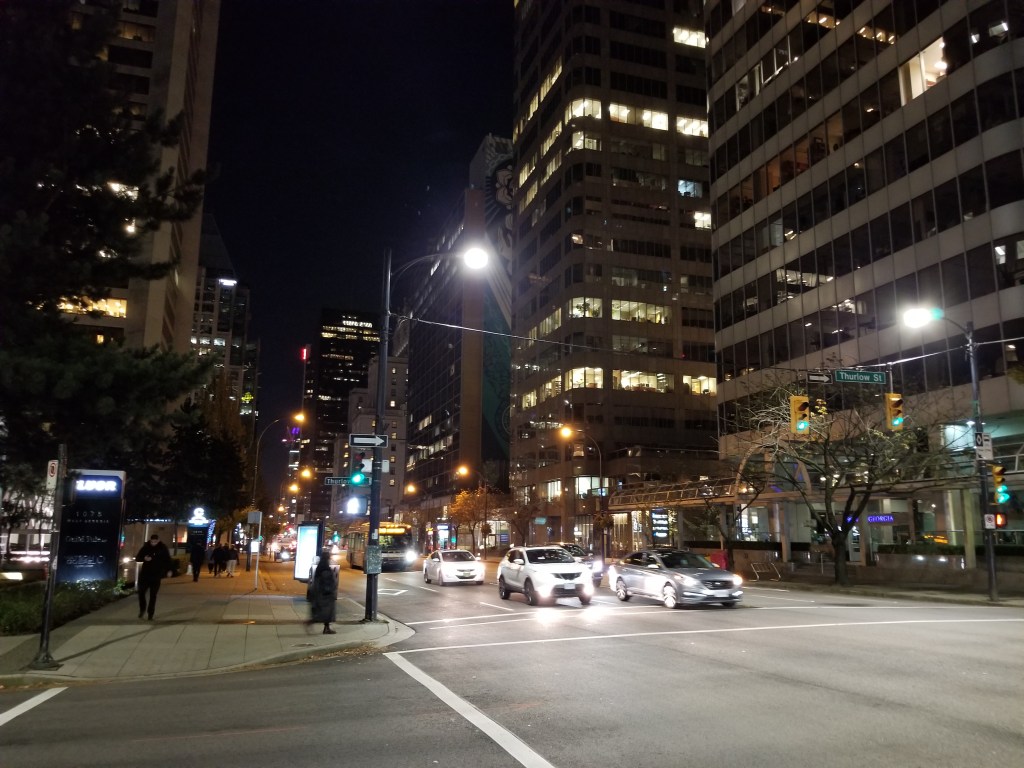
Seymour Street stretches from Pacific Boulevard in the south (near the False Creek area) to the edge of Stanley Park in the north, where it transitions into a residential and commercial corridor. It crosses key east-west streets like West Georgia Street and Dunsmuir Street, making it a central artery in the downtown grid. It passes through vibrant districts such as Yaletown (south of False Creek), the central business district, and the West End, offering a mix of commercial, residential, and cultural spaces.
The Vancouver Heritage Site Finder highlights 1295 Seymour Street, a former Federal Motor Company showroom and Chapman’s Garage built in 1920. This structure is noted as a rare surviving example of early 20th-century industrial-commercial architecture in Vancouver, reflecting a minimalist, functional design typical of automotive workshops from that era. The 1200-block of Seymour Street once housed a cluster of similar workshops, though most have been replaced by modern developments, making 1295 Seymour a valuable historical relic.
The WeWork location at 333 Seymour Street is a well-regarded coworking hub, spanning seven floors with amenities like a fitness center, showers, and pet-friendly policies. Reviews praise its central location, modern design, and community-driven atmosphere, with staff like Sade, Yammy, and Vera enhancing its appeal. It’s easily accessible via public transit (e.g., buses at Cordova Street) and bike stations, reflecting Vancouver’s emphasis on sustainable transport. The Mark at 1372 Seymour Street is a notable condominium development in the Downtown Vancouver West area, near Pacific Street. Recent sales data (e.g., #1503 sold for $30K under asking on July 19, 2025) indicate a competitive market, with the building offering luxury units in a prime location. This reflects ongoing urban densification and investment in the area.
Seymour Street’s proximity to the SeaBus terminal and major transit routes makes it a hub for commuters. The street map data confirms its role as a navigable, pedestrian-friendly corridor with Google Street View available for exploration. The street blends historic charm with contemporary urban life, hosting a mix of offices, shops, and residential towers. Its central location near Gastown and the waterfront adds to its appeal for professionals and residents alike.

The Austrian botanist Gregor Johann Mendel was a genius of the plodding, hardworking, single-minded sort – a genius for whom discovery was, as Thomas Edison put it, one percent inspiration and 99 percent perspiration. He was not a playful, intuitive genius like Picasso. (The great painter once said, “I do not seek — I find,” an attitude that describes many of the men and women we now think of as geniuses.)
Mendel “toiled, almost obsessively, at what he did. But still he had that extra 1 percent, that inspiration that helped him see his results from a slightly different angle. It was this flash of insight that allowed Mendel to perform a feat of genius: to propose laws of inheritance that ultimately became the underpinning of the science of genetics” (Henig, 2001, p. 6).
According to Henig (2001) it was Mendel’s non-heroism that allowed him to do the patient, thorough work through which his genius emerged (p. 168). A science was named in his honor: Mendelian genetics. High-functioning autism/Asperger Syndrome would be highly useful in this kind of plodding work, and this chapter presents the evidence that Mendel displayed this condition.
Mendel made the first tentative step towards a concept that would not be fully elucidated for another 50 years: the difference between phenotype (the way something looks) and genotype (the particular combination of genes that explains those looks) (Henig, 2001).
Life History
Mendel was born on July 22, 1822, near Udrau, in Austrian Silesia. His father, a farmer, did some experimental work with grafts to create better fruits. Mendel entered the Augustinian cloister at Briinn, and was ordained a priest. Having studied science at Vienna, he returned to Briinn and later became abbot. He studied plant variation, heredity, and evolution in the monastery’s garden, particularly in pea plants. (It is interesting that many adults with autism work well in gardens; e.g., at Dunfirth in Ireland, people with autism live and work at activities such as organic vegetable growing that are intended to foster their growth and development.)
Mendel died at Briinn in January 1884, from Bright’s disease (inflammation of the kidneys). Later, he was heralded as the father of genetics. During his years of anonymity, the priest was fond of telling his friends, “My time will come.”
Work
According to Henig (2001), Mendel “observed that traits are inherited separately and that characteristics that seem to be lost in one generation may crop up again a generation or two later, never having been lost at all. He gave us a theoretical underpinning for this observation, too: he believed the traits passed from parent to offspring as discrete, individual units in a consistent, predictable, and mathematically precise manner” (p. 7). Sixty years after his death, a friend stated, “Not a soul believed his experiments were anything more than a pastime, and his theories anything more than the maunderings of a harmless putterer” (Henig, 2001, p. 164). During the winter, Mendel spent as much time as he could in the monastery library, doing meticulous work. His relationship to peas was probably similar to that of other persons with autism to numbers.
Social Behavior
Mendel was essentially homebound for his first forty years. In one photograph he is “standing in the precise middle of the group and looking off somewhere past the photographer’s left shoulder” — he stands “erect and alone” (Henig, 2001, p. 121).
Mendel was a very shy person, with major peer and relationship problems. He had a naturally reticent personality: a friendly reserve with an underlying privacy. He was unable to do the most basic work that priests were required to do and was not in good health. He took to bed with a mysterious illness. Abbot Napp, the head of the monastery, stated that he was “seized by an unconquerable timidity when he has to visit a sick-bed or to see anyone ill or in pain. Indeed, this infirmity of his has made him dangerously ill” (Henig, 2001, p. 37).
When trying to do some teaching, he panicked and performed poorly at a teaching assessment that involved both an oral and a written examination. Professor Kanner, who examined his geological essay, described it as arid, obscure, and hazy, his thinking as erroneous, and his writing style as hyperbolic and inappropriate. Clearly Mendel had been an autodidact. Six years later he again tried to pass the certificate examination but panicked again and failed. According to Henig (2001), he was relegated for the rest of his career to the rank of uncertified substitute teacher.
Narrow Interests/Obsessiveness
As a boy Mendel was a disappointment to his father because of his reluctance to get out of bed. Mendel was attracted to book learning and joined the local monks.
Henig (2001) referred to a “one-track, simmering genius that had a chance to explode only years later, when the twin stars of intuition and accident were momentarily aligned in Mendel’s favor, providing him an insight into the mystery of inheritance that few but he were prepared to understand” (p. 22). Henig thought that as a young man Mendel was probably eager, driven, and scientifically voracious. Nevertheless, he had interests other than experimental science: He became the official “weather watcher” for the city of Briinn and recorded meteorological readings every day. The fame that he longed for would come to him in his lifetime primarily as a local meteorologist. He was a skilled chess player (persons with autism are often interested in chess); he kept bees and gathered honey. He regarded his bees as his “dear little animals.”
According to Henig:
Mendel was also forever amusing himself with scientific and mathematical ideas that had nothing to do with plants. On the back of a draft of one of his dozens of church-tax missives, he scribbled lists that showed that, even in the midst of administrative tasks, he set himself new intellectual challenges. One of the most intriguing was a list of common surnames. Using several directories — the Military Year Book of 1877, the register of transporters, the register of bankers, a barristers’ year book — Mendel collected more than seven hundred names, which he arranged in different ways in an apparent attempt to spot some sort of pattern. First he placed them in alphabetical order, then he grouped them according to meaning. (2001, p. 165)
Mendel’s experimentation with peas was tedious work: In the autumn of 1857 alone, he had to shell, count, and sort by shape more than 7,000 peas, and that was just for one experiment, involving crosses between round and angular peas (Henig, 2001, p. 81). By the time he finished his work, seven years after he began, Mendel had conducted seven versions of this experiment, seven different monohybrid crosses, designed to look at plants that varied in only a single trait (shape first, then color, then height). By the time he had completed this succession of crosses, re-crosses, and backcrosses, he must have counted a total of more than 10,000 plants, 40,000 blossoms, and a staggering 300,000 peas. Virtually no one except a person with autism could do this.
Henig (2001) noted that Mendel applied his passion for counting almost indiscriminately to everything in his own little world. He counted not only peas but weather readings, students in his classes, and bottles of wine purchased for the monastery cellar. People with high-functioning autism are fascinated by numbers.
After Mendel became abbot of his monastery, he engaged in an obsessive letter-writing campaign against the new “monastery tax,” which he continued until his death.
Routines/Control
“Monastery life was a balm to Mendel. Its regularity provided ease and comfort to a man who had spent his first twenty-one years in a thicket of uncertainty” (Henig, 2001, p. 25).
The orangery became his favorite place in the monastery. This is reminiscent of Ludwig Wittgenstein writing his philosophy in the warm botanic gardens in Dublin. He furnished the orangery with “a game table for playing chess; an oak writing table; six rush-bottomed nut wood chairs; and a few paintings. In his last years, when as abbot he could use the monastery’s grandest rooms, he still spent his time in the orangery … working through the mathematical, biological, and meteorological problems that vexed and intrigued him all the days of his life” (Henig, 2001, p. 65).
Language/Humor
Mendel, even to the end of his life, had a waggish and somewhat mischievous sense of humor, and “collected good jokes the way Darwin collected barnacles” (Henig, 2001, p. 163). He once upset the local bishop by saying, in what he thought was a whisper, that the bishop possessed “more fat than understanding.” He would “walk slowly among the plants, which he liked to call his ‘children’ to get a reaction from visitors who did not know about his gardening experiments. “Would you like to see my children?’ the priest would ask. Their startled and embarrassed faces were always good for a chuckle” (Henig, 2001, p. 116).
Anxiety/Depression
Mendel became paranoid later in his life, just like Isaac Newton, and was suspicious of everyone, even his fellow monks, whom he thought to be “nothing but enemies, traitors and intriguers” (Henig, 2001, p. 162).
Mode of Thought
Mendel became interested in combination theory, which describes the relationship among the objects in a group arranged in any predetermined way. Henig (2001) saw this belief in combination theory as a mark of Mendel’s genius: “Throughout history, some of the most creative minds have been those capable of maintaining two different mental constructs of the world simultaneously and applying the principles of one model to problems in the domain of the second” (p. 54).
The day he died, the local Natural Science Society heard a eulogy that referred to his “independent and special manner of reasoning” (Henig, 2001, p. 166).
Appearance
Henig (2001) quoted an acquaintance who described Mendel as “a man of medium height, broad-shouldered … with a big head and a high forehead, his blue eyes twinkling in the friendliest fashion through his gold-rimmed glasses. Almost always he was dressed, not in priest robes, but in the plain clothes proper for a member of the Augustinian order acting as schoolmaster — tall hat; frock coat, usually rather too big for him; short trousers tucked into topboots.” His dress “bespoke his decorum and modesty; he was out in the world, but always a cleric” (p. 90). It is interesting that he is supposed to have had a big head: 50% of people with autism have big heads. This may be due to less pruning of cells early in life but may lead to a greater capacity to carry out mathematical calculations. When he walked, according to an acquaintance, he looked straight in front of him.
Conclusion
Mendel showed many of the criteria for Asperger Syndrome, particularly obsessiveness, social impairment, and love of routine. He also had the interest in counting, classifying, and mathematical calculation that is quite typical of the syndrome.