


The Sundarbans covers 10,000 km2 of land and water (more than half of it in India, the rest in Bangladesh) in the Ganges delta. It contains the world’s largest area of mangrove forests. A number of rare or endangered species live in the park, including tigers, aquatic mammals, birds and reptiles.
Brief synthesis
The Sundarbans contain the world’s largest mangrove forests and one of the most biologically productive of all natural ecosystems. Located at the mouth of the Ganges and Brahmaputra Rivers between India and Bangladesh, its forest and waterways support a wide range of’ fauna including a number of species threatened with extinction. The mangrove habitat supports the single largest population of tigers in the world which have adapted to an almost amphibious life, being capable of swimming for long distances and feeding on fish, crab and water monitor lizards. They are also renowned for being “man-eaters”, most probably due to their relatively high frequency of encounters with local people.
The islands are also of great economic importance as a storm barrier, shore stabiliser, nutrient and sediment trap, a source of timber and natural resources, and support a wide variety of aquatic, benthic and terrestrial organisms. They are an excellent example of the ecological processes of monsoon rain flooding, delta formation, tidal influence and plant colonisation. Covering 133,010 ha, the area is estimated to comprise about 55% forest land and 45% wetlands in the form of tidal rivers, creeks, canals and vast estuarine mouths of the river. About 66% of the entire mangrove forest area is estimated to occur in Bangladesh, with the remaining 34% in India.
Criterion (ix): The Sundarbans is the largest area of mangrove forest in the world and the only one that is inhabited by the tiger. The land area in the Sundarbans is constantly being changed, moulded and shaped by the action of the tides, with erosion processes more prominent along estuaries and deposition processes along the banks of inner estuarine waterways influenced by the accelerated discharge of silt from sea water. Its role as a wetland nursery for marine organisms and as a climatic buffer against cyclones is a unique natural process.
Criterion (x): The mangrove ecosystem of the Sundarbans is considered to be unique because of its immensely rich mangrove flora and mangrove-associated fauna. Some 78 species of mangroves have been recorded in the area making it the richest mangrove forest in the world. It is also unique as the mangroves are not only dominant as fringing mangroves along the creeks and backwaters, but also grow along the sides of rivers in muddy as well as in flat, sandy areas.
The Sundarbans support a wealth of animal species including the single largest population of tiger and a number of other threatened aquatic mammals such as the Irrawaddy and Ganges River dolphins. The site also contains an exceptional number of threatened reptiles including the king cobra and significant populations of the endemic river terrapin which was once believed to be extinct. The property provides nesting grounds for marine turtles including the olive riley, green and hawksbill. Two of the four species of highly primitive horseshoe crab (Tachypleus gigas and Carcinoscorpius rotundicauda) are found here. The Sajnakhali area, listed as an Important Bird Area, contains a wealth of waterfowl and is of high importance for migratory birds.
Integrity
The property is situated within a larger UNESCO Biosphere Reserve that was designated in November, 2001. It is well protected and largely undisturbed as it is surrounded by three wildlife sanctuaries which act as a buffer zone, as recommended in the original 1987 evaluation report. However, the salinity of the Indian Sundarbans, largely due to the eastward shift of the mouth of the Ganges, is being influenced by upstream diversion of up to 40% of the dry season flow of the Ganges, the repercussions of which are not clearly understood. Oil spills are a potential threat which cause immense damage, especially to aquatic fauna and seabirds and probably also to the forest itself into which oil could be carried by high tides. An average of 45 people were killed annually by tigers from 1975-1982. This has caused certain conflicts with local people who use the adjacent Tiger Reserve for collection of honey and firewood and for fishing.
Protection and management requirements
The legal protection provided to the property is adequate. The Indian Forest Act, 1927 with its amendments, Forest Conservation Act 1980, Wildlife Protection Act, 1972 and Environment Protection Act 1986 are being effectively implemented, with rules and regulation regarding environmental pollution strictly enforced. The existing laws are sufficiently strict in respect to the protection and conservation of the property.
The property is currently in a good state of conservation with regular maintenance undertaken according to a set maintenance schedule. There is an approved Management Plan of the property.
With the existing infrastructure, the Forest Department is making its best efforts, although there is a need to maintain and enhance the level of financial and human resources to effectively manage the property. This includes an ecosystem approach that integrates the management of the existing protected areas with other key activities occurring in the property, including fisheries and tourism. There is a need to develop alternate livelihood options for the local population to eliminate the dependence of people on the Sundarbans ecosystem for sustenance. Maintenance of participatory approaches in planning and management of the property is needed to reinforce the support and commitment from local communities and NGOs to the conservation and management of the property. Research and monitoring activities also require adequate resources.
The Neglinnaya River (Russian: Неглинная), also known as Neglinka, Neglinna, Neglimna (Неглинка, Неглинна, Неглимна), is a 7.5-km long underground river in the central part of Moscow and a tributary of the Moskva River. It flows in the tunnels under Samotechnaya Street, Tsvetnoy Boulevard, Neglinnaya Street and Alexander Garden and Zaryadye. The Neglinnaya discharges into the Moskva River through two separate tunnels near Bolshoy Kamenny Bridge and Bolshoy Moskvoretsky Bridge.
There is no need to remind the reader in what situation Russia and the Russians found themselves as a result of the crisis in their history, which happened after 1985. This information is already known from numerous sources. But there still remains a shroud of secrecy over the fact that that situation did not happen merely as a result of untoward historical developments, but had been diligently planned by certain forces in the West and artificially imposed on the Russians. That condition is the consequence of one of the greatest tragedies in the social history of mankind. The tragedy which began in the mid 1980s may with high probability have a fatal end for Russia, but I do not count on my ability to turn the course of history and ward off this end. This may only be done by a great effort of millions of people, by persistent struggle and self-sacrifice. I am moved by the call of duty of a Russian person, who sees the tragic outcome of the Russian history and thinks it criminal to keep silence.
Actual historical developments are always a combination of two processes: 1) ‘elemental’, unplanned and uncontrolled; 2) conscious-volitional, planned and controlled. Their proportions and roles vary with certain limitations. The domination of the second type will lead to a situation, when the general line of development is monitored, and only less important components may be out of control.
If we intend to give a scientific description of these processes, we will require quite different methodologies and sets of concepts. ‘Elemental’, natural processes are described with the concepts and postulates of dialectic. For the conscious-volitional processes we would need a different methodology, based on the knowledge of what social plans (projects) are, how and why they are created, how they are executed, and by what rules. Though this other methodology does not exclude dialectic, it implies an essentially different focus of attention while examining social objects.
All famous theories of social evolution proceed from the explicit or implicit view on history of mankind as an ungoverned natural process, beyond human will and conscious planning. This view was formed at a time, when people knew very little about the laws of their social life and had few ways of influencing their own evolution, let alone controlling it. The powers of mankind were not enough to manage history: there were several rivaling alliances, and the idea of international unity seemed an unattainable utopia. There were regions with great autonomy and even those independent of the mainstream evolution tendencies.
But beginning with the latter half of the 20th century the situation in the world fundamentally changed, so that the view on history as a natural process has become an anachronism. Humankind has entered an era when evolution no longer develops by its own freaks, but rather by conscious deliberate planning. In fact, planning has become the dominant factor in the range of factors conditioning history. Multitudes of people and huge resources have been involved in history; acting for the same end, they have enhanced the role of the subjective factor in history. This, coupled with the achievements in the research of social phenomena, processes and human behavior, has resulted in the situation, when the measure of control over history and the efficiency of trimming its course to plans have grown. On the pragmatic side, mass communications, manipulation technologies and means of solving problems on a large scale have become incredibly sophisticated. Immense intellectual powers and great resources have been put on to solving numerous problems, so that the percentage of unforeseen, unexpected historical developments has been drastically reduced as compared with predictable and planned ones. All the mentioned factors have combined to bring about a qualitative change in human evolution.
The historical process, which decided the fate of Russia in the late 20th century, was essentially conscious-volitional, preplanned, although it did contain certain uncontrolled, ‘elemental’ features. I would define it with the help of the concept of social tragedy.
SOCIAL TRAGEDY
The word ‘tragedy’ itself is polysemantic, its meaning is rather fuzzy for a scientific concept. But this holds true for most other terms of sciences, studying social objects. So I think its use is quite justifiable. If we wish to understand the essence of what happened to Russia and the Russian people at the end of the 20th century and what we can expect to come in the 21st century, we should study this concept carefully.
In everyday speech we commonly use the word ‘tragedy’ to denote events, which cause loss of lives of individuals or death of groups of people. Not every death may be called ‘tragedy’. For example, this word will be used inaccurately to denote death of soldiers in a war. To call death a tragedy, one has to refer to his/ her own or other people’s experience of this death as a tragedy. And this experience has to be so strong, that all other experiences fade in its face.
In antiquity the meaning of tragedy had a narrower meaning – it included the semantics of predetermined death of certain people. Their death was predetermined by some supreme powers – gods or Fate. Gods victimized an individual, motivating it by a certain ‘guilt’ of the selected victim and sentencing him or her to death. The tragedy in this sense was predictable – it was predicted by oracles, prophets and gods. Sometimes victims themselves were conscious of their fate and acted as doomed to death. I will use the word ‘tragedy’ as a sociological concept, which is closer in its meaning to the antique understanding, rather than to its intuitive everyday usage.
Tragedy in the sociological sense, or social tragedy, includes the following main components: 1) a Victimized, 2) a Judge, 3) an Executioner. All these components are people as social creatures or unities of people viewed as a whole: they are social subjects. Two of these components (or even all the three of them) may coincide in one subject – the Victimized may convict and even punish himself. Two or even three roles may be performed by the same subject, though, of course, these are logically singular cases.
The Judge of the social tragedy is not the cause of historical developments, he is exactly the judge. His historical role consists in choosing a social subject to be victimized, assessing some of his actions as criminal (from the Judge’s perspective!), i.e. establishing the guilt of the Victimized, passing the verdict, and finding an Executioner.
The notion of guilt here is also sociological, rather than legal or moral (although the legal and moral judgments of the Victimized’s actions are not excluded). Guilt in the legal sense suggests the existence of a victim of somebody’s crime. In social tragedy, the assessment of a social subject’s actions as ‘guilt’ only nominally suggests the party in relation to whom the Victimized may be judged as guilty. This party may be only a pretext (not a cause!) for the Judge to justify his selection of the Victimized. If the Victimized and his alleged victim are parts of the same social subject, then there is a doubling of social roles.
In a social tragedy the Judge convicts the Victimized, justifying his verdict by these or those considerations – moral, legal, humanistic, religious, etc. The Executioner enforces the judgment, he does not have to justify anything. The Victimized is not required to confess his crime – such are the rules of a social tragedy. But if he repents, he merely acts as an assistant of the Judge and the Executioner – and such cases in history are not rare.
In a social tragedy the Judge possesses the power, which exceeds that of the Victimized. He counts on getting away unhurt, or with a small toll, in his struggle, or even on profiting by the situation. If the planned victimization does not happen, the situation will not be a tragedy.
The classic example of the tragic situation in the above-mentioned sense may be the situation with Serbia, which we witnessed not so long ago. The Victimized here is Serbia and the Serbians as a nation. The Judges are the masters of the Western world, namely, the global suprasociety – a kind of superstructure over the nation-states. This Judge perceived the guilt of Serbia in the crime against Albanians in Kosovo. The Executioner here is the armed forces of the USA and NATO. The punishment had been planned in advance – the international public opinion had been doctored with the help of massive disinformation in the media, which aimed at the justification of the offensive against Serbia. That offensive, the repercussions of which are heard now in the form of the unrest on the Balkans, was planned as a means of destroying the Serbians as a sovereign human community, depriving them of their communal feeling as a people. It was planned to kill the nation.
RUSSIAN TRAGEDY
The Victimized in the Russian tragedy are Russia and the Russian people as a human community. I emphasize – as a human community. Let’s draw analogy with an army – the death of this community will not entail deaths of each individual soldier. The death of a nation will not entail deaths of each individual, belonging to this nation. The nation as an integral whole may be destroyed even without large losses of its people. And the death of a country is not necessarily the destruction of everything on its territory. Speaking about the Russian nation, I mean ethnic Russians and all the people, who identify themselves with Russians, share their historical fate and experience it as their own.
The word ‘fate’ may be used in two senses: in the common colloquial sense and in the narrow sociological sense. The second sense of this word refers not to a certain event in the life of a social subject, but to his life as a whole, which terminates with a certain end. In this sense we may speak about the fate of the Roman Empire, the Romanovs dynasty, Soviet communism, the Soviet Union, Stalin, Napoleon, Hitler, etc.
What has begun happening in Russia since 1985 is a protracted death of Russia as an integral social body and the death of the Russian people, the death, which is now showing itself in the degradation and extinction of the Russians. Not all the people on Earth experience this death as a tragedy. For most people it is just an event somewhere in a far-away country, for many it is a welcome and joyous phenomenon, especially for those who had planned that death and actively promoted the implementation of their plan, and also for those who had somehow or other benefited by the collapse of the Soviet Union and Soviet communism, by the destruction of the Russian people. Only a certain part of people sincerely experience this happening as a tragedy. They are those Russian people, who have endured personal losses, or witnessed such losses in their close environment, and recognized the fact that what has been going on is exactly the death of the people to which they belong, and whose death they suffer as their own personal death. Not all Russian people feel this way. Perhaps, those who do are a minority. Others may not experience it as a tragedy, and some are even glad of such an outcome.
The Russian tragedy has features of the antique tragedy. The factor of predestination in it is extremely strong. Its inevitability was predicted by some prophets, its imminence has long been felt by many Russians. The assertions that that death could be forestalled are logically indefensible and empirically false. They are probably signs of belated repentance, self-justification, or self-consolation. Statements like ‘Russia has seen worse’, ‘Russia has been through worse times, but survived’, ‘Russia will rise and become a great country’ are no more than examples of uncommitted demagoguery. They do not have any viable power. The relentless and formidable truth is that there has never been anything of the kind in the history of the Russian people. The death of the people happens but once in its historical life, as it its birth happens but once.
Although all the nations of the former Soviet Union have found themselves in distress as a result of the overturn, which happened after 1985, it is only the Russians for whom it proved to be a social tragedy. Why is it so? To answer this question we will have to estimate who is the judge in the Russian tragedy and what guilt this judge incriminates Russia and the Russian people.
THE JUDGE IN THE RUSSIAN TRAGEDY
The role of the Judge in the Russian history is played by the masters of the Western world, who have organized in the joined global suprasociety. I have already mentioned it, let me now explain what it is.
The modern Western world is not a mere sum total of countries, such as the USA, Great Britain, Germany, France and other nation-states. It is a social formation of a more complex and advanced level of organization, with the transnational oligarchic element at its top. The nation-states are, in fact, included in this formation as its basic structural components. The global suprasociety is a historically young structure, which began to take shape after World War II and is still in its formation stage. It is not an idyllically harmonious whole. Its formation is accompanied by a keen struggle; it is not free of conflicts and disintegration tendencies. But this is a usual thing in large unions of people. What is essential about the global suprasociety is that the integration processes in it dominate, and the nation-states are more and more losing their independence and sovereignty.
The process of integration occurs as a ‘vertical structuring’ of these countries and the Western world in general. This structuring entails the appearance of numerous and various organizations, institutions and enterprises of supranational type. There are tens, perhaps, hundreds of thousands of them nowadays. They do not belong to any concrete country, they sort of rear above them. Millions of people are involved in them. They are organized and function according to social laws, different from the laws by which the traditional nation-states are organized and function. This superstructure dominates the nation-states in the most fundamental aspects of their life. Using the financial means of those countries, it controls over 50 per cent of the world resources (other estimates give the figure of 70 per cent). In fact, it has spread its tentacles over the whole planet, so to call it ‘global’ will not be an overstatement.
Today the global suprasociety, rather than a bunch of money-bags, actually governs the world. Of course, this suprasociety employs the financial machine of the Western world, using it as a means of ruling the West and the rest of mankind. But finance alone is not enough to control the West with its nearly billion people, let alone the rest of the world with nearly five billion. To do it, the suprasociety requires powerful armed forces, political machinery, secret services and mass media. It needs to have instruments to compel national governments to grant it free disposal of national resources of each country.
In fact, all the Western societies, including the USA, are the field of the global monster’s activity. Its head, ‘the world government’, is in the USA. This country therefore becomes the headquarters for exercising the world power, the chief recruiter of punitive armed forces, the forge of commanding and ideological executives of the world masters.
As was mentioned above, the global suprasociety already involves tens or hundreds of millions of people. It has a complex structure, not yet clearly defined and profoundly studied. It does not submit to national governments, contrariwise, they somehow or other depend on it. It has at its disposal such huge resources, as no separate nations possess. It is the rulers of this suprasociety who have assumed the role of the historical Judge of Russia and its people in the above-mentioned Russian tragedy. The suprasociety involves millions of people, who support the resolution of their masters to punish the Russians for their alleged guilt against humanity. Those people are included in the ‘collective’ Judge in the Russian tragedy.
HISTORICAL GUILT OF RUSSIANS
What is the guilt incriminated to Russia and the Russians by the Judge? This guilt consists in the role of Russia in the Great October Socialist Revolution of 1917, which changed the world and threatened the interests of the Western social order. Although the Socialist construction in the Soviet Union was jointly performed by the nations populating it, the world associated it primarily with Russia and the Russians, as Russia was the largest area of the Soviet Union, and the Russians were the largest part of its population. It was chiefly their accomplishment that the socialist revolution was successful, and the socialist order became firmly established.
The historical role of Russia in socialist movement was experienced by the Western world and its masters in many aspects; I will dwell here on those of them, which are the most important.
First of all, Russia has achieved a breakthrough in the world evolutionary process. It discovered a new direction of social evolution, qualitatively different from the Western direction, and achieved colossal success on this path. It found solutions to the most fundamental social problems, which, within the framework of the Western model, are unsolvable in principle. It became the real communist competitor of the Western way of human evolution. The Soviet Union (Russia in the first place) had developed, within a strikingly short time from the historical perspective, an enormous intellectual and creative potential, which frightened the West no less than the military potential.
Secondly, the experience of Socialist Russia has become an infectious example for numerous nations of the world. Besides, following the victory over fascist Germany in 1945, The Soviet Union imposed its social order on the countries of Eastern Europe, thereby immensely increasing its influence in the world. Communism began its rapid expansion on the planet. Consequently, the West began to lose its opportunities for colonization and exploiting other peoples’ resources in its interests. Capitalism in general was facing the threat of being ‘herded into its national enclosures’, which was tantamount to its decline, or even its historical death.
Thirdly, the Soviet Union was turning into the second Superpower with a growing military potential, the threat for the Western capitalism. Come an open military confrontation with the Soviet Union, the victory of the world communism might have become real. The West had lived in fear of the Soviet threat (the threat of the ‘Russians’!) for many decades.
Fourthly, under the influence of the Soviet (‘Russian’) communism the Western world itself has adopted a whole range of socialist features – unscrupulous profiteering was cut short, antiracist movement developed, working people insisted on their rights, social security was established, colonialism was declining, etc.
It is under the threat of ever strengthening Soviet (Russian) communism, that the Western world consolidated, and the conditions for the global suprasociety appeared. The basis for this consolidation was formed during the Cold War of the USA against the Soviet bloc – the genophobic propaganda war, misrepresenting the Soviet people and their state as the heart of evil. For more than fifty years the Western ideologists and propagandists have been hammering into the heads of people that the Soviet Union is the Empire of Evil, the Soviet period is the ‘black gape’ in history and socialism is a criminal regime. The idea of the criminal nature of communism in general and Russian communism in the first place has become the staple idea of Western propaganda. Unlike more small-scale, pacific and spineless Soviet propaganda, the Western propaganda was very aggressive: it inspired the necessity of the destruction of the Soviet Union for the sake of the salvation of the Western world and capitalist values. It became the mouthpiece of the international forces, fighting against the allegedly criminal, allegedly guilty of all sins against humanity, Russian communism.
Their malicious appeal was extended to Russia and the Russians as the ‘carriers’ of the communist ‘infection’. The Judge and the Executioners did not separate the social order of Russia from its people (similar to Serbia, when it was bombed by the NATO: the bombs, which in word were aimed against Miloshevich and his regime, in fact were destroying Serbia and its people). Thus the fate of Russia and the Russian people has been decided by the masterminds of the global suprasociety after World War II. I will further refer to this project as ‘anti-Russian’.
ANTI-RUSSIAN PROJECT
The anti-Russian project was not developed overnight. It was particularized and corrected during the Cold War.
At first it only included the problem of the future of the Soviet Union. The solution of this problem had to be accomplished in three stages. Stage One – to restrain the activity and influence of the Soviet Union in the world, to ‘restrict its global claims’. Stage Two – to disintegrate the Soviet bloc and isolate the Soviet Union from the other socialist countries. Stage Three – to disintegrate the Soviet Union.
Next, the project envisaged the dismantling of communism – the social order of the Soviet Union zone and the Soviet influence zone. Here two stages were included – elimination of communism in the former Soviet bloc countries and then in the former Soviet Union countries.
Next, the specifically Russian problems were to be tackled. The first stage was to impose on Russia the Western-style social order. The second stage envisaged atomization of Russia. Atomization presupposed that, while nominally preserving sovereignty (as long as it was expedient!), Russia had to face disintegration of its community in various dimensions. To perform this, several steps were envisaged. The autonomy of Russian regions was eagerly promoted, separatist trends were instigated, and contacts of Russian regions with foreign countries, by-passing the central power in Moscow, were stimulated. Also, counter-government parties, dissident groups and organizations, mass media corporations were encouraged and financed. These and other similar actions were accomplished to disintegrate the social whole of Russia, to break up the Russian society into numerous groups, strata, classes, etc.
The third stage, which is still underway, envisages separation of the problems of Russia as a commonwealth of republics, regions, social groups and individuals from the problems of the Russians as a nation. What does this mean? So far the focus has been on the disintegration of the Russian people, and on resolving this nation into individuals. Now it turns on the decision of the fate of the Russians as the ethnic group, who are viewed as the innate (biological, genetic) carriers of the communist infection. In this respect the cause of the global suprasociety masters in a way continues Hitler’s cause, but on a more powerful foundation of sophisticated political strategies, and in a ‘democratic’ disguise. (Although the present epoch is more suitably characterized as both post-communist and post-democratic).
The third stage, in its turn, includes a number steps, the most important of which are as follows. It is proposed to disseminate hostility among the Russian peoples and reduce them to the position of nationalities, incapable of having a united sovereign state. It is also planned to set the Russians upon the track of biological degradation and extinction, to the point of vanishing as an important ethnic group. It is proposed to reduce the Russian population to 50-30 m. people and promote its further depopulation. There is a varied arsenal of methods and means to achieve this. They include promotion of drug addiction, degradation of medical care and hygiene systems, children’s diseases, corruption of morals, homosexuality, crime, etc. The main purpose is the reduction of the Russian young population by physical elimination or health impairment, so there could be no successors of the nation. Then, it is suggested to legitimatize distribution of land according to the number of people in a nation on the level of international law. Then there will be legal grounds for driving the minor Russian nation to a restricted territory, the same way as the Indians were driven to reservations in North America. Russians are supposed to be herded into a relatively small part of European Russia. This idea is fed by the greatest temptation of the global suprasociety masters – to colonize the fabulously rich Russian territory. It is proposed to replace the Russians by other nations, capable of living in hard climatic conditions and less demanding than Russians for life standards. The indigenous Russian places will be populated by non-Russian peoples, and the remaining Russians will be diluted with other ethnic populations. Another plan envisages using Russians as cannon-fodder in the future war with China – it is planned to sacrifice at least thirty million Russians for that war.
When I unveil these plans, I often hear objections to the effect that ‘people in the West are civilized’ and unable of hatching such devilish projects. However, we have to look beyond the surface and learn from the lessons of the past. The ruthlessness and greed of the Western civilization is well known, it was revealed in its extermination and maltreatment of ‘inferior’ nations of North America, Australia, Africa, Asia in the earlier centuries. I am sure that contemporary Western people are capable of even of greater barbarity – they proved it in Vietnam, Iraq and Serbia.
EXECUTION OF SENTENCE
The anti-Russian project was not just a blueprint, it was carried into effect. Moreover, with time the anti-Russian campaign has gained momentum – appetite comes with eating. The major part of this project may be considered accomplished: the Soviet bloc has been ruined, the Soviet Union demolished, the Soviet communism destroyed, and a new social order, desirable for the Masters of the Western world, has been imposed on Russia. The nation has been set upon the path of degradation to prepare ground for the future colonization of the Russian territory.
So, who were the Executioners of Russia and the Russians? First of all, the Western institutions and concrete individuals, who were involved in the Cold War. Secondly, ‘the fifth column’ of the West in the Soviet Union, including the Western spies, Soviet citizens, enlisted by Western secret services, dissidents, emigrants, nationalists, etc. Thirdly, traitors in the high echelons of power, morally depraved party and government officials, representatives of privileged strata of the society. Fourthly, the malcontent intelligentsia. Fifthly, the organized crime, rampant in the 1990s and merging with power structures. Sixthly, tens or even hundreds of thousands of people in the West and dependent regions, employed for the falsification of Russian history. Seventhly, masses of the Soviet people, duped by the Western anti-Soviet, anticommunist and, ultimately, anti-Russian propaganda, who actually became the foundation and the striking force of the counter-revolutionary overturn.
The Western Cold War army skillfully doctored the public opinion for the downfall of the Soviet social order and the destruction of the Soviet Union. But the inevitable result of this was the disintegration of all the foundations of life for the Russians. It is exactly the case when the Victimized becomes an accomplice of the Executioner, which I mentioned above, whereby the historical murder takes the form of social suicide of a whole nation, planned and engineered by an external projector.
The crucial point in the Russian tragedy, turning the tide of history, has already been accomplished. It was the counter-revolutionary overturn (the Russian counter-revolution) of the late 1980s of the 20th century. However, the Russian tragedy is not finished yet. The execution of Russia and the Russians has extended over many years.
COMPLETION OF THE RUSSIAN TRAGEDY
The third, most dreadful, stage of the anti-Russian project has already been begun, albeit without direct interference so far. One of today’s strategies is blotting out the Soviet achievements from the collective human memory by the defamation of the Soviet Union and Russia, and by distortion of their roles in human history. This is accomplished methodically, gradually, assuring the humanity that it is done for its good.
History was more than once falsified in the past, and the modern means of technology have made it a trivial task to manage. In fact, we should distinguish between two types of falsification of history. The first type is involuntary, routine falsification of details, caused by the imperfectness of means of historical cognition and description – the invariably limited means of human memory. The second type is the intentional, extraordinary and complex falsification by social projectors, guided by their objectives.
Let us consider the first type. In the pre-written and pre-discursive periods means of social memory were scanty, and means of falsification of what little was remembered were scanty too. In the written period the events of history have been fixed with the help of the written word. But, as Fyodor Tyutchev put it, ‘A thought once uttered is untrue’.
We cannot embrace all history. We have to draw from it comparatively sparse information, make conjectures and organize the isolated data into a whole – in this way historians compose coherent texts. The modern information technology does not drastically change the situation. If we introduce certain historical ‘atoms’ – minimal undivided historical events – as units of historical description, we will realize that to describe the aggregate of all events of one-year’s history in one language would require all the computers of the world and all the people working as computer operators for scores of years. We may admit that modern technologies increase our opportunities in learning history objectively, but we will not fail to realize that they may actually serve as a means of falsifying history. The scientific analysis will be drowned in the ocean of facts.
Besides, it is people, not gods, who describe history. People are brought up and educated in a certain way; they occupy certain social positions and pursue their selfish interests. All this influences the processing of information. As time passes, many events simply fall into oblivion; they are neither set down, nor even taken notice of. And as historical contexts change, people’s attitude to and interpretation of past events change, too.
As a matter of fact, there are two processes in evolution – above the threshold, which implies conscious perception, and below the threshold, which implies subliminal perception. The threshold is the level at which a person is aware of a stimulus. In describing history, people frequently underestimate the role of below the threshold events and overestimate the contrary. We all know, how frequently less important personalities (certain kings, presidents) and events are given most attention by historians, and substantial facts are slurred over. Even if we suppose that all historians are after truth, their efforts will result only in their personal notions and impressions. And, over centuries, a tremendous flow of involuntarily falsified history, with some tributaries of voluntary distortion and fraud, is channeled together in one pool.
This distorted history does fulfill its function for a while, but at a certain time the picture of the past, presented by it, becomes inadequate. People are apt to seek for truth – abstract scientific truth and concrete factual truth. But is there truth, as applied to history? I doubt it. It would be better to speak of the conformity of people’s notions of the past to their social conjunctures and the new needs, which they develop in the historical process. When people’s notions of the past cease to conform to their new demands, and this discrepancy reaches a critical point, there occurs a conscious ‘correction’ of history. In fact, revolutions entail large-scale, organized falsification of history as a whole, not only of its isolated facts. The whole bulk of never again observable historical data, once set down in black and white, is processed and modified. It is not just reevaluation of phenomena of reality. It is the adaptation of a total of signs, denoting these phenomena of reality, to the changed demands of people, who have to live in a different environment. This requires organized work of specifically trained people, who create a new coordinated picture of the past – with available data, they conjure up the past, needed for the present. In fact, such kind of falsification has been made since ancient times, for example, when Christianity was introduced in Europe, when the Romanovs ascended the throne in Russia, and in the modern history – in the Soviet Union, in the United States.
But the falsification of facts concerning the Soviet Union and Russia as its centre has been planned with a special care. I emphasize – it is a consciously planned and all-purpose operation, aimed at obliteration of any truth about the great country, which opened up to humanity the path of socialist development. The West reckoned with the Soviet Union when it was strong, when it was the superpower, competing with the West and threatening it, when it could itself falsify history in its interests. But as soon as the Soviet Union and the Soviet communism collapsed, as soon as the all-round disintegration of Russia began, the attitude towards Russia changed. The Russians came to be represented in an ugly aspect – as fools, thieves, lackeys, criminals, mediocrities, etc. In culture only the names of Russian dissidents and emigrants – ‘the rump’ of the Western culture – are mentioned. The Soviet achievements of the past, not so long ago shaking the world, are consciously silenced or taken for the West’s own. All this is a part of the planned attempt to represent the Russian nation as one of the most primitive ethnoses.
Of course, it is hard to believe, that the intention to obliterate the Russian nation from human memory can be accomplished – distortions of history are somehow or other exposed. But not all of them. It is possible to nail down one lie, but when there are millions of them, when they are selected and recombined from year to year, from decade to decade, when millions of expertly trained people participate in this falsification, using huge resources and sophisticated technologies, and billions of people are ideologically brainwashed from generation to generation, there is no chance of overcoming the barrage of lies and establishing the truth. It is not improbable that in several centuries a scintilla of truth may be discovered, but what difference will it make? It will be just a weak and twisted reflection of history.
I think it most likely, that the Russians will be blotted out of history altogether. Their achievements will be distorted and misappropriated, ascribed to others. In the future, some traces of a great nation, which occupied a certain area, may be found, but there will never be a true picture of that nation and its history.
RUSSIAN COUNTER-REVOLUTION
In the period between Gorbachev’s election to the post of Secretary General of the Central Committee of the Communist Party in 1985 and the shelling of the ‘White House’ (the Russian Parliament) on Yelstin’s orders in 1993 a series of events happened, which resulted in the destruction of the communist social order, formed in the Soviet Union after the October Socialist Revolution of 1917. The scale of those events and their aftermath are so important, that we have all the rights to call them the Soviet (Russian) counter-revolution.
The Western propaganda usually portrays it so, as if the Soviet socialism collapsed because of its internal insolvency, that it had had its day, and the Soviet people themselves, in the course of their experience, realized the necessity of rejecting communism and transiting to capitalism. This concept has long been taken for granted by Western ‘people in the street’. After 1986 it has been imposed on the Russians. It was not through sheer carelessness (though carelessness was also in evidence), that such a thoroughly false idea could take root in the minds of people. It was inculcated into their mind as an ‘official belief’ and ‘established truth’, causing a peculiar ambivalence – when a person thinks one thing, and says another.
In fact, the Western masterminds and the Russian performers of the counter-revolution are still uncertain if the destruction of communism is final. That is why concealment of truth about the essence of the Soviet counter-revolution is still an important task for its apologists. Besides, they wish to appear as noble liberators of the Soviet people and mankind from oppression and terror of the ‘communist evil’, rather than obedient Western puppets and voluntary traitors of Russia, whose historic achievements, attained through enormous effort and self-sacrifice of its people, they betrayed.
Scientific research of the Soviet counter-revolution is the task for history and social science of the future, when passions simmer down, and it will be permitted to open up the veil of ideological fraud. Here I will limit myself to outlining the chief directions for the future thinkers, groping for historical truth.
ESSENCE AND TIME OF COUNTER-REVOLUTION
To grasp the social essence of the Russian counter-revolution we have to study the multitude of actions of the people, who participated in it, and establish what united those actions into a single joint action of different individuals. This research reveals that all those actions were essentially directed at the destruction of the Russian social order – the ‘real’ communism [ii]. It is exactly this anticommunist polarity that united all the actions into a single historical action, resulting in the defeat of the Soviet communism. To understand how it happened we have to look into the principles of the communist social organization and the social order of the Soviet society. We should know it objectively, as researchers, discarding its ideological misrepresentations (both Soviet and anti-Soviet). And to understand the social essence of its destroyers’ joint doings, we must apply a scientific approach, although it is obvious, that they were not guided by theoretical postulates, but by other motives. Perestroika (rebuilding) launched by them did the job of destruction nevertheless.
The basis of the Soviet society was formed by the organized system of power and government (not by the country’s economy, as some erroneously assume.) The position of that system in the social organization was very important. It pervaded society in its axial dimensions at all levels of social hierarchy, from the top of the government to the primary collectives. The communist society in the Soviet Union was a human community organized by the state, but not simply by the state. The superstructure and foundation of it were formed by the social phenomenon called ‘the party’. This phenomenon is not equal to the habitual concept of Western political parties, although it bears some resemblance to them and comes from the same source. In fact, The Communist Party of the Soviet Union was a phenomenon of a different type. This difference is due to the Party apparatus – the CPSU executive body. The apparatus was tightly incorporated into the state system as its special, vitally important part. It formed the backbone and skeleton of the whole system of government. The party apparatus ‘governed the government’, exercising control over it as a power of the higher order. In fact, the government system was the extension and bifurcation of the party apparatus and, vice versa, all the government organizations somehow converged in the party apparatus and were represented in it.
If we apply scientific approach without false ideological dogmas, and proceed from the real, not imaginary, communist social organization, we may say that the dismantling of the CPSU apparatus and the Soviet system of government signaled the beginning of the counter-revolution. In fact, it was sanctioned at the top – initiated by Mikhail Gorbachev shortly after he was elected Secretary General of the CPSU Central Committee, and backed by the top party leaders and their ideological lackeys. I emphasize – it was begun at the top of the government – from the core of the party, which provided the basis for the communist social organization. Initiated by Gorbachev, this counter-revolution was completed already under Yeltsin, when the CPSU was liquidated on his orders and the remnants of the Soviet state system were shelled in his attack on the Supreme Soviet in October 1993.
It would be wrong to date the beginning of the Soviet system’s collapse to Nikita Khrushchev’s times and its end – to the years following Yeltsin’s shelling the House of Soviets. This would mean diluting the very event of counter-revolution in the extended historical span and distorting its essence. Certain events, which preceded Gorbachev’s activity for the CPSU destruction, were somehow connected with it, providing conditions for it, but they were not counter-revolution itself. And the events, following Yeltsin’s coming to power and his suppression of the Supreme Soviet, were but inevitable consequences of the de facto counter-revolution. As for the counter-revolution itself, it happened in the period of 1987-1993, when the social foundation of the Soviet society was undermined and the edifice of the Soviet Union demolished.
CONDITIONS AND CAUSES OF COUNTER-REVOLUTION
The Soviet (Russian) counter-revolution was determined by a number of factors, which represent a multi-dimensional complex. In one of its dimensions, these factors fall into internal and external – the conditions in the Soviet Union, which contributed to the counter-revolution, and those connected with its preparation and accomplishment from the outside. In another dimension, there are objective and subjective factors. The former are given conditions of life, uncontrolled by people’s will, the latter are the ideological, moral, psychological and intellectual state of the people, involved in the preparation and accomplishment of the counter-revolution. These factors were interconnected, their role and proportion changed over time.
There is no denial that the Soviet counter-revolution was grounded in the Soviet society, it was the phenomenon of the internal life of the Soviet society, and later – of the Russian society. But those grounds would not by themselves lead to any social upheaval in the Soviet Union. They became conditions for the counter-revolutionary overturn only in combination with the external factors, coming from the West. Proceeding from this, I will discuss below the three major – in my view – internal factors, which led to the counter-revolution – social stratification, economic and administrative crisis and the shift of the Soviet people’s outlook.
SOCIAL STRATIFICATION
Contrary to Karl Marx’s teaching about the classlessness of the Communist society, in the real Soviet society a kind of social stratification began to take shape. From the very incipience of the Soviet Union, there appeared social classes, which took different positions in the structure of the society. They also had different opportunities in the distribution of worldly goods. This inequality was not a deviation from certain ‘correct’ norms of classical Marxism, but a manifestation of the objective laws of social existence. Towards the end of Leonid Brezhnev’s era this class stratification reached its peak. It became apparent, that the vertical dynamics of the population was decreasing – this concerned primarily the higher strata representatives, who seldom sank to lower strata. Owing to their position in the society, they possessed various privileges and vast opportunities to acquire worldly goods. They were masters of the society – nothing threatened their privileges, which were guaranteed by their position. Material and other goods were acquired by them without much effort, care and risk of loss. Their situation was enviable even for the privileged strata of the Western countries.
Meanwhile, this resulted in what appears to be a discrepancy with social laws and even with common sense: these upper strata of the society, its privileged part, became the main ideologists and activists of the counter-revolution. They rose to the highest spheres owing to the Soviet system, achieved success and made careers within it. They were the Soviet ideological and cultural elite. By logic, it was incumbent on them to be pillars of the society they were indebted to, its apologists and champions. But they rushed into destroying it, and surpassed in their zeal all the dissidents, critics of the Soviet regime and most unmitigated anti-communists of the West. Why did it happen? There were no objective causes for this development in the social organization of the Soviet society. Obviously, it was the effect of certain factors, operating from without.
One of these factors, the anti-Communist ideological propaganda, was subjective: it brought about a certain ideological, moral and psychological shift in the Soviet people’s minds. Right after the end of World War II the Western countries, headed by the USA, launched the Cold War against the Soviet bloc. It is acknowledged, that the main weapon of the West in that war were the media, broadcasting to the Soviet bloc. The manipulative techniques used by them were very efficient, they were extremely hostile to socialism, and particularly, to the Soviet Union, and, broadcasting in Russian, affected the ideological, moral and psychological state of the Soviet people. Their main target were the socially active higher and middle strata of the Soviet society, including the ruling and ideological elite. The Cold War lasted for forty years before the beginning of the Soviet counter-revolution – the period more than sufficient to ensure that a part of the Soviet society lapsed into moral and ideological degradation, becoming the vanguard of the future overturn, organized by the West. The Soviet elite became Westernized in their mode of thinking, developing, among other things, a consumerist turn of mind. They craved for Western goods in spite of the wealth they already possessed.
The elite’s degradation proved to be one of the most important conditions for the counter-revolution. But in itself it did not induce any subversive plans or actions, and there were no other important internal conditions for the counter-revolution. Actually, it needed to be unleashed by someone. And so it happened: the counter-revolution was sanctioned at the top, followed by open calls for it and examples of unpunished, and even rewarded, anti-Communist behavior. When the fact of the counter-revolution became apparent, the elite were quick to betray their social order and in most cases, their country.
IMPENDING ECONOMIC AND ADMINISTRATIVE CRISIS
Towards the end of the nineteen-sixties the Soviet economy entered into the phase of stagnation. It was at a disadvantage compared to the brisk Western economy of that period. This, along with the subversive drone of the Western propaganda, proved to be an important factor, conducive to a specific frame of mind of certain groups of the Soviet people. Having lost faith in the quick advent of the Communist plenty (‘to each according to their needs’), they began to look to the West as ‘paradise on earth’.
The Marxist-Leninist classics asserted that the communist society was crisis-free. This belief was shared by both communist and Western leaders and ideologists, including anti-communist and anti-Soviet ones. But the crisis-free postulate might only be valid, if there were no instances of crises except in capitalist societies. It is not so. Each society experiences economic crises, depending on the nature of that society. True, there were no capitalist crises in the Soviet society, since it was not capitalist. But it was not exempt from crises as such. In the mid 1980s the communist crisis, first of its kind, began in the Soviet Union. Since there was no scientific understanding of the Soviet society – in fact, its study beyond the dogmas was forbidden – the approaching crisis was simply overlooked, unnoticed (or preferred not to be noticed).
The economic situation in the Soviet Union was viewed as an indicator of the lag of the communist economy, while the prospering economy of the West was solely ascribed to capitalism. That view did not grow on the Soviet soil, but was imposed on the Soviet society from without, by the Western ideology and propaganda. It was assimilated by some Soviet people, because there was absolutely no scientific understanding of the Soviet social order, including its economy. Nor was there adequate understanding of the Western social order (or Westernism, in my terminology). Besides, by that time in certain sections of the Soviet population, especially and primarily in its upper circles, the ‘Westernist’ values practically superseded the system of Communist values.
So what was actually going on in the Soviet Union at that time? The Soviet Union turned into the second superpower of the world. This happened by no means because of the insolvency of communist economy, but quite the opposite, because of its wonderfully intensive development. Unfortunately, some people, in their self-bedazzlement, overlook this fact, and others try to falsify it and represent it as a failure. But the truth is that, despite all hardships, the living standards in the Soviet Union rose enormously. Its population increased by nearly 100 million people. People’s demands grew – they became so much more than a loaf of bread and a roof over their heads. They included their own houses and apartments, television-sets, refrigerators, motorcycles, automobiles, etc. And the country was performing stupendous achievements to ensure that its citizens could have relatively high standards of living.
In the postwar years (especially in the so-called ‘stagnation years’ of the 1970s-1980s!) the number of industrial enterprises, establishments and institutions grew dozens of times. Large-scale processes of development and sophistication of the society were going on at an unprecedented speed, unheard-of in the history of mankind. And this was happening in a community of enormous dimensions. All the aspects of life underwent sophistication – education, culture, communications, international ties, etc. Naturally, there emerged inevitable problems and difficulties, which could not be dealt with by the old means. The organizational crisis was looming. But the Soviet leaders and ideologists were unaware of the threat it posed.
The essence of the impending crisis lay in the fact, that the established system of power and government, efficient and successful for the time being, became inadequate under the new conditions. Moreover, as the Soviet society and economy advanced, the inadequacy grew. That process could have been stopped, and the crisis could have been averted or alleviated. No doubt, it could have been done by the means that the Soviet society possessed, i.e. by the communist means. There was no need for the transformation of the social system, quite the opposite – it was necessary and sufficient to improve exactly the communist social structure. It was urgent to enlarge the apparatus of power and government – the Communist Party apparatus, which was inadequately small for the growing number of objects and more complicated conditions of administration, for more sophisticated structure of the society. It was important to strengthen the system of planning and exercise stricter control over the fulfillment of the plans. It was necessary to raise the proficiency of government and administration officials, develop the economic theory for the changing conditions, enhance centralization of economy and management, etc. In short, it was necessary to develop the country along the lines of strengthening and improvement of all the attributes of the communist system – the things that were criticized and mocked at in the West, precisely because they functioned so well and permitted the Soviet Union to overcome all its difficulties.
But the Soviet leaders and their ideological lackeys did quite the opposite. They rushed into perestroika (rebuilding), the disastrous effect of which was evident from the very beginning. Perestroika unleashed the crisis, which became all-embracing, covering political, economic, social and other spheres. It is well-known what this crisis resulted in, and there is no need to speak about it again.
Why did the top government officials, headed by Mikhail Gorbachev, act so? Can it be explained only by their folly, by the fact that they were thoughtless of the consequences of their actions? I think it can’t. It was a conscious operation, a clandestine coup d’etat, prompted by the West. And, as we have seen, there were no prerequisites for the weakening and destruction of the socialist state and economic systems and other vital aspects of the Soviet society, even if we take into account all the tensions in the Soviet society on the eve of the counter-revolution. Nor did such ideas circulate in any sizable and influential sections of the Soviet population. Destabilization came in the wake of the de facto counter-revolution from the top and engulfed the country, like a sudden epidemic or natural disaster.
SHIFT IN THE SOVIET PEOPLE’S OUTLOOK
Weakening of the iron curtain, expansion of ties with the West, intensification of the Western propaganda and other factors combined to bring about the turn in the Soviet people’s views on the Western society. During Leonid Brezhnev’s times the West permeated into the internal life of the Soviet society through numerous radio stations, broadcasting in Russian. The Western propaganda inflicted a hard blow on the fundamental principles of the Soviet ideology and shook people s conviction of the undisputed advantages of the Soviet social order and mode of life over the Western ones. On the one hand, certain negative facts of the Soviet communism became an object of tremendous anti-communist propaganda in the West. Those facts were consistently blown up and brought into focus by the Western companies, broadcasting for Russia. On the other hand, as it turned out, capitalism did not quit the stage of history, as Marx and Lenin had predicted, but seemingly got stronger and, as the Western propagandists inspired, won the competition with communism in the economic aspect. In that period of time the Soviet economy revealed a tendency towards economic slowdown, while the capitalist West was experiencing a boom. Under the influence of the propaganda the Soviet people’s interests shifted to material and individualistic goals. They fell for the temptation of the Western wealth, idealizing and exaggerating the situation there as paradise on earth.
Let me specifically dwell on two factors, which played an important part in the crisis of the Soviet outlook. The first factor was the scantiness of objective information about the West and the incapability of the Soviet ideological apparatus to counter the Western propaganda with a more or less efficient counterpropaganda. True, the Soviet Union sent dozens of thousands of representatives to the West – diplomats, journalists, scientists, spies, etc. Besides, inside the Soviet Union there were numerous institutions and organizations, engaged in the research of the West. But this gigantic army of experts proved to be, with rare exceptions, no more than a horde of hack-workers, parasites, ignoramuses and thieves. And the gigantic ideological apparatus, engaged in the mastication of Marx’s dogmas, was unable to use even a small part of the materials, abundant in the Western mass media, which virtually cried about the advantages of the Soviet economy over the Western one.
The second factor was the Soviet elite, who were permitted to get acquainted with the West at first hand – by traveling there. Their stay in the West was their privilege as a distinguished group of the Soviet people – politicians, diplomats, cultural workers, academicians, honored intellectuals, party functionaries and government nomenclatura. They saw there what they were permitted and wanted to see in their position – abundance of goods in stores, comfort, excellent service, etc., i.e. the show window, the advertisement, the surface manifestations of the Western economy, rather than its basis, its heart and hidden essence. They compared this splendor with the relatively austere conditions, in which their compatriots lived in the Soviet Union. And nearly all of them shared the opinion, that the paradise on earth, promised by Marxists, was actually in the West, and the Soviet Union was a kind of a historical black gape. I emphasize, that such a statement came not from ordinary Soviet people, but from the corrupt elite, which found themselves in exclusive conditions in the West.
They did not have to earn their daily bread, seek jobs, compete with Western professionals, buy or rent a place to live in, pay taxes, worry about medical care, education for their children, work in the conditions of Western companies, experience the negative sides of down-to-earth daily life in the West etc., i.e. they did not immerse themselves in the real life of the Western world with its real hardships, which were described by thousands of honest Western writers and shown in thousands of more or less realistic films. The Soviet elite had a guaranteed position at home in the Soviet Union – housing, salaries, medical care, etc., they were paid by their country and received certain gratification from Western companies. They could spend that money without a foresight that it should be put by for the future. And if they spent it, they could offset their expenses with interest, because they bought certain Western goods, which were items of luxury in the Soviet Union, and speculated. They were guests and idlers in the West, and parasites and speculators in the Soviet Union.
The ideological shift occurred primarily in the minds of the upper circles of the Soviet society, its top leaders, and its intellectual and ideological elite. I emphasize: the crisis of the Soviet society was not primarily economic in essence. It sprang from the top of power and ideology, and its major symptoms were the loss of civic responsibility, the sense of duty to their country and people, and the incapacity to understand the Soviet and the Western economies objectively – even at the level of the common sense, let alone from the scientific perspective. It was these higher strata – not the lower ones – which became pro-Western in their mind-set. They began to covet Western comforts, hoping to preserve what they possessed in the Soviet Union.
Despite all this, the positive trend in the internal social life prevailed, and no matter how discontented were certain groups of population with certain phenomena of Soviet life (and there is no society in which everyone is always content with everything), nobody ever questioned the Soviet social organization and proposed its elimination. The older generations felt its advantages from experience, and the younger ones tasted its fruits, as standards of life were slowly but surely improving. Besides, there was no opposing ideology strong enough for an internal ideological breakdown to take place. Even dissidents and critics of the Soviet regime did not advance the slogan of overthrowing communism, and organizations, capable of instigating people to this, were inconceivable – even a hint of such organizations would be crushed. And they would not be able to find support in the masses, anyway. Thus the corruption of the elite could not by itself generate counter-revolution. But when the command for it came from the top, they abetted in assaulting and destroying the foundations of communist ideology.
EXTERNAL FACTORS
The Soviet counter-revolution cannot be explained without taking into consideration the external factors. As a matter of fact, it was planned in the West and imposed on the Soviet people by the West. True, that counter-revolution was carried out by Soviet people, but there is no doubt that the West stood behind them. So far from being a local Soviet event, it was an epoch-making operation of global dimensions.
It had been prepared for a long time. At first the only task was to restrain the international ambitions of the Soviet Union, to discredit and weaken it in all possible ways. In the course of the Cold War various methods were used to that end. Realizing that the ideological propaganda did not affect the Soviet population in a planned way, the Cold War strategists decided to take drastic measures. They used a propitious occasion to effect the clandestine coup, which resulted in the counter-revolution.
The Soviet counter-revolution was the final step of the West in its Cold War against the Soviet Union. This consciously and meticulously planned operation joined all the other factors together, focusing their aggregate effect on one goal.
I have mentioned a propitious occasion which played a critical role in the Cold War. What was it? It was Mikhail Gorbachev. Gorbachev as an individual, as well as a symbol of the beginning of the subversive operation, resulting in the defeat of the Soviet state system. The Cold War strategists in the West had been studying the Soviet system of government since the emergence of the Soviet State. They paid special attention to the top administration, which they designated by the word the Kremlin. A special branch of Sovietology – Kremlinology – punctiliously studied the structure of the Soviet state system, the Communist Party apparatus, the central apparatus, the CPSU Central Committee, the Politburo and individual administrative officials. In fact, they did not even shrink from examining urine and feces tests of Soviet leaders.
However, for a long time (perhaps, till the late 1970s) the main focus of Sovietology had been the psychological and ideological brainwash of the Soviet population and fostering the pro-Western group, who would act as the fifth column of the West in the USSR. For this purpose the dissident movement was created. The dissidents were engaged – consciously or unconsciously – in the ideological and moral corruption of the Soviet people directly in the enemy’s camp.
Thus, an important part of anti-Soviet work was done at the grassroots level with the view to destroying the Soviet society from within. There were considerable achievements along that line, which became one of the factors of the future counter-revolution, but they were insufficient to lead to the wreck of the Soviet society.
By the late 1970s the Western Cold War activists had realized this and decided to change their tactics. They concluded, that the Soviet society could only be destroyed from the top and decided to undermine the Soviet government system. The basis of the Soviet communism was formed by the CPSU apparatus, so to destroy the USSR it was necessary and sufficient to destroy the party apparatus, beginning from its very top. Sovietologists studied the structure of the CPSU apparatus in all aspects: interaction between its executives, their psychology and expertise, methods of their selection, etc. Then the golden opportunity was put in their way, permitting them to intervene in the Communist apparatus directly.
This opportunity was provided by the crisis of Soviet administration, coupled with the infirmity of the ageing CPSU Politburo members. It happened in 1982-1985 – the latter years of Brezhnev’s rule and the subsequent quick change of leadership in Andropov and Chernenko years. At that time the Western command of the Cold War worked out a definite plan: to seize the supreme power in the Soviet Union by introducing in the government their agents of influence, who would manipulate a weak leader. That corrupt nucleus would induce the Soviet leader to destroy the apparatus and carry out radical reforms, which would chain-react in the all-round disintegration of the Soviet society. The Western plan was bound to succeed, because Mikhail Gorbachev – their candidate for the weak leader’s part – became CPSU Secretary General. That leader quite lived up to, and even surpassed, the expectations of the West.
If we recall all Gorbachev’s actions, we will easily see that they were systematic and premeditated destruction of the CPSU apparatus. In those years a joke was current in the USSR, that the CPSU was carrying on a large-scale campaign for the eradication of the … CPSU. And it was really so. Only it was no laughing matter, but the beginning of a great historical tragedy. Started in the mid 1980s by Gorbachev and the top Soviet leaders, it undermined the very foundation of the Soviet society. The process was completed already under Yeltsin, who simply abolished the CPSU, while the head of the party Mikhail Gorbachev obediently signed the decree of the CPSU Central Committee self-liquidation (though by logic and conscience, he ought to have called the Party for resistance). Following it, the process of the Soviet state system disintegration went on at precipitous speed. The Soviet society itself collapsed virtually in a moment – all the ‘primary collectives’, economy, ideology, culture, etc. This could never have happened as a natural process; it only became possible because the Soviet leaders, prompted by the agents of influence, had given the go-ahead for it.
The West claims that the Soviet Communism did not have any steadfast defenders. True, it was ruined nearly without any resistance of the population, CPSU members (and there were about twenty million of them!) and party functionaries. There were but two open protests – the so called ‘putsch’ in August 1991 and the revolt of the Supreme Soviet deputies in October 1993. But even the participants of those events did not proclaim defense of Communism as their goal. Most leaders the 1993 revolt were themselves involved in the CPSU dismantling and the defeat of the 1991 ‘putsch’, whereas the ‘putschists’, in their day, took part in Gorbachev’s anti-party and anti-government overturn. Some Western authors called the Soviet counter-revolution ‘velvet revolution’.
In the Western and pro-Western Russian propaganda the absence of massive and staunch defense of the Soviet Communism was explained (and is explained now) by the alleged ‘hate’ of the Soviet people for Communism. The Soviets have been represented as suffering under the yoke of monstrous totalitarianism and longing for liberation. This ‘explanation’ is a blatant ideological lie, which has nothing to do with reality. To explain the Western victory in the Cold War and the Soviets’ non-resistance adequately, it is necessary to have an understanding of the organization of the Soviet society, the psychology of its people and the essence of the counter-revolution as a specific operation of the Cold War.
Let us begin with the highest echelons of power. We have already mentioned certain Soviet government officials and top ideologists, who were secret agents of the West, used to subvert the USSR. It is not excluded that Gorbachev himself was involved with some Western secret services. However, all those people were not clear in their own minds about the course, upon which they were setting their country, and about the consequences of their activities. Many of them were sure that the communist social order in the country was impregnable. And those who knew what was going on did not declare their goals and intentions openly. Even Gorbachev, at first, publicly declared that his only purpose was to perfect the system (to build socialism with a human face).
Other participants of that process made their careers under Gorbachev’s leadership, as followers of his political line. They perceived Gorbachev’s perestroika as a mere prerequisite for their personal success and did not care a damn about their civic responsibility. By their nature they were and acted as ordinary careerists. They were products of the system of power, with its established training and selection procedures, and behaved according to its laws. At first they swore allegiance to Communism, promising to perfect the existing social order. Then they began to speak about perestroika – reformation of the social and political system, and finally – about the decisive rejection of communism. This apostasy was largely caused by the increased ideological pressure from the West.
Then, the counter-revolution did not reveal its social essence immediately. Every step, taken separately, did not resemble counter-revolution, nor did these steps reveal any apparent connection with each other. The counter-revolution at first occurred in the form of several relatively insignificant modifications of the CPSU apparatus, particularly, on the top level. If any struggle did take place at all, it never transcended the apparatus framework. The decisions, which in their aggregate amounted to the counter-revolution, were gradually sent down from the top to party apparatuses on lower levels. Step by step, they pervaded the whole system of power. The lower-rank officials of all sorts were carrying on the destruction of communism as a part of their routine duties, adjusting their activity to the new set-up.
As for the masses of Soviet people, their social position and past experience accustomed them to trusting in the course of their government. Nobody suspected at first that that course would lead to the collapse of the society. When the process of destruction began to spread and the masses became aware of it, the counter-revolution was already in earnest, chain-reacting in the destruction of economy, ideology, culture, system of education and other spheres of the Soviet society. People simply failed to guard against it in time.
We should also take into account the factor of the anti-communist propaganda, which had been carried on for nearly half a century, with the use of more and more sophisticated technologies. This propaganda was picked up and redoubled by the internal counter-revolutionary forces. The Soviet people were besotted and demoralized: the Western system of values, imposed on them, was organically alien to their morals. Broad masses of population fell into ideological and psychological confusion and became still more susceptible to manipulation.
HOW RUSSIA WAS ‘REBUILT’
The fact, that the Soviet counter-revolution was a large-scale subversive operation of the West, carried out by the treasonable government, becomes manifest, if we consider the Western-style social order, that came to stay as a result of this counter-revolution. This social order, imposed on the Soviet people from the top, was absolutely contrary to the interests of the majority of the population and had disastrous consequences for the country.
In the early days of the counter-revolution Alexander Solzhenitsyn published an article, entitled How to Rebuild Russia. This article, containing a program for the development of the new capitalist Russia, raised a lot of public clamor. Later Solzhenitsyn expressed exasperation at the fact, that instead of paradise, which he proposed to establish with the help of his program, the real hell set in. It is yet another proof of the fact that the road to hell is paved with good intentions. The truth is that the problem how to rebuild Russia after Communism had been solved long before Solzhenitsyn’s crazy article – in those US institutions, which were engaged in the Cold War.
But let us omit this incident in the Russian tragedy and turn to the essence of the problem. We can invent scores of projects of ‘rebuilding’ Russia, foreseeing scores of ‘desirable and necessary’ steps. But all those projects will inevitably fail, if they are not based on reality, if they are but wishful thinking. The interests of different categories of people do not coincide – sometimes they are diametrically opposite. Desirable – for whom? Necessary – for whom? The real problem is how Russia is actually being rebuilt and will, of necessity, be rebuilt in the nearest decades (and even centuries) due to the objective historical factors, existing forces and social laws of large human communities’ existence. Any subjectivity, wishful thinking and cunning should be excluded when we deal with this problem – we only need the truth, the whole truth and nothing but the truth, however ungainly it might be. Neither idealistic promises nor terrible threats can coax the current of history into flowing in a desirable course. Objective reality should be reckoned with.
True, the social organization of any human community is created by the conscious volitional activity of its most proactive members. But for this they need to have some viable ideas, concepts, theories, plans. What happened in Russia after the collapse of the communist social organization? The Marxist theory, which claimed to provide the supreme scientific explanation of social formations, was discarded without any significant scientific argumentation. The sociological concepts of Western ideologists, formerly labeled as pseudoscientific, became fashionable and were extolled as the ultimate scientific knowledge.
As a result, instead of the thought-out theory and scientifically grounded project, the performers of Russia’s social transformation took ready-made models from the West. Those models were ideologically ‘prepared’ for the non-Western peoples (and especially, for their ruling elite). Adopting them, the post-Soviet reformers completely ignored the copy-book sociological truth, that the Western model has been taking shape for centuries in the specific conditions of the Western world, in acute social struggle and devastating wars, at the expense of huge human losses. That model is not universal, it didn t equally suit to all times and all peoples. They ignored the fact, that applying the same model to different conditions would yield different results, sometimes quite opposite to those expected.
Even if the Western model was in some respects applicable to a non-Western country, it should not be transferred to this country without reckoning with its specific conditions in their entirety. A thoughtless transference of alien models to societies inevitably leads to disastrous results. There are abundant examples of it in history. It is not surprising, that Westernization of the non-Western world has become a mighty weapon in the struggle of the West for its world supremacy.
The Russian reformers imposed upon Russia not the actual social organization of the Western countries, but their ideological image. The differences here are similar to the difference between the real Soviet communism and its description by the Soviet (Marxist) ideology. The Western democracy was idealized: the superficial democratic aspect of power in the West was exaggerated, and its basic undemocratic essence was ignored. In the description of economy, the ‘free market’ and entrepreneurship were exaggerated and embellished, and the monetary totalitarianism, the command and dictatorial aspects of power silenced. In ideology, the Western ‘freedom’ from ideology was propagated, and the fact of the total ideological brainwash, immeasurably exceeding that in the Soviet Union, was, again, silenced.
Plus the fact that the ‘West-made’ capitalism was not suited for specific Russian conditions, necessitating communal way of life and mentality. The tinsel Western model was thrown upon the austere Russian reality – this factor was totally ignored by the reformers. They were guided by the principle ‘why don’t we live as they do in the West?’ Let me draw here the analogy with Khrushchev’s wild idea that American maize would help build communism in Russia already by the 1980s. But maize did not ripen or even sprout in the Russian conditions. Likewise, the Western social system has failed to take root or to ripen in Russia.
The failure of the Western-style social order to strike root in Russia was also due to the law of social-historical successiveness: if the social structure of a human community collapses, leaving behind its human material and cultural foundations, those factors ensure that the new system, emerging from the fragments of the old one, repeats the features of the latter in many important aspects. But, as they say, you cannot build a skyscraper out of the fragments of a woodshed. You can only build another woodshed, worse than the previous one. The social structure in today’s Russia is in many respects similar to the Soviet one. Many people live as though there was no counter-revolution at all. Only much worse than in the Soviet times.
In a word, a social monster, or, rather, a social mongrel was born, in some features resembling the Western model, in others – the Soviet one. Let’s take the basic components of the social structure. The actual Western system of government and administration has a powerful undemocratic framework, though shams democracy. In the Soviet Union, the whole system of power was totalitarian. As for the post-Soviet authority, it was imitating the Western democracy in its admission of the multi-party system and parliamentarian shows, while, by the law of social successiveness, it gravitated towards the Soviet totalitarian type.
A wholly different situation was in the post-Soviet economy. The Western government and administration dispose of huge financial resources. The Soviet power disposed of all the resources of the USSR. The early post-Soviet government, which declared privatization of national property at the time of the Russian economic crisis, was destitute. It disposed of few resources, spending them largely on their own salaries. It depended on Western sops. It was incapable of important nation-scale actions. It was even incapable of preserving the integrity and sovereignty of the country. It actually stayed in power owing to the Western support, including military support in case the Communist restoration was attempted. The same about economy. The task of economy is to provide population with everything required for life. The post-Soviet economy was incapable of that, and Russia was almost entirely dependent on the West. The situation in Russia in the 1990s is well known.
And, despite its economic insolvency, the early post-perestroika government concentrated in its hands all the control levers of the executive: the Ministries of Internal Affairs, Foreign Affairs, Defense, Justice, Security Service, Revenue Service, Protection, Frontier Guards, Communication, Information, etc. In fact, fulfilling the function of a colonial administration, the post-Soviet government largely reproduced the Soviet power in its internal mechanism. (The same happens today. The Russian parliament, the Duma, plays a secondary role compared to the presidential power. In fact, it repeats the function of the Supreme Soviet, the Duma’s counterpart, compared to the Central Committee of the Communist Party of the Soviet Union. It is alleged that the Russian government imitates the American model. It is only partially right, because it also reproduces the Soviet model.)
The Soviet counter-revolution was successfully accomplished, determining the fate of Russia and the Russians for many centuries ahead. Now it is bad form to recall those events. We are reassured that they are bygone and no longer topical. The vanity of vanities of the post-Soviet life has seized the minds of the Russians. Much is said and written about the salvation and revival of Russia. What is utterly ignored or falsified is the main cause why and how Russia found itself in such a situation, that the problem of its salvation and revival should arise. But I am sure that without objective and relentless truth about the Soviet counter-revolution Russia stands no chance of salvation and revival.
THE BETRAYAL FACTOR
One of the main factors, which enabled the demolition of Soviet (Russian) communism, was betrayal. Perhaps, for the first time in human history this factor was not only taken into account by the Western masterminds, but also planned, cultivated and replicated on a large scale as a historical factor. Its conscious use is worthy of our attention as one of the signs of planned and controlled history.
I use the word ‘betrayal’ in the sociological meaning, as a scientific term. A question may arise why I use the word, loaded with moral and legal overtones, characteristic of people’s intuitive understanding of it. However, this is exactly why I insist on using it – taken as a scientific notion, betrayal serves to explicate certain phenomena of reality, to which this word is not normally applied.
The notion of betrayal is seemingly easy, but only seemingly so – in the easiest and most trivial cases. If a person has begun to spy for a foreign country, he is a traitor. If he or she has deserted to the enemy during the war, they are traitors. But even in these cases the criteria for estimation of betrayal are loose and may be trimmed according to the situation. For example, the traitor General Vlasov has been turned into a hero, an ideological fighter against Stalinism. Or many overt representatives of the Western ‘fifth column’ in the Soviet Union and Russia live on the Russian land unpunished and thrive. Some of them enter into the highest circles of the Russian society and the ruling elite.
Betrayal becomes even less evident, when we deal with large groups of people, human communities and nations, when we analyze people’s behavior under complex and changing conditions. The character of people’s actions and criteria for their evaluation change over time. Starting with the most primitive and obvious forms of individual betrayal, humanity has developed more sophisticated forms – hidden betrayal, mass betrayal, etc. This fact should be taken into account when we give a scientific definition of this phenomenon. We should also distinguish between moral, legal and sociological approaches to this problem. The moral and legal approaches are sufficient to evaluate individual actions in simple situations. The sociological approach is necessary to understand the behavior of large masses of people and whole communities in complex historical processes. It is this approach that should be applied to the analysis of the years of preparation, carrying out and fixing the results of the counter-revolution in the USSR.
The easiest case of betrayal occurs in the relations between two people, who are bound by a certain commitment (naturally, legally or by a contract), especially when the fate of one person essentially depends on the other. The former trusts the latter and believes that the latter will fulfill his or her obligations. The latter is committed to the former and is aware of the fact that his vis-à-vis trusts him and relies on him. This relationship may be consolidated by a promise, an oath, a tradition, a custom, a habit, public opinion, moral rules, laws or a formal agreement. If the obligor does not fulfill his commitment to the obligee as understood, we have the right to call this case ‘betrayal’ – the former betrays the latter.
More sophisticated cases of betrayal include those when the relationship of obligation binds an individual and a group of people, a group of people on each side, entire communities, masses of people, nations and countries. We may include here the relationship between a government and the people it governs, between a party and the class it represents, between party leaders and ordinary party members, etc. When an individual, a group of people or a human community betray themselves, we deal with the degenerative case of self-betrayal. But in this case there is a kind of ‘doubling’, when a person or a community functions in different roles. For example, an individual can betray his life principles to gain some benefits, or unwittingly perform some actions, which may prove to be self-betrayal (at a certain time, or in a certain respect). There may also be self-betrayal of human communities.
Other cases of betrayal involve the actions of a third party – an enemy (an individual, a group, a community), who provokes a betrayal and benefits from it. The classical example here is the situation of two warring countries – when groups of citizens betray their country in favor of a hostile country, under the influence of the enemy’s propaganda or threat. Betrayal becomes more sophisticated, if the number of parties includes more than just the traitor, the betrayed and the enemy, if there is a complex tangle of actions, amounting to treacherous behavior, or a prolongation of betrayal in time. Betrayal may pass unnoticed. For instance, the government of a country conducts a policy, detrimental to its nation and favorable for a hostile country. Each action of this government in itself may not be treacherous, but their total amounts to a betrayal.
Who is indictable for betrayal? In the easiest cases of individual betrayal the answer is evident – it is the traitor himself. To apply moral and legal criteria in these cases does not pose any problem. But what if the participants of the situation of betrayal are large human communities? For example, an entire army capitulates (as it frequently happened in 1941 – 1945). If a command orders to lay down arms and soldiers obey these orders, are the latter traitors or not? And what about the former, who decide that fighting is useless? In certain circumstances people violate their oaths, and we may find it hard to assess their behavior at its true value. And if we deal with a whole country and its government, the situation becomes immeasurably more complicated. There are no universal criteria for behavioral assessment in this case. In fact, moral and legal norms become meaningless – at least the acknowledged and legalized code of norms for such cases is absent. The effective tools here are public opinion, political considerations, traditions.
Betrayal may be conscious and unconscious, intentional and unintentional. In any large-scale and complicated betrayal, which involves lots of people and consists of lots of acts over an extended period of time, we can detect conscious and intentional, as well as unconscious and unintentional actions, in various degrees and combinations. This renders the general assessment of sophisticated cases of betrayal quite difficult, the more so that there are no strict criteria for it and no particular desire to understand that phenomenon objectively. Most betrayals belong to this category: they are commonly not estimated as betrayals – they are left unpunished or are leniently punished, and traitors are not ravaged by their conscience. All that is not due to the decay of morality (although this factor is present, too), but because there are life situations, to which the moral and legal norms are not easily applied.
To assess some people’s behavior as betrayal, there should be other people, standing ‘above’ the traitors or at least being independent of them. To punish some people for a betrayal, there should be other people, entitled to punish (or exonerate) them. If there are no such Judges and Executioners, the betrayal is not publicly exposed and punished. The perfidy of the powerful and privileged is seldom estimated as such and, more often than not, goes unpunished.
THE GREATEST BETRAYAL IN HISTORY
Betrayal is a widespread phenomenon, both in people’s personal life, and in historical processes. It is a permanent factor of human existence. The history of humanity is contradictory. It has rewarded betrayal, perfidy and shiftiness much more frequently, than devotion, loyalty and honesty. And the pinnacle of progress in this respect has become the betrayal, committed in the Soviet Union and Russia by Mikhail Gorbachev and Boris Yeltsin , as the former prepared the counter-revolution in 1989-1991 and the latter actually carried it out in 1991-1993.
It is enough to recall the behavior of the top party leaders and the government under Gorbachev and Yeltsin, the behavior of the CPSU apparatus and millions of ordinary CPSU members, who had sworn allegiance to the party, their country, the ideals of Communism and so on. All of them violated their oaths, the effect of which was that the Soviet social order, the Soviet system of power, the party, the ideals of Communism, and the country itself were downtrodden. All that was done according to the plans of the USSR’s enemies and to their acclaim. It is clear, that no verbal jugglery can justify that treacherous behavior – treacherous both from the moral and, in most cases, from the legal perspectives.
This betrayal is a tangle of various actions of a large number of people. It is also entwined in the complicated processes happening inside the USSR and in the world. It has a complex, multi-dimensional structure. In one dimension, it has a hierarchical vertical direction: Gorbachev’s clique betrays the rest of the top party leadership, which, in their turn, betray the party apparatus as a whole. The apparatus betrays the government system, which betrays its subjects. The Soviet Union betrays its allies from the socialist bloc, the socialist bloc betrays that part of international community, which has relied on its support in their struggle for socialist ideals. In other dimensions, too, this phenomenon reveals a complex structure. Thus, it is necessary, but not sufficient to describe this social epidemic by the notion of betrayal as we understand it intuitively. Special cognitive tools are needed to define and analyze this enormous social act of betrayal. It certainly requires an expert social research. I am making just the first step in that direction.
The discussed betrayal by no means resulted from the social laws of the Soviet socialist order – the ‘real’ communism (the actual, practically implemented communism). It was neither natural, nor inevitable. It could have been avoided. It resulted from a unique concurrence of circumstances. At the same time, it was not accidental. It was carefully prepared by the anti-communist masterminds, who took advantage of certain aspects of Soviet life. Their efforts fell on a fertile soil. Below we will consider some (but not all) components and landmarks of the preparation of that fatal betrayal in the Soviet period of the Russian history.
STALIN PERIOD
For the scientific explanation of such a grandiose phenomenon, as social betrayal, we need to take into account a range of interacting factors. Isolated factors, looked upon from just one perspective, will give a distorted picture.
Let’s begin with the orgy of informing, which broke out in the Soviet State in the 1930s. Informing on somebody, in itself, is not a betrayal. But under certain conditions it may become a school and a means of betrayal. Informing is a common human phenomenon – not a specifically Soviet or communist one. It throve in Czarist Russia, in Napoleonic France, in Hitler’s Germany. In the West, it was conceived as a social phenomenon at the beginning of Christianity – Judah was one of the first socially condemned traitors. In the centuries-old history of Christianity it also played an important part – enough to recall the Holy Inquisition and violation of the secret of confessionals. In the Soviet history informing played an important part, and in the 1930s-1940s it was especially rampant. It became one of the important means of ruling the country.
The attitude to informing was controversial. On the one hand, it was considered immoral, because it concerned one’s nearest and dearest (relations, friends, colleagues, comrades), and was regarded as betrayal. On the other hand, it was artificially imposed on the masses from the top and encouraged. Informers were convinced that they were discharging their sacred duty to their country, their people and the ideals of communism. And, whether the Soviet authorities wanted it or not, the system of mass informing had become the State-organized school of betrayal for millions of people. Betrayal ceased to be violation of moral and legal norms.
The main detriment from this practice did not lie in the fact that established secret informers were bred for State security bodies (those were not so many), but in the appearance of numerous voluntary enthusiasts, who wrote countless reports to government bodies and mass media offices, made vocal denunciations at meetings, unmasked saboteurs in publications (‘public’ informing). The whole country became an arena of sneaking. Betrayal of friends, relations, colleagues and comrades became a usual element of reports.
Individual betrayals went hand in hand with collective betrayals. The life of the Soviet people abounded in meetings with their criticism and self-criticism, unmasking drawbacks, censuring culprits, motioning sanctions against the wrongdoing members of collectives. This was going on in the government and administration bodies, in artistic collectives and educational institutions, etc. Collective ‘pogroms’ of colleagues relieved each individual member of a collective of personal responsibility. Adherence to one’s word, loyalty, honor, reliability and other qualities of a decent person came to be disadvantageous and sometimes even perilous. Collective betrayals disguised each individual one, so that, separately, members of a collective did not look or feel traitors. Of course, the responsibility for collective betrayals could be laid at the door of those who headed collectives. But they could be eventually relieved of it by the fact, that they were obeying instructions from the top.
Vicious as it was, the policy of encouraging betrayal, conducted by the Soviet government, was grounded on reality itself. The construction of the new Socialist social order was happening amidst the acute struggle of pro-communist and anti-communist forces. That struggle caused people to be split into opposing camps. By the very logic of struggle, the opponents of Stalin’s policy were pushed into the enemy’s camp and embarked on the path of sabotage. The purpose of Stalin’s repressions thus was to suppress the activity of actual and potential saboteurs. Of course, there were extremes, many innocent people suffered and all kinds of blackguards benefited by the repressions. However, in the light of the mass suffering and huge death toll following the overturn of the late 1980s – 1990s, they look overt and are at least justified by the interests of the majority (the Stalin epoch paved the way for the country’s flourishing). In all events, we should assess Stalin’s repressions in a realistic aspect, casting away ideological myths.
Still, apart from suppressing sabotage, the repressions created prerequisites for breeding future traitors. Thus the activity of the Soviet power for the establishment and consolidation of the new social order simultaneously forged large numbers of future traitors of this order. Let us not forget that the high Soviet betrayers (Gorbachev, Yakovlev, Yeltsin and others) learnt their first lessons of betrayal in the Komsomol and the Communist Party of Stalin’s period.
At the beginning of 1941 efficient military units and even troops surrendered to the enemy. Why? Anti-Sovietists and anti-communists ascribed this fact to the alleged ‘hate’ that people felt for the Soviet social order (for communism). However, this was only true for a very insignificant minority of people. But I personally witnessed an occasion, when a whole military unit, voluntarily and without high orders, laid down arms, although they were quite able to fight the Germans. So the special anti-retreat troops, introduced by Stalin in the rear of some unreliable units, were an absolutely justified defense step. And the soldiers, placed in the conditions, when the refusal to fight was tantamount to death, began to fight with fortitude and selflessness. I think the reason for this was the quality of the ‘human matter’. We, the Russians, have a rather marked natural inclination to betray. Such qualities as servility, obsequiousness, cringing to power, chameleonic timeserving are not alien to us, and they naturally transform, under circumstances, into betrayal.
Yes, but how about Russian heroism? Alexander Martosov, the Panfilovites, the defense of Brest?.. One does not exclude the other. To one Matrosov there were several thousand cowards, self-seekers and parasites. We did win the war. But the main factors of that victory were, in my view, the Soviet social order and Stalin’s leadership. Owing to these factors, the same people who were able to betray their country could win a stupendous victory. Stalin’s government remained loyal to the country and the ideals of communism. It declared relentless war against any manifestation of betrayal. What would have happened, if Stalin’s government had wavered in the face of danger? The USSR would have been defeated already in 1941.
The USA has employed the predisposition of some Soviet people to betrayal since the very incipience of the Cold War in 1946. They discerned that the Russians could not be defeated in a ‘hot war’ and wisely staked on betrayal as the crucial factor in the Cold War. In fact, they made the most of it, when the suitable conditions for an overthrow arose in the USSR in the early 1980s.
KHRUSHCHEVISM
The Stalin era ended with Khrushchev’s de-Stalinization of the Soviet society. I will touch only upon one little known fact of that period, somehow connected with the subject discussed above. It is significant that millions of Stalinists headed by Khrushchev, who himself had been Stalin’s lackey, betrayed their former leader at lightning speed and turned into active anti-Stalinists. I don’t remember a single person who would have publicly defended Stalinism and expressed devotion to Stalin. The entire de-Stalinization was carried out as a mass betrayal, initiated from the top, but involving nearly all the active Soviet population. It was a dress rehearsal for the fatal general betrayal, which, thirty years later, would be committed on the initiative of Gorbachev’s, and later, Yeltsin’s governments.
Khrushchev’s betrayal affected but a few aspects of the Soviet society, leaving unchanged the social order as such. This is why it did not become fatal. Besides, presumptuous Khrushchev was checked in time and dismissed from his post. However, his activity revealed the vulnerability of the ideological and moral condition of the Soviet society. It also demonstrated the destructive power of the Soviet government system, if it happened to be in the hands of a fool and political adventurer. Having broken out at the top, the epidemic of betrayal of Stalinism rapidly spread in the masses and became universal. The masses displayed peculiar humbleness and dependency on the authorities. At the same time, the Soviet government slackened the control, needed to preserve the social organization of the society, and abated the historical struggle for Communism. Those facts were noted and taken into account by the Cold War organizers.
BREZHNEV’S YEARS
In the years of Leonid Brezhnev as the CPSU Secretary General the epidemic of betrayal, begun by Khrushchev, was checked and muffled. But the viruses of that illness were not destroyed for good. They began to multiply and infect the Soviet society on the sly by many channels. The main channels were the liberal intelligentsia with its selfish opposition to the masses, the dissidents’ movement, the samizdat and tamizdat, the emigrants’ wave, etc. We should bear in mind that the Cold War was in full swing and the USSR had a mighty opponent – the Western world. That opponent raised, fostered and bribed the USSR internal traitors. They took their cues from the West. If there had been no that opponent, or it had been weaker and less active, the epidemic of betrayal would have been contained.
In fact, the Western services, engaged in the Cold War, counted on betrayal. They employed expert and well-informed people. They knew about the betrayals of Stalin’s times and about the capitulation of Soviet soldiers at the beginning of the 1941-1945 war. They were aware of the mass betrayal factor of de-Stalinization. They directly made it their aim to set up the ‘fifth column’ in the Soviet Union. And they possessed especially worked-out techniques to achieve it.
For instance, one of their specific devices was to single out an outstanding Soviet personality of science or culture, and set him or her off against the ‘faceless conformist mass’ of their colleagues and fellows. They were extolled by the Western mass media, and their colleagues – abased and mocked at. The works of the select individuals were published and exhibited in the West; they were invited to work there and paid big salaries. By the very logic of interpersonal relations, they turned into conscious or unconscious traitors, infecting the others with the spirit of jealousy and betrayal.
Dissidents also received broad publicity in the West; they were given grants and other material incentives. Vociferous campaigns for their defense were an important part of the anti-Soviet propaganda. There were even occasions of exerting political and economic pressure on the Soviet authorities for dissidents. Soviet immigrants were cherished: lucrative appointments were prepared for them in advance; they were allotted lavish tips. (In passing, I think that in Gorbachev’s case it was this weak politician’s envy of dissidents and his eagerness to contend with them for glory, that played the crucial role in his turning out an epochal traitor.)
There were many attempts of fanning nationalism: special nationalist centers and organizations were set up, future leaders for dissident nationalist movements were nurtured. In a word, for many years the Western Cold War activists had been patiently and consistently carrying on the work of infecting the Soviet society with the virus of anti-Sovietism and anti-communism and preparing the masses for the final epochal act of betrayal.
THE APOGEE OF BETRAYAL
The whole evolution of betrayal, that we have described, consummated in the betrayals of Mikhail Gorbachev and Boris Yeltsin. The new aspect here was that those leaders’ betrayals were components of the large-scale counter-revolutionary operation organized by the West. Gorbachev in his capacity of the party leader and head of the State opened the anti-communist locks; and the well-prepared torrent crushed the country. Terminating the Cold War, the Soviet counter-revolution also terminated the USSR.
Why did the Soviet Union collapse? To answer this question we should look into the behavior of the top Soviet officials. We should determine whether the Soviet authorities acted on their own or were manipulated from without; whether their behavior was planned by some external forces or not, and in whose interests they acted.
It is incumbent on the authority to carry out its duty to their subjects. This duty consists in protecting the territorial integrity of the country, strengthening and protecting its sovereignty in all the aspects of its social organization (power, law, economy, ideology, culture), ensuring the personal security of its citizens, protecting the system of education, social and civil rights, etc. In the case of the Soviet Union it meant preserving everything that was achieved in the Soviet years and entered into the life of Soviet citizens as something fundamental and habitual. The Soviet authorities knew about their duty, they also knew that the population trusted to them. And they abused the people’s trust. The realities of the Soviet history after 1985 are such, that they raise no doubt about the nature of the Soviet authorities’ behavior. In fact, it is a model case of betrayal.
Why, then, hasn’t that qualification been articulated by any experts? Simply because there were no such experts before, as there are none now. The external forces, which were manipulating the Soviet people, encouraged betrayal and represented it in the guise of good. As a result, there were no people inside the country to assess the actions of the authorities as betrayal. Nobody could deal with them as traitors are usually dealt with.
That betrayal was also left unpunished because of its mass character. The pro-Western manipulators managed to involve in it millions of Soviet people, who ‘drowned’ their personal betrayal in the mass betrayal and relieved themselves of all responsibility for it. Thus the Soviet population themselves turned into accomplices and means of betrayal, or passive and indifferent observers of it. The majority of people did not realize what was going on at all. And when they did realize it, all they could do was to reap the harvest of that betrayal.
An important circumstance was also that for seventy years the Soviet people had been carrying the heavy burden of its historical mission. It was tired and viewed the counter-revolutionary overthrow as a delivery from that burden. The population supported the overthrow, or rather, did not interfere with it, without a thought about what consequences that delivery might lead to. It did not occur to anyone that, by shifting off the burden of its historical mission, the Soviet people capitulated to its enemy without fighting. It miserably betrayed itself, and behaved as a traitor to the Socialist world, for whom it served as a beacon-light.
The behavior of masses was largely determined by the political system of the USSR. The system of power was so organized, that the initiative came from the very top and then was distributed down the hierarchical ladder. People got used to trusting to their government, and especially its top. They couldn’t even imagine that it was capable of such a profound betrayal. So when the process of betrayal began, the masses thought that the authorities launched a special campaign, overlooking the essence of that campaign.
Ideology also made its contribution to the preparation of the betrayal. It is well-known, that one of the principles of Soviet ideology was internationalism. On the one hand, it turned into cosmopolitanism in a large part of the population, predominantly in well-educated, well-to-do or non-Russian circles. Stalin’s attempts to fight cosmopolitanism failed. On the other hand, internationalism reduced the Russian nation to a pitiable position in the Soviet Union. The Soviet national policy proved to be anti-Russian, although it was conducted largely at the expense of this nation. This resulted in the deprivation of national identity and even denationalization of Russians, who became uncritical of what dissidents, emigrants, traitorous party leaders, cosmopolitan-minded cultural workers (mainly non-Russian) and other such categories were saying, and indifferent to their betrayal.
Was it the high treason of the top party leadership that played the crucial role in the downfall of the Soviet social system? If we understand ‘crucial’ in the sense that had it not been for that treason, the social order of the Soviet Union and the Soviet Union itself would have survived, then the answer is likely to be yes. But the possibility of the Soviet Union’s collapse was enhanced by the fact, that the final stage of the anti-Soviet struggle was almost entirely built upon betrayal. Thus the Soviet (Russian) counter-revolution happened in the historical form of betrayal, which was organized by the external enemy, executed by the ruling and ideological elite, supported by socially active renegades and the passive mass of population, which capitulated without fighting.
In all dimensions, Gorbachev-Yeltsin’s betrayal is the greatest betrayal in the history of mankind: by the rank of the people involved, by its mass character, by the degree of premeditation, by its concrete historical content, by its social level, by its consequences for the international socialist movement, for the solidarity of progressive forces of the world, for many countries and nations, and for the evolution of mankind in general. As a matter of fact, the Russians were divested of their pioneer right as discoverers of the new, communist course of the social evolution of mankind. They were reduced to the role of puppets in the global operations of the Western world (the global suprasociety). Even the executioners of this unprecedented, epochal betrayal – Gorbachev and Yeltsin – went on record as cretins and scoundrels.
The wretchedness of the Russian tragedy is that it happened not in a heroic, elevated and martyr-like form, but in a dastardly, self-seeking, base manner. We, the Russians are leaving the international arena and passing into oblivion not in a furious fight for the life and dignity of a Great Nation, as it should be in an ancient tragedy, but kissing the feet and hands of the cold-hearted enemy, who’s trampling on us and throwing us miserable sops. Our tragedy is unprecedented in its disgrace.
GREAT EVOLUTIONARY CRISIS
The second half of the 20th century witnessed a momentous change in the social evolution of humanity. This change essentially meant the transition from the ‘society era’ to the ‘suprasociety era’. It resulted from a contingency, formed by a number of historical factors. So far those factors have received no logical systematization and complete scientific description, at least to my knowledge. Nevertheless, they are widely known – they have become customary objects of social study – as single events and in certain combinations. In this work I will not focus on all of them, but delimit myself to the discussion of the concept of suprasociety itself. A more detailed exposition of my ideas on this account may be found in my books Communism as Reality, Crisis of Communism, The West, Global Humant Hill, Russian Experiment, New Utopia, Suprasociety Ahead, and in a number of articles and interviews.
Let’s define the notion of suprasociety by its concomitant notions – cheloveynik[vi] and society. A cheloveynik is an association of people, possessing the following complex of features. Its members live their collective historical life, from generation to generation reproducing their kin. They live as a body, regularly interacting with the other members of the cheloveynik. There is a division of functions within this community, and individuals occupy different positions. Differences between individuals are partly biologically conditioned, dependent on sex, age, genetic features, but mostly acquired dependent on the community conditions. A cheloveynik occupies and exploits a certain area, which is jointly guarded and preserved by its members, who enjoy a relative autonomy in their internal life, produce livelihood, protect and defend themselves from external menaces. A cheloveynik imparts a sense of identity to its members, that is, they identify themselves as such, and are identified as such by other members. Those, who do not belong to a given cheloveynik, but somehow come into contact with it, recognize it as an alien community.
The evolutionary predecessors of such communities are herds, packs and similar groups of animals, but cheloveyniks are in a way more similar to ant-hills. Not in the sense that the former associations of creatures originated from the latter, but in the sense that morphologically they stand close to each other in the evolutionary classification of associations of creatures. If we arrange such associations in a vertical row by the degree of their development, we’ll see that cheloveyniks stand above the others. Naturally, cheloveyniks are different from groups of insects and animals – first of all, by the substance (‘matter’) and its organization. The substance of cheloveyniks are people and all the material and cultural objects that people create and use – labor tools, dwellings, clothes, means of transport and communication, technical constructions, domestic animals, cultural plants and other objects. We will call them material culture.
The first cheloveyniks were families, fraternities and tribes, which were later replaced by larger communities, spread over larger areas and more advanced socially and technologically. There appeared complex cheloveyniks. Some of them dissolved in the course of time, others arose. They came into contact with each other, waged wars, influenced each other. Over time they reached a high level of development and transformed into full-fledged societies, which were more viable, competitive and rapidly developing. Human history has become the history of societies, emerging, evolving, struggling, competing, sometimes perishing. There were numerous instances and types of cheloveyniks, differing in dimensions, duration, structural complexity, human ‘matter’ and many other features – suffice it to compare the primitive cheloveyniks, numbering several hundred people, which have miraculously survived on earth, and modern Western countries, which consist of tens of millions of people. In fact, the Western nation-states have become the acme of the cheloveyniks.
Society is a special evolutionary type of cheloveynik, with its qualitative evolutionary peculiarities. Actually, cheloveyniks of lower than society organization are pre-societies. The higher organization structures – societies – dialectically deny pre-societies as such, but do not presuppose the full disappearance of their residual features. Many of those features are retained and reproduced in the new society in a ‘skimmed’ form, i.e. divested of their historical content and transformed to the conditions of this society. However, the residual features of the old social structure do not pertain inherently to the newly-formed one and do not form its basis.
Societies emerge in conglomerations of cheloveyniks under certain conditions. Those conditions, among others, include the following. Firstly. Considerable masses of people conglomerate on a restricted area and are compelled to co-exist for many generations – not as relatives (although, of course, they may have blood relations), but for some other reasons. For example, different tribes unite to protect themselves from their common enemy or to cope with adverse environmental conditions. These people are, to a large extent, unrelated, sometimes even antagonistic to each other, for example, if one cheloveynik conquers another. In a society the ties of blood are of lesser importance than in a pre-society, and the ratio of relatives to all the other members of a society is very small. Secondly. The people conglomerated in a society represent autonomous and stable groups, fairly small in size, united by a common work. Even if a group is formed by relations (e.g. a family), its basis is not their blood ties, but their common occupation. Being more or less autonomous, each of these groups pursues its own interests. Those interests may coincide with or differ from the interests of other groups. Different groups may have certain common points and certain points of disagreement.
What unites all these groups is that the private interests of individuals in them may be only met if they are united, and the interests of each group can be satisfied only in association with other groups, united in a society. Thus, society emerges as a unity of heterogeneous people and their groups to ensure the satisfaction of their self-interests.
The society is distinguished from the pre-society in its social quality – in the level of social organization. The major components of a social organization in a developed cheloveynik are identical with those of a society; they include the system of power and administration, organization of primary administration cells, economy, mental and cultural spheres. But in a society these components are understood and purposefully used. Thus the social organization of a society is rational. In this respect, societies are exceptional cheloveyniks.
The three major components of social organization are the State system, economy and ideology. In my previous works I analyzed the components of social organization, and the possible variations of their interaction, which we may observe in the most developed samples of societies (and which makes them empirical facts). My chief conclusion is that the State system – the system of power and administration – should be acknowledged as basic among other components. In fact, the definition of other components cannot be logically correct without the reference to the State, whereas the State can be defined without a reference to them.
The State system determines the other components specific to a society. For example, economy as a standardized ‘feeding’ domain of a cheloveynik is conditioned by the State and formulated through its functioning. The State organizes economy, arranges and legalizes the economic cells and introduces legal regulations, in the framework of which the economic life is to take place. Owing to the State a common and internally connected economy is formed, complete with fiscal and monetary systems, exchange, division of functions, etc.
Among the properties of the State as a system of power and administration important are legitimacy of power, sovereignty, i.e. the absence of any non-state (or external) power, standing above it, and also the fact, that the State functions within a legislation, which it establishes and rules the society whereby. All the other means of administration are, in their turn, based on legislation and applied within the rule of law.
Not everything, that emerges during the human evolution, can be assimilated by a society as its integral part. Not everything that a society generates can be contained within its boundaries. Already this stage of social development (i.e. society) manifests the incipience and consolidation of phenomena, which do not fit into it, go beyond its social quality. Thus the phenomena, generated by the society, deny the society itself.
The loss of the old quality and the acquisition of the new one signals the upper border of society. It earmarks the appearance of a social organization, which is qualitatively new and more complex – the suprasociety. Thus the upper boundary of a society is at the same time the lower boundary of the suprasociety. It reveals the aspects, which rise above the society, forming the foundation for a higher floor of evolutionary hierarchy. However, the phenomena of the suprasociety are still intertwined with the characteristics of the society. They appear in their disguise, look as their continuation or varieties, are immersed in the total of concrete historical conditions and events. In fact, the epochs of society and suprasociety overlap: one of them is still going on, while the other begins – in the same social space and at the same time.
The change is more visible from a certain historical distance. What has not been seen at close quarters then becomes apparent to everyone. We can already assert as an empirical fact that there have emerged two types of suprasocieties – Comminist and Westernist. The classic sample of the first one was the Soviet Union. It had existed for more than seventy years and quit the historical stage, without being understood as a suprasociety. However, it was precisely that – an entirely innovative structure in the social evolution of mankind. For the first time the world witnessed a huge cheloveynik of a higher rank of social organization than the Western (‘Westernist’) societies (the USA, France, England, Italy, Germany and others), which dominated the world.
In the Soviet Union the phenomena reaching beyond the social organization of just one society were quite manifest. They dominated the society and subordinated it to their laws. The first phenomenon was the division of the system of power and administration into State (the Soviets), economic (the system of administrative bodies, headed by the Soviet of Ministers) and Party (the party apparatus, topped by the Central Committee of the Communist Party of the Soviet Union). The power of the Party surpassed that of the Soviets and Ministries – it exercised control over the cheloveynik through the legitimate power of the Soviets. The second phenomenon concerned the economic sphere – the emergence of the supraeconomy, which rose above the national economies and subordinated them. The supraeconomy presupposed central planning, command methods, price formation, etc. The third phenomenon is the elaborate machinery of supraideology, which controled all the aspects of the cheloveynik’s mentality.
At the same time, as the West waged the Cold War against the Soviet Union, it forged its own, Westernist, suprasociety. It appeared in the post-war Europe as the antiequal mirror image of the communist suprasociety – the suprasociety of the Western type, which also developed its supranational politics, economy and ideology. I have described these features in the books The West, Suprasociety Ahead and in some other works. In fact, the Western system had its analogy for every component of the communist social organization. Both types of suprasocieties were also closely interconnected. Therefore, having destroyed the Soviet suprasociety, the Western countries undermined some of their own important foundations and embarked upon a similar track of evolution.
The structure of each individual country in a suprasociety is based upon two levels, the first corresponding to the structure of a society, and the second being a peculiar superstructure over the social organization of each society. Suprasociety may be associated both with this superstructure and with the entire human community included in it. It determines the social type of this community as a whole, reflecting in the set-up of each individual country. Essentially, the Western suprasociety configures as a complex association of interacting countries, each functioning as a part of the superstructure. Today the arena of this superstructure’s activity, probably involves the whole planet.
Originally a pan-Western phenomenon, it has transcended the borders of the Western world, established the new world order and exercises full control over it. As a matter of fact, European integration has been developing for a long time – intercepted and, perhaps, contributed to by bloody wars. The new period has introduced the superstructure with ‘vertical’ structuring of mankind. There emerged numerous organizations, institutions and enterprises of pan-Western (supranational) kind. There are tens, even hundreds of thousands of them, rising above nation-states and involving millions of people. They organize and function according to social laws, different from those of the Western nation-states. This superstructure subordinates the nation-states in most of their vital functions. It is this suprasociety – the society of the second order, rather than a bunch of moneybags, that rules the world. It embraces the monetary mechanism of the Western world and uses it as a tool to control the West and the world. It also uses powerful armed forces, political system, secret services, and mass media. Through compelling and coercion, it enlists nation-states’ support.
In this respect the Western world is divided in such a way, that the USA is becoming the embodiment of the “superstructural” part of the Western suprasociety. It is in the USA that the major components of the Western suprasociety are deployed. The USA are the seat of the ‘world government’, the supplier of world armed forces (‘gendarmes of the world’), the headquarters of various levers to control the world, the forge of command, punitive and ideological personnel, fulfilling the will of the masters of the globe.
Here we observe the merger of the elements of two societies – the USA and the pan-Western suprasociety. This feature makes the USA a real embodiment of the superstructural part of the Western society, rising above and ruling the other countries. At the same time the USA remains one of the zones of the pan-Western suprasociety’s activity. In other words, the Western aspiration for world hegemony takes shape in the US domination, but the USA itself is governed by the pan-Western suprasociety.
What appears to be the tendency of uniting mankind into a global whole is in reality the process of subjugation of the entire world by the West as a global whole. With this regard we would be justified in saying that globalization is none the other than Westernization of mankind. Also, since the USA dominates in the Western world and dispose of most resources of the planet, we may rightfully call this process Americanization of mankind. And since the USA and other Western countries are dominated by the superstructure of the pan-Western suprasociety, whose activity involves the entire world, it becomes the process of globalization of mankind. Thus the major tendency in social evolution of mankind is its unification into global suprasocieties, at present represented by the Western suprasociety. The terms globalization, Westernization and Americanization, in fact, denote various aspects of the same evolution process, upon which mankind embarked in the second half of the 20th century. But this process has just begun. It will dominate human history in the 21st century, which is likely to be a period even more tragic than the previous periods.
The transition to suprasocieties entails that the previous societies’ achievements are partly preserved and even augmented, and partly lost. The major loss in this process is the reduced number of participants of the evolutionary competition. In fact, cheloveyniks participate in this competition not as single entities, but as parts of ideologies (ideological worlds). And there are but a few worlds, capable of fighting for their independent evolutionary path. Until recently, the major competitors in the struggle for the world evolutionary path were communism and Westernism. After the destruction of the Soviet Communism the Westernist evolutionary course got the upper hand. Other options, such as the Muslim, African or South American models are but evolutionary cul-de-sacs, imitations of other (mainly Western) models, or colonization zones for the West. At any rate, whatever happens in them, they are unable to change the direction of social evolution, merely by virtue of the momentum, which evolution has gained from the major ideologies.
As for the Western evolution course, it is impossible to change it because of its social organization. The defeat of the Communist world in the Cold War has buried for long (perhaps, forever) the opportunity, and even the very idea of a social revolution and an entirely different evolutionary path. The global suprasociety has brought about the fundamental change in the evolutionary process. The control of historical events has reached a point, when the spontaneity gave way to consciously governed and planned evolution. This does not imply that it’s all decided for mankind, but the conscious control of historical processes has come to stay.
The aims of forces, controlling history, may not be quite noble, they may be (and actually are) selfish, mercenary and infamous. The means, by which those forces propose to achieve their aims, are not necessarily expedient and reasonable, they may be absurd and even insane. And the implementation of those plans may be managed not wisely or efficiently, but quite amateurishly and inefficiently. All this, however, does not change the evolution course, just as bad State organization does not change the type of State power, and bad economy organization does not change the type of economy.
The global superstructure strives at exclusive omnipotence, viewing individuals and nations as live material to mould into what projects they envisage. Whenever they sense that power could be exercised unpunished, they do it immediately. At present, they are only afraid to use state-of-art weapons on a large scale, because they themselves can suffer from the environmental disaster. The Western suprasociety will integrate more and more, but not as a united whole, but as atomized weak nations, with lifted borders – convenient for the superstructure to govern. Any demur from separate Western states will be successfully overcome, by force or by manipulation. The features of the Western (Westernist) suprasociety, with its legislation, global economy, monetary totalitarianism, supraideology (ideology of Western, particularly, Anglo-Saxon superiority), and future Westernization of mankind are discussed in my books (especially, Suprasociety Ahead). As for this exposition, I will end it with the grave concern about Russia, whose future I envisage as quite grim. The global superstructure can bide its time, but it will relentlessly pursue its course.
Hello there! This video has been recommended to me forever and I never bothered to watch it because I could’ve guessed what he was going to say. Nonsense about freedom, disingenuous comparisons, references to Germany, maybe an Orwell quote or two. Turns out, I wasn’t far from the truth. Hope you enjoy it.
Luzhniki (Russian: Лужники) is a Moscow toponym associated with several localities and settlements; currently designates the southwestern part of the Khamovniki district, which became part of Moscow in 1917. As part of the Konyushenny order there were horse settlements: Big Luzhniki and Small Luzhniki. The area, which is now called Luzhniki, was formerly called Luzhniki Small Novodevichi, and at the first mention, in 1638, the settlement Small Luzhniki under the Novodevichy Convent. In 1654, the inhabitants of Luzhniki began to build the wooden church of St. John Chrysostom near the shore and built it “up to the upper platform; and by the will of God there was a pestilence”, the unfinished church “was taken to the Kuznetsk settlement”. In the same place in 1701, the Church of the Tikhvin Icon of the Mother of God was built. In 1955, all buildings between the Okruzhnaya railway and the river were demolished for the construction of a sports complex.
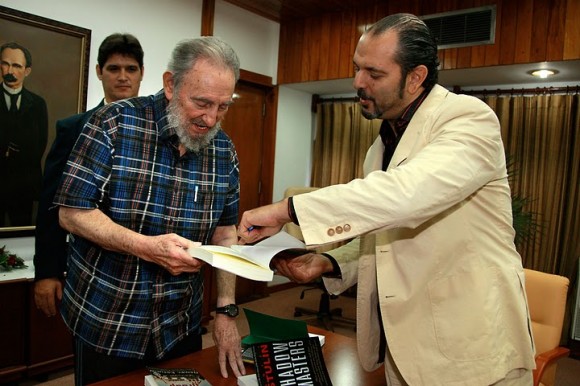
The Bilderberg Group is an annual meeting of corporate executives and government officials from around the world. Until recently, most people probably did not know it existed. In the past week, the group and theories about its real purpose have been featured prominently in the news.
The main cause of this unprecedented surge in interest was the visit of author Daniel Estulin to Cuba on Aug. 26. Estulin has written two books about the Bilderberg Group. When in Cuba, Estulin met with revolutionary leader Fidel Castro, who had just written several articles citing Estulin’s work. The meeting and Estulin’s writings have been given extensive coverage in the Cuban press. This coverage has, in turn, been picked up by media outlets worldwide.
The Party for Socialism and Liberation stands fully in solidarity with the great Cuban Revolution. The revolution freed Cuba from U.S. domination and exploitation and brought into being the “first free territory of the Americas.” Cuba’s determined struggle and internationalism, under the leadership of Fidel and the Cuban Communist Party, have been an inspiration to those struggling for liberation everywhere.
We are concerned, however, that the publicity given to Estulin and his ideas could have a disorienting effect on some in the world socialist and progressive movements. We view Estulin’s writings as anti-Marxist and rooted in right-wing conspiracy “theories” that lack factual support.
Since shortly after its founding in 1954, numerous extreme right-wingers, starting with the John Birch Society and Phyllis Schlafly, have theorized that the Bilderberg Group is really a conspiracy to take over the world, some saying that it already has.
Among them is Estulin, a virulent anti-communist who describes himself as “a Russian expatriate who was kicked out of the Soviet Union in 1980,” and claims that his grandfather “was a colonel in the KGB and the counter-intelligence in the 1950s so I am privileged somewhat to get a lot of the information from secret service which are our best sources.” (Infowars.com, May 27, 2005.) The accuracy of this or anything else that Estulin says about himself or the world is open to question, given his seemingly limitless capacity for fabrication.
Passing fiction for reality
According to Estulin, the “Bilderbergers,” as he calls them, are responsible for an extraordinary range of things he does not like, from the 1917 Bolshevik Revolution to the popularity of the Beatles. In his 2007 book, “The true story of the Bilderberg Group,” Estulin asserts that the group has “become a shadow world government.”
Along with other bizarre conspiracy “theories,” the “Bilderberger” version totally rejects class analysis in favor of the notion that a small, supra-national band of men is pulling the global strings, creating everything from flu epidemics, to the housing collapse, to the wars in Afghanistan and Iraq.
Rather than seeing imperialism and capitalism—led by the United States—as the enemy of the world’s workers and oppressed peoples, Estulin and his co-thinkers (including the notorious Lyndon LaRouche) propagate the fiction that a secret, all-powerful cabal has been running the world since before the dawn of the capitalist era.
In an interview with a blogger in Barcelona, Spain, Estulin said of the Bilderberg Group:
“It is essentially a private criminal enterprise which stretches across the globe, operating through a network of government agencies, private institutions and both publicly owned and private corporations and financial institutions. Now this extended network, which is called the fondi, stretches all the way back to the Middle Ages. Again the fondi is the combined wealth of these oligarchical families. … At the heart of the fondi system, you have the powerful merchant private banks such as the Rothschild banks. And even more powerful than Rothschild is the Lazard bank. One of the reasons that the Bilderbergers have never been able to discredit me is that historically I can show you that what today is called the Bilderberg Club can be traced back in time to the Venetian Black Nobility, 500 years ago.” (Lishman’s Diary, Feb. 2, 2008.)
Estulin links the Bilderberg Group to the Trilateral Commission, and claims that both seek to suppress imperialist nationalisms in favor of a secret “New World Order.” Here is more from “The true story of the Bilderberg Group”:
“Without a doubt, the Bilderberg Group is the premier occult forum operating in the shadows of power, but a little understood entity—the Trilateral Commission (TC)—also plays a vital role in the New World Order’s scheme to use wealth, concentrated in the hands of the few, to exert world control.”
Estulin continues, “The powerful individuals who belong to the Trilateral Commission all share the same anti-nationalist philosophy, and try to prevent the national forces within their respective countries from exerting influence on policy. The Trilateral Commission was established in 1973. Its founder and primary mover was international financier David Rockefeller, longtime chairman of the Rockefeller family-controlled Chase Manhattan Bank.”
Turning history on its head
In his 2006 book “Secrets of the Bilderberg Club,” Estulin, like his fellow reactionary LaRouche (who is heavily referenced by Estulin) puts forward the anti-materialist thesis that the British are in control of the United States, the most powerful empire in history.
In Estulin’s fantasy world the “Bilderbergers” organized and financed the Bolshevik Revolution in 1917 and “controlled” the leaders of the revolution. All of this, 37 years before the Bilderberg Group even came into existence! “Once again, it would be the networks of British military intelligence which would be the initiators, with CIA help via its ex-director William Casey and its contacts with Sefton Delmer of MI6, whose contact Bruce Lockhart was the MI6 controller of Lenin and Trotsky during the Bolshevik Revolution,” asserts Estulin in the “Secrets of the Bilderberg Club.”
In the real world, Robert H. Bruce Lockhart, the British ambassador to Moscow, was arrested in 1918 and nearly executed for his part in a plot to assassinate Lenin and overthrow the new Soviet state before being freed in a prisoner exchange. The British government was the main coordinator of counterrevolution in Soviet Russia from 1918-20, when armies of 14 imperialist countries joined the “White” forces against the Bolsheviks. The counterrevolutionaries were ultimately defeated in their attempt to “strangle the Bolshevik baby in its cradle,” as Winston Churchill had urged.
A half-century later, the nefarious British “Bilderbergers” were still at work, alleges Estulin in comic-ominous tones. This time, they used music to corrupt the youth of the United States and control their minds. Estulin’s “Secrets of the Bilderberg Club” continues, “For an unprecedented two Sundays in a row, on the Ed Sullivan Show, over 75 million Americans watched the Beatles shake their heads and sway their bodies in a ritual which was soon to be replicated by hundreds of future rock groups.”
He then attempts to link—without the thinnest strand of actual evidence—the Beatles and rock music to Nazi propaganda. Referring to the wave of British groups that came to the United States in the following years, Estulin states, again with no supporting facts, that “it was demonstrated that this ‘English invasion’ had been well-planned and coordinated.”
For Estulin and his co-conspiracy “theorists,” nothing is ever as it seems, and all major world developments are the work of the hidden “Bilderberger” hand. Here is a clear example of his worldview from “The true story of the Bilderberg Group”: “The Watergate crisis is a case of mistaken identity and a travesty of justice. The truth behind Watergate has never been revealed, but those who orchestrated the overthrow of the Shah, the war in the Falklands, the death of Aldo Moro and the downfall of Margaret Thatcher are again implicated.”
The bombings of the Oklahoma City Federal Building in 1995, the World Trade Center in 2001 and a nightclub in Bali in 2002 were all mini-nuclear attacks carried out in the interests of the “Bilderbergers,” according to Estulin. He does not seem to care that none of the bombings emitted any radiation—the main characteristic of a nuclear explosion.
Conspiracy “theories” like those put forward by Estulin, LaRouche and others produce false consciousness and cultism. They have a generally disorienting and demoralizing effect on people’s consciousness and movements for change.
Marxism rejects conspiracy ‘theories’
Conspiracy “theories” lead to a dead end. If taken at face value, people must believe that there is no hope for change; there is no opportunity to struggle and make things better for the mass of humanity who suffers. After all, how could anyone fight against a hidden, all-powerful enemy that controls every event of significance in the world? The sense of powerlessness that logically flows from conspiracy “theories” often leaves those who buy into them looking for a lone “savior,” a role the same conspiracy proponents are more than prepared to fulfill.
Conspiracy “theories” lack any true analysis of the systemic class forces at work that oppress billions of people each day. They do not point to imperialism and capitalism as the main problems, instead ascribing society’s ills to a few leaders from imperialist countries that are somehow above the class systems under which we live. Such “theories” are not only false, anti-Marxist and truly reductive of history—they are dangerous diversions that keep people from aiming their anger and hatred toward the system that actually causes oppression throughout the world.
Of course, we understand that actual conspiracies and intrigue do exist. They are used by the ruling classes to set people up, as pretexts to start conflicts or overthrow governments, and in myriad ways to serve the interests of capitalism. But actual conspiracies are much different than presenting crudely assembled facts as representative of broad social and political trends.
Revolutionary Marxism rejects such false conspiracy “theories.” Marxism not only has a radically different understanding of the causes of crises in contemporary capitalist society, it offers a real basis for optimism and solutions as well.
Marxism’s class-based analysis of history offers an explanation of war and other crises rooted in reality, not fiction.
War has a particular cause in the modern epoch. Major wars are not conspiracies launched by a handful of people, but result from the constant search by capitalists to open up and dominate new markets to exploit for profits. Sometimes capitalist competition for these markets is the cause. Wars also result from the attempt by capitalists to destroy countries and peoples who seek to liberate themselves from imperialist domination and market exploitation.
Let’s be clear: the struggle against war and exploitation is a struggle against the very system that breeds war—capitalism. It is not the struggle against the Bilderberg Group or some shadowy world government. In fact, no such world government exists.
The conspiracy “theories” espoused by Estulin offer no solutions. There is no light at the end of the conspiracy tunnel—just thousands of discreet facts jumbled together to create a rather incoherent reality that has little to do with the real world.
The real solution is something Estulin and other conspiracy writers would never advocate or contemplate: socialism. Humanity’s struggle is to put an end to the destructive and dehumanizing capitalist system that rules in most of the world’s countries today and replace it with a system based on meeting the needs of the people.
The first socialist revolutions in Russia, China, Cuba and other countries show that this hope is not a pipedream. Up until now, those revolutions have taken place in poorer countries, which posed huge obstacles to the workers’ governments. The ever-present threat of imperialist attack has also made development difficult. Nevertheless, each country was able to make great, sometimes incredible, advances while building socialism.
Cuba’s outstanding health and education systems and its renowned internationalism would have been unthinkable without a socialist revolution. Cuba has resisted counterrevolution and worked to construct socialism for over 50 years. Its ongoing revolutionary process has not been sanctioned by any capitalist government or by the Bilderberg Group. That is not why revolutionary Cuba exists today.
Cuba’s people have been able to withstand the greatest economic hardships and imperialist threats because the system under which they live benefits the people, and seeks to end exploitation. They have had the invaluable, revolutionary leadership of the Communist Party.
The promotion of Estulin’s ideas in Cuba does not diminish one iota the PSL’s defense of the Cuban Revolution and its incredible ongoing achievements. It is our opinion, however, that Estulin’s worldview is incompatible with revolutionary Marxism.

Zamoskvorechye District (Russian: райо́н Замоскворе́чье) is a district of Central Administrative Okrug of the federal city of Moscow, Russia. The district contains the eastern half of historical Zamoskvorechye area (its western half is administered by Yakimanka District), and the territories of Zatsepa Street and Paveletsky Rail Terminal south of the Garden Ring. The boundary between Yakimanka and Zamoskvorechye districts follows Balchug Street and Bolshaya Ordynka Street (north of Garden Ring), Korovy Val and Mytnaya streets (south of Garden Ring).

