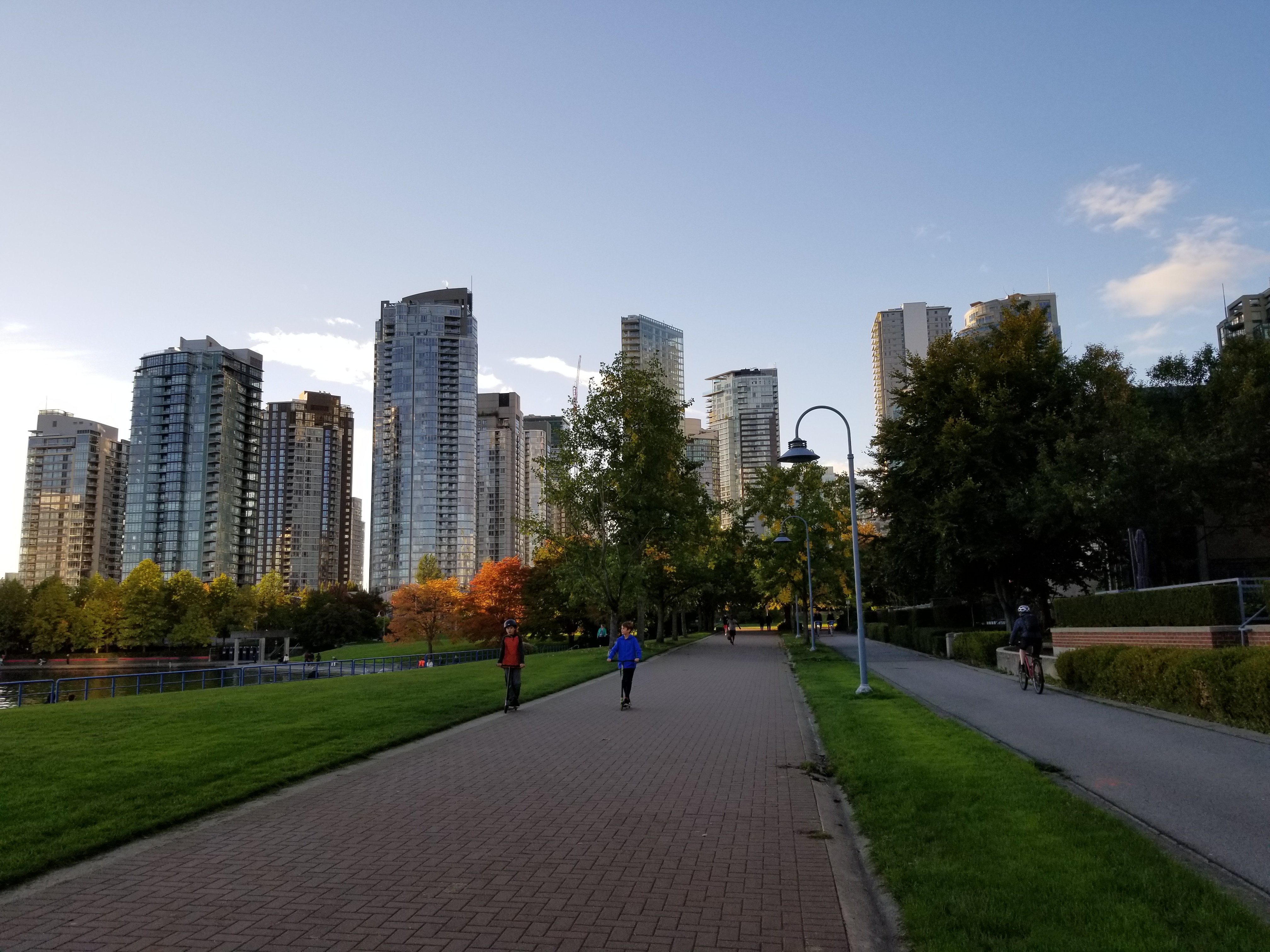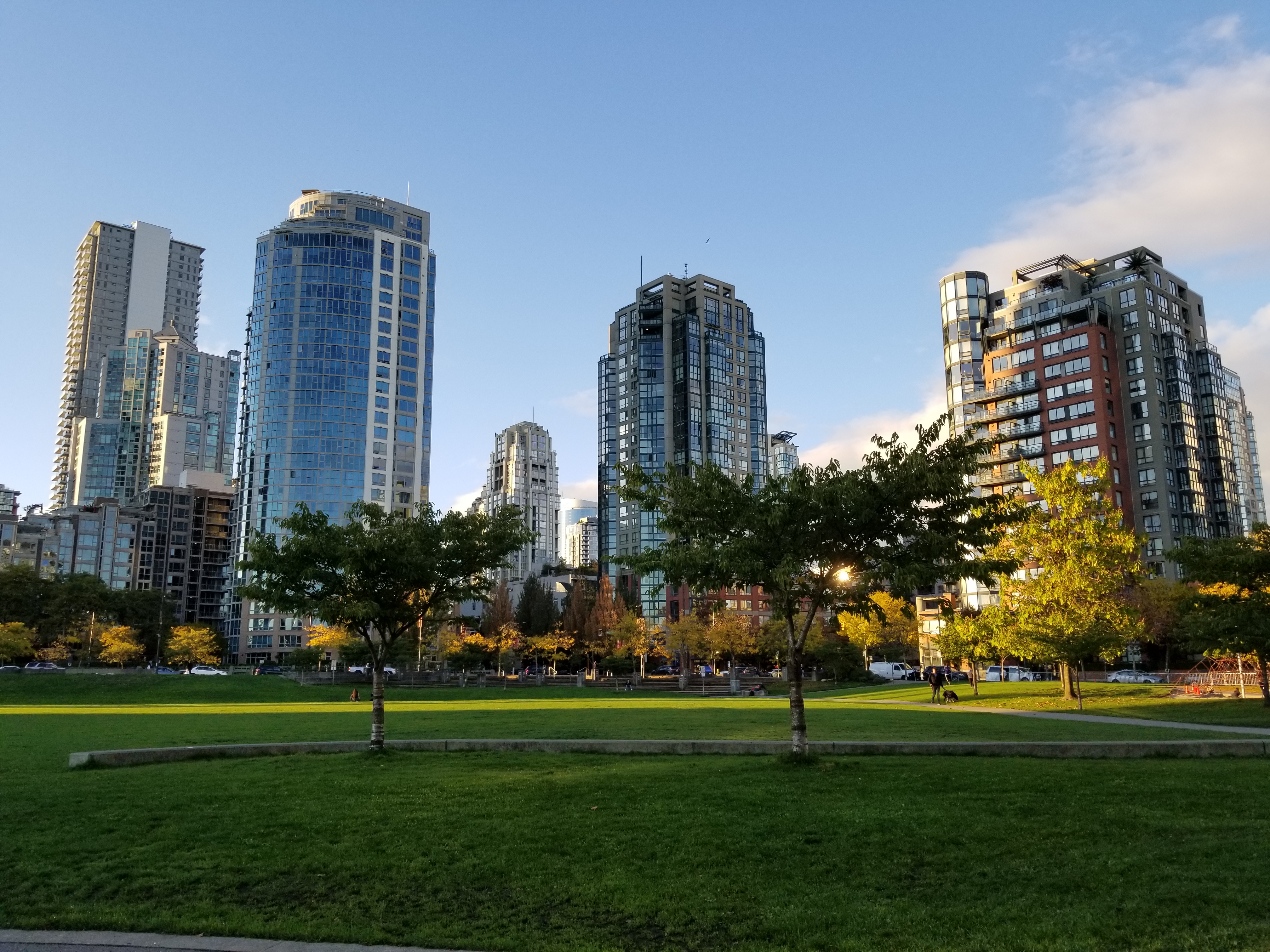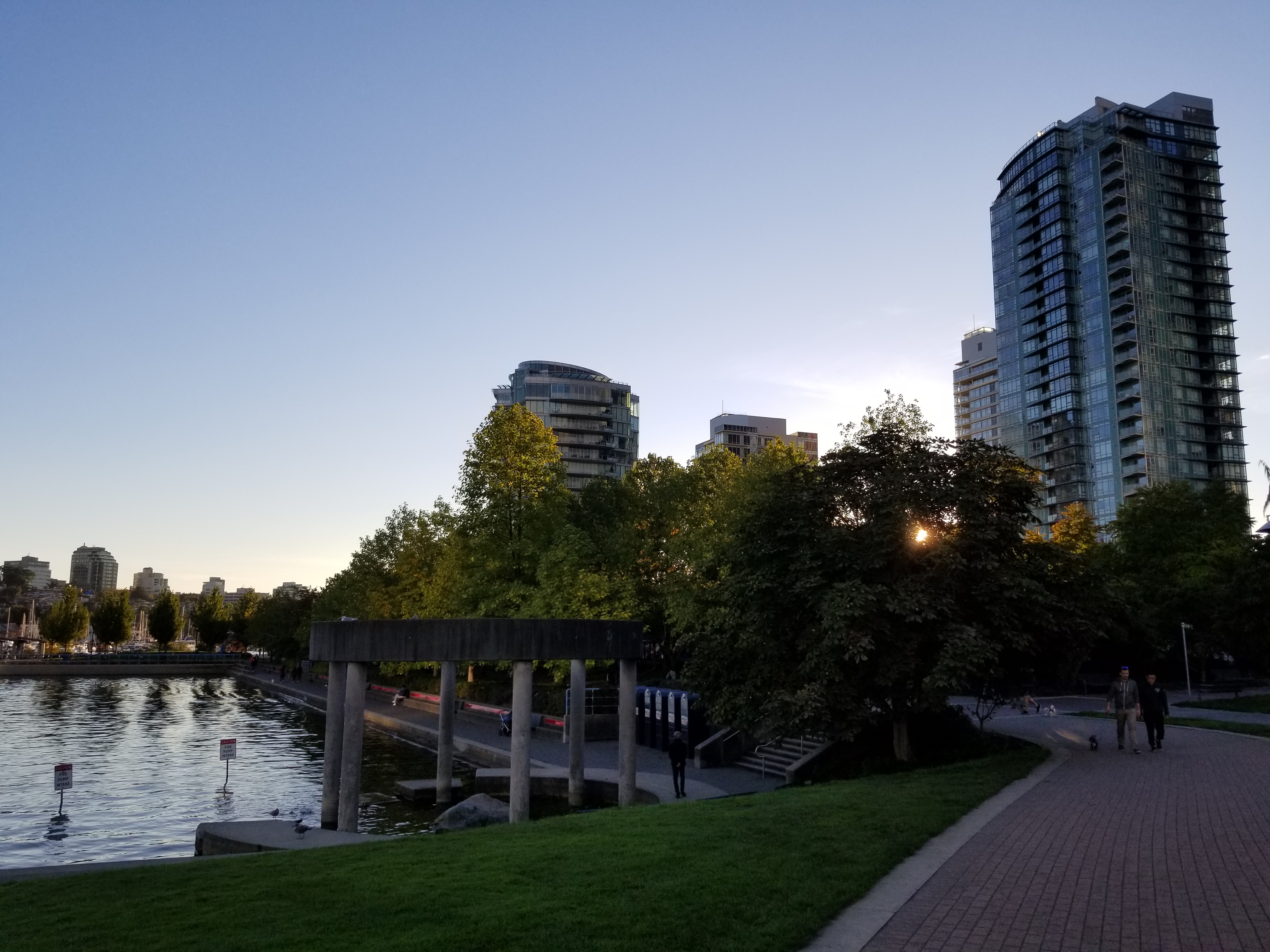
On Burrard Street in Downtown Vancouver. Autumn of 2018.

Burrard Street is a major thoroughfare in Vancouver, British Columbia, Canada. It is the central street of Downtown Vancouver and the Financial District. The street is named for Burrard Inlet, located at its northern terminus, which in turn is named for Sir Harry Burrard-Neale.

The street starts at Canada Place near the Burrard Inlet, then runs southwest through downtown Vancouver. It crosses False Creek via the Burrard Bridge. South of False Creek, on what used to be called Cedar Street before the completion of the bridge in 1932, the street runs due south until the intersection with West 16th Avenue.

The intersection of Burrard Street and Georgia Street is considered to be the centrepoint of Downtown Vancouver, along with the more tourist-oriented and upscale shopping-spirited intersection of Burrard Street and Robson Street to the south. At and due northeast of the centre is the heart of the Financial District. Further down closer to Vancouver Harbour stands the historic Marine Building, an Art Deco masterpiece, opened in 1930, two years before the Art Deco pylons of the Burrard Bridge at the opposite end of the street. Finally at the Harbour lies Canada Place and the Vancouver Convention Centre.

Nearer to Burrard Bridge is located St. Paul’s Hospital, established on Burrard Street in 1894.

Burrard Street served as the dividing line between the two district lots laid out on the downtown peninsula in the second half of the 19th century: District Lot 185 (now West End) and District Lot 541 (granted to the Canadian Pacific Railway). The two grids were oriented differently, with the result that only every third northwest-southeast street in DL185 actually continuing southeast beyond Burrard into DL541. Burrard currently serves as the boundary between West End and Downtown, as defined by the City of Vancouver.

Burrard Street is served by SkyTrain’s Burrard Station, located underground between the intersections with Melville and Dunsmuir Streets in the heart of the Financial District. Along the downtown portion, there is a bike lane on the southwest-bound direction towards the Burrard Bridge.

Book Review: The Fifth Profession by David Morrell

https://tysonadams.com/2014/09/03/book-review-the-fifth-profession-by-david-morrell/

How do you tell if a book has samurai in it? Don’t worry, they’ll put a katana on the cover. A book about ninjas is a little harder, since they are invisible to anyone that hasn’t just been killed by a ninja. How do you tell if a book is a thriller? Don’t worry, they’ll put a gun on the cover.

Professional protectors – the fifth profession…. get it! – Savage and Akira are teamed up to protect a travelling businessman. Things go horribly wrong and Savage is beaten to a pulp after seeing the businessman and Akira killed. Akira is also beaten to a pulp and sees the businessman and Savage killed. And so begins the twist in this David Morrell thriller.

A lot of thrillers take you from point A to point B very efficiently to the point of cliche. Some authors even churn out the same book dozens of times in this manner. The thing that keeps you coming back is the the taut writing, thrills and cool escapism. The strength of The Fifth Profession is that it starts with the standard thriller plot setup and then eschews that for a different plot entirely. It makes the entire story novel. See what I did there?

There are some annoying aspects to Morrell’s novel. David has a habit of hammering certain points and descriptions at the reader, to the point I started assuming everyone had “karate” calloused hands. To some people this could be annoying and enough to throw the book against a wall – which I wouldn’t be doing this since I read this on my iPad. To others the plotting and pacing will keep you entertained, as it did with me.

Why Modern Nintendo Sucks

Why does modern Nintendo suck, well its not what you think. It’s not stuff like their mediocre online service, cheap hardware, treatment of legacy games and then selling those legacy games back to consumers at full price or just the fact that their games never go on sale. While all of these things are super frustrating, it’s not the reason modern Nintendo sucks. The reason is Nintendo has lost its creativity.

Nintendo is shedding its veneer of kindness and embracing a new reputation: Vigorous legal bully

https://www.pcgamer.com/gaming-industry/nintendo-is-shedding-its-veneer-of-kindness-and-embracing-a-new-reputation-vigorous-legal-bully/

Nintendo is speedrunning the Disney playbook. We all know where that goes.

We’re experiencing a golden age of Nintendo…’s legal bloodhounds. Seriously, these days I hear more about Nintendo’s latest target of annihilation than Nintendo’s latest videogames. That’s partly because the console giant’s recent output has mostly been a forgettable roster of late-generation call-ups like “a Zelda spinoff” and “more Mario Party”, but it’s also because Nintendo’s public persona has gotten pretty ugly.

Beyond that one month that we were all really into Tears of the Kingdom, the story of Nintendo lately is one of picking fights or (more commonly) threatening to sue its own fans so hard that they don’t even dare fight back. The decimation of the Ryujinx emulator and a potentially risky Palworld lawsuit are making headlines everywhere, but taking stock of just the past couple of years revealed a bunch of Nintendo legal actions that I totally forgot about.

Between late 2022 and 2024, Nintendo:

  • Went after a PC application that assigns box art to your non-Steam games because it had Nintendo art in its database
  • Barraged a YouTuber/modder with copyright strikes and threats until he took down a Breath of the Wild multiplayer mod
  • Blocked the release of the Dolphin emulator on Steam by warning Valve it’d come after them next
  • Indirectly killed a cool Portal 64 demake in development for genuine N64 hardware: Amazingly, Valve nipped this one in the bud not because of the Portal usage, but because it didn’t want to deal with the inevitable Nintendo fallout.
  • DMCA’d a Palworld Pokémon mod off the internet as the game was blowing up (months before the patent suit)
  • Sued the developers of the Yuzu Switch emulator, killed the project, and settled for millions of dollars before a judge could decide if there is anything illegal about Yuzu
  • Killed the Citra 3DS emulator, made by the same Yuzu group, in the fallout
  • Nuked 20 years’ worth of Nintendo-related Garry’s Mod creations from orbit (because why not)
  • Formally filed a patent lawsuit against Palworld
  • Sicced the dogs on the last Switch emulator standing, Ryujinx

It’s worth saying out loud that this is not normal, even for videogame company standards. Hostility toward fan games isn’t unique to Nintendo (though it is easily the most hostile), but you don’t see Microsoft wiping Xbox emulators off the net, and it’d be pretty weird for EA to go after a software dev because they downloaded some box art. Sega and Sony, two companies with a rich backlog of IP and console hardware, aren’t sending cease and desist letters to ISO sites, and they’re generally more chill about fan projects, too (though the Sega-owned Atlus loves go after fans almost as much as Nintendo). Earlier this year, the developers of the Bloodborne Kart fan game was able to release its FromSoftware-inspired kart racer after scrubbing it of official Bloodborne branding.

In a time when we’re used to viewing game companies as adversaries—”[insert company here] isn’t your friend” is a common social media refrain—Nintendo’s heel turn has been a slower burn. It’s been true as long as I’ve followed games that people just aren’t normal about Nintendo. The company has always enjoyed this special, Disney-like reputation as a game maker that puts fun first and breeds creativity. Those qualities have cultivated a fandom fiercer than any other entertainment brand on earth, and insulate the billion-dollar operation from cynicism.

Perhaps it’s that Disney-like trajectory fueling Nintendo’s latest litigious surge against any and all perceived infringers. After all, Nintendo ain’t a game company anymore—with a billion-dollar Mario movie under its belt, a sequel on the docket, theme parks, and a Zelda film on the way, the company’s value is increasingly tethered to its icons, and decreasingly associated with brand new characters or worlds. When your game plan revolves around repackaging decades-old stories, everything starts to look like a threat..

Nintendo’s situation is unique because nobody hates emulation quite like Nintendo. To the Big N, there is no game preservation debate: emulation leads to piracy, so emulators are as good as pirates. Mario in Garry’s Mod is a crime. Fan games are an assault on the IP vault.

That one particularly sticks in my craw. When a publisher pressures a fan into cease-and-desisting their fan game, you’ll sometimes hear that the Nintendos of the world have an obligation to defend their trademark, because if they don’t, they’ll lose it. That makes sense when you first think about it—if they let just anyone make a game called Pokémon, Nintendo’s baby would get genericized like Kleenex or the yo-yo! But when you consider that this worst-case scenario of a publisher losing its intellectual property because it didn’t shut down a fan game has never actually happened, it starts to sound less like a legitimate worry and more like a one-size-fits-all excuse.

It’s not like Nintendo’s legal exploits are gonna trigger a mass fan exodus, but I’d argue we’re seeing the effects of its reputation in how people are talking about the Palworld lawsuit: In one corner are Nintendo diehards cheering for the downfall of a too-familiar creature collector, in the other a mix of Palworld players and Nintendo skeptics who see this as just another example of Nintendo overreach—its latest attack on PC gaming. Even if it emerges victorious, Nintendo will come out the other side having chipped another little piece of its “lovable toymaker” mask.

And if Nintendo is going to keep going full Ace Attorney on emulators, drawing larger borders around its precious IP in the process, it shouldn’t be tedious-to-impossible to access so much of its precious back catalog legally. With the Wii Virtual Console, 3DS, and Wii U stores gone forever, the only official way to emulate an old Zelda is to buy Nintendo’s crappy online subscription and wait for that service to die in a decade, too. The Switch 2 is an opportunity to do better—to put as much focus on how fans can play its games as it’s currently putting on how they can’t.

Leonardo da Vinci – New World Encyclopedia

https://www.newworldencyclopedia.org/entry/Leonardo_da_Vinci

Leonardo di ser Piero da Vinci (April 15, 1452 – May 2, 1519) was an immensely talented Italian Renaissance polymath: architect, anatomist, sculptor, engineer, inventor, geometer, musician, and painter. Leonardo was the archetype “Renaissance man,” infinitely curious and equally inventive. He is widely considered to be one of the greatest painters of all time.

Leonardo is famous for his realistic paintings, such as the Mona Lisa and The Last Supper, as well as influential drawings including the Vitruvian Man. He conceived of ideas vastly ahead of his time. Notably, he invented concepts for the helicopter, a tank, the use of concentrated solar power, the calculator, a rudimentary theory of plate tectonics, the double hull, and many others. Relatively few of his designs were constructed or were feasible during his lifetime as modern scientific approaches to metallurgy and engineering were only in their infancy during the Renaissance. However, he greatly advanced the fields of knowledge in anatomy, astronomy, civil engineering, optics, and hydrodynamics.

Of his works, only a few paintings and his notebooks (scattered among various collections) containing drawings, scientific diagrams and notes have survived.

Biography

The first known biography of Leonardo was published in 1550 by Giorgio Vasari, who wrote Vite de’ più eccelenti architettori, pittori e scultori italiani (“The lives of the most excellent Italian architects, painters and sculptors”). Most of the information collected by Vasari was from first-hand accounts of Leonardo’s contemporaries because Vasari was only a child when Leonardo died. This biography remains the first reference in studying Leonardo’s life.

Leonardo was born in the village of Anchiano, a few miles from the small town of Vinci, in Tuscany, near Florence. It was thought that Leonardo was the illegitimate son of a local peasant woman known as Caterina. His biological father appears to have been a Florentine notary or craftsman named Piero da Vinci. Leonardo’s mother was married off to one Antonio di Piero del Vacca, a laborer employed by his biological father. According to papers recently found by the Museo Ideale Leonardo Da Vinci in his home town of Vinci, the marriage occurred just a few months after she gave birth to a boy called Leonardo. Even though he was born after modern naming conventions came into use, he was known as “Leonardo di ser Piero da Vinci,” which simply means “Leonardo, son of Piero, from Vinci, Italy.” Leonardo signed his works “Leonardo” or “Io, Leonardo” (“I, Leonardo”).

Leonardo grew up with his father in Florence, where he started drawing and painting. He started school when he was five years old. His early sketches were of such quality that his father showed them to painter/sculptor Andrea del Verrocchio, who subsequently took on the 14-year old Leonardo as a garzone (an apprentice). In Verrocchio’s workshop Leonardo was introduced to many activities, from the painting of altarpieces and panel pictures to the creation of large sculptural projects in marble and bronze. Leonardo also worked with Lorenzo di Credi and Pietro Perugino. According to Giorgio Vasari, Leonardo’s first biographer (1550):

But the greatest of all Andrea’s pupils was Leonardo da Vinci, in whom, besides a beauty of person never sufficiently admired and a wonderful grace in all his actions, there was such a power of intellect that whatever he turned his mind to he made himself master of with ease.

In 1472 Leonardo was inducted into the painter’s guild of Florence, while even four years later, he was still considered Verrocchio’s assistant. The earliest known dated work of Leonardo’s is a pen and ink drawing of the Arno Valley. It is dated August 5, 1473. This work was done before Leonardo became an independent master in 1478 at age 26. His first commission, to paint an altarpiece for the chapel of the Palazzo Vecchio, the Florentine town hall, was never started. His first large painting, The Adoration of the Magi, started in 1481, was never completed. It was to be for the Monastery of San Donato a Scopeto in Florence.

From around 1482 to 1499, Ludovico Sforza, Duke of Milan, employed Leonardo, providing him a workshop, complete with apprentices. During this period, seventy tons of bronze set aside for Leonardo’s Gran Cavallo horse statue were cast into weapons for the duke in an attempt to save Milan from the French under Charles VIII in 1495.

When the French returned under Louis XII in 1498, Milan fell without a fight, overthrowing Sforza. Leonardo stayed in Milan for a time, until the morning he came upon French archers using his life-size clay model of the Gran Cavallo for target practice. He left with Salai, his assistant, and his friend Luca Pacioli for Mantua. After two months, he moved on to Venice where he was hired as a military engineer.

Leonardo returned to Florence briefly at the end of April 1500. In Florence he entered the services of Cesare Borgia, the son of Pope Alexander VI. He worked as Borgia’s military architect and engineer and traveled with him throughout Italy. In 1506 he returned to Milan, then in the hands of Maximilian Sforza after Swiss mercenaries drove out the French.

From 1513 to 1516, Leonardo lived in Rome, where painters Raphael and Michelangelo were active at the time, although he had little contact with these artists. However, Leonardo was probably pivotal in the relocation of Michelangelo’s David in Florence; the move was against Michelangelo’s will.

In 1515 Francis I of France retook Milan. Leonardo was commissioned to make a centerpiece mechanical lion for the peace talks between the French king and Pope Leo X in Bologna. This was likely his first encounter with the French king. In 1516 he entered Francis’ service, and was given the use of the manor house Clos Lucé (also called “Cloux”; now a museum open to the public) next to the king’s residence at the Royal Chateau Amboise. The king granted Leonardo and his entourage generous pensions. A surviving document lists 1,000 écus for the artist, 400 for Count Francesco Melzi, his apprentice, and 100 for Salai (“servant”). In 1518 Salai left Leonardo and returned to Milan, where he eventually perished in a duel.

King Francis became a close friend of Leonardo. Some 20 years after Leonardo’s death, Francis told the artist Benevenuto Cellini that he believed about Leonardo that, “No man had ever lived who had learned as much about sculpture, painting, and architecture, but still more that he was a very great philosopher.”

Da Vinci lived for the last three years of his life at Clos Lucé, France, and died there on May 2, 1519. According to his wish, 60 beggars followed his casket. He was buried in the Chapel of Saint-Hubert in the castle of Amboise. Although Melzi was his principal heir and executor, Salai was not forgotten. He received half of Leonardo’s vineyards.

It is apparent from the works of Leonardo and his early biographers that he was a man of high integrity and very sensitive to moral issues. His respect for life led him to vegetarianism for at least part of his life. The term “vegan” would have fit him well. He entertained the notion that taking milk from cows amounted to stealing. Under the heading, “Of the beasts from whom cheese is made,” he answers, “the milk will be taken from the tiny children.” Vasari reported a story that as a young man in Florence, Leonardo often bought caged birds just to release them from captivity. He was also a respected judge on matters of beauty and elegance, particularly in the creation of pageants.

Leonardo pioneered new painting techniques in many of his pieces. One of them, a color shading technique called Chiaroscuro, used a series of glazes custom-made by Leonardo. It is characterized by subtle transitions between color areas. Chiaroscuro is a technique of bold contrast between light and dark. Another effect created by Leonardo is called sfumato, which creates an atmospheric haze or smoky effect.

Early works in Florence (1452–1482)

While working as an apprentice to in 1476, Leonardo worked with Verrocchio to paint The Baptism of Christ for the friars of Vallombrosa. He painted the angel at the front and the landscape. The difference between the two artists’ work can be seen. Leonardo’s blending and brushwork was finer than Verrochio’s technique. Vasari told the story that when Verrocchio saw Leonardo’s work he was so amazed that he resolved never to touch a brush again.

Leonardo’s first solo painting was the Madonna and Child, completed in 1478. During the same time period, he also painted a picture of a little boy eating gelato. From 1480 to 1481, he created a small Annunciation painting, now in the Louvre. In 1481 he also painted St. Jerome, but never finished the painting. Between 1481 and 1482 he started painting The Adoration of the Magi. He made extensive, ambitious plans and many drawings for the painting, but it was never finished, as Leonardo’s services had been accepted by the Duke of Milan.

Milan (1482–1499)

Leonardo spent 17 years in Milan in the service of Ludovico Sforza (between 1482 and 1499). He did many paintings, sculptures, and drawings during these years. He also designed court festivals, and drew many engineering sketches. He was given free rein to work on any project he chose, though he left many projects unfinished, completing only six paintings. These include Virgin of the Rocks in 1494 and The Last Supper (Ultima Cena or Cenacolo, in Milan) in 1498. In 1499 he painted Madonna and Child with St. Anne. He worked on many of his notebooks between 1490 and 1495, including the Codex Trivulzianus.

Leonardo had a habit of planning grandiose paintings with many drawings and sketches, only to leave them unfinished. One of his projects involved making plans and models for a monumental seven-meter-high (24 feet) horse statue in bronze called Gran Cavallo. Because of war with France, the project was never finished. The bronze originally intended for use in building the statue was used to make a cannon. Victorious French soldiers used the clay model of the statue for target practice. The Hunt Museum in Limerick, Ireland has a small bronze horse thought to be from Leonardo’s original design and created by an apprentice. In 1999 a pair of full-scale statues based on his plans were cast. One was erected in Grand Rapids, Michigan, the other in Milan.

When the French invaded Milan in 1499, Ludovico Sforza lost control, forcing Leonardo to search for a new patron.

Nomadic Period: Italy and France (1499–1516)

Between 1499 and 1516, Leonardo had numerous patrons. He traveled around Italy doing several commissions before moving to France in 1516. This period has been described as his “Nomadic Period.”

He visited:

  • Mantua (1500) (sketched a portrait of the Marchesa Isabella d’Este)
  • Venice (1501)
  • Florence (1501–1506) sometimes referred to as his Second Florentine Period.
  • Traveled between Florence and Milan staying in both places for short periods before settling in Milan.
  • Milan (1506–1513) sometimes referred to as his Second Milanese Period, under the patronage of Charles d’Amboise until 1511)
  • Rome (1514)
  • Florence (1514)
  • Pavia, Bologna, Milan (1515)
  • France (1516–1519) (patronage of King Francis I)

Upon returning to Florence, he was commissioned by the Grand Council Chamber in the Palazzo Vecchio, the seat of government of the Florentine Republic for a large mural commemorating a great military triumph in the history of Florence, The Battle of Anghiari. Leonardo’s rival, Michelangelo, sketched on the opposite wall. After producing a fantastic variety of studies in preparation for the work, Leonardo left the city with the mural unfinished. He was not getting paid as he had expected. More importantly, he was struggling with his choice of technique. Instead of the fresco technique, he experimented (as in the Last Supper) with oil binders, hoping to extend the time to manipulate the paint. The incomplete painting was destroyed in a war during the mid-sixteenth century. Not only Peter Paul Rubens but artists in the modern era have produced their own studies based on Leonardo’s original sketches.

Most evidence suggests that he began work on the Mona Lisa (also known as La Gioconda, now at the Louvre in Paris) in 1503 and continued to work on it until 1506. He continued to work sporadically on it well after that. The painting is likely to be of Lisa de Gherardini del Giocondo, wife of the silk merchant Francesco del Giocondo. The painting was commissioned by the silk merchant to commemorate the birth of their second son as well as a move to a new home. Leonardo most likely kept the painting with him at all times, and did not travel without it.

The Mona Lisa is the most famous painting in the world. It was famous at the time because of his use of sfumato (the smoky effect he created), which transcended the convention of the time, as did the sitter’s angle, contrapposto, as well as the bird’s-eye view of the background. In modern times, the painting has received an astounding amount of media attention. In addition to Leonardo’s cutting edge techniques, Mona Lisa’s alluring and mysterious smile is very captivating.

The Mona Lisa was one of only three paintings that Leonardo took with him to his final residence at Clos Lucé. It may have been his favorite work, and the painting had a rather large monetary valuation listed in the will of his protégé, Salai.

Between 1506 and 1512, Leonardo lived in Milan under the patronage of the French governor Charles d’Amboise. He painted St Anne in 1509. One painting, The Leda and the Swan, is known now only through copies as the original work did not survive. He also painted a second version of The Virgin of the Rocks during this time (1506–1508).

While under the patronage of Pope Leo X, he painted St. John the Baptist (1513–1516).

During his time in France, Leonardo made studies of the Virgin Mary for The Virgin and Child with St. Anne, and many drawings and other studies.

Selected works:

  • The Baptism of Christ (1472–1475) – Uffizi, Florence, Italy (from Verrocchio’s workshop; angel on the left-hand side is generally agreed to be the earliest surviving painted work by Leonardo)
  • Annunciation (1475–1480) – Uffizi, Florence, Italy
  • Ginevra de’ Benci (c. 1475) – National Gallery of Art, Washington, D.C., United States
  • The Benois Madonna (1478–1480) – Hermitage Museum, Saint Petersburg, Russia
  • The Virgin with Flowers (1478–1481) – Alte Pinakothek, Munich, Germany
  • Adoration of the Magi (1481) – Uffizi, Florence, Italy
  • The Madonna of the Rocks (1483–86) – Louvre, Paris, France
  • Lady with an Ermine (1488–90) – Czartoryski Museum, Krakow, Poland
  • Portrait of a Musician (c. 1490) – Pinacoteca Ambrosiana, Milan, Italy
  • Madonna Litta (1490–91) – Hermitage Museum, Saint Petersburg, Russia
  • La belle Ferronière (1495–1498) – Louvre, Paris, France—attribution to Leonardo is disputed
  • Last Supper (1498) – Convent of Sta. Maria delle Grazie, Milan, Italy
  • The Virgin and Child with St. Anne and St. John the Baptist (c. 1499–1500) – National Gallery, London, UK
  • Madonna of the Yarnwinder 1501 (original now lost)
  • Mona Lisa or La Gioconda (1503-1505/1507) – Louvre, Paris, France
  • The Madonna of the Rocks or The Virgin of the Rocks (1508) – National Gallery, London, UK
  • Leda and the Swan (1508) – (Only copies survive; best-known example in Galleria Borghese, Rome, Italy)
  • The Virgin and Child with St. Anne (c. 1510) – Louvre, Paris, France
  • St. John the Baptist (c. 1514) – Louvre, Paris, France
  • Bacchus (or St. John in the Wilderness) (1515) – Louvre, Paris, France

Science and Engineering

Renaissance humanism saw no mutually exclusive polarities between the sciences and the arts. Leonardo’s studies in science and engineering, recorded in notebooks comprising some 13,000 pages of notes and drawings, fuse art and science. They are as impressive and innovative as his artistic work. These notes were made and maintained during Leonardo’s travels through Europe, as he made continual observations about the world around him.

Leonardo was left-handed and used mirror writing in his journals throughout his life. The explanation is that it is easier to pull a quill pen than to push it. By using mirror writing, the left-handed writer is able to pull the pen from right to left and also avoid smudging what has just been written.

Leonardo’s approach to science was an observational one. He tried to understand a phenomenon by describing and depicting it in utmost detail. He did not emphasize experiments or theoretical explanation. Since he lacked formal education in Latin and mathematics, contemporary scholars mostly ignored Leonardo the scientist. Later, he did teach himself Latin and it has been said that he was planning a series of treatises on a variety of subjects, though they were never written.

Anatomy

Leonardo started to discover the anatomy of the human body while apprenticed to Andrea del Verrocchio. His teacher insisted that all his pupils learn anatomy. When he became a successful artist, he was given permission to dissect human corpses at the hospital Santa Maria Nuova in Florence. Later in Milan, he performed dissections at the hospital Maggiore and in Rome at the hospital Santo Spirito (the first mainland Italian hospital); from 1510 to 1511 he collaborated with the doctor, Marcantonio della Torre. Leonardo dissected 30 male and female corpses of different ages. Together with Marcantonio, he prepared to publish a theoretical work on anatomy and made more than two hundred drawings. His book was finally published in 1580, 61 years after his death. It was titled Treatise on Painting.

Leonardo drew many images of the human skeleton, and was the first to describe the double-S form of the backbone. He also studied the inclination of pelvis and sacrum, stressing that the sacrum was not uniform, but composed of five fused vertebrae. He was also able to represent the human skull and cross-sections of the brain exceptionally well (transversal, sagittal, and frontal). He drew many images of the lungs, mesentery, urinary tract, sex organs, and even coitus. He was one of the first who drew the fetus in the intrauterine position and wished to learn about “the miracle of pregnancy.” He often drew diagrams of the cervical muscles and tendons and the shoulder. He was a master of topographic anatomy. He not only studied human anatomy, he studied the anatomy of many animals, as well.

It is important to note that he was not only interested in structure but also in function, so he became a physiologist in addition to being an anatomist. Leonardo actively searched for models among those who had significant physical deformities, for the purpose of developing caricature drawings.

Leonardo’s study of human anatomy led to the first known design of a robot in recorded history. The design, which has come to be called Leonardo’s robot, was probably created around 1495 but was rediscovered in the 1950s. It is not known if an attempt was made to build the device.

Leonardo also correctly worked out how heart valves eddy the flow of blood, yet he was unaware of blood circulation. He believed that blood was pumped to and consumed by the muscles. A diagram Leonardo did of a heart inspired a British heart surgeon to pioneer a new way to repair damaged hearts in 2005.

Inventions and Engineering

Fascinated by the phenomenon of flight, Leonardo produced detailed studies of the flight of birds, and plans for several flying machines, including a helicopter and a light hang glider which could have flown.

In 1502 Leonardo produced a drawing of a single span 720-foot (240 meter) bridge as part of a civil engineering project for Sultan Beyazid II of Constantinople. The bridge was intended to span an inlet at the mouth of the Bosporus known as the Golden Horn. Beyazid did not pursue the project because he believed that construction was impossible. Leonardo’s vision was resurrected in 2001 when a smaller bridge based on his design was constructed in Norway.

Owing to employment as a military engineer, Leonardo’s notebooks also contain several designs for military machines: machine guns, an armored tank powered by humans or horses, cluster bombs, a working parachute, a diving suit made out of pig’s leather and a hose connecting to air, etc. He came to believe that war was the worst of human activities. Other inventions included a submarine, a cog-wheeled device that has been interpreted as the first mechanical calculator, and one of the first programmable robots that has been misinterpreted as a car powered by a spring mechanism. In his years in the Vatican, he planned an industrial use of solar power, by employing concave mirrors to heat water. While most of Leonardo’s inventions were not built during his lifetime, models of many of them have been constructed with the support of IBM and are on display at the Leonardo da Vinci Museum at the Château du Clos Lucé in Amboise.

The Notebooks

Leonardo wrote daily in notebooks throughout his life. He wrote about his sketches, inventions, architecture, elements of mechanics, painting ideas, human anatomy, grocery lists and even people that owed him money. These notebooks—originally loose papers of different types and sizes, distributed by friends after his death—have found their way into major collections such as the Louvre, the Biblioteca Nacional de España, the Biblioteca Ambrosiana in Milan, and the Victoria and Albert Museum and British Library in London. The British Library has put a selection from its notebook (BL Arundel MS 263) on the web in the Turning the Pages section. The Codex Leicester is the only major scientific work of Leonardo’s in private hands. It is owned by Bill Gates, and is displayed once a year in different cities around the world.

Why Leonardo did not publish or otherwise distribute the contents of his notebooks remains a mystery to those who believe that Leonardo wanted to make his observations public knowledge. Technological historian Lewis Mumford suggested that Leonardo kept notebooks as a private journal, intentionally censoring his work from those who might use it irresponsibly (the tank, for instance). They remained obscure until the nineteenth century, and were not directly of value to the development of science and technology. In January 2005, researchers discovered the hidden laboratory used by Leonardo for studies of flight and other pioneering scientific work in previously sealed rooms at a monastery next to the Basilica of the Santissima Annunziata, in the heart of Florence.