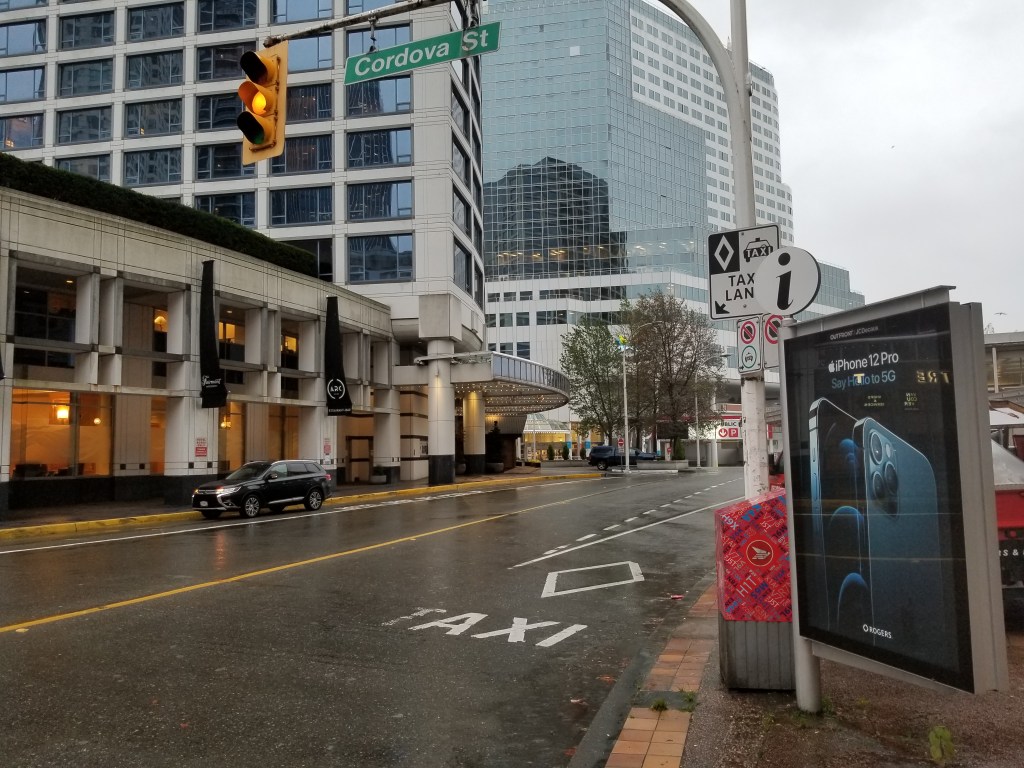
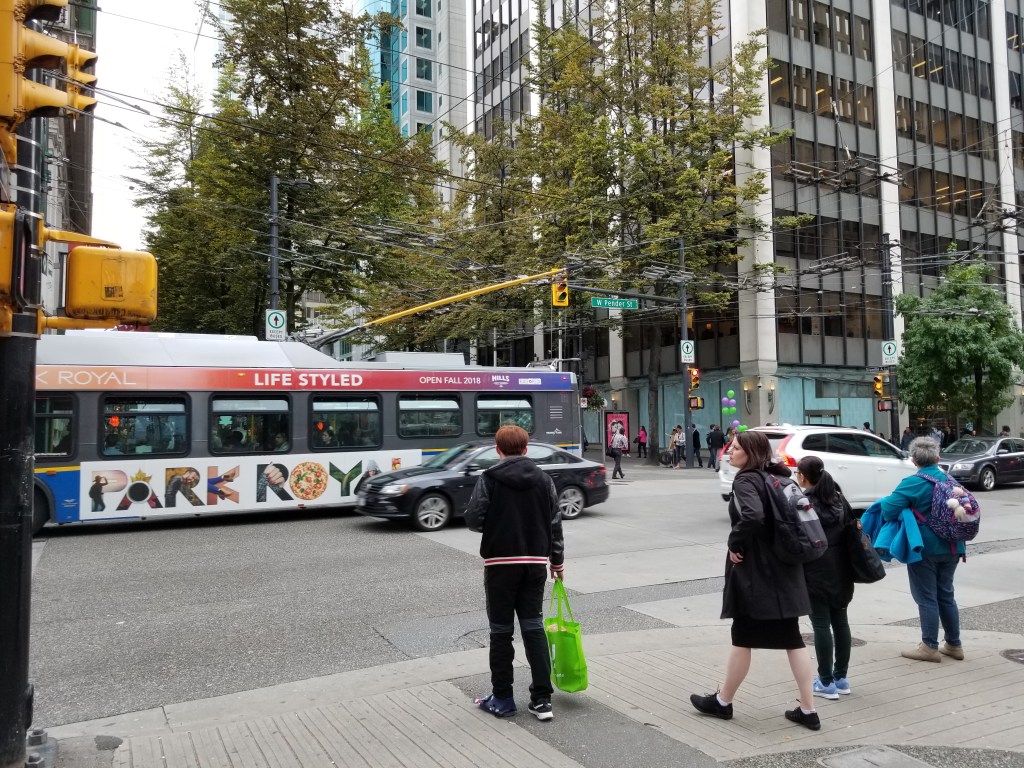
Cordova Street is a major east-west arterial road in downtown Vancouver, stretching from Coal Harbour in the west to the Strathcona neighborhood in the east. It’s named after Don Antonio Maria de Bucareli y Ursua, the Viceroy of New Spain (including Mexico) during the late 18th century, though the naming reflects a historical nod facilitated by L.A. Hamilton, a key figure in Vancouver’s early development. The street is divided into East Cordova and West Cordova, with its path encompassing diverse neighborhoods like Gastown, one of Vancouver’s oldest commercial districts.
Originally part of the Granville Townsite (pre-1886), Cordova Street was initially called Willow Street, as noted in a historical map from August 1885. It was renamed during the city’s incorporation in 1886, influenced by Lauchlan Alexander Hamilton, a CPR land commissioner and surveyor who played a pivotal role in laying out Vancouver’s streets. The street’s naming ties to Hamilton’s proposal to honor Spanish colonial figures, reflecting the era’s fascination with global history. It evolved from a short block-long path to a key route as Vancouver grew after the 1886 Great Fire, which reshaped the city’s layout.
In 1886, a photograph from the Vancouver Archives shows Cordova Street (then Oppenheimer) looking west from Westminster Avenue (now Main Street), capturing the early wooden structures and the city’s nascent form. The street borders Oppenheimer Park, a historic site established in 1902, which has served as a community hub and, at times, a focal point for social issues like homelessness.
West Cordova begins in Coal Harbour near Canada Place, a major cruise and convention hub, and runs eastward past the Vancouver Convention Centre. It’s closed to general traffic from June 30 to July 5 for events like Canada Together, as per vancouver.ca, with sections like the 800 and 900 blocks also closed on July 1. East Cordova extends through Gastown, past landmarks like the Woodward’s building and Army & Navy, and continues into Strathcona, ending near Powell Street. It splits past Water Street, a nod to its historical waterfront proximity.
Canada Place (600-1000 W Cordova) is an iconic waterfront complex hosting cruises and events, with traffic adjustments during summer (e.g., two-way Howe Street operation). Gastown (100-500 E Cordova) is known for its cobblestone streets, steam clock, and heritage buildings, including the Koret Lofts at 55 East Cordova, a 1909 warehouse converted into lofts in 2004. Oppenheimer Park is located south of East Cordova, it’s a green space with historical ties to the city’s working-class roots.
Cordova Street was a commercial artery from the start, with businesses like the McLennan and McFeely Building (55 East Cordova) serving as a hardware distribution hub. Its evolution into Gastown’s trendy lofts and shops reflects Vancouver’s shift to a creative economy. The street’s proximity to the Canadian Pacific Railway (historically northwest of 55 East Cordova) underscores its role in early trade and transportation.
Vancouver’s diverse economy and livability enhance Cordova Street’s appeal, with neighborhoods offering unique local businesses. Events like CelticFest (February 17, 2025) and Canada Together celebrations draw crowds, boosting its cultural profile.
West Cordova sees heavy congestion during cruise season and events, with ride-hailing drop-offs at Canada Place’s P2 level. The one-way pilot between Howe and Burrard streets aims to manage this. East Cordova, especially in Gastown, balances tourism with residential needs, though areas near Oppenheimer Park face social issues like encampments. The Koret Lofts’ success (property values rising since 2004) mirrors Gastown’s gentrification, attracting investors and residents.
Cordova Street encapsulates Vancouver’s past and present, from its frontier days to its current status as a cultural and economic corridor. It’s one of the most photographed streets due to its historical density and architectural charm.
If you need to flash the firmware on your Samsung phone, here’s how to do it through your PC. This is useful for scenarios where you need to fix a software issue with the phone.
Please do not try this if you’re not sure if you truly have a software problem or if you have very important data. Instead, consider sending it to us for Data Recovery.
In this case, we have a Samsung S24 Ultra that we flashed firmware S928U1UES4AYA1 into the phone & did not lose any data.
Earlier in the day, I had done a CPU, NAND, EEPROM transplant on this phone & found it was booting up to the Samsung logo, then Android logo & would stay there forever.
Sometimes I would get the home screen, but it would be frozen & then fall back to the Android logo.
Flashing the firmware like I show in this video solved the issue & was able to recover all the data.
First step to flashing any Samsung firmware is to find out what version it currently has. You do that by putting the phone into Download Mode and click Volume UP
I’m not against making more videos with translations, since there are people out there that are asking about this. There are some videos that I’d like to translate and post. But making more videos hasn’t been a priority for me in the last few years. Moreover, since the internet is now teeming with people who, for example, think that someone like Alex Jones is “real” and “trustworthy”, it’s not really a system that I want to use much. The internet has its uses for me, but I don’t spend much of my time socializing on it or trying to please people. I never have done this. In fact, for the last few years, I have been trying to see if I can actually lose followers and subscribers instead of attracting them. Most of my attention has been going toward work stuff and health stuff lately. I’m an autistic person that has to live in a world that hates autistic people. The discrimination and hostility that’s directed toward autistic people is overwhelming. Every day brings something unpleasant and challenging. Therefore, I don’t have the privilege of taking it easy and yapping every day, like all of those neurotypicals that make up 95% of society. I must say that when it comes to my health there are a few breakthroughs that I made recently. What has been causing me the most trouble is a certain health condition that I’ve had since I was little, and I inherited this condition from my controlling and abusive neurotypical mother. But I began finding out about this condition only about a decade ago, although it has affected me my whole life. This is a serious and complex condition that forces me to think about it and to try to control it a lot of the time every day. If I’m not careful, I can even die from it. But it affects me in a variety of ways. I have been learning how to deal with it on my own for about a decade already, ever since I realized that I have it. However, I recently found out that it’s even more serious than I had thought. I recently bought drugs that alleviate this condition in a minor way. These drugs became available for purchase without a prescription from a doctor in the late 2000s. Drugs that completely cure this condition don’t exist, but these drugs at least have some effect. So, after I began taking these drugs, I realized that I can think better and that I have more energy. Before this, there have been very few times in my life when I felt this well. These drugs do lose their effectiveness after everyday use for several days, but there’s a way to get around this. Simply don’t take the same drug every day. Take one drug one day and a similar drug the next day. That is, alternate taking drugs or supplements if you don’t want them to lose their effectiveness. Or you can take the same drug for several days, and, when it begins to lose its effectiveness, stop taking it for a day or two or take another drug for a day or two. So, as good as the supplements that I mentioned in my earlier posts can be for me, they just don’t get to the roots of my main health problem. Another supplement that I recently discovered is called Memoria + Huperzine A. It’s an effective supplement that supports cognitive function and memory. Besides the alkaloid Huperzine A, it also contains Lion’s Mane, Phosphatidylserine, Korean Ginseng, Bacopa, Gingkgo, and Toothed Club-moss. It’s an effective combination that definitely helps a person to think better. Anyway, some years ago, I learned that I have to avoid certain things in order to feel better, but, as it turns out, simply avoiding certain things isn’t enough because the condition that I’m talking about reduces blood flow and oxygen to my brain every day and all the time, thereby muddying my focus, memory, and mood. Because of this, I always have brain fog and fatigue, on top of all of the other health problems that I have. So, needless to say, because I have such a condition, as well as a few other serious conditions, my health occupies a lot of my time every day. The funny thing is that I inherited almost all of these problems from my so-called parents. My sister, for example, didn’t inherit any of them. My neurotypical mother also has the condition that I’m talking about, since I inherited it from her, but it’s not as bad for her as it is for me. Perhaps this explains why she has remained a housewife and why she’s still married to a certain “man”, although they always quarrel and they rarely agree on something. I still find it somewhat hard to understand how so many neurotypicals can be so aimless and how they can drink alcohol and use drugs. This neurotypical society that we live in is created for them and their comfort and yet they still turn to alcohol and to drugs. If only I had their health and their ability to communicate with neurotypicals. Anyway, although I haven’t done anything when it comes to making videos for some time, I have still done some reading in my free time. I just don’t live and breathe on the internet, like all of those content creators on YouTube and on other popular websites. Moreover, I have generally tried to avoid using YouTube and other popular websites for a long time already because I don’t really want to listen to propagandists, sellouts, reactionaries, money makers, business owners, industry insiders, and crappy neurotypical philosophers with their bad modern education. I finished reading ‘Secrets of the Exodus: The Egyptian Origins of the Hebrew People’ (2000) by Messod Sabbah and Roger Sabbah not that long ago. I enjoyed reading this book, for the most part. The book is described as a fascinating reference that fuels the passionate debate about the biblical Exodus with a provocative not only was Moses an Egyptian but so were the Hebrew people who followed him to Canaan. Through linguistic, philologic, and religious explorations, the authors prove that the “Chosen People” were not slaves from a foreign country but high-ranking Egyptian priests and the adherents of the monotheist pharaoh Akhenaton. During a counterrevolution against monotheism, his followers were forced to move to the Egyptian province of Canaan. The following is a quote from the book. “There were many things happening in Akhet-Aten (the “Ark”) that Ay found subversive. Among them was the language of the inhabitants. A new language was developing among the people. The city was cosmopolitan, composed of people not only from all over Egypt, but from throughout the known world. There was an urgent problem of communication. In order to converse with one another, a new language was adopted by the population. The new language of Akhet-Aten was created from the foreign dialects. This new language incensed the Divine Father Ay. He could not tolerate the insult, this heresy to the holy language of ancient Egypt. Ay could not speak or understand the new language. He needed an interpreter in order to be understood in the capital of his own country. This new language was the beginning of Hebrew. Ay had to negotiate with Pharaoh Smenkhkare who spoke Hebrew, the new popular language of Akhet-Aten. The pharaoh also, of course, spoke Egyptian. However, an interpreter was indispensable in dealing with the court, since many of the courtiers spoke only their own foreign language and the new language, Hebrew. Thus we find Egyptian words in the Hebrew language. These words come from the Delta to Lower Egypt. Additionally there are words derived from Canaanite, Phoenician, Aramaic, Babylonian, and from many foots of the Arabic language. The birth of the Hebrew language, then, was another reason for Ay’s wrath. That corrupt city, with its corrupt language, had to be destroyed. Ay even considered destroying all those who lived within it, but relented. The parallel with the Noah story is notable. It is not as though actual arks were not part of Egyptian life. And the flood in the Noah story certainly has a strong Egyptian basis. Among the models of boats found in Tutankhamun’s tomb, an alabaster one is the most beautiful and imposing. It is Pharaoh’s Ark, with the stern and bow sculpted with gazelle heads. The second book of the Bible, the Book of Exodus, tells the story of how 600,000 male slaves, accompanied by “a great multitude,” including their wives and children went from Egypt to Canaan. In all, some two million people – men, women, children, plus another “multitude” – are reported to have made the journey. That number would represent nearly as many people as the entire population of Egypt at that time. The slaves purportedly had been in Egypt for 430 years (Exodus 12:40-41) before they made the great escape. As a prelude to their escape from slavery, ten dreadful plagues infested Egypt, including one that killed the firstborn sons of every Egyptian. The slaves and the “multitude” made their escape by walking right through the waters of the Red Sea. As important as such an event would have been to Egypt, there is no record outside the Bible that an event like this ever occurred. Ancient Egypt left behind a great written record. Archeologists have brought additional insight to our knowledge of that cradle of civilization. Yet, try as they might, no researcher has been able to find any proof of such an exodus. There is not a single reference to any group of people called “Hebrews.” Is it possible that an enormous horde of people, resident slaves in the country for so many years, who brought down horrendous plagues on the land, and who escaped by a parting of the Red Sea, could have left no historical or archeological trace behind? This puzzle has bothered historians and archeologists ever since the nineteenth century when the French Egyptologist, Champollion, deciphered the hieroglyphic writing that recorded the history of Egypt. On the other hand, Egyptian history and archeology do happen to report a significant exodus, which occurred around 1344 BC. The population of an entire city – the capital of Egypt at the time, Akhet-Aten – departed from Egypt and settled in the Egyptian province of Canaan. The people who made this astounding trip were monotheists, believers in the One God. They left the polytheistic land of Egypt in an exodus that is well recorded in Egyptian history, and is verified by modern archeology.” The book isn’t difficult to obtain. I bought it on eBay in used condition. I’ve also read a big chunk of ‘Michelangelo: His Life, His Times, His Era’ (1921) by Georg Brandes already. This is one of the most celebrated biographies of Michelangelo, but it’s not easy to obtain. It actually costs quite a lot on eBay, even in used condition. Brandes wrote, “For what we call inventive genius consists precisely in the combining of concepts hitherto separate – and inventiveness is one of the marks of genius. It is an activity of the mind, not mechanical but rather in the main unconscious, inspired, independent of resolutions and systematic procedures. Audacity, daring is another sign of genius. Who possessed this quality in stronger measure than Michelangelo when he, who heretofore had dealt almost entirely with sculpture, first stretched out on his scaffold beneath the ceiling of the Sistine Chapel? His whole body ached from the cramped position. Paint dripped into his eyes. Yet he set out to fill those ten thousand square feet without being able to judge, from his dizzying height, what effect the painting would have on the beholder below. It was Kant who defined genius. It is that, he said, which in the course of events makes history. If he is right none more deserves the title than Michelangelo. Michelangelo was not a man endowed with the social graces. In his relationships with people, as in his art, he was terribile. Leo X was referring to the difficulties in dealing with him when he said: there’s no getting along with him. He was the fondest of sons, the most worrisome of brothers – a family man, a true Italian, given to nepotism, like Napoleon after him. He loathed Leonardo whose great talents aroused his rivalry. When Leonardo had the misfortune to fail on his first attempt to cast a statue, Michelangelo scored him as a bungler – and soon afterward fate played him the same trick. He loathed Raphael, child of grace and fortune, seeing in him only one who had misappropriated his creative heritage, who had learned all he knew from him. No, he was not a gracious man; but he was touched with divinity. Homely and proud, he was also timid and shy. He was indifferent to applause, brimful only with his creative power. Not since the great age of Athens had a town left so epoch-making an impress on the history of art as did Florence. Florence was never the capital of Italy, any more than Athens was ever the capital of ancient Greece. Moreover it lacked the conditions for ever becoming the fountainhead of a great country. It was located neither on the sea nor even on a navigable river. The time of its greatness falls neither into the Roman Empire nor the modern Kingdom of Savoy. It extends roughly from 1250 to 1530. As in all such cases the inherent vitality of the people of Florence was first manifested in shifting internal struggles. The parties of the aristocracy hated and exterminated one another and involved the commoners in their feuds. From 1215 onward deadly enmity prevailed between the Guelphs and the Ghibellines, the papal and imperial parties. The bloodiest of civil wars immediately preceded Florence’s time of greatness. Despite forever recurring political unrest and revolution the people of Florence were frugal and hard-working and registered steady progress. They lived and ate simply though they valued a display of splendor during official festivities. Luxury was not pursued in private life, but such was the growth of the city that public buildings, ecclesiastic or secular, were given a monumental aspect pleasing to the eye. The municipality was as open-handed as the citizen was frugal. A carefully observed tradition manifested itself in an architecture of essentially harmonious character, despite a broad range in style. Most streets remained narrow and there was no overabundance of squares, but both were well paved, while for decades to come the Romans still had to wade through dust and mud. Citizens who insisted on having overhanging upper stories that darkened the street below were heavily taxed. Beyond the gates lay hospitals and hostels for lepers, and others afflicted with contagion who were not allowed inside, but whom the citizens showed generous charity. The numbers of monasteries outside the walls kept growing, on the hills and at the bridges spanning the river. Most eminent of the circle, after the death of the universal genius Alberti, was the writer Angelo Poliziano (1454-1494), already mentioned, Lorenzo’s friend and contemporary. Poliziano, better known to us as Politian, was primarily a philologist, translated and published the writers of antiquity. Among the Greeks he preferred Aristotle and the Stoics, among the Romans the writers of the so-called Age of Silver – Quinctilius, Statius, Persius – displaying a certain independence of mind, if not flawless taste, for Cicero was then worshipped with a passion that tolerated no dissent. The Catholic view of the world underwent a change from the unworldly isolation of the Middle Ages. Acquaintance with classical antiquity shattered the narrow medieval outlook. True, the Arabs had already appropriated the traditions of ancient Greece – but they had gone about it quite differently. Translating the old texts into Arabic, they steeped them in Oriental ideas. Aristotelianism became theosophy, astronomy astrology, employed even in medicine. The Italians, on the other hand, sought but enlightenment. From the Romans they proceeded to the Greeks, and the art of printing broadcast the ancient classics in many copies. Geography was learned from Ptolemy, medicine from Hippocrates and Galen.”
The Visitors arrive from another world in 50 huge flying saucers. They look human, and want our help in obtaining chemicals and minerals needed to aid their dying world, for which in return they will share their advanced technology. The governments of Earth accept this, but are the Visitors really our friends? Curious scientists become the objects of public hostility, experience restrictions on their activities, and even begin to disappear – before sometimes reappearing to confess to subversive activities or exhibit other unusual behaviour such as suddenly demonstrating hand preference opposite to the one they were known to have. TV journalist cameraman Michael Donovan covertly boards one of their ships and discovers the truth about the Visitors and even films some evidence – but what chance does he have when the Visitors take control of the media and declare martial law?….
We all have strong memories of films and TV programmes that terrified us as youngsters. Youthful vampire Ralphie Glick paying a nighttime visit to his brother in the original mini-series of Salem’s Lot haunted me and many others from my generation for a great many years thereafter. Viewings of both the first versions of Invasion Of The Body Snatchers, Invaders From Mars and I Married A Monster From Outer Space, when I can’t have been much older than 8, really made me wonder if my family and friends weren’t really alien impostors, or had been taken over by extra-terresterials. And then there was V. It contains two moments which were real shockers at the time – Visitor leader Diana eating a live guinea pig, her face horribly stretching as she does [truth be told, the effect looks a bit naff now], and the birth of a reptilian baby after a traumatic build-up. But what did it for me was a scene where the Visitors have captured Julie the leader of the Resistance, and Diana tries to “convert” her by inflicting hallucinations on Julie’s mind, basing them on a childhood fear of being abandoned and chased, the idea being that she’ll beg Diana to stop and submit to her. Seeing this poor woman standing in this chamber [and wearing a spandex flesh coloured suit which makes it all a bit sexual] and being totally terrified and tortured while we see images of her running down corridors menaced by reptile-like monsters really got to me – and then just when you think it’s over, we return to the scene and Diana increases the intensity of the process further so that Julie has lights flashing on her face and she’s throbbing in the most horrible way. Despite being so scared that I didn’t even want to leave the lounge where I was on my own [mum and stepdad had decided that V wasn’t really their thing which was probably just as well], to go upstairs to bed, I know that I would have still raised the mother of all tantrums if I couldn’t see the next part the following night!
Said scene is still quite harrowing, aided immensely by Faye Grant’s very convincing performance. But aside from such highlights, how well does V hold up in general? I’m going to admit that I’d only watched it once between that 1983 and the last few evenings, that being on video. I wonder if the reason I didn’t buy it on DVD until a few weeks ago was that a new viewing would result in disappointment. But I needn’t have worried. While it certainly retains a strong cult following to this day, I feel that it deserves more attention and praise as a striking piece of television, and one that was pretty ambitious in its day. Like much of the best science fiction, it uses its premise to examine us. Even though I was quite up on history, I’m not sure that the really blatantly obvious parallels with Nazi Germany were apparent to me in 1984, but of course there'[s no doubt now that creator/director and producer Kenneth Johnson was not just simply telling a tale of a rather too easy Fascist takeover. He was examining how people would react to it, beginning with showing how easily people can be made to believe the lies that are told [need I say more?], then going on to portraying how folk can be lured in to help and support Fascism even when they know its true nature, while others will attempt to fight back. Of course we still have our totally good protagonists to root for and our totally evil ones to hiss at [relevant pun totally intended!], but nothing is simple. We see human nature at both its best and its worst, and we also have some friendly Visitors too. The series is constantly asking us what we would do in similar circumstances, and even dares to ask whether resisting is always the best choice. Moral dilemma is really the overriding thing, and this just doesn’t apply to the main premise. Of course if you haven’t seen V then I don’t want it to sound too heavy because it’s still a piece of exciting entertainment with lizard-like aliens disguised as humans, space ships, laser guns etc.
It actually wasn’t originally intended to be about aliens at all. Inspired by Sinclair Lewis’s 1935 and very timely novel It Can’t Happen Here, about a Fascist takeover of America, Johnson wrote an adaptation called Storm Warning in 1982 and presented it to NBC for production as a miniseries. However, the NBC executives decided that it was too “cerebral”, and that American viewers would never believe that another country could conquer them. Science fiction is popular though, so how about re-casting the US fascists as extraterrestrials? A few days into filming, Poltergeist‘s Dominique Dunne, who’d been signed to play the role of Robin Maxwell, was at her house with co-star David Packer going over lines for the next day’s filming, when her boyfriend John Sweeney suddenly arrived and choked Dunne into a coma. Five days later, she died. Blair Tefkin was cast to replace her and re-shoots were done, though if you look closely you can still make out Dunne in one early group scene when the Visitors arrive on Earth. The two-part miniseries drew huge viewing figures and turned NBC’s dwindling fortunes around. V: The Final Battle followed the next year, though Johnson left during production due to disagreements with NBC over the budget which he felt was too small to do his story justice. With him not around, his script was rewritten by six others and supposedly little of his material remains. A weekly TV series came after and one season, and I could never understand why, in the UK, ITV dumped it into a 10:30 pm time slot. In 2008, Johnson wrote his own sequel to V in novel form called V: The Second Generation, and tried to get Warner Bros. who now owned the rights, to make it. Warner instead opted for a remake series – and I gave up on it after the first episode with its rushed storytelling and near lack of older characters. Since then, Johnson has been trying to get a three-part big-screen remake off the ground.
We all raved about V at school, though of course the main debate between us boys was who was “fittest” out of the several babes in it. For me, it was and still is Jane Balder [who was actually the last person to be cast] as Diana, who likes to shoot others in the arm first so their deaths are drawn out and they feel more pain. She plays the part with great conviction without hamming it up, and even manages to make us feel some of this monster’s irritation when others try to usurp her. Of course this being 1984, her lesbian leanings are just a way to make her seem more villainous. Out of her cohorts good and bad, the one who stands out is a certain Robert Englund as the friendly, sweet but goofy Willie, a nicely judged comic performance by the guy who would go on to play an iconic horror villain who also has a humorous side. The leader of the fight against the Visitors might be the afore-mentioned Julie Parrish, but top billed is Marc Singer as Mike Donovan A daredevil cameraman who always putting himself in danger, is handy in a fight but is also liked by the ladies, he seemed to us the epitomy of cool back in 1984 but actually looks a bit of a t*** now the way he walks around with his shirts open to show off a bit of his chest. He has an on and off relationship with Kristine Walsh, a journalist who becomes the Visitor’s spokesperson. Donovan’s mother Eleanor seems to quickly go even further over to the Visitor’s side. You could say that with those two cases it’s a matter of fame and status respectively, but how about Daniel Bernstein, who is perhaps the most interesting character in the whole thing? He’s a teenage boy who joins a movement called the Friends of the Visitors akin to the Hitler Youth. Very well played by David Parker as exactly the kind of lonely, disaffected youth susceptible to getting involved with dodgy organisations, he features in some of the most powerful moments when he lords it over his parents and guns down characters we like in cold blood.
The cast is large and very racially diverse for the time, enhancing the scale of the show even if some of the characters are stock and shots of other countries are clearly stock footage. Most people, many of whom are later shown to be related to each other, are given quick, to the point introductions, but things take quite a while to really kick off even if we open with a cracking action sequence that introduces Mike escaping from soldiers in El Salvador, a scene shot in the same location as that terrible accident that took place a year before when Vic Morrow and two kids were decapitated by a helicopter rotor blade during the making of Twilight Zone: The Movie. I imagine that some now may find the first part too slow, but I can’t say that I did back in 1984. Right from the offset there’s a feeling that something could be off, and I feel that it had to be quite leisurely to show how comfortably the Visitors ease their way into power and to build up the suspense until Donovan boards that ship and gets into a fight which ends with him tearing the side off his opponents face revealing scaly, reptilian skin underneath, then seeing Diana eat that mouse while she discusses takeover with others. Of course the whole reptile thing is a bit daft really because there’s no way those faces could be properly disguised by human masks. Donovan now has to go on the run because he’s been declared a fugitive by the media. Media control is another important theme, it’s returned to throughout and is yet another thing which ensures that V doesn’t really date that much aside from the obvious things like no mobile phones, and remains timely. Donovan eventually finds himself with some other hunted folk and a motley resistance movement begins to form, possibly one of many throughout the world, but it seems that their efforts could be in vain even when Micheal Ironside, in typically formidable form as demolitions expert Ham Tyler, the arrogant hard man who you know is also the real deal, joins their ranks.
The way that Donovan is able to continually sneak on and off the same spaceship gets laughable as does his immediate ability to fly an alien craft, and the socio/political commentary does lessen as the focus becomes more on gun battles, chases, fifth columnists on both sides, and poor teenager Robin Maxwell, seduced by a Visitor as one of Diana’s experiments and about to give birth to – something. This subplot is powerfully handled and both heartbreakingly and harrowingly acted by Blair Tefkin. In both my previous viewings, it never occurred to me that parts three, four and five comprised a different series written and directed by other people despite certain minor details like Diana’s new hair style, some different music, and the total disappearance of what seemed to be the beginning of an important subplot right at the end of part two involving humans trying to contact the other alien race that the Visitors are battling. Watching again with this knowledge, there are a few other noticeable things. The matte work during spaceships flying isn’t quite as good and there are more repeated shots, indicating a lower budget. The writing isn’t often as strong, there being nothing as good as the brilliantly scripted scenes earlier where Daniel’s grandfather, Holocaust survivor Abraham, reminds his son Stanley that people have to stay with them or “we haven’t learned a thing”, and when Abraham’s wife Lynn reads out his impassioned, inspirational letter that he left before he was captured by the Visitors. One potentially powerful subplot of Donovan’s son Sean being a spy fails to give us the confrontation you expect. Things still generally look and feel similar though, and we’re still given issues to think about such as whether it’s worth sacrificing thousands for millions, along with plenty of great moments. They even get away with a device borrowed from The War Of The Worlds – I mean how many other believable ways to get rid of aliens can there be?
The ball is only really dropped in the very last episode where it’s clear that they didn’t know what to do with the “starchild” character, leading to a silly deux ex machina finale – did they have no ending and use the first idea that somebody came up with? However, up to then, V remains a considerable achievement, and it’s not total and utter seriousness either, with several amusing touches like one of these space invaders playing space invaders. I love the human Harmony Moore’s sweet and honest simple declaration of love to the Visitor Willie, who’s been used as a guinea pit by the resistance. She’s seen his “true colours”, yet isn’t put off, saying to him “I didn’t fall in love with you for your looks”. Even if there are some shots that couldn’t be completed on time, and the mother ship isn’t even a model it’s a matte painting, the special effects overall are comparable to many theatrically released films of the period, and there are so many strong performances – I haven’t yet, for example, mentioned Rafael Campos as Sancho Gomez, the Mexican gardener whose expertise in smuggling people in his truck becomes handy. The scoring is usually fairly good despite the using of motifs from Beethoven and Wagner, while the low amount of close-ups and the variety of shots along with the widescreen filming helps it to feel quite cinematic. On TV it was of course shown open matte where apparently boom mikes were visible – though I can’t say that I remember. I’m sure that this planned movie trilogy of V could be amazing, while of course some of the issues it looks at are still important but, like the TV version of It, this V still has a great deal to recommend it and will probably be more beloved by some. It manages very well the difficult task of balancing considerable escapism with having a lot to make you think about – and worry.
hi guys! this video was a request! if you would like a request, contact me via email! rate is $2/minute Canadian (I don’t do NSFW). Please be patient with requests, thank you 🙂
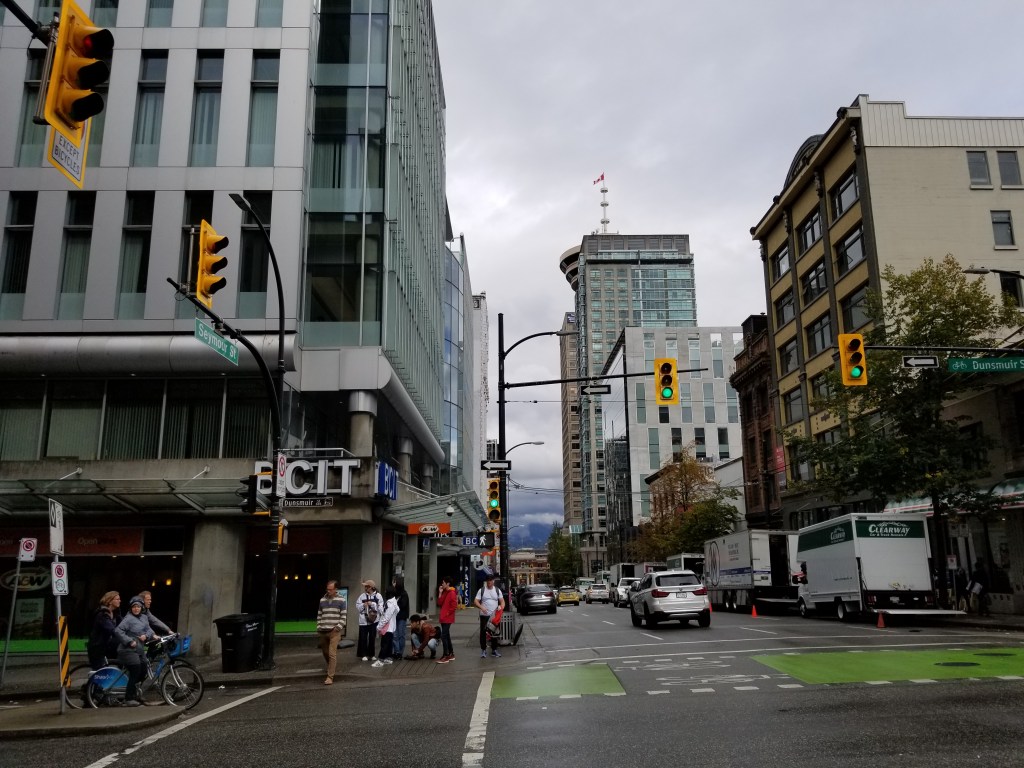
Dunsmuir Street is a major east-west street in downtown Vancouver, British Columbia, running through the heart of the city’s central business district. It stretches from Burrard Street in the west to Cambie Street in the east, where it transitions into Dunsmuir Viaduct, connecting to Prior Street and the Georgia Viaduct. Dunsmuir Street is a key arterial route, parallel to other prominent downtown streets like Georgia Street to the north and Robson Street to the south.
Dunsmuir Street is named after Robert Dunsmuir, a prominent 19th-century Scottish-Canadian coal magnate and politician who played a significant role in British Columbia’s industrial history, particularly through his development of coal mines on Vancouver Island and his involvement in the construction of the Esquimalt and Nanaimo Railway.
Dunsmuir Street was established as part of Vancouver’s early grid system in the late 19th century, a period when the city was rapidly growing due to the arrival of the Canadian Pacific Railway (CPR) in 1887. The street’s naming reflects the influence of figures like Robert Dunsmuir, whose wealth and political clout shaped much of BC’s early economic landscape.
Over the decades, Dunsmuir Street evolved from a relatively modest thoroughfare into a central artery in Vancouver’s downtown core. By the mid-20th century, it was surrounded by commercial buildings, and by the late 20th century, it became a hub for office towers, cultural institutions, and transit connections, reflecting Vancouver’s growth into a major metropolitan center.
The City of Vancouver has been working on a project to improve Dunsmuir and Melville Streets, focusing on the stretch between Hornby Street and the Coal Harbour Seawall. This initiative, part of the Downtown Bike Network Expansion, aims to make the area safer and more accessible for walking, biking, and rolling (e.g., using wheelchairs or scooters). Public engagement for this project concluded on October 6, 2024, with the city collecting feedback through surveys and in-person events. An engagement summary was expected to be released in late 2024 or early 2025, which should now be available as of May 2025. Construction is slated to begin in 2026, indicating that preparatory work, such as final design approvals, might be underway now. The upgrades will enhance connectivity between key routes, improving access to the Coal Harbour Seawall, a popular recreational area along the waterfront.
Dunsmuir Street is home to several notable buildings, including Bentall Centre (near Burrard Street). It’s a complex of office towers that houses major corporations and is a focal point for business activity. 500 Dunsmuir Street is associated with the Holborn Group of Companies, a real estate firm. The building itself is likely a commercial property, reflecting the street’s role in Vancouver’s business district. Dunsmuir Street is close to cultural landmarks like the Vancouver Art Gallery (on Georgia Street, just north of Dunsmuir) and public spaces like Robson Square, accessible via nearby streets. The Hyatt Regency Hotel is located near Burrard and Dunsmuir, making the area a hub for tourists as well as locals. Retail options, such as those at The Bay store on Granville Street (accessible via Dunsmuir), also contribute to the street’s vibrancy.
Dunsmuir Street is a busy route for vehicular traffic, particularly during rush hours, as it serves as a primary east-west corridor for commuters heading to or from the central business district. The ongoing Dunsmuir/Melville Street upgrades highlight the city’s focus on improving cycling infrastructure. Dunsmuir Street already has a protected bike lane for much of its length, a feature introduced in 2010 as part of Vancouver’s push to become a bike-friendly city. The 2026 upgrades will likely enhance these facilities further. In addition to SkyTrain stations, Dunsmuir Street is served by multiple bus routes, and its proximity to the Granville transit mall (on Granville Street) makes it a key node for public transit users.
The planned upgrades starting in 2026 will likely cause temporary disruptions on Dunsmuir Street, such as lane closures or detours, but the long-term benefits include improved safety and accessibility for all users. Vancouver’s focus on sustainable transit and walkable streets suggests that Dunsmuir Street will continue to evolve into a more eco-friendly corridor, potentially with features like expanded bike lanes, more greenery, and better integration with public transit. As downtown Vancouver grows, Dunsmuir Street may see increased development, such as new high-rises or mixed-use projects, though the city’s emphasis on preserving views and public spaces will likely temper this growth.
Dunsmuir Street’s viaduct section, the Dunsmuir Viaduct, has been a point of contention in Vancouver’s urban planning debates. Some city planners and residents have advocated for its removal (along with the Georgia Viaduct) to reclaim land for parks or housing, a proposal that gained traction in the 2010s and 2020s. As of May 2025, no final decision has been widely publicized, but this could be a future change to watch for.
Dunsmuir Street is a vital part of Vancouver’s downtown core, blending historical significance with modern urban functionality. It’s a hub for business, transit, and cultural activity, and the ongoing upgrades (set to begin in 2026) will enhance its role as a pedestrian- and cyclist-friendly corridor. Its proximity to landmarks like the Bentall Centre, SkyTrain stations, and the Coal Harbour Seawall makes it a central artery in the city’s daily life.