

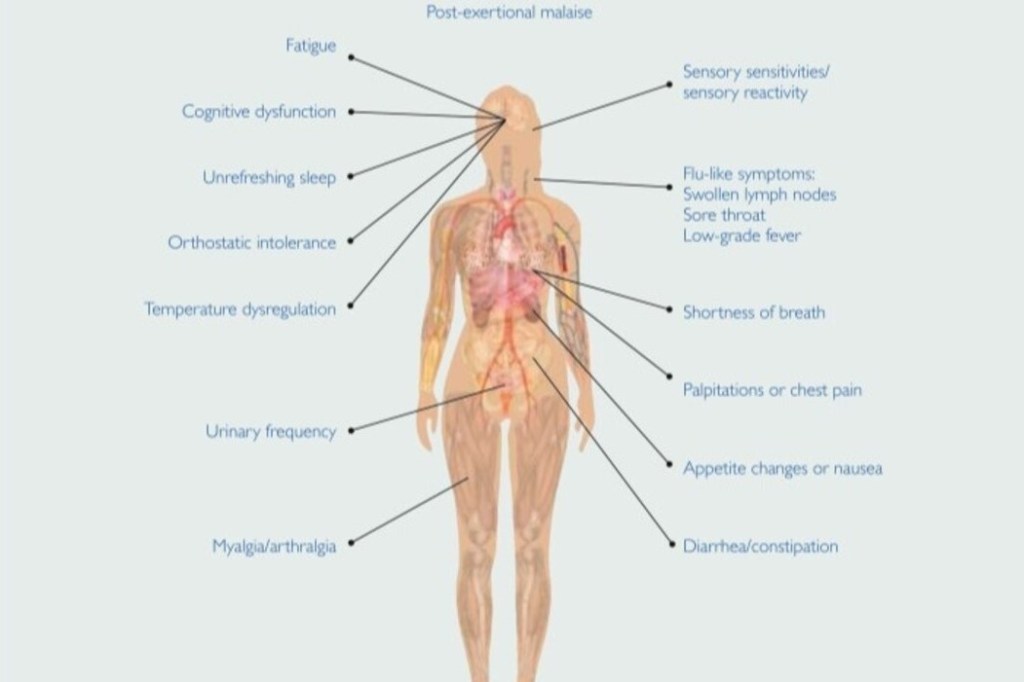
In this post, I will quote from Katrina Berne’s ‘Running on Empty: The Complete Guide to Chronic Fatigue Syndrome’ (1992), which is one of the books that I’m reading now. “There have been pockets of CFIDS outbreaks across the United States and in other countries as well – CFIDS is literally all over the map. CFIDS crosses all barriers – age, nationality, gender, income, lifestyle, and occupation – although certain predisposing factors make some people more susceptible than others. The onset of CFIDS is abrupt in about 75% of cases: most patients can pinpoint exactly when they became ill. “I was sitting in the airport the day before Thanksgiving when I suddenly started to feel awful,” says Tom. “My flight was fine, but I wasn’t; I don’t even remember the time I spent with my relatives. I slept through the entire visit.” However, the onset may not be as abrupt as it seems. Often, patients note in retrospect that they experienced a number of CFIDS-like symptoms over a period of years, often throughout their lifetimes: easy fatigability, allergies, frequent infections, unexplained body pain, and such. These symptoms were mild or intermittent and did not cause significant distress until an infectious agent, toxic exposure, and/or major life changes initiated the onset of full-blown CFIDS. The distinction between gradual and abrupt onset of CFIDS is blurry. Female PWCs are believed to outnumber males by a 2:1 or 3:1 ratio. This phenomenon is not uncommon in autoimmune diseases, which CFIDS may indeed prove to be. “What are you doing with a woman’s disease?” asked one insensitive doctor of a male PWC. In fact, CFIDS may be less frequently diagnosed among males because men often do not seek medical attention when they are ill. If the “sex bias” does exist, it may be explained by hormonal differences and/or occupational differences. The majority of known cases have occurred among professionals, health care workers, airline personnel, and businesspeople, while blue-collar workers and those in solitary professions seem to be less affected. It has been hypothesized that Type A personalities may be more susceptible to developing CFIDS. The average age at onset is 37, and most patients are in their middle or “prime” years, in the 25-50 age range. Numerous studies indicate that about 75% of patients are aged 20-49; 50-60% are 30-49. The preponderance of cases in these middle, normally productive years is potentially devastating to our work force. However, the age range may be skewed because the illness is probably underdiagnosed in children and in the elderly. CFIDS is found in every age group. Symptoms vary widely among patients and will vary in severity and change over time in each PWC. Many CFIDS symptoms have been experienced by healthy individuals from time to time, but in PWCs the symptoms are more continuous, severe, and pronounced. A college professor who was forced by CFIDS into early retirement calls it “the disease of jumping symptoms.” Another PWC notes, “The fatigue, disequilibrium, and frequent illnesses that plagued me in the first year of my illness aren’t such a problem anymore. But I now have more difficulty with allergies, digestive problems, and sometimes muscle pain. I’m ill all the time, but the severity and the symptoms keep changing. It’s really hard to plan anything or live any kind of predictable life with this crazy stuff going on. I’m getting really angry and fed up, and so is my family. We never know what to expect.” For the sake of convenience, we may describe CFIDS symptoms as falling into three general categories. General or physical symptoms include: debilitating fatigue; sore throat; swollen or tender lymph nodes; frequent infections; unusual and often severe headaches; allergies (worsening of previous allergies and/or new allergies); sensitivities to foods, odors, or chemicals; weight change, usually a gain unaccompanied by a change in eating habits; muscle and joint aches; gastrointestinal problems such as gas, diarrhea, nausea, and abdominal pain; rashes; low-grade fevers; night sweats, shortness of breath with minimal or no exertion, heart palpitations, chest pain; cough; urinary tract problems; decreased sex drive. Neurological symptoms include: sensitivity to bright light; disequilibrium (balance problems, “spaceyness,” and disorientation); difficulty with concentration and memory; impaired calculation and word-finding abilities; numbness or tingling feelings; sleep disturbance; visual problems; seizure-like episodes or “blackouts”; unusual and disturbing nightmares; and altered perception, which is often most evident when driving a vehicle. These neurological symptoms are a hallmark of CFIDS. Emotional problems associated with CFIDS include: depression, which may be accompanied by suicidal ideation or attempts; anxiety with or without panic attacks; mood swings; irritability and/or “rage attacks”. The depression may be both endogenous (chemically caused) and exogenous (caused by external events – in this case, being chronically ill). Although patients often feel crazy, many of the emotional changes they experience are directly caused by the illness. Most did not experience such problems prior to the onset of CFIDS. PWCs generally feel poorly understood by others, experiencing self-doubt as well as relationship conflicts. It is impossible for those without CFIDS to understand the true impact of the illness and the havoc it can wreak. Because patients invariably appear healthier than they feel, those with whom they come into contact are not immediately aware of CFIDS-related limitations and often expect the PWCs to behave “normally” – that is, to be active and to handle the same responsibilities as in the past. It is difficult for PWCs to communicate the degree of their physical impairment and emotional pain to others, and as a result many relationships are disrupted. In addition, the PWC copes daily with lowered self-esteem, a very restricted activity level, an inability to predict health fluctuations, and feelings of powerlessness and worthlessness due to the inability to function as in the past. Many have based their self-esteem on what they were able to do rather than on who they were and are, leading to changing roles and identity problems that must be addressed. The emotional fallout of CFIDS can be as devastating as the symptoms themselves. There is no laboratory test to diagnose CFIDS. Diagnosis is based on symptoms, length of the illness, degree of impairment, and by ruling out other illnesses with similar symptoms. In the past an Epstein-Barr antibody panel was used, but this should no longer be regarded as a diagnostic tool since the elevation of Epstein-Barr virus antibodies found in most patients is now viewed as an epiphenomenon – a secondary phenomenon accompanying another and caused by it – rather than a cause of CFIDS. Many PWCs see numerous doctors before being diagnosed. CFIDS is both underdiagnosed (when patients’ symptoms are not understood or taken seriously by their doctors) and overdiagnosed (when fatigue is caused by other factors, including anemia, sleep disorders, psychological/psychiatric disorders, effects of drugs, metabolic disorders, and other chronic illnesses). The severity of the illness varies considerably among patients as well as individual patients across time. Some are mildly affected and can carry on a modified activity schedule, others are extremely debilitated, and many are completely disabled. Those in the latter group are unable to work and may be bedbound or housebound. Most cases fall between these extremes, with the illness following a waxing and waning cycle. The Center for Disease Control and Prevention, initially resistant to acknowledging the existence of this illness, issued a definition and symptoms criteria for the diagnoses of Chronic Fatigue Syndrome (the term they prefer) in March 1988. Revised diagnostic criteria were published in December 1994. Although the criteria were developed for research purposes, they are often used as a diagnostic tool by physicians and the Social Security Administration. CFIDS researchers, medical practitioners, and patients agree that their definition is quite narrow in scope and needs to be updated. The mode of transmission is unknown. Multiple cases of CFIDS in families are common, and those afflicted are usually genetically related (blood relatives) rather than nonblood relatives such as spouses. Some researchers suspect that the risk for partners of PWCs of developing the disease increases over time due to increased viral “load” or repeated exposure, while others believe that the risk of contagion is high only in the early stages of the disease. However, there is no evidence that CFIDS is contagious or transmissible. If CFIDS is found not to be highly contagious, then genetic predisposition and/or exposure to environmental agents may explain the route by which the disease is contracted. Although there is no known cure, CFIDS is treatable. Rest and lifestyle modification are the most helpful treatments. PWCs who are used to being active achievers find that moderating their activity levels falls somewhere between inconvenient and impossible. However, it is absolutely necessary to adapt by altering one’s activity level. The worst thing PWCs can do is push themselves too hard, thereby inviting relapses and possibly prolonging the course of the illness. In addition to rest and moderation of activity, general and symptomatic treatments are available. It is essential to work with a physician who is knowledgeable about CFIDS and current treatment regimens. Individual or group psychotherapy is helpful for dealing with the emotional devastation that invariably accompanies CFIDS: illness-imposed limitations, anger, losses, depression, relationship and family issues, and lifestyle alterations. Instruction in relaxation and stress-reduction techniques can also be helpful. Most support groups provide referral lists of recommended professionals. Is there life after CFIDS? Do people recover? Many PWCs have been told by their physicians that they will get well in a specified amount of time, such as three to five years. However, it is impossible to predict how long an individual will remain ill or whether full or significant recovery will take place. Although the prognosis is uncertain in individual cases, various clinicians have noted trends in the course of the illness. Daniel Peterson, M.D., has noted that 75% of patients improve gradually, 20% reach a plateau at a certain level of dysfunction, and 3% remain severely disabled and may continue to deteriorate. Paul Cheney, M.D., has reported that about 12% of patients recover fully, usually during the first one or two years or during the fourth or fifth year. Another expert finds that 30% of patients experience significant remission, although full recovery is unlikely. Degree of recovery seems to be associated not with how severe the illness is, but with how long it has lasted. Several experts observe that those who remain ill for longer than three years have a low incidence of complete recovery, although many improve. Those who have become fully disabled often remain disabled for many years. The majority of patients continue to have chronic moderate-to-severe symptoms. Although most continue to have symptoms, a small subgroup recovers and most patients do improve – often substantially – over time. “CFIDS is a mystery waiting for a miracle,” wrote one PWC. “CFIDS changes your priorities and puts you firmly in the now. You can’t remember yesterday, and you can’t predict tomorrow. When your now is full of pain and frustration, it’s the end of the world. When your now improves, there’s hope in your heart.” CFIDS has been defined and described by many experts. Paul Cheney, M.D., noted that although we lack a specific definition of this syndrome, “we know it when we see it” (February 1990). He described the common denominators of PWCs as immune system dysregulation and neurocognitive dysfunction. Noting both similarities and differences among PWCs, Mark Loveless, M.D., calls CFIDS a “spectrum of disease.” Jay Goldstein, M.D., has referred to CFIDS as “the most complex disease I have ever studied.” He defined CFIDS in March 1991: “I regard CFIDS as the final common pathway of a multifactorial psychoneuroimmunologic disorder with a limbic encephalopathy causing autonomic dysfunction and subtle neuroendocrine derangements.” Although this definition is the most specific to date, it is difficult for those outside the medical profession to understand. Its essence is that disruption in normal brain functioning is the cause of most or all CFIDS symptoms, although the causes of the brain abnormalities are not currently known. Defining CFIDS as a psychoneuroimmunologic disorder addresses the interactions among behavior, the immune system, and the central nervous system. These interactions are quite complex and form the basis of understanding illness and wellness in an appropriate and meaningful way. Various community-based studies indicate that the prevalence of CFIDS is between 76 and 267 cases per 100,000 people in the United States. Some estimates indicate 2 to 10 million cases in this country alone, and millions more in other countries around the world. Because systematic studies have not been done and many cases remain undiagnosed, we can only guess at the actual number of PWCs. One reason for the underdiagnosis of the syndrome is the resistance or unwillingness of many physicians to diagnose a poorly understood illness whose name reflects only one symptom: fatigue – the most common complaint among all medical patients. CFIDS is an illness that is easy to diagnose if the physician has experience with it; however, it is difficult and expensive to treat, making it especially unpopular with HMOs (health maintenance organizations). Pocket outbreaks of the illness have occurred in many areas, including Incline Village, Nevada; Lyndonville, New York; and parts of North Carolina and northern and southern California. The CDC, the CFIDS Association of America, local support groups, and health practitioners are continually deluged with requests for information about CFIDS. Clearly this is an epidemic of huge proportions. CFIDS isn’t just chronic fatigue. The medical profession and general public have tended to confuse chronic fatigue and chronic fatigue syndrome, an unfortunate result of the terminology used for this illness. The name CFIDS is often preferred because it includes the “immune dysfunction” aspect of the illness, but the term “CFS” remains more widely used. The CDC insists on using this name, a point of contention for many researchers, practitioners, and PWCs. CFIDS has significantly affected us individually and collectively. By afflicting those in their most productive years, CFIDS is a serious threat to the nation’s work force. The loss of workers, the mounting medical and research expenses, and the increasing number of disability cases and cumulative disability payments from Social Security and private insurers are potentially devastating to our national economy. Also devastating are the divorce rate and suicide rate of PWCs. The divorce rate for chronically ill persons is an astounding 75%. The suicide rate is unknown but believed to be much higher than that of the general population. Because many PWCs (including children and adolescents) feel overwhelmed, misunderstood, depressed, and hopeless, suicide is often contemplated and sometimes attempted by PWCs as an alternative to a life of desperation and pain. Anthony Komaroff, M.D., wrote, “Chronic fatigue syndrome and its related conditions represent an illness distinct from other known physical and psychological illnesses” (1988). Other researchers concur and remain baffled by this illness, which resembles other illnesses but is a phenomenon all its own. CFIDS is a disease like no other.”

