
During 1935 the palaeontologist Gustav Heinrich Ralph von Koenigswald visited a Chinese apothecary shop in Hong Kong and discovered an unusually large molar, a tooth similar to the large flat ones that you have towards the back of your mouth.
Fossils like this are often found in Traditional Chinese medicine where they are called ‘dragon bones’, but this tooth did not come from a mythical creature, instead study revealed it to have come from some kind of gigantic ape.
When describing it as a new genus the choice of name was obvious and so von Koenigswald created Gigantopithecus with literally translates as ‘giant ape’.
Since this first discovery over one thousand three hundred teeth have been tracked down, many of them from the Traditional Chinese medicine market.
More excitingly however are the discoveries of some lower jaws which have allowed palaeontologists and primatologists to infer a little about what Gigantopithecus might have been like.
Unfortunately this is where the clues stop as so far no other parts of the skeleton or even the skull have so far been found.
The most famous species of Gigantopithecus known is G. blacki which seems to be the largest of the known species.
This was the first species to be named and so far is known from caves in South East Asia and is represented by both teeth and mandibles.
Another species is G. giganteus, but this is something of a misnomer as it actually seems to be only half the size of G. blacki.
This species is however known from India, and the size difference might be down to a different climatic adaptation, even though there is evidence to suggest that it also inhabited parts of China.
Another Indian species is G. bilaspurensis and this species really stands out from the other two because its remains are dated to as far back as the late Miocene period, extending the temporal range of Gigantopithecus for many millions of years between the Miocene and Pleistocene periods.
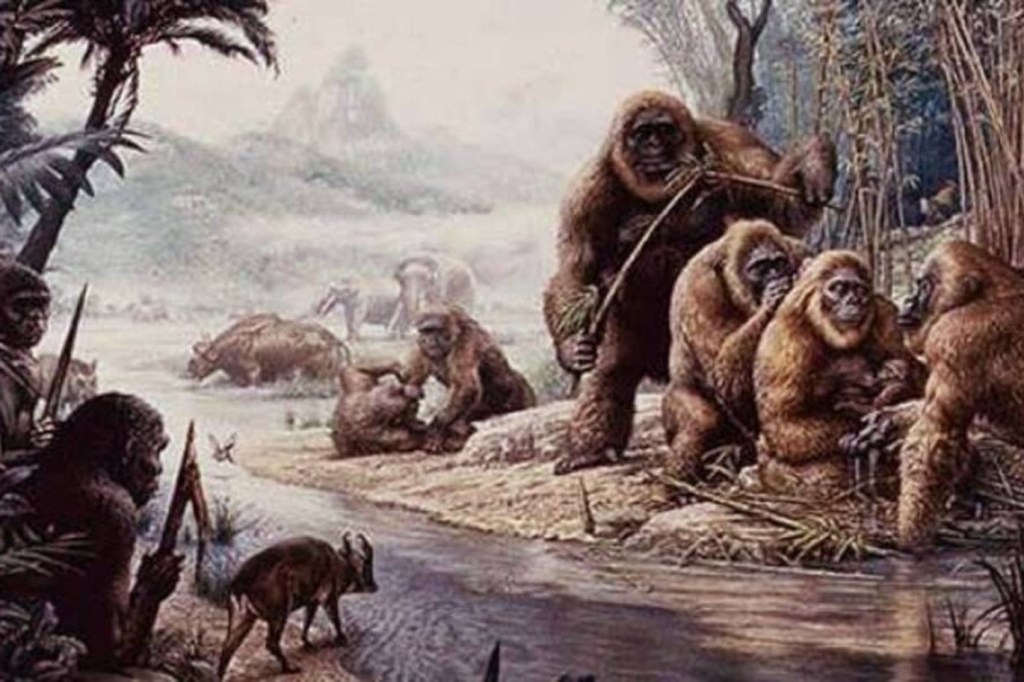
Because no complete or even partially complete skeleton is known, reconstructions of Gigantopithecus are highly speculative, but the parts which are known do reveal a surprising amount of information.
Reconstructions of Gigantopithecus are often of a gorilla like ape because gorillas are the largest apes that we know today, but the lower jaw structure is actually much closer to that of an orangutan.
This is why Gigantopithecus is classified within the Ponginae group of apes along with orangutans (which are actually classed under the genus Pongo). It is also for this reason that what are considered to be more accurate reconstructions give Gigantopithecus a more orangutan-like appearance.
Reconstructions of Gigantopithecus are usually of an individual in an erect upright posture so that the full size of this ape can be more easily appreciated, for example, when you see a bear on all four legs it looks big, but when it stands on its back two it gives the impression of a considerably larger animal.
However the wider consensus amongst researchers is that if Gigantopithecus was like other known great apes (a theory that is supported by current fossil evidence) it would have mostly supported its body with all four limbs in a hunched quadrupedal posture, although bipedal locomotion would be occasionally observed, particularly as part of displays or moving short distances.
Assuming that the rest of the skeleton of Gigantopithecus resembled the skeletons of other great apes, then it simply would not have the skeletal posture or musculature to maintain a bipedal stance without additional effort.
There is one theory that was proposed by the anthropologist Grover Krantz that was made to support the idea that Gigantopithecus was primarily bipedal.
Krantz noted how the known jaws of Gigantopithecus widen towards the rear and proposed that this widening occurred to allow for the housing of a trachea (the ‘windpipe’ that connects the lungs to the mouth opening) when the skull was placed directly in top of the head like a human and not carried forward like a great ape.
It’s possible however that Krantz’s thinking was skewed by his desire to connect Gigantopithecus with ‘bigfoot’ stories from North America when he tried to prove this supposedly bipedal creature’s existence.
Most animal jaws widen as they approach the point of articulation regardless of how the head orients to the neck, which is why the vast majority of researchers consider this to be a flawed theory at best.
It is actually a lot easier to infer what kind of things that Gigantopithecus ate and analysis so far reveals a picture of it being a strict herbivore.
Like with orangutans the lower jaws of Gigantopithecus are very deep and robust which hints that they are built for strength in chewing tough fibrous plants.
The molars of the teeth are also low crowned with very thick enamel, yet also show excessive wear, all further signs of a browser of tough vegetation.
Further in depth analysis of phytoliths (silica deposits from plant cells) has revealed that dietary staple of Gigantopithecus was likely bamboo, a very common plant in areas where Gigantopithecus fossils are known from.
Additionally there also seems to be the remains of fruits such as figs associated with Gigantopithecus fossils suggesting that this ape also ate fruits when it was able to find them.
This might also explain occurrences of cavities in Gigantopithecus teeth which could have been caused by acidic fruit juices wearing away the tooth enamel.
Granted this is a slow process, but a diet that incorporated a regular intake of fruit would allow for the teeth to come into near constant contact with these juices.
Further support for bamboo being one of the main foodstuffs that Gigantopithecus relied upon actually comes from deformities in some of the Gigantopithecus fossils.
These deformities are most likely caused by malnutrition, an inability of the individual to gather the minimum necessary food to maintain a healthy body.
Bamboo forests that can cover vast areas of landscape will periodically go through what is termed a mass ‘die off’ every few decades.
Although the exact timing of this die off is hard to predict with certainty as the time between occurrences can vary considerably, it can be relied upon to happen and when it does it causes a mass shortage of available food for the animals that live on bamboo, today an occurrence most commonly mentioned in studies of wild panda (Ailuropoda melanoleuca).
As large apes it’s presumed that even in the wild that Gigantopithecus would have lived for at least several decades so it is very likely that they would live to see at least one bamboo die off which resulted in the deformities.
Palaeontologists will tell you that what caused an animal to go extinct is probably the most difficult question to answer.
Sometimes you can tie in the disappearance of an animal to an event such as an asteroid hitting the planet, or the arrival of a new species in an ecosystem, but there does not seem to be any one event that could help palaeontologists to get an idea why Gigantopithecus disappeared.
Quite often early humans get the blame for wiping out the worlds megafauna during the Pleistocene but this doesn’t seem to be the case for Gigantopithecus.
Around eight hundred thousand years ago Homo erectus arrived in south East Asia, but Gigantopithecus does not disappear from fossil deposits until three hundred thousand years ago, something which reveals that both Homo erectus and Gigantopithecus co-existed for some five hundred thousand years.
Habitat loss could be a better answer, but there is currently not a lot of evidence to support this beyond the regular die offs that are occasionally observed.
Unless die offs began occurring with greater frequency over the course of several hundred or several thousands of years, this might not be enough to explain the disappearance.
Another and often used fall back theory is that of the emergence of a new strain of disease that proved particularly lethal to Gigantopithecus.
This could have been further exacerbated by a small population that had a limited gene pool that resulted in less genetic diversity for a few to have been resistant.
Counter to this idea of course is the naming of three separate species that would have been genetically different enough to have different forms, so unless a disease was particularly virulent this idea is not all that likely either.
A fairer approach is not to look for just one unique cause in the extinction of Gigantopithecus (or any animal for that matter).
A number of small things are more likely to affect the population numbers of a species and together they can unify to be just as devastating as a single freak event.
For example, the arrival of Homo erectus did not have an immediate effect upon Gigantopithecus, but their presence in the ecosystem meant that there was less food and other resources like sheltered areas to go around other animals.
When food became periodically scarce this would have caused greater competition between the species for what little food was left pushing those that could not compete as well closer to the brink of extinction.
For Gigantopithecus this competition would come from many other kinds of creatures that ate the same food as it did and when these animals finished what little was left of the remaining food, Gigantopithecus would end up starving.
This is also where the large size of Gigantopithecus would have significantly counted against it because such a large body would need significantly more food in order to get the minimum level of calories to survive.
Remember, what little fossil evidence we currently have does suggest that malnutrition was a real problem for these apes.
This is of course all theory, no one person can yet say for certain what happened, but with this in mind extinction could have either been a gradual event where population numbers reduced to the point where the species could no longer be maintained, or that the population grew weaker and smaller to be finished off by a final event such as disease or a significantly bad upset to the ecosystem that sorted itself out after Gigantopithecus vanished.
Despite the lack of fossils in any deposits more recent than three hundred thousand years ago however, there remains a few people who are vocal about their belief that Gigantopithecus is still alive.
The chances are that a lot of people reading this article found it either from a link from another website or doing a web search about the yeti, bigfoot or sasquatch and it’s supposed connection with Gigantopithecus in cryptozoology.
Well this connection is very controversial and most, palaeontologists, anthropologists, primatologists and even many Bigfoot researchers consider it unlikely to impossible.
Supporters of the idea began to make the connection not long after Gigantopithecus was described but first a little history upon just what these other creatures are supposed to be.
Across Asia and North America there are many stories about giant apes that are described either as human-like apes or ape-like humans that are much bigger than people are today with heights being estimated to be anything from around two to two and a half meters, or bigger depending upon the witness.
These creatures occasionally feature in folk stories passed down from generation to generation and the creatures in them have almost as many names as there are variations of the stories from Yeti to Bigfoot to sasquatch to grassman, the list goes on.
Many of these stories are now in the public consciousness and today there have been countless sightings by eyewitnesses, photographs and plaster casts of footprints, possible hair samples, sound recordings to most famous of all the Patterson-Gimlin film that supposedly shows a Bigfoot walking away from a video camera.
The problem with the above body of evidence is that it is not enough to convince ardent sceptics. Eyewitnesses will sometimes be accused of misidentifying something else or rather more unkindly just making things up.
Footprints and sound recordings also get labelled as being fake or misidentified because no one was around to see who or what made them.
Hair samples are usually deemed inconclusive as well and the Patterson-Gimlin film is usually accused of being a guy in a suit because the creature walks like a man and not an ape.
Because this body of evidence cannot conclusively prove one way or the other that bigfoot-like creatures are wandering around, some researchers have tried to ground the stories in scientific fact.
Apes are an obvious choice because they are supposedly the most bigfoot-like creatures that are known without doubt to exist.
The main problem is that they are much smaller than the creatures of legend, but when Gigantopithecus entered the science of palaeontology many researchers immediately started talking about how there was now fossil evidence to prove that Bigfoots existed.
As you can probably already appreciate this is a very reckless way of proving the existence of a creature and when you evaluate the Gigantopithecus fossil evidence and combine that with Bigfoot folklore the two just don’t go together.
Back in the 1950’s theories started to be pieced together that stories of Yeti and Bigfoots were actually descriptions of encounters with relict populations of Gigantopithecus that had survived by isolation from the changing world around them.
Although not given much serious thought at the time, some quite well known anthropologists such as Carleton Coon and Grover Krantz (previously mentioned above) began to push their minds to finding form to the idea.
Krantz in particular is known for dedicating a lot of serious study to proving the existence of Bigfoot, even though initially he was sceptical of claims and evidence.
Krantz proposed that Gigantopithecus had crossed over Beringia (also known as the Bering Land Bridge) from upper Asia into North America.
Krantz also tried to formerly assign Bigfoot to Gigantopithecus blacki in 1985 but was rejected by the ICZN (the body that governs the naming of animals) on the grounds that there were no Bigfoot body parts that could be attributed to the existing G. blacki remains.
Krantz later tried again but this time calling it a new species, ‘Gigantopithecus canadensis‘ (from Canada), but again this was rejected because the plaster casts that he was trying to have treated as holotypes were not considered credible.
As already mentioned above, Krantz was an early proponent of Gigantopithecus being bipedal, but the reasoning behind this was discredited on the basis that the jaw features alone are not a distinguishable enough feature to conclude that Gigantopithecus was a purely bipedal animal.
This is the most obvious problem of the Gigantopithecus-bigfoot connection theory because Bigfoot is supposed to be a bipedal creature with feet similar to a human (but of course a lot bigger) as well as a walking gait similar to a human.
The great apes however have very different feet with elongated opposable big toes that help them to hold things with their feet.
Also while they can and sometimes do walk on two legs, their preferred mode of locomotion is to walk on all fours.
Supporters of a Bigfoot lineage often say that you cannot claim that Gigantopithecus was not bipedal because the feet have never been discovered.
By this very logic however you cannot say that it was either, but additional support against it comes from other known parts.
As mentioned above, the lower jaw of Gigantopithecus is very similar to that of an orangutan to the point that it is classed within the same great ape family.
This means that it is much more likely that Gigantopithecus had the same kind of grasping feet as an orangutan rather than human-like feet.
Not only would this make footprints different to what have been called Bigfoot prints, these feet are not that very well adapted for supporting the body of a creature during bipedal walking, an important part of the reason why great apes will most often walk on all fours.
Another argument against a Gigantopithecus-bigfoot lineage is the huge gap in the fossil record that marks the most recent Gigantopithecus fossils and the present day.
Some supporters of the theory have made claims varying from no one has bothered to look for Gigantopithecus in other areas like North America to even Gigantopithecus being discovered but hidden away by palaeontologists so that they don’t have to change their theories.
To begin with the first matter, palaeontologists cannot find fossils on demand, discovering a fossil is unfortunately not that convenient. The best that palaeontologists can do when looking for a certain kind of animal is to look for a deposit that ticks the right boxes.
For example, if you want to search for Triassic age ichthyosaurs you would first need to identify Triassic age rocks that were formed from a marine environment (Shasta County of California, USA springs to mind here).
This does not guarantee a discovery, but it does maximise your chances for finding something along the lines that you are looking for.
For Gigantopithecus you would need Miocene to Pleistocene age formations, from areas that had dense growths of bamboo during these times.
These deposits are well known from south East Asia where Gigantopithecus fossils are currently only known from, but North America has different deposits.
These deposits are still Miocene to Pleistocene in age, but the habitats are more like grassy plains instead of the bamboo forests of Asia.
For the sake of argument, a Gigantopithecus would have to radically adapt in form and behaviour to move into this new environment to the point where it would not be a Gigantopithecus anymore.
The idea that palaeontologists deliberately hide fossils to protect their teaching is basically laughable.
Theories in palaeontology are changing all the time with new discoveries and ideas that were standard teaching a few decades ago already being challenged by new discoveries today.
Also a palaeontologist that discovered confirmed Bigfoot remains would receive instant fame and recognition for the discovery, so nobody has any reason to hide anything.
It is the likelihood that Gigantopithecus was almost certainly a great ape similar to a large orangutan that leads sceptics and many Bigfoot enthusiasts to the conclusion that Gigantopithecus is not the mysterious Bigfoot, Yeti or whatever from legend.
Should a Bigfoot ever actually be found however and the eyewitness reports and footprints have all been correct, then we’ll probably find that the creature is no more related to Gigantopithecus than what humans are.