


The prolific British writer Herbert George Wells, who is known particularly as a pioneer of science fiction, was born in Bromley, Kent, on September 21, 1866, the son of a shopkeeper. He was educated at the Normal School of Science in London, and, having been a draper’s apprentice for a time, held various jobs before becoming a full-time writer in 1895. Wells was a deep and idealistic thinker on society and the individual’s role within it; for a time he was a member of the left-wing Fabian Society, whose members included George Bernard Shaw. Wells tended to be argumentative, and he fell out bitterly with Shaw and others.
In 1890, Wells married his first cousin, Isabel; they were soon divorced. He married Amy (“Jane”) Robbins in 1895, and had numerous affairs, including a 10-year relationship with the writer Rebecca West, which produced a son, Anthony.
Wells’s works in the science-fiction genre include The Time Machine, The Island of Doctor Moreau, The Invisible Man, and The War of the Worlds — all of which, along with much other writing, he produced in a burst of productivity in the second half of the 1890s. More conventional novels included Kipps and The History of Mr. Polly, he also wrote non-fiction, including the hugely popular The Outline of History. In all, he produced more than 100 books in a 50-year writing career. He developed an interest in world government, social planning, and ways of controlling technology for the benefit of society. He had a massive prophetic imagination, exemplified in his prediction (see Note 9) of “the Age of Motors, down to a detailed description of sweeping throughways, the congestion in city centres and the suburbanisation of the countryside” (Mac-Kenzie & MacKenzie, 1973, p. 163).
H. G. Wells died on August 13, 1946, six weeks before his 80th birthday. He was an enigmatic character — the contention of this chapter is that his idiosyncrasies are best explained by the presence of Asperger Syndrome.
Family and Early Life
Wells’s father, Joseph Wells, was the son of a gardener. While he acquired a love of plants, he somehow failed to acquire the disciplines of his trade — he was restless, given to spurts of enthusiasm, impatient to the point of being quick-tempered, and had a taste for being his own master. He was also quick-tempered and irritable; he may have shown signs of a combination of Asperger Syndrome and hyperkinetic syndrome. He had a great liking for books but was a poor manager of his life. In 1853, he married H. G.’s mother, Sarah Neal, an innkeeper’s daughter with an ingrained evangelical view of the world (MacKenzie & MacKenzie, 1973).
Soon after the birth of the first child, Frances, Joe Wells lost his job as gardener. When he was offered another post, he refused. This was a disastrous decision. The couple took over a china shop in Bromley from a cousin of Joe. This shop never did well; Joe supplemented their income as a semi-professional cricketer. The marriage was an unhappy one, with a high level of conflict and intimacy problems. Sarah suffered from depression and Joe “failed as a husband and father” (MacKenzie & MacKenzie, 1973, p. 15), possibly because of his Asperger Syndrome. He was generally happier when he was away from Sarah’s moans about his inadequacy. Sarah became pious and self-pitying; she was prone to snobbery and regretted the fact that Joe was not a gentleman.
Three further children were born: Frank in 1857, Fred in 1862, and H. G. (“Bertie”) in 1866. Frances died in 1864, to her mother’s great distress; Bertie was seen, in a way, as a substitute. Joe developed “a slow but profound estrangement from all the values his wife was determined to uphold. Sarah was too rigid in her outlook, too stereotyped in her beliefs, for a husband who enjoyed small talk and whiling away his evenings with cards and draughts” (MacKenzie & MacKenzie, 1973, p. 19).
As a baby, H. G. was cross and tiresome, according to his mother. Asperger babies are often like this. As a child he was precocious and good at drawing. He was very controlling and would not share his toys, and like his father, he suffered tantrums. H. G. later wrote, “T made a terrific fuss if my toys or games were touched and I displayed great vigor in acquiring their [his brothers’] more attractive possessions. | bit and scratched my brothers and I kicked their shins” (MacKenzie & MacKenzie, 1973, p. 21). Frank, the oldest boy, was a rebel, who found neither a cause nor a niche, ending up as an itinerant clock repairer. H. G. described him as a complete failure in life, like his father.
When H. G. was 7 years old, his leg was broken in an accident — one of the luckiest events of his life, as he described it in his autobiography (Wells, 1934). During his weeks of recuperation, he was exposed to a wide range of books and developed a great interest in reading, which opened the world to him. As a child, H. G. “roamed around Bromley, sometimes alone.” He was a very observant boy (persons with Asperger Syndrome are often great observers).
Wells stated that at the end of his childhood he had been “a sentimentalist, a moralist, a patriot, a racist, a great general in dreamland, a member of a secret society, an immortal figure in history, an impulsive fork thrower, and a bawling self-righteous kicker of domestic shins” — “a dress-rehearsal for much of his adult life” (MacKenzie & MacKenzie, 1973, p. 30).
His first job was as an apprentice in a drapery shop. He performed poorly and was dismissed. As a young person, the books he most admired were Tom Paine’s Common Sense, Swift’s Gulliver’s Travels, and above all, Plato’s Republic. MacKenzie and MacKenzie (1973) noted that these represent three themes — “radicalism and agnosticism, utopian satire, and the idea of a rational society ruled by men of intellect — which played a predominant role in his ideas and his writings” (p. 39). By the age of 14, he had acquired autodidactic habits of learning that remained with him all his life — curiosity, impatience, “a bubbling excitement at discovering facts or making connections that were already known to the better-educated, and a passionate belief in the power of words to stir the imagination” (MacKenzie & MacKenzie, 1973, p. 40). Novelty seeking and a fascination with words are characteristic of Asperger Syndrome.
At the Normal School of Science in South Kensington, Wells “not only absorbed (T. H.) Huxley’s pessimistic gloss on evolutionary theory, but he was also affected by the work of Kelvin and others who insisted that the law of entropy would eventually lead to a cooling of the sun and the reduction of the planets to a system of dead matter whirling in the nothingness of space” (MacKenzie & MacKenzie, 1973, p. 120). Wells left the college “with wilted qualifications and a reputation as an inattentive and undisciplined student. The dream that he might make a career as a scientist was shattered” (MacKenzie & MacKenzie, 1973, p. 69).
After suffering a few serious illnesses, of which the exact nature is not known, he gained a first-class honors degree in zoology from the University of London, having taken a correspondence course, and also became a Fellow of the College of Preceptors. At this time he was working as a teacher of science. He appears to have been a good and successful teacher and wrote a biology textbook. He had a superego and was conscientious and untiringly helpful to his students. One of his pupils later described him as showing “evident signs of poverty, or at least disregarding any outward appearance
of affluence. In dress, speech and manner he was plain and unvarnished, abrupt and direct, with a somewhat cynical and outspoken scorn of the easy luxurious life of those who have obtained preferment and advantage by reason of social position or wealth … he was extremely painstaking” (MacKenzie & MacKenzie, 1973, p. 83).
Work
Wells started to publish stories in periodicals around 1895, the year of his divorce. They were very well received — the Review of Reviews described him as a man of genius. He was employed as a theater critic by the Pal/ Mall Gazette, but, according to MacKenzie and MacKenzie (1973), he “never had much sense of the theatre, nor did contemporary stage versions of his tales have much success. Though he hugely enjoyed charades and amateur theatricals, he could never catch the peculiar quality of illusion which must be fused in a play” (p. 109). This may have been because of his Asperger Syndrome.
He badgered his publishers: “He was … intensely suspicious, and one or two small instances of sharp practice confirmed his view that any unwatched publisher might well swindle him of his due. The result was that Wells was always in the market, and no publisher could ever be sure that he would have the next book, or on what terms he would get it; and even when a contract was signed he could expect a steady flow of criticism of his shortcomings and attempts to tell him how to run his business” (MacKenzie & MacKenzie, 1973, p. 112). Persons with Asperger Syndrome tend to be rather paranoid, controlling, unempathic, and intrusive.
Wells’s work was compared with that of Jules Verne, a comparison that both men disavowed on the basis that Verne’s work was more scientific. Wells “always wrote as a moralist, concerned with man’s place among the mysteries of Nature, or the social implications of mastering them. Verne reflected mid-century optimism about progress, celebrated the advance of science, and conscientiously tried to work out what marvels might lie on the hidden agenda of the future. The similarity of their subject matter obscured this contrast between the pessimist and the positivist” (MacKenzie & MacKenzie, 1973, p. 118). Wells produced stories that were rich in symbolism and dreamlike in their structure: It is not true that persons with Asperger Syndrome cannot use symbolism, as is often thought.
“Several of the stories … used the theme of doppelganger — the idea of double identity. In “The Late Mr. Elvesham, “The Stolen Body’ and “The Plattner Story’ Wells revealed his fascination with the idea of dual personality which breaks out repeatedly in his later fiction” (MacKenzie & MacKenzie, 1973, p. 118). Persons with Asperger Syndrome often feel split and certainly have identity diffusion. Wells used models of writing that “matched his own psychic preoccupations (such as the feeling of double identity or the alienation of the outsider) or his cosmic obsessions (such as the nature of man and the fate of his planet)” (MacKenzie & MacKenzie, 1973, p. 119). His writing embodies a sense of impending apocalypse.
The Island of Doctor Moreau describes the agony of beasts made half-human by surgery. The study of nature, according to Moreau, “makes a man at last as remorseless as nature.” Man “is still only half a human being, a creature torn between its mental aspirations and its instinctual drives, and thereby condemned to unending pain and torment. In case the analogy between Moreau’s beasts and normal man had been missed, Wells underlined it. After the final horrors on the island after Moreau’s death, the beast-men begin to regress. Prendrick, the scientist who has been cast away on the island, manages to escape and returns to London. There he looks at the “blank expressionless faces of people on trains and omnibuses,’ and fears that ‘they would presently begin to revert, to show first this bestial mark and then that” (MacKenzie & MacKenzie, 1973, p. 125). Here he may be describing certain Asperger-type experiences.
In The War of the Worlds, “anything weak or silly” will be wiped out by the Martians’ heat-rays as their tripods stalk on through the blackened ruins toward London. In this deeply pessimistic story, Wells wrote that only “able-bodied, clean-minded men” would survive: men who would obey orders and ensure the future of an untainted race by mating with “able-bodied, clean-minded mothers and teachers” (p. 128). This reminds one of the writings of George Orwell, who also had Asperger Syndrome (Fitzgerald, 2005).
Around the turn of the century, there was some criticism of “the disproportionate realism that almost amounted to vulgarity” in Wells’s books (MacKenzie & MacKenzie, 1973, p. 152). For example, Edward Garnett wrote, “the author as artist has not so completely absorbed & assimilated the author’s philosophy” as to conquer “the rather hard prosaic exact creed of explanation, analysis and demonstration’: Wells had been so involved in recording his personal life that he had failed to realize that “life is so much greater than any possible explanation of it” (MacKenzie & MacKenzie, 1973, p. 122; emphasis in original). Because Wells could not distinguish between life and art, he had begun “to justify his inability to distinguish [them] into a principle.” This difficulty of distinguishing life from art is a classic Asperger issue. Virginia Woolf was later to attack Wells for disinterest in the mental and emotional life of his characters and for the detailed realism of his novels. What else can a writer with Asperger Syndrome do?
MacKenzie and MacKenzie (1973) note that in Wells’s later novels, the autobiographical theme was used as a substitute for selfrevelation, rather than as a means to it. “Wells indulged himself in his past, relying on his power of vivid description and good storytelling to obscure the fact that he was unable to use his experience at the emotional level required to transmute life into art. He drew upon his own life for plot and detail like a reporter rather than a novelist, setting the scene brilliantly but failing to people it with characters that were anything more than comic caricatures, puppets for his ideas, or projections of himself. At each point where his larger designs required him to transcend the obvious, to explore behind the self-image of which he made such free use in his fiction, some emotional inhibition frustrated him” (p. 280).
This is a critical observation, because it is a classical Asperger style of writing. Henry James wrote of “the co-existence of so much talent with so little art, so much life with (so to speak) so little living!” but found Wells “more interesting by his faults than he will probably ever manage to be in any other way” (MacKenzie & Mac-Kenzie, 1973, p. 282). Again, this is a typical comment about an Asperger person.
Social Behavior
In school, Wells had one friend, an older and more sophisticated student. It is typical of persons with Asperger Syndrome to have a single good friend — often older. Many of his friendships were carried out largely by correspondence, which would suit the Asperger person. He drew comic sketches in his letters. Persons with Asperger Syndrome can form loyal, long-lasting relationships. There is usually a highly intellectual element to the relationships, which tend to be with fellow intellectuals or fellow thinkers.
When Wells was working as a teacher, he “had already acquired a knack of using his acquaintances as sounding-boards for whatever fancy was quick in his mind” (MacKenzie & MacKenzie, 1973, p. 48) — this is reminiscent of Ludwig Wittgenstein. At college he was “bewitched” by the evolutionist T. H. Huxley; he “remained so, emotionally and intellectually, to the end of his days” (MacKenzie & MacKenzie, 1973, p. 57).
In the debating society at college, Wells loved smashing popular beliefs and was a great talker, which is common in persons with Asperger Syndrome. He was a gawky student and socially insecure. His first wife, Isabel, was shy and simple. During their courtship he “talked to her, and at her” (the “at” is typical Asperger Syndrome). She had to listen to his rambling discussions of “atheism and agnosticism, of republicanism, of the social revolution, of the releasing power of art, of Malthusianism, of free love and such-like liberating topics” (MacKenzie & MacKenzie, 1973, p. 67) — topics in which she had no interest, as she was unintellectual and conservative by nature. This is typical of a one-way Asperger kind of discussion.
In the marriage, “He did not realize that the drive to subjugate Isabel crushed whatever chance there might have been that she could grow to meet him on more equal terms” (MacKenzie & MacKenzie, 1973, p. 88). He was showing the Asperger Syndrome over-control here. The pattern of a typical Asperger marriage started to develop; he “began to keep his interests to himself, especially when he found that even conversation on petty topics died or escalated into irritable tiffs” (MacKenzie & MacKenzie, 1973, p. 89). Wells discovered that his ideal was an illusion now that Isabel was his wife.
Once he was married, he felt trapped — he found marriage a prison and wanted to get out of it. Early in the marriage he seduced one of Isabel’s friends. Infidelity then became a feature of his life. Wells became attracted to a student of his named Amy Robbins (known then as Catherine). His abstract idea of the ideal woman, Venus Urania, “had failed to embody herself in Isabel … My mind was seizing upon Amy Catherine Robbins to make her the triumphant rival of that elusive goddess … in her turn, I was trying to impose a role (MacKenzie & MacKenzie, 1973, p. 92). Many Asperger marriages break down.
His language in a letter to Robbins regarding an attack of illness — “When we made our small jokes on Wednesday afternoon about the possible courses a shy man desperate at the imminence of a party might adopt, we did not realize that the Great Arch Humorist also meant to have his joke in the matter” (p. 93) — is reminiscent of the type of language used by Paul Erdés, a mathematician with Asperger Syndrome.
In 1891, Wells had a meeting with Frank Harris, editor of the Fortnightly Review, about an article that Wells had written. The meeting did not go well because Wells, instead of explaining the article to Harris, who did not understand it, concentrated on the state of his top hat — he had dressed up for the meeting, but “couldn’t for a moment adopt the tone and style of a bright young man of science. There was my hat tacitly revealing the sort of chap I was.” When he got home Wells smashed the hat — “the symbol of a failure which hurt him so much that he claimed he could not attempt another serious article for a year or more” (MacKenzie & MacKenzie, 1973, p. 87). This is a good example of problems that persons with Asperger Syndrome have in interpersonal relationships. What Harris wanted was not high-flown abstractions but vivid metaphors that would illuminate for his readers the new and strange, and even terrifying, world into which science was carrying them. But because of his Asperger Syndrome, Wells was tending toward high-flown abstractions.
Wells and Isabel parted in early 1894, over his relationship with Ms. Robbins; he and Catherine eloped together. It seems that no strong sexual passion was driving them together — Wells wrote of “immense secret disillusionments” — but Catherine was quick, amusing, and more sophisticated than Isabel. MacKenzie and MacKenzie (1973) observed that Wells had abandoned a wife whom he had been unable to subjugate, and chosen a mistress who was willing to live her life through him and for him.
In being willing to live her life through and for Wells (just as David Hilbert’s wife did for him, for example), Catherine was the ideal “Asperger wife.” They married in 1895. After experimenting with various nicknames for her, he settled on Jane. At this time, Wells was “uneasy in company, unsure of his manners and given to shyness. He knew he lacked polish. He had a very high-pitched voice, between a husky squeak and a falsetto, and something of a cockney accent. Though his appearance improved as he grew older and put on some weight and dressed better, he still gave an impression of being a counter-jumper” (MacKenzie & MacKenzie, 1973, p. 112).
He remained involved in one way or another with Isabel throughout his life and gave her financial support. Even though they divorced, he never fully separated psychologically from her. Like many persons with Asperger Syndrome, he was both attracted to her and wanted to get away from her — a kind of claustro-agora position. Persons with Asperger Syndrome, although they often find close emotional relationships incredibly difficult, are also very dependent on people.
Jane gave birth to two sons: George Philip (Gip) in 1901, and Frank in 1903. Soon after the birth of Gip, H. G. set off on an extended trip around southern England. He was later to write that a compromise with Jane developed: the modus vivendi they contrived was sound enough to hold them together to the end, but it was by no means a perfect arrangement (MacKenzie & MacKenzie, 1973). Jane suppressed any jealous impulse and gave him whatever freedom he desired. MacKenzie and MacKenzie (1973) wrote,
There can be no doubt of Jane’s rather desperate attachment to H. G. It is clear from the remaining years of their marriage that he had a continuing dependence upon her unwavering support. But it is also clear that she was willing at all costs to conciliate him, even at the price of self-abnegation. There is a hint of fear, of a desire to appease his irritability as an apprehensive parent mollifies a self-indulgent child. It is as if, in mothering little Gip, she was discovering that she had to mother her husband as well. (p. 157)
Wells was an immature personality: He was sadistic towards his wife, who showed evidence of complimentary masochism and selfeffacement. Since she made no emotional demands for herself, and had no intention of divorcing him, she was left with no alternative but to accept his mistresses. This kind of relationship is not uncommon in the “Asperger marriage.” It seems that H. G. could only indulge his fantasies of freedom outside marriage, and needed to retain the formal tie of marriage as an assurance of order and continuity (MacKenzie & MacKenzie, 1973).
Regarding Wells’s book Anticipations of the Reaction of Mechanical and Scientific Progress Upon Human Life and Thought, the novelist Joseph Conrad wrote to him in 1901,
It seems to presuppose … a sort of select circle to which you address yourself, leaving the rest of the world outside the pale. It seems as if they had to come in into a rigid system, whereas I submit that Wells should go forth, not dropping fishing lines for particular trout but casting a wide and generous net, where there would be room for everybody … Generally the fault I find with you is that you do not take sufficient account of human imbecility which is cunning and perfidious. (p. 167).
According to MacKenzie and MacKenzie (1973), “Conrad had hit on the very point on which Wells was most vulnerable: his inability to see why rational men should not immediately accept his reasonably self-evident convictions — and his irritable, even contemptuous dismissal of the irrational in human nature” (p. 167). This is due to his Asperger Syndrome.
Wells was combative, impatient, over-sensitive, intemperate, and given to vendettas. Within the Fabian Society, George Bernard Shaw tried to coach him in politics — how to work in a committee, how to run meetings and conduct propaganda. Like Eamon de Valera, an Irish politician who also had Asperger Syndrome (Fitzgerald, 2004), there were ambiguities in Wells’s political tracts, which were to his advantage. Regarding the Fabian Society machinations, Beatrice Webb wrote that Wells’s “accusations were so preposterous — his innuendos so unsavory and his little fibs so transparent that even his own followers refused to support him … he has no manners in the broadest meaning of the word” (MacKenzie & MacKenzie, 1973, p. 219). This is indicative of his Asperger Syndrome. Shaw wrote to him: “You are forgetting your committee manners, if a man can be said to forget what he never knew.” Even Leslie Haden Guest, a militant supporter of Wells within the Fabians, wrote to him, “You will make it easier by endeavoring to imagine the possibility that your views & judgments may occasionally be wrong. My fear is that your mental peculiarities may — despite the great value of your ideas & your writings — isolate you in the socialist movement & render any attempt to realize your ideas very difficult” (MacKenzie & MacKenzie, 1973, p. 220).
Shaw felt that Wells had all the sins he ascribed to his colleagues – touchiness, dogmatism, irresponsibility; to these must be added “every other petulance of which a spoilt child” is capable. Multiply these to the millionth power “and you will still fall short of the truth about Wells. Yet the worse he behaved the more he was indulged, and the more he was indulged the worse he behaved” (MacKenzie & MacKenzie, 1973, p. 220). He used projection and was paranoid about people in a general sense. The Fabian executive committee commented on his “incurable delusion … that the executive committee is a conspiracy of rogues to thwart and annoy him.” Persons with Asperger Syndrome often have paranoid ideas. He clearly was tactless, wanted to have his own way, wanted to control everything — all suggestive of Asperger Syndrome. Wells was also novelty seeking or sensation seeking — a rather hyperactive, exhausting host, interested in inventing new games or improving old ones, and highly impetuous. The writer Frank Swinnerton described weekends at H. G. and Jane’s house as ‘whirls of unceasing activity” and H. G. as “the animated, unexhausted, inexhaustible talker” (MacKenzie & MacKenzie, 1973, p. 307). Persons with Asperger Syndrome often have hyperkinetic syndrome also.
“When he felt frustrated, H. G. was liable to pick petty quarrels with his critics, and in the spring of 1932 he had such an exchange with Leonard Woolf, who had unwisely quoted a quip from an unnamed Oxford don to the effect that Wells was a ‘thinker who cannot think” (MacKenzie & MacKenzie, 1973, p. 371). Persons with Asperger Syndrome do have problems with thinking — they think in a particular way. According to MacKenzie and MacKenzie (1973),
As the years passed … he came to thrive on frustration as if he could experience the world only when he was in conflict with it … The heroes of his early novels were little men crushed by life. After Wells had proved to himself that success was possible, his spokesmen became more masterful characters whose aim was to bring order to a world full of waste and chaos and whose lives followed a similar trajectory to his own. Yet they remained driven creatures, as restless as their author, equally at odds with a social system that brought them material rewards but eventually disillusioned and destroyed them. (p. 239)
Wells’s novel Tono-Bunjay had strong elements of autobiography, but he was furious when this was pointed out, and threatened to “trace the Foo/ who started this to his lair and cut his obscene throat.” He also reacted furiously to Beatrice Webb’s mild criticism of the book. Wells often thought there were conspiracies against him, although he was more the cause than the victim of troubles within the Fabian Society. MacKenzie and MacKenzie (1973) pointed out, “During his Fabian phase … he transferred his attentions to impressionable young people who were more vulnerable and more likely to become emotionally entangled with him, and he increasingly sought refuge in their flattery from the humiliating defeats he received at the hands of their elders” (p. 246).
Unconsciously he was always looking for a woman who would cure the problems that arose from his Asperger Syndrome. This would be the ideal woman. He engaged in frequent and blatant infidelities. His second marriage became a prison like the first — as Mac-Kenzie and MacKenzie observed, though he always related to her as “Jane,” he was aware that there was a secret “Catherine” whom he had failed to reach.
He was tactless about his novelty-seeking relationships with other women. Jane was able to hide the upsets that she felt because of his behavior. As the perfect Asperger wife, she patiently picked up the loose ends that trailed behind him as he bustled through life, and catered for the stream of visitors that H. G. needed to stimulate him when he was at home and wanted distraction from his writing (MacKenzie & MacKenzie, 1973).
He shrugged off on Jane all the petty inconveniences of household and domestic affairs that tried his patience — persons with Asperger Syndrome strongly dislike housework. Jane suffered greatly from loneliness and longing. Swinnerton described her as follows: “an amusing mixture of terror and confidence … Her voice was small and insignificant; she had no manner; and her conversation was merely that of one who — sometimes desperately — introduced topics for others to embroider … She never seemed quite free from painful concern lest some hitch, some argument, some breakdown
in conviviality should occur … She would look anxious, almost frightened” (MacKenzie & MacKenzie, 1973, p. 261). Beatrice Webb wrote that Jane had an ugly absence of spontaneity of thought and feeling. She was a masochistic housewife, accepting Wells keeping photographs of his women friends in his room and meeting them socially.
Jane appears also to have had some of Wells’s traits. According to MacKenzie and MacKenzie, the evidence suggests that the tragedy of their estrangement lay less in the differences that he stressed than in the likenesses he overlooked. Asperger husbands tend, unconsciously, to seek out Asperger wives. After Jane’s death Wells wrote, “She stuck to me so sturdily that in the end I stuck to myself.” MacKenzie and MacKenzie (1973) noted, “Wells, who always expected too much from people and felt betrayed when they disappointed him, was never ‘let down’ by Jane. She accepted as much of his life as he was willing to give her, and acquiesced in the fact that the rest of it — including his passions — lay outside the scope of their marriage. She was thus able to tolerate a situation that most women would have found intolerable” (p. 263). This reminds one of W. B. Yeats’ wife, who helped him find mistresses (Fitzgerald, 2004). Indeed, when one of Wells’s mistresses, Amber Reeves, was pregnant, Jane “did the practical thing and went out and bought the baby clothes” (p. 264).
The Irish writer Rebecca West, with whom Wells had a long relationship and a son, wrote,
He would go away after a happy time and have to stay away and I would get furious letters alluding to imaginary misfortunes and failures on my part, and this would go on for ten days or so, to my great distress, and then he would come back and there would be complete pleasantness. Or there would be some trouble with the servants and he would then tell me that I was causing all such difficulties by my incompetence and would accuse me of dwelling on these difficulties, if not actually causing them in order that he should leave Jane and marry me. (MacKenzie & MacKenzie, 1973, p. 340)
He was using an enormous amount of projection here, and paranoid behavior is typical of Asperger Syndrome. Rebecca also wrote, “If Jane divorced him and I married H. G. we would have had a ghastly life. H. G.’s sense of guilt would have thrown him off balance” (p. 340). This was his severe autistic superego. Rebecca had a “half-life” with H. G. A half-life is generally all that a person with Asperger Syndrome can offer a partner, if even that. Rebecca also said, “He went round and round like a rat in a maze” in the last year of their relationship (MacKenzie & MacKenzie, 1973, p. 338). This is both hyperkinetic and autistic. He did not create this claustrophobic world — it was part of his Asperger Syndrome. Gradually Rebecca “grew less tolerant of H. G.’s shortcomings — his selfishness, his vanity, his disregard of her work. ‘He never read more than a page or two of any of my books,’ she recalled.” This was probably because of his autism. She described him as “enormously vain, irascible, and in a fantasy world” (MacKenzie & MacKenzie, 1973, p. 339).
Narrow Interests/Obsessiveness
Wells was fascinated as a young man by “compact encyclopedias, which summarized philosophical doctrines, scientific ideas and historical events.” He engaged in much solitary study, having “an insatiable desire for knowledge and a talent for self-expression” (MacKenzie & MacKenzie, 1973, p. 41). These are Asperger traits.
When Wells was writing The Island of Dr. Moreau, “he touched the spring of creative energy which enabled him to produce new work in a flood … He wrote almost as though he were in a trance, detaching himself from money troubles and shutting out the uneasy distraction of his domestic situation. He was in a state of repressed anger,” having just split up with Isabel (MacKenzie & MacKenzie, 1973, pi. 107).
He was obsessed with the salvation of humankind — probably as a surrogate for the repair of his personal Asperger Syndrome. He was always fascinated by science and scientific developments: This is common in persons with Asperger Syndrome.
Routines/Control
At the age of 14, as a draper’s apprentice, Wells used the imagery of imprisonment to describe his plight. The idea of imprisonment, or being locked in, is characteristic of a sense that many persons with Asperger Syndrome experience, particularly when they are not doing what they want. Wells would later apply it to his marriages. Control was very important to him — he said that in the drapery, “The unendurable thing about it was that I was never master of my own attention” (MacKenzie & MacKenzie, 1973, p. 41). When he had to become an Anglican communicant in order to get a teaching job, he felt a deep shame at this betrayal of his conscience, because it undermined “the queer little mood of obduracy” which he felt to be vital to his sense of identity (MacKenzie & MacKenzie, 1973, p. 48).
Wells was a workaholic, extremely driven, and also very driving in his determination to get others to do his wishes. He was overcontrolling with his publishers and at social gatherings, which he tended to dominate. Beatrice Webb quoted him as saying, “I don’t believe in tolerance, you have got to fight against anything being taught anybody which seems to you harmful, you have got to struggle to get your own creed taught” (MacKenzie & MacKenzie, 1973, p. 191). She felt that his conceit was positively disabling, and that he was in a state of unstable equilibrium. Many years later Wells admitted that he had shown bad judgment and vanity in his dealings with the Fabian Society, yet he insisted that his motives had been misunderstood and that he had been fundamentally right.
According to MacKenzie and MacKenzie (1973), Wells “felt more and more compelled to talk at his readers through his characters, rather than to allow them the room they needed to emerge as personalities” (p. 193). This was a flaw in his work that other notable writers discerned from time to time. People with Asperger Syndrome often present as prophets. In 1906, Wells found it galling that praise for his talents as a prophet and propagandist was not to be translated immediately and uncritically into acceptance of his grandiose plans for transforming the Fabian Society (MacKenzie & MacKenzie, 1973). He was more interested in fantasies of omnipotence than in detailed work and painstaking organization.
In Wells’s 1920 book The Secret Places of the Heart, the main character, Richmond Hardy, “turns to the psychiatrist Dr. Martineau for help because his life has become meaningless. This novel reveals that by the end of 1920, and despite his recent success and increasing wealth and prestige, H. G. was in a desperate state of mind — as restless and uncertain of himself as he had been during earlier crises in his career” (MacKenzie & MacKenzie, 1973, p. 330). Existential questions and the meaning of life are always critical for persons with Asperger Syndrome (see for example The Meaning of Life
by A.J. Ayer — Ayer had Asperger Syndrome; Fitzgerald, 2005).
Odette Keun, who had a long sexual relationship with Wells, became bitterly disillusioned. In 1934, reviewing his autobiography, she wrote that she had begun as a disciple of this “gigantic personality” who “smposed his dream on all of us,” and she now attempted to define the flaw in his genius. This “noisy, rude, selfish, sulky, ungrateful, vulgar, and entirely insuppressible” little boy had been miraculously “over-sensitized.” H. G. had no moral discipline, Huxley’s rationalism had destroyed his religious sense, and his behavior depended wholly upon the impulsive likes and dislikes of an “outraged ego.” He had no humility, and for him life was a game rather than a vocation. Though he won an enormous following, he was a player rather than a true leader, and he would never take responsibility for the role in which he had cast himself. His “unparalleled capacity for shifting and changing” was “shattering for the men and women who aspired to be disciples.” (MacKenzie & MacKenzie, 1973, pp. 385-386)
The writer Ford Madox Ford found that in conversation Wells “monologued in a conversational tone until he had led the discussion into the strategic position he had chosen — and then defended it … He let his hearers say a word or two and then suppressed them either with superior knowledge or a quip that changed the course of discussion” (MacKenzie & MacKenzie, 1973, p. 143). This is typical Asperger control of conversation.
Wells described his routine to Charlie Chaplin: “When you have written your pages in the morning, attended your correspondence in the evening, and have nothing further to do, then comes that hour when you are bored; that is the time for sex” (MacKenzie & MacKenzie, 1973, p. 388).
Language/Humor
H. G. “was never a good speaker. He described himself at Fabian meetings as ‘speaking haltingly on the verge of the inaudible, addressing my tie through a cascade moustache that was no help at all, correcting myself as though I were a manuscript under treatment” (MacKenzie & MacKenzie, 1973, p. 185). This has the hallmarks of an Asperger speech and language problem. MacKenzie and MacKenzie noted that Wells lacked a real sense of humor behind the seductive charm, the bubbling fun, the vulgar larks and Cockney capers.
Lack of Empathy
Joseph Conrad, though he admired much of Wells’s writing, wrote to him, “The difference between us is fundamental. You don’t care for humanity but think they are to be improved. I love humanity but know they are not” (Hart-Davis, 1952, p. 168).
Wells was interested in utopias but distrusted the masses. He applauded Malthus as well as Darwin and was interested in eugenics, having decided that “the best insurance against the kind of evolutionary regression which haunted his earlier writing is to secure the survival of the fittest by the elimination of the unfit.” He felt if the “unfit” were protected, society would be “swamped in their fecundity,” and also that the “unfit” can exist only on sufferance, and that the “New Republicans” would not “hesitate to kill when that sufferance is abused” (MacKenzie & MacKenzie, 1973, p. 166). Wells advocated birth control and even sterilization to counter the masses’
propensity to breed useless, troublesome, and miserable children — clearly there are parallels with Nazism here.
MacKenzie and MacKenzie (1973) wrote of Wells’s lack of any stable frame for his attitudes and conduct, and a carelessness for his effect on his wives, his mistresses, his publishers, political associates and friends. This made him unable to distinguish between small and great annoyances and between trivial notions and sweeping principles, or to scale his responses to the relative importance of what was said or done to him. Wells was an ideologist and an outsider.
In trying to take over the Fabian Society he went “too far, too fast, and [was] rude to everyone as well” (MacKenzie & MacKenzie, 1973, p. 199). This shows his tactlessness. It was not unusual for him to alienate his supporters because of his lack of empathy — in the Fabian Society he forced a choice between him and Beatrice and Sidney Webb and failed to get a single vote in a meeting full of his sympathizers — an astonishing feat, according to MacKenzie and MacKenzie, and one that he was later to repeat. Shaw considered him “too reckless of etiquette,” and advised him, “Generally speaking, you must identify yourself frankly with us, and not play the critical outsider and the satirist … there are limits to our powers of enduring humiliations that are totally undeserved” (Mac-Kenzie & MacKenzie, 1973, p. 200). Shaw also told him, “You must study people’s corns when you go clog dancing.”
As we have seen, Wells tended to be away from home a lot, but Jane concealed her depression and loneliness. He was an Asperger husband and totally insensitive to her. She took his insensitivity and absorbed it. She once wrote to him: “If set out to make a comfortable home for you & do work in [sic], I merely succeed in contriving a place where you are bored to death” (MacKenzie & MacKenzie, 1973, p. 202).
Wells was confused about emotions and inclined to be touchy; he “always flew into a rage when anyone suggested that his books were in any way immoral. He seems to have no more insight into the implications of his books than his own behavior” (MacKenzie & MacKenzie, 1973, p. 267). This is consistent with Asperger Syndrome. Beatrice Webb further noted “his total incapacity for decent conduct … What annoyed him was our puritan view of life and our insistence on the fulfillment of obligations … he passed back again to … sexual dissipation and vehemently objected to and disliked what he knew would be our judgment of it” (MacKenzie & Mac-Kenzie, 1973, p. 270). He was tactless in the way he lampooned people and had the capacity to be very self-destructive.
In his book The New Machiavelli, Wells “permitted his life to sprawl into the novel so carelessly that self-indulgence had ruined it as a work of art” (MacKenzie & MacKenzie, 1973, p. 278). Persons with Asperger Syndrome have problems with boundaries. Because of their lack of empathy and problems with theory of mind, they often overstep the boundaries and get themselves into trouble. At this time Wells had determined that all his books must present his notions of reconstructing the world: This was somewhat megalomaniacal. MacKenzie and MacKenzie noted that in his later novels Wells “indulged himself in his past, relying on his power of vivid description and good story-telling to obscure the fact that he was unable to use his experience at the emotional level required to transmute life into art” (p. 280). This was a failing consistent with Asperger Syndrome.
Odette Keun wrote that Wells was flawed by his “brutality … He turned intellectual debate into a private quarrel … he ridiculed his adversaries. This idol of course … is cruel. He had no conviction of reality about either humanity or the individual. ’The game was the thing” (MacKenzie & MacKenzie, 1973, p. 386). Here Keun is describing the problems of an Asperger man. This is a typical Asperger Syndrome attitude to sex. For example, Wells told William Somerset Maugham that “the need to satisfy sexual instincts had nothing to do with love. It was a purely physiological matter.” According to MacKenzie and MacKenzie (1973), “It was actually more than that: Wells found sex a vital anodyne for despair” (p. 307).
In 1935, on a visit to the United States, Wells visited William Randolph Hearst’s fantastic castle at San Simeon, where he delivered a long speech after dinner, “saying in his whispering squeaky voice that the past hundred years in American history were nothing for Americans to be proud of, and that since 1920 Americans had behaved like idiots. They had the chance to rule the world, but because of greed and pusillanimity had lost all their chances. ’The Americans at the table looked blue and were very polite” (MacKenzie & MacKenzie, 1973, p. 393). This was a typical tactless Asperger speech, ignoring the context. Beatrice Webb concluded, “H. G. in fact expected too much from his fellow men, and that he therefore felt misunderstood, misrepresented and disappointed” (MacKenzie & MacKenzie, 1973, p. 399) — again, an Asperger position.
According to MacKenzie and MacKenzie (1973), “H. G. was cocky, tactless and rude almost without being aware of the harm he was doing himself; but it was not just manners that made him so tiresome that people found it hard to work with him even when they agreed with his ideas” (p. 459). These authors attribute his idiosyncrasies to his upbringing in a disgruntled household; we attribute them to his Asperger Syndrome. He showed a classical Asperger failure to “hold the line between the worlds of fiction and fact,” which “led him to so parade his sexual career that it became unusually pertinent to his public careers” (MacKenzie & MacKenzie, 1973, p. 459). This lack of reality testing is possibly one of the reasons why Asperger Syndrome is sometimes misdiagnosed as schizophrenia.
Naivety/Childishness
Because of Wells’s immature personality, he often enjoyed “boyish games,” and went to elaborate lengths in organizing and playing them with his guests and others. His “boyhood imagination was still active: H. G. liked nothing better than fantasies in which his enemies were routed” (MacKenzie & MacKenzie, 1973, p. 231). Indeed, Shaw compared him to a spoilt, petulant child.
During World War I, H. G. was on an advisory committee that produced a memorandum to the Foreign Office, but he was “naive about the realities of power politics,” being unaware that Britain had made secret agreements and that “he and his colleagues were being cynically used as decoys by a government which had no intention of turning fine phrases into deeds” (MacKenzie & MacKenzie, 1973, p. 307).
Moods
Toward the end of the nineteenth century, “The frantic writing of the stories had proved therapeutically effective and enabled him to find the thread of purpose he teased out through life” (MacKenzie & MacKenzie, 1973, p. 130). Wells suffered bouts of depression and petulance and experienced temper tantrums and “days in incapable rage” (Asperger rage is common). Writing was Wells’s antidepressant and kept him alive. As a young man, frustrated with his lot as a draper’s apprentice, he had contemplated suicide.
Chapter 17 in MacKenzie and MacKenzie (1973) is entitled “A Tangle of Moods and Impulses” — a phrase Wells used in describing himself, with reference to his relationship with Jane. He had a vindictive temper, and became depressed and disappointed as he grew older. Notwithstanding his behavior, Wells was an idealist — he had a very big ego ideal and an autistic superego.
Wells was capable of being an aggressive, nasty, vindictive man; he was also a very tormented man. In 1931, his book What Are We to Do With Our Lives? set out his current plan for the salvation of mankind and revealed his feelings of “irritation and impotence at his failure to influence the course of events” (MacKenzie & MacKenzie, 1973, p. 367). Persons with Asperger Syndrome often turn into gurus, or try to.
A cook in the Wells household aptly advised a new governess that Wells “can be pretty prickly at times, and most exasperating and impatient. It all depends on his mood. There are days when he goes skylarking about the house and garden like a schoolboy home for the holidays, and the next day everybody seems to get in his way and annoy him. So beware” (MacKenzie & MacKenzie, 1973, p. 230). This kind of moodiness is characteristic of Asperger Syndrome.
Wells often felt stress; for example, in 1897 he wrote “I have been very much worried by a commission for two short stories and an inability to get up to the mark with them — a consequent disorganization — nerves wrong — sleeplessness, swearing, weeping” (MacKenzie & MacKenzie, 1973, p. 133). He suffered from a great deal of mental distress, and indeed mental ill health, in his life. Another cause of stress was that he became embroiled in squabbles with publishers, partly due to his paranoid stance with regard to life and to people. Certainly, in close relationships he suffered from claustrophobia.
According to MacKenzie and MacKenzie (1973), “Many of the books in which Wells explored his own life concluded with a dying fall, but the obsession with death had never been so explicit as it became in the group of books written after 1921” (p. 338). Persons with Asperger Syndrome have a lot of death anxiety.
Odette Keun noted that when Wells was irritated he could be ferocious and quite demonic. She also said, “He was never sane enough to forget — much less to the throw off — his personal bitterness.” For Keun, “Wells’s towering self-pity and abrasive pettiness had gradually eroded the idol she had worshipped” (MacKenzie & MacKenzie, 1973, p. 372). A series of bitter rows between them led to H. G. “characteristically seeing himself as the injured party.” Such self-pity is commonly shown by persons with Asperger Syndrome.
Identity Diffusion
Wells had a fragmented sense of self, or multiple selves, as persons with Asperger Syndrome often do. MacKenzie and MacKenzie (1973) noted, “There was no cohesion in his life, or in his work” (p. 335) and that he “avoided the implications of his own dualism” (p. 408). At a certain point during World War I, “He was no longer in a marriage punctuated by infidelities: he was beginning a double life, in which he switched moods as quickly as he doffed his role as husband and host at Easton and, at the other end of a train journey, appeared at Rebecca’s house in the part of a lover. The magic transformations which had characterized the doppelganger figures in his stories had now become habitual in his own life” (MacKenzie & MacKenzie, 1973, p. 305). This is suggestive of autistic multiple selves.
Similarly, Wells wrote of his conduct during his affair with Amber Reeves, “I was, by twists and turns, two entirely different people” — a “schizoid state of mind” that MacKenzie and MacKenzie (1973, p. 451) explained by reference to his parents’ contrasting and conflicting personalities but that we feel is better accounted for by Asperger Syndrome. MacKenzie and MacKenzie (1973) noted that he picked up psychological catchphrases and served them half-baked; in the postscript to his autobiography he covered them in bland Jungian sauce, and could never achieve a coherent explanation of any of the questions he asked himself This was because of his autistic lack of a sense of self.
Political Views
As previously noted, some of Wells’s political and social opinions had much in common with Nazism. In later life, his political interests were “on the eccentric fringes of the Labour Movement. He had a distinctive position in politics which could not be neatly classified in contemporary terms as ‘right’ or ‘left,’ and anyone who tried to locate him along the spectrum found puzzling contradictions” (MacKenzie & MacKenzie, 1973, p. 375). This rather diffuse stance perhaps makes more sense if viewed through the lens of his Asperger Syndrome. (After Eamon de Valera spoke, people didn’t know whether he was for or against the topic of discussion.) For example, Wells admired large-scale planning and approved of the Soviet Union but simultaneously denounced Marxism as nonsense and Stalinism as a tyranny. This shows Asperger contradictions and confusion in thinking. The large-scale planning, of course, would fit with the Asperger wish for total control. After meeting Stalin, “H. G. came away feeling that he had ‘never met a man more candid, fair and honest’ and that it was to these qualities ‘and to nothing occult and sinister’ that Stalin owed his power” (MacKenzie & MacKenzie, 1973, p. 380). Here Wells was showing his massive lack of empathy and lack of judgment.
Late in life Wells wrote that the common man “finds himself menaced unaccountably and impeded and frustrated at every turn, in his will to live happily” (MacKenzie & MacKenzie, 1973, p. 432). This might be a good description of a person struggling with Asperger Syndrome.
Conclusion
On the title page of their fascinating biography of H. G. Wells, Norman and Jeanne MacKenzie include these lines from Matthew Arnold’s “Empedocles on Etna:”
‘Tis not the times, ’tis not the sophists vex him; There is some root of suffering in himself, Some secret and unfollow’d vein of woe, Which makes the time look black and sad to him.
We think this “vein of woe” can be seen, in Wells’s case, as a metaphor for Asperger Syndrome.
The Soviet Union had a chance to computerize and automate its economy. Why did efforts to achieve this vision not succeed? This video covers a brief history of cybernetics in the USSR and offers some explanations for the ultimate demise of automated planning in the Soviet context.


Former Delta Force officer Cavanaugh (a pseudonym) is now a personal protection agent working for Global Protective Services. For those that can afford the steep price, GPS will provide top-level protection services for those in need of them; they can also help a client disappear and create a new identity. Cavanaugh is assigned to protect scientist Daniel Prescott who has developed an incredible drug: it activates uncontrolled, virulent fear in humans. Everyone wants this drug, including a foreign drug cartel which is determined to capture Prescott. Fear is the most primitive of human emotions. All people feel the same sensations when they experience fear, but whereas normal people may find the sensation unpleasant, adrenaline junkies (like the kind of guys who have what it takes to become a member of Delta Force) find the sensation quite pleasurable. But this drug changes all that and can turn the most hardened trained operative into a whining, terrified puppy.
Cavanaugh immediately gets a weird vibe off Prescott, and unfortunately, his instincts are right. Prescott has his own agenda, one that could get Cavanaugh and his entire team killed. When Prescott shows his true colors, Cavanaugh finds himself injured, on the run and quickly running out of options. He reluctantly calls on his wife, Jamie, for help (he’s always tried to keep her out of his dangerous line of work) and soon the two are on Prescott’s trail, while trying to stay alive themselves.
Nobody does the thriller quite like David Morrell. Morrell skillfully creates vivid, complex characters, and keeps the action coming, non-stop. The tradecraft featured in the book is fascinating: escape and evade techniques, car chases and how to control people and situations are all covered. But a trained operative doesn’t even need sophisticated weaponry; in the right hands, common household objects can either save your life or become a lethal weapon. Morrell’s hands-on research style really comes through in the stark realism of the action scenes. Cavanaugh’s wife, Jamie, who does not have the training her husband does, is especially well-written: she’s tough and funny, and adaptable. Fear is a universal emotion, and the scenes where Cavanaugh has to overcome his own fear are absolutely gripping. Morrell keeps the plot twists coming until the very last, addictive chapter.
This review was published in the June-July, 2003 of The Internet Writing Journal.

Gil Kenan’s sequel further bridges the gap between generations of Ghostbusters fans.
One of the biggest debates surrounding the Ghostbusters franchise is whether or not it was built for such purposes in the first place. Some are of the mind that the 1984 classic was never truly “meant” to be a franchise, and even those who think the opposite would argue that the direction 2021’s Ghostbusters: Afterlife went in was not the correct way to fulfill that promise.
From where I’m sitting, I’ve never seen a movie in this franchise that I didn’t like, and that hasn’t changed after seeing Ghostbusters: Frozen Empire. With the world of paranormal extermination coming back home to New York City, the Spengler family and friends embark on a new journey to save our world from realms beyond.
This time, a second ice age and a spirit that can kill merely on fear alone are in the mix, and as is readily apparent in the marketing, it’s going to take both Busters old and new to save the day.
Writer/director Gil Kenan continues the franchise that he and co-writer/director Jason Reitman successfully revitalized with Ghostbusters: Afterlife; and he hasn’t missed a step. If anything, Frozen Empire might be the movie that OG fans had wished was the true beginning of this modern phase. Exhibiting a tone and setting being closer to the late Ivan Reitman’s classic franchise starter, it isn’t merely a nostalgic throwback, it’s a rekindling of a legend.
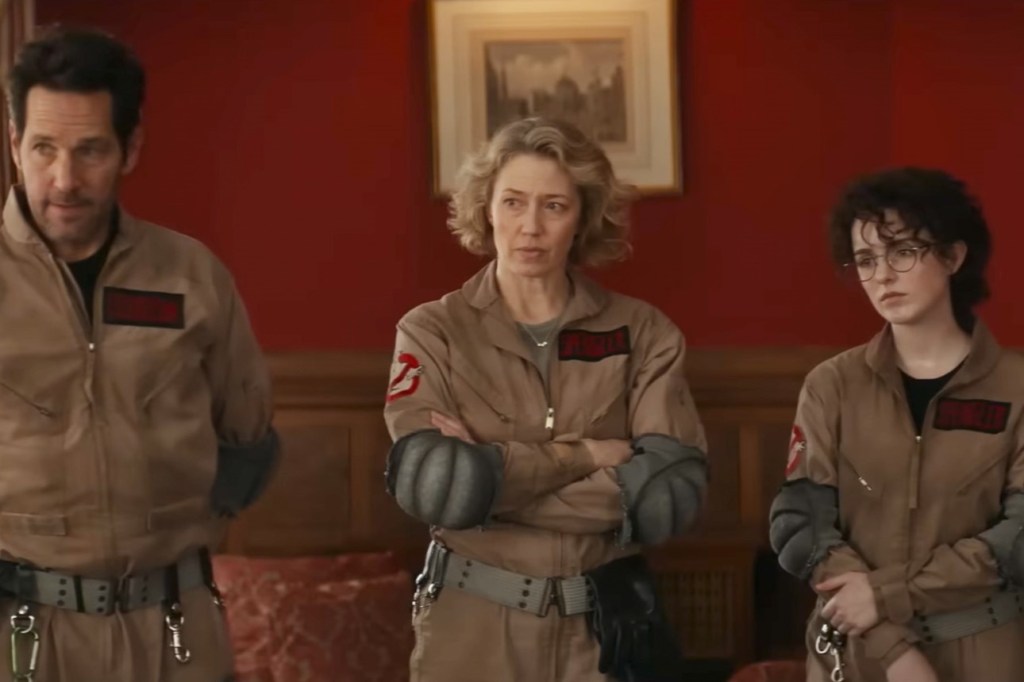
We continue to follow Phoebe (McKenna Grace), Trevor (Finn Wolfhard), and Callie Spangler (Carrie Coon), as well as her serious boyfriend Gary (Paul Rudd) and their friends Lucky (Celeste O’Connor) and Podcast (Logan Kim) in their adventures of ghostbusting. Having relocated to the classic firehouse base in New York, the family business is up and running…and being threatened once again by Walter Peck (Wiliam Atherton).
In that synopsis alone, you can see how Ghostbusters: Frozen Empire is a proper crossroads between the classic films and the next generation’s adventures. While Afterlife before it employed the surviving legacy cast (Bill Murray, Dan Aykroyd, Ernie Hudson, and Annie Potts) as cameos, this sequel uses the gang in a more substantial context. And thankfully, it’s not a compartmentalized affair, allowing the first class of Ghostbuster to mix it up with the young crew.
Through this practice the Ghostbusters series has now become a multigenerational affair, and not in a way that’s dependent on awkward humor or fish out of water gags. At the heart of this story is an effective family drama involving Phoebe growing up with ambitions of being a Ghostbuster, but straining against both the law and her mother’s want to keep her safe. It’s a thread that could have been explored a little deeper, but considering it doesn’t slip into the usual family melodrama you might expect, it still plays like a charm in Ghostbusters: Frozen Empire.
Now here’s where the original fans are probably going to give Ghostbusters: Frozen Empire the most points for improvement: the humor. I’ll admit, while I did really like Ghostbusters: Afterlife, that is the more family friendly blockbuster of the two legacy-quels we have so far. That’s not to say that Frozen Empire is entirely devoted to the Peter Venkman-style raunch of the classics; but there’s definitely some more adult one-liners and references that are slyly included to entertain parents.
Off the top of my head, I’m not sure if anyone has really singled out just how fantastic Carrie Coon and Paul Rudd’s chemistry happens to be on screen. But it’ll surely be highlighted after Ghostbusters: Frozen Empire, as they’re two of the most consistent laugh drivers in this continuation. Rudd in particular seems to have fun as the goofster, with Coon playing it perfectly straight against him for the most part. Though The Gilded Age star does get her moments to get a bit goofy herself, which makes for even more delightful moments.
Adding comedians like James Acaster, Patton Oswalt, and Kumail Nanjiani to the cast also helps bolster Ghostbusters: Frozen Empire’s ranks. Each of them support the main team in their own ways, with unique styles of humor adding to the stew that is this new picture’s landscape of laughter. While the emotion that carried Afterlife is still somewhat present in Frozen Empire, this sequel is definitely more of the blockbuster comedy that 1984’s Ghostbusters happened to be.
Ghostbusters: Frozen Empire is a confident homecoming that continues to progress into the legacy franchise’s modern era with a knowing stride. Dedicated to Ivan Reitman’s memory, due to his passing between films, this second outing brings this modern contingent closer to the spirit of the original he helped shepherd into history forty years ago.
While there’s definitely more of a family friendly vibe, Frozen Empire experiments more with balancing the tone alongside some more mature jokes, and feels like a progression rather than merely playing it safe. Though the overall story could use a little more effort in balancing the emotional with the fantastical, the vibes are definitely there.
That, in particular, is important, because you can throw all of the easter eggs or legacy cast members into a legacy-quel such as this, and it would ultimately fall flat if it doesn’t feel like a Ghostbusters movie. Ghostbusters: Frozen Empire captures that spirit in an energetic and entertaining way that makes it the sequel that’s come the closest to recapturing the total magic of its origins.
Seeing the Ghostbusters saga return to theaters does indeed make me feel good, especially if it continues to develop in the ways that Ghostbusters: Frozen Empire has. It feels like this variant of the series is growing with its audience, while also keeping the touches that made that original unexpected blockbuster so charming. If Sony’s ready to greenlight another adventure, I’m ready to believe I’ll be there on opening night.



 Igor's Blog